Work boots are not one category — they combine different style, construction, toe, and safety systems that often get mixed together in buying guides. This article breaks those systems apart so readers can choose the right boot type for their job, fit, and safety needs.
Types of work boots at a glance
| Category | What it means | Best for |
|---|---|---|
| Boot style | The visible shape and silhouette, such as logger, Wellington, or Chelsea | Preference, job setup, and terrain |
| Construction method | How the boot is built, such as Goodyear welt or cemented | Durability, comfort, and resoling |
| Toe type | Steel, composite, alloy, metatarsal, or soft toe | Protection level and workplace rules |
| Sole type | Wedge, heel, logger, lugged, or rubber shell | Surface, grip, and traction |
| Safety rating | ASTM codes like I/75, C/75, PR, EH, and MT | Compliance and hazard protection |
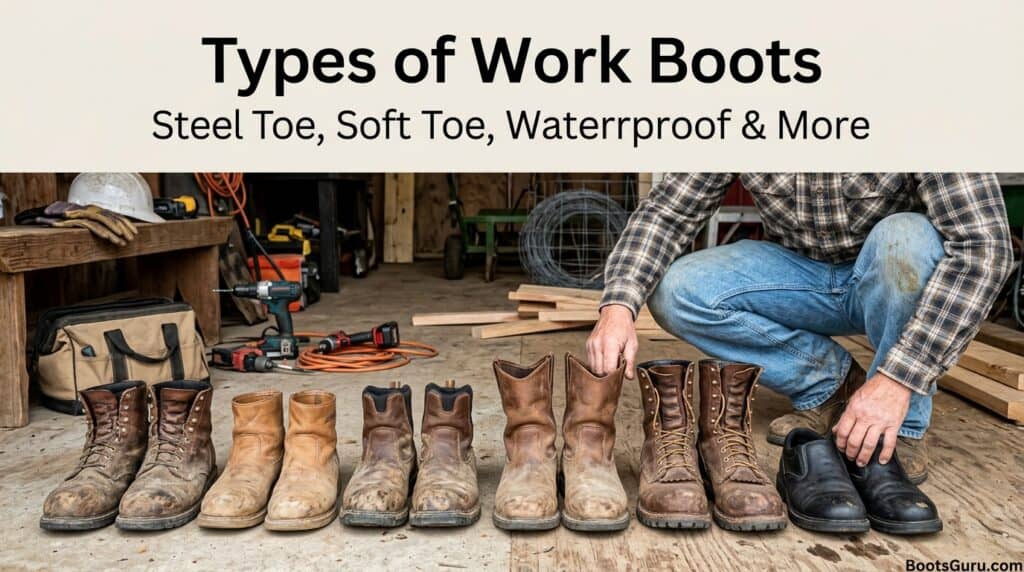
A variety of work boots are showcased on a wooden surface in a workshop setting, highlighting different styles such as steel toe, soft toe, and waterproof boots for professional use.
Why boot types get confused
Many guides use the word “type” to mean different things at once. A logger boot is a style, composite toe is a toe type, and ASTM EH is a safety rating — those are three different decision layers. Once readers understand that difference, they can compare boots more accurately and avoid buying the wrong pair.
Style types
Work boot styles describe the overall shape, height, and look of the boot. Common examples include lace-up work boots, pull-on boots, Wellington boots, Chelsea work boots, logger boots, lineman boots, and Western work boots. Style matters because it affects ankle coverage, speed of use, flexibility, and whether the boot works better indoors or outdoors.
Lace-up work boots
Lace-up work boots are the most versatile option because they offer the best lockdown and fit adjustment. They are a strong default choice for construction, carpentry, plumbing, HVAC, and electricians. If someone needs one pair for mixed daily use, lace-up boots are usually the safest starting point.
Pull-on and Wellington boots
Pull-on work boots and Wellington boots are built for quick on-and-off wear. They suit farmers, ranch workers, mud-heavy jobs, and people who spend time in wet conditions. They are less adjustable than lace-up boots, so fit becomes more important.
Logger and lineman boots
Logger boots and lineman boots are built for climbing, rough terrain, and outdoor work. They usually have a taller heel and more aggressive outsole pattern than flat work boots. That heel helps on uneven ground and climbing surfaces, but it is not always the best choice for long shifts on concrete.
Chelsea and slip-on work boots
Chelsea work boots are low-profile pull-on boots that balance convenience with a cleaner look. They are common in light industrial work, shops, and jobs where workers want a boot that moves easily between work and casual wear. Slip-on work boots are also helpful when speed matters and the job does not require heavy ankle support.
Toe types
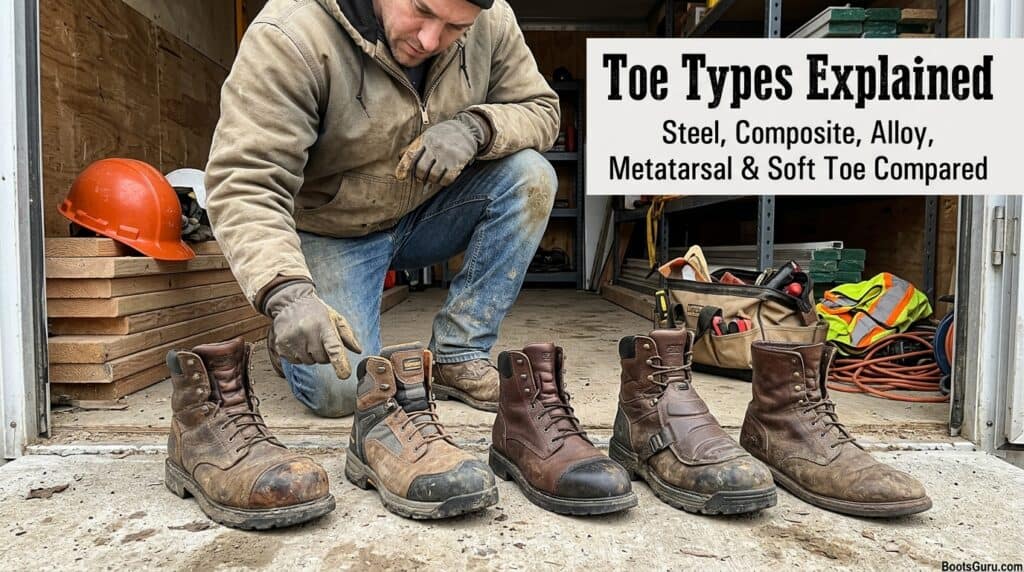
work boot toe types comparison 202606110838
Toe type is one of the biggest comfort and safety decisions. Steel toe is the traditional heavy-duty option, composite toe is lighter and non-metallic, alloy toe is the lightest hard toe option, metatarsal protection extends the safety area, and soft toe gives you the most comfort but no toe-cap protection. The best choice depends on the hazards at work, not just personal preference.
| Toe type | Material | Metal detector | Temperature conduction | Weight | Best for |
|---|---|---|---|---|---|
| Steel toe | Steel alloy | Usually triggers | Conducts cold and heat | Heaviest | Heavy-duty construction and general protection |
| Composite toe | Fiberglass, Kevlar, carbon fibre, or plastic | Usually passes | Does not conduct | Lighter | Electricians, airports, cold climates, tight spaces |
| Alloy toe | Aluminum alloy | May trigger | Conducts temperature | Lightest hard toe | Comfort-focused hard-toe use |
| Metatarsal guard | Guard over the toe extending to mid-foot | Varies | Varies | Heavier | Heavy manufacturing, logging, foundry work |
| Soft toe | No hard cap | Passes | N/A | Lightest | Low-hazard comfort work |
When to choose steel toe
Steel toe boots are best when the main concern is impact and compression protection and weight is not a dealbreaker. They are still a common choice in construction and other physically demanding jobs. The tradeoff is extra weight and more temperature transfer in hot or cold conditions.
When to choose composite toe
Composite toe boots work well when the wearer wants protection without metal. They are a strong pick for electricians, HVAC technicians, airport workers, and anyone who wants a lighter boot with more toe room. They also tend to feel less cold in winter.
When to choose alloy toe or soft toe
Alloy toe gives hard-toe protection with less weight than steel, but it can still conduct temperature and may not solve every comfort issue. Soft toe is better when the job does not require protective toe caps and comfort is the top priority. In practice, soft toe is usually best for low-hazard, standing-heavy environments.
When to choose metatarsal protection
Metatarsal guard boots are for jobs where the top of the foot needs extra protection, not just the toes. That matters in foundry work, heavy fabrication, forestry, and certain industrial environments. If a job can drop objects onto the upper foot, metatarsal protection is worth considering.
Sole types
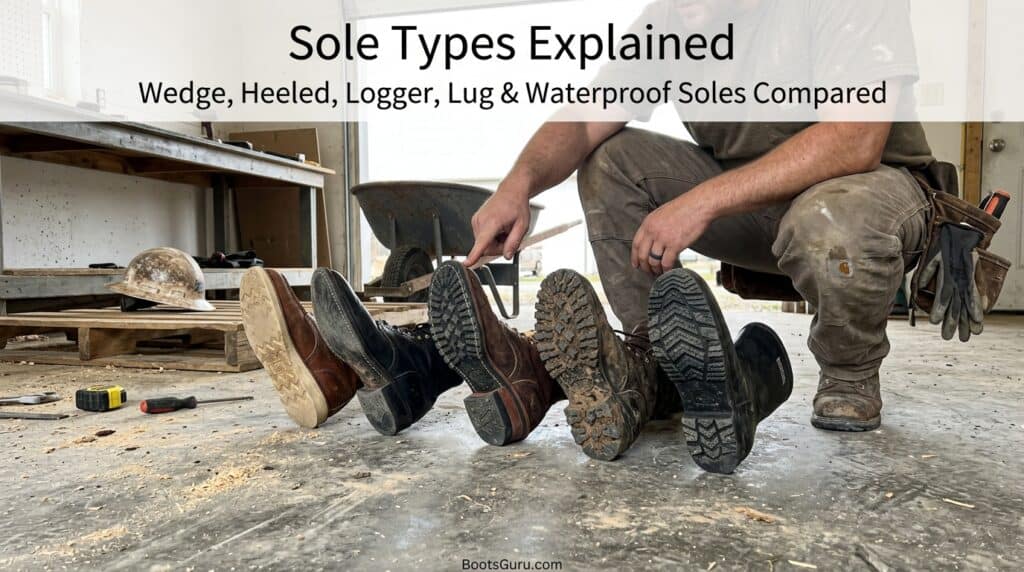
work boot sole types explained 202606110841
The sole changes how the boot feels on the ground, and it often determines whether a boot is comfortable all day or miserable after lunch. Wedge soles are flat and stable, heeled boots help on uneven terrain, logger heels help with climbing and soft ground, deep lug soles improve traction, and rubber waterproof shells help in mud or wet work. Surface type should guide the choice more than boot style alone.
| Sole type | Shape | Best terrain | Best trades |
|---|---|---|---|
| Wedge sole | Flat, no separate heel | Concrete, pavement, shop floors | Construction, warehouses, indoor labor |
| Heeled work boot | Raised heel | Mixed terrain | General outdoor work |
| Logger / lineman heel | Tall underslung heel | Soft ground and climbing | Logging, linework, tree work |
| Deep lug / cleated | Aggressive tread | Mud and loose soil | Landscaping, agriculture |
| Rubber waterproof shell | Full rubber exterior | Water and mud | Farming, fishing, wet environments |
Wedge sole work boots
Wedge soles are usually the best choice for people who stand or walk on hard flat surfaces all day. The full-contact sole spreads pressure more evenly and often feels less tiring on concrete. That is why wedge soles are popular in shops, warehouses, and indoor construction settings.
Heeled and logger soles
Heeled boots and logger soles are better when the ground is uneven or soft. The heel helps keep footing in mud, dirt, and rough outdoor terrain, and it helps with climbing in some work environments. The downside is that they are usually less stable on long flat-surface shifts.
Construction methods
Construction method affects durability, comfort, and whether a boot can be resoled. Goodyear welt boots are usually the most repairable and long-lasting, cemented boots are often lighter and comfortable right away, and strobel construction creates an athletic-feeling work shoe. The right method depends on whether the buyer wants long service life or immediate comfort.
| Construction | How it works | Resolable | Comfort out of box | Durability |
|---|---|---|---|---|
| Goodyear welt | Upper stitched to welt, outsole attached to welt | Yes | Requires break-in | Very high |
| Cemented / direct attach | Sole glued to upper | Usually no | Very comfortable | Moderate |
| Strobel | Upper stitched to insole like a sock | Usually no | Very flexible | Lower to moderate |
| Norwegian welt | Outward welt variation for extra weather resistance | Yes | Moderate break-in | High |
Goodyear welt boots
Goodyear welt construction is ideal for buyers who want to resole the boot and keep it in service for years. It is common in premium work boots and heritage-style boots. The tradeoff is that these boots often need more break-in time.
Cemented and strobel boots
Cemented boots are glued together and usually feel comfortable quickly, which makes them appealing for people who want an easy first wear. Strobel construction feels more flexible and athletic, so it works well for lighter work and all-day movement. Both are common in comfort-first boots, but they usually do not last as long as welted builds.
Safety codes
ASTM codes tell you what kind of hazards the boot can handle. These labels are not marketing language — they are the clearest way to tell whether a boot is made for impact, compression, puncture resistance, electrical hazards, or metatarsal protection. Readers should always check the tag when a job has formal footwear requirements.
| Code | Meaning | When it matters |
|---|---|---|
| F2413 | ASTM safety footwear standard | Any safety-rated work boot |
| I/75 | Impact resistance | Falling or rolling objects |
| C/75 | Compression resistance | Crush hazards |
| PR | Puncture resistance | Nails and sharp debris |
| EH | Electrical hazard | Electricians, HVAC, dry electrical work |
| MT | Metatarsal protection | Heavy object impact on upper foot |
| SD | Static dissipative | Electronics, fuel handling, controlled static environments |
| CD | Conductive | Specialized static-control environments |
Impact and compression
Impact resistance protects the toes from falling objects, while compression resistance helps when heavy items roll or crush the foot. In many work environments, both matter together. A boot that passes one and not the other may not be enough for the job.
EH, PR, MT, SD, and CD
EH is important for people working around electricity, but it does not replace every other safety need. PR matters in construction and roofing, while MT is valuable in heavy-duty industrial settings. SD and CD are more specialized and should be chosen only when the workplace specifically needs them.
Match boots to trade
Different jobs benefit from different boot types, and this is where the article becomes most useful for buyers. Construction workers usually need lace-up boots with safety toes and traction, electricians often want composite toe and EH protection, HVAC workers need flexible boots with good grip, and welders need heat-resistant boots with strong coverage. Matching the boot to the job reduces mistakes and returns.
| Trade | Best boot style | Best toe | Best sole | Key rating |
|---|---|---|---|---|
| Construction | Lace-up work boot | Steel or composite | Wedge or lugged | I/75, C/75, PR |
| Electrician | Lace-up work boot | Composite | Rubber insulating sole | EH |
| HVAC | Lace-up work boot | Composite | Slip-resistant rubber | EH, slip resistance |
| Lineman | Logger / lineman boot | Composite or steel | Logger heel | EH, MT if needed |
| Plumber | Lace-up work boot | Steel or composite | Slip-resistant rubber | Waterproof, slip resistance |
| Welder | Lace-up work boot | Steel | Heat-resistant sole | Heat resistance, MT often helpful |
| Landscaper | Lace-up or pull-on | Composite or soft toe | Deep lug | Waterproof, traction |
| Warehouse | Athletic work shoe | Composite | Cushioned rubber | Slip resistance |
Best boot types by work setting
For concrete-heavy indoor work, wedge soles usually win. For rough outdoor work, a heeled or logger sole often performs better. For electrical jobs, composite toe plus EH protection is usually the best combination, while jobs with mud and moisture benefit from pull-on or waterproof styles.
Aesthetic boot types
Some readers are not buying for safety first — they are buying for style and general wear. In that case, the same boot vocabulary gets used differently, and the article should help them understand that too. Chelsea boots, Western boots, engineer boots, and moc-toe boots are mostly style-led categories, even when they overlap with work use.
Boots for style and casual wear
Moc-toe boots are popular because they blend heritage styling with comfort. Western boots and engineer boots have strong identity and visual appeal, while Chelsea boots work well when the wearer wants something cleaner and easier to wear casually. These styles can be work-capable, but they are not automatically the best safety boots.
Buying checklist
Before publishing or buying, readers should compare four things: toe protection, sole type, safety code, and construction method. Then they should check fit, width, and the surface they stand on most often. That sequence prevents the common mistake of choosing a boot that looks right but performs wrong.
- Choose toe type first.
- Choose sole type second.
- Check the ASTM code third.
- Check construction method fourth.
- Finish with fit, width, and break-in comfort.
FAQ
What is the best type of work boot?
The best type depends on the job. For most general labor, a lace-up boot with a safety toe and wedge or lug sole is the safest all-purpose option.
Are composite toes better than steel toes?
Neither is universally better. Composite toes are lighter and non-metallic, while steel toes are often more rugged and traditional.
What sole is best for standing all day?
A wedge sole is usually best for standing on hard flat surfaces like concrete or shop floors.
What is the most durable construction method?
Goodyear welt construction is usually the best choice for long-term durability and resoling.
Final takeaway
The main lesson is that “work boot type” is not one thing. Style, toe type, sole type, construction method, and safety code all answer different questions, and the best boot is the one that matches the actual job hazard and surface. Once readers understand those layers, they can shop faster and with much more confidence.