

Short answer: EE (also written 2E) is a US width that most brands call "wide" for men, a step beyond the standard D. H is a UK fitting letter. At makers like Barker, H is "extra wide", two steps above their standard F. They come from different systems, so an EE and an H are close in intent but not interchangeable. The only way to compare them is each brand's own size chart.
The confusion comes from UK brands using letters too, but starting the scale in a different place. And even within the UK, brands don't agree on where "standard" sits.
What EE Means (US System)
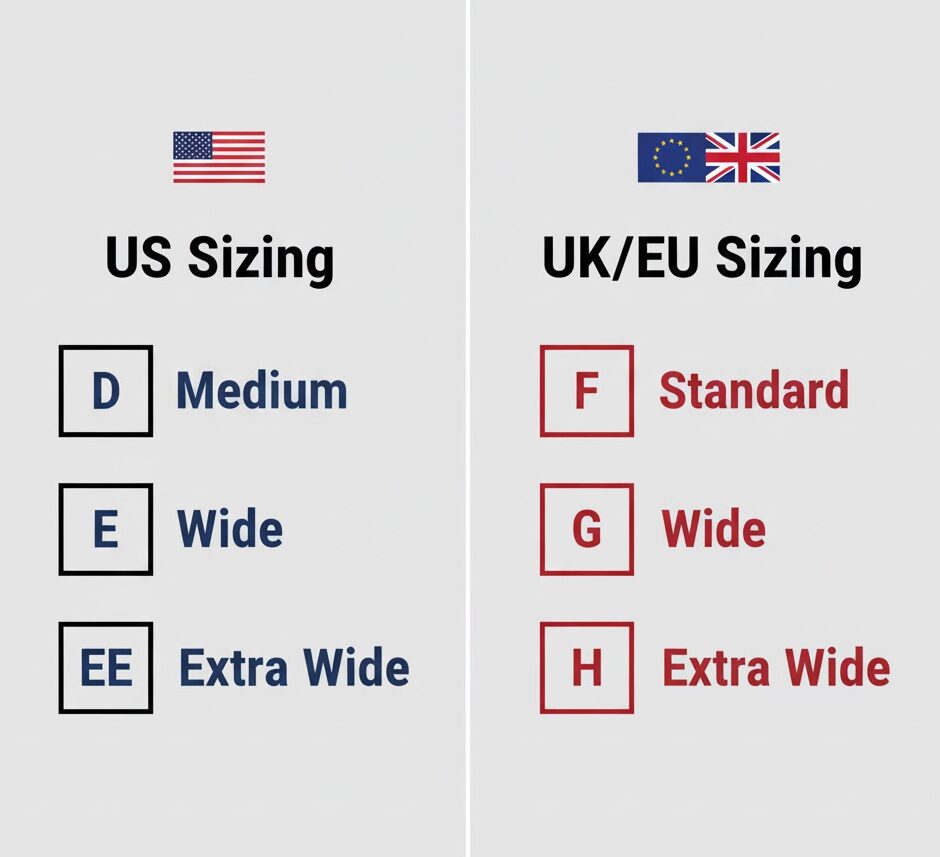
US brands use a letter scale where more E's mean wider:
| Width | Men's | Women's |
|---|---|---|
| Narrow | B or C | A |
| Standard / medium | D | B |
| Wide | E or EE (2E) | C or D |
| Extra wide | EEE (3E), 4E | EE (2E) |
Brands draw the "wide" line in slightly different places. LOWA, for example, lists men's Medium as D and Wide as E/EE, and women's Medium as B and Wide as C (LOWA, retrieved 2026-09-24). So a US "W" on a boot box usually means EE for men, but check the brand.
What H Means (UK Fittings)
UK makers use fitting letters that describe the girth of the foot, measured around the instep. Barker, a UK shoemaker, uses:
- E: narrow
- F: standard
- G: wide
- H: extra wide
Barker says each step is about 1/4 inch (6mm) across the instep (Barker, retrieved 2026-09-24).
Other UK brands start the scale elsewhere. Clarks lists its standard UK men's fitting as G and its standard women's fitting as D (Clarks, retrieved 2026-09-24). At Clarks, then, an H men's shoe is one step wider than standard, not two. That's why an H from one UK brand isn't always the same as an H from another.
Are EE and H the Same?
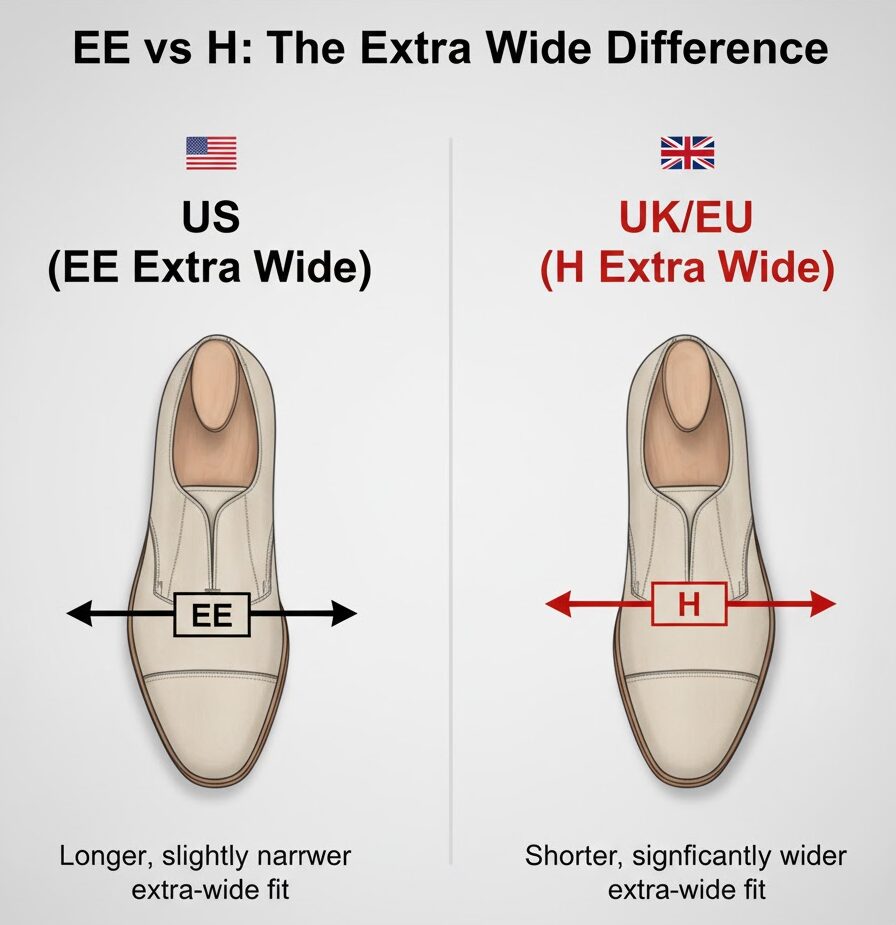
No. They sit in similar territory, both meaning wider than standard, but they're on different scales and brands define them differently.
| EE | H | |
|---|---|---|
| System | US width letters | UK fitting letters |
| Where you'll see it | US brands and US listings | UK shoemakers and UK listings |
| Meaning | Wide (men's), one step above D | Extra wide at Barker, wide at Clarks men's |
| How to compare | Use each brand's chart and your own foot measurement | |
The last, the foot-shaped form a boot is built on, also changes the fit. A boot built on a narrow, pointed last can feel tight even in EE, while a roomy last can feel generous in a standard width.
How to Pick the Right Width
- Measure your foot at the end of the day, when it's largest. A Brannock device at a shoe store is the most accurate. Our boot width chart shows how to measure at home with paper and a ruler.
- Check which system the listing uses. US letters (D, EE) or UK fittings (F, G, H).
- Open the brand's own size chart. Match your measurement to their numbers, not to a letter you wore in another brand.
- Check the return policy before you order a width you haven't tried.
Boots That Come in Wide Widths
If you've worked out you need a wide fit, buying a boot made in your width beats sizing up in length. These boots from our reviews come in a wide option, as listed by the maker:
| Boot | Widths | Best for |
|---|---|---|
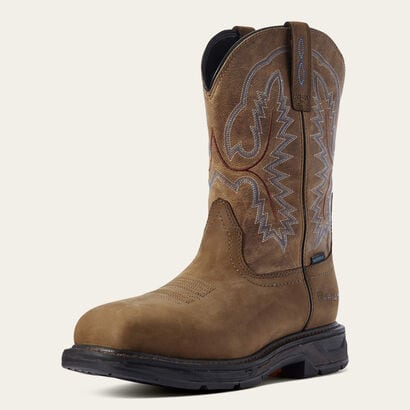
| Ariat WorkHog XT (review) | D, EE | Pull-on for ranch and outdoor work |
| KEEN Utility Cincinnati 6" (review) | Regular, Wide | Waterproof wedge for concrete |
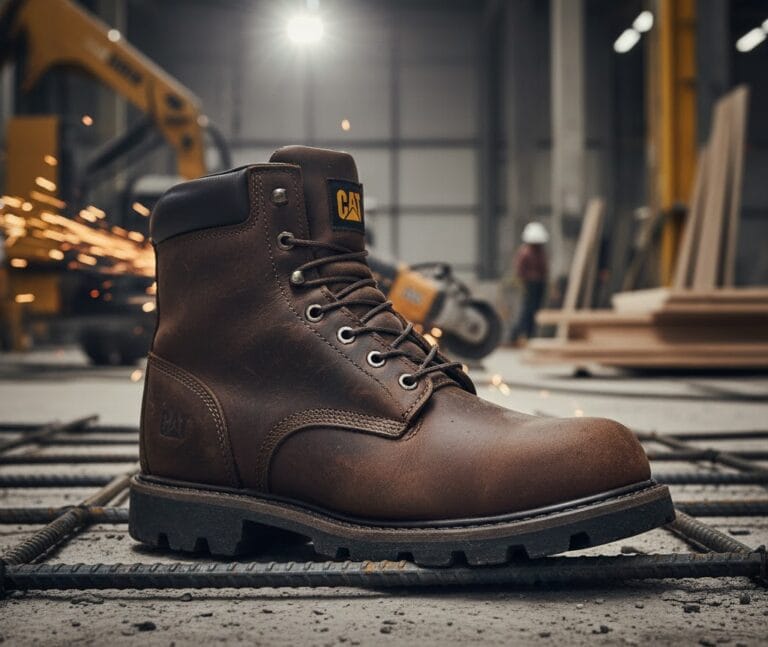
| CAT Second Shift Steel Toe (review) | Medium, Wide | Budget steel toe for dry sites |
| Merrell Women's Moab 3 (review) | Regular, Wide | Warm-weather day hiking |
For more, see our best work boots for wide feet and women's waterproof hiking boots for wide feet.
Frequently Asked Questions
Is H wider than EE?
It depends on the brand. H is a UK fitting letter and EE is a US width, so there's no fixed conversion. At Barker, H is extra wide. At Clarks, H is one step above their standard men's G. Compare each brand's chart.
Is 2E the same as EE?
Yes. 2E and EE are two ways of writing the same US width.
What does W mean on a boot?
On US listings, W (wide) usually corresponds to EE for men. LOWA, for example, lists men's Wide as E/EE.
Is D wide or standard?
For US men's shoes, D is standard. For US women's shoes, D is wide, because the women's standard is B. At Clarks UK, D is the standard women's fitting.
Should I size up instead of buying wide?
Usually not. Sizing up in length adds space at the toe and often leaves your heel slipping. A wide width adds room across the ball of the foot while keeping the length right.
The Bottom Line
EE and H both mean "wider than standard", but EE is a US width and H is a UK fitting, and UK brands don't all start their scale in the same place. Measure your foot, check which system the boot uses, and go by that brand's chart. For a full breakdown of every width letter with inch measurements, see our boot width chart.