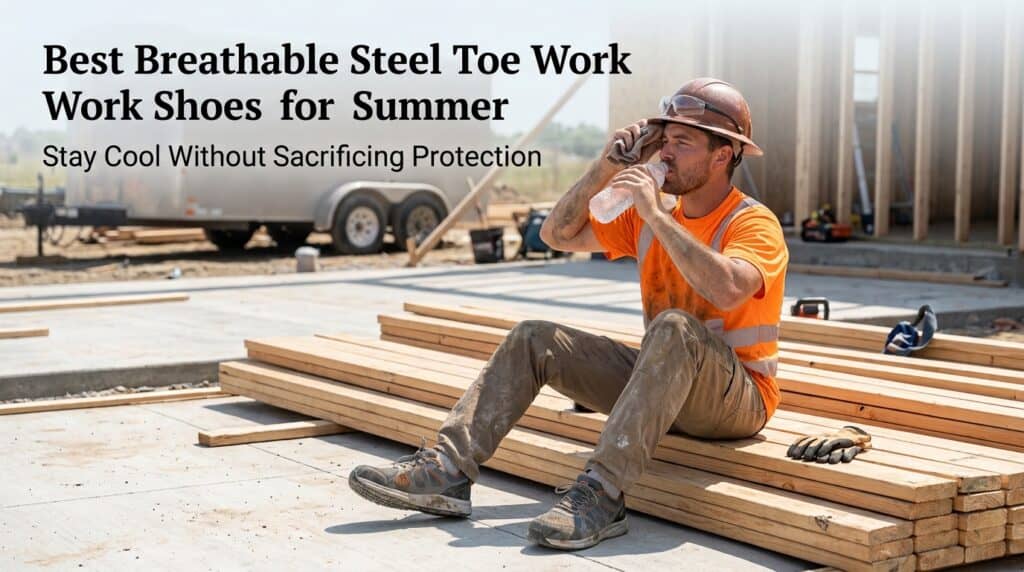

Here's a question almost nobody answers honestly: if a "breathable steel toe shoe" still has a solid steel cap sitting at the front of your foot, how breathable can it actually be? The mesh upper might move air beautifully — but steel conducts heat. It absorbs ambient temperature from hot concrete, from direct sun, from the air itself, all day long. By 2 PM on a 95°F job site, the inside of that steel toe box can be noticeably hotter than the rest of the shoe, regardless of how much mesh surrounds it.
That's the first thing this guide does differently: it tells you the truth about steel vs. composite in summer heat, instead of just listing mesh shoes and calling them done. The second thing: it explains exactly which job sites will destroy a mesh upper in weeks — rebar, rough concrete block, nail debris — and which ones are perfectly safe for it. The third: it answers the EH-rating question directly, because "does mesh upper reduce electrical hazard protection" is a real safety concern with a real answer, not a marketing footnote.
Ten shoes below, organized by exactly which summer job situation each one solves — outdoor construction, indoor warehouse concrete, electrical and EH work, lightweight delivery routes, wide feet, rough terrain, budget-certified, anti-fatigue standing, and women's-specific sizing. Every pick carries verified ASTM F2413 certification. No exceptions.
⚡ Quick Picks — Best Breathable Steel Toe Work Shoes for Summer
| Best For | Shoe | Toe | EH | Price |
|---|---|---|---|---|
| Best overall / outdoor summer | KEEN Atlanta Cool ST | Steel | ✅ | ~$135 |
| Best indoor warehouse / concrete | Timberland PRO Powertrain Sport | Alloy | ✅ | ~$110 |
| Best electrical / EH | Reebok Astroride Work ST EH | Steel | ✅ | ~$90 |
| Best lightweight / delivery | Skechers Work Cankton ST+EH | Steel | ✅ | ~$95 |
| Best outdoor rough construction | KEEN Flint II ST | Steel | ✅ | ~$140 |
| Best budget certified | Carhartt CMO3251 Lightweight ST Hiker | Steel | ✅ | ~$75 |
| Best anti-fatigue / sustained standing | Timberland PRO Drivetrain | Composite | ✅ | ~$115 |
| Best women's | KEEN Women's Atlanta Cool Low ST | Steel | ✅ | ~$120 |
| Best composite / coolest toe box | Wolverine Overpass CT WP | Composite | ✅ | ~$155 |
Table of Contents
- The Mesh Durability Problem: What Destroys It and Where
- Steel Toe vs. Composite Toe: The Summer Thermal Truth
- Is It Actually Breathable or Just Marketing?
- EH Rating + Mesh Upper: Are They Compatible?
- Wide Feet and the Summer Swelling-Squeeze Problem
- Job-Type Picker
- Best Overall / Outdoor: KEEN Atlanta Cool ST
- Best Indoor Warehouse: Timberland PRO Powertrain Sport
- Best Electrical / EH: Reebok Astroride Work ST EH
- Best Lightweight / Delivery: Skechers Work Cankton
- Best Outdoor Rough Construction: KEEN Flint II ST
- Best Budget Certified: Carhartt CMO3251
- Best Anti-Fatigue: Timberland PRO Drivetrain
- Best Women's: KEEN Women's Atlanta Cool Low ST
- Best Composite / Coolest: Wolverine Overpass CT WP
- After-Shift Drying Protocol
- FAQ — 8 Questions Answered
- Final Verdict by Job Type
The Mesh Durability Problem: What Actually Destroys a Breathable Upper, and Where
Almost every "breathable steel toe shoe" article lists mesh shoes without explaining where mesh genuinely fails. That omission matters, because buying the wrong upper construction for your job site doesn't just shorten the shoe's life — it can compromise the protection it's supposed to provide.
Open mesh panels fail on rough job sites through four specific mechanisms. Abrasion — rough concrete block, cinder block, and rebar cut mesh fibers at contact points, and those small tears propagate every time the shoe flexes. Penetration — nails, screws, and sharp debris pass through mesh that would never get through leather, creating both a structural failure point and a debris-entry point. Chemical contamination — cement, cutting oils, and cleaning solvents degrade synthetic mesh fiber faster than they degrade leather. UV degradation — sustained direct sun exposure, the kind roofers and outdoor crews live in, breaks down the polymer fiber structure over months.
| Job Environment | Full Mesh Upper | Hybrid Upper (Leather/Nylon + Mesh) |
|---|---|---|
| Indoor warehouse / shop floor | ✅ Excellent | ✅ Fine, unnecessary |
| Light assembly / delivery routes | ✅ Excellent | ✅ Fine, unnecessary |
| Mixed outdoor terrain, general trades | ⚠️ Risky | ✅ Correct choice |
| Framing, rough concrete, demolition | ❌ Will fail within weeks | ⚠️ Better, monitor wear |
| Roofing, prolonged direct sun, landscaping w/ equipment | ❌ UV degrades fast | ⚠️ Better, still monitor |
The practical rule: full open-mesh shoes belong indoors or on clean, predictable surfaces. Hybrid uppers — leather or ballistic nylon at the toe and lateral contact zones, with mesh reserved for the tongue and upper collar — are the correct choice for outdoor mixed-terrain work. Several picks below use exactly this hybrid construction specifically because the job sites they're built for would destroy a full-mesh shoe.
Steel Toe vs. Composite Toe: The Summer Thermal Truth Nobody States Plainly
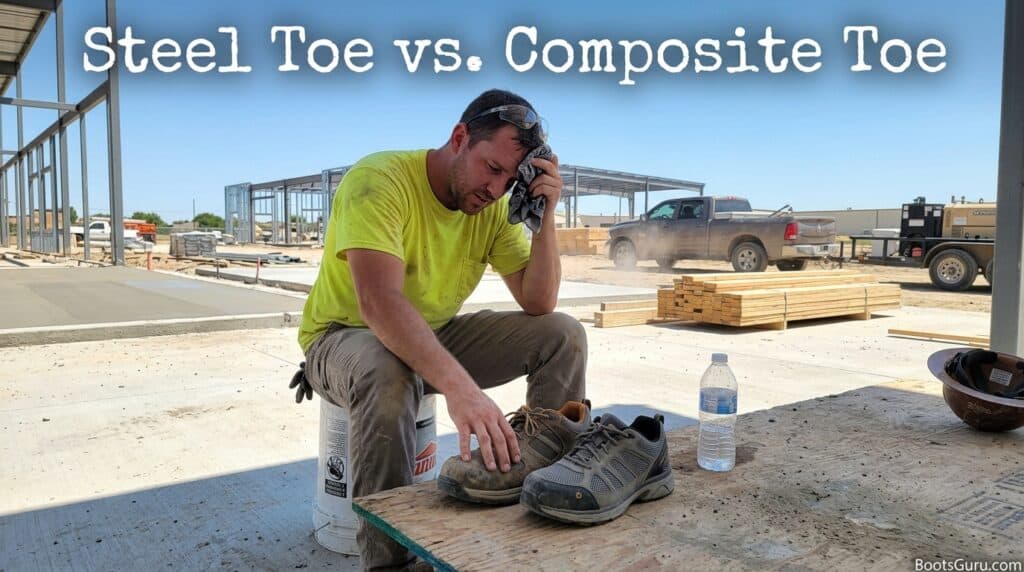
Steel is a thermal conductor with high thermal mass. In a 95°F outdoor environment, a steel toe cap absorbs ambient heat from every direction throughout the day — radiant heat off concrete, convective heat from hot air, direct heat from sun exposure on the cap itself. By mid-shift, the interior of that steel toe box can be meaningfully hotter than the rest of the shoe, no matter how much mesh surrounds it.
Composite toe caps — carbon fiber, fiberglass, Kevlar composite — are thermal insulators. They don't conduct ambient heat the way steel does, so the toe box stays much closer to body temperature regardless of what the concrete or steel around it is doing. This thermal advantage is at least as significant as the weight savings composite is usually marketed for, and it's the specific reason a breathable composite toe shoe often keeps feet measurably cooler than a breathable steel toe shoe with an identical mesh upper.
🔑 The Honest Recommendation
If your job site accepts composite toe — and ASTM F2413 composite meets the exact same impact and compression standard as steel — summer is the strongest argument for choosing it. If your site specifically requires steel (some older site policies still do), breathable upper design matters even more as compensation for that thermal disadvantage. This guide includes both steel and composite picks, clearly labeled, so you can match the certification your site actually requires.
Is It Actually Breathable or Just Marketing? A 4-Point Test
"Breathable" gets used as if it's a binary yes/no characteristic. It isn't. Here's how to actually evaluate the claim before you buy.
1. Upper material hierarchy — from most to least breathable: open weave mesh, then engineered knit, then perforated leather, then full-grain smooth leather, then non-perforated synthetic. A "breathable lining" paired with a solid, non-perforated leather upper is close to meaningless — the lining can manage sweat at the skin surface, but if no air moves through the upper itself, that lining is just shuffling trapped moisture around rather than exchanging it with outside air.
2. The dry-time test — how long does the shoe take to dry after rain or a sweaty shift? This is the single most practical real-world breathability indicator. A shoe that dries out overnight provides meaningfully better next-day comfort than one that starts your next shift still damp from yesterday.
3. The backlight test — mesh you can see daylight through clearly when held up to a light moves meaningfully more air than mesh that looks solid under normal lighting, even if both are labeled "mesh.
4. Wicking liner vs. standard liner — a genuine moisture-wicking liner actively moves sweat away from the skin; a standard fabric liner just holds it there. The wicking liner makes a breathable upper functionally better even when the external airflow is identical to a non-wicking competitor.
EH Rating + Mesh Upper: Are They Actually Compatible?
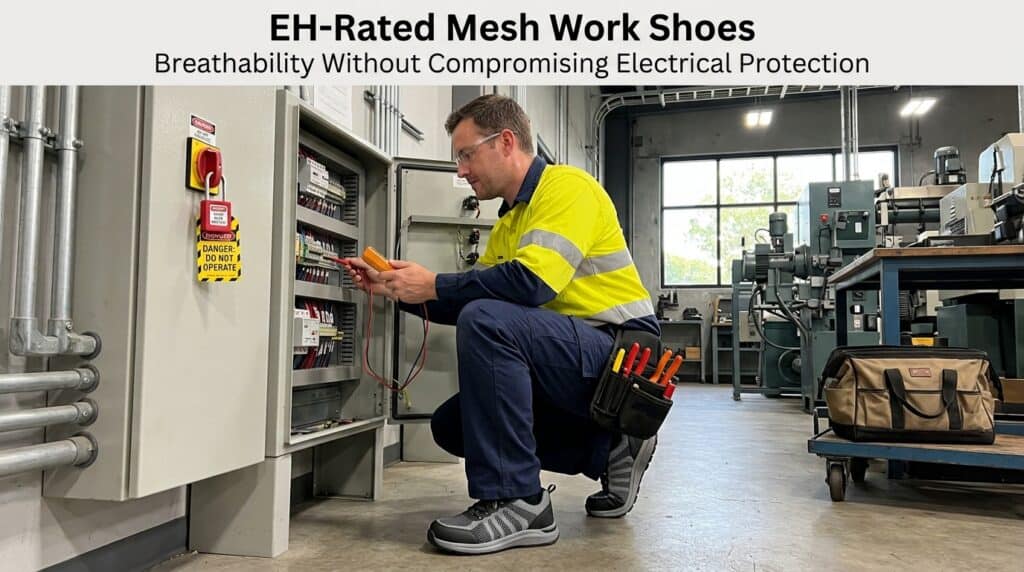
This is a legitimate safety question, and it deserves a direct answer rather than a marketing dodge. EH (Electrical Hazard) protection under ASTM F2413 comes from the insole-midsole-outsole system — specifically the electrically non-conductive outsole that prevents current from flowing through the shoe to the ground. The upper material does not affect EH rating at all. A mesh-upper shoe with an EH-rated sole system provides the same electrical hazard protection as a leather boot with the identical rating.
The one place toe material genuinely matters for electrical work: steel is a conductor. The EH-rated insole stops the ground-path current flow, but a steel toe cap that directly contacts a live conductor introduces an additional current pathway that a composite cap simply doesn't have. This is exactly why most electrical PPE guidance leans toward composite toe for EH-heavy environments — the sole protects the ground path either way, but composite removes one more potential exposure point.
Verified EH + mesh combinations in this guide: Skechers Work Cankton (steel toe + EH + mesh), KEEN Atlanta Cool ST (steel + EH + hybrid upper), Reebok Astroride (steel + EH). For composite + EH + mesh specifically: Wolverine Overpass CT and Timberland PRO Drivetrain both deliver that combination.
Wide Feet and the Summer Swelling-Squeeze Problem
Breathable mesh work shoes are typically designed and tested around medium-width feet. A wide-footed worker in a standard-width breathable shoe experiences medial and lateral upper compression that physically reduces the gap between the mesh and the foot — and that gap is exactly what makes mesh breathable in the first place. Less gap means less airflow, regardless of how open the mesh weave is.
Summer makes this worse on its own timeline: feet swell 5–10% in volume by mid-afternoon in hot conditions. A shoe that fits comfortably at 7 AM can be compressing the forefoot by 2 PM — right when the shift is hottest and that compression is doing the most damage to airflow.
The fixes: seek genuinely wide (2E/4E) variants where available — they're rarer in safety-toe shoes than in general athletic footwear, but they exist. Size up half a step specifically for summer breathable purchases to build in afternoon swelling margin. And favor toe box designs built with natural forefoot width in mind — KEEN's asymmetric toe box geometry (left-foot-specific, right-foot-specific shaping rather than a generic centered cap) consistently provides more usable forefoot room than standard symmetric toe boxes, which is one reason multiple picks in this guide come from that line.
Job-Type Picker: Match Your Site to the Right Shoe
| Job Type | Primary Need | Best Pick |
|---|---|---|
| Outdoor construction (mixed terrain) | Hybrid upper durability + breathability + safety certification | KEEN Atlanta Cool ST |
| Indoor warehouse / distribution | Anti-fatigue for concrete standing, lighter alloy toe | Timberland PRO Powertrain Sport |
| Electrical / HVAC / utility | EH priority, mobility for ladder/kneeling work | Reebok Astroride Work ST EH |
| Delivery / mobile / fast-paced | Lightweight, memory foam comfort, EH + steel toe | Skechers Work Cankton |
| Framing / rough outdoor construction | Maximum hybrid-upper abrasion resistance | KEEN Flint II ST |
| Budget-conscious, certification non-negotiable | Genuine ASTM cert under $80 | Carhartt CMO3251 |
| Manufacturing floor / assembly line | Combined heat + fatigue management on concrete | Timberland PRO Drivetrain |
| Women in any of the above roles | Genuine women's last, asymmetric wide toe box | KEEN Women's Atlanta Cool Low ST |
Best Overall / Outdoor Summer: KEEN Atlanta Cool ST
✅ ASTM F2413 Certified — I/75 C/75 EH — Steel Toe
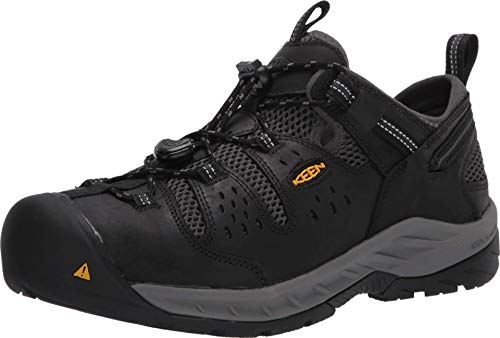
The Atlanta Cool ST is the default recommendation for outdoor summer work specifically because it solves the mesh-durability problem rather than ignoring it. The upper is a hybrid construction — open mesh panels for genuine airflow, with a leather toe overlay and reinforced lateral zones at exactly the points where rough concrete, lumber, and job-site debris would shred a full-mesh shoe within weeks. This is the construction principle from the durability section above, built into a single product: breathable where it's safe to be breathable, protected where contact actually happens.

KEEN's asymmetric steel toe is the other reason this earns the top outdoor spot. Unlike a generic centered toe cap, the asymmetric shape follows the natural taper of the foot — left-foot-specific and right-foot-specific — which provides genuinely more usable forefoot width than a standard cap of the same overall size. That matters directly for the afternoon-swelling problem discussed earlier: a foot that's expanded by 2 PM has more room to expand into before the mesh upper starts compressing and choking off airflow. ASTM F2413 I/75 C/75 certified, EH rated, oil and slip resistant outsole, KEEN.ReGEN midsole for energy return across a long shift.

Available in wide sizing — genuinely useful given the squeeze problem this guide covers in detail. Sizing runs true to length; KEEN's general guidance is that their asymmetric toe box accommodates slightly wider feet at standard width than most competitors, so try standard before jumping straight to wide unless you've already confirmed you need the extra volume. Break-in is minimal thanks to the athletic-leaning construction.

Summer Specs
Toe: Steel — ASTM F2413 I/75 C/75 | EH: ✅ Yes | Upper: Hybrid mesh + leather overlay
Breathability tier: High (hybrid) | Wide width: ✅ Available
Job site compatibility: ✅ Outdoor mixed terrain | ✅ Indoor | ⚠️ Heavy demolition/rebar (monitor wear)
✅ Best for: Outdoor construction, mixed-terrain trades, general crews who need genuine durability alongside breathability. ❌ Not for: Sustained heavy demolition or rebar-handling work where even reinforced mesh zones see excessive abrasion — step up to a full hybrid leather boot for that environment.
Pros: Hybrid upper survives outdoor job sites that destroy full-mesh shoes; asymmetric toe box adds real forefoot room; EH rated; available in wide.
Cons: Steel toe still conducts ambient heat — composite alternatives (Pick 09) run cooler in extreme sun; premium price relative to budget picks.
Best Indoor Warehouse / Concrete Standing: Timberland PRO Powertrain Sport Alloy Toe
✅ ASTM F2413 Certified — Alloy Toe — EH
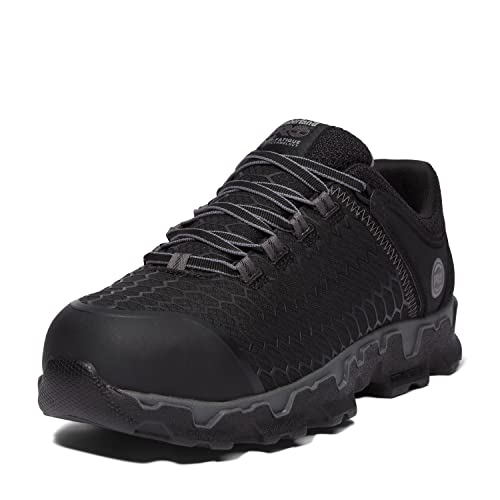
Alloy toe caps give you the same ASTM impact and compression protection as steel at meaningfully less weight — a real advantage for warehouse and distribution workers covering significant daily mileage on concrete floors. The Powertrain Sport pairs that lighter toe cap with Timberland PRO's Anti-Fatigue Technology, a geometric insert specifically engineered to absorb impact and return energy across sustained standing and walking, which is the actual fatigue problem warehouse workers face — not heat in isolation, but heat compounding with hours of repetitive concrete-floor impact.

The breathable mesh upper is appropriately matched to its environment here — warehouse and distribution-center floors are clean, predictable, indoor surfaces, exactly the conditions where full open mesh has no durability downside at all. This is the use case the durability table earlier in this guide flags as ideal for full mesh: no rebar, no cement contamination, no UV exposure, just consistent indoor conditions where maximum airflow is pure upside. EH rated for facilities with electrical equipment exposure.

Sizing runs true; the athletic-style lacing system and lower-profile build mean essentially no break-in period, which matters for warehouse roles where a new hire needs functional footwear from day one rather than a two-week adjustment period.

Summer Specs
Toe: Alloy — lighter than steel, same protection rating | EH: ✅ Yes | Upper: Full breathable mesh
Midsole: Anti-Fatigue Technology | Job site compatibility: ✅ Indoor warehouse/distribution | ❌ Rough outdoor terrain
✅ Best for: Warehouse, distribution center, and indoor concrete-floor roles where heat and standing fatigue combine. ❌ Not for: Outdoor mixed-terrain or rough construction sites — the full mesh upper has no abrasion protection for that environment.
Pros: Lighter alloy toe reduces fatigue over a long shift; genuine anti-fatigue midsole technology; zero break-in; EH rated.
Cons: Full mesh upper is indoor-only — will not survive rough outdoor job sites; less ankle protection than higher-cut alternatives.
Best Electrical / EH: Reebok Astroride Work Steel Toe EH
✅ ASTM F2413 Certified — Steel Toe — EH
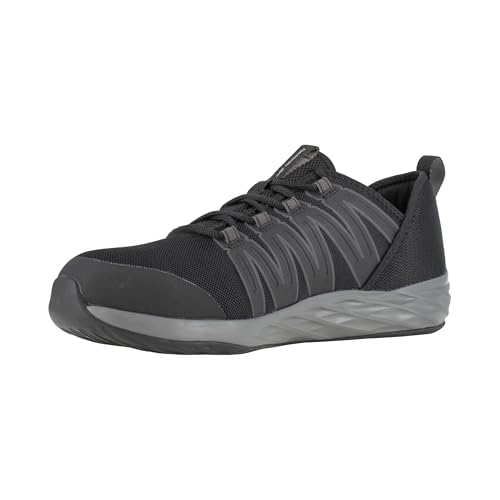
The Astroride is built around a genuinely athletic-feeling midsole that prioritizes mobility — directly relevant for electricians, HVAC technicians, and utility workers whose day involves constant climbing, kneeling, and ladder work rather than sustained standing in one spot. EH rated per the ASTM F2413 standard, with steel toe protection for the falling-object risk that comes with panel and equipment work.

Worth flagging here, connecting directly to the EH-mesh discussion earlier: this is a steel toe EH shoe, not composite. The EH-rated sole system provides the same ground-path protection regardless of toe material, but if your work involves frequent direct contact risk with live conductors specifically at the toe area, the composite alternatives in this guide (Pick 07, Pick 09) remove that one additional steel-conductor pathway. For general electrical and utility work where the EH-rated outsole is doing the primary protective work, the Astroride's steel toe and lighter overall build make it a genuinely strong everyday option.

The breathable construction keeps this comfortable through long outdoor service calls in summer heat, and the accessible price point makes it a practical choice for crews equipping multiple technicians without the premium pricing of some competitors.

Summer Specs
Toe: Steel — ASTM F2413 | EH: ✅ Yes | Build: Athletic, mobility-focused
Job site compatibility: ✅ Electrical/utility/HVAC service calls | ⚠️ Steel toe near direct conductor contact — consider composite
✅ Best for: Electricians, HVAC techs, utility workers needing EH protection with genuine mobility for climbing and kneeling. ❌ Not for: Work with frequent direct toe-area contact risk near live conductors — choose a composite alternative for that specific scenario.
Pros: Athletic mobility for ladder/kneeling work; EH certified; accessible price; breathable for long outdoor service days.
Cons: Steel toe (not composite) — verify it matches your specific electrical hazard profile; standard width may compress for wider feet by afternoon.
Best Lightweight / Delivery: Skechers Work Cankton Steel Toe + EH
✅ ASTM F2413 Certified — Steel Toe — EH

The Cankton packs steel toe, EH rating, memory foam cushioning, and a breathable mesh upper into one shoe — a combination that's genuinely hard to find at this price. Skechers' Relaxed Fit wide toe box gives real forefoot room without requiring a separate wide-width purchase, which is useful for delivery drivers and mobile workers who are in and out of a vehicle constantly throughout a shift and need a shoe that stays comfortable across varied, fast-paced movement rather than sustained standing.

One honest caveat directly relevant to summer use: memory foam, while extremely comfortable, does retain some thermal mass on the hottest days. On 100°F+ shifts, pull the insoles out overnight rather than leaving them sealed inside the shoe — this lets trapped heat and moisture actually escape rather than building up shift after shift. It's a small habit that meaningfully extends both comfort and the insole's working life through a full summer season.

EH rated, mesh upper appropriately matched to the indoor/light-duty/delivery-route environment this shoe is built for — not intended for rough construction terrain, where the full-mesh upper would face the same durability limitations covered earlier in this guide.

Summer Specs
Toe: Steel — ASTM F2413 | EH: ✅ Yes | Upper: Breathable mesh, Relaxed Fit wide toe box
Midsole: Memory foam | Job site compatibility: ✅ Delivery, light industrial, shop floor | ❌ Rough outdoor construction
✅ Best for: Delivery drivers, mobile workers, and dry indoor industrial roles needing steel toe + EH + genuine all-day comfort. ❌ Not for: Rough outdoor terrain where the mesh upper has no abrasion protection.
Pros: Rare combination of steel toe + EH + memory foam + mesh at an accessible price; wide-friendly fit without a separate wide purchase; EH rated.
Cons: Memory foam holds some heat on extreme days — vent insoles overnight; not built for rough construction terrain.
Best Outdoor Rough Construction: KEEN Flint II Steel Toe
✅ ASTM F2413 Certified — Steel Toe — EH
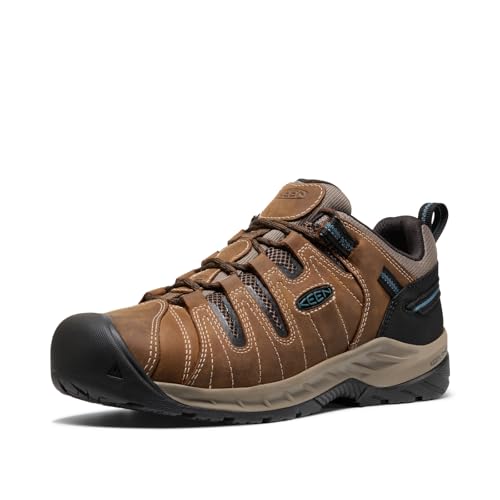
For framing crews, outdoor concrete work, and any job site where rebar, lumber, and general construction debris are constant companions, the Flint II's hybrid upper construction is the deciding factor. Leather and reinforced synthetic panels cover the toe and lateral abrasion zones — exactly the areas the mesh-durability section identified as the failure points on rough terrain — while mesh ventilation is reserved for the tongue and upper collar where airflow matters without taking abuse.

KEEN's asymmetric steel toe returns here, providing the same natural-taper forefoot room discussed with the Atlanta Cool. The outsole is built with more aggressive lugs than the warehouse-focused picks in this guide, appropriate for the varied outdoor terrain — loose soil, gravel, uneven ground — that framing and general outdoor construction actually involve. EH rated. Defined heel for stable footing on equipment steps and ladders.

This is the pick to reach for specifically when a full-mesh shoe would be the wrong call — when your honest answer to "will this job site destroy an open-mesh upper in weeks" is yes. The trade-off is a slightly heavier, less ventilated shoe than the warehouse-optimized picks, which is the correct trade given the environment it's built for.

Summer Specs
Toe: Steel (asymmetric) — ASTM F2413 | EH: ✅ Yes | Upper: Hybrid leather/synthetic + mesh
Job site compatibility: ✅ Framing, rough outdoor construction, varied terrain | ✅ Indoor (overkill but fine)
✅ Best for: Framing crews, outdoor concrete work, and any rough construction site where a full-mesh shoe would fail within weeks. ❌ Not for: Workers prioritizing maximum ventilation over durability — the warehouse picks breathe better but won't survive this environment.
Pros: Genuine hybrid upper survives rough construction terrain; asymmetric toe box; aggressive outsole for varied ground; EH rated.
Cons: Less ventilation than full-mesh picks — appropriate trade-off for the durability it provides; heavier than the lightweight delivery/warehouse options.
Best Budget Certified: Carhartt CMO3251 Lightweight Steel Toe Work Hiker
✅ ASTM F2413 Certified — Steel Toe
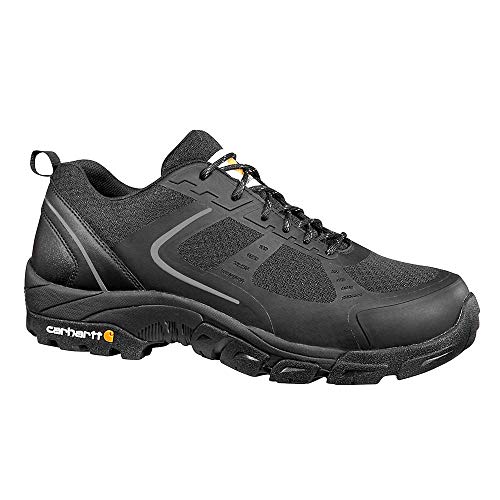
The honest budget recommendation in this guide, and a genuinely important one: this is a real ASTM F2413-certified steel toe shoe under $80 from an established brand with a verifiable safety certification — not an uncertified Amazon listing dressed up to look like a safety shoe. That distinction matters more than it might seem; the work-boot safety market has plenty of products that look the part without carrying genuine certification, and Carhartt's name carries enough manufacturing accountability that the cert label means what it says.
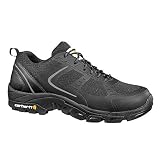
The low-cut work-hiker silhouette keeps weight down and breathability reasonable for a budget-tier shoe, while the steel toe delivers the same ASTM I/75 C/75-equivalent protection as the premium picks in this guide. This is the right call for workers who need verified compliance at the lowest legitimate price point, or who want to trial a lighter, more breathable safety shoe before committing to a premium purchase to see if the format works for their job.
No EH certification specified on this model — verify the current listing if electrical hazard protection is a requirement for your site, and choose one of the EH-rated picks above instead if it is. For general impact/compression protection on a budget, this is a legitimate, honest choice.
Summer Specs
Toe: Steel — ASTM F2413 | EH: Verify current listing | Build: Low-cut work hiker, lightweight
Price: Lowest certified option in this guide | Job site compatibility: ✅ General light-duty work | ⚠️ Verify EH before electrical-proximity use
✅ Best for: Budget-conscious workers needing genuine ASTM certification, or anyone trialing a lighter safety-shoe format before a premium purchase. ❌ Not for: Electrical-proximity work without confirming EH rating on the current listing first.
Pros: Genuine ASTM certification from an established brand at the lowest price in this guide; lightweight low-cut hiker build; established Carhartt manufacturing accountability.
Cons: EH rating not specified — verify before electrical work; fewer premium comfort features than higher-priced picks.
Best Anti-Fatigue / Sustained Standing: Timberland PRO Drivetrain
✅ ASTM F2413 Certified — Composite Toe — EH
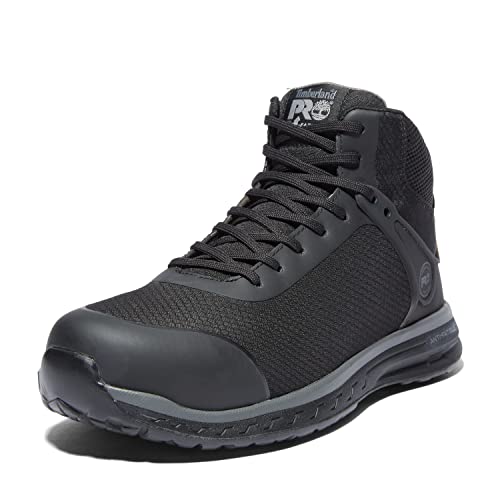
The Drivetrain is built specifically for the combined problem this guide keeps returning to: it's never just heat, and it's never just fatigue — on a summer concrete floor, the two compound each other. Timberland PRO's Anti-Fatigue Technology midsole uses an inverted-cone geometry designed to absorb impact energy and return it efficiently, reducing the cumulative joint and muscle fatigue of 8–10 hours on hard concrete, while the breathable mesh upper handles the thermal half of that same problem.

This is a composite toe shoe, which connects directly to the thermal-truth discussion earlier — on a hot manufacturing floor or assembly line where the toe cap sits close to warm machinery or sun-heated loading dock concrete, composite's thermal insulation gives a real, measurable comfort advantage over steel at the exact same ASTM protection level. EH rated for facilities with electrical equipment in the work area.

Best suited to manufacturing floor staff, assembly line workers, and anyone whose job is defined by standing in a relatively fixed position for most of a shift rather than constant movement — the anti-fatigue geometry is specifically tuned for that load pattern.

Summer Specs
Toe: Composite — ASTM F2413 (thermally insulating) | EH: ✅ Yes | Upper: Breathable mesh
Midsole: Anti-Fatigue Technology (inverted cone) | Job site compatibility: ✅ Manufacturing/assembly floor | ❌ Rough outdoor terrain
✅ Best for: Manufacturing floor, assembly line, and any sustained-standing concrete-floor role where heat and fatigue compound across a long shift. ❌ Not for: Outdoor rough terrain — the mesh upper isn't built for that abuse.
Pros: Genuine anti-fatigue geometry for sustained standing; composite toe stays cooler than steel on hot floors; EH rated; full mesh breathability appropriate for indoor use.
Cons: Not built for outdoor rough terrain; less ankle coverage than higher-cut alternatives.
Best Women's: KEEN Utility Women's Atlanta Cool Low Steel Toe
✅ ASTM F2413 Certified — Steel Toe — EH
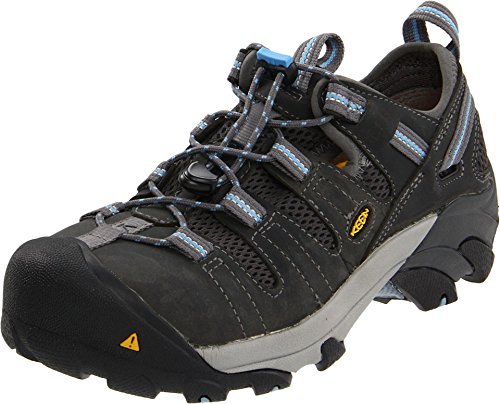
This is a genuine women's-specific last, not a men's shoe simply offered in smaller sizes — and that distinction is worth being explicit about, because it's the single most common shortcut in this category. KEEN built the women's Atlanta Cool Low on its own last, with the same asymmetric wide toe box philosophy as the men's version, adapted specifically to women's typical forefoot-to-heel proportions, which tend to run wider through the forefoot relative to heel width than men's standard lasts assume.
The low-cut profile keeps the shoe lightweight and reduces the upper heat retention that a taller boot shaft would add — directly useful for summer indoor work in warehouse, light assembly, and similar environments where the low-cut height is appropriate and a taller shaft would only trap more heat without adding protective value. Steel toe ASTM F2413 certified, EH rated, non-waterproof construction specifically chosen here to maximize indoor ventilation rather than trade airflow for water resistance the role doesn't need.

The asymmetric wide toe box is the specific feature that addresses the swelling-squeeze problem covered earlier in this guide — for women who've experienced afternoon forefoot compression in standard-width safety shoes, this geometry is consistently the most-recommended solution across the women's work boot category. Sizing runs slightly wide; KEEN's general sizing tends to fit true to length.

Summer Specs
Toe: Steel — ASTM F2413 | EH: ✅ Yes | Last: ✅ Genuine women's-specific, not scaled men's
Upper: Full breathable mesh, low-cut | Job site compatibility: ✅ Indoor warehouse, assembly, light industrial
✅ Best for: Women in warehouse, assembly, and light industrial summer roles needing genuine women's fit with steel toe + EH certification. ❌ Not for: Rough outdoor terrain or wet conditions — non-waterproof mesh construction is indoor-optimized.
Pros: Genuine women's last addresses real fit and proportion differences; asymmetric wide toe box solves the swelling-squeeze problem directly; EH rated; lightweight low-cut design.
Cons: Not waterproof — indoor-focused; low-cut offers less ankle/debris protection than mid or high-cut alternatives.
Best Composite / Coolest Toe Box: Wolverine Overpass Composite Toe Waterproof
✅ ASTM F2413 Certified — I/75 C/75 — Composite Toe — EH

This is the honest pick for anyone reading this guide who searched "breathable steel toe" but whose job site actually accepts composite — and who should know that composite is the meaningfully cooler choice once you understand the thermal-conductor mechanics covered earlier. The Overpass carries the same ASTM F2413 I/75 C/75 protection rating as any steel-toe equivalent in this guide, but the composite cap simply doesn't absorb and hold ambient heat the way steel does, which translates to a real difference in toe-box temperature by the back half of a hot shift.

Despite the "WP" in its name, this model balances waterproof capability with genuine breathability through its ContourWelt construction and flexible build — appropriate for technicians and tradespeople who need some weather resistance without fully sacrificing the airflow this guide has been focused on throughout. EH rated, making it one of the strongest composite + EH + breathable combinations available, and a direct answer to the EH-mesh compatibility question from earlier: this shoe proves you don't have to choose between electrical safety and a cooler-running toe box.
Anti-fatigue construction adds comfort for active workdays involving a mix of walking and standing. This is the right shoe for any worker with flexibility on toe-cap material who wants the single biggest thermal upgrade available within ASTM-certified footwear.
Summer Specs
Toe: Composite — ASTM F2413 I/75 C/75 (thermally insulating, non-metallic) | EH: ✅ Yes
Waterproof: ✅ Yes, with breathable balance | Job site compatibility: ✅ Any role where composite toe is accepted
✅ Best for: Any worker whose job site accepts composite toe and who wants the coolest-running, EH-rated certified option available. ❌ Not for: Sites that specifically mandate steel toe — verify your PPE policy before choosing composite.
Pros: Coolest-running toe cap in this guide due to composite's thermal insulation; EH rated; waterproof without fully sacrificing breathability; anti-fatigue construction.
Cons: Composite isn't accepted at every site — confirm your PPE requirements first; premium price point.
After-Shift Drying Protocol: Keeping Breathable Shoes Breathable All Summer
A mesh work shoe that starts each shift already saturated with yesterday's sweat provides almost no breathability advantage. Wet fibers can't facilitate evaporative cooling, and the residual moisture just creates a hot, wet environment from minute one — defeating the entire point of the breathable upper you paid for.
Step 1 — Remove insoles immediately after the shift. Insoles need to dry separately. A sealed shoe interior with the insole left in place can take 24+ hours to fully dry in still air, which isn't enough time between daily shifts. Pull the insole and the shoe interior dries in roughly 6–8 hours with basic air circulation.
Step 2 — Loosen laces completely. Open the shoe to its maximum internal volume. The tongue and collar both need to pull back so air can reach the interior from both directions, not just from the top opening.
Step 3 — Use cedar shoe trees or crumpled newspaper. Cedar absorbs moisture and inhibits the bacterial growth that causes odor — those bacterial colonies need roughly 12+ hours to establish in a cedar-treated interior, which a daily drying routine never gives them. Newspaper wicks moisture faster if you don't have cedar trees on hand. Either beats relying on still air alone.
Step 4 — Fan dry for 15–30 minutes. Moving air dries mesh dramatically faster than still air. Point a box fan at the open shoes for 15–30 minutes post-shift and you'll complete the drying cycle well before the next morning. Important: this means moving air, not heat — never use boot dryers on high, hair dryers, direct sun, or proximity to heat vents, all of which degrade mesh fiber and adhesive bonds over time.
Weekly mesh cleaning: Mesh accumulates dirt, concrete dust, and organic debris in the weave itself, which gradually reduces airflow even on a shoe that's otherwise in good condition. Brush mesh panels weekly with a soft brush — an old toothbrush works fine — to dislodge debris from the weave and maintain the airflow performance you bought the shoe for in the first place.
FAQ — 8 Summer Breathable Steel Toe Questions Answered
Can you get breathable steel toe work shoes that are actually ASTM certified?
Yes — every pick in this guide carries genuine ASTM F2413 certification from an established brand. The certification covers impact and compression protection (I/75 C/75) and, where applicable, electrical hazard (EH) rating. Breathable mesh uppers do not compromise these certifications; the safety performance comes from the toe cap and sole system, not the upper material.
Is composite toe cooler than steel toe in summer?
Yes, meaningfully. Steel is a thermal conductor with high thermal mass — it absorbs ambient heat from sun, hot concrete, and warm air throughout a shift. Composite (carbon fiber, fiberglass, Kevlar composite) is a thermal insulator and stays much closer to body temperature regardless of surrounding conditions. Both meet the same ASTM protection standard, so if your job site accepts composite, it's the better summer choice purely on heat management.
Do breathable mesh work shoes hold up on rough construction sites?
Full open-mesh shoes generally do not — rough concrete, rebar, nail debris, and sustained UV exposure will degrade or tear mesh within weeks on those job sites. Hybrid uppers, which use leather or reinforced synthetic at the toe and lateral contact zones with mesh reserved for the tongue and collar, are the correct choice for outdoor mixed-terrain and construction work. Several picks in this guide (KEEN Atlanta Cool ST, KEEN Flint II ST) use exactly this hybrid construction for that reason.
Can breathable mesh work shoes be EH (electrical hazard) rated?
Yes. EH protection comes from the insole-midsole-outsole system, not the upper material — a mesh-upper shoe with an EH-rated sole provides identical electrical hazard protection to a leather boot with the same rating. The one nuance: steel toe caps are themselves conductive, so for work with frequent direct contact risk near live conductors, a composite toe (which isn't conductive) removes one additional exposure pathway, independent of the upper material question.
What is the most breathable steel toe work shoe available in 2026?
Among certified options, full-mesh indoor-focused shoes like the Timberland PRO Powertrain Sport and Skechers Work Cankton offer the highest airflow, since they don't need reinforced abrasion zones for their intended indoor/light-duty environments. For outdoor use where some upper protection is necessary, hybrid designs like the KEEN Atlanta Cool ST balance genuine breathability with the durability outdoor work requires.
Are there breathable steel toe work shoes for wide feet?
Yes — KEEN's asymmetric toe box design (used across the Atlanta Cool and Flint II lines, men's and women's) provides genuinely more forefoot room than standard symmetric toe caps, and wide-width variants are available on several models. The general buying advice: size up half a step for summer purchases specifically to build in margin for the 5–10% afternoon foot swelling that hot conditions cause.
How do I keep breathable work shoes breathable through a full summer season?
Remove insoles immediately after each shift so they dry separately rather than trapped inside a sealed interior. Loosen laces fully to maximize airflow into the shoe overnight. Use cedar shoe trees or newspaper to accelerate moisture removal and inhibit odor-causing bacteria. Fan-dry for 15–30 minutes with moving air — never with direct heat. Brush mesh panels weekly to clear accumulated dust and debris that otherwise gradually chokes off airflow.
Are cheap Amazon mesh steel toe shoes actually ASTM certified?
Not always — this is a genuine risk in this category. Verify any safety shoe carries an explicit ASTM F2413 certification statement (with the specific impact/compression codes, e.g., I/75 C/75) from a recognized brand, not just marketing language like "steel toe protection" without a cited standard. All picks in this guide were selected specifically because they carry verifiable ASTM certification from established manufacturers — the Carhartt CMO3251 (Pick 06) demonstrates that genuine certification is available even at budget prices, so there's rarely a good reason to risk an uncertified listing.
Final Verdict: Best Breathable Steel Toe Shoe by Job Type
Job Type → Best Shoe
Outdoor construction / mixed terrain: KEEN Atlanta Cool ST — hybrid upper survives rough sites, asymmetric toe box, EH rated
Indoor warehouse / distribution center: Timberland PRO Powertrain Sport — lighter alloy toe, genuine anti-fatigue midsole, full breathable mesh
Electrical / HVAC / utility service: Reebok Astroride Work ST EH — athletic mobility for ladder and kneeling work, accessible price
Delivery / mobile / fast-paced roles: Skechers Work Cankton — steel toe + EH + memory foam + mesh in one shoe
Framing / rough outdoor construction: KEEN Flint II ST — maximum hybrid-upper durability for the harshest job sites
Budget-conscious, certification non-negotiable: Carhartt CMO3251 — genuine ASTM cert under $80
Manufacturing floor / assembly line: Timberland PRO Drivetrain — anti-fatigue geometry plus composite's cooler-running toe cap
Women in any certified-footwear role: KEEN Women's Atlanta Cool Low ST — genuine women's last, asymmetric wide toe box
Any role where composite is accepted / coolest option needed: Wolverine Overpass CT WP — the single biggest thermal upgrade available in certified footwear
The right summer safety shoe isn't just "the breathable one" — it's the one whose upper construction matches what your job site will actually do to it, whose toe material matches the heat reality you're standing in, and whose certification matches the hazard you're actually protecting against. Match those three things correctly and the mesh panel becomes the easy part of the decision.