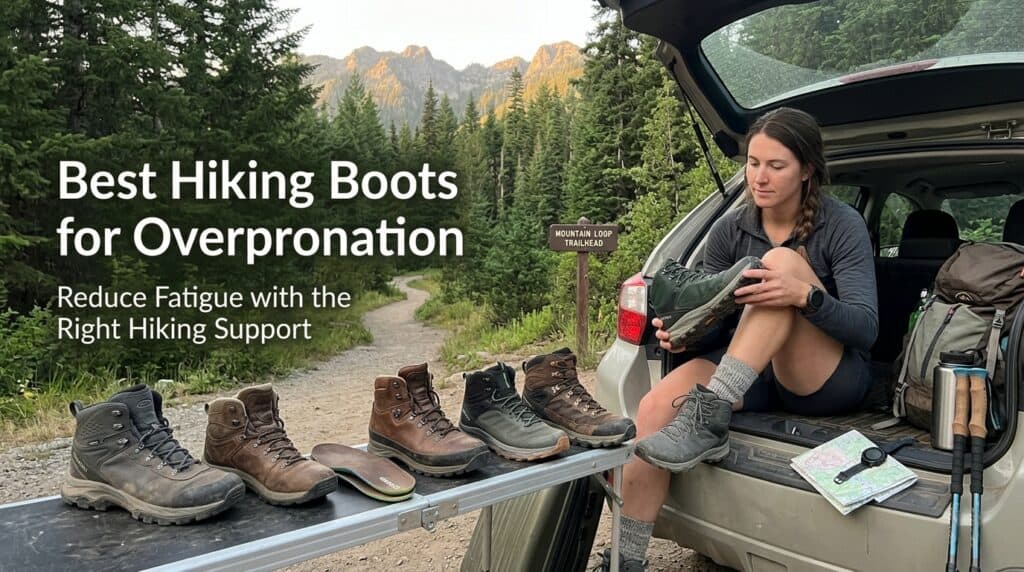

Overpronation — excessive inward rolling of the foot during each step — is common, manageable, and often barely noticeable on flat pavement. Put that same foot on an uneven trail, add a loaded backpack, and the effect compounds. Ankles collapse further inward, knees and shins take more strain, and a mild issue at home can become a genuinely uncomfortable one on mile eight of a hike.
The good news: the right hiking boot genuinely helps. A firm heel counter, structured arch support, and good torsional rigidity all work together to limit the excessive inward roll that causes pain. The less-good news: most buying guides treat "overpronation boots" as one undifferentiated category, when podiatrists actually think in terms of three distinct stability tiers matched to severity — and picking the wrong tier can be as unhelpful as picking no support at all.
This guide organizes seven picks by stability tier rather than price or brand, includes a genuine at-home self-check before you buy anything, and covers a question almost nobody addresses: what to look for if you already wear custom orthotics.
A quick and important note: this is general buying guidance, not a diagnosis. If you have persistent pain, visible arch collapse, or any uncertainty about your foot type, a podiatrist or physical therapist with gait analysis will get you to the right answer far faster and more reliably than any article, including this one.
Quick Comparison: Best Hiking Boots for Overpronation
| # | Boot | Stability Tier | Drop | Best For | Price |
|---|---|---|---|---|---|
| 1 | Merrell Moab 3 Mid | Light stability | 11.5mm claimed / 13.5mm lab-measured | Mild overpronation, day hiking | ~$150–170 |
| 2 | La Sportiva Spire GTX | Stability | 16.0mm | Moderate overpronation, best all-round | ~$209 |
| 3 | Hike Ridge Plus Barefoot | Not a stability shoe — see caveat below | 0mm (zero-drop) | Very mild/borderline cases only, strong feet | ~$70–90 |
| 4 | Salomon Quest Winter GTX | Stability / motion control | ~14mm | Backpacking, loaded pack, sidehills | ~$220–240 |
| 5 | KEEN Targhee IV Wide | Light stability | ~10mm | Orthotic compatibility, wide feet | ~$150–170 |
| 6 | NORTIV 8 Tactical Hiking | Light stability | Low/moderate | Budget entry point | ~$60–75 |
| 7 | Merrell Moab 2 Mid WP (Women's) | Light stability | ~11mm | Women's, mild-to-moderate overpronation | ~$100–130 |
Which tier are you?
| Your situation | Best starting point | Why |
|---|---|---|
| Mild, self-noticed, no pain | Merrell Moab 3 Mid (#1) | Solid heel counter and moderate stack without excessive stiffness |
| Moderate, diagnosed, day hiking + light backpacking | La Sportiva Spire GTX (#2) | Sidewall control system and tall, torsionally rigid stack |
| Backpacking with a loaded pack | Salomon Quest Winter GTX (#4) | Chassis-style lateral support tested to hold up on sidehills under load |
| Already use custom orthotics | KEEN Targhee IV Wide (#5) | Removable insole, roomy last, stability (not motion control) base |
| Budget-conscious first pair | NORTIV 8 Tactical (#6) | Wide toe box and reinforced heel at an accessible price |
Do You Actually Overpronate? A Simple At-Home Check
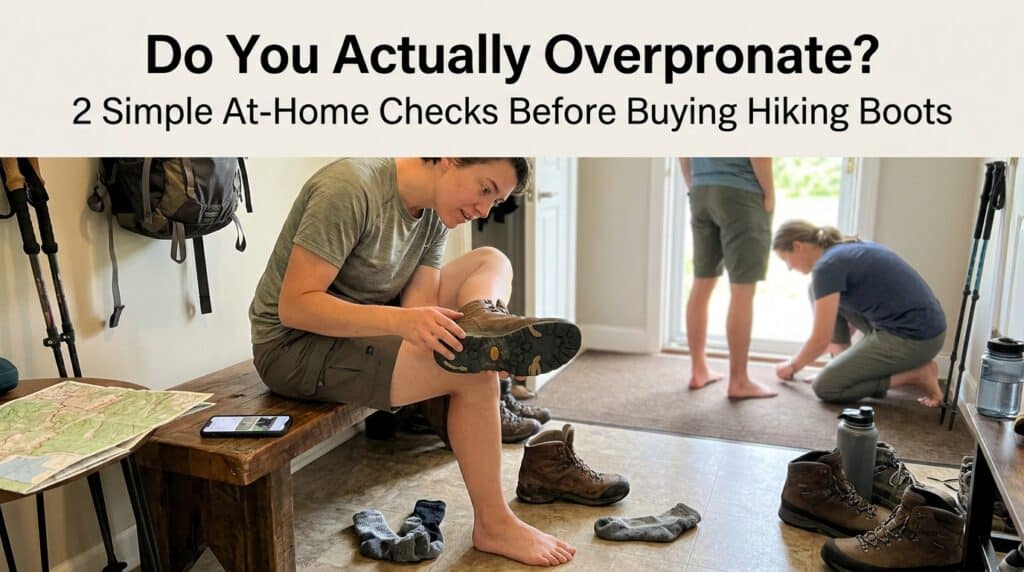
Before buying anything, it's worth doing two quick checks. Neither replaces a professional gait assessment, but both give you a genuinely useful starting signal.
Check your current shoes' wear pattern
Flip over a pair of shoes you've worn regularly for several months and look at the outsole. Excessive wear on the inside (medial) edge of the heel and forefoot is a classic overpronation signal — your foot is rolling inward more than it should with each step, concentrating wear on that inner edge. Excessive wear on the outside (lateral) edge points the other way, toward supination — a different foot type that needs the opposite kind of shoe. Even, centered wear suggests a fairly neutral gait.
The "too many toes" sign
Stand normally and have someone look at your feet from directly behind. If you can see more than your little toe and roughly half of your fourth toe poking out past the outside edge of your ankle, your arch may be collapsing inward more than average — another indicator worth noting.
Neither of these tests is diagnostic on its own. If you're seeing clear signals from both, or you're dealing with recurring knee, shin, or arch pain, that's the point where a proper gait analysis — not another pair of boots — is the right next step.
Neutral, Stability, and Motion Control: What the Terms Actually Mean
Podiatrists think about supportive footwear in three tiers, matched to how much correction a foot actually needs. Buying the wrong tier isn't just unhelpful — in some cases it can genuinely make things worse.
Neutral: no corrective structure built in. Designed for a normal, healthy amount of pronation. The wrong starting point for anyone with confirmed overpronation.
Stability: moderate correction through a wider midsole platform, guide-rail-style sidewalls, or a light-to-moderate medial post under the arch. This is the right tier for most hikers with mild-to-moderate overpronation, and it's generally the correct base if you use custom orthotics — more on that below.
Motion control: the strongest correction level, built around a firm medial post and a genuinely rigid heel counter. Appropriate for significant flat feet or pronounced, diagnosed overpronation — but not a "safest bet for everyone" default. A boot this rigid can feel unnecessarily stiff for a hiker with only mild pronation, and podiatrists specifically caution that pairing a rigid custom orthotic with a rigid motion-control shoe can over-correct the foot, pushing it toward supination-pattern problems (lateral knee pain, IT band irritation) instead.
The Features That Actually Matter
Heel counter rigidity
Think of the heel counter as the boot's rearfoot backbone. A firm thermoplastic or reinforced polyurethane counter resists the heel collapsing inward far better than a thin foam liner does. You can test this yourself in a store: squeeze the heel cup from both sides between your fingers — it should resist rather than fold easily.
Torsional rigidity
This measures how much a boot resists twisting along its length — and it's directly relevant to overpronation on uneven trail terrain. Twist a boot in your hands the way your foot might twist over a root or angled rock. A boot that resists this twisting motion gives your foot less opportunity to roll inward when the ground beneath it isn't flat, which is exactly the situation where overpronation causes the most trouble. Boots built around a stiffer internal shank or chassis system score well here.
Ankle collar height and structure
A mid-to-high cut boot — roughly 4 to 6 inches above the ankle bone — limits excessive rearfoot and tibial rotation more effectively than a low-cut hiking shoe. The important caveat: this only works if the collar itself is structured and firm. A tall but soft, floppy collar can collapse under load and give you the worst of both worlds — the weight of a taller boot without the stability benefit.
Medial arch support
Look for a firm, contoured arch built into the midsole or footbed — not a soft gel pad that compresses flat under load. A removable stock insole matters here too, both because it lets you swap in a custom orthotic later and because arch support in any insole degrades over the life of a boot and eventually needs replacing.
Heel-to-toe drop
A moderately steep drop — roughly 10 to 16mm across the boots in this guide — takes some load off the Achilles and ankle joint, which tends to benefit overpronators carrying a pack or covering longer distances. It's not the single most important spec, but it's worth checking alongside heel counter and torsional rigidity rather than in isolation.
The 7 Best Hiking Boots for Overpronation, by Stability Tier
1. Merrell Moab 3 Mid — Best for Mild Overpronation / Day Hiking

Stability tier: Light stability | Drop: 11.5mm claimed, 13.5mm lab-measured | Forefoot stack: 22.6mm | Outsole: Vibram Ecostep EVO, 5mm lugs | Weight: ~2 lb 3 oz (men's) / 1 lb 12 oz (women's)
Why it's the right starting point for mild cases: The Moab 3 Mid has been the default recommendation in the budget-to-mid-range hiking boot category for years, and it earns that reputation with a heel-to-toe drop that lab testing measured at a genuinely supportive 13.5mm — notably taller than several competitors and squarely in the range podiatrists associate with reduced Achilles and ankle strain for hikers new to supportive footwear. The reinforced suede panel running from the back of the heel to the front of the ankle acts as a structural guardrail against side-of-foot rolling, and reviewers consistently note the substantial toe bumper and heavy rubber side protection hold up well without punishing your feet on rocky or rooty terrain.

The Kinetic Fit contoured insole conforms reasonably well to the foot and is fully removable — a genuine plus if you later want to add a stability-appropriate orthotic. The toe box measures a notably wide ~102mm at its widest point, which suits hikers whose overpronation comes with some natural toe splay, though narrower-footed hikers may find it a touch roomy. The trade-off for all this structure is weight — at roughly 2 lb 3 oz for the pair, it sits on the heavier end of the budget hiking boot spectrum, and the waterproof GORE-TEX version scores a low 1/5 on breathability in lab testing, meaning it's not the shoe for hot-weather hiking above 70°F.
Best for: Hikers with mild, self-noticed overpronation who want solid structure without committing to a rigid motion-control boot. Good entry point before deciding whether you need more correction.
→ Check current price on Amazon
2. La Sportiva Spire GTX — Best for Moderate Overpronation / Best All-Round Pick
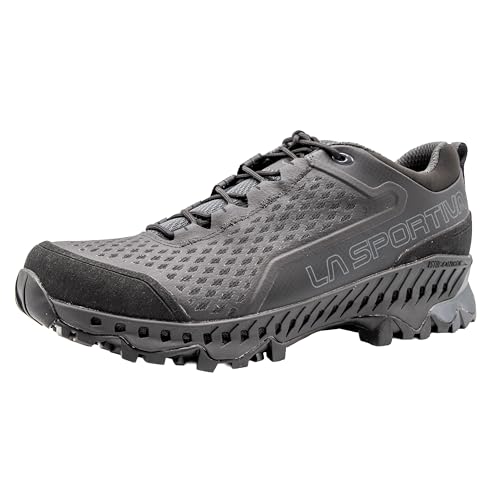
Stability tier: Stability | Drop: 16.0mm | Heel stack: 39.1mm — 7.2mm above average | Torsional rigidity: 4/5 lab-rated | Midsole firmness: 52.2 AC, 12% firmer than average
Why it's the strongest overall pick for diagnosed, moderate overpronation: Independent lab testing gives the Spire GTX some of the most compelling data in this category. Its STB control system — sidewalls specifically built to guide foot alignment through the gait cycle — combines with a genuinely tall 39.1mm heel stack and a firm 52.2 AC midsole to produce a boot that felt stable and resisted twisting even under load, earning a 4 out of 5 torsional rigidity rating in independent testing. That resistance to twisting is exactly the property that matters most for controlling overpronation on uneven trail surfaces, where your foot is far more likely to roll inward over an angled root or rock than it is on flat ground.

The steep 16.0mm drop takes meaningful pressure off the ankle and Achilles, which matters more, not less, on longer or loaded hikes — exactly the scenario where overpronation tends to worsen as fatigue sets in. The midsole is intentionally protective and isolating rather than plush, so you'll feel more removed from the ground than in a trail-runner-style hiking shoe, but that trade-off is deliberate: less ground feedback generally means less opportunity for the foot to twist and roll. At around $209, it's priced at the premium end of this list — steep relative to the roughly $142 average hiking shoe price, but the lab-verified stability performance is the clearest justification of any boot in this guide.
Best for: Hikers with a diagnosed, moderate overpronation pattern who want the best combination of correction and comfort across day hikes and lighter backpacking trips.
→ Check current price on Amazon
3. Hike Ridge Plus Barefoot Hiking Shoes — An Important Caveat, Not a Motion-Control Pick
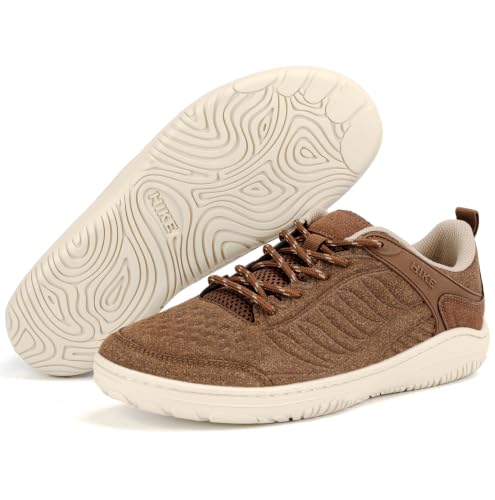
Stability tier: None — zero-drop, minimal structure | Drop: 0mm | Construction: Flexible, wide toe box, thin sole
An honest note before anything else: a barefoot or zero-drop shoe is, mechanically, close to the opposite of a motion-control shoe. Motion control relies on a firm medial post and a rigid heel counter to physically resist inward rolling. A barefoot shoe deliberately removes that structure, on the theory that strengthening the foot's own intrinsic muscles over time reduces the need for external correction in the first place. This is a real and legitimate approach for some people — but it is not appropriate for anyone with a significant, diagnosed overpronation pattern, and it is absolutely not a substitute for the motion-control category if that's what your gait actually needs.

Where this shoe can genuinely fit into an overpronation-aware hiking kit: for hikers with only very mild, borderline pronation who have already built solid foot and ankle strength (through months of progressive barefoot or minimalist use, not overnight), a shoe like this can work well for short, easy trail days. It should not be your first pair if you overpronate significantly, and it is not appropriate for backpacking with a loaded pack, where the reduced structure gives your foot nothing to resist the inward roll that a heavier load amplifies. If you're unsure which category you fall into, start with a stability-tier boot (picks #1, #2, #5, or #7) rather than this one.
Best for: Very mild, borderline cases with already-strong feet, or as a second pair for easy trail days once a more supportive primary boot has established comfortable, pain-free hiking. Not recommended as a first purchase for moderate-to-severe overpronation.
→ Check current price on Amazon
4. Salomon Quest Winter GTX — Best for Backpacking with a Loaded Pack
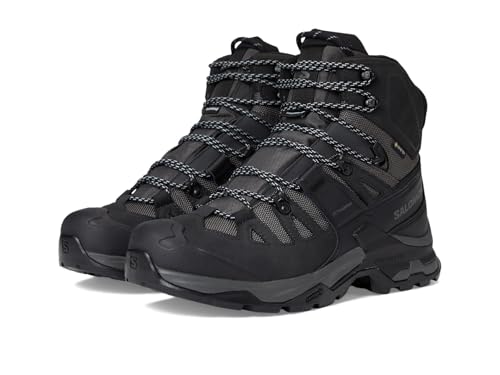
Stability tier: Stability / motion control | Key tech: Advanced Chassis lateral support system | Waterproofing: GORE-TEX | Best use: Cold-weather backpacking, loaded pack, sidehill terrain
Why load-bearing overpronators need this specifically: A loaded backpack changes the overpronation equation. Testing with an equivalent Salomon Quest chassis boot under a 30-lb pack found the Advanced Chassis system took over full control of overpronation on sidehill terrain — meaningfully more support than the boot's own base weight might suggest, precisely because the chassis structure resists the added lateral forces a loaded pack creates. This matters: stability requirements don't stay constant as pack weight increases, they scale up, and a boot chosen only for unloaded day hikes can fall short once you add 25–35 lbs of gear.

The Quest Winter GTX brings that same chassis philosophy into a genuinely cold-weather, insulated build — the outsole's thicker medial and lateral lugs bite into loose or muddy terrain more effectively than a standard trail lug pattern, and the boot sheds mud well rather than packing up and losing grip. The honest trade-off is weight: this is a heavier boot than the day-hiking picks in this guide, and it can waterlog and feel noticeably heavier still in genuinely wet, rainy multi-day conditions. That weight penalty is the cost of the stability performance — for backpackers whose overpronation gets meaningfully worse under load, it's a fair trade.
Best for: Backpackers carrying 25+ lbs on technical or sidehill terrain, cold-weather multi-day trips, and any hiker whose pronation clearly worsens once a loaded pack is added.
→ Check current price on Amazon
5. KEEN Targhee IV Wide — Best Orthotic-Compatible Pick

Stability tier: Light stability | Waterproofing: KEEN.DRY membrane | Toe box: Notably wide | Widths available: Medium and wide
Why it's the right base if you already use orthotics: If you've already invested in a custom orthotic prescribed by a podiatrist, the buying question changes completely — you're no longer looking for a boot that corrects pronation on its own, you're looking for one that gets out of the orthotic's way. The Targhee IV Wide is built specifically for this. It has a genuinely wide, roomy toe box and last — reviewers consistently flag it as the pick for hikers who found other boots, including the Moab, too narrow once an insert was added — and it's available in a true wide width, not just a slightly relaxed standard fit.

Just as importantly, it sits in the light-stability tier rather than motion control, which is exactly the base podiatrists recommend for orthotic use — pairing a rigid custom insert with a rigid motion-control shell risks over-correcting the foot into a different problem entirely. The stock insole is properly removable, the leather and mesh upper is durable and reasonably breathable, and the KEEN.DRY waterproofing performs reliably without the boot feeling as stiff as some fully leather alternatives. Some reviewers note the stock insole benefits from a third-party swap even before adding a medical orthotic, which only reinforces how well-suited this boot is to accepting an aftermarket footbed of any kind.
Best for: Hikers who already wear a custom orthotic and need a wide, accommodating stability-tier boot to build it into — not motion control, and not a narrow last that crowds the insert.
→ Check current price on Amazon
6. NORTIV 8 Tactical Hiking Boot — Best Budget Pick
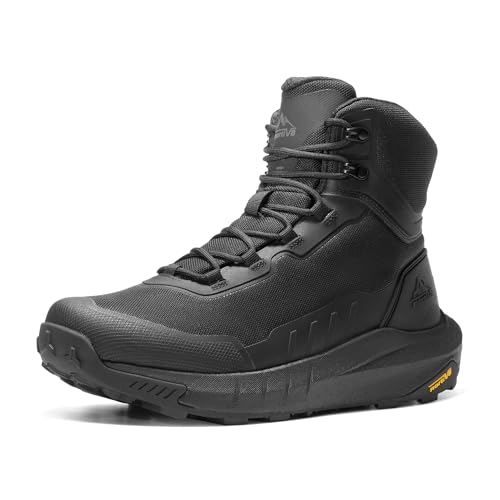
Stability tier: Light stability | Toe box: Wide | Construction: Suede upper, waterproof membrane, reinforced heel
Why it earns its place at this price: Not every hiker with mild overpronation needs — or can justify — a $200 stability boot to find out whether extra structure actually helps. The NORTIV 8 covers the fundamentals that matter most at a fraction of the price: a wide toe box that allows natural toe splay rather than compressing it, a reinforced heel and ankle collar for meaningfully more lateral stability than an unstructured budget boot, and a moderate heel-to-toe drop that takes some pressure off the ankle without the aggressive stiffness of a true motion-control boot.

The removable insole and shock-absorbent midsole are genuine value-adds at this price point, and the rubber toe cap adds real protection on rocky terrain. It won't match the torsional rigidity or lab-verified stability performance of the La Sportiva Spire or Salomon Quest — this is a heavier, less refined build overall — but as a starting point for a hiker who suspects mild overpronation and wants to test whether a supportive boot helps before spending significantly more, it's a genuinely reasonable entry point.
Best for: Budget-conscious hikers testing whether a stability-oriented boot helps their symptoms, or anyone wanting a solid entry-level pair before committing to a premium option.
→ Check current price on Amazon
7. Merrell Moab 2 Mid Waterproof — Best Women's Pick
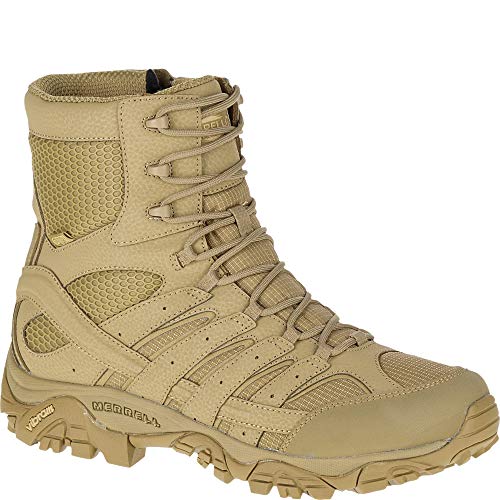
Stability tier: Light stability | Drop: ~11mm | Last: True women's-specific construction | Weight: ~1 lb 12 oz per pair
Why the women's-specific last matters here: Overpronation-correction features only work as intended when they're built into a last that actually matches the anatomy wearing it. A men's boot resized into a smaller women's length doesn't reposition the heel counter, arch support, or medial structure to match a typically narrower heel and different arch position — it just shrinks the whole shoe uniformly. The Moab 2 Mid Waterproof is built on Merrell's genuine women's last, giving the same reinforced heel counter, structured mid-cut collar, and Vibram outsole traction as the men's Moab line, but positioned correctly for a woman's foot shape.

It carries the same well-earned reputation for comfort-to-cost value that makes the Moab line a long-running favorite — a durable suede and mesh upper, dependable waterproofing, and a moderate drop that offers real ankle and Achilles relief without the stiffness of a full motion-control build. Like the men's Moab 3, it sits in the light-stability tier: a solid, sensible choice for mild-to-moderate overpronation, with the option to size up to something like the KEEN Targhee IV Wide or a women's-specific Salomon or La Sportiva model if symptoms suggest you need more correction than this tier provides.
Best for: Women with mild-to-moderate overpronation who want a genuinely women's-last stability boot at a reasonable price, for day hikes and light backpacking.
→ Check current price on Amazon
Orthotic Compatibility: Fitting a Custom Insert Into a Hiking Boot
If you already wear a custom orthotic prescribed by a podiatrist, the buying calculus is different from everything above. Here's what to check specifically.
Confirm the stock insole is genuinely removable — not glued or molded into the footbed. Most modern hiking boots are, but budget models occasionally aren't. Check the product description or Q&A section before ordering if it isn't explicitly stated.
Check interior volume, not just length. A rigid orthotic shell takes up real space. A boot with a narrow last that fits your foot perfectly without an insert can crowd the toe box uncomfortably once one is added — this is exactly why the KEEN Targhee IV Wide (pick #5) is featured specifically for this use case; its roomier last has margin built in.
Choose stability, not motion control, as your base. This is worth repeating because it's the single most common mistake: combining a rigid custom orthotic with a rigid motion-control boot can double up the correction and push your foot toward the opposite problem — supination-pattern lateral knee or IT band pain. A moderate stability-tier boot gives the orthotic room to do its job without adding a second layer of rigid correction on top.
Size up if you're between half sizes once you know you'll be adding an orthotic — the insert adds enough volume that a true-to-size boot can feel tight where it wouldn't otherwise.
When a Boot Alone Isn't Enough
A well-fitted stability boot genuinely helps most hikers with mild-to-moderate overpronation. It is not, on its own, a fix for every case. See a podiatrist or physical therapist for a proper gait evaluation if: pain — medial knee, shin splints, plantar fascia — persists despite a good stability boot and reasonable rest; you notice rapid or clearly one-sided arch collapse; or symptoms are getting worse over time rather than settling down. None of that is cause for alarm, but it is a clear signal that the next useful step is a professional assessment rather than another pair of boots.
Looking for the best boot in every category? See our best hiking boots guide.
Frequently Asked Questions
Do hiking boots actually help with overpronation?
Yes, to a meaningful degree. Stability and motion-control boots with a firm heel counter, structured arch support, and good torsional rigidity help limit excessive inward rolling — particularly on uneven trail terrain, where the effect of overpronation is amplified compared to flat pavement. They manage the mechanics of each step; they don't cure the underlying condition.
What's the difference between stability and motion control hiking boots?
Stability boots use moderate correction — a wider midsole platform, guide-rail sidewalls, or a light medial post — appropriate for mild-to-moderate overpronation. Motion control boots use a firm medial post and a genuinely rigid heel counter, built for significant flat feet or pronounced overpronation. Using motion control when your case is actually mild can feel unnecessarily stiff and offers no real benefit over the lighter stability tier.
How do I know if I overpronate?
Check the wear pattern on your current shoes — excessive wear on the inside edge of the heel and forefoot is a signal. The "too many toes" sign, viewed from behind while standing normally, is a second home indicator. For a definitive answer, a podiatrist or specialty running store offering pressure-plate or video gait analysis will give you a much more reliable picture than either home check alone.
Can I put custom orthotics in hiking boots?
Yes, as long as the boot has a genuinely removable stock insole and enough interior volume to accommodate the insert without crowding the toe box. Choose a stability-tier boot as the base rather than motion control — pairing a rigid orthotic with a rigid motion-control boot can over-correct pronation and create new problems.
Do overpronators need different boots for backpacking versus day hikes?
Often yes. A loaded pack adds significant lateral force at the ankle, so stability features that feel like plenty on an unloaded day hike can fall short once you're carrying 25+ lbs on technical or sidehill terrain. A chassis-style boot built with backpacking load in mind, such as the Salomon Quest Winter GTX in this guide, is worth the extra weight for multi-day trips.