
Ever ordered boots online, waited a week, and felt your foot being crushed the second you put them on? Or maybe you felt like a kid wearing their dad's shoes, swimming in empty space? Most people blame the number size. More often, the problem is width. A size 10 boot isn't just a size 10. A size 10 D fits completely differently than a size 10 EE. And if you're buying a European brand, you might encounter an "H" width that throws everything off. This guide decodes the width system from standard D to the elusive H, and breaks down how brands like Red Wing, Ariat, and Timberland actually fit so you can stop guessing.
Quick Answer: D vs EE vs EEEE Boot Width
D is standard width for men. EE is wide, EEE is extra wide and EEEE (also written 4E) is extra-extra wide. For women, B is standard and D is wide. Each letter step adds roughly 1/8 to 3/16 inch across the ball of the foot, so EEEE is noticeably roomier than D, about 0.6 inch wider at a men's size 10 in our chart below.
| Letter | Men's fit | Approx. width at men's size 10 |
|---|---|---|
| D (M) | Standard | 4.0 in / 10.2 cm |
| E | Slightly wide | Between D and EE |
| EE (2E, W) | Wide | 4.3 in / 10.9 cm |
| EEE (3E) | Extra wide | Between EE and EEEE |
| EEEE (4E, XW) | Extra-extra wide | 4.6 in / 11.7 cm |
| H | Depends on the brand | See the H section below |
EEEE vs D in plain terms: if a D feels tight across the ball of your foot or your little toe rubs, try EE first. Go to EEEE only if EE still pinches, or if you have very wide or swollen feet. Don't size up in length to get width. For what H means, see our Wide EE vs Wide H guide.
Shopping for Wide Boots?
Buying a boot made in your width beats sizing up or stretching. Start with our wide-fit roundups:
- Best work boots for wide feet
- Best hiking boots for wide feet (men)
- Best women's waterproof hiking boots for wide feet
- Best steel toe boots, including KEEN's roomier asymmetrical steel toes
- Boots we've reviewed that come in wide widths, further down this page
The Standard Width Scale: What the Letters Actually Mean
Boot widths are measured at the ball of the foot, the widest part. The system uses letters to indicate volume and girth. The most confusing part: men's and women's scales use the same letters to mean different things.
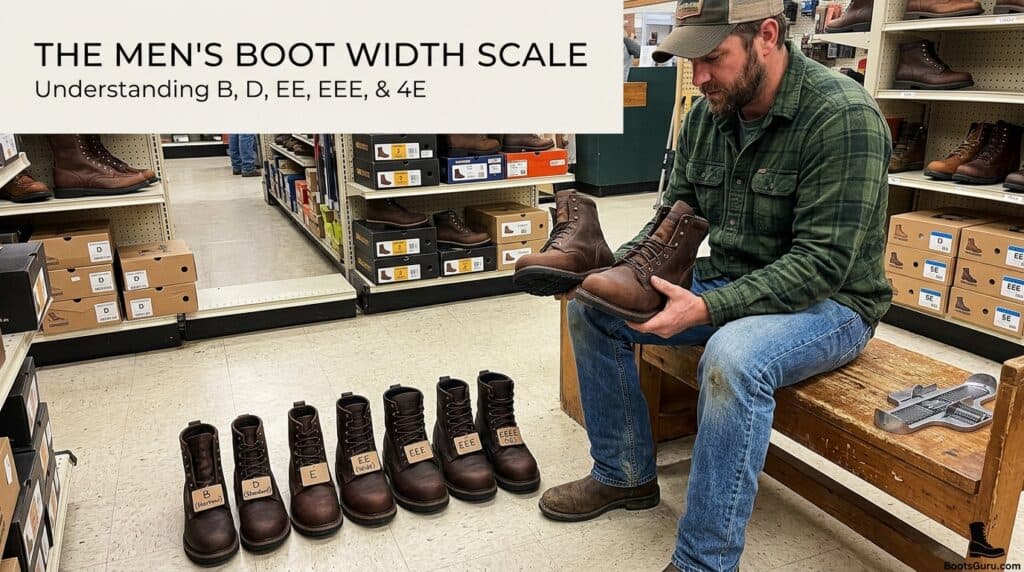
comparing boot widths in store
The Men's Width Scale
If you buy off the shelf without checking width, you're buying a D. That's the industry default. If a boot doesn't list a width, it's D.
- B (Narrow): Rare in work boots, occasionally found in western and cowboy styles.
- D (Standard/Medium): The industry standard. Unlisted width means D.
- E (Wide): Slightly wider than standard.
- EE or 2E (Extra Wide): The most common wide option you'll find at retail.
- EEE or 3E (Extra-Extra Wide): For high-volume feet.
- EEEE or 4E: Extra-extra-extra wide.
- 6E-8E: Ultra-wide specialty sizes for severe swelling or unusual foot shapes.
The Women's Width Scale
- 4A or SS (Super Slim): Extra narrow, rare but available in some brands.
- 2A or AA (Narrow): For slender feet.
- B or M (Standard/Medium): The industry standard for women.
- C or D (Wide): The most common women's wide width.
- EE or 2E (Extra Wide): Harder to find, usually requires specific work or comfort brands.
- 4E: Extremely rare in women's sizing.
The gender difference that matters: A men's medium (D) is approximately equivalent to a women's extra wide (2E). If you're a woman with wide feet, buying a men's boot in a smaller size is a legitimate strategy to get the width you need without paying for custom sizing.
What These Letters Mean in Actual Inches
In a men's size 10, here's what each width letter translates to at the ball of the foot:
- D (Standard): ~4.0" (10.2 cm)
- EE (Wide): ~4.25" (10.8 cm)
- 4E (Extra Wide): ~4.5" (11.4 cm)
A quarter inch might not sound like much, but in a boot it's the difference between comfortable all-day wear and blisters by noon. Each width increment adds approximately 3/16" to 1/4" of additional width at the ball.
Understanding "H" Width: The Most Confusing Designation
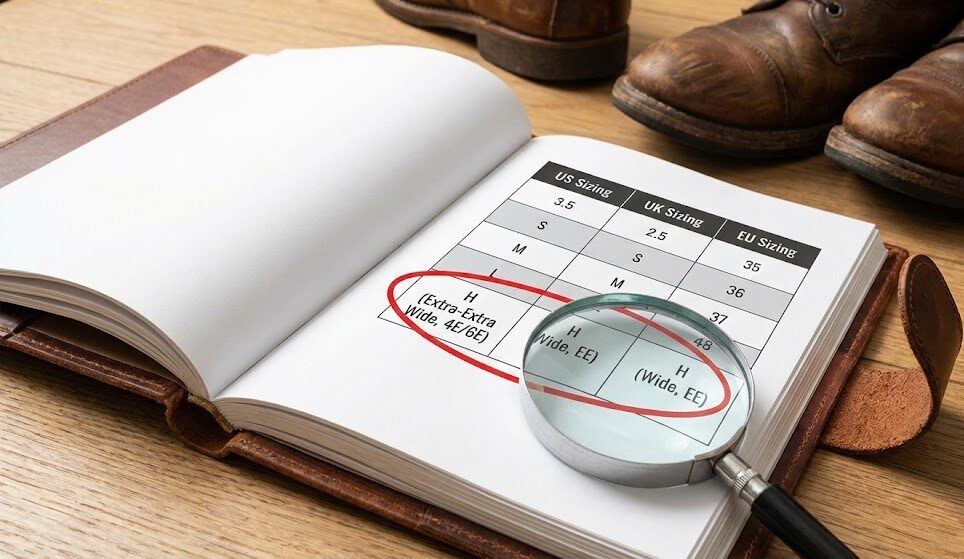
h to indicate extra extra wide
"H" width is one of the most frustrating designations in boot sizing because it means completely different things depending on the brand and country of origin.
In US Boot Systems
Some American work boot manufacturers, particularly older brands and military contractors, use H on older or specialty sizing charts to mean a very wide fitting, beyond EE. There is no single US standard for it, so an H from one maker can fit very differently from another. If you see H on a US-made boot, treat it as "extra wide" and check that brand's own chart for the actual measurement.
In UK/European Systems
UK makers often use letter fittings too, but the letters don't line up with US widths, and they differ by brand and by gender. Clarks is a good example. Its UK standard fitting is G for men and D for women (Clarks, retrieved 2026-09-24). Each letter up the alphabet is a wider fitting, so an H on a Clarks men's shoe is one step wider than standard, while a D on a US men's boot is standard.
Many German and Austrian hiking brands skip letters altogether. Meindl, for example, sells a named "Comfort fit" range that it describes as wider and more generous than its standard trekking fit (Meindl, retrieved 2026-09-24). With European brands, look for the fit name and the brand's size chart rather than a letter.
Other Width Designations You'll See
- W / EW: Many modern brands simplify the system. "W" (Wide) usually maps to EE, and "EW" (Extra Wide) maps to EEE or 4E.
- MW / XW: "Medium Wide" and "Extra Wide" are more common in athletic-based boot brands.
How to Decode H Width for Your Specific Boot
Always check the manufacturer's sizing chart. H can mean anything from 2E to 6E depending on the brand. Here's the process:
- Check the brand's country of origin (US vs. UK/EU)
- Look for their sizing chart with measurements in inches or centimeters
- Call customer service if measurements aren't listed clearly
- Read reviews that specifically mention H width fit
- Never assume H means the same across brands
A US-made H width (4E-6E) is vastly different from a German-made Meindl H width (roughly US 4E). Ordering the wrong one means a boot that's either painfully tight or comically oversized.
How to Measure Your Boot Width at Home
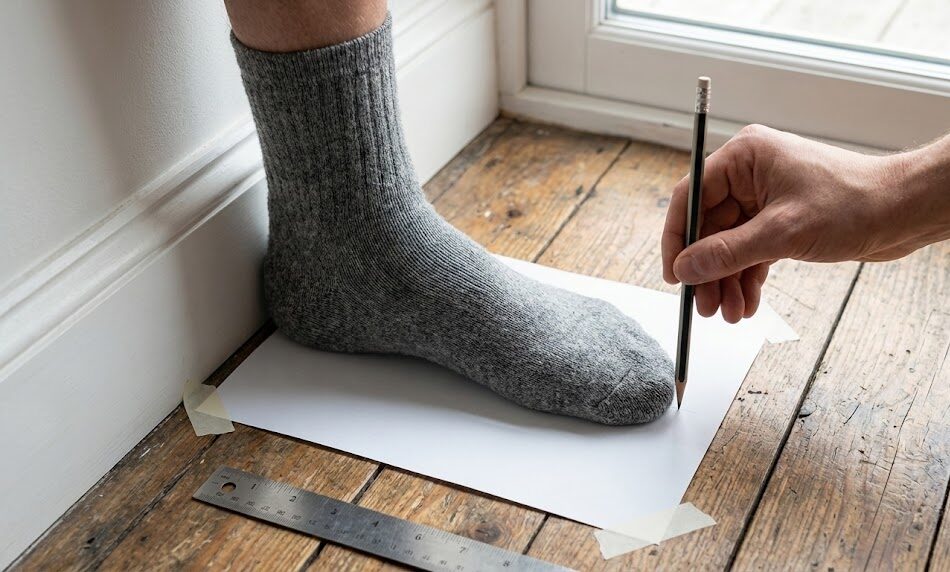
the wall method
You don't need a Brannock device to get a baseline. A piece of paper and a ruler are enough. One rule applies before everything else: measure your feet in the evening. Feet swell throughout the day, and you want boots that fit your largest foot.
What You'll Need
- Blank sheet of paper (8.5" x 11" or A4)
- Ruler or measuring tape with both inches and centimeters
- Pen or pencil
- The socks you plan to wear with your boots
Measure both feet. Most people have one foot slightly larger than the other. Always fit boots to the larger foot.
The Paper Trace Method
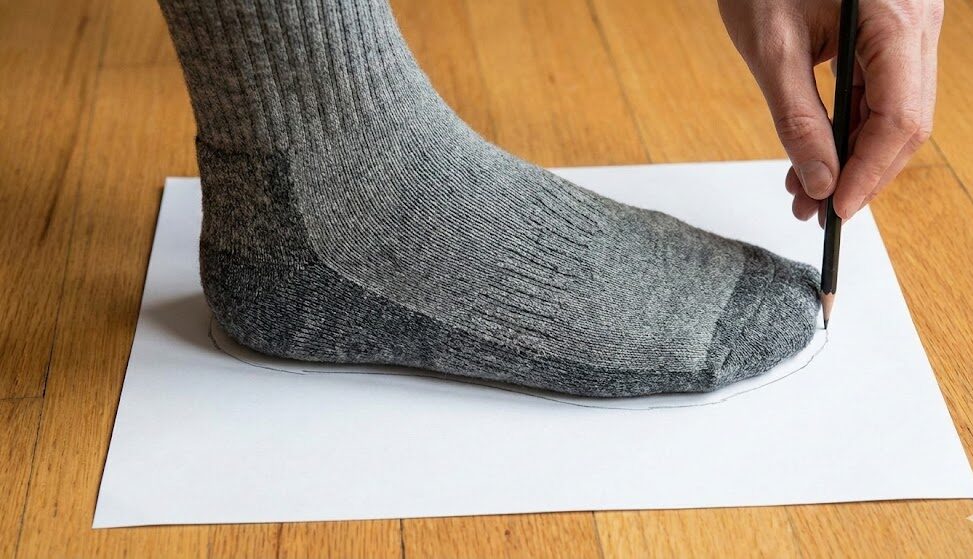
the paper trace method
- Trace: Stand on the paper with your full weight. Trace the outline of your foot keeping the pencil at 90 degrees, not angled under your foot.
- Measure: Measure the widest part of the tracing across the ball of the foot, not across the toes.
- Compare: Use the charts below to estimate your width based on your shoe size.
Men's Width Reference Chart (Inches and Centimeters)
Width scales with foot length. A size 12 D is wider than a size 8 D.
| US Size | Narrow (B) | Standard (D) | Wide (EE) | Extra Wide (4E) |
|---|---|---|---|---|
| 8 | 3.4" / 8.6 cm | 3.8" / 9.7 cm | 4.1" / 10.4 cm | 4.4" / 11.2 cm |
| 9 | 3.5" / 8.9 cm | 3.9" / 9.9 cm | 4.2" / 10.7 cm | 4.5" / 11.4 cm |
| 10 | 3.6" / 9.1 cm | 4.0" / 10.2 cm | 4.3" / 10.9 cm | 4.6" / 11.7 cm |
| 11 | 3.7" / 9.4 cm | 4.1" / 10.4 cm | 4.4" / 11.2 cm | 4.7" / 11.9 cm |
| 12 | 3.8" / 9.7 cm | 4.2" / 10.7 cm | 4.5" / 11.4 cm | 4.8" / 12.2 cm |
Approximated from industry standard sizing charts. Individual brands may vary by up to 1/8".
Women's Width Reference Chart (Inches and Centimeters)
| US Size | Narrow (AA) | Standard (B) | Wide (D) | Extra Wide (EE) |
|---|---|---|---|---|
| 6 | 3.0" / 7.6 cm | 3.3" / 8.4 cm | 3.6" / 9.1 cm | 3.9" / 9.9 cm |
| 7 | 3.1" / 7.9 cm | 3.4" / 8.6 cm | 3.7" / 9.4 cm | 4.0" / 10.2 cm |
| 8 | 3.2" / 8.1 cm | 3.5" / 8.9 cm | 3.8" / 9.7 cm | 4.1" / 10.4 cm |
| 9 | 3.3" / 8.4 cm | 3.6" / 9.1 cm | 3.9" / 9.9 cm | 4.2" / 10.7 cm |
| 10 | 3.4" / 8.6 cm | 3.7" / 9.4 cm | 4.0" / 10.2 cm | 4.3" / 10.9 cm |
The difference between a D and an EE is roughly 3/16" to 1/4" (about 5-6mm) at the ball of the foot. That's the difference between a comfortable walk and a blister.
The Brannock Device Method
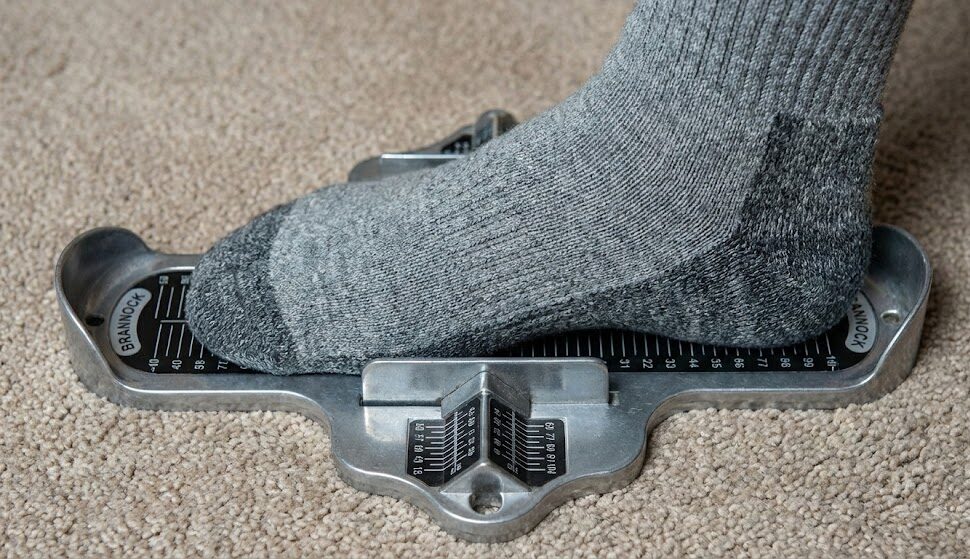
brannock device method
The metal foot measuring tools at shoe stores are more accurate than the paper trace method because they measure three dimensions simultaneously: length, width, and arch length. The paper trace gets you close. The Brannock gets you precise.
Most shoe stores and boot retailers have one. REI, Bass Pro Shops, and western boot specialty stores keep them behind the counter. Boot stores will usually measure you for free even if you don't buy that day.
How to use it correctly:
- Stand with your full weight on the device
- Slide the length adjuster until it touches your longest toe
- Use the width bar to measure at the ball of your foot
- Note both the length AND width measurements, not just the length
- Measure both feet
If you're spending $200 or more on boots, finding a store with a Brannock before ordering online is worth the trip.
Brand Variance: Why Your Size Doesn't Transfer Between Brands
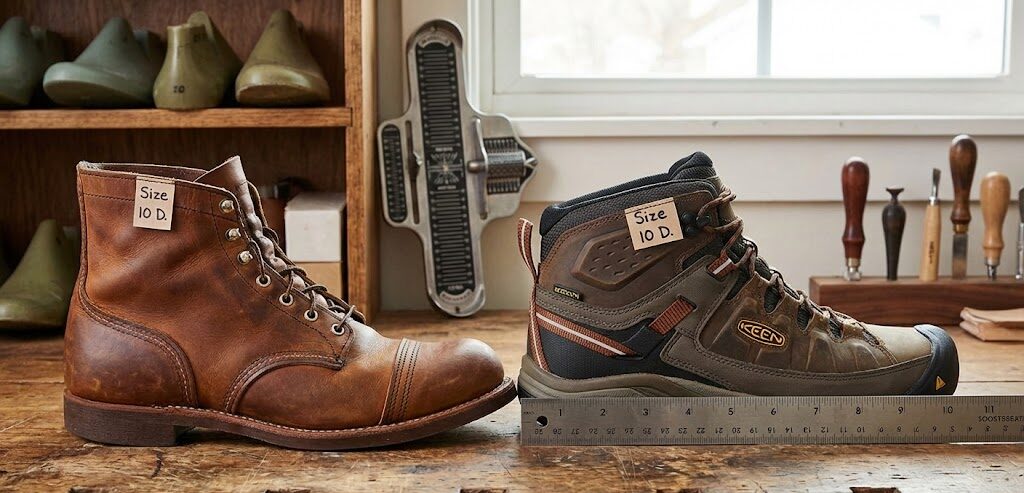
brand variance size
There is no law governing boot sizing. A D width in Red Wing is not the same as a D width in Nike. No industry-wide standard exists, which means researching specific brands isn't optional. Here's how the major boot brands actually fit, based on owner feedback and retailer data.
The Reliable Reference Brands
These brands fit closest to what the width letters are supposed to mean. If their D fits you well, you're probably a genuine D width.
Ariat
Ariat runs true to standard sizing across most of their catalog, which makes them useful as a baseline reference. Their WorkHog series stays consistently at a genuine D width. The Heritage western collection runs slightly narrower on pointed-toe styles, but the work boot line is reliable. Width options vary by model. The WorkHog XT, for example, comes in D and EE. If Ariat D fits you comfortably, you're a standard D and can use that as your reference point for every other brand.
Thursday Boot Company
Accurate true-to-size fit. The Captain, President, and Vanguard all fit consistently at a genuine D width. Thursday also sells a Wide width on selected styles, which it says is best for customers who wear EE or EEE (Thursday Boot Company, retrieved 2026-09-24). Check the style you want, since not every model comes in Wide.
Allen Edmonds
The most comprehensive width range in the dress boot market, from A through EEE. Different lasts (65, 201, 511) have slightly different shapes but consistent width measurements. If you've never had a properly fitted boot and want to understand what width you actually need, Allen Edmonds is worth the trip to a retailer for a proper fitting, even if you don't buy there. Their accuracy is useful as a calibration point for other brands.
Brands That Run Wide
These brands are generous. Workers with slightly wide feet often find the standard D accommodates them without needing to order a wide width.
Red Wing Work Boot Line
Red Wing's work boot line (SuperSole, Worx series) runs noticeably wide. Their D often fits the way other brands' EE fits. Workers with wide feet who've struggled with standard D sizing in other brands frequently report Red Wing work boots fitting comfortably in a standard width without needing to order EE. The flip side: if you have narrow feet, the standard D will feel sloppy. Width options available in D, EE, and EEEE.
Note: Red Wing's Heritage line (Iron Ranger, Blacksmith) fits differently. See the section below on unusual fits.
KEEN
KEEN's toe box is wider than almost anything else at their price point. Their standard width accommodates many wide feet, and several KEEN Utility work boots, including the Cincinnati 6", also come in a Wide width. The Pittsburgh and Targhee lines in particular have substantial toe box volume. Workers with bunions or wide forefeet who've never found a comfortable steel-toe boot consistently name KEEN as the exception. The trade-off: narrow-footed buyers frequently report heel slip and lateral instability because the fit is too generous at the forefoot without enough structure to compensate.
Timberland
Timberland runs large in both length and width. The PRO work boot line is particularly generous. Many buyers size down half a size in length; their M width often fits like other brands' W. The boots are built with thick work socks in mind, so if you're trying them with dress socks they'll feel enormous. Width options in M and W. If you've ordered Timberland boots and they felt too large, that's a common experience rather than a defective pair.
Thorogood
True to size with a roomy toe box, particularly in the Moc Toe line. The moc-toe silhouette gives more forefoot volume while maintaining a genuine D width at the ball of the foot. Workers who want toe room without sizing up in length find Thorogood a good solution. Made in the USA (Wisconsin). Width options in D and EE.
Danner Work Boot Line
The Quarry, Vicious, and other Danner work boots run wide. Their D feels closer to an EE in most competing brands. However, Danner's Heritage hiking line (Mountain Light, Mountain Pass) runs narrow, often requiring buyers to order EE even with a standard-width foot. Modern tactical Danner boots sit closer to true size. The variation between Danner lines is large enough that you cannot generalize. Research the specific model, not the brand.
Brands That Run Narrow
Workers with wide feet almost certainly need to order EE or Wide in these brands. Their D fits narrow to standard feet.
Lucchese
Lucchese runs narrow, especially in the toe box. Their D fits the way other brands' B or C fits. Premium handcrafted leather with minimal stretch means the snug initial fit won't loosen much. Width options in D and EE, with limited EE availability. If you have standard or wide feet, order EE. The craftsmanship justifies the price ($400-$1,000+) but the fit requires accurate width measurement before ordering.
Tecovas
True to slightly narrow. Pointed-toe styles like the Cartwright run narrower than the round-toe options. Limited EE availability compared to heritage western brands. Standard-width feet fit well. Wide-footed buyers should verify EE availability in their specific style before ordering, and check that EE isn't sold out in their size.
Nike Tactical Boot Lines
Built on athletic shoe lasts with a narrow profile. The SFB (Special Field Boot) runs particularly narrow. Usually available in one standard width only. If you have wide feet and are considering Nike tactical boots, the fit won't accommodate you without significant discomfort.
Brands With Unusual Fits
These don't fit standard patterns and need specific attention before ordering.
Red Wing Heritage (Iron Ranger, Blacksmith, Moc Toe)
Red Wing Heritage is not the same fit as Red Wing work boots. The No. 8 last used for the Iron Ranger and Blacksmith runs long but narrow at the sides with a roomy toe box. Most buyers size down half to a full size in length. However, if you have wide feet, you still need EE width despite sizing down in length, because the sides of the No. 8 last hold the foot tightly. The No. 23 last used for the Moc Toe runs closer to true to size and doesn't require sizing down as aggressively. Check the specific last for your model before ordering.
Blundstone
Blundstone uses a unique sizing approach where a half size up adds width without adding length. A size 9.5 is wider than a size 9 but not longer. Standard-width feet order their whole size. Wide feet order the half size up. Narrow feet may need to size down. This isn't a typo or a trick, it's how their system works. Once you know it, Blundstone sizing is actually straightforward. No standard width designations (D, EE) are used in their catalog.
Wolverine
Wolverine's fit varies significantly between product lines. Their work boot line (Raider, Overpass, Floorhand) runs wide, with a generous D. Their DuraShocks line runs large overall. Their 1000 Mile Heritage line fits closer to true to size. As with Danner, you cannot generalize across the brand. Check reviews for the specific model you're considering, not the brand as a whole. Width options in D and EE with variable availability by model.
Dr. Martens
No width options. One width fits all, and it runs large with UK sizing. Most buyers size down from their US size. The 1460 8-eye boot is roomy overall and the leather molds to your foot through the break-in period, but the initial stiffness is significant. Plan for several weeks of gradual wear.
Irish Setter
Owned by Red Wing and fits almost identically to Red Wing's work boot line, not the Heritage line. Their D is generous, fitting the way other brands' EE fits. Wide feet often fit comfortably in their standard width. Width options in D and EE.
Justin, Tony Lama, Dan Post
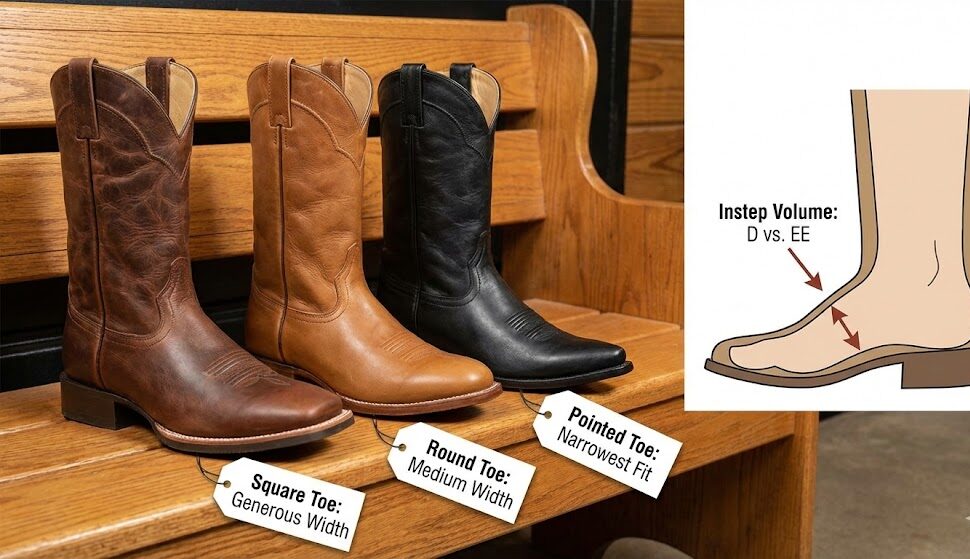
Traditional western brands use an A, B, C, D, E, EE system rather than the 2E/4E system common in work boots. Fit varies significantly by toe shape within the same brand: square toe is most generous, round toe sits in the middle, and pointed toe runs narrowest. Western boots rely on instep tension to stay on without laces, so they feel snugger than a lace-up work boot in the same width. Don't compare western boot D widths directly to work boot D widths.
Brand Width Summary
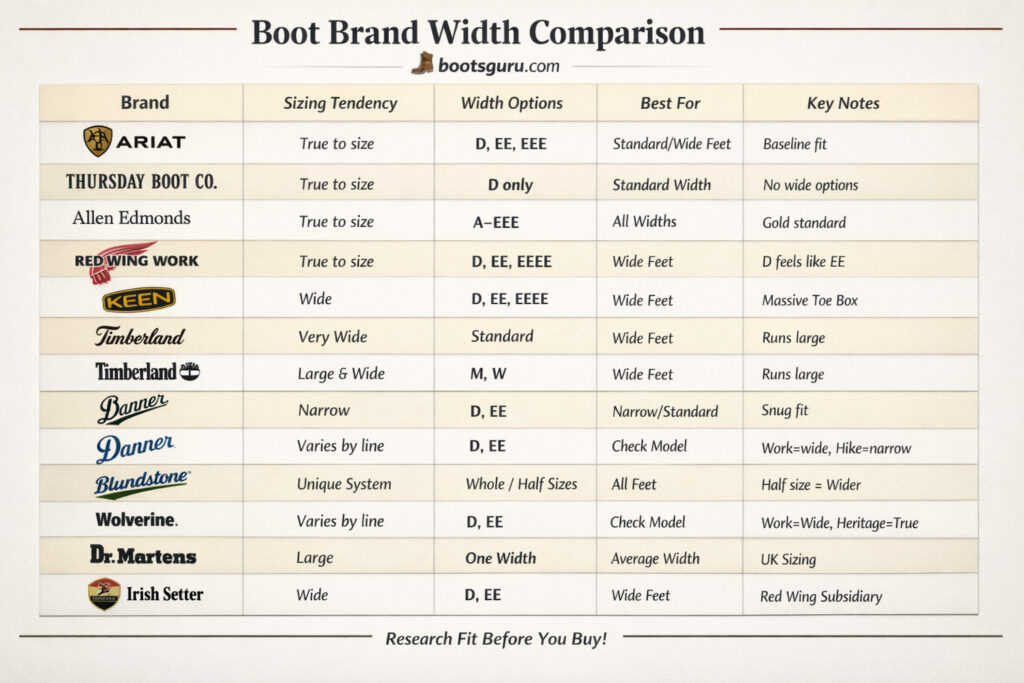
brand width comparison table
| Brand | Sizing Tendency | Width Options | Best For | Key Note |
|---|---|---|---|---|
| Ariat | True to size | D and EE on most work boots, varies by model | Standard/wide feet | Best reference baseline |
| Thursday Boot Co. | True to size | Standard, Wide on selected styles | Standard width, some wide | Wide fits EE to EEE per Thursday |
| Allen Edmonds | True to size | A through EEE | All widths | Most comprehensive range available |
| Red Wing Work | Runs wide | D, EE, EEEE | Wide feet | Their D fits like most brands' EE |
| Red Wing Heritage | Long, narrow sides | D, EE, EEEE | Size down, check last | No. 8 last differs from No. 23 |
| KEEN | Very wide toe box | Regular, Wide on many Utility models | Wide feet, bunions | Roomy standard toe box |
| Timberland | Runs large overall | M, W | Wide feet | Often size down half in length |
| Thorogood | True, roomy toe | D, EE | Standard/wide | Moc Toe has more volume without sizing up |
| Danner | Varies by line | D, EE | Check model first | Work=wide, Heritage hiking=narrow |
| Lucchese | Narrow | D, EE (limited) | Narrow/standard feet | Order EE if standard or wide |
| Tecovas | True to slightly narrow | D, EE (limited) | Standard width | EE limited availability |
| Nike/Tactical | Narrow | Standard only | Narrow/standard feet | Not built for wide feet |
| Wolverine | Varies by line | D, EE | Check model first | Work=wide, 1000 Mile=true to size |
| Blundstone | Unique system | Whole/half sizes | All widths | Half size = wider, not longer |
| Dr. Martens | Runs large, UK sizing | One width only | Average width | Size down from US size |
| Irish Setter | Runs wide | D, EE | Wide feet | Same generous fit as Red Wing work boots |
Common Boot Width Myths
Myth 1: "I'll just buy a bigger size to get more width"
Sizing up in length doesn't meaningfully increase width. A size 11 is slightly wider than a size 10, but it's also longer, which means your arch won't line up with the boot's arch support and the flex point sits in the wrong position. What actually happens: your heel slides around and creates blisters, your toes hit the end on descents, the boot flexes at the wrong point causing foot fatigue, and the fit looks and feels sloppy. Order the correct length in a wider width instead.
Myth 2: "They're tight, but leather stretches"
Leather uppers stretch. Soles do not. If your foot spills over the edge of the sole, or if your pinky toe is being crushed by a steel toe cap, the boot will never fit properly regardless of how long you wear it. Leather break-in softens and molds the upper material to your foot's specific shape, but it doesn't change the boot's structural width. A boot that's painfully tight at the ball of the foot on day one will still be uncomfortable on day 100.
Myth 3: "EE is for people who are overweight"
Wide feet are mostly determined by bone structure, not body weight. The spread of your metatarsal heads, the natural splay of your toes, and whether you have bunions are skeletal characteristics. You can be lean and athletic and still need a 4E. You can be heavier and have narrow feet. Body weight is not the determining factor. Genetics is.
Myth 4: "If I'm a size 10D, all 10D boots will fit the same"
A Red Wing 10D fits completely differently from a Thursday Boot 10D. No industry-wide standard enforcement exists. Different lasts have different proportions, manufacturing tolerances vary, and American versus European fit philosophies differ. Always research the specific brand and model before ordering.
Special Considerations by Boot Type
work boots
Work Boots With Safety Toe
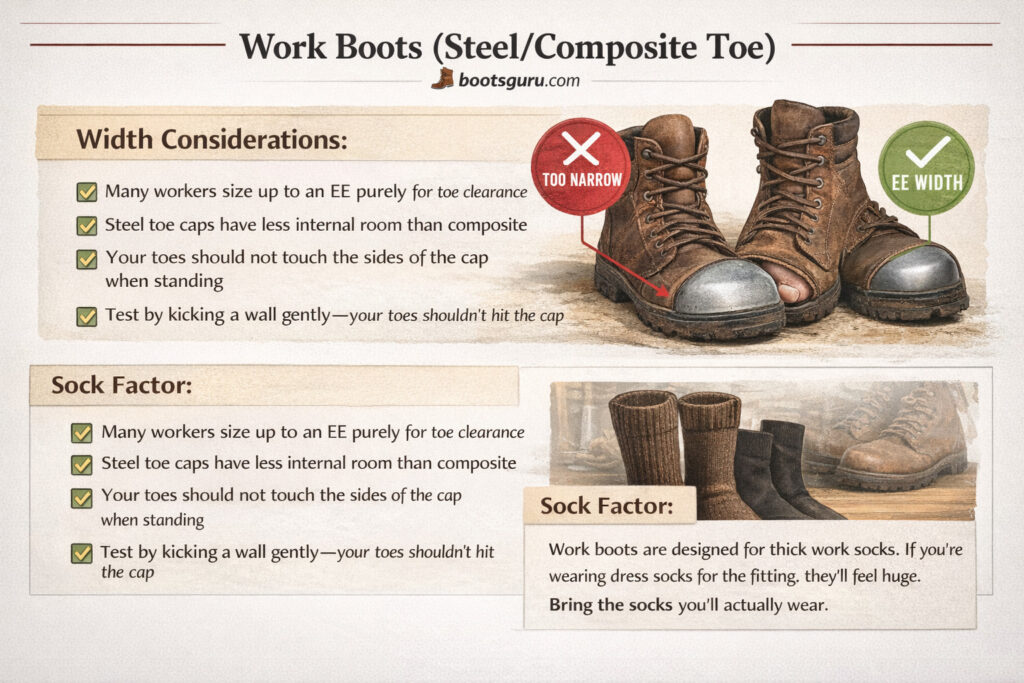
You cannot stretch a safety toe. The cap is rigid, and if your toes contact the side of it, you'll be in pain by lunch regardless of how long you break the boot in. When in doubt, go wider. Many workers who wear standard D in regular shoes order EE in safety-toe boots purely for toe clearance. Steel toe caps have less internal room than composite caps at the same external footprint, so workers switching from composite to steel sometimes need to go up a width. Always try safety-toe boots with the socks you'll actually wear at work. Work boots are built for thick socks; showing up in dress socks for the fitting will make them feel comically oversized.
Cowboy and Western Boots
western boots
No laces means no adjustment after purchase. Cowboy boots rely entirely on the fit at the time of purchase, which makes getting the width right more critical than in any other boot category.
Width in western boots affects not just the ball of the foot but the volume of the throat, the opening where your foot enters. A high instep (the top of your foot is tall) may require an EE width just to get your foot inside the boot, even if your foot isn't technically wide at the ball. Toe shape matters significantly: square toe is the most generous, round toe is middle ground, and pointed toe runs narrowest even in a wide width. Western boots are designed to fit snug initially and form to your foot through use. But if you can't get your foot in or the ball of your foot is being crushed, size up in width.
Hiking Boots
hiking boots
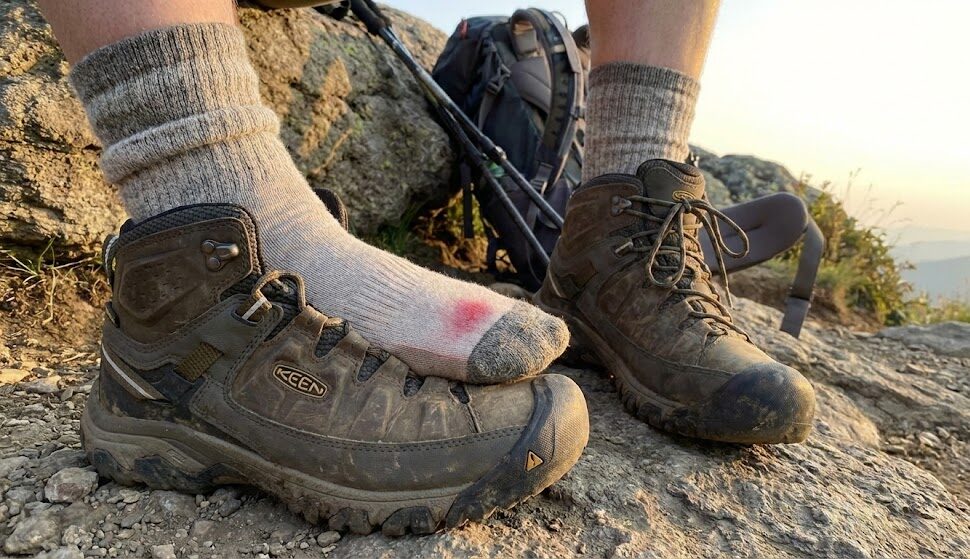
Feet swell on long hikes, at altitude, and in hot conditions. A boot that fits in the store may feel tight after 8 miles. On descents, feet slide forward in the boot, and if the boot is too narrow, toes get compressed against the sides. Many hikers order one width wider than their measured width for multi-day or high-mileage use specifically for this reason. Test hiking boots with your full sock system, including a liner sock if you use one, not just a single light sock.
Chelsea and Dress Boots
dress boots
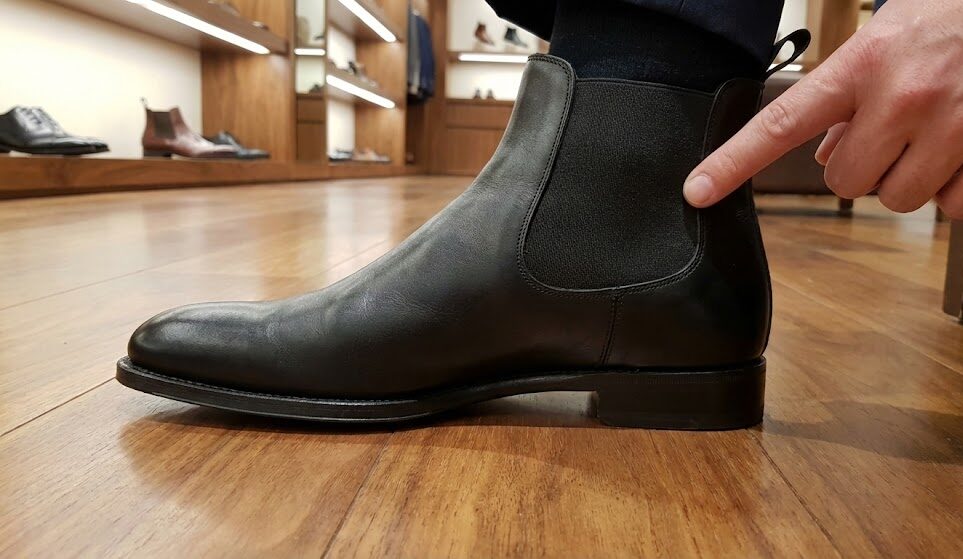
Width options are limited in fashion-forward boots. Most Chelsea boots come in one width with elastic panels doing most of the accommodation work. The elastic gives volume but not platform width. If your foot is wider than the sole, the elastic won't fix it. Your foot will still sit off the edge of the insole and create instability.
Wide-footed buyers looking for dress boots have limited options. Stick with brands that prioritize fit over fashion (Allen Edmonds, Thursday Boot, Meermin) and avoid slim European fashion brands unless you have genuinely narrow feet. If you need wide dress boots and can't find them, sizing up in length is the least-bad option, but expect heel slip as a consequence.
How to Shop for the Right Width
In-Store
Bring the socks you'll actually wear with the boots. Bring any orthotics or insoles you use regularly. Shop in the late afternoon or evening when your feet are at their largest. Wear the boots for at least 10 minutes while standing and walking on multiple surfaces. The pinky toe test: can you wiggle it, or is it compressed against the side? Your foot should sit squarely on the footbed with no spilling over the edge, and your heel should not slip when walking.
Online
Before ordering, search the brand name plus "sizing" or "runs wide/narrow" on Reddit and trade forums. Read width-specific reviews rather than general ones. Check the return policy before you order, not after. If you're genuinely unsure between widths, ordering both and returning the one that doesn't fit is cheaper than keeping a boot that causes pain. Use the brand's own sizing chart with actual inch measurements rather than generic charts. Each brand measures differently.
Warning Signs a Boot Is Too Narrow
- Your foot spills over the footbed when you look down
- Numbness or tingling in your toes after 5 minutes
- Pain or pressure at the ball of the foot
- The sides of your foot bulge over the sole
- Your pinky toe is compressed
- You can't wiggle any of your toes
Return them. They will not break in enough to fix this.
Warning Signs a Boot Is Too Wide
- Your heel slips more than 1/4" when walking
- Your foot slides laterally inside the boot
- Blisters form on your heel from friction
- You feel unstable standing or changing direction
- Even laced tight, the fit still feels loose
Try the next width down, or use the fit adjustments listed below.
Fixing Width Issues When You Can't Get Your Exact Width
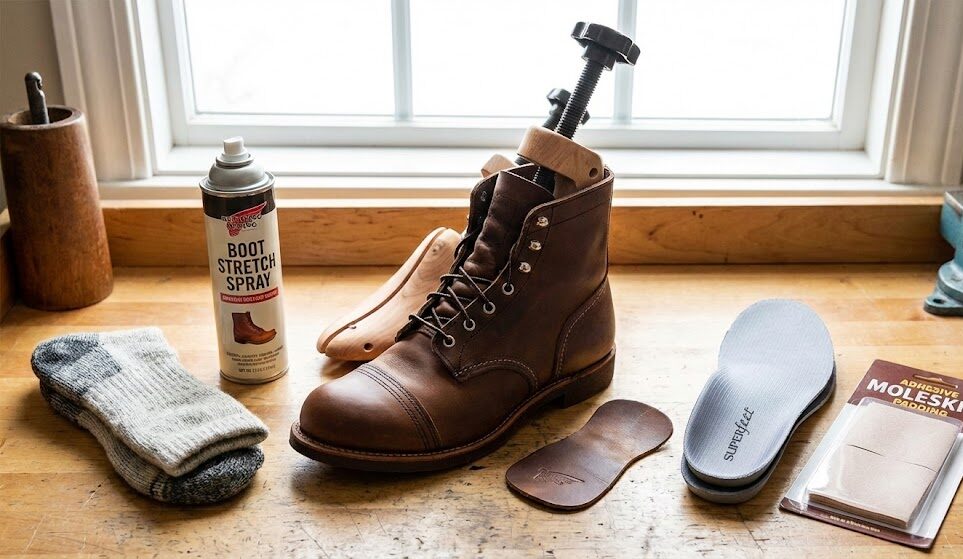
fixing width issues
If the Boot Is Slightly Too Wide
Thicker socks work for up to about 1/4" of extra space. Volume-adjusting insoles from Superfeet or Powerstep add cushioning and take up space, reducing effective width by about 1/8" to 1/4". Tongue pads stick to the inside of the tongue and push your foot back into the heel cup to reduce forward sliding. Heel grips add material to the heel counter and prevent slip. These fixes work for boots that are slightly wide. If you're a D wearing a genuine EE, none of them will close the gap.
If the Boot Is Slightly Too Narrow
A cobbler can stretch leather boots up to about 1/4" to 1/2" for $20-$40. This only works on leather, not synthetic uppers. Boot stretching spray combined with a stretcher tool is the DIY version for about $30-$50 in tools. Both methods work for minor adjustments. Neither works on safety toe caps, heel counters, or the structural width of the sole platform.
If the boot is more than 1/4" too narrow, or if your foot is spilling over the sole edge, return them and order the correct width. Forcing a narrow boot will damage the boot and cause ongoing foot problems.
Custom and Made-to-Order Options
If you have feet that consistently don't fit off-the-shelf boots, custom is worth the investment. Nicks Boots, White's Boots, and Wesco make custom-width work boots starting around $400. JK Boots does the same for western styles from about $500. Lead times run 8-16 weeks. The cost makes sense if you've never found a comfortable off-the-shelf boot, if you have a significant width difference between feet, or if you're spending $300+ on boots anyway and want them to fit correctly.
Boots That Come in Wide Widths
The easiest fix for a width problem is buying a boot that's made in your width, instead of stretching or sizing up. These are boots we've reviewed that come in a wide option, with the width listed by the maker.
| Boot | Widths | Best for | Our review |
|---|---|---|---|
| Timberland PRO Pit Boss 6" Steel Toe | Medium, Wide | General trade work with a steel toe | Best steel toe boots |
| KEEN Utility Cincinnati 6" Soft Toe | Regular, Wide | Waterproof wedge for concrete | KEEN Cincinnati review |
| CAT Second Shift Steel Toe | Medium, Wide | Budget steel toe for dry sites | CAT Second Shift review |
| Merrell Women's Moab 3 | Regular, Wide | Warm-weather day hiking | Merrell Moab 3 review |
Widths are listed on each maker's product page. Stock varies by size and color, so check that your exact width is available on the listing before you order. For more options by job, see our best work boots for wide feet and women's waterproof hiking boots for wide feet. If you're trying to decode EE versus H on a specific label, our wide EE vs wide H explainer goes deeper.
Shopping for winter? See our best winter boots for wide feet, where every pick is sold in Wide or Extra Wide.Frequently Asked Questions
Is 2E the same as EE and W?
Yes, in men's sizing. "2E," "EE," and "W" (Wide) all refer to the same width. Different brands use different notation for the same thing. In women's sizing, "W" usually refers to D width, which is wide for women but standard for men. Always check the brand's specific chart.
How much wider is each width increment?
Approximately 3/16" to 1/4" (about 5-6mm) at the ball of the foot per width letter. Going from D to EE adds roughly 1/4" of width. Going from D to 4E adds about 1/2" to 5/8". The difference scales slightly with shoe size as larger sizes have proportionally more width difference between increments.
Can women wear men's boots if they have wide feet?
Yes. A men's D width is roughly equivalent to a women's 2E. Women typically go down 1.5 to 2 sizes from their women's size when buying men's boots. A women's size 9 is approximately a men's 7 or 7.5. Watch for the wider heel cup in men's boots, which can cause heel slip for women with narrower heels, and the lower instep shape that may not accommodate high-volume feet.
Do boots stretch in width over time?
Leather uppers stretch for volume and instep height, molding to your foot's unique shape over time. You'll get about 1/8" to 1/4" of give in the leather. The width of the sole platform, safety toe caps, and heel counters do not stretch. If a boot is painfully tight at the ball of the foot on day one, it will not break in enough to fix the problem.
Why don't all brands offer wide widths?
Each width requires a different last, the foot-shaped mold around which boots are built. Different lasts mean different cutting patterns for every piece of leather or fabric in the upper. More widths mean more inventory and higher production costs. About 60-70% of buyers fit standard widths, so smaller brands often can't justify the cost of low-volume size runs.
Should I size up in length if I need a wider boot?
No. Sizing up in length doesn't proportionally increase width enough to solve the problem, and it misaligns your arch with the boot's support structure and places the flex point in the wrong position. Order the correct length in a wider width. If the brand doesn't offer wide widths, choose a different brand that does.
What if one foot is wider than the other?
Most people have feet that differ slightly. Always fit boots to the larger and wider foot, then adjust the smaller foot with thicker socks, aftermarket insoles, or heel grips. If the difference is more than one full width, some brands will sell mismatched pairs (call and ask). Custom boot makers (Nicks, White's, Wesco) routinely build different widths for each foot.
Do work socks affect width sizing?
Yes, but less than most people expect. Thick socks compress under weight and take up about 1/8" of space at most. If you're between widths and plan to wear thick socks daily, consider going up one width. Always try boots with the socks you'll actually wear. Fitting work boots with dress socks gives you a meaningless result.
Can I return boots after wearing them indoors?
Depends on the retailer. Most allow indoor try-on with tags on. Wear them only on carpet or rugs to avoid scuffing the sole. Keep all packaging until you decide. Some brands offer 30-60 day wear test periods. Check the specific return policy before ordering, not after. Zappos and REI are known for generous return policies.
The Bottom Line
Width is just as important as length for proper boot fit. The difference between boots that sit in your closet and boots that feel like part of your foot often comes down to getting the width right. The system is confusing, and the lack of standardization across brands makes it worse. But the process is straightforward: measure your feet in the evening with your work socks on, compare against the charts in this guide, research the specific brand and model you're considering (not just the brand), check the return policy before ordering, and don't compromise on fit. A boot that's wrong at the ball of your foot on day one won't improve with time.