Wolverine has been making work boots since 1883. That longevity earns them credibility — but it also means they run 50+ models at any given time, and most roundup articles just pick whichever ones rank highest in search results, describe them with the same spec-sheet language, and move on.
This guide covers all 16 Wolverine boots in our test list, organized by what your job actually demands. Wedge soles for concrete and carpentry. DuraShocks for high step-count trades. CarbonMAX composite toes for workers going through metal detectors. 10-inch shafts for mud and standing water. Wellington pull-ons for oil field and ranch.
It also covers what most Wolverine guides skip: which boots are Goodyear-welted and can be resoled, which use cement construction and will delaminate eventually, what DuraShocks and CarbonMAX actually do (not just that they exist), and the outsole splitting pattern that shows up in long-term owner reviews. All 16 boots are available on Amazon.
Quick Picks — Best Wolverine Boot by Situation
| Situation | Best Pick | Key Reason | Buy |
|---|---|---|---|
| Best overall | Wolverine Ride Performance WP Composite Wedge | Composite toe + waterproof + EPX footbed in one wedge-sole boot | Amazon |
| Best traditional moc-toe wedge | Wolverine Trade Wedge 6″ Moc Toe | Wider toe box than round-cap styles, classic carpenter aesthetic | Amazon |
| Best DuraShocks / long shifts | Wolverine Raider DuraShocks 6″ | DuraShocks cushion + lug outsole handles concrete and outdoor terrain | Amazon |
| Best BOA / tech closure | Wolverine I-90 EPX BOA CarbonMax | Dial closure for cold-weather or dexterity-limited workers | Amazon |
| Best budget waterproof | Wolverine Floorhand WP 6″ Steel Toe | Steel toe + waterproof direct-attach under $130 | Amazon |
| Best waterproof mid-range | Wolverine Carlsbad WP 6″ | Better leather quality and fit than the Floorhand | Amazon |
| Best composite toe value | Wolverine Overpass Composite Toe WP | Lightest safety option in the lineup, athletic midsole flex | Amazon |
| Best for mud / standing water | Wolverine Floorhand WP 10″ Steel Toe | 10-inch shaft keeps debris and water out where a 6-inch boot fails | Amazon |
| Best Goodyear welt investment | Wolverine Harrison Lace Up 6″ | Resoleable 6-inch boot — the correct answer if you replace boots annually | Amazon |
| Best pull-on / oil field | Wolverine I-90 WP CarbonMAX Romeo | Slip-on speed, composite toe, no metal detector trigger | Amazon |
| Best ranch / western tall | Wolverine Rancher Steel Toe 10″ | Goodyear welt, 10-inch shaft, pull-on, steel toe | Amazon |
| Best budget soft toe | Wolverine Loader 6″ Soft Toe Wedge | Same wedge platform without the steel toe weight or cost | Amazon |
Full Comparison: All 16 Wolverine Boots
| Boot | Toe | Sole Type | Waterproof | Construction | Shaft | Price |
|---|---|---|---|---|---|---|
| Ride Performance WP Composite Wedge | Composite (ASTM) | Wedge | Yes | Cement | 6″ | $180–$210 |
| Trade Wedge 6″ Moc Toe | Soft (no ASTM) | Wedge | No | Cement | 6″ | $130–$160 |
| Loader 8″ Safety Toe Wedge | Steel (ASTM) | Wedge | No | Cement | 8″ | $140–$170 |
| Loader 6″ Soft Toe Wedge | Soft (no ASTM) | Wedge | No | Cement | 6″ | $110–$135 |
| DuraShocks SR Direct-Attach | Soft / Steel options | Lug | No | Direct-attach | 6″ | $100–$130 |
| Raider DuraShocks 6″ | Steel (ASTM) | Lug | No | Cement | 6″ | $130–$155 |
| I-90 EPX BOA CarbonMax | CarbonMAX (ASTM) | Lug | Yes | Cement | 6″ | $180–$215 |
| Overpass Composite Toe WP | Composite (ASTM) | Athletic lug | Yes | Cement | 6″ | $120–$150 |
| Carlsbad WP 6″ (Men’s) | Steel (ASTM, verify) | Lug | Yes | Cement | 6″ | $140–$165 |
| Carlsbad WP 6″ (Unisex) | Steel (ASTM, verify) | Lug | Yes | Cement | 6″ | $140–$165 |
| Floorhand WP 6″ | Steel (ASTM) | Lug | Yes | Direct-attach | 6″ | $110–$135 |
| Harrison Lace Up 6″ | Steel (verify) | Lug | Yes | Goodyear welt | 6″ | $150–$180 |
| Floorhand WP 10″ Steel Toe | Steel (ASTM) | Lug | Yes | Direct-attach | 10″ | $130–$160 |
| Rancher Steel Toe 10″ | Steel (ASTM) | Lug | No | Goodyear welt | 10″ | $150–$185 |
| I-90 WP CarbonMAX Romeo | CarbonMAX (ASTM) | Lug | Yes | Cement | 6″ | $140–$170 |
| DD Work Wellington W04727 | Steel (verify) | Lug | No | Goodyear welt | 10″ | $155–$190 |
Wolverine Technology Systems — What They Actually Mean
Every Wolverine roundup lists “DuraShocks” and “CarbonMAX” without explaining them. Here’s what each system does in plain terms.
DuraShocks
worker examining work boot sole 202607272211
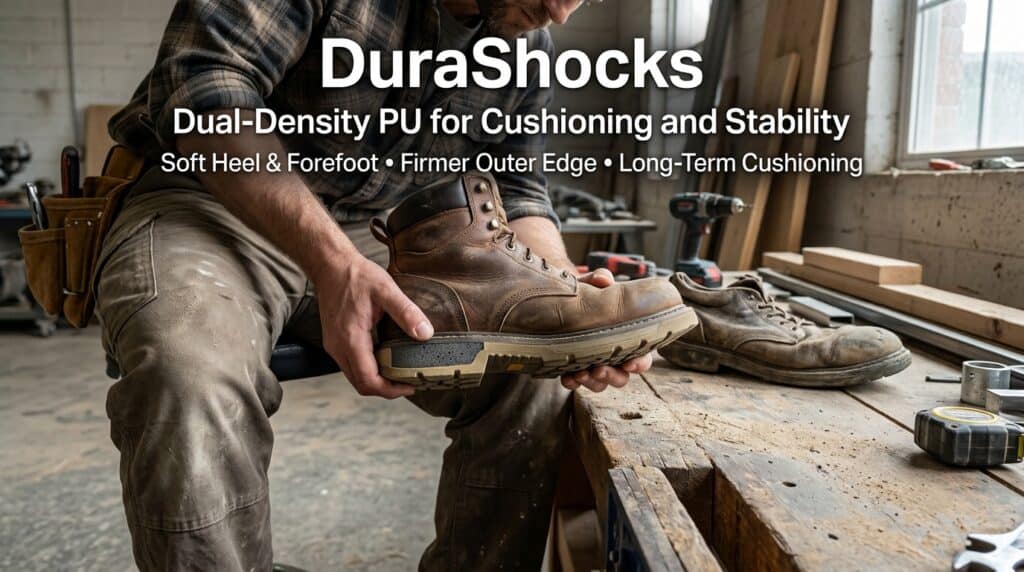
A dual-density PU midsole. The outer edge is firmer for lateral stability; the heel and forefoot are softer for cushioning. The PU compound absorbs impact and returns some energy forward rather than just dissipating it. The practical difference from a standard EVA midsole: PU takes longer to compress under daily use. A quality EVA insole flattens noticeably at 6 months. The DuraShocks PU midsole holds its profile longer.
DuraShocks SR is the same cushioning system combined with a slip-resistant outsole compound. SR stands for Slip Resistant — it’s not a different midsole, just an outsole upgrade.
Best suited to workers on concrete and hard industrial floors with high step counts. Less relevant for purely outdoor terrain where the outsole tread pattern matters more than the midsole cushioning system.
CarbonMAX Toe
worker inspecting work boot toe 202607272212
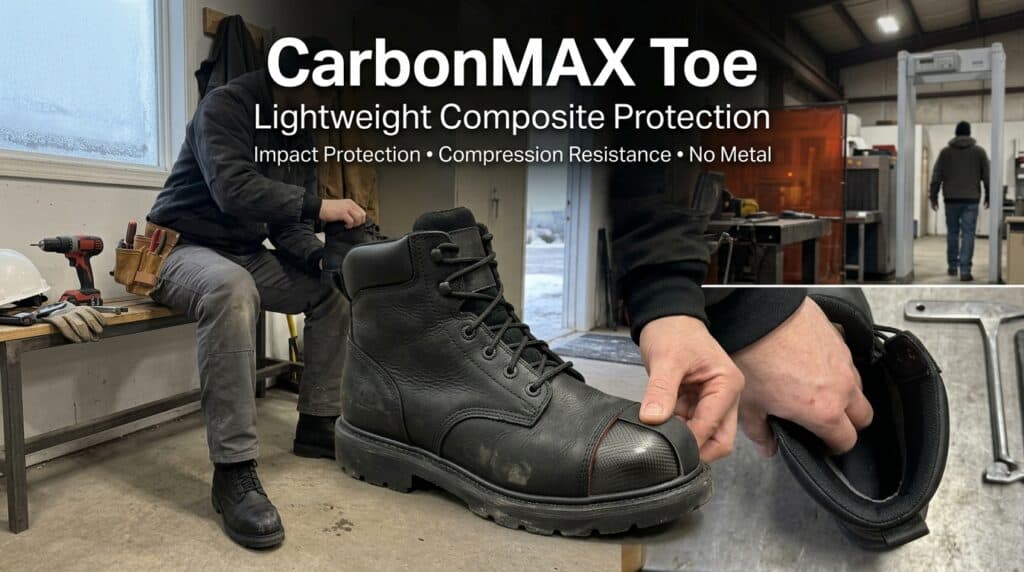
Wolverine’s carbon fiber composite safety toe. Meets the same ASTM F2413 I/C rating as steel — 75 ft-lbs of impact resistance, 2,500 lbs of compression resistance — at roughly 75% of the weight. The carbon fiber construction makes the walls thinner than standard fiberglass or plastic composite toes, which gives more interior room for the same external footprint.
It doesn’t conduct cold or heat. In sub-freezing temperatures, steel toes feel noticeably colder than CarbonMAX. Near heat sources or welding, steel conducts heat through the cap; CarbonMAX doesn’t. CarbonMAX also triggers no metal detectors, which matters at oil field facilities, government sites, and correctional environments.
EPX Anti-Fatigue Footbed
A dual-density PU footbed — firmer in the arch zone, softer at the heel. Used in the I-90 platform boots. Resists compression better than single-density EVA insoles. Plan to replace it eventually regardless — all foams compress with enough use — but it holds its cushioning profile longer than the standard insoles in most competing work boots at the same price.
BOA Fit System
A stainless steel lace-and-dial closure replacing traditional laces. The dial tightens the boot in even micro-increments across the full lace length. Releasing it opens the boot quickly. BOA Technology offers a lifetime guarantee on the hardware — replacement kits are free.
Useful for workers with gloves who can’t thread traditional laces, workers with arthritis or limited hand dexterity, and workers who want to adjust fit mid-shift as feet swell. Less useful in environments requiring fast boot removal — the dial is faster than tying laces but slower than pulling a tab on a traditional pull-on boot.
Goodyear Welt vs. Cement Construction
Only three boots in this guide are Goodyear-welted: the Harrison 6″, the Rancher 10″, and the DD Wellington. Every other boot uses cement or direct-attach construction.
A Goodyear-welted boot can be resoled by any cobbler when the outsole wears out. The stitched welt holds the sole to the upper independently of adhesive. Resoling costs $60–$90 and adds another 2–3 years of life to a boot whose leather upper is still good.
Cement and direct-attach boots bond the sole with adhesive. When the adhesive degrades or the outsole wears through, the boot is done. The long-term cost math on the Goodyear-welted boots is usually better for workers who hold their boots past 18 months.
Wedge Sole vs. Lug Sole — The Decision That Matters Most for Wolverine Buyers
work boot sole comparison 202607272213
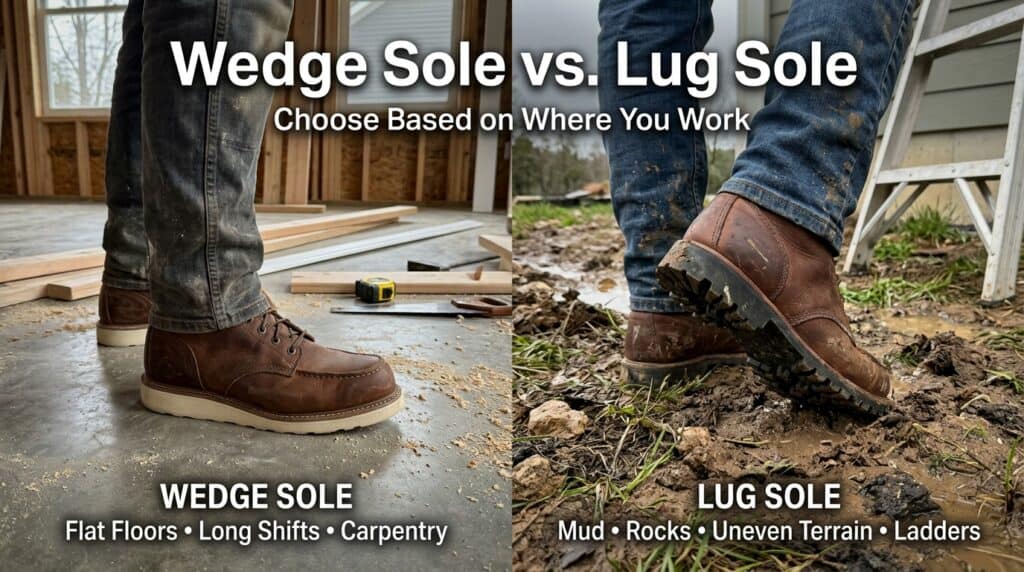
Wolverine’s wedge-sole boots are among their most popular products. They’re also the most commonly misapplied. Most buyers pick them for the aesthetic. The functional case for and against a wedge sole is more specific.
Where a Wedge Sole Works
- Concrete, hardwood, tile, smooth industrial floors — the full-contact base grips flat surfaces better than a heeled boot
- Carpentry, framing, and finish work — the flat profile doesn’t catch on boards or snaffle trim
- Long shifts on flat surfaces — no heel-toe height differential means less ankle fatigue over 10 hours
- Finished floors — moderate wedge tread doesn’t mark polished surfaces the way deep lugs do
Where a Wedge Sole Fails
- Ladders — a defined heel catches ladder rungs. A wedge sole doesn’t. Linemen, roofing workers, and anyone on steel ladder rungs regularly should use a heeled boot
- Uneven outdoor terrain — mud, loose soil, and rocks need lug depth to bite and release. A wedge tread packs with mud and loses grip
- Logging and forestry — these industries explicitly require heeled lug-sole boots for terrain safety
- Wet grass — wedge tread doesn’t shed organic material effectively
The rule: If your workday is primarily on flat, smooth surfaces — concrete, wood floors, tile, loading docks — a wedge sole is the right choice. If you move between flat and outdoor terrain in the same shift, a lug sole like the Raider DuraShocks handles both adequately. If you’re primarily outdoors on uneven ground, neither the wedge nor the Wolverine lineup is the first place to look.
The Outsole Durability Issue — What Most Reviews Don’t Tell You
worker inspecting boot outsole d… 202607272215
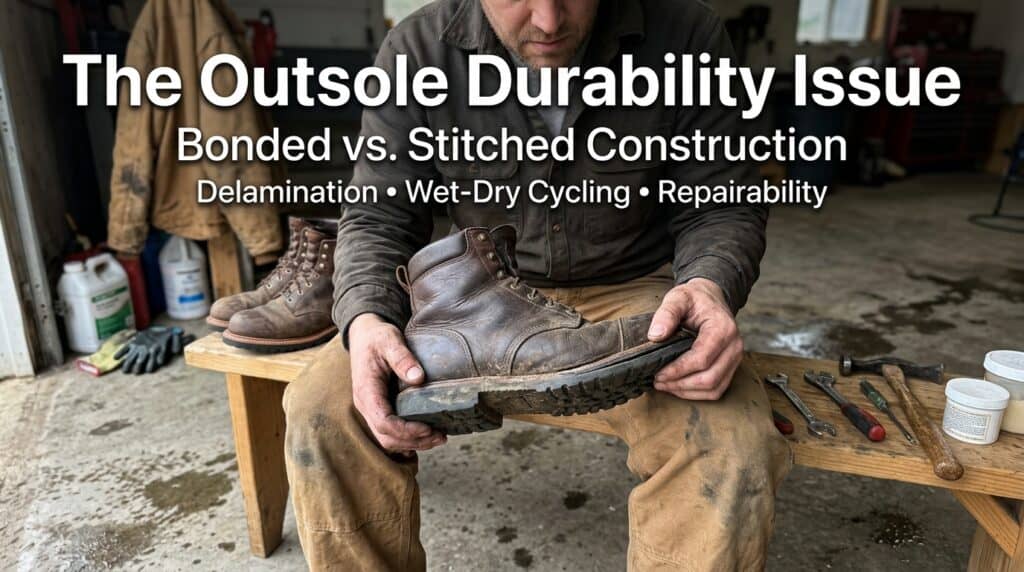
The most consistent complaint across long-term Wolverine owner reviews is outsole delamination: soles separating from the upper at the bond line, or cracking at the toe flex point, typically at 12–18 months of daily use. It appears regardless of price point and despite proper care.
The pattern concentrates in direct-attach and cement construction boots — the Floorhand series and the DuraShocks SR in particular. Both use adhesive bonding as the primary (and only) connection between upper and sole. Wet-dry cycling degrades that adhesive faster than normal wear. Chemical environments — oils, solvents, cleaning agents common on industrial floors — accelerate it further.
A cobbler can re-glue an early-stage delamination for $20–$40 if you catch it before the sole cracks. Once the rubber has split at the flex point, the boot needs replacement.
The Goodyear-welted boots in this guide — the Harrison, the Rancher, and the DD Wellington — use a stitched welt that holds the sole independently of adhesive. They don’t delaminate; they wear through. When the outsole wears, a cobbler resolves it. The leather upper continues.
This isn’t a reason to avoid the cement-construction Wolverine boots — they offer real value at their price points. It is a reason to be realistic: plan for 12–18 months of hard daily use, or buy one of the three Goodyear-welted options if you need longer.
Wolverine Work Boot Sizing — The Honest Version
worker checking work boot fit 202607272217
Every review says “runs true to size.” That’s accurate for length but misses what actually causes fit problems.
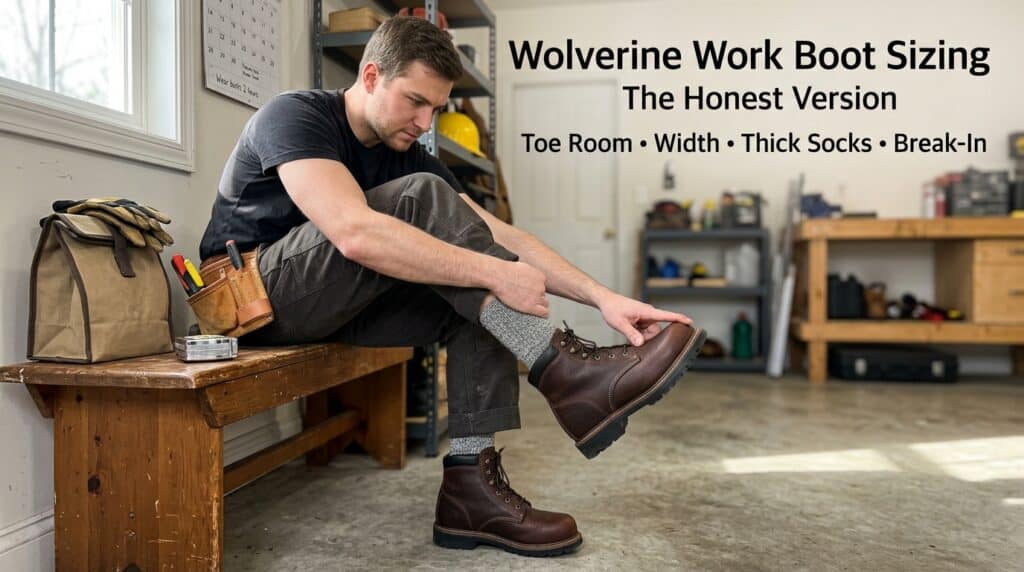
Wolverine runs slightly narrow in the toe box compared to KEEN, New Balance, or Thorogood. Workers with medium to wide feet find the moc-toe styles more accommodating than the standard round-cap toe silhouette — the moc design gives more volume in the forefoot without requiring a width upsize.
For long shifts, size up half if you wear thick wool or synthetic work socks. Feet expand by 4–8% in volume over 10 hours of standing and walking. A boot that fits well at 7 AM can feel tight and cause blisters by hour 8.
If your Brannock measurement falls between sizes, go up rather than down with Wolverine. The toe box accommodation in most Wolverine styles is tighter than it looks, and cramped toes at the end of a long shift compound into real problems.
The Carlsbad Unisex (B0C9P2RBP1) is the most accessible wide-fit option in this guide. Some Wolverine models list EW (extra-wide) sizing on Amazon — check individual listings before purchasing.
Full-grain leather boots (Rancher, DD Wellington, Harrison) need 8–12 hours of gradual break-in before a full demanding shift. The synthetic and nubuck upper boots (Floorhand, Overpass, Carlsbad) break in in 2–4 hours. Don’t start a demanding shift in new stiff leather Wolverines.
Section A — Wolverine Wedge Sole Work Boots
Four wedge-sole boots for workers on concrete, hardwood, tile, and flat industrial surfaces. If your primary work surface is outdoors or involves ladders, go to Section B or C instead.
1. Wolverine Ride Performance Waterproof Composite Toe Wedge — Best Overall
Best for: Carpenters, concrete finishers, and finish tradespeople who need waterproofing and a composite safety toe on a wedge-sole platform without spending $200+ at a specialty trade retailer.
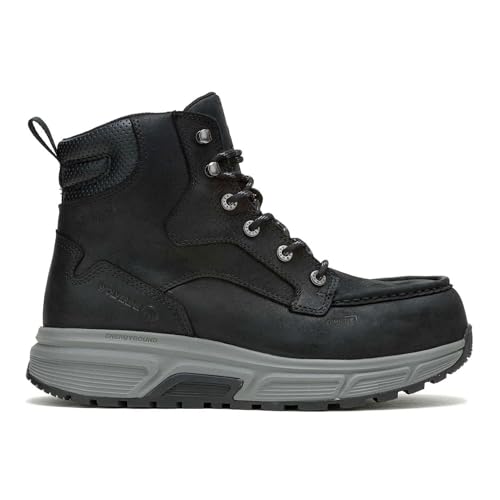
The Ride Performance puts Wolverine’s best technology into one wedge-sole boot. A waterproof membrane plus a CarbonMAX composite toe plus an EPX dual-density footbed used to require choosing two of the three, or spending significantly more. This boot combines them at a price that still makes sense for annual replacement if it comes to that.
The CarbonMAX toe keeps the boot lighter than equivalent steel-toe wedge models. On a 12-hour concrete pour or a full framing day, that weight saving accumulates. The EPX footbed holds its cushioning profile longer than the standard EVA insoles that ship in most competing boots. The waterproof membrane handles rain, wet concrete, and morning dew without requiring daily leather treatment.
The wedge sole grips smooth concrete better than the heeled lug-sole boots in this guide. On a polished floor or hardwood subfloor, the full-contact base outperforms aggressive lug tread.
Key Specs
| Price | $180–$210 |
| Toe Type | CarbonMAX composite — ASTM F2413 I/C (verify listing) |
| EH Rated | Verify current Amazon listing |
| Waterproofing | Waterproof membrane |
| Sole Type | Wedge — full-contact flat sole |
| Footbed | EPX dual-density PU — removable |
| Upper | Full-grain leather |
| Construction | Cement — not resoleable |
| Shaft | 6 inches |
Pros
- CarbonMAX composite toe — lighter than steel, no metal detector trigger, no cold conduction
- Waterproof membrane — no daily leather treatment required to maintain waterproofing
- EPX footbed resists compression longer than standard EVA
- Wedge sole for concrete and flat-surface grip
- Best technology combination in the Wolverine wedge lineup
Cons
- Cement construction — at 18–24 months of daily construction use, the outsole is the limiting factor. Plan to replace rather than resole
- Wedge sole loses grip on ladders and outdoor uneven terrain — if your shift involves both, the Raider DuraShocks handles mixed surfaces better
Skip this if you work primarily on ladders or spend significant time on outdoor uneven terrain. The wedge sole doesn’t catch ladder rungs.
2. Wolverine Men’s Trade Wedge 6″ Moc Toe — Best Traditional Moc-Toe Wedge

Best for: Carpenters and finish contractors who’ve worn Wolverine moc-toe wedges before and want the classic profile with current construction.
The moc-toe silhouette gives noticeably more forefoot volume than a round-cap toe boot. Workers who’ve felt cramped in standard Wolverine round-toe styles — particularly those with wider forefeet — find the moc-toe more comfortable through a full shift. The wider toe box also means less forefoot squeeze as feet swell over 10 hours.
The wedge sole handles the same concrete, hardwood, and flat-surface environments as the Ride Performance above. This boot is lighter and less expensive because it drops the waterproof membrane and the CarbonMAX toe. If your work environment is dry and doesn’t require an ASTM-rated toe, the Trade Wedge delivers the same wedge-sole comfort at a lower cost.

Key Specs
| Price | $130–$160 |
| Toe Type | Soft moc toe — no ASTM safety rating |
| Sole Type | Wedge — slip-resistant |
| Upper | Full-grain leather |
| Construction | Cement |
| Shaft | 6 inches |
Pros
- Moc-toe profile provides more forefoot room than standard Wolverine round-toe boots
- Classic carpenter aesthetic — looks right in union and finish trade environments
- Lower price than safety-toe wedge options
- Wedge sole grips concrete and flat surfaces
Cons
- No ASTM safety toe — not appropriate on sites requiring certified toe protection
- No waterproofing — wet environments need the Ride Performance or Carlsbad instead
Skip this if your job site requires ASTM-certified toe protection. Most OSHA-regulated construction sites do.
3. Wolverine Men’s Loader 8″ Safety Toe Wedge Boot — Best Tall Wedge for Debris Environments

Best for: Loading dock and warehouse workers who need the debris exclusion of a taller boot shaft without the ankle instability that a lug-sole heeled boot creates on smooth concrete.
An 8-inch shaft on a wedge sole is an uncommon combination. Most tall boots use a lug sole because they’re assumed to be for outdoor use. The Loader 8″ solves a specific problem: loading dock workers and warehouse crews who deal with debris, pallets, and fork traffic on smooth concrete want the extra shaft coverage of a tall boot but don’t want the lug sole that grips poorly on their actual surface.
The steel toe handles pallet and forklift adjacent hazards. The wedge sole grips the concrete floor. The 8-inch shaft keeps debris and minor splash out. That’s the combination, and it’s harder to find than it should be.

Key Specs
| Price | $140–$170 |
| Toe Type | Steel toe — ASTM F2413 (verify listing) |
| EH Rated | Verify current Amazon listing |
| Sole Type | Wedge — 8-inch shaft |
| Upper | Full-grain leather |
| Construction | Cement |
| Shaft | 8 inches |
Pros
- 8-inch shaft excludes debris and splash without the weight of a 10-inch boot
- Wedge sole correct for smooth concrete and warehouse floors
- Steel toe for pallet and equipment impact protection
Cons
- Cement construction on a taller boot means the outsole concern is more relevant — workers buying a taller boot typically plan to own it longer
- Not waterproof — wet environments need the Floorhand 10″ instead
Skip this if you need a resoleable boot for 2+ year ownership. The direct-attach construction is the limiting factor.
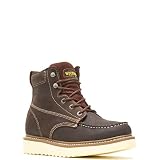
4. Wolverine Men’s Loader 6″ Soft Toe Wedge Work Boot — Best Budget Wedge

Best for: Carpenters and finish tradespeople in environments that don’t require ASTM-rated toe protection, who want wedge-sole comfort at the lowest price in the Wolverine lineup.
The soft-toe Loader is about 0.4 lbs lighter per pair than the equivalent steel-toe version. Over 10,000 steps in a shift, that weight difference shows up. If your worksite doesn’t mandate toe protection — private residential carpentry, woodworking shops, finish work on sites without an ASTM requirement — the soft-toe version delivers the same wedge-sole platform without the safety toe cost or weight.
Full-grain leather upper. Same wedge outsole as the steel-toe Loader. Lower price. The only thing it drops is the steel toe cap. If you genuinely don’t need one, this is the boot.
Key Specs
| Price | $110–$135 |
| Toe Type | Soft toe — no ASTM safety rating |
| Sole Type | Wedge — slip-resistant |
| Upper | Full-grain leather |
| Construction | Cement |
| Shaft | 6 inches |
Pros
- Lightest wedge-sole option in this guide
- Lowest price of the four wedge-sole boots
- Same platform and outsole as the safety-toe Loader
Cons
- No toe protection of any kind — not for sites with any impact hazard
Skip this if there is any possibility of an impact hazard at your worksite. Choose the steel-toe Loader 6″ or the Ride Performance instead.
Section B — Wolverine DuraShocks Work Boots
Two boots built around the DuraShocks cushioning system. Best for workers with high step counts on concrete and industrial floors.
5. Wolverine Men’s DuraShocks SR Direct-Attach Work Boots — Classic Budget DuraShocks

Best for: Warehouse workers, general tradespeople, and anyone who spends a shift primarily standing and walking on concrete and wants proven cushioning at a budget price.
The DuraShocks SR has been essentially the same boot for over two decades, which says something about whether it works. The dual-density PU midsole feels noticeably different from a standard EVA boot at hour 8 — the heel doesn’t bottom out the way single-density foam does after months of daily use. The slip-resistant SR outsole handles the wet and oily concrete conditions common in manufacturing and food production environments.
At this price point, this is the DuraShocks entry point. The honest trade-off: direct-attach construction makes this the boot most commonly mentioned in the outsole delamination pattern. It’s the right boot if you plan to replace it at 12–18 months. It’s not the right boot if you want to hold it longer than that.

Key Specs
| Price | $100–$130 |
| Toe Type | Soft or steel options — verify listing |
| Midsole | DuraShocks SR dual-density PU |
| Outsole | Slip-resistant SR compound |
| Upper | Full-grain leather |
| Construction | Direct-attach — not resoleable |
| Shaft | 6 inches |
Pros
- Proven DuraShocks PU cushioning — holds its profile longer than EVA alternatives
- Slip-resistant SR outsole for wet and oily industrial floors
- Lowest price DuraShocks option
- Decades of documented performance in warehouse and manufacturing environments
Cons
- Direct-attach construction is the most common Wolverine outsole delamination pattern — inspect the sole bond at 6-month intervals
- Not waterproof
- Not resoleable — plan for 12–18 month replacement cycle under heavy daily use
Skip this if you work in wet-dry cycling conditions regularly, or if you want a boot that lasts past 18 months of hard daily use. The Harrison is the correct choice for longer ownership.
6. Wolverine Men’s Raider DuraShocks 6″ Construction Boot — Best for Mixed Surface Work

Best for: General construction workers whose shifts move between concrete, outdoor terrain, and gravel — workers who need cushioning for the flat surfaces and grip for the outdoor ones.
The Raider combines DuraShocks cushioning with a lug outsole. It doesn’t maximize on either surface the way a dedicated wedge-sole boot maximizes on concrete or a deep-lug boot maximizes on mud. What it does is handle both adequately, which is the right trade-off for mixed-surface work.
The steel toe meets ASTM F2413. The lug outsole grips outdoor terrain and gravel better than the wedge-sole boots above. The DuraShocks midsole reduces the concrete fatigue that accumulates when that same shift includes time on flat industrial surfaces. If you spend 60% of your day on concrete and 40% on outdoor terrain, the Raider is a better answer than either a dedicated wedge or a dedicated lug-sole boot.

Key Specs
| Price | $130–$155 |
| Toe Type | Steel toe — ASTM F2413 (verify listing) |
| EH Rated | Verify current Amazon listing |
| Midsole | DuraShocks dual-density PU |
| Outsole | Lug rubber — not wedge |
| Upper | Full-grain leather |
| Construction | Cement |
| Shaft | 6 inches |
Pros
- DuraShocks midsole cushioning for concrete and flat-surface fatigue
- Lug outsole handles outdoor terrain, gravel, and muddy conditions
- Steel toe ASTM F2413
- Better mixed-surface versatility than any wedge-sole boot in this guide
Cons
- Doesn’t outperform a dedicated wedge on concrete or a deep-lug boot in heavy mud
- Not waterproof — wet conditions need the Carlsbad or Floorhand
Skip this if your work is 90% on one surface type. A specialized boot will perform better than a versatile one in that case.
Section C — CarbonMAX / I-90 Platform Boots
7. Wolverine I-90 EPX BOA CarbonMax 6″ Boot — Best BOA Closure Work Boot

Best for: Workers who wear gloves and can’t easily thread traditional laces, workers with arthritis or limited hand dexterity, and workers who need mid-shift fit adjustment as feet swell on long shifts.
The BOA system is more practically useful in a work boot context than most reviews acknowledge. In January on a construction site with insulated gloves, threading traditional laces through 10 eyelets takes genuine effort. The BOA dial takes 3 seconds. That’s not a novelty — it’s a functional improvement for a specific group of workers.
Beyond the closure system, the I-90 EPX BOA delivers the CarbonMAX composite toe (lighter than steel, no metal detector trigger, no cold conduction) and the EPX anti-fatigue footbed. The combination is aimed at workers who want Wolverine’s best safety toe with the best cushioning system and a closure that works with gloves.
The waterproof membrane handles wet conditions without requiring leather treatment. The lug outsole grips outdoor terrain.

Key Specs
| Price | $180–$215 |
| Toe Type | CarbonMAX composite — ASTM F2413 I/C (verify listing) |
| EH Rated | Verify current Amazon listing |
| Waterproofing | Waterproof membrane |
| Closure | BOA Fit System (dial + stainless steel laces) |
| Footbed | EPX dual-density PU — removable |
| Outsole | Lug rubber |
| Construction | Cement |
| Shaft | 6 inches |
Pros
- BOA closure works with gloves — 3-second tightening vs. 30 seconds of threading laces with insulated gloves
- CarbonMAX composite toe — lighter than steel, no cold conduction, no metal detectors
- EPX footbed resists compression longer than standard EVA
- Waterproof membrane
- BOA hardware carries a lifetime guarantee from BOA Technology
Cons
- The BOA premium adds cost that’s wasted if you have no dexterity or cold-weather lacing issue
- In environments requiring very fast boot removal, the dial is slower than a pull-tab on a traditional pull-on boot
- Cement construction
Skip this if you have no dexterity limitations and work in moderate temperatures where traditional lacing presents no problem. You’re paying for a feature you won’t use.
8. Wolverine Men’s Overpass Composite Toe Waterproof Work Boots — Best Value Composite Toe

Best for: Workers who need an ASTM-rated composite toe with waterproofing and prefer a lighter, more athletic-feeling boot over a traditional heavy leather work boot.
The Overpass is the most athletic-feeling boot in the Wolverine lineup. The midsole flex and overall weight are noticeably different from the leather-heavy boots elsewhere in this guide — it moves more like a hiking boot than a traditional work boot. Workers transitioning from trail runners or athletic footwear find the Overpass the easiest Wolverine to adapt to.
The composite toe meets ASTM F2413 without the weight of steel. The waterproof membrane handles wet conditions. The nylon shank in the midfoot provides structural support without adding the stiffness of full leather construction.
The trade-off: the more athletic construction doesn’t hold up as long as full-grain leather boots in hard daily use. The upper marks and scuffs more visibly. At 12–18 months of heavy construction use, plan for replacement.

Key Specs
| Price | $120–$150 |
| Toe Type | Composite — ASTM F2413 (verify listing) |
| EH Rated | Verify current Amazon listing |
| Waterproofing | Waterproof membrane |
| Midsole | Athletic EVA + nylon shank |
| Upper | Nubuck leather + synthetic |
| Construction | Cement |
| Shaft | 6 inches |
Pros
- Lightest safety-toe boot in this guide
- Most athletic feel — easiest transition from non-work footwear
- Composite toe — no metal detectors, no cold conduction
- Waterproof membrane
- Good value for a composite-toe waterproof boot
Cons
- Upper scuffs more visibly than full-grain leather alternatives
- Shorter lifespan in hard construction use vs. the leather boots in this guide
Skip this if you need maximum durability. The Harrison or Carlsbad leather boots hold up better in hard daily environments.
Section D — Wolverine Waterproof Work Boots
Four waterproof boots covering budget through long-term investment, including the Goodyear-welted option.
9. Wolverine Men’s Carlsbad Waterproof 6″ Work Boot — Best Waterproof Mid-Range

Best for: Landscapers, general outdoor tradespeople, and workers whose shifts move between dry and wet surfaces — who want better leather quality and fit than the budget Floorhand provides.
The Carlsbad is a step up from the Floorhand in leather quality and overall fit. The waterproof full-grain leather upper is better finished than the Floorhand’s, and the boot generally gets better reports for all-day fit comfort. The slip-resistant outsole handles mixed terrain reasonably well.
The waterproofing depends partly on leather maintenance. Unlike a membrane-first design, the Carlsbad’s waterproof leather needs re-treatment with Nikwax or Obenauf’s every 4–6 weeks in wet active use to maintain performance. Workers who maintain their leather will find it more durable over time than the Floorhand’s direct-attach construction.

Key Specs
| Price | $140–$165 |
| Toe Type | Steel toe — ASTM F2413 (verify listing) |
| EH Rated | Verify current Amazon listing |
| Waterproofing | Waterproof full-grain leather upper |
| Upper | Full-grain leather — better finish than Floorhand |
| Construction | Cement |
| Shaft | 6 inches |
Pros
- Better leather quality and fit than the Floorhand
- Steel toe ASTM F2413
- Full-grain leather holds up to abrasion well
- Good for mixed outdoor and light-wet environments
Cons
- Waterproofing depends on leather maintenance — re-treat every 4–6 weeks in wet active use
- Cement construction
- Not the right boot for standing water or prolonged submersion
Skip this if you won’t maintain the leather regularly. The Floorhand’s direct-attach waterproofing requires less maintenance in wet conditions.
10. Wolverine Unisex Adult Carlsbad Waterproof 6″ — Best Wide-Fit Waterproof Option

Best for: Workers who found the men’s Carlsbad narrow in the forefoot, or those needing wider fit options within the Carlsbad design.
Same core construction as the men’s Carlsbad. The unisex last typically provides more forefoot room than the men’s-specific last, making it worth trying if the men’s Carlsbad felt tight across the toes or the ball of the foot. Available on Amazon in a range of sizes. If you’re between widths, the unisex version often accommodates wider feet more naturally than ordering up in the men’s version.

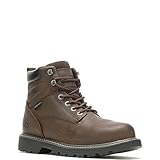
11. Wolverine Men’s Floorhand Waterproof 6″ Boot — Best Budget Waterproof Steel Toe

Best for: Warehouse workers, manufacturing floor crews, and general industrial workers who need ASTM steel-toe protection and genuine waterproofing under $130.
At this price, the Floorhand delivers the two things most industrial workers actually need: a certified safety toe and waterproofing that handles floor spills, rain, and morning wet conditions. The direct-attach construction seals the upper to the sole in a way that makes the boot genuinely waterproof without requiring daily leather treatment.
The slip-resistant outsole handles wet industrial floors. The steel toe meets ASTM F2413. For the price, this is straightforwardly good value for what it is.
The honest trade-off: direct-attach construction is the most commonly cited Wolverine outsole delamination pattern. Inspect the sole bond at 6 months. Plan for replacement at 12–18 months of heavy daily use. The Floorhand is the right boot if you treat it as a consumable at its price point; it’s the wrong boot if you expect 3-year ownership.
Key Specs
| Price | $110–$135 |
| Toe Type | Steel toe — ASTM F2413 (verify listing) |
| EH Rated | Verify current Amazon listing |
| Waterproofing | Direct-attach waterproof construction |
| Upper | Full-grain leather |
| Construction | Direct-attach — not resoleable |
| Shaft | 6 inches |
Pros
- Best price for steel toe + waterproof combination in this guide
- Direct-attach waterproofing requires no leather treatment to maintain
- Steel toe ASTM F2413
- EH rated (verify listing)
Cons
- Direct-attach construction — inspect sole bond at 6 months, most common boot in Wolverine outsole splitting reports
- Not resoleable — 12–18 month replacement cycle under heavy daily use
Skip this if you need the boot to last 2+ years. The Harrison Lace Up 6″ with its Goodyear welt is the financially better choice over a 3-year horizon.
12. Wolverine Men’s Harrison Lace Up 6″ Work Boot — Best Long-Term Investment in Waterproof

Best for: Workers who want to resole their boots rather than replace them — the only 6-inch Goodyear-welted waterproof boot in this guide.
The Harrison is the correct answer if you’re tired of replacing boots every 12–18 months. Goodyear welt means when the outsole wears through, a cobbler resolves it for $70–$90 and the boot continues. The full-grain leather upper, properly conditioned, outlasts the outsole by years.
The cost math over 3 years: a $130 Floorhand replaced twice costs $260. A $165 Harrison resoled once costs $245 and is in better condition at year 3 than the Floorhand was at year 1. The Harrison wins on total cost of ownership from year 2 onward.
The trade-offs are real: it’s stiffer and heavier than cement-construction alternatives. Break-in takes 8–12 hours of gradual wear. It prioritizes durability over comfort padding. The payoff is in year 3 and 4, not day one.

Key Specs
| Price | $150–$180 |
| Toe Type | Verify current Amazon listing for toe specification |
| Waterproofing | Waterproof full-grain leather |
| Upper | Full-grain leather — long service life |
| Construction | Goodyear welt — resoleable |
| Shaft | 6 inches |
Pros
- Goodyear welt — the only resoleable 6-inch boot in this guide
- Full-grain leather upper lasts years beyond the outsole
- No outsole delamination risk — the welt stitching holds the sole independently of adhesive
- Better long-term cost per month than any cement-construction boot in this guide
Cons
- Stiffer and heavier than cement-construction alternatives — Goodyear welt adds weight and rigidity
- Break-in requires 8–12 hours of gradual wear — not comfortable on day one of a demanding shift
- Higher upfront cost vs. the Floorhand
Skip this if you prioritize lightweight comfort or athletic midsole flex. The Overpass or Raider will feel better in the short term. The Harrison wins on total cost if you hold it past 2 years.
Section E — Wolverine 10-Inch Tall Shaft Boots
Two boots for environments where a 6-inch shaft doesn’t provide enough coverage: mud, standing water, debris, and western ranch work.
13. Wolverine Men’s Floorhand Waterproof 10″ Steel Toe — Best for Mud and Standing Water

Best for: Landscapers, outdoor tradespeople, and anyone working in conditions where a 6-inch boot shaft doesn’t keep mud, water, or debris out.
The extra 4 inches of shaft makes a specific, practical difference. Mud and water that overtops a 6-inch boot stays outside a 10-inch shaft. In spring landscaping, storm drain work, site grading after rain, or any environment involving ankle-deep conditions, the 6-inch and 10-inch boots are not comparable products. They solve different problems.
The steel toe handles the impact hazards that come with outdoor construction and landscaping. The waterproof construction handles the wet conditions that justify a 10-inch boot in the first place. The lug outsole grips outdoor terrain.
Same direct-attach construction concern as the 6-inch Floorhand — inspect the sole bond at 6 months. Plan for replacement at 12–18 months of hard daily use.

Key Specs
| Price | $130–$160 |
| Toe Type | Steel toe — ASTM F2413 (verify listing) |
| EH Rated | Verify current Amazon listing |
| Waterproofing | Direct-attach waterproof construction |
| Outsole | Lug rubber — outdoor terrain grip |
| Construction | Direct-attach — not resoleable |
| Shaft | 10 inches |
Pros
- 10-inch shaft keeps mud and water out where 6-inch boots fail
- Steel toe ASTM F2413
- Waterproof for the wet conditions that require a tall boot
- Lug outsole for outdoor terrain grip
Cons
- Heavier and slower to put on than 6-inch boots
- Direct-attach construction — same outsole durability concern as the 6-inch Floorhand
- Not resoleable
Skip this if your conditions don’t regularly involve mud or water above ankle height. The 6-inch Floorhand is lighter and more practical for most dry or light-wet environments.
14. Wolverine Men’s Rancher Steel Toe 10″ Work Boot — Best Ranch and Western Tall Boot

Best for: Ranch workers, oil field workers, and Western tradespeople who need a tall leather pull-on boot with genuine long-term durability.
The Rancher is a Goodyear-welted pull-on boot with a 10-inch shaft and steel toe. Pull-on design with pull straps means no laces to catch on anything or get stepped on around livestock. The tall leather shaft provides ankle and lower-leg coverage for outdoor ranch and farm environments.
The Goodyear welt means this boot resolves rather than gets replaced. At the price of one replacement Floorhand, a cobbler resolves the Rancher and it continues. For ranch workers who put serious mileage on boots over a season, the Goodyear welt changes the economics considerably.
The pull-on fit is fixed — no lace adjustment. Workers with non-standard foot shapes (very narrow or very wide) should try to fit test before committing. Try it with your work socks.

Key Specs
| Price | $150–$185 |
| Toe Type | Steel toe — ASTM F2413 (verify listing) |
| Design | Pull-on with pull straps |
| Upper | Full-grain leather — 10-inch shaft |
| Construction | Goodyear welt — resoleable |
| Shaft | 10 inches |
Pros
- Goodyear welt — resoleable, long-term ownership
- Pull-on design — no laces to manage around livestock or equipment
- 10-inch leather shaft for ranch and farm environments
- Steel toe ASTM F2413
Cons
- Pull-on fit is fixed — harder to size for non-standard feet than lace-up alternatives
- No waterproof membrane — the leather needs maintenance in wet conditions
- Heavier than lace-up 6-inch options
Skip this if you need waterproofing in a tall boot. The Floorhand 10″ handles wet conditions; the Rancher handles dry outdoor ranch use.
Section F — Wolverine Wellington and Pull-On Boots
Two pull-on boots for workers who remove and put on boots frequently throughout the day.
15. Wolverine Men’s I-90 Waterproof CarbonMAX Romeo Slip-On Boot — Best Pull-On for Speed

Best for: Oil field workers, workers who remove boots multiple times daily, and workers in facilities requiring boot removal between zones.
The Romeo (slip-on) design with elastic goring gives enough ankle hold to work in without the slop that makes some slip-ons feel unstable. Getting in and out of a lace-up boot 6 times in an 8-hour shift adds up. For oil field workers who move between their truck, the facility office, and the wellsite, the Romeo’s on/off speed is a practical advantage.
The CarbonMAX composite toe means no metal detector issues — relevant at most oil facilities and government sites. The waterproof membrane handles wet field conditions. The elastic goring provides enough ankle security for light-to-moderate terrain, though it’s noticeably less supportive than a lace-up boot on uneven ground.

Key Specs
| Price | $140–$170 |
| Toe Type | CarbonMAX composite — ASTM F2413 (verify listing) |
| EH Rated | Verify current Amazon listing |
| Waterproofing | Waterproof membrane |
| Design | Slip-on Romeo with elastic goring |
| Construction | Cement |
| Shaft | 6 inches |
Pros
- Fastest on/off of any boot in this guide
- CarbonMAX — no metal detector trigger, no cold conduction
- Waterproof membrane
- EH rated (verify listing)
Cons
- Less ankle support than any lace-up boot in this guide
- Cement construction — not resoleable
- Not suitable for sustained uneven terrain work
Skip this if your work involves significant uneven terrain or requires maximum ankle support. The Romeo trades support for speed.
16. Wolverine Men’s W04727 DD Work Wellington Boots — Best Goodyear-Welted Pull-On

Best for: Oil field workers and ranchers who want the speed of a pull-on boot but are tired of replacing cement-construction Wellingtons when the sole goes.
The DD Wellington is the resoleable answer to the pull-on question. Every other slip-on in this guide uses cement construction. When the sole wears on those boots, the boot is done. The DD Wellington goes to a cobbler, gets a new sole for $80, and continues for another 2–3 years. For oil field workers who spend serious money on boots every season, the Goodyear welt changes the math quickly.
The full-grain leather shaft and upper handle outdoor and industrial conditions. The pull-on design provides the on/off speed that matters in field environments. The boot is stiffer and heavier than cement alternatives — the Goodyear welt adds structure that direct-attach boots don’t have. The value is in year 3 and 4, not day one.

Key Specs
| Price | $155–$190 |
| Toe Type | Verify current Amazon listing for toe specification |
| EH Rated | Verify current Amazon listing |
| Design | Pull-on Wellington with pull straps |
| Upper | Full-grain leather — 10-inch shaft |
| Construction | Goodyear welt — resoleable |
| Shaft | 10 inches |
Pros
- Goodyear welt — the only resoleable pull-on boot in this guide
- Pull-on speed with long-term ownership economics
- Full-grain leather — long service life
- 10-inch shaft for oil field and ranch environments
Cons
- Stiffer and heavier than cement-construction Wellingtons — the welt adds structure
- No waterproof membrane — leather maintenance required in wet conditions
- Higher upfront cost than the I-90 Romeo
Skip this if you replace boots frequently regardless of construction, or if you need the lightest possible boot for high step-count work. The value is entirely in long-term ownership.
Price Tier Analysis and Cost-Per-Month Math
| Tier | Price Range | Construction | Expected Lifespan (Heavy Daily Use) | Boots in This Guide |
|---|---|---|---|---|
| Budget | $100–$135 | Direct-attach / cement | 12–18 months | DuraShocks SR, Loader Soft Toe, Floorhand 6″ and 10″ |
| Mid-Range | $130–$175 | Cement | 15–24 months | Carlsbad, Raider, Loader 8″, Trade Wedge, Rancher, I-90 Romeo, Overpass |
| Premium / Investment | $150–$215 | Goodyear welt or best-tech cement | 2–5 years (welt) / 18–24 months (cement) | Ride Performance, I-90 EPX BOA, Harrison, DD Wellington |
Cost-per-month over 3 years:
- $120 Floorhand replaced twice at 15 months: $240 total — $6.70/month
- $165 Harrison resoled at 30 months ($165 + $80 resole): $245 total over 3 years — $6.80/month — with a boot still in good condition
- $200 Ride Performance replaced at 20 months, bought again: $200 + $200 — $11.10/month
The Harrison and DD Wellington win on cost per month from year 2 onward — but only if you actually resole them. If you know you won’t take a boot to a cobbler, the cement-construction boots at their price points are the rational choice.
Job-Specific Picks
| Trade | Best Wolverine Boot | Reason |
|---|---|---|
| Concrete / carpentry / framing | Ride Performance WP Composite Wedge | Wedge sole + waterproof + CarbonMAX composite |
| Finish carpentry (no safety toe required) | Trade Wedge 6″ Moc Toe | Wide toe box, flat surface grip, lighter without safety toe |
| Warehouse / loading dock | Loader 8″ Safety Toe Wedge | Wedge for concrete, taller shaft for debris |
| General construction (mixed terrain) | Raider DuraShocks 6″ | DuraShocks cushion + lug outsole handles both surfaces |
| Landscaping / outdoor wet | Floorhand WP 10″ | Tall shaft + waterproof for mud and wet outdoor conditions |
| Oil field (metal detector sites) | I-90 WP CarbonMAX Romeo | CarbonMAX composite, pull-on speed, no metal detector trigger |
| Ranch / western trades | Rancher Steel Toe 10″ | Goodyear welt + pull-on + 10-inch shaft |
| Long-term investment / resole | Harrison Lace Up 6″ | Only resoleable 6-inch waterproof boot in this guide |
| Glove wearers / limited dexterity | I-90 EPX BOA CarbonMax | BOA dial works with gloves — 3-second tightening |
| Athletic feel / lightest safety toe | Overpass Composite Toe WP | Lightest boot in the guide, most athletic midsole flex |
Frequently Asked Questions
What are the best Wolverine work boots?
For most workers on concrete and flat surfaces, the Wolverine Ride Performance Waterproof Composite Toe Wedge is the top pick — it combines the best technology in the lineup with a wedge sole. For long-term investment, the Harrison Lace Up 6″ or DD Wellington are the correct answers because both are Goodyear-welted and resoleable.
Are Wolverine boots true to size?
True to length, but slightly narrow in the toe box compared to KEEN or New Balance. Workers with medium to wide feet should size up half or try the moc-toe styles, which have more forefoot volume. Size up half if you wear thick socks on long shifts.
What is DuraShocks technology?
A dual-density PU midsole — firmer at the outer edge for stability, softer at the heel and forefoot for cushioning. PU holds its cushioning profile longer than standard EVA under daily compression. DuraShocks SR is the same midsole combined with a slip-resistant outsole compound.
What is the difference between CarbonMAX and a regular composite toe?
CarbonMAX is Wolverine’s carbon fiber composite toe. Standard composite toes use fiberglass or plastic. CarbonMAX is typically thinner-walled, giving more interior toe room for the same ASTM F2413 protection rating. It’s also lighter than both steel and standard composite. Neither triggers metal detectors.
Are Wolverine boots good for concrete?
Yes, particularly the wedge-sole models. The full-contact wedge base grips smooth concrete better than heeled lug-sole boots. The DuraShocks PU midsole reduces fatigue over long concrete shifts better than single-density EVA alternatives. For concrete work, the Ride Performance Wedge or Trade Wedge are the specific picks.
Which Wolverine boots are Goodyear-welted?
Three boots in this guide: the Harrison Lace Up 6″, the Rancher Steel Toe 10″, and the DD Wellington. All other boots use cement or direct-attach construction and cannot be resoled.
Why do Wolverine boot soles split?
The most common cause is direct-attach cement construction degrading under wet-dry cycling or chemical exposure. The adhesive bond between upper and sole weakens over time, particularly in industrial cleaning agent environments or repeated soaking and drying. Goodyear-welted boots don’t have this problem because the stitched welt holds the sole independently of adhesive.
Are Wolverine wedge sole boots good for ladders?
No. A wedge sole doesn’t catch ladder rungs the way a defined heel does. Linemen, roofers, and anyone who regularly climbs steel ladders should use a heeled lug-sole boot, not a wedge sole. The wedge is correct for flat surface work.
What is the BOA Fit System on Wolverine boots?
A stainless steel lace-and-dial closure that replaces traditional laces. The dial tightens in micro-increments across the full lace length. Useful for workers who wear gloves or have hand dexterity limitations. BOA Technology offers a lifetime guarantee on the hardware.
How long do Wolverine work boots last?
Direct-attach and cement-construction boots last 12–18 months under heavy daily industrial use before outsole delamination or wear-through. Goodyear-welted boots last 2–5 years under the same conditions, as the outsole can be resoled when it wears. Conditioned full-grain leather uppers on Goodyear-welted boots outlast the outsole by years.
Final Verdict — Which Wolverine Boot Is Right for Your Job
- Concrete, carpentry, flat surfaces: Wolverine Ride Performance WP Composite Wedge — best technology in a wedge platform
- Traditional moc-toe wedge: Wolverine Trade Wedge 6″ Moc Toe — wider toe box, classic aesthetic
- Mixed concrete and outdoor terrain: Wolverine Raider DuraShocks 6″ — DuraShocks cushion, lug outsole
- Budget waterproof steel toe: Wolverine Floorhand WP 6″ — best value, plan for 15-month replacement
- Mid-range waterproof: Wolverine Carlsbad WP 6″ — better leather, maintain it regularly
- Long-term investment (resoleable): Wolverine Harrison Lace Up 6″ — Goodyear welt, cost-per-month winner at year 2+
- Mud and standing water: Wolverine Floorhand WP 10″ — the only answer when 6 inches isn’t enough
- Ranch and western tall: Wolverine Rancher Steel Toe 10″ — Goodyear welt, pull-on, resoleable
- Oil field pull-on (speed): Wolverine I-90 WP CarbonMAX Romeo — composite toe, fastest on/off
- Oil field investment (resole): Wolverine DD Wellington — Goodyear-welted pull-on, long-term ownership
- BOA / gloved workers: Wolverine I-90 EPX BOA CarbonMax — 3-second lacing with gloves
- Athletic feel, lightest safety toe: Wolverine Overpass Composite Toe WP
One last note on sizing: if your Brannock measurement falls between sizes, size up with Wolverine. And if you’re replacing direct-attach boots every year, price out the Harrison or DD Wellington first. At the same annual cost over two years, the Goodyear-welted boot is in better shape at the end of that period than the cement boot was at the beginning.