

Last Updated: November 16, 2025 | By: The BootsGuru Team
Let's get one thing straight: "a safety boot" isn't a single thing. A boot that's perfect for an electrician could be dangerously wrong for a welder, and a welder's boot would be miserable for a warehouse picker. Buying the wrong "safety boot" isn't just uncomfortable; it can lead to a career-ending injury.
The world of safety footwear is a confusing alphabet soup of codes: ASTM, F2413, MT/75, EH, PR... It's overwhelming, and most people just default to "steel toe" without knowing what they really need.
As the BootsGuru, my job is to be your expert translator. This guide breaks down every type of safety boot and what those confusing codes actually mean. We'll show you how to read the tag on your boot and how to match your boot's specific protections to the real hazards of your job. This is Work Boot Safety 101.
Safety Boot Features at a Glance: Decoding the Tag
Here is a no-BS translation of the codes you'll see on a boot's tag. A boot is only certified for the features it lists.
| Safety Feature | ASTM F2413 Code | What It Is (The "No-BS" Explanation) | Who Needs It (Example Trades) |
|---|---|---|---|
| Impact (Toe) | I/75 | The safety toe (Steel, Comp, Alloy) protects against a 75-pound drop impact. | Most construction, warehouse, manufacturing |
| Compression (Toe) | C/75 | The safety toe protects against a 2,500-pound rolling load (e.g., a pallet jack). | Most construction, warehouse, manufacturing |
| Metatarsal Guard | MT/75 | A shield (internal or external) that protects the delicate bones on top of your foot. | Heavy equipment operators, welders, demolition |
| Electrical Hazard | EH | The sole is non-conductive and protects you from live circuits up to 18,000V (in dry conditions). | Electricians, maintenance, utility workers |
| Puncture Resistant | PR | A plate inside the sole stops nails or sharp objects from puncturing your foot. | Demolition, roofers, construction, recycling |
| Static Dissipative | SD | Safely bleeds static electricity off your body to protect sensitive equipment. | Electronics manufacturing, computer labs |
| Slip Resistant | SR / SRC | The sole has been lab-tested for grip on wet and oily/soapy surfaces. | Everyone. Especially foodservice, healthcare, indoor trades. |
The "Big Three": Safety Toe Types Explained (Steel vs. Composite vs. Alloy)
This is the most common choice you'll make. All three types pass the exact same ASTM I/75 and C/75 safety tests. The difference is weight, material, and cost.

Safety Toes
1. Steel Toe (The Classic Tank)
| Pros | Cons |
|
|
2. Composite Toe (The Lightweight & Electrician's Pick)
Made of non-metal materials like carbon fiber, fiberglass, or Kevlar®.
| Pros | Cons |
|
|
3. Alloy Toe (The "Best of Both" Hybrid)
Made of lightweight metals like aluminum or titanium.
| Pros | Cons |
|
|
Beyond the Toe: Critical Protection Types You Can't Ignore
A safety toe is just the beginning. The real hazards on your job site often require these specialized features.
4.1. Metatarsal Guard (MT/75): The "Crush Protector"
Honest Take: "A steel toe is a helmet for your toes; a met guard is the armor for the rest of your foot. If you operate heavy equipment, work with heavy, falling objects, or weld, a steel toe alone is not enough protection."
- External Guards: The "old-school" flap you see on top of the boot. Pros: Maximum protection, deflects sparks/slag. Cons: Bulky, can snag on grating.
- Internal Guards (D3O®, XRD®): The "modern" choice. Uses "smart foam" that's soft and flexible for walking but instantly hardens on impact. Pros: Flexible, light, no snagging. Cons:** Doesn't protect the boot's laces.
→ See our Top Picks: Best Metatarsal Guard Boots
4.2. Electrical Hazard (EH): The "Life Saver"
How it Works: "This isn't about the toe; it's about the sole. EH-rated boots have a thick, non-conductive rubber sole and heel designed to stop your body from completing an electrical circuit if you step on a live wire. It's a non-negotiable for electricians and maintenance crews."
4.3. Puncture Resistant (PR): The "Nail Stopper"
How it Works: A puncture-resistant plate is built into the sole to stop nails, screws, and rebar from stabbing you through the bottom of your foot. This can be a flexible woven fabric (like Kevlar®) or a thin steel plate. It's an absolute must-have for demolition, scrap yards, and new construction sites.
Work Boot Types by Style & Construction
The shape and build of the boot also determine its job. Here's a quick breakdown.
6-Inch & 8-Inch Boots
These are the all-arounders. A 6-inch boot offers great mobility, while an 8-inch boot provides significantly more ankle support, which is ideal for walking on rocky or uneven terrain.
Pull-On / Wellingtons
Designed for speed, convenience, and keeping debris out. Common in oil/gas, farming, and trades where you're in and out of houses. → See our Best Pull-On Work Boots
Logger Boots
A specialized tool purpose-built for climbing. The defined 90-degree heel is a safety feature for locking onto ladder rungs, pole gaffs, and beams. → See our Best Lineman & Logger Boots
Hiker / Athletic Safety Shoes
These are best for high-mileage on concrete (like warehouse pickers or delivery drivers). They prioritize light weight and cushioning (EVA midsoles). → See our Best Boots for Warehouse Pickers
Rubber / Muck Boots
Used for 100% waterproofness, mud, and chemical resistance. Ideal for farmers, concrete workers, and chemical plants. → See our Best Mud Work Boots
Other Key Features to Consider
- Waterproofing: Look for GORE-TEX® or proprietary membranes. → Shop Waterproof Boots
- Insulation: Measured in grams (g) of Thinsulate™. 200g is for cool weather, 400g-600g is for cold, and 800g+ is for extreme cold. → Shop Insulated Boots
- Midsoles: PU (Polyurethane) is firm, durable, and resists flattening (best for support). EVA (Ethylene-vinyl acetate) is soft, light, and cushioned (best for comfort, but flattens faster). → Shop Comfortable Boots
- Insoles: The easiest upgrade for comfort. → Shop Insoles
How to Read Your Boot's Safety Tag
Always check the tongue tag! Here's how to translate your boot's resume.
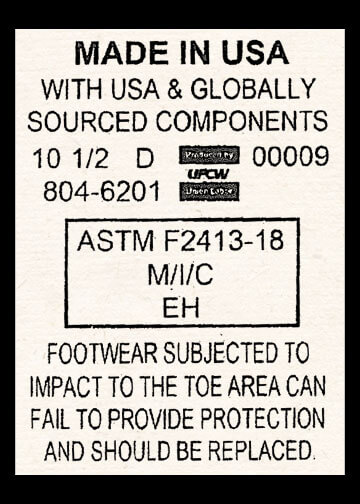
astm f2413 safety boot
| Example Tag Line | Meaning (The "No-BS" Translation) |
|---|---|
| ASTM F2413-18 | The safety standard and the year it was last revised (2018). |
| M I/75 C/75 | M (Male), I/75 (Impact rated to 75 ft-lbs), C/75 (Compression rated to 2,500 lbs). |
| MT/75 EH PR | MT/75 (Metatarsal Guard), EH (Electrical Hazard), PR (Puncture Resistant). |
Frequently Asked Questions (FAQ)
Here are the common questions we get about safety boot rules.
Do safety boots have an expiry date?
There is no set "expiry date" on a boot. The lifespan is determined by use. However, the materials (glues, leathers, foams) do degrade over time, even in storage. A boot that's sat in a box for 5+ years may not have the same integrity. For boots in use, they should be replaced every 6-12 months, or immediately after a major impact or if the sole/upper is compromised.
When should I replace my work boots?
You MUST replace your boots immediately after any major impact (like a heavy drop on the safety toe), even if they look fine. The internal structure is now compromised. You should also replace them if: the seams are splitting, the sole is separating from the upper, the tread is worn flat (slip hazard), or the leather is cracked and leaking.
Are composite toes really as strong as steel?
Yes. To get the ASTM F2413 rating, all safety toes (steel, composite, alloy) must pass the exact same 75-pound impact and 2,500-pound compression tests. One is not "stronger" than the other in terms of safety rating; they just use different materials to achieve it.
Are steel toe boots safe for electricians?
This is a common myth. Yes, they are safe if the boot is EH Rated. The EH rating comes from the non-conductive sole, not the toe. The steel toe is fully enclosed by leather and rubber, so it never makes contact with the ground or the live circuit. You can absolutely wear an EH-rated steel toe. However, many electricians prefer composite for the peace of mind and lighter weight.
Conclusion: Choose for Your Hazard, Not Just Your Job
A work boot is a piece of PPE, just like a hard hat or safety glasses. A "steel toe" is just one feature, not the whole story. A boot that can't protect you from a nail, a 500-lb cart, or a live wire is the wrong boot.
Final Takeaway: Read your job site's safety requirements first. Then, use this guide to understand what those codes (EH, MT, PR) mean. Don't just buy a "safety boot" – buy the right safety boot for your specific hazards.
Now that you're an expert on safety types, find your perfect pair in our guide to the 10 Best Construction Work Boots or the 10 Most Comfortable Work Boots.