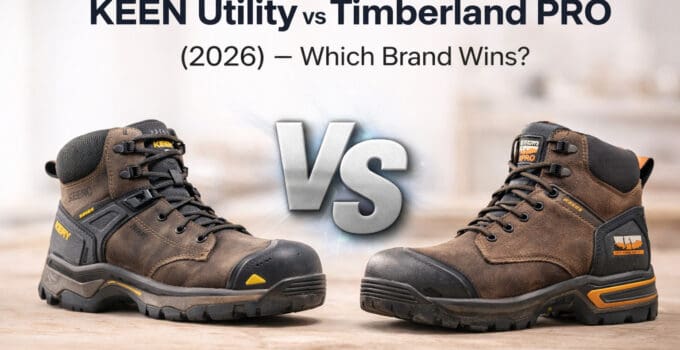

You've narrowed it down to two brands. KEEN Utility or Timberland PRO. Both are in every top-10 list. Both get strong reviews. Both are on Amazon Prime. So which one do you actually buy?
The honest answer: these are two different design philosophies, not two versions of the same thing. KEEN Utility is built around foot shape — wider anatomical toe boxes, immediate out-of-box comfort, lighter builds. Timberland PRO is built around jobsite performance — Anti-Fatigue Technology, heavier-duty outsoles, and industrial durability that holds up longer under sustained abuse.
Which one is right for you depends on your job type, your foot shape, and whether your work punishes your boots harder — or your feet. This article compares both brands across 8 categories, matches specific models head-to-head, and gives you a direct winner for each job type. No hedging.
EH Certification Notice: Electrical hazard (EH) ratings on Amazon listings can change between production runs without notice. Always verify the current listing shows ASTM F2413 EH certification before purchase. Links in this article are checked at publication — re-verify before ordering.
KEEN Utility vs Timberland PRO — Quick Verdict
| Category | Winner |
|---|---|
| Comfort out of the box | ✅ KEEN Utility |
| Toe box width | ✅ KEEN Utility |
| Anti-fatigue on concrete | ✅ Timberland PRO |
| Durability / lifespan | ✅ Timberland PRO |
| Price / value | ✅ Timberland PRO (mid-range models) |
| Waterproofing | 🤝 Tie — different strengths (see below) |
| Safety certifications | 🤝 Tie — both cover standard industrial needs |
| Weight & agility | ✅ KEEN Utility |
| Best for wide feet | ✅ KEEN Utility |
| Best for 12-hour concrete shifts | ✅ Timberland PRO |
| Best overall for most workers | ✅ Timberland PRO |
One-line verdict: For most workers, Timberland PRO is the safer all-around recommendation. For wide feet or instant comfort with minimal break-in, KEEN Utility is the smarter buy. The right answer depends less on brand loyalty and more on whether your job punishes your boots — or your feet — harder.
Brand Profiles — What Each Is Built For
KEEN Utility
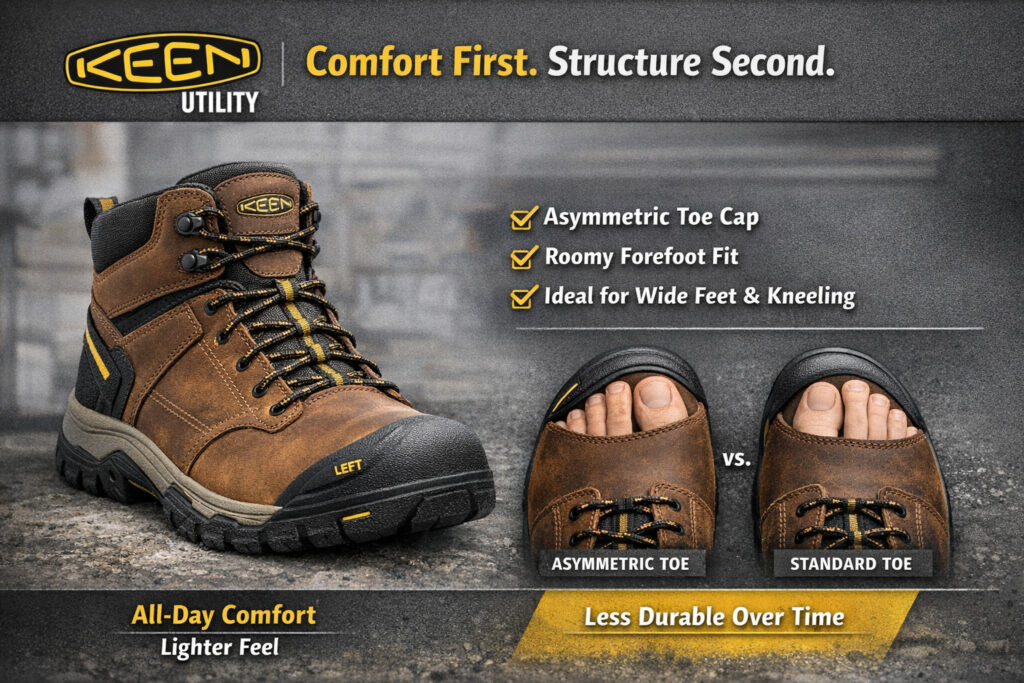
Experience the ultimate comfort with KEEN Utility footwear! Designed for wide feet, these boots offer superior support all day long.
KEEN Utility grew out of KEEN's outdoor footwear DNA — the same brand that made asymmetric toe caps and wide forefoot fits famous in hiking boots brought that philosophy to the jobsite. The result is a work boot line that prioritizes anatomical fit, immediate comfort, and lighter-feeling builds over maximum industrial durability. KEEN's signature asymmetric steel or composite toe cap sits further from the toes than a standard toe cap, giving real room where most safety boots compress. For workers with wide feet, bunions, or jobs that involve a lot of kneeling and crouching, this is a meaningful structural difference — not a marketing claim.
The tradeoff: KEEN Utility's comfort-first approach means some models trade long-term outsole toughness for flexibility and weight savings. For light industrial, warehouse, mechanic, and walking-heavy roles, this is the right call. For sustained concrete abuse on 12-hour construction shifts, it becomes a limitation.
Timberland PRO
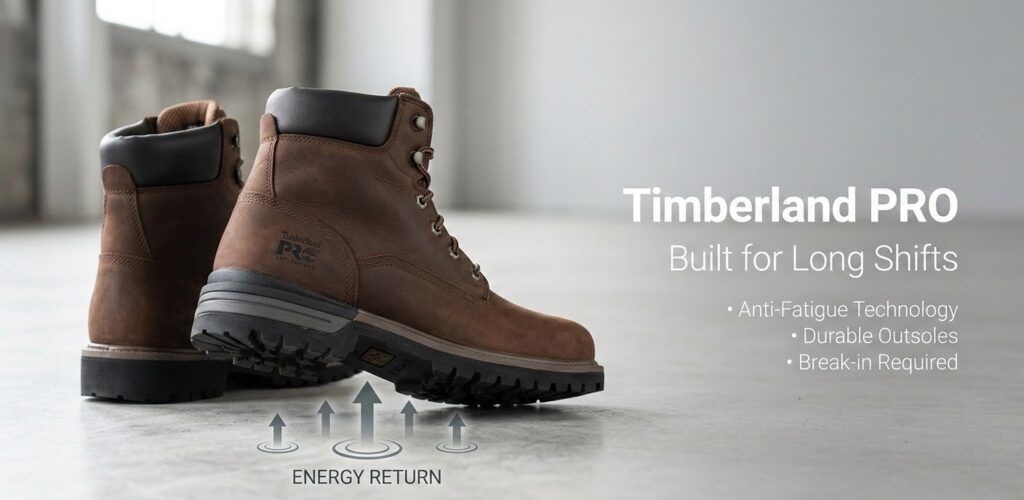
Step into comfort with Timberland PRO work boots, designed for all-day wear.
Timberland PRO is built for industrial jobsite performance first. The brand's Anti-Fatigue Technology — a geometry-engineered midsole insert that returns energy and reduces fatigue on hard surfaces — is the biggest real-world differentiator in this comparison. It's not marketing language; workers who move from a standard EVA midsole boot to a Timberland PRO report a tangible difference at hour 8–10 on concrete. The outsoles on Timberland PRO models are generally more abrasion-resistant and hold their structure longer under heavy use.
The tradeoff: Timberland PRO boots typically feel stiffer out of the box, fit a more traditional (narrower) last, and require more break-in than KEEN. For workers with standard-width feet who prioritize long-shift durability over day-one feel, this is an acceptable trade. For wide feet or workers who go straight from the box to a full shift, it can be a painful week.
Head-to-Head — 8 Categories
1. Comfort & Break-In — Winner: KEEN Utility
KEEN wins clearly on day-one comfort. The wider forefoot, softer ride, and asymmetric toe cap mean most workers can wear KEEN Utility straight from the box without a meaningful break-in period. Timberland PRO models — particularly full-grain leather uppers like the Boondock HD — feel stiffer at first and require 1–2 weeks of regular wear before the upper and footbed settle.
The real trade-off: KEEN feels better in week 1. Timberland PRO often feels better in month 6, once the boot has conformed and the Anti-Fatigue midsole is doing consistent work under load. If you're going straight from the box to a 10-hour shift, KEEN wins. If you can afford a break-in period, Timberland PRO catches up.
2. Toe Box Width — Winner: KEEN Utility
This is the clearest brand-level difference between the two. KEEN's asymmetric toe cap is set further forward on the boot than a standard safety toe — it mirrors the natural shape of the foot rather than forcing the foot to conform to a symmetrical cap. The result is a toe box that feels genuinely roomier, especially on the outside edge where the pinky toe sits.
For workers with wide feet, bunions, hammertoes, or jobs that require sustained kneeling (where the toe box compresses forward against the toes), this isn't a minor comfort preference — it's a structural fit issue that no amount of break-in fixes with a standard last. Timberland PRO fits a traditional last that works for standard-width feet but offers nothing comparable for wide fits.
3. Durability & Lifespan — Winner: Timberland PRO
Timberland PRO generally wins on outsole durability, structure retention, and resistance to abrasive surfaces. The rubber compounds used in Timberland PRO outsoles are formulated for heavy industrial environments — concrete, grating, construction site debris. KEEN Utility outsoles perform well but some models prioritize flexibility and traction geometry over raw compound hardness, which means faster wear on highly abrasive surfaces.
Both brands use cement construction on most models, meaning neither is resoleable — when the outsole wears, the boot is replaced. Given this, outsole longevity matters more than it would with a welted boot. Under heavy daily industrial use, expect 12–20 months from KEEN Utility vs 16–24 months from comparable Timberland PRO models.
4. Safety Certifications — Winner: Tie
Both brands cover the standard industrial certification requirements: ASTM F2413 I/C (impact and compression), EH (electrical hazard secondary protection), and waterproof variants across most lines. Timberland PRO has slightly broader coverage at the heavy-duty end — more models with explicit met guard options and heavier industrial ratings. For most commercial and standard industrial environments, both brands meet the required specs equally. The decision here should be model-specific, not brand-specific — always verify the exact ASTM certifications on the current Amazon listing before purchase, as these can change between production runs.
5. Waterproofing — Winner: Tie (with important differences)
Both brands offer solid waterproofing, but they work differently and perform differently depending on conditions. KEEN.DRY — KEEN's proprietary waterproof membrane — is notably more breathable than most competitive systems. In warm, humid environments where moisture comes from inside the boot (sweat) as much as outside, KEEN.DRY's breathability advantage is real. Feet stay drier and cooler on warm days than in a fully sealed boot.
Timberland PRO's seam-sealed waterproof builds are more oriented toward wet-cold jobsite conditions — standing water, heavy rain, morning concrete work in cold weather. The sealing is robust and the construction feels more jobsite-hardened. In cold wet environments, Timberland PRO's approach is preferable. In warm wet environments or where foot breathability matters, KEEN.DRY has a genuine edge. This is why the tie stands — it's a conditions match, not a quality difference.
6. Price & Value — Winner: Timberland PRO (mid-range models)
Timberland PRO delivers comparable safety specifications at lower price points across most of its line. The Boondock HD sits at $195–$215 and covers composite toe, EH, seam-sealed waterproofing, and Anti-Fatigue Technology — a strong spec-per-dollar ratio. KEEN Utility charges a premium for fit and comfort, with the Pittsburgh at $165–$185 and the Cincinnati typically $175–$200+.
An important caveat: the value comparison is strongest in the $160–$220 range. Timberland PRO's entry-level Endurance 6" at around $120–$140 is a decent budget pick but not representative of the brand's quality ceiling — comparing the Endurance to KEEN's mid-range models would be an unfair match. Compare equivalent models, not brand floors to brand midpoints.
7. Weight & Agility — Winner: KEEN Utility
KEEN Utility boots are generally lighter and feel less planted than equivalent Timberland PRO models. For mechanics, warehouse workers, and roles with significant walking or movement, this translates to less fatigue from the boot's own weight over a long shift. Timberland PRO boots feel more substantial and grounded — which is an advantage in static, heavy-standing industrial work but a mild disadvantage in agility-demanding roles.
8. Anti-Fatigue on Hard Surfaces — Winner: Timberland PRO
Timberland PRO's Anti-Fatigue Technology is the brand's most significant real-world advantage in this comparison. The geometry-engineered insert is designed to return energy with each step on hard surfaces, reducing the cumulative fatigue that builds across a 10–12 hour concrete shift. Workers who have moved from standard EVA midsole boots to Timberland PRO consistently report a noticeable difference in lower back and knee fatigue by the end of a long shift.
KEEN Utility's KEEN.ReGEN midsole (on the Pittsburgh and select other models) is a genuine competitor to standard EVA — it's meaningfully better than a basic foam midsole and delivers good long-shift comfort. But head-to-head on sustained concrete work, Timberland PRO's Anti-Fatigue Technology is the stronger system. If concrete is your primary surface for 8+ hours daily, this category matters more than most.
Comfort vs Durability Timeline
The single most misunderstood thing about this comparison: KEEN and Timberland PRO don't stay in their respective positions across the life of the boot. Here's how they actually track:
| Timeframe | KEEN Utility | Timberland PRO |
|---|---|---|
| Day 1 | ✅ Better comfort — wide toe box, soft ride | Stiffer upper, more break-in needed |
| Week 2 | ✅ Still easier on foot, fully comfortable | Starting to settle; Anti-Fatigue system engaging |
| Month 3 | Good comfort maintained; some lighter models begin softening | ✅ Better structure retention; Anti-Fatigue working consistently |
| Month 12 | Comfort good but outsole may show wear on abrasive surfaces | ✅ Usually better long-term durability on heavy industrial surfaces |
| Month 18–24 | Replacement likely on heavy industrial use | ✅ Often still serviceable with proper care on most surfaces |
The takeaway: If you evaluate these boots in week 1, KEEN wins. If you evaluate them at month 12, Timberland PRO wins in most heavy industrial environments. Choosing based on how a boot feels in the store is how people end up disappointed at month 8.
Sizing & Fit — What the Spec Sheet Doesn't Tell You
The toe box difference is real and it's structural — but the sizing picture is more nuanced than "KEEN runs wide." Here's what actually matters when choosing between these two brands:
KEEN Utility Sizing
KEEN Utility runs true to size in length for most buyers. The meaningful difference is width — specifically in the forefoot and toe box. KEEN's asymmetric toe cap creates more room on the outside edge of the foot and across the ball. Workers with standard or narrow feet sometimes find KEEN Utility boots feel sloppy in the forefoot, with the foot sliding laterally. Workers with wide, medium-wide, or D-width feet typically find KEEN a significantly better fit than standard-last boots without needing to go up a width.
If you kneel frequently — pipefitters, electricians, HVAC techs — size up half a size in KEEN to prevent the toe box from compressing against the cap in a flexed kneeling position. This applies regardless of foot width.
Timberland PRO Sizing
Timberland PRO runs slightly narrow in the toe box by most accounts, particularly in the Boondock HD. Workers at the wide end of standard width should size up half a size. The Titan runs slightly more forgiving. If you're between sizes, go up — Timberland PRO boots with a leather upper will break in and conform slightly, but they won't widen appreciably across the toe box. What you try on is approximately what you'll wear.
The practical test
If you can try both brands before buying: stand in the boot, then drop into a kneeling position. In a KEEN, your toes should have clearance from the safety cap in both positions. In a Timberland PRO, check that the toe box doesn't pinch across the widest part of your foot when standing. If either pinches standing — walk away. Break-in won't fix a toe box that's wrong for your foot shape.
Model-by-Model Matchups
Matchup 1 — KEEN Utility Pittsburgh vs Timberland PRO Boondock HD
The flagship comparison — the most purchased model from each brand in the industrial work boot category.
| Factor | KEEN Utility Pittsburgh | Timberland PRO Boondock HD |
|---|---|---|
| ASIN |  |
 |
| Amazon | Amazon → | Amazon → |
| Price | $165–$185 | $195–$215 |
| Toe type | Steel — ASTM F2413 I/C | Composite — ASTM F2413 I/C |
| Toe box | Wide asymmetric | Standard last |
| EH rating | Yes — verify current listing | Yes — verify current listing |
| Waterproof | No on base model — WP variant available | Yes — seam-sealed |
| Anti-fatigue | KEEN.ReGEN midsole | Anti-Fatigue Technology |
| Break-in | ✅ Minimal — wear from day 1 | Moderate — 1–2 weeks |
| Toe detector | Steel — triggers metal detectors | Composite — non-metallic |
| Best for | Wide feet, mechanics, walking-heavy roles | Concrete, industrial, refinery, plant access |
Verdict: KEEN Pittsburgh for wide feet and instant comfort. Timberland Boondock HD for tougher all-around industrial use, refinery access, and workers who need composite non-metallic toe. If you're comparing these two specifically: the Boondock HD is the better-spec'd boot for most heavy industrial environments. The Pittsburgh is the better-fitting boot for wide feet and roles that don't demand the Boondock's durability ceiling.
Matchup 2 — KEEN Utility Cincinnati vs Timberland PRO Titan
⚠️ Production Note: Two Cincinnati ASINs exist — B07VDLWLF7 and B07XYPQKLG. These may be different variants (toe type, EH status, width). Verify both on Amazon before publishing and link to the correct variant for your audience. The Timberland PRO Titan ASIN B0CLQTGYJJ should be confirmed as the alloy-toe EH variant — do not publish the Titan section until this is verified. Placeholder links included below.
| Factor | KEEN Utility Cincinnati | Timberland PRO Titan |
|---|---|---|
| ASIN |  |
 |
| Amazon | Amazon → | Amazon → |
| Toe type | Variant-dependent — confirm before linking | Alloy safety toe — verify EH version |
| Toe box | Wide — KEEN standard | Standard last |
| EH rating | Variant-dependent — verify listing | Verify current listing |
| Waterproof | Variant-dependent | Variant-dependent |
| Best for | Wide feet, comfort-first buyers, light industrial | Budget-conscious industrial buyers needing alloy toe |
Verdict: KEEN Cincinnati for wide-foot buyers stepping up from the Pittsburgh. Timberland PRO Titan for budget-conscious buyers who need alloy toe and don't require composite non-metallic construction. Verify both ASINs before making a final recommendation here — variant mismatches in safety certifications are a genuine issue on Amazon listings for both models.
Matchup 3 — KEEN Utility Milwaukee 6" vs Timberland PRO Endurance 6"
The entry-level comparison — the most affordable models from each brand that still cover core safety specs.
| Factor | KEEN Utility Milwaukee 6" | Timberland PRO Endurance 6" |
|---|---|---|
| ASIN |  |
 |
| Amazon | Amazon → | Amazon → |
| Price | $120–$145 | $120–$140 |
| Toe type | Steel — ASTM F2413 I/C | Steel — ASTM F2413 I/C |
| EH rating | Yes — verify current listing | Yes — verify current listing |
| Waterproof | No | No |
| Anti-fatigue | Standard midsole | Standard midsole (not Anti-Fatigue Technology) |
| Break-in | ✅ Easier | Moderate |
| Best for | Entry-level comfort, wide feet on a budget | Entry-level durability and value |
Verdict: KEEN Milwaukee for comfort and wide-foot fit at entry-level price. Timberland PRO Endurance for durability and value. One important note: neither of these entry-level models carries Timberland PRO's Anti-Fatigue Technology — the Endurance uses a standard midsole. If someone is choosing between these two specifically because they've read that "Timberland PRO has better anti-fatigue tech," they need to know the Endurance doesn't have it. That feature lives in the Boondock HD and select other mid-to-upper range models. Compare honestly at the same level.
Which Brand Wins by Job Type
| Job Type | Recommended Brand | Best Model | Link | |
|---|---|---|---|---|
| Construction / concrete (8–12hr shifts) | Timberland PRO | Boondock HD | Amazon → | |
| Electrician / EH-critical work | Timberland PRO | Boondock HD (composite, non-metallic) | Amazon → | |
| Pipefitter / refinery | Timberland PRO | Boondock HD | Amazon → | |
| Warehouse / light industrial | KEEN Utility | Pittsburgh or Cincinnati | Amazon → | |
| Mechanic / walking-heavy role | KEEN Utility | Pittsburgh | Amazon → | |
| Wide feet / bunions | KEEN Utility | Pittsburgh | Amazon → | |
| Budget buyer (under $140) | Timberland PRO | Endurance 6" — note: no Anti-Fatigue Technology | Amazon → | |
| First boot / minimal break-in | KEEN Utility | Pittsburgh | Amazon → |
5 Things Nobody Tells You About KEEN Utility vs Timberland PRO
1. KEEN's comfort advantage is real — but it's not always a durability advantage. The wide toe box and lighter build genuinely feel better in week 1. That doesn't mean the boot will outlast a Timberland PRO on abrasive concrete. Comfort and durability are different variables — don't use one as a proxy for the other.
2. Timberland PRO's Anti-Fatigue Technology matters most on hard surfaces — and it's not in every model. If you buy the Endurance 6" expecting Anti-Fatigue Technology because you read it in a review of the Boondock HD, you'll be disappointed. The feature is model-specific. Confirm before you buy.
3. KEEN's toe box is not a small difference for some feet — it's the deciding factor. Workers with genuinely wide feet often report that no amount of break-in makes a standard-last boot comfortable. KEEN's asymmetric cap solves a structural problem, not a comfort preference. If this applies to you, KEEN isn't just a better choice — it's the correct one.
4. Model quality varies significantly within both brands. "KEEN Utility is more comfortable than Timberland PRO" is a statement about the Pittsburgh vs. the Boondock. It's not a statement about every model in both lines. The Milwaukee vs. the Endurance is a different comparison. Compare models, not logos.
5. Timberland PRO is usually the better value — KEEN is usually the better fit. If you have standard-width feet and want the most performance per dollar, Timberland PRO's mid-range wins on spec-to-price. If you have wide feet, paying the KEEN premium is the rational choice — a boot that doesn't fit isn't a value at any price.
Common Mistakes Buyers Make
Choosing KEEN for heavy industrial abuse because it feels better in week 1. Comfort on day one is a real advantage. It's not a predictor of outsole durability at month 18 on abrasive concrete. If your environment is genuinely punishing on boots, factor in durability as a separate variable.
Choosing Timberland PRO without trying KEEN when you have wide feet. If you've been living with cramped toe boxes and assuming that's just what work boots feel like, KEEN's asymmetric cap may change your mind. The width difference is structural, not cosmetic.
Comparing brands without checking model-specific EH, waterproof, or toe-type differences. "I want a Timberland PRO with composite toe and EH" — that's the Boondock HD. "I want a Timberland PRO that's cheaper" — that's the Endurance, which has a steel toe and no Anti-Fatigue Technology. Brand loyalty doesn't transfer specs between models.
Treating "comfort" and "durability" as the same thing. The most comfortable boot is often not the most durable one. For workers who replace boots annually anyway, comfort-first makes sense. For workers who wear boots hard for 2+ years, durability-first is the better investment.
Who Should Skip Both Brands
Neither KEEN Utility nor Timberland PRO is the right answer for every worker. Specific situations where you're better served elsewhere:
Heavy met-guard oilfield or drill-floor workers. Neither brand's standard lineup is optimized for the specific protection requirements and environment of oilfield and drill floor work. Specialized oilfield boots from brands like Thorogood, Carolina, or Ariat are better matched.
Workers wanting a premium resoleable heritage boot for 4–5 year wear. Both KEEN Utility and Timberland PRO are primarily cement-construction boots — when the outsole wears, the boot is replaced. Workers who want a Goodyear-welted, resoleable boot with better long-term cost of ownership should look at Thorogood, Danner, or Red Wing instead.
Workers in extreme chemical, foundry, or specialized hazard environments. Standard ASTM F2413 safety toe and EH certifications cover the majority of industrial environments. For chemical splash, foundry heat, chainsaw hazard, or other specialized protection requirements, purpose-built PPE footwear is the right tool — not a general industrial work boot from either brand.
Frequently Asked Questions — KEEN Utility vs Timberland PRO
Is KEEN Utility better than Timberland PRO?
Neither brand is universally better — they're optimized for different priorities. KEEN Utility is better for wide feet, immediate out-of-box comfort, lighter weight, and roles that involve significant walking or kneeling. Timberland PRO is better for sustained concrete work, long-shift anti-fatigue performance, and durability under heavy industrial abuse. The right choice depends on your foot shape and job environment.
Which is more comfortable — KEEN Utility or Timberland PRO?
KEEN Utility wins on day-one and early-wear comfort due to its wide asymmetric toe box and minimal break-in. Timberland PRO typically requires 1–2 weeks of break-in but often performs better at month 3–6 for workers on hard surfaces all day, thanks to its Anti-Fatigue Technology midsole. For instant comfort: KEEN. For long-shift concrete endurance: Timberland PRO.
Do KEEN work boots last as long as Timberland PRO?
Under heavy daily industrial use on abrasive surfaces, Timberland PRO generally lasts longer — typically 16–24 months vs. 12–20 months for comparable KEEN Utility models. Both brands use primarily cement construction. For lighter industrial, warehouse, or mechanic environments, the durability gap narrows considerably.
Are KEEN Utility boots good for construction?
KEEN Utility meets the safety certifications required for most construction environments. For workers on concrete all day, Timberland PRO's Anti-Fatigue Technology gives it a long-shift comfort edge and its outsoles typically hold up better on abrasive construction surfaces. For workers with wide feet, KEEN Utility is still worth considering — a boot that fits correctly will always outperform a better-spec'd boot that doesn't.
What is Timberland PRO Anti-Fatigue Technology?
Timberland PRO Anti-Fatigue Technology is a geometry-engineered midsole insert that absorbs shock and returns energy during each step on hard surfaces. Workers on concrete for 8–12 hour shifts consistently report a noticeable reduction in lower back and knee fatigue compared to standard EVA midsole boots. Important: this feature is in the Boondock HD and select models — not in the entry-level Endurance 6".
Why does KEEN have a wide toe box?
KEEN's asymmetric toe cap is set further forward on the last than a standard safety toe, mirroring the natural shape of the foot. This creates more room across the forefoot — particularly on the outside edge — and reduces compression in kneeling and flexed positions. KEEN developed this design from its outdoor footwear roots where anatomical fit and toenail clearance were priorities.
Which brand is better for wide feet?
KEEN Utility is clearly better for wide feet. The asymmetric toe box creates more room in the forefoot than any Timberland PRO model on this list. Workers with genuinely wide feet often find that no amount of break-in makes a standard-last boot comfortable. If wide feet are the primary concern, KEEN Utility is the correct choice regardless of other brand comparisons.
KEEN Pittsburgh vs Timberland PRO Boondock — which should I buy?
Buy the KEEN Pittsburgh if: you have wide feet, want wear-from-day-one comfort, your role involves significant walking or kneeling, or you work in light to medium industrial environments. Buy the Timberland PRO Boondock HD if: you work on concrete for 8+ hours daily, need composite non-metallic toe for plant access, prioritize durability over immediate comfort, or work in wet cold conditions where seam-sealed waterproofing has an advantage.
Final Verdict — KEEN Utility vs Timberland PRO
For most workers, Timberland PRO is the better buy. The Anti-Fatigue Technology is a real advantage on hard surfaces, the mid-range models deliver strong spec-per-dollar value, and the durability holds up better under sustained industrial abuse. The Boondock HD is one of the most complete industrial work boots available at its price point.
For wide feet and immediate comfort, KEEN Utility is the smarter buy. The asymmetric toe box solves a structural fit problem that no amount of break-in or insole upgrades fixes in a standard-last boot. For mechanics, warehouse workers, and anyone who needs to be comfortable from hour one of day one, KEEN's design philosophy pays off immediately.
The right answer depends less on brand loyalty and more on whether your job punishes your boots — or your feet — harder. If it's the boots: Timberland PRO. If it's the feet: KEEN Utility.
| Your Situation | Buy This | Link |
|---|---|---|
| Best for most workers — concrete, industrial | Timberland PRO Boondock HD | Amazon → |
| Best for wide feet & instant comfort | KEEN Utility Pittsburgh | Amazon → |
| Best budget pick — under $140 | Timberland PRO Endurance 6" | Amazon → |
| Best entry-level wide fit | KEEN Utility Milwaukee 6" | Amazon → |