

Listen up, because this is the real talk about motorcycle boots. They aren't just sturdy shoes; they are engineered pieces of personal protective equipment (PPE) designed to save your feet, ankles, and lower legs.
You might think your tough work boots are good enough, but let me burst that bubble: they are not. They lack crush protection and specific motorcycle safety features that can be the difference between walking away and a long hospital stay.
Around 30% of non-fatal motorcycle injuries happen to the legs and feet, making it the most likely spot you’ll get hurt. A proper riding boot is designed to handle three forces that regular footwear fails to manage: Abrasion (sliding on asphalt), Impact (blunt force), and Torsion/Crush (twisting or the weight of the bike falling on you).
The "Non-Negotiables": Core Safety Features
If a boot doesn't have these, skip it. Seriously.
1. Transverse Rigidity (The Crush Test)
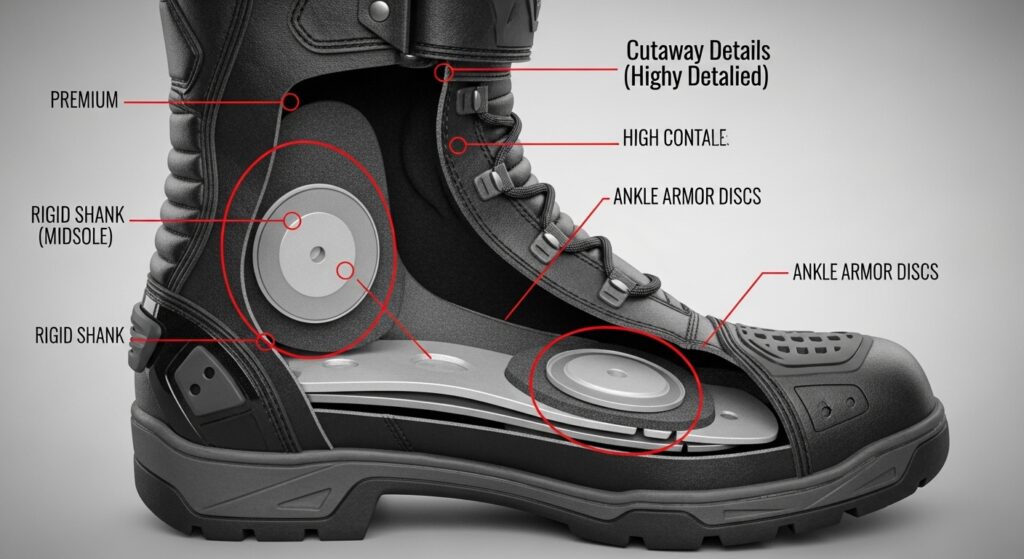
This feature measures the boot's ability to resist being squeezed sideways. If your 550 lb adventure bike tips over and lands on your foot, a flimsy sole folds, crushing the bones inside. A rigid sole, often reinforced by a steel or fiberglass shank, acts like a roll cage for your foot.
2. Ankle Protection (The Malleolus Cup)
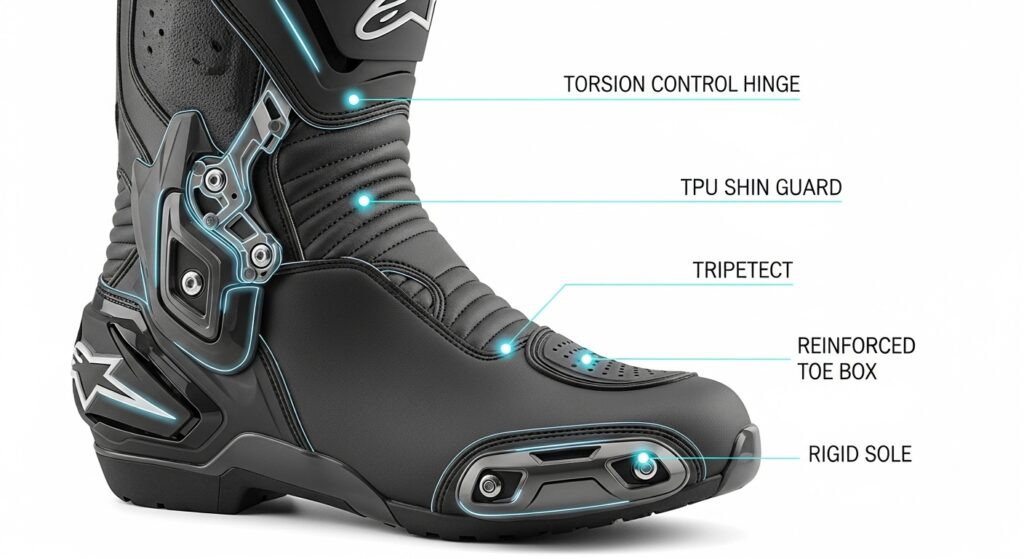
Your ankle bones (malleoli) are vulnerable because they protrude. In a slide, they can rapidly grind down on the asphalt without armor. You need armor discs or inserts—often made of TPU or energy-absorbing materials like D3O—on both the internal (medial) and external (lateral) sides of the ankle.
The Catch: Here’s where honesty matters: standard CE certification (EN 13634) does not mandate testing for ankle torsion (twisting) protection. You must look for advanced, proprietary systems specifically designed to manage twisting forces.
3. Reinforced Toe and Heel Boxes
Proper boots use thermo-plastic reinforcement in the toe box rather than steel. This prevents crushing without compromising the feel needed for shifting. Heel cups are also vital for absorbing shock if you tumble or slide.
Decoding the Label: CE Ratings Explained (EN 13634)
The CE mark (EN 13634) is the benchmark standard proving the gear has been tested. When you look at the label, you're looking for a motorcycle icon followed by a series of numbers—the 4-Digit Code:
- Height (1st Digit): 1 = Ankle high (Short). 2 = Shin high (Tall). Warning: Short boots leave your shin exposed.
- Abrasion Resistance (2nd Digit): How long the material survives sliding. Level 2 requires ≥ 12 seconds.
- Impact Cut Resistance (3rd Digit): Resistance to sharp objects. Level 2 penetration ≤ 15 mm.
- Transverse Rigidity (4th Digit): Crush resistance. Level 2 resists ≥ 1.5 kN force.
| Feature | Level 1 (Basic) | Level 2 (Superior) |
|---|---|---|
| Height (Type) | 1 (Ankle High) | 2 (Shin High) |
| Abrasion Resistance | ≥ 5 seconds | ≥ 12 seconds |
| Transverse Rigidity | 1.0 - 1.4 kN | ≥ 1.5 kN |
Advanced Tech: Stopping the Snap (Torsion Control)
Because the mandatory CE tests overlook rotational injuries, true safety demands boots that integrate torsional control systems.
- Torsion Control Systems (TCS): These hinged systems (seen in Dainese/TCX boots) guide the ankle movement, actively preventing twisting, hyper-extension (backward snap), and hyperflexion.
- FlexLock LockOut Systems: Found in heavy-duty MX/ADV boots (like Leatt). They use a mechanical stop to prevent catastrophic sideways movement. The Leatt FlexLock system is documented to reduce ankle forces by up to 37%.
- The Shank: A steel or composite stiffener running through the sole prevents your foot from bending catastrophically over the footpeg in a crash.

10 Recommended Boots Prioritizing Safety (By Riding Style)
Choosing the right boot is always a compromise between comfort and maximum safety. Here are 10 boots that prioritize crucial safety features.
ADV/Touring (Priority: Durability & Weatherproofing)

| Boot Model | Key Safety Features | Honest Advice |
|---|---|---|
| Alpinestars Toucan Adventure | Gore-Tex, heavy armor, anti-slip sole. | Premium price, but built for hard off-road use. |
| Sidi Adventure 2 | Full shin/heel/ankle protection, Gore-Tex. | Can be stiff. Highly protective ("Squeaky Sidi"). |
| Forma Adventure | Comfortable, vintage style, anti-slip. | Too flexible for hard off-roading. Great 50/50 boot. |
| Touratech Destino Ultimate | DSF hinged support, BOA fit, Vibram sole. | Very expensive and heavy. Maximum protection. |
Sport/Track (Priority: Torsion Control & Abrasion)

| Boot Model | Key Safety Features | Honest Advice |
|---|---|---|
| Dainese Torque 3 Out | D-Axial hinged ankle system, magnesium sliders. | Incredible protection but clunky for walking. |
| Alpinestars SMX 6 V2 | CE certified, lateral ankle brace, shin guard. | Versatile (track/touring) but single hinge only. |
| TCX S-TR1 | TCS (Torsion Control System), TPU shield. | Maximum safety with optimal comfort. |
| Alpinestars SuperTech R | Bio-mechanical inner bootie, full race armor. | Extremely high protection. Pricey but worth it. |
Dirt/MX (Priority: Impact & Lockout)
| Boot Model | Key Safety Features | Honest Advice |
|---|---|---|
| Leatt 5.5 FlexLock | LockOut stop reduces ankle forces by 37%. | Absolute beast. Heavy and stiff (not for walking). |
| Alpinestars Tech 7 Enduro | MX protection, Drystar waterproof membrane. | Expensive and heavy, but very comfortable. |
Summary: Invest in Protection, Not Just Style
Every pair of quality motorcycle boots requires balancing protection, comfort, and functionality. The safest gear is always the gear you actually wear consistently.
Final Checklist:
- CE Certified: Look for EN 13634 compliance.
- Level 2 Rigidity: Demand ≥ 1.5 kN crush resistance (check the 4th digit).
- Ankle & Shin Protection: Look for armor on both sides of the ankle.
- Torsion Control: Look for mechanical bracing (TCS, FlexLock, D-Axial).
Don't trust the intricate mechanical structure of your feet to anything less than proven, CE-rated protection. It’s an investment that truly pays off when things go sideways.