
Short answer: if both boots are certified to ASTM F2413, a steel toe and a composite toe meet the same impact and compression requirements. Neither is automatically safer. The real differences are weight, bulk, how they handle cold and heat, and whether they set off metal detectors. So the right choice depends on your job, not on which material sounds tougher.
This guide covers what the standard actually requires, where each toe type makes more sense, and a few boots of each type we've already compared in our roundups.
Steel Toe vs Composite Toe at a Glance
| Steel toe | Composite toe | |
|---|---|---|
| What it's made of | Steel cap | Non-metal materials such as carbon fiber, fiberglass, Kevlar or plastic |
| Meets ASTM F2413 impact and compression | Yes, if certified | Yes, if certified |
| Weight | Heavier | Usually lighter |
| Cap thickness | Thinner, so a slimmer toe box | Thicker, so a bulkier toe box |
| Cold and heat | Conducts cold and heat | Doesn't conduct cold or heat |
| Metal detectors | Sets them off | Usually doesn't (check the whole boot) |
| Electrical hazard (EH) | Can be EH rated | Can be EH rated |
| Typical price | Often cheaper | Often a bit more |
What Is Actually Inside the Boot?
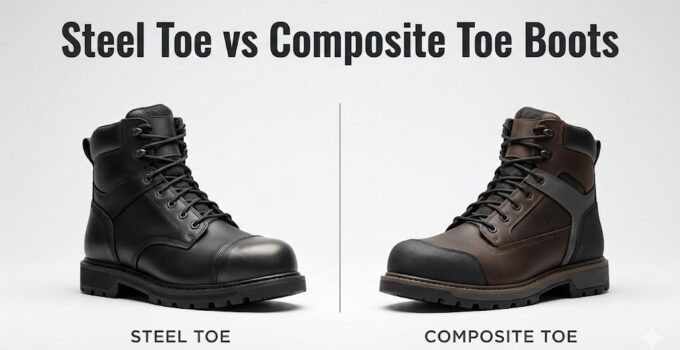
- Steel toe: a formed steel cap built into the toe of the boot. It's thin and strong, which is why steel toe boots can look fairly slim.
- Composite toe: a cap made from non-metal materials. It has to be thicker than steel to meet the same test, so composite toe boots often have a rounder, bulkier toe.
- Alloy toe: a lightweight metal cap, usually aluminum or titanium. It's thinner than composite and lighter than steel, but it's still metal.
- Carbon fiber and "nano" toes: newer non-metal caps that aim to be thinner than standard composite. See nano toe vs steel toe.
All of these are "safety toes." If your employer says "steel toe required," ask whether any ASTM-rated safety toe is accepted. More in is safety toe the same as steel toe.
Do They Meet the Same Safety Standard?
Yes. In the US, OSHA's general industry rule, 29 CFR 1910.136, requires protective footwear where workers face falling or rolling objects, objects piercing the sole, or electrical hazards, and points to the ASTM F2413 consensus standard (OSHA, retrieved 2026-09-25).
Under the current ASTM F2413, safety toes are rated at a single level for impact and compression, the "I" and "C" ratings (WorkBoots.com, retrieved 2026-09-25). That level has long meant a 75 foot-pound impact and 2,500 pounds of compression (University of Washington summary of ASTM F2413, retrieved 2026-09-25). The toe material doesn't change the test. A certified composite toe passed the same test as a certified steel toe.
How to check: look for the ASTM F2413 label inside the tongue or on the box. It lists the standard, the I and C ratings, and any extra protections:
- Mt: metatarsal protection for the top of the foot
- EH: electrical hazard protection from the sole
- PR: puncture resistance from a plate under the foot
- SD or CD: static dissipative or conductive, for electronics or explosive environments
Note that EH, puncture and metatarsal protection come from other parts of the boot, not the toe cap. A composite toe boot is not automatically EH rated, and a steel toe boot can be. Always check the label.
Where Steel Toe Makes More Sense
- Tight budgets. Steel toe boots are often the cheaper option.
- Heavy-impact jobs like steel mills, demolition and heavy equipment, where many workers prefer the thin, rigid cap. Pair it with metatarsal protection if your job calls for it. See best metatarsal guard work boots.
- A slimmer look and fit. The thinner cap leaves more room inside the same boot size.
Where Composite Toe Makes More Sense
- Long days walking. A lighter boot means less fatigue over a shift.
- Cold weather. Composite doesn't pull heat away from your toes like steel does. See best winter work boots.
- Metal detectors at airports, prisons, courthouses and some plants. Check that the shank and eyelets are non-metal too. See composite toe boots for airport security jobs.
- Electricians, who often prefer to avoid metal on the job. Still check for the EH rating.
Safety Toe Choice by Job
| Job | Common choice | Why |
|---|---|---|
| Construction | Either | Both pass the same test. Composite saves weight on long days. |
| Steel mill, foundry, demolition | Steel, often with metatarsal guard | Rigid cap and slimmer toe box. Add Mt protection if required. |
| Electrician | Composite, EH rated | No metal cap, but the EH rating is what matters. |
| Warehouse, logistics | Composite or alloy | Lighter for high step counts. |
| Airport, security, corrections | Composite | Less likely to set off metal detectors. |
| Outdoor winter work | Composite | Doesn't conduct cold. |
| Budget or occasional use | Steel | Usually cheaper. |
Steel Toe Boots Worth a Look
These come from our roundups, where we checked each Amazon listing's specs, ratings and buyer feedback (Amazon, retrieved 2026-09-25).
- Irish Setter Ely 6": steel toe, removable PU footbed, 4.5 stars from more than 1,700 ratings. Buyers call it comfortable and light for a steel toe.
- Timberland PRO Keele Ridge: steel toe industrial hiker, waterproof, EH, 4.4 stars from more than 4,400 ratings. Buyers say it feels light, like a sneaker.
- Timberland PRO Pit Boss 6": budget steel toe, EH, more than 27,000 ratings. Comfort and durability get mixed reviews.
More in our best steel toe boots.
Composite Toe Boots Worth a Look
- Timberland PRO Boondock 6": composite toe, waterproof, EH, 4.5 stars from more than 10,000 ratings. Buyers say it's well built and comfortable.
- Wolverine Overpass 6": composite toe, waterproof, removable OrthoLite footbed, 4.3 stars from more than 13,000 ratings. Buyers compare it to sneakers.
- Carhartt CMF6366 6": composite toe, EH, wide toe box, 4.4 stars from more than 4,600 ratings, about $125.
More in our best composite toe work boots.
Common Myths
- "Composite is weaker." Not if it's certified. It passed the same ASTM impact and compression test.
- "Composite toe boots are always EH rated." No. EH comes from the sole and has its own label code.
- "A boot is fine after a heavy hit if it looks OK." Don't count on it. After a serious impact or compression, replace the boot, whatever the toe material. Follow your employer's and the manufacturer's guidance.
- "Steel toes are always too heavy." Many modern steel toe boots are fairly light. The whole boot's build matters more than the cap alone.
Frequently Asked Questions
Is composite toe as safe as steel toe?
Yes, if both carry ASTM F2413 certification. They meet the same impact and compression requirements.
Does OSHA require steel toe boots?
No. OSHA's rule requires protective footwear that meets a consensus standard like ASTM F2413 where there are foot hazards. It doesn't require steel specifically. Your employer may have its own rule.
Are composite toe boots lighter?
Usually, though the whole boot's construction matters more than the cap. Alloy toes are another light option.
Which is better in cold weather?
Composite, because it doesn't conduct cold the way steel does.
Do composite toe boots set off metal detectors?
The cap won't, but check for metal shanks, eyelets or puncture plates if you pass through detectors often.
The Bottom Line
Pick the toe type for your job, not for the material. Choose steel for budget and heavy-impact work, and composite for cold weather, metal detectors and long days on your feet. Either way, check the ASTM F2413 label for the extra protections you need, like EH, Mt or PR.