
Standard safety-toe work boots protect your toes. But the top of your foot — the metatarsal bones running across the instep — is left completely exposed. In jobs where heavy objects can land on the foot from above, or where crush hazards exist at instep height, that gap in protection is a serious risk.
Metatarsal guard work boots are specifically designed to close that gap. They are a separate safety category from standard steel-toe or composite-toe boots, and they carry their own ASTM certification — the "Mt" label — that standard safety boots do not.
This page covers everything you need to choose the right pair:
- What metatarsal guard boots actually are and who needs them
- Internal vs external met guard — the key differences and how to choose
- What ASTM Mt means and how to verify it on a label
- Seven verified picks, each matched to a specific job use case
Price note: Met guard boots range from around $110 for value picks to $280+ for premium models. Prices fluctuate frequently on Amazon — always click through for current pricing before deciding.
Quick Picks: Best Metatarsal Guard Work Boots
| Label | Pick | Check Price |
|---|---|---|
| ⭐ Best Overall | Timberland PRO Titan EV 6" | Amazon → |
| 🔵 Best Internal Met Guard | Carhartt Rugged Flex 6" | Amazon → |
| 🔴 Best External Met Guard + Best Value | Iron Age Groundbreaker IA5016 | Amazon → |
| 🔥 Best for Welding | Timberland PRO Boondock 8" | Amazon → |
| 🏗️ Best Heavy-Duty | Danner Steel Yard 6" | Amazon → |
| ⚡ Best Pull-On | Carhartt Rugged Flex 8" Pull-On | Amazon → |
| 🤠 Best Mid-Range External | Ariat WorkHog XT Met Guard | Amazon → |
What Is a Metatarsal Guard Work Boot?
A metatarsal guard work boot is safety footwear with protection built over the top of the foot, designed to reduce injury from falling objects and compression hazards beyond the toe area.
The metatarsal bones run across the top of the foot from the ankle toward the toes. A standard steel-toe or composite-toe boot protects the toe box only — the metatarsal zone is completely unprotected by any standard safety-toe design.
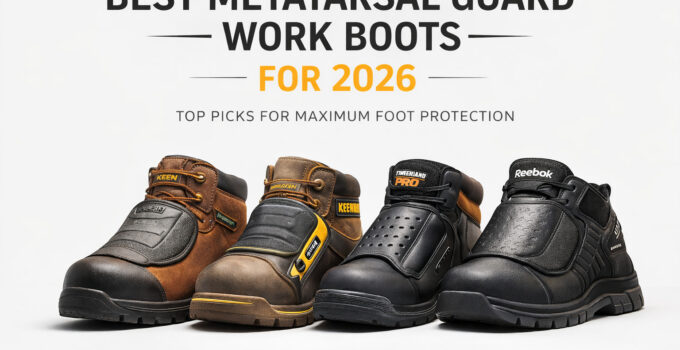
Met guard boots add a protective layer over this instep zone — either built inside the upper (internal) or mounted on the outside (external) — to absorb or redirect impact energy from falling objects and compression hazards at instep height.
This protection is classified and tested under ASTM F2413, the U.S. standard for protective footwear, with the specific designation "Mt" on the boot's internal safety label. This is an entirely separate certification from the toe impact and compression ratings — having a steel toe does not mean a boot has met guard protection.
Not every worker needs met guard boots. They are most critical where a site-specific hazard assessment or employer PPE policy identifies top-of-foot risk as significant — foundries, steel mills, heavy construction, welding, and logging are the most common environments where met guard protection is required.
Internal vs External Met Guard Boots: Which Do You Need?
This is the most important decision most buyers face when choosing a met guard boot. The two designs solve the same protection problem in different ways, and the right choice depends on your job environment and movement requirements.
| Feature | Internal Met Guard | External Met Guard |
|---|---|---|
| Guard placement | Built inside the upper | Mounted on outside of upper |
| Profile | Lower, sleeker | More industrial, visible guard |
| Snag risk | Lower | Higher in tight/confined spaces |
| Flex for kneeling/squatting | Varies by design | Some models allow good flex |
| All-day comfort | Closer to standard boot feel | Can feel bulkier; collar contact possible |
| Protection level | Both ASTM Mt-certifiable | Both ASTM Mt-certifiable |
| Best environment | Construction, general industrial, warehousing | Foundry, steel mill, welding, severe drop-hazard zones |
✅ Choose internal met guard if you move constantly, climb ladders, kneel regularly, or work construction or warehousing where a lower-profile boot is practical and your employer does not specifically mandate external guards.
✅ Choose external met guard if you work in a foundry, steel mill, or heavy fabrication environment where falling-object risk to the instep is severe, or your site PPE policy mandates external protection.
Important: Both internal and external met guards can meet ASTM Mt certification requirements when properly tested. The difference is comfort profile and task suitability — not compliance level.
What Does ASTM Mt Mean on a Work Boot Label?
ASTM F2413 is the U.S. standard for protective footwear. The "Mt" designation on the boot's internal label specifically indicates that metatarsal protection has been tested and certified — it is entirely separate from the toe impact (I) and compression (C) ratings that standard safety boots carry.
Key facts about ASTM Mt labeling:
- Older labels may show "Mt/75" (indicating 75 ft-lb impact resistance). Newer labels under the updated ASTM F2413-18 standard may use a simplified format without the numeric suffix — both are valid
- The boot must maintain internal clearance after impact so the guard does not collapse onto the foot during a strike
- EH (Electrical Hazard), SR (Slip Resistance), and PR (Puncture Resistance) are entirely separate certifications — having one does not mean having the others
💡 Pro Tip: A steel-toe boot does NOT automatically have metatarsal protection. Always look for the "Mt" marking on the safety label inside the boot. If it isn't labeled Mt, it isn't ASTM-certified for metatarsal protection — regardless of what the product name or marketing says.
Do I Need Mt Certification or Just a Met Guard Attachment?
If your employer requires ASTM-certified metatarsal protection, the boot itself must carry the Mt label. Strap-on external met guard covers worn over regular boots are not equivalent to ASTM-certified met guard footwear and should not be used as a substitute in compliant workplaces. When in doubt, verify with your site safety officer which type of protection your workplace requires.
Who Actually Needs Metatarsal Guard Work Boots?
Met guard boots are essential in environments where heavy objects can fall or compress the top of the foot. The most common industries and roles include:
- Steel mill and foundry workers
- Welders and metal fabricators
- Heavy construction and demolition crews
- Logging and forestry workers
- Automotive manufacturing line workers
- Mining and industrial maintenance
- Workers near heavy steel plate, tooling drops, or overhead lift zones
Honest qualifier: Many workers do not need met guard boots unless a site hazard assessment or employer PPE policy requires them. If your job only requires standard toe protection and regular safety-toe boots meet your workplace compliance requirements, the added bulk and weight of a met guard design may not be warranted. Choose based on your actual hazard profile — not just because met guard boots are available.
How We Chose These Met Guard Work Boots
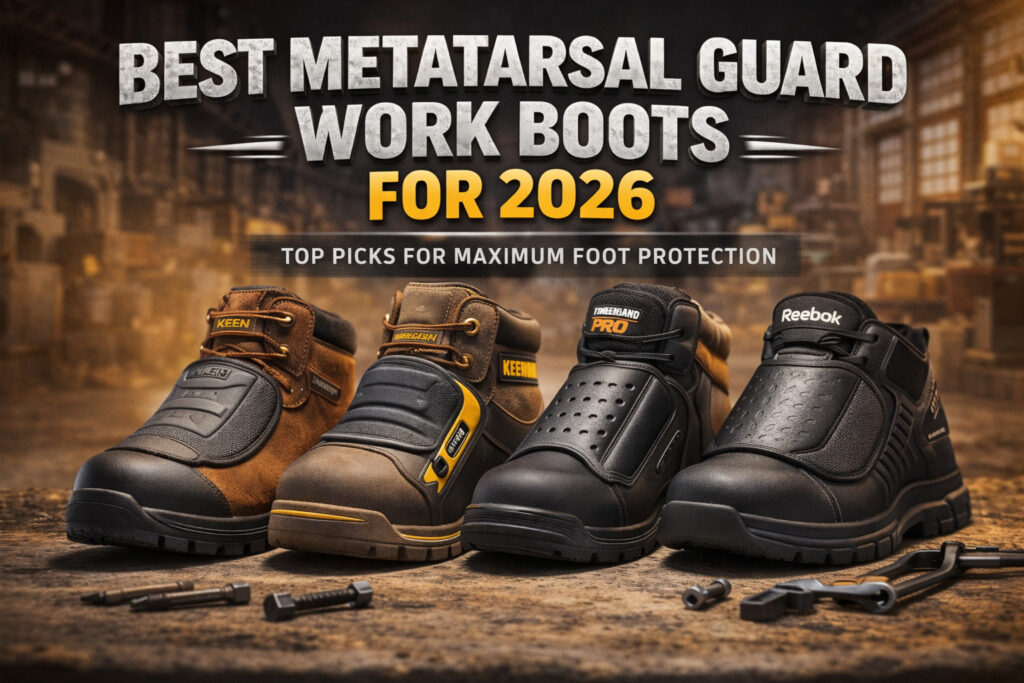
Discover the top metatarsal guard work boots for 2026!
Every boot in this roundup was selected based on verified criteria — not marketing claims or list popularity. Evaluation factors included:
- Confirmed met guard design and ASTM Mt labeling verified against manufacturer and retailer pages
- Met guard type (internal or external) confirmed per model
- Toe type and hazard pairing (steel, alloy, composite)
- Outsole grip, heat resistance, and oil resistance verified where relevant
- EH certification confirmed separately from met guard status
- Weight and bulk tradeoff for daily wear
- Break-in profile and long-shift comfort notes
- Brand reputation and warranty availability
- Width availability and job-specific fit notes
- Balanced buyer reception — consistent positives and confirmed criticisms
"We prioritize boots that solve a specific job-site problem. If a boot appeared on other roundup lists but could not be verified for its safety certifications, met guard type, or fit profile, it was not included."
Quick Comparison: Best Metatarsal Guard Work Boots
| # | Boot | Met Guard | Toe | ASTM Mt | EH | Approx. Price | Best For | Check Price |
|---|---|---|---|---|---|---|---|---|
| 1 | Timberland PRO Titan EV 6" | Internal | Composite | ✅ | ✅ | ~$160–$170 | Best overall, general industrial | Amazon → |
| 2 | Carhartt Rugged Flex 6" | Internal (Poron XRD) | Composite | ✅ | ✅ | ~$185–$200 | Best internal, all-day wear | Amazon → |
| 3 | Iron Age Groundbreaker IA5016 | External | Steel | ✅ Mt/75 | ✅ | ~$110–$130 | Best external + best value | Amazon → |
| 4 | Timberland PRO Boondock 8" | External | Composite | ✅ | ✅ | ~$255–$280 | Best for welding + heavy industrial | Amazon → |
| 5 | Danner Steel Yard 6" | External | Steel | ✅ F2413-24 | ✅ | ~$215–$230 | Best heavy-duty/premium | Amazon → |
| 6 | Carhartt Rugged Flex 8" Pull-On | Internal | Composite | ✅ | ✅ | ~$200–$215 | Best pull-on / lace-free | Amazon → |
| 7 | Ariat WorkHog XT Met Guard | External | Steel | ✅ | Check listing | ~$110–$130 | Best mid-range external, trades | Amazon → |
⚠️ Price note: All prices are approximate at time of writing and fluctuate on Amazon. Click through for current pricing before purchasing.
Best Metatarsal Guard Work Boots: Reviewed
Each boot below was selected for a specific job-site use case. Specs were verified against manufacturer pages and retailer listings. Prices are approximate.
1. Timberland PRO Titan EV 6" — Best Overall
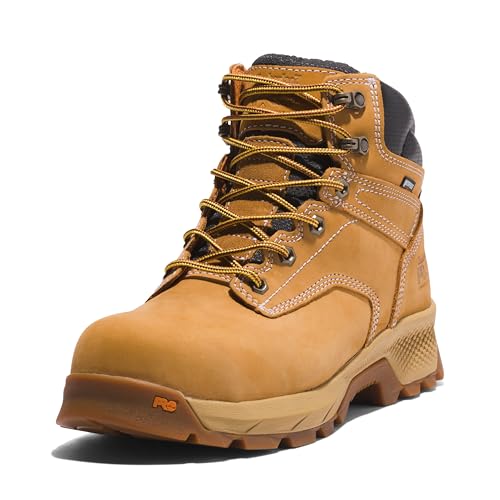
One-line verdict: The best all-around internal met guard boot for general construction and industrial use — certified, comfortable, and genuinely lighter than most competitors in this class.
Why This Boot Stands Out
The Timberland PRO Titan EV is one of the few boots in this category where the Anti-Fatigue Technology footbed does double duty — it functions as the met guard base as well as the cushioning system. The guard is integrated rather than a separate insert, which keeps the instep profile noticeably lower than many competing internal met guard designs.

The Hover Spring foam midsole makes this one of the lighter options in the met guard category despite carrying full ASTM Mt and EH certification — a real advantage for workers who are on their feet and moving all day on construction or general industrial sites.

The Ladder Lock heel is a standout feature that most competitors don't offer — it provides enhanced grip on ladder rungs, which is a meaningful safety detail for construction workers who climb regularly. The Microban antimicrobial lining controls odor through long shifts.

Key Specs
- Met guard: Internal — anatomical polyurethane Anti-Fatigue Technology
- Toe: Asymmetrical composite safety toe
- Upper: Full-grain leather
- Outsole: Timberland PRO rubber — heat, oil, slip, and abrasion-resistant
- ASTM: Mt-certified, EH-certified
- Waterproof: No (standard version) — waterproof version available separately
Watch-Outs
- Standard version is not waterproof — specify the waterproof variant if your job requires it
- Cement construction means no resoling — this is a replace-not-repair boot
- Asymmetrical composite toe runs slightly wide; check fit notes for narrow-footed workers
Best for: Construction workers, general industrial, and warehouse workers who need a lower-profile internal met guard with EH certification and genuine all-day comfort.
2. Carhartt Rugged Flex 6" Lace-Up Met Guard — Best Internal Met Guard

One-line verdict: The best internal met guard boot for workers who need all-day comfort with genuine ASTM Mt certification — the Poron XRD material directly answers "is internal as protective as external?
Why This Boot Stands Out
The Carhartt Rugged Flex 6" uses Poron XRD — a rate-dependent material that stays soft and pliable during normal wear but hardens instantly on impact. This is the key differentiator from rigid internal met guard inserts: the boot feels like a standard work boot throughout the day and only activates its protection when it's needed. That combination of all-day comfort and on-demand protection is what earns this boot the best internal met guard slot.

The Rugged Flex outsole is notably more flexible than typical rigid work-boot soles — it bends and moves with the foot, which matters for workers who climb, kneel, or crouch regularly. Most heavy met guard boots fight against these movements; this one accommodates them.

Having both EH and Mt confirmed on an internal met guard boot at this price point is less common than it should be. The Carhartt delivers both without pushing into premium territory.

Key Specs
- Met guard: Internal — Poron XRD rate-dependent material
- Toe: Composite
- Upper: Full-grain leather
- Outsole: Carhartt Rugged Flex rubber — slip and oil-resistant
- ASTM: F2413-18 Mt-certified, EH-certified
- Waterproof: Confirmed on lace-up version
Watch-Outs
- Medium width confirmed on most listings — wide width not universally available; verify per size before ordering
- Internal met guard adds instep volume — workers with a high instep should check fit or try in-store before ordering
- Composite toe only — no alloy or steel toe option in the met guard configuration
Best for: General construction, industrial, and manufacturing workers who want the most comfortable internal met guard boot with full ASTM Mt and EH certification.
3. Iron Age Groundbreaker IA5016 6" — Best External Met Guard + Best Value

One-line verdict: The best external met guard boot under $130 — Goodyear welt construction, all four ASTM ratings on one label, and Kevlar stitching at a price most competitors can't match.
Why This Boot Stands Out
The Iron Age Groundbreaker IA5016 carries the most complete ASTM certification of any boot in this roundup: I/75, C/75, Mt/75, and EH — all four ratings confirmed on a single label. Most budget work boots carry one or two of these. Getting all four at ~$110–$130 is genuinely unusual in this category.

Goodyear welt construction at this price point is the other standout. Almost every budget met guard boot uses cement construction — the sole is glued rather than stitched. Goodyear welt creates a mechanical bond between the sole and upper, and critically, it means this boot can be resoled when the outsole wears out. That dramatically extends the usable lifespan and changes the long-term value calculation significantly.

Kevlar stitching throughout the upper adds abrasion and heat resistance — relevant in trade environments where standard thread wears through quickly. The oil, slip, and chemical-resistant rubber outsole handles foundry floors, machine shop surfaces, and greasy industrial environments effectively.

Key Specs
- Met guard: External
- Toe: Steel
- Upper: Full-grain black leather with Kevlar stitching
- Outsole: Solid rubber — oil, slip, and chemical-resistant
- ASTM: F2413-11 I/75 C/75 Mt/75 EH — all four confirmed
- Construction: Goodyear welt — resoleable
- Insole: Removable EVA cushion insert
Watch-Outs
- External guard is visible and industrial — not suitable for workers who need a lower-profile boot
- Basic EVA insole — an aftermarket upgrade is recommended for workers on their feet for long shifts
- Available in black only — no brown option
- Stiff welt construction requires a break-in period of 2–3 weeks before reaching full comfort
Best for: Foundry workers, fabricators, and industrial workers who need external met guard protection with full ASTM coverage and want long-term durability from a resoleable construction at a budget price.
4. Timberland PRO Boondock 8" — Best for Welding
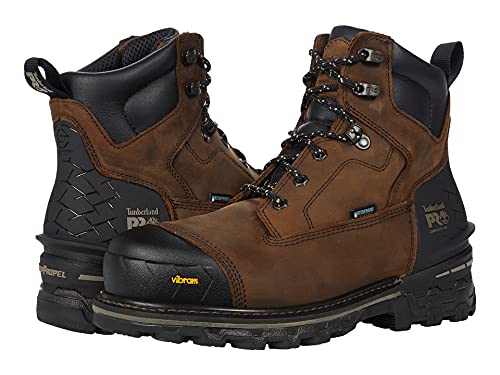
One-line verdict: The most complete welding and heavy industrial boot in this roundup — external Flex-integrated met guard, EH certification, waterproof leather, and a heel system built for unstable industrial flooring.
Why This Boot Stands Out
The Timberland PRO Boondock differentiates itself from other external met guard boots with the PRO Flex system integrated into the external guard design. Traditional external met guards are rigid and can restrict ankle movement significantly — the Flex-integrated guard is specifically engineered to allow a better range of motion for workers who need to crouch, kneel, or move through tight spaces despite working in heavy industrial environments.
The 8-inch height is a deliberate choice for welding and foundry environments — it provides a larger coverage zone against sparks, hot debris, and heat splash above the ankle. Combined with the premium full-grain waterproof leather upper, this boot addresses both the met guard requirement and the heat/spark exposure hazards that welding environments present simultaneously.
The ExoSpine heel support combined with the external heel cup delivers a notably stable heel lockdown on uneven industrial flooring — relevant for foundry and mill environments where floor surfaces are rarely flat or clean.
Key Specs
- Met guard: External with Timberland PRO Flex range-of-motion system
- Toe: Asymmetrical composite safety toe
- Upper: Premium full-grain waterproof leather
- Outsole: Lightweight abrasion-resistant TPU — oil, slip, and abrasion-resistant
- ASTM: Mt-certified, EH-certified
- Waterproof: Yes
- Other: Non-metallic puncture-resistant plate, ExoSpine heel support, Microban antimicrobial lining
Watch-Outs
- Highest price in this roundup at ~$255–$280 — the Flex guard technology and full certifications justify the cost, but it's a significant investment
- 8-inch height means a longer break-in period than 6-inch boots — allow 2–3 weeks before expecting full comfort
- External guard can print visibly under some pants — may not suit workers who move between job site and office environments
Best for: Welders, foundry workers, and heavy fabricators who need external met guard protection with EH certification, heat-resistant leather, and a guard design that doesn't completely sacrifice ankle mobility.
5. Danner Steel Yard 6" Steel Toe — Best Heavy-Duty
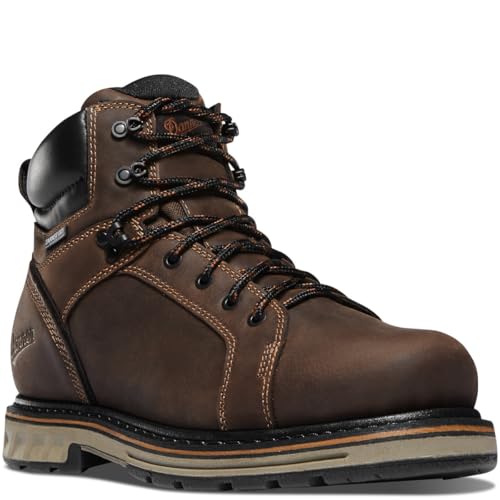
One-line verdict: The premium pick for workers who want the most current ASTM compliance standard, a 365-day warranty, and a full-grain leather build that performs in both indoor industrial and outdoor job-site conditions.
Why This Boot Stands Out
The Danner Steel Yard is one of the few boots in this roundup certified to ASTM F2413-24 — the most current version of the U.S. protective footwear standard. Most competing boots still carry F2413-18 or older labeling. This matters for worksites that specifically require compliance with the current standard and for buyers who want assurance that their protection has been tested against the latest requirements.

The 365-day warranty is above-average for work boots at any price point — Danner is offering a full year of coverage against defects and construction failures. That level of warranty confidence is a meaningful signal about build quality and is worth factoring into the total cost of ownership calculation.

The full-grain leather upper paired with the Danner Dry waterproof membrane performs across a wide range of job environments — indoor foundry floors, outdoor construction sites, and wet industrial settings. The oil and slip-resistant Steel Yard rubber outsole handles greasy surfaces effectively.

Key Specs
- Met guard: External (confirmed via retailer safety listings)
- Toe: Steel
- Upper: Full-grain leather
- Outsole: Danner Steel Yard rubber — oil and slip-resistant
- ASTM: F2413-24 I/C EH compliant
- Waterproof: Yes — Danner Dry membrane
- Shank: Steel
- Warranty: 365 days confirmed
Watch-Outs
- Steel toe only in the met guard configuration — no composite or alloy option
- At 70 oz per pair, this is one of the heavier boots in this roundup — better suited for stationary-heavy roles than jobs requiring significant walking distance
- Not recraftable despite Danner's general reputation for recraftability — confirmed on the Steel Yard spec sheet
Best for: Heavy industrial workers, foundry staff, and construction workers who want the most current ASTM compliance standard with a full-year warranty and premium waterproof construction.
6. Carhartt Rugged Flex 8" Pull-On Met Guard — Best Pull-On

One-line verdict: The best lace-free met guard boot for welding and foundry environments where laces are themselves a heat and spark hazard.
Why This Boot Stands Out
In welding and foundry environments, boot laces are a genuine hazard — they can catch sparks, melt, and expose the foot to burns. The Carhartt Rugged Flex pull-on eliminates that hazard entirely by removing laces from the design. This is not just a convenience feature — it is a practical safety advantage in the specific environments where met guard protection is most critical.
The internal XRD protection material uses the same Poron-based technology as the lace-up version — rate-dependent hardening on impact while staying flexible during normal wear. EH certification combined with composite toe and internal met guard in a pull-on design is a genuinely rare combination at this price point.

The 8-inch height provides added ankle coverage against sparks and heat splash — the same advantage as the Timberland Boondock but in an internal met guard configuration and without laces. For workers who move frequently and dislike external guard bulk, this offers meaningful protection in a more practical package.

Key Specs
- Met guard: Internal — XRD Poron rate-dependent material
- Toe: Composite
- Upper: Full-grain leather
- ASTM: Mt-certified, EH-certified (confirmed)
- Waterproof: Yes
- Design: Pull-on — no laces
Watch-Outs
- Pull-on fit cannot be fine-tuned the way laced boots can — instep height and calf circumference matter more here; check brand sizing guide carefully before ordering
- 8-inch height adds weight compared to 6-inch alternatives
- Some reports of stiff break-in at the ankle due to the tall unlined shaft — budget 2–3 weeks before expecting full comfort
Best for: Welders, foundry workers, and fabricators who want lace-free met guard protection with EH certification to eliminate lace exposure to sparks and heat.
7. Ariat WorkHog XT Met Guard — Best Mid-Range External

One-line verdict: The best external met guard boot for trades workers who prefer Ariat's Western-influenced last and want external protection at a mid-range price point.
Why This Boot Stands Out
Ariat's WorkHog XT Met Guard brings the brand's well-regarded Western-influenced last and fit profile to the met guard category. For trades workers who have built their footwear preferences around Ariat's sizing and comfort geometry, this is the most natural way to add met guard protection without switching to an unfamiliar boot fit.

The WorkHog XT carries Ariat's ATS (Advanced Torque Stability) technology in the midsole — a four-layer system designed to reduce foot fatigue during long shifts while maintaining stability on uneven surfaces. This puts the comfort level above basic EVA midsole designs common in other external met guard boots at this price range.

At ~$110–$130, it competes directly with the Iron Age Groundbreaker IA5016 on price. The key difference is fit profile — Ariat's last suits workers who prefer the wider toe box and traditional Western boot geometry, while the Iron Age suits workers who prefer a more conventional industrial work boot shape.

Key Specs
- Met guard: External
- Toe: Steel
- ASTM: Mt-certified — verify current listing at time of purchase as Ariat updates compliance labeling seasonally
- EH: Check current product listing — verify before purchasing
- Midsole: ATS four-layer stability system
Watch-Outs
- ASTM Mt labeling should be verified against the current Ariat product page before purchasing — Ariat updates compliance labeling per model year and listings change
- Not waterproof in standard configuration — confirm before buying if water resistance is required
- More limited width availability than Carhartt or Timberland options in this roundup
Best for: Trades workers who are already familiar with Ariat's fit and want external met guard protection at a mid-range price without switching boot brands.
How to Choose the Right Metatarsal Guard Work Boot
By Hazard Type
Falling objects and crush zones
If your job involves steel plate handling, heavy tooling drops, or working under overhead lifts, met guard protection directly addresses top-of-foot crush and impact risk. Both internal and external designs can meet ASTM Mt requirements — your employer's site hazard assessment or PPE policy will often specify which type is required.
Heat, sparks, and hot surfaces
Welding and foundry environments add a heat layer to the hazard picture. Look for full-grain leather uppers confirmed for heat exposure resistance, outsoles with verified heat-resistant ratings, and EH certification if electrical hazard is also present. Do not assume a boot is welding-safe simply because it has a met guard — verify the upper material and outsole spec independently.
Wet, oily, or chemical floors
Foundry floors, machine shops, and industrial maintenance areas often combine met guard requirements with serious slip risk. Look for boots carrying SR (Slip Resistance) alongside the Mt label. Oil-resistant outsoles are a minimum baseline — chemical-resistant uppers are worth checking in processing or maintenance environments.
Long-shift movement jobs
Construction workers, warehouse staff, and general industrial workers who move constantly, climb ladders, or kneel frequently should prioritize lower-bulk internal met guard designs. External guards add measurable weight and can snag on ladder rungs or catch in tight spaces — a real issue across long shifts involving repeated movement.
By Met Guard Type
Internal met guard — better for jobs requiring frequent movement, climbing, or kneeling. Lower snag risk. Feels closer to a standard work boot throughout the day. Poron XRD-style materials harden on impact and stay soft during normal wear — a meaningful comfort advantage over rigid inserts.
External met guard — better suited for severe impact environments like foundries, steel mills, and heavy fabrication. Some external designs — specifically the Timberland PRO Boondock's Flex-integrated guard — allow a good range of ankle motion. Do not assume all external guards are equally restrictive; check by model.
Bottom line: If your employer specifies one type, follow that requirement. If you have a choice, weigh your movement frequency against the severity of the instep drop and crush hazard at your specific site.
By Toe Type
- Steel toe: Maximum traditional protection. Heavier than alternatives but well-tested across decades of industrial use
- Alloy toe: Same impact and compression rating as steel under ASTM standards but measurably lighter — a strong option when you need met guard plus lower weight
- Composite toe: Non-metallic and non-conductive — preferred in electrical hazard environments and airport or security checkpoint settings. Slightly bulkier than alloy at equivalent protection levels
By Comfort on Long Shifts
- Break-in time: External met guard boots often take longer to break in due to additional structure near the instep — budget 2–3 weeks before expecting full comfort
- Insole replaceability: A removable insole lets you upgrade to an aftermarket option for long shifts. The Iron Age IA5016 and Carhartt Rugged Flex both include removable footbeds
- Collar padding: Padded collars reduce ankle irritation, particularly with external guards where the guard edge can contact the ankle collar
- Moisture management: Moisture-wicking liners matter in industrial environments where footwear cannot be changed mid-shift — Microban treatment on both Timberland PRO models is worth noting
- Weight fatigue: The Danner Steel Yard at 70 oz per pair and the Timberland Boondock 8" are the heaviest options — factor this in for movement-heavy roles
By Fit
Fit varies significantly across work-boot brands, and met guard structure changes how the instep area feels compared to a standard boot. Before ordering:
- Internal met guards occupy instep volume — workers with a high instep may need a wider width or looser lace tension in the instep zone
- External guards can raise effective instep volume and change how the collar sits — check whether the guard edge contacts the ankle before committing
- Width availability matters: Carhartt and Timberland PRO options offer multiple width choices; the Iron Age IA5016 and Ariat WorkHog have more limited width ranges — verify per size
- Do not apply a blanket half-size-up rule — check brand-specific fit guides and instep notes per model
Met Guard Boots vs Steel Toe Boots: Key Differences
| Feature | Steel Toe Only | Met Guard Boot |
|---|---|---|
| Toe box protection | ✅ | ✅ |
| Top-of-foot (instep) protection | ❌ | ✅ |
| ASTM Mt label required | ❌ | ✅ |
| Suited to instep drop/crush hazards | Limited | Yes |
| Typical weight | Lighter | Heavier (external especially) |
| Required by OSHA in high-risk sites | Situation dependent | Yes in some classifications |
If your employer's hazard assessment only requires impact and compression protection at the toe, a standard safety-toe boot meets that requirement. Met guard boots are specifically for environments where top-of-foot risk is identified as significant enough to warrant the additional protection and weight penalty. When in doubt, consult your site safety officer or employer PPE policy before purchasing.
Metatarsal Guard Work Boots — Common Questions
What does Mt mean on a work boot label?
Mt stands for metatarsal protection under ASTM F2413. A boot labeled Mt has passed testing to protect the top of the foot against impact and compression hazards — beyond what the toe cap alone covers. Older labels show "Mt/75" indicating 75 ft-lb impact resistance; newer labeling under the updated ASTM F2413-18 standard may not include the numeric suffix. Both formats indicate a compliant certified boot.
Are metatarsal guard boots required by OSHA?
OSHA does not universally mandate a specific boot type. Employers are required to assess foot hazards at each site and provide appropriate PPE. In environments where top-of-foot crush or impact risk is identified — foundries, steel mills, logging, heavy construction — met guard boots are commonly required under employer site-specific PPE policies.
Are internal met guards as protective as external met guards?
Yes — both can meet ASTM Mt certification requirements when properly tested. The difference is comfort profile, bulk, and fit for different work movements — not the raw protection level. Poron XRD-based internal guards like those in the Carhartt Rugged Flex are rate-dependent materials that harden on impact while remaining flexible during normal wear.
Do all steel-toe boots have metatarsal protection?
No. Steel-toe protection and metatarsal protection are entirely separate features under ASTM F2413. A steel-toe boot protects the toes only. Always look for the "Mt" marking on the safety label inside the boot if you specifically need top-of-foot protection.
Can I add a met guard attachment to my existing boots?
Strap-on external met guard covers exist, but they are not equivalent to ASTM Mt-certified footwear. If your employer requires ASTM-certified metatarsal protection, only boots carrying the Mt label on the internal safety label meet that requirement. Add-on attachments should not be used as a substitute for certified met guard boots in compliant workplaces.
Are met guard boots good for welding?
Yes, but welding also requires heat-resistant leather and often EH (Electrical Hazard) certification alongside the met guard protection. Met guard alone is not sufficient for welding environments — verify the upper material, outsole heat resistance, and EH rating on the specific boot before purchasing. The Timberland PRO Boondock and Carhartt Rugged Flex pull-on are the strongest welding picks in this roundup.
What is the difference between Mt and EH ratings?
Mt refers to metatarsal impact protection. EH (Electrical Hazard) means the boot provides secondary insulation against electrical ground fault. They are entirely separate ASTM certifications under F2413. A boot can carry one, both, or neither — always check the internal safety label for each designation independently before assuming a boot covers both hazard types.
Which Metatarsal Guard Boot Is Right for You?
The right met guard boot depends entirely on your specific job hazards and movement requirements — not just the price tag.
- ✅ Choose the Timberland PRO Titan EV if you want the best all-around internal met guard for general construction or industrial use — composite toe, EH-rated, Anti-Fatigue footbed, Ladder Lock heel. Check price →
- ✅ Choose the Carhartt Rugged Flex 6" if all-day comfort with Poron XRD internal protection is the priority — especially on jobs requiring constant movement and climbing. Check price →
- ✅ Choose the Iron Age Groundbreaker IA5016 if you want the best value external met guard boot with Goodyear welt construction and all four ASTM ratings on one label. Check price →
- ✅ Choose the Timberland PRO Boondock 8" if you need the most complete welding and foundry boot — external Flex guard, EH, waterproof leather, and full certification. Check price →
- ✅ Choose the Danner Steel Yard if you want the most current ASTM F2413-24 compliance standard with a 365-day warranty. Check price →
- ✅ Choose the Carhartt Rugged Flex 8" Pull-On if you need a lace-free design to eliminate spark exposure to laces in welding or foundry environments. Check price →
- ✅ Choose the Ariat WorkHog XT Met Guard if you prefer Ariat's Western-influenced fit and want external met guard protection at a mid-range price. Check price →
↑ Jump back to the Quick Picks box at the top to compare all prices at a glance.