
Last Updated: February 2026 | By: The BootsGuru Team
Most "safety sneakers" promise comfort — then fail you somewhere around hour six. Your heels ache. Your arches give up. And the shoe that looked great in the product photo feels like a compromise you're paying for in pain.
That's the trap the work sneaker category has been stuck in: light enough to feel like a sneaker, but not comfortable enough to actually replace your boots. Or the opposite — legitimate safety credentials packed into a shoe that's heavier than the "athletic" label suggests.
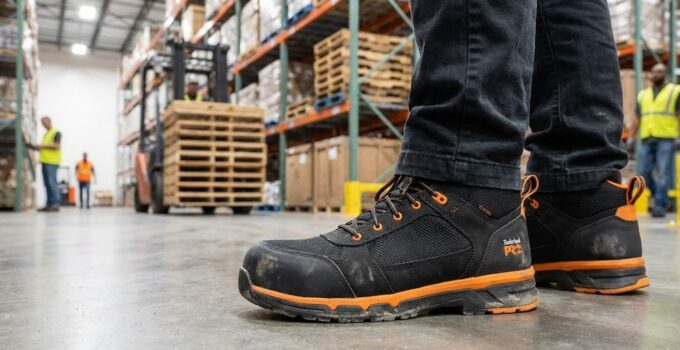
The Timberland PRO Radius Mid Composite Safety Toe (Black/Orange, 2024) goes after that gap directly. It looks like a mid-top training shoe. But underneath — composite toe, EH rating, Anti-Fatigue Technology footbed, HoverSpring™ foam midsole, and a full stack of ASTM certifications that hold up to real OSHA scrutiny.
On paper, it's the rare work sneaker that doesn't ask you to compromise. But real-world users have some things to say about durability and sizing that the product page won't tell you.
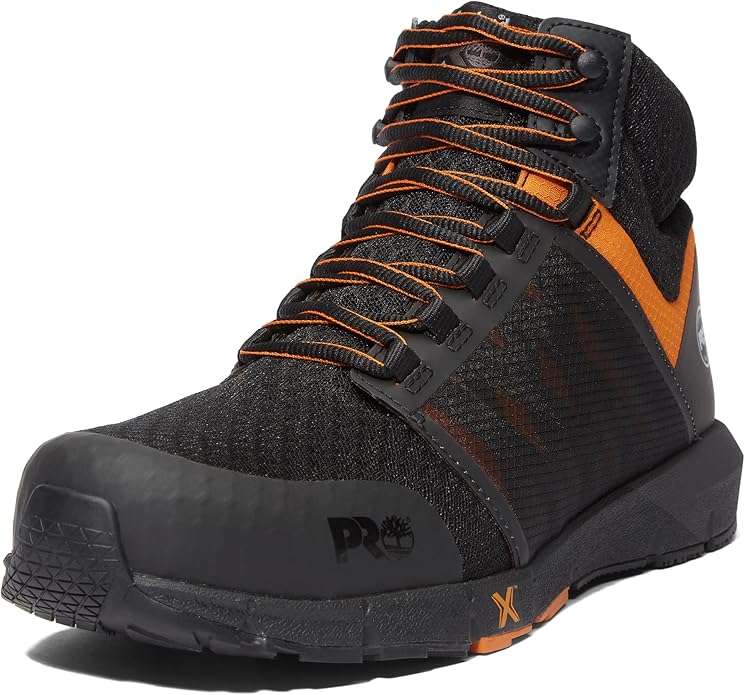
timberland pro radius mid
We've dug into verified certifications, analyzed long-term wear reports from delivery drivers, warehouse workers, and manufacturing staff, and compared it head-to-head against three direct competitors. Here's the honest verdict.
⚡ QUICK VERDICT
4.5 / 5
★★★★½
✅ BEST FOR
Warehouse workers, delivery drivers, manufacturing floor staff, operations supervisors, electricians (light work)
💰 PRICE
~$110–$130
📐 SIZE TIP
Order half a size down
💪 BIGGEST STRENGTH
Sneaker comfort + full ASTM safety credentials with near-zero break-in time
⚠️ BIGGEST WEAKNESS
Outsole wears fast on rough surfaces; not waterproof
Bottom line: The strongest composite toe work sneaker for controlled indoor environments. If you're on warehouse or manufacturing floors 8–12 hours a day and the idea of waterproofing doesn't apply to your job, this is a hard shoe to beat.
📐 Section 1: Timberland PRO Radius Mid — Full Specs
Before anything else, here's what you're actually getting. These specs are verified against Timberland's official product page and ASTM certification documentation.

| Feature | Detail |
|---|---|
| Upper | Raptek™ microfiber + breathable mesh with abrasion-resistant reinforcements |
| Safety Toe | Composite — non-metallic, asymmetrical, metal-detector friendly |
| Safety Standards | ASTM F2412-18a / ASTM F2413-18 I/C (Impact & Compression) |
| Electrical Hazard | ASTM F2892-18 EH rated |
| Midsole | HoverSpring™ lightweight foam |
| Footbed | Anti-Fatigue Technology PU + OrthoLite® (removable) |
| Outsole | Timberland PRO rubber — heat, oil, slip & abrasion resistant |
| Slip Rating | Mark II oily/wet .55 on American Olean tile (ASTM F2913-19) |
| Flex Technology | Timberland PRO FLEX — anatomical flex grooves + stretch fabrics |
| Lining | ReBOTL™ (≥50% recycled plastic) — moisture-wicking, Microban® antimicrobial |
| Height | Mid-top |
| Closure | Lace-up with top lace hooks |
| Metal Free | Yes — mutilation-free, metal-detector friendly |
| Waterproof | No |
| Weight | 1.41 lbs per shoe (size 11) |
| Colorways (2024) | Black/Orange, Black Raptek, Navy/Charcoal, Grey/Navy |
🔬 Section 2: Design & Build Quality
The Upper: Raptek Microfiber + Mesh
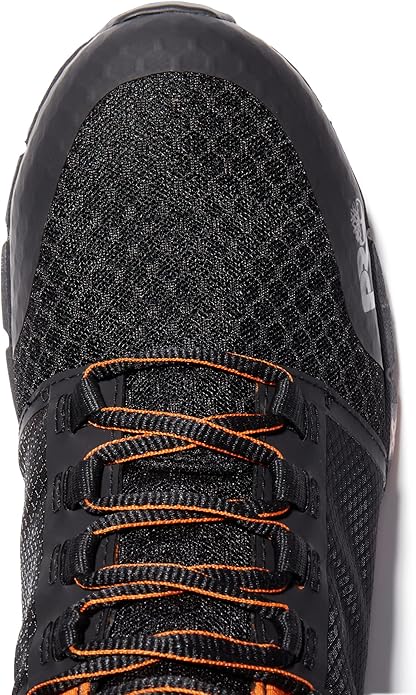
timberland pro radius mid3
Timberland replaces traditional leather here with Raptek microfiber — a non-solvent synthetic material with better wicking, faster drying, and less cracking over time than natural leather. It won't need conditioning. It won't stiffen in cold storage. And it won't crack down the toe box after six months of flexing.
The trade-off is that mesh panels, while excellent for breathability, are a durability concern under heavy abuse. Multiple long-term users report cracking or tearing at the toe box mesh after several months of daily wear in rough environments. This is worth knowing upfront — the Radius Mid is optimized for indoor industrial environments, not outdoor rough terrain.
For warehouse, manufacturing, or service environments where breathability matters more than abrasion resistance, the mesh-and-Raptek combination is genuinely well-executed.
Mid-Top Height — The Right Compromise
The Radius Mid sits higher than a standard athletic work shoe but well below a 6" boot. That mid-top position does specific things well:
- Extra ankle structure during lateral movement on warehouse floors
- More support when stepping in and out of delivery vehicles all day
- Better stability when climbing stairs, maneuvering around equipment, or kneeling
- A cleaner look for supervisors and workers who move between floor and office environments
It does not provide heavy-duty ankle protection for logging, roofing, or uneven terrain. That's not what this shoe is designed for, and pretending otherwise would be misleading.
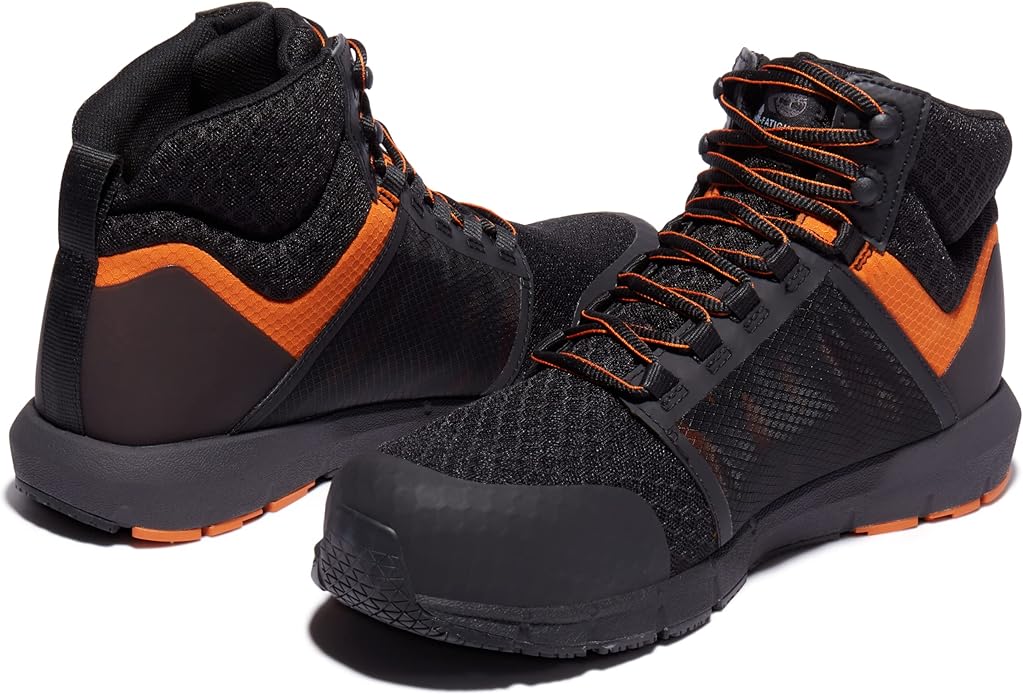
timberland pro radius mid4
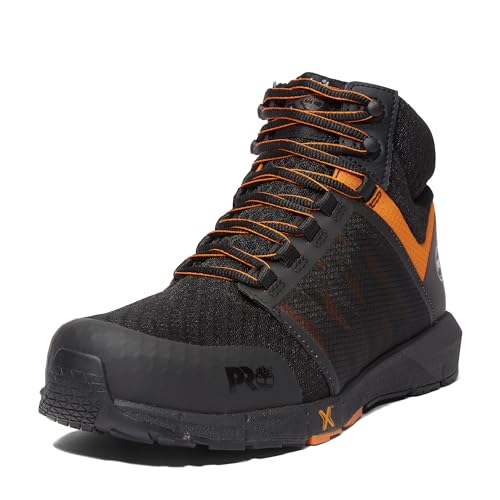
Black/Orange 2024 Colorway
The updated black and orange colorway sits at a useful middle ground — industrial-looking without being garish. The orange accents add a degree of visibility in busy work environments and give the shoe a modern athletic aesthetic that reads as intentional rather than incidental. If you prefer lower profile, the all-Black Raptek variant is available. For workers who go from the shop floor to the front office, either option works.
🛡️ Section 3: Safety Features — What the Certifications Actually Mean
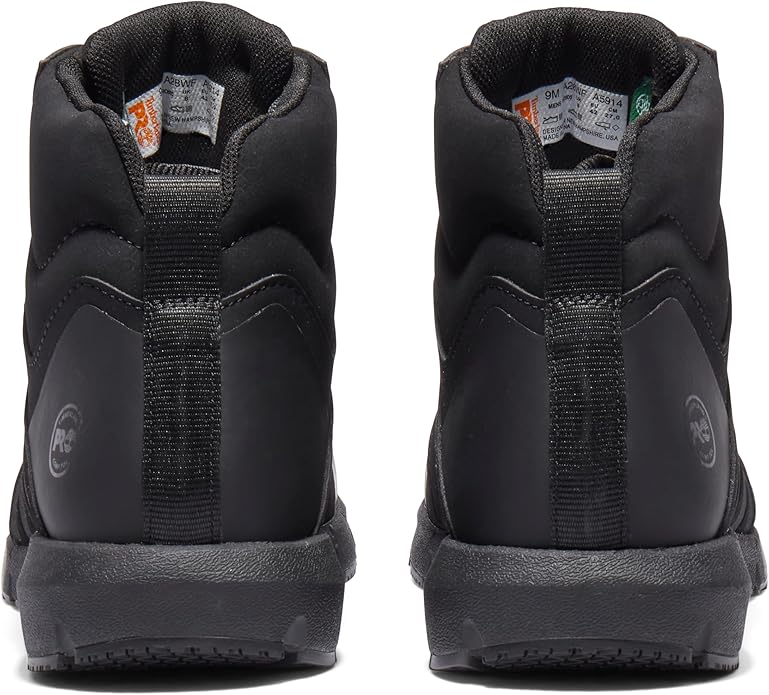
timberland pro radius mid44
This section matters. Work shoe marketing is full of vague claims — "protective," "safety-ready," "job-site approved." The Radius Mid backs its claims with specific ASTM standards. Here's what each one means in plain language.
Composite Safety Toe
Standard: ASTM F2412-18a / F2413-18 I/C
What it means: Tested to withstand 75 ft-lbs of impact and 2,500 lbs of compression without deforming. The asymmetrical shape follows your toe box naturally — no pinching at the outside toe. Non-metallic, so no temperature transfer and no metal detector trips.
One Zappos reviewer put a front rider pallet jack over their foot: "I didn't feel anything — it just scared me and left a mark on the shoe."
Electrical Hazard (EH)
Standard: ASTM F2892-18
What it means: Secondary underfoot protection against accidental contact with live electrical circuits up to 600 volts in dry conditions. Important clarification: EH-rated footwear is secondary protection only — it does not replace insulated gloves, rubber mats, or other primary PPE for electrical work.
Who benefits most: electricians on light-duty installs, HVAC technicians, facilities maintenance staff.
Slip Resistance
Standard: ASTM F2913-19
Rating: Mark II oily/wet .55 on American Olean tile
What it means: A coefficient of friction above .40 is generally considered slip-resistant; .55 is a solid score. Tested on oily, wet tile — the worst-case scenario for most indoor environments. Restaurant workers, hospital staff, and warehouse workers with wet or oily floors will get real protection here.
Metal-Free Construction
What it means: No metal anywhere — composite toe, synthetic upper, no metal hardware. Zero risk of triggering metal detectors. Also "mutilation-free" — no components that can scratch polished floors or leave marks in clean environments.
This is the feature that makes the Radius Mid the go-to for Amazon warehouse workers, airport ground crew, hospital staff, and anyone who walks through security checkpoints during the workday.
💆 Section 4: Comfort Technology — How It Actually Feels
HoverSpring™ Foam Midsole
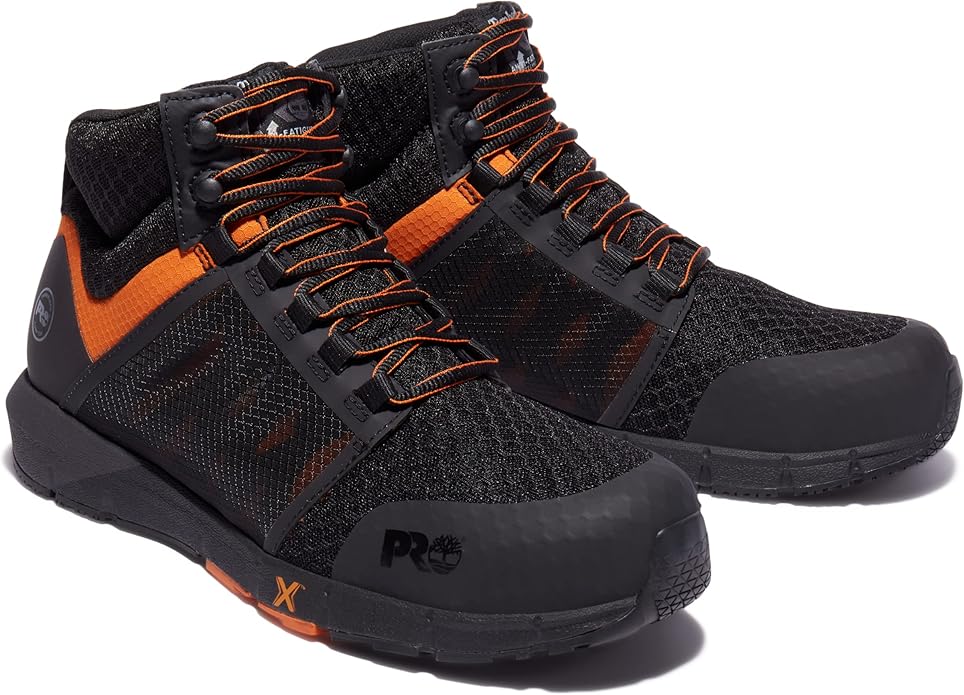
timberland pro radius mid2
The midsole is where most cheap work sneakers cut corners — stiff EVA, minimal cushion, dead underfoot feel by noon. Timberland uses their HoverSpring™ foam here, which is engineered to stay resilient over long-term use while staying fuel and oil resistant (important in manufacturing environments where floor contamination is common).
In practice, users consistently report that the shoe doesn't "die" on them mid-shift — the foam maintains its feel over the course of a 10–12 hour day better than competing shoes in this tier. The trade-off, as we'll discuss in durability, is that the outsole can wear out faster than the midsole comfort declines.
Anti-Fatigue Technology Footbed
This is Timberland's most validated technology, and it works. The footbed uses a geometric polyurethane cone structure that compresses on heel strike to absorb impact, then rebounds to return energy at toe-off. It's not marketing language — the geometry of the cones is doing real physics work to reduce the cumulative load on your joints over a full shift.
The footbed is removable, which matters for two reasons: workers with custom orthotics can swap it out, and plantar fasciitis sufferers who need specific arch support aren't locked into the stock footbed.
Timberland PRO FLEX Technology
PRO FLEX is the combination of anatomically placed flex grooves in the outsole and stretch fabrics in the upper working together. The result is a shoe that bends where your foot bends — not in a compromised, floppy way, but in a way that removes the resistance you feel in stiffer safety footwear when kneeling, squatting, or climbing. For workers who are constantly transitioning between positions, this makes a noticeable difference over eight hours.
"There was little to no break-in period. I usually walk about 8–10 miles a day at work and my feet felt fine at the end of my shift."
Moisture Management: ReBOTL™ Lining + Microban®
The interior lining is made from ReBOTL™ fabric — at least 50% recycled plastic — and treated with Microban® antimicrobial. It wicks moisture efficiently and resists odor buildup, which matters more than it sounds for any work environment where shoes are worn 8–12 hours daily. The recycled material is also a genuine sustainability credential, not a PR add-on.
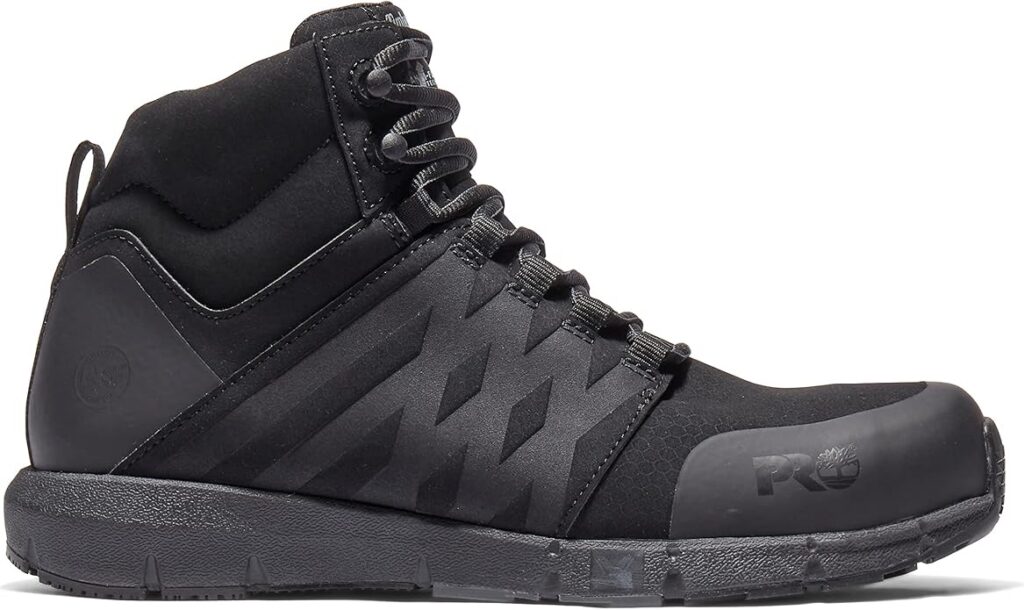
timberland pro radius mid5
Rigid External Heel Cup
Less discussed but worth noting: the rigid heel cup provides lateral stability that pure cushion-focused work sneakers miss. For workers doing sideways movement — picking orders, unloading vehicles, working around equipment — the heel cup reduces ankle fatigue by preventing micro-lateral shifts with each step.
🎯 Section 5: Who Should Buy This (and Who Should Skip It)
| Worker Type | Why the Radius Mid Works for Them |
|---|---|
| ✅ Warehouse & Fulfillment Workers | All-day concrete comfort, metal-detector friendly for security checkpoints, EH rated, composite toe for pallet jack incidents |
| ✅ Delivery Drivers | Lightweight for vehicle transitions, mid-top gives ankle support when climbing in/out repeatedly, breathable for extended hours |
| ✅ Manufacturing Floor Workers | Composite toe, oil/slip resistant outsole, EH rating, PRO FLEX for kneeling and crouching positions |
| ✅ Operations Supervisors | Professional-looking enough for office environments, compliant enough for shop floor — the mid-top profile reads as intentional workwear |
| ✅ Hospital & Healthcare Workers | Mutilation-free (won't scratch floors), slip resistant on wet surfaces, metal-detector friendly for sterile environments |
| ✅ Electricians (Light Work) | EH rated, composite toe, metal-free — solid secondary protection for installs in finished environments |
| ❌ Outdoor Construction Workers | No waterproofing, mesh tears under rough-terrain abuse, no puncture resistance plate — wrong shoe for the environment |
| ❌ Restaurant Kitchen Workers | Outsole wears fast on restaurant floors specifically — multiple users report tread loss within 6 weeks in this environment |
| ❌ Workers in Wet/Muddy Conditions | Mesh upper is not waterproof. If rain or standing water is a regular factor, look at the Timberland PRO Reaxion Waterproof instead |
| ❌ Loggers / Roofers / Heavy Construction | Needs a full 6" boot with puncture resistance. This shoe is not engineered for those environments. |
⚖️ Section 6: Honest Pros & Cons
✅ PROS
- Near-zero break-in time — multiple users report immediate comfort from day one
- Full ASTM safety credentials — composite toe + EH + slip resistance in a sneaker profile
- Metal-detector friendly — critical advantage for Amazon, airport, and healthcare workers
- Anti-Fatigue footbed works — genuine energy return geometry, not just marketing
- Raptek upper — lighter, more breathable, no conditioning vs leather
- Removable insole — orthotic-compatible for custom fit needs
- Mid-top adds ankle support without the weight or bulk of a traditional boot
- EH + composite toe combo — relatively rare in this price tier and shoe profile
- Sustainable materials — ReBOTL recycled lining is a genuine credential
⚠️ CONS
- Not waterproof — mesh upper will not keep feet dry in rain or puddles
- Outsole durability is environment-dependent — wears fast on restaurant floors and rough outdoor surfaces; better suited to smooth indoor floors
- Runs half a size large — consistent across hundreds of reviews; must size down
- Mesh upper can crack at the toe box — reported after several months of daily flex on hard surfaces
- No puncture-resistant plate — some competitors include one at this price point
- Upper durability concerns in rough environments — designed for indoor industrial use, not outdoor abuse
⚔️ Section 7: Comparisons — How the Radius Mid Stacks Up
The work sneaker category is crowded, and the Radius Mid regularly gets compared against three specific competitors. Here's an honest breakdown of where each one wins — and who each is actually best suited for.
1. Timberland PRO Radius Mid vs Timberland PRO Reaxion
This is the most common within-family comparison. Both are Timberland PRO composite toe athletic work shoes with EH ratings and Anti-Fatigue footbeds. But the differences matter more than the similarities.
- Anti-Fatigue Technology: A comfort system designed with shock-absorbing, geometrical technology that returns energy back to the foot to deliver all-day support and comfort.
- HoverSpring: Our proprietary lightweight HoverSpring foam provides industry leading underfoot comfort and flexibility while being durable enough for the harshest environments.
- Timberland PRO FLEX: Timberland PRO FLEX technology gives you full range of motion with features like durable fabrics that stretch, strategically placed gussets and bi-swings ensuring you’ll get the most from every move.
- Composite Safety Toe: Lightweight, non-metallic, asymmetrical-shaped toe cap that meets US safety standards including ASTM F2412-18a and ASTM F2413-18 I and C impact and compression safety standards.
- Timberland PRO Rubber: Heat-resistant, durable rubber compound offers enhanced slip, oil and abrasion resistance.
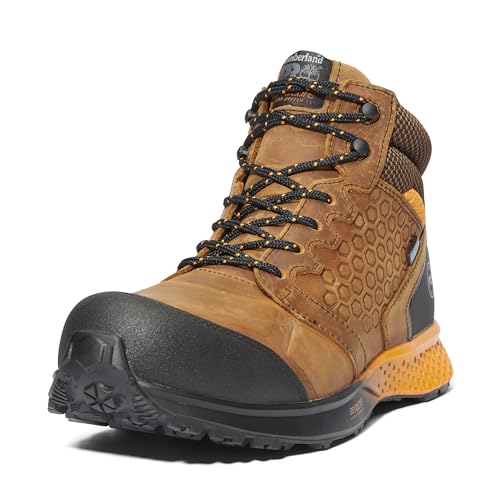
- Anti-Fatigue Technology: A comfort system designed with shock-absorbing, geometrical technology that returns energy back to the foot to deliver all-day support and comfort.
- Aerocore Energy System: We’ve created a super lightweight sole that provides comfortable cushioning so you can stay on your feet longer that is made of long-lasting materials that are designed not to break down over time.
- CarbonShield Technology: Engineered with nanotechnology, adds strength and unmatched protection, provides a better fit and reduces weight with a lightweight, non-metallic, asymmetrical-shaped toe cap that meets US safety standards including ASTM F2412-18a and ASTM F2413-18 I and C impact and compression safety standards.
- Waterproof Membrane: Delivers maximum waterproof protection and meets ASTM F1671-07 safety standard.
- Timberland PRO Rubber: Heat-resistant, durable rubber compound offers enhanced slip, oil and abrasion resistance.

| Radius Mid | Reaxion | |
|---|---|---|
| Upper Material | Raptek microfiber + mesh | Ripstop nylon |
| Midsole | HoverSpring™ foam | TPU-wrapped Aerocore™ |
| Height | Mid-top | Low (standard) |
| Upper Durability | Good indoors | Better — ripstop is more abrasion resistant |
| Ankle Support | Better — mid-top height | Minimal |
| Waterproof Option | No | Yes (separate WP version) |
| Outsole | PRO Rubber | All-Weather TPU |
| Price | ~$110–$130 | ~$100–$120 |
| Best For | Ankle support priority, structured feel, indoor use | Maximum lightweight profile, some outdoor use, waterproof option available |
💡 BootsGuru Verdict: The Reaxion's ripstop nylon upper is more durable under rough conditions and its All-Weather TPU outsole holds up better outdoors. The Radius Mid wins on ankle support and structured feel for workers who need that mid-top height. If you need waterproofing, the Reaxion Waterproof version is the better call overall.
2. Timberland PRO Radius Mid vs KEEN Utility Sparta XT
The KEEN Sparta consistently appears in the same buying decision as the Radius Mid. KEEN's reputation for wide toe boxes and anatomical fit makes this a natural comparison for anyone who's had trouble with pinching in safety toe shoes.
- Anti-Fatigue Technology: A comfort system designed with shock-absorbing, geometrical technology that returns energy back to the foot to deliver all-day support and comfort.
- HoverSpring: Our proprietary lightweight HoverSpring foam provides industry leading underfoot comfort and flexibility while being durable enough for the harshest environments.
- Timberland PRO FLEX: Timberland PRO FLEX technology gives you full range of motion with features like durable fabrics that stretch, strategically placed gussets and bi-swings ensuring you’ll get the most from every move.
- Composite Safety Toe: Lightweight, non-metallic, asymmetrical-shaped toe cap that meets US safety standards including ASTM F2412-18a and ASTM F2413-18 I and C impact and compression safety standards.
- Timberland PRO Rubber: Heat-resistant, durable rubber compound offers enhanced slip, oil and abrasion resistance.
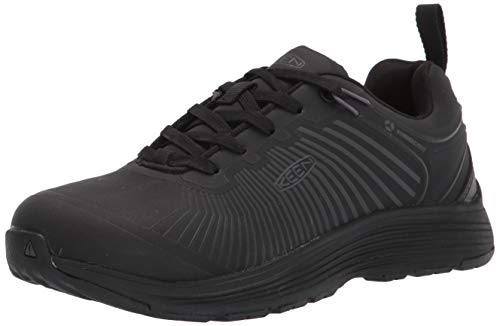
- ALLOY TOE: Left and right asymmetrical aluminum alloy toes weigh 35% less than steel and offer a sleeker appearance; The men’s Sparta XT work shoe meets or exceeds ASTM F2412 and F2413 I/75 C/75 EH Standards
- TRACTION: Oil- and slip-resistant, non-marking, rubber outsoles are used for improved traction that meet or exceed ASTM F1677 MARK II and ASTM F2913 SATRA Non-Slip Testing Standards; Athletic/running sole patterns keep you agile on your feet
- UNDERFOOT PROTECTION: Electrical hazard (EH) or Electric Shock Resistant (ESR) footwear provides a secondary source of protection in case of accidentally coming into contact with live electrical circuits; Features removable metatomical PU footbeds
- SUPPORT & COMFORT: Features KEEN. ReGEN technology; a lightweight, compression-resisting midsole providing 50% more energy return than standard EVA foam making safety footwear more comfortable; KONNECTFIT heel-capture system provides a locked-in feel
- ADDITIONAL FEATURES: Non-mutilating uppers reduce the chance of marking or scratching surfaces; A nylon shank is included for midfoot support; Moisture-wicking textiles are used to keep feet dry and CLEANSPORT NXT provides natural odor protection
| Radius Mid | KEEN Sparta XT | |
|---|---|---|
| Safety Toe | Composite | Aluminum |
| Metal Detector Safe | ✅ Yes | ❌ No — aluminum toe trips detectors |
| Toe Box Width | Standard | Wide asymmetric — more room for wider feet and swelling |
| EH Rated | ✅ Yes | ✅ Yes |
| Height | Mid-top | Low |
| Comfort for Long Shifts | Anti-Fatigue PU + HoverSpring foam | PU midsole — cushioned but no energy-return geometry |
| Temperature Performance | Composite toe — no thermal transfer | Aluminum toe — gets cold in winter, warm in heat |
| Breathability | High — mesh + Raptek combo | High — large mesh windows are among best in category |
| Price | ~$110–$130 | ~$100–$120 |
| Best For | Metal-detector environments, EH priority, mid-top support | Wide feet, foot swelling, anyone who finds standard toe boxes uncomfortable |
💡 BootsGuru Verdict: If you work in an environment with metal detectors — full stop, buy the Radius Mid. KEEN's aluminum toe disqualifies it for Amazon, airport, and security-sensitive workplaces. But if metal detectors aren't a factor and you have wider feet or struggle with toe box fit, the KEEN's signature wide anatomical toe box may genuinely be more comfortable for you. KEEN is also the better call for workers who experience significant foot swelling later in long shifts.
3. Timberland PRO Radius Mid vs Reebok Sublite Cushion Work
The Reebok Sublite is arguably the biggest name in the lightweight composite toe work sneaker category. It's frequently cited as the most comfortable option in its class — and for some use cases, it earns that reputation.
- Anti-Fatigue Technology: A comfort system designed with shock-absorbing, geometrical technology that returns energy back to the foot to deliver all-day support and comfort.
- HoverSpring: Our proprietary lightweight HoverSpring foam provides industry leading underfoot comfort and flexibility while being durable enough for the harshest environments.
- Timberland PRO FLEX: Timberland PRO FLEX technology gives you full range of motion with features like durable fabrics that stretch, strategically placed gussets and bi-swings ensuring you’ll get the most from every move.
- Composite Safety Toe: Lightweight, non-metallic, asymmetrical-shaped toe cap that meets US safety standards including ASTM F2412-18a and ASTM F2413-18 I and C impact and compression safety standards.
- Timberland PRO Rubber: Heat-resistant, durable rubber compound offers enhanced slip, oil and abrasion resistance.
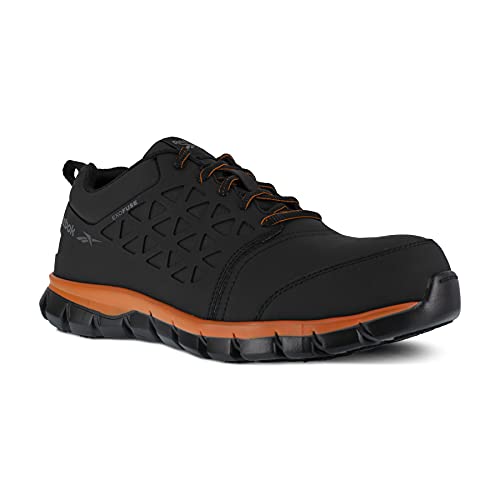
- Full-foot flex grooves for improved mobility and flex with every step
- EXOFUSE water resistant and breathable microfiber upper for comfort and flexibility
- MemoryTech Massage footbed adapts to the contours of your foot and provides immediate cushioning
- Sublite foam midsole for lightweight cushioning and soft support
- Composite toe reduces weight while maintaining impact protection (meets or exceeds ASTM F2413)
| Radius Mid | Reebok Sublite Cushion | |
|---|---|---|
| Safety Toe | Composite | Alloy |
| Metal Detector Safe | ✅ Yes | ❌ No — alloy toe triggers detectors |
| EH Rated | ✅ Yes | ✅ Yes |
| Weight | 1.41 lbs/shoe | 0.94 lbs/shoe — noticeably lighter |
| Midsole Cushion | HoverSpring™ foam + Anti-Fatigue PU footbed | Sublite foam — consistently praised as softest in class |
| Ankle Support | Better — mid-top + rigid heel cup | Low-top only — minimal ankle structure |
| Upper Durability | Better — Raptek microfiber + reinforcements | Good — textile with toe overlay; best for light duty |
| Flexibility | PRO FLEX grooves and stretch fabrics | Exceptionally flexible — softest, most running-shoe-like flex |
| Price | ~$110–$130 | ~$80–$110 |
| Best For | Metal-detector environments, ankle support, composite toe requirement | Maximum weight reduction, high-mileage indoor work, pure cushion priority on a budget |
💡 BootsGuru Verdict: The Reebok Sublite is lighter and softer, with a lower price point — and if your job doesn't require metal-detector compliance or composite toe specifically, it's a legitimate contender. But the Radius Mid wins on safety certification breadth (composite + EH in the same package), ankle support, and upper durability. If your workplace requires metal-detector clearance or composite-specific certification, the Sublite's alloy toe removes it from the running entirely.
📊 Summary: Which Should You Buy?
- Metal-detector environment? → Radius Mid or Reaxion
- Need waterproofing? → Reaxion Waterproof
- Wide feet or swelling issues? → KEEN Sparta XT
- Lightest possible shoe on a budget? → Reebok Sublite
- Ankle support + composite toe + EH + indoor use? → Radius Mid wins
📏 Section 8: Fit & Sizing Guide
This is the section that will save you a return. The sizing issue with the Radius Mid is consistent, clearly documented across hundreds of reviews, and easy to avoid once you know it.
⚠️ SIZE DOWN HALF A SIZE
If you normally wear a 10, order a 9.5.
If you normally wear a 11.5, order an 11.
This is not speculation — it's confirmed across dozens of verified reviews from Amazon, Zappos, and WorkBoots.com. Multiple buyers report the shoe fitting best at half a size down from their normal size.
Detailed Sizing Notes by Foot Type
| Foot Type | Sizing Recommendation |
|---|---|
| Standard width (D) | Order half a size down. The Raptek upper is snug initially and doesn't stretch much. The shoe will adapt to your foot over the first 1–2 days. |
| Wide feet (2E) | Check availability in wide width first. If your foot is on the wider side but not dramatically so, some reviewers report the standard width works with good socks and firm lacing. If you're genuinely wide-footed, the KEEN Sparta's anatomical wide toe box may serve you better. |
| Narrow feet | The top lace hooks help dial in fit for narrower feet — multiple users report the lacing system compensates well. Still size down half a size, then lace firmly through the top hooks. |
| Between sizes | Size down. The rigid external heel cup helps prevent slippage for those who end up between sizes after going down half. |
| Orthotics users | The footbed is removable — remove the stock Anti-Fatigue footbed and replace with your custom orthotics. Some users report needing to size up if using thick custom orthotics; otherwise, follow the standard half-size-down rule. |
🔧 Section 9: Durability — What Real Users Report After Months of Wear
This is where the Radius Mid's story gets nuanced. Durability is heavily dependent on the specific work environment, and understanding that split is essential to knowing whether this shoe is right for your job.
Indoor Warehouse / Fulfillment / Supervised Environments
Users in Amazon-style warehouse environments, manufacturing floors, and indoor operations consistently report strong durability at this price tier. One FedEx warehouse worker noted wearing theirs through two full years of daily use — stairs, ladders, vehicles, and concrete — before signs of significant wear appeared. A delivery driver logged "hundreds if not thousands of miles" over five months with the shoe holding its shape and structure.
"I've had these shoes for almost five months now and have put hundreds if not thousands of miles on them as a delivery driver. They're super light and very comfortable and pretty sleek looking."
Restaurant Kitchens and High-Abrasion Indoor Surfaces
Restaurant workers represent the most consistent source of negative durability feedback. Multiple reviewers report outsole tread loss within 6 weeks on restaurant kitchen floors. The tread doesn't fail suddenly — it wears progressively in the highest-pressure zones under the ball of the foot. For $110+ shoes, 6 weeks is an unacceptable durability ratio for a kitchen environment.
If you work in a restaurant kitchen, look at purpose-built kitchen footwear with more durable outsole compounds. The Radius Mid is not optimized for that specific environment.
Outdoor and Rough Terrain Use
Workers who transition between indoor and outdoor environments — especially outdoor concrete, gravel, or mixed surfaces — report accelerated outsole wear compared to pure indoor use. One construction-to-hospital-supervisor reviewer noted the outsole deteriorating significantly after three months on polished tile, which suggests the rubber compound is tuned for specific floor types rather than general durability.
Upper Longevity
The mesh panels at the toe box are a long-term wear point. Several users report cracking or tearing at the toe box bend after sustained daily flexing — typically emerging somewhere between 3–6 months of heavy use. For workers who kneel frequently, this is worth monitoring. The Raptek microfiber sections show better longevity than the mesh panels in most reports.
📊 Durability at a Glance by Environment
- 🏭 Indoor warehouse / fulfillment (smooth floors): 12–24 months — solid value
- 🚚 Delivery driving (vehicle transitions + walking): 6–12 months — good
- 🏥 Hospital / healthcare (polished tile): 6–12 months — acceptable
- 🍳 Restaurant kitchen (high-abrasion floors): 4–8 weeks — poor, wrong shoe
- 🏗️ Outdoor rough terrain: Not recommended
❓ Section 10: Frequently Asked Questions
Is the Timberland PRO Radius Mid waterproof?
No. The mesh upper is breathable but will not keep feet dry in rain, puddles, or wet environments. If waterproofing is a requirement for your work, look at the Timberland PRO Reaxion Composite Toe Waterproof, which uses a waterproof leather upper with membrane protection while maintaining the composite toe and EH certification. The Radius Mid is built for controlled, dry indoor environments.
How much should I size down?
Half a size. This is consistent across hundreds of verified reviews. If you normally wear a 10, order a 9.5. If you're between sizes in your normal footwear, the half-size-down recommendation still applies. The one exception: if you're using thick custom orthotics, you may need to try your true size to accommodate the footbed swap.
Will the Radius Mid set off metal detectors?
No. The Radius Mid is fully metal-free — composite toe, synthetic upper, no metal hardware anywhere. This is one of its primary advantages for Amazon warehouse workers, airport ground crew, hospital staff, and anyone working in or around security screening environments. You will not need to remove these at checkpoints.
Is there a break-in period?
Minimal to none — this is one of the Radius Mid's most consistently praised qualities. Most users report being comfortable from the first shift, with the shoe fully adapting within 1–2 days at most. The combination of HoverSpring foam, Anti-Fatigue footbed, and the stretch fabrics in the PRO FLEX upper means the shoe doesn't need to be "broken in" the way traditional leather boots do.
How does the composite toe compare to steel or alloy?
The composite toe meets the same ASTM impact and compression standards as steel and alloy toes — 75 ft-lbs of impact resistance and 2,500 lbs of compression. The practical differences: composite is lighter, non-conductive (won't transfer temperature in cold or heat), and metal-free. The trade-off historically was that composite toes are slightly bulkier than alloy to achieve the same protection — but the asymmetrical shaping on the Radius Mid addresses that, following the natural curve of your toe box rather than the traditional blunted composite profile.
Is this good for plantar fasciitis?
Many users with plantar fasciitis report positive results, particularly because the Anti-Fatigue Technology footbed provides genuine shock absorption rather than just passive cushioning. The footbed is also removable — so if the stock footbed doesn't work with your foot mechanics, you can replace it with custom orthotics prescribed for your PF. For workers whose condition requires specific arch support, removing the stock insole and inserting an orthotic may be the better move than relying on the stock footbed alone.
How does the Mid version differ from the standard Radius low?
The Radius Mid adds ankle height above the standard Radius low. That translates to: more lateral ankle support during sideways movement, better stability when climbing in/out of vehicles or going up/down stairs, and slightly more overall structure. The safety certifications and comfort technology are identical across both versions. If ankle support is a priority — delivery driving, order picking, stair climbing — the Mid is the better choice. If you want the lightest and most minimal profile and ankle support isn't a factor, the standard Radius low does the job at the same or slightly lower price.
🏆 Final Verdict
The Timberland PRO Radius Mid does what it sets out to do: deliver legitimate, ASTM-certified work safety in a shoe that feels like an athletic mid-top. The composite toe, EH rating, slip resistance, and metal-detector-friendly construction form a safety stack that most work sneakers in this price range can't match. The comfort technology — Anti-Fatigue footbed, HoverSpring foam, PRO FLEX — works, and the near-zero break-in time is a genuine advantage over traditional safety footwear.
The limitations are real and worth stating clearly. This shoe is built for smooth, dry, indoor industrial environments. The outsole isn't built for restaurant kitchens or rough outdoor terrain. The mesh upper isn't built for rain. And if you buy in your regular size, you'll be sending it back. None of these are surprises — they're just trade-offs you need to know before ordering.
For warehouse workers, delivery drivers, manufacturing staff, and operations supervisors who spend their shifts on indoor floors: the Radius Mid is one of the best options in its category.
📊 FINAL SCORECARD
| Comfort (Long Shift) | ⭐⭐⭐⭐⭐ 5/5 |
| Safety Certifications | ⭐⭐⭐⭐½ 4.5/5 |
| Durability (indoor environments) | ⭐⭐⭐⭐ 4/5 |
| Durability (rough/outdoor) | ⭐⭐ 2/5 |
| Value for Money | ⭐⭐⭐⭐ 4/5 |
| Fit & Sizing (once you know to go down) | ⭐⭐⭐⭐ 4/5 |
| Breathability | ⭐⭐⭐⭐½ 4.5/5 |
| OVERALL | 4.5 / 5 |
Ready to Ditch the Heavy Boots?
The Radius Mid is available in Black/Orange and Black Raptek colorways. Remember: size down half a size before you order.