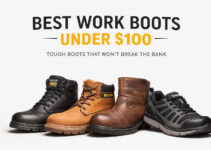
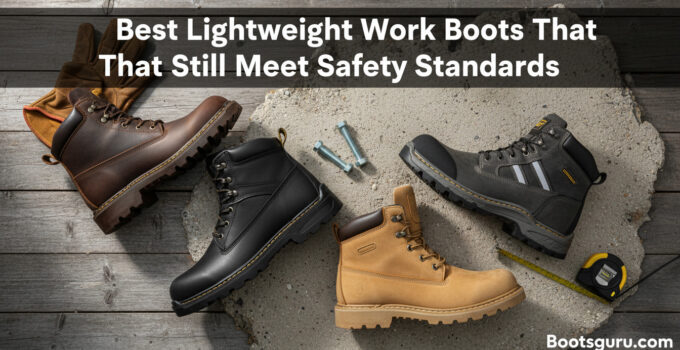

Every extra pound on your feet adds up to roughly five pounds of perceived fatigue per mile walked. After a ten-hour shift on a job site, that math becomes very personal. For decades, workers accepted heavy boots as the unavoidable price of proper toe protection — steel caps, thick leather uppers, chunky midsoles. But modern materials science has quietly rewritten that deal. Composite toe caps built from fiberglass, Kevlar, and carbon-fiber blends now meet the same ASTM F2413 impact and compression ratings as steel, at a fraction of the weight. Alloy toes split the difference. Even steel-toe boots have gotten lighter as midsole and upper technology improved. You no longer have to choose between safety and comfort.
This guide rounds up the eleven best lightweight work boots that still meet full safety standards — ASTM F2413, OSHA-compliant, built for real trades. Whether you're on a construction site, in a warehouse, doing electrical work, or pulling twelve-hour shifts on concrete, there's a boot here that will protect your feet without making you feel like you're dragging cinderblocks by 3 p.m.
We've organized this guide with a quick-picks section at the top, a detailed explainer on what "meets safety standards" actually means, and then a full review of every boot. Use the table of contents below to jump straight to the review you need.
Explore the allure of abstract geometry.
What "Meets Safety Standards" Actually Means
Before we get into specific boots, it's worth spending a few minutes on what safety certification actually means — because a lot of buyers either ignore it completely or assume it's more complicated than it is.
The benchmark you'll see on virtually every certified work boot sold in the United States is ASTM F2413 (currently updated to the F2413-24 revision). ASTM International sets the physical test requirements. OSHA mandates compliance with those standards in regulated workplaces — it sets the rule that requires safety footwear, while ASTM defines what "safety footwear" means in measurable terms.
The Two Core Ratings
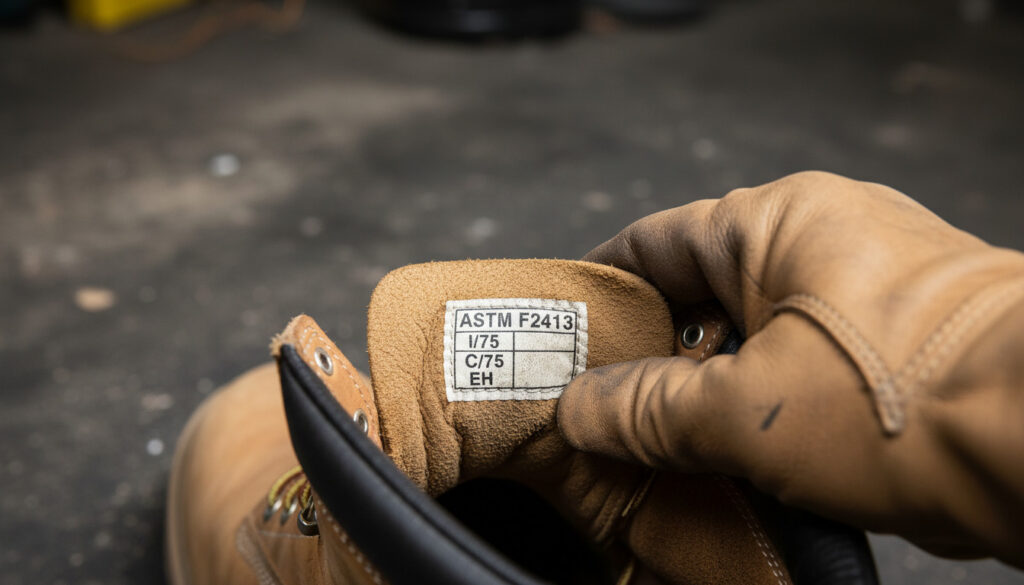
When a boot says it meets ASTM F2413, it must pass at minimum two tests. The I/75 impact test drops a 50-pound weight from a set height to simulate something heavy falling on your foot — the toe cap must protect against 75 foot-pounds of energy without transmitting more than a defined force to the foot below. The C/75 compression test rolls 2,500 pounds across the toe area to simulate a heavy object rolling over your foot. A passing boot keeps the toe box from collapsing below a minimum clearance height. Both ratings are required for the basic safety toe designation.
Optional Ratings to Know
EH (Electrical Hazard) — Secondary source of electrical current protection; the outsole resists completing a circuit up to 600 volts AC. Electricians and utility workers should look for this. PR (Puncture Resistant) — A plate in the midsole resists puncture from a 60-penny nail driven upward with 270 pounds of force. Roofing and demolition work. SD/SR (Static Dissipative / Slip Resistant) — SD reduces static buildup; SR is a traction designation though ASTM doesn't define a single SR standard the way it does I/75 and C/75. MT (Metatarsal Guard) — Protects the metatarsal bones above the toe box from direct impact.
Does Lightweight Mean Less Safe?
No — and this is the most important thing to understand. The ASTM F2413 standard tests performance outcomes, not materials. A composite toe and a steel toe are judged against the same 75 foot-pound impact requirement. Modern fiberglass-Kevlar composites and carbon-fiber caps pass that test at 15–20% less weight than steel. The label inside your boot — which should read something like "ASTM F2413-18 I/75 C/75 EH" — is the only thing that matters for compliance. The material used to achieve it is irrelevant to certification.
If your employer or job site requires safety toe footwear, any boot with that ASTM label satisfies the requirement regardless of whether the toe cap is steel, alloy, composite, or carbon fiber.
What Makes a Work Boot Truly Lightweight?
The word "lightweight" gets thrown around loosely in boot marketing. Here's a practical framework for what it actually means in this category.
Weight Benchmarks (Per Boot, Size 9–10 Men's)
- Heavy: Over 2 lbs per boot (4+ lbs per pair) — traditional full-grain leather with steel toe
- Average: 1.5–2 lbs per boot (3–4 lbs per pair) — most modern safety work boots
- Lightweight: 1.2–1.5 lbs per boot (under 3 lbs per pair) — composite toe, lighter midsole
- Ultra-light: Under 1.2 lbs per boot — carbon fiber toe, knit/mesh upper, EVA midsole
The Three Main Weight Drivers
The toe cap material is the most obvious factor, but it's not always the biggest contributor. Midsole construction matters just as much — a traditional rubber outsole-midsole stack can add significant weight that a PU or EVA midsole won't. Upper material is the third lever: full-grain leather at 2.0–2.5 oz per square foot is heavier than nubuck or pull-up leathers, and mesh/textile uppers are lighter still (though they sacrifice durability and waterproofing).
Composite vs. Alloy vs. Steel: The Weight Trade-off
Steel toes are the heaviest but also the most affordable and time-tested. Alloy toes (typically titanium or aluminum alloys) sit about 10% lighter than steel with a narrower profile — good if you want a safety boot that fits closer to a dress shoe silhouette. Composite toes (fiberglass, Kevlar, carbon-fiber blends) are the lightest option and have no metal content — critical for anyone passing through airport-style metal detectors on site. Carbon-fiber toe caps, like the Wolverine CarbonMAX, are the leading edge of weight reduction.
6-Inch vs. 8-Inch Height
All else equal, an 8-inch shaft adds about 1–2 oz per boot over a 6-inch version of the same model. That's not a dramatic difference, but if true weight minimization is the goal, the 6-inch wins. The real trade-off between shaft heights is ankle support and protection, not weight.
Quick-Picks: Best Lightweight Safety Work Boots at a Glance
Not sure which section to jump to? Use this table to find your best match by job type, then scroll to the full review for details.
| Boot | Toe Type | Height | Waterproof | Best For | Price Tier | Link |
|---|---|---|---|---|---|---|
| BRUNT Marin 6" | Composite | 6" | Yes | Best overall lightweight | $$ | Amazon |
| BRUNT Sullivan 6" | Composite | 6" | Yes | High-wear trades / kneeling work | $$ | Amazon |
| BRUNT Marin 8" | Composite | 8" | Yes | Best lightweight tall boot | $$ | Amazon |
| KEEN San Jose 6" | Alloy | 6" | Yes | Best comfort / long walking shifts | $$ | Amazon |
| KEEN Atlanta Cool Low | Steel | Low | No | Warm climates / shop floor | $$ | Amazon |
| Timberland PRO Boondock | Composite | 6" | Yes | Premium durability pick | $$$ | Amazon |
| Timberland PRO Titan 6 | Alloy | 6" | No | Budget Timberland / indoor work | $ | Amazon |
| ARIAT Treadfast 6" | Steel | 6" | No | Wide feet / agricultural crossover | $$ | Amazon |
| Wolverine I-90 EPX | Carbon Fiber | 6" | No | Lightest toe cap / metal detectors | $$ | Amazon |
| DEWALT Richardson BOA | Steel | 6" | No | Best lacing system / fast on-off | $$ | Amazon |
| LARNMERN Steel Toe | Steel | 6" | No | Best budget lightweight | $ | Amazon |
Price tiers: $ = under $100 · $$ = $100–$180 · $$$ = $180+
Individual Boot Reviews
1. BRUNT Marin 6" Waterproof Composite Toe — Best Overall Lightweight Work Boot
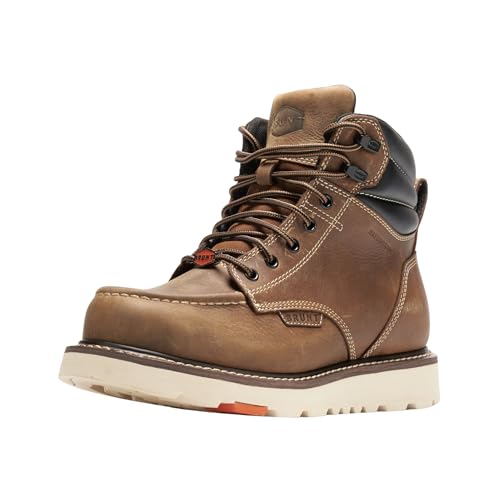
The BRUNT Marin 6" sits at the top of this list for a reason: it's the best combination of certified lightweight construction, genuine comfort, and practical job-site features available right now. BRUNT is a younger brand built by tradespeople specifically to address what the big legacy names kept getting wrong — boots that sacrifice weight-savings for unnecessary bulk, and don't accommodate real foot shapes. The Marin is their flagship answer.
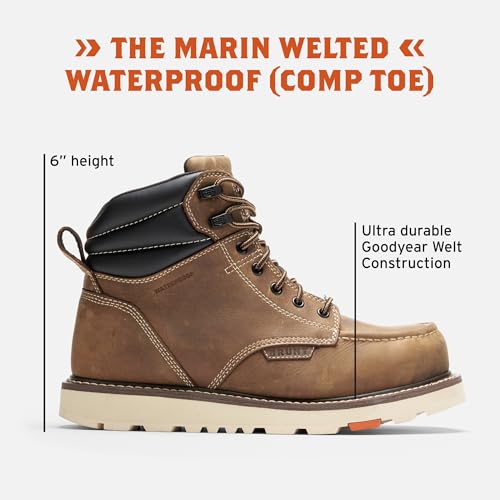
At approximately 2 lbs per boot in a size 9 (varies by size), the Marin 6" comes in well below the average for its category. That's achieved through a nano composite toe cap that passes full ASTM F2413-24 I/75 and C/75 ratings — the current revision of the standard — without any metal content. No metal also means no issues with metal detectors on regulated sites, and no cold conduction in winter. The boot is rated EH (electrical hazard resistant to 600V AC) and SR (slip-resistant outsole), and BRUNT rates the outsole to handle surface heat up to 572°F / 300°C.

One of the most practical features on the Marin is the SWITCH-FIT width system. The boot ships with two removable insole layers. Remove one layer and the boot converts from a D (standard) to EE (wide) width fit. If you've ever bought boots based on length but struggled with width — which describes a significant portion of trades workers — this is a genuinely useful system that eliminates the need to size up and deal with extra length. The CUSH'N 3-layer insole includes memory foam, and the PU midsole is durable enough to outlast EVA options you'll find on cheaper boots.

The upper is built from FARMGUARD leather — a full-grain leather treated to resist chemicals, urine, and mud. That might sound like an odd selling point until you've spent time on a farm, livestock facility, or chemical-adjacent job site and destroyed a pair of untreated leather boots. Waterproofing is handled by a waterproof membrane lining rather than just treated leather, which holds up better over time as the boot flexes and the leather treatment wears.
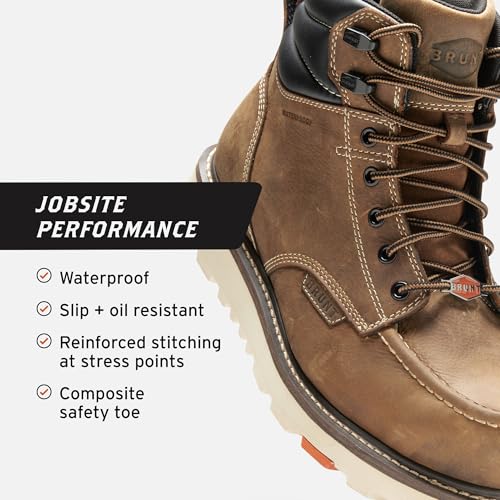
What we like: Composite toe keeps weight down without sacrificing certification; SWITCH-FIT solves the width problem elegantly; FARMGUARD leather handles chemical environments; EH and high-heat outsole ratings make it versatile across job types; ASTM F2413-24 (the latest revision) certified.
Things to consider: Cemented construction means resoling isn't practical — factor in replacement cost over time. Some users report the half-sizes run slightly inconsistently; if between sizes, order the larger.
Best for: Construction, electrical, plumbing, general contracting, any job that involves standing or walking all day on varied surfaces.
Check current price on Amazon →
2. BRUNT Sullivan 6" Waterproof Composite Toe — Best for High-Wear Trades
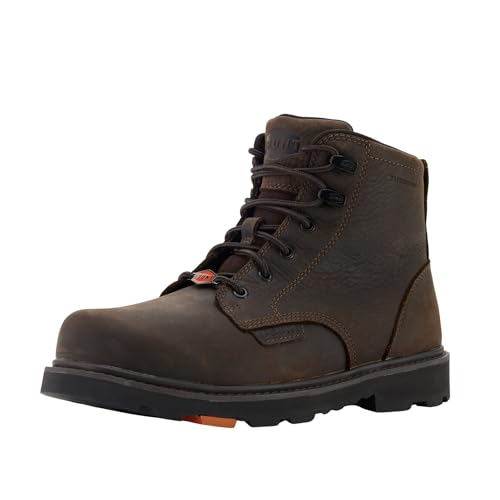
The Sullivan shares the same foundation as the Marin — composite toe, waterproof membrane, CUSH'N insole system, PU midsole — but adds something the Marin doesn't have: the patented BRUNT Toe™ exterior cap. This is a thick rubber reinforcement that wraps the exterior of the toe and heel of the boot. If you've ever worn through the toe leather on a work boot from kneeling on concrete, roofing, or tile-setting, you'll immediately understand the value here.
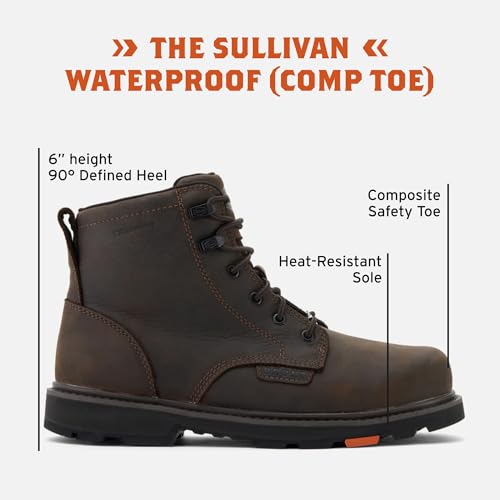
The trades that destroy the toes of regular boots the fastest are the ones that spend the most time on their knees — tilers, plumbers, electricians, HVAC techs, flooring installers. In those applications, the toe of the boot takes repeated abrasive contact with concrete, grout, or rough subfloor materials. The BRUNT Toe cap is designed to absorb that punishment so the upper leather doesn't have to. It dramatically extends the usable life of the boot in those specific conditions.

The Sullivan carries the same ASTM F2413-24 composite toe rating as the Marin, along with EH protection. The SWITCH-FIT width system is also present, making it equally accommodating for wider feet. The boot is slightly heavier than the standard Marin due to the exterior cap construction, but the durability trade-up is well worth it for anyone in a kneeling-intensive trade. Waterproofing, sole construction, and the FARMGUARD leather are identical to the Marin 6".

What we like: BRUNT Toe exterior cap dramatically extends boot life in kneeling-intensive trades; all the benefits of the Marin platform; same composite toe certification and EH rating; SWITCH-FIT width system included; FARMGUARD leather handles chemical environments.
Things to consider: Slightly heavier than the Marin 6" due to the exterior rubber cap. The cap styling is industrial rather than refined — this is a work tool, not a fashion statement. Cemented construction, same as the Marin.
Best for: Tile setters, plumbers, electricians, HVAC technicians, flooring installers — any trade where the boot toe takes constant abrasive contact with hard surfaces.
Check current price on Amazon →
3. BRUNT Marin 8" Waterproof Composite Toe — Best Lightweight Tall Work Boot
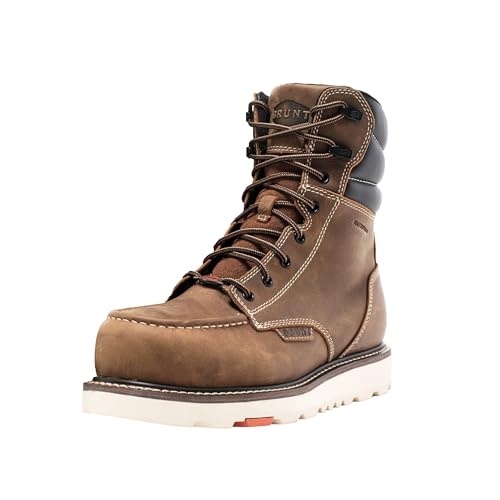
The BRUNT Marin 8" is exactly what it sounds like: the Marin 6" platform extended with a taller shaft for ankle support. If you've read the Marin 6" review above, most of what applies there applies here too — same nano composite toe, same ASTM F2413-24 certification, same FARMGUARD waterproof leather, same CUSH'N insole, same SWITCH-FIT width system, same EH rating. The difference is two more inches of shaft and the ankle protection that comes with it.
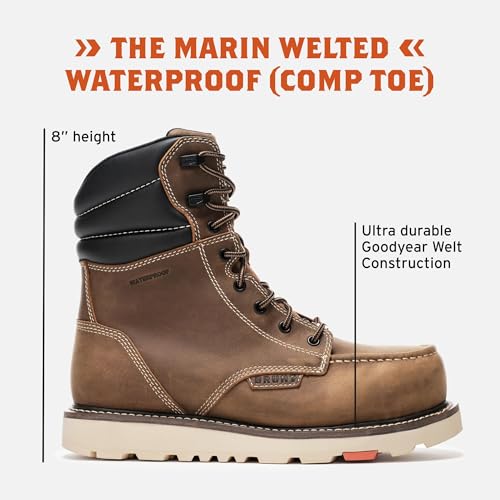
The case for an 8-inch lightweight boot over a 6-inch comes down to job conditions. If you're framing, roofing, doing site work on uneven ground, or any application where ankle-roll is a real risk, the taller shaft provides meaningful structural support. It also gives more protection from debris, splatter, and low hazards that might catch the top of a 6-inch boot. The added shaft height adds only about 1–2 oz per boot compared to the 6-inch version — which means you're getting a certified tall safety boot that still comes in well under the weight of the average 6-inch leather work boot from a decade ago.

The key selling point of the Marin 8" within this list is that it challenges the common assumption that tall boots are inherently heavier and more fatiguing. Modern midsole and upper engineering have largely closed that gap. If your job requires an 8-inch boot, you don't need to automatically accept a heavier boot — the Marin 8" proves that.

What we like: All the benefits of the Marin 6" with added ankle support; weight increase over the 6" is minimal; full ASTM F2413-24 composite toe certification; SWITCH-FIT width system; waterproof membrane; EH rated.
Things to consider: If you don't need ankle support, the 6" gives you slightly more mobility and a tiny bit less weight. Cemented construction throughout the BRUNT lineup — same caveat as the other Marin models.
Best for: Roofing, framing, site grading, forestry work, or any application on uneven terrain where ankle support matters.
Check current price on Amazon →
4. KEEN Utility San Jose 6" Alloy Toe Waterproof — Best for Comfort and Long Walking Shifts
More detail: our full KEEN San Jose review.
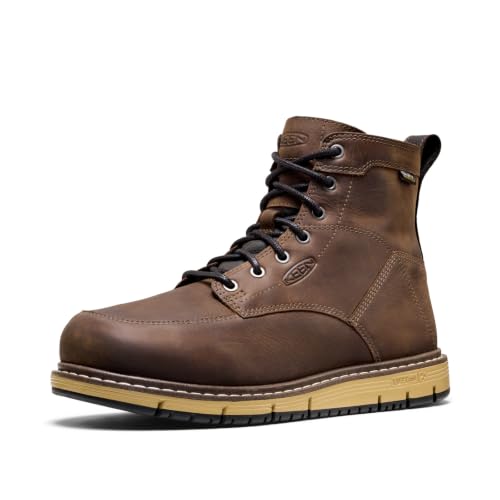
KEEN Utility built a reputation in the safety footwear space by approaching boot design from a completely different angle than traditional work boot makers: they started with foot comfort science and worked backward to safety compliance, rather than starting with safety specs and treating comfort as an afterthought. The San Jose 6" is one of the clearest expressions of that philosophy in a waterproof alloy-toe boot.
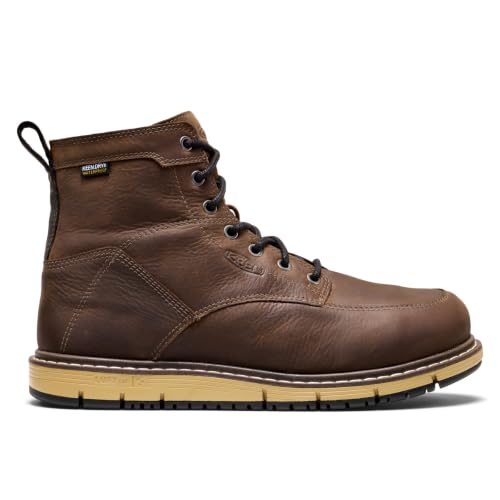
The alloy toe cap in the San Jose is both lighter than steel and narrower in profile, contributing to the boot's overall weight savings. But KEEN's biggest comfort advantage is the asymmetrical toe box design — each boot is shaped specifically for the left and right foot, with a wider, more anatomically correct toe room than the symmetric round-toe construction most work boots use. If you've ever noticed your little toe getting compressed by the end of a long shift, that's a problem the KEEN toe box design directly addresses. The KEEN.DRY waterproof breathable membrane handles wet conditions while allowing more airflow than simple treated leather, which matters on active, walking-heavy jobs.

The midsole uses KEEN's LuftCell technology — a PU foam system engineered for energy return and cushioning under compression. This is a meaningful difference on hard surfaces like concrete and asphalt, where the cumulative impact of thousands of steps per day creates the fatigue that makes workers sit down by mid-afternoon. The San Jose's outsole is oil- and slip-resistant, making it equally at home in a warehouse, on a manufacturing floor, or out on a construction site.

The San Jose 6" has earned consistent recognition from independent boot review publications specifically for the combination of lightweight construction and all-day comfort — a pairing that's genuinely hard to achieve in a fully waterproofed alloy-toe boot. The ASTM F2413 certification covers standard impact and compression requirements, and the boot meets EH standards as well.
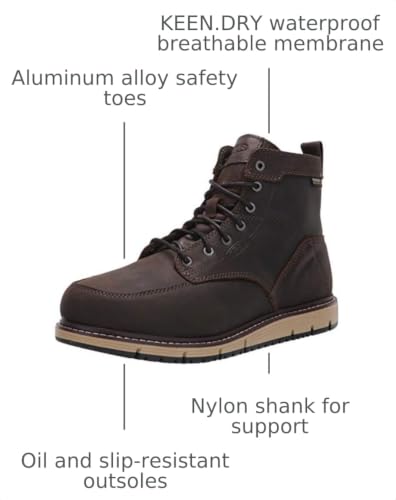
What we like: Asymmetrical left/right toe box addresses foot anatomy properly; KEEN.DRY membrane balances waterproofing with breathability; LuftCell midsole excels on hard surfaces; alloy toe is lighter than steel with the same certification; wide toe box accommodates wider foot shapes naturally.
Things to consider: The KEEN wide toe box is a defining feature — if you prefer a slim, narrow toe profile, this isn't the boot for you. Alloy toes contain metal, so they will trigger metal detectors. Some users find the break-in period slightly longer than average.
Best for: Warehouse workers, inspectors, project managers, tradespeople who spend long shifts walking across mixed terrain — anyone who prioritizes end-of-day comfort above all else.
Check current price on Amazon →
5. KEEN Utility Atlanta Cool Low Steel Toe — Best Low-Cut Lightweight Safety Boot
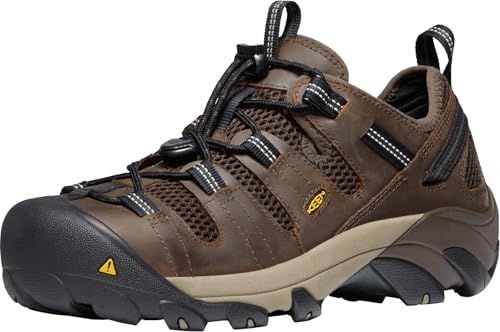
Every other boot on this list is a 6-inch or 8-inch shaft. The KEEN Atlanta Cool Low is the only low-cut safety shoe on the list, and its inclusion here isn't a mistake — for certain applications, a low-cut safety shoe is genuinely the best tool. If you work indoors on flat surfaces, in a workshop, on a manufacturing floor, or in any environment where ankle hazards are minimal and heat and comfort are the main concerns, the low-cut design wins on both weight and breathability.
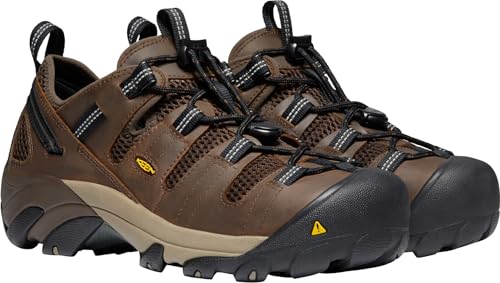
The "Cool" in the name refers to KEEN's ventilation-focused upper construction. This boot uses a combination of open-air channels and breathable lining material to maximize airflow — a major quality-of-life upgrade in warm facilities or during summer work. The steel toe meets ASTM F2413 impact and compression requirements; safety is entirely in the toe cap, not the shaft height, so a low-cut shoe with a certified toe is just as compliant as a 6-inch boot for the same hazard class.

KEEN's asymmetrical toe box design carries over from the San Jose, giving you the same anatomically shaped left/right fit and wide toe room. The outsole is oil- and slip-resistant for shop-floor conditions. The low-cut design saves weight over a comparable 6-inch version, and the open construction saves additional weight by reducing upper material. The result is one of the lightest fully safety-rated options on this list, with the trade-off being that you give up ankle support and some protection from debris and splash.

What we like: Only low-cut option on this list — unique positioning for flat-surface indoor work; KEEN ventilation makes this the go-to for warm climates and hot facilities; asymmetrical KEEN toe box; significantly lighter than any 6-inch option; steel toe meets full ASTM certification; slip-resistant outsole.
Things to consider: No ankle support — not suitable for uneven terrain, roofing, or any application with ankle-roll risk. No waterproofing — strictly an indoor or dry-weather boot. Steel toe adds weight versus composite alternatives and will trigger metal detectors.
Best for: Light manufacturing, warehouse picking, shop floor work, trade show or facility inspection roles, and anyone in a warm work environment who spends long hours on their feet indoors.
Check current price on Amazon →
6. Timberland PRO Boondock 6" — Best Premium Lightweight Work Boot
More detail: our full Timberland PRO Boondock review.
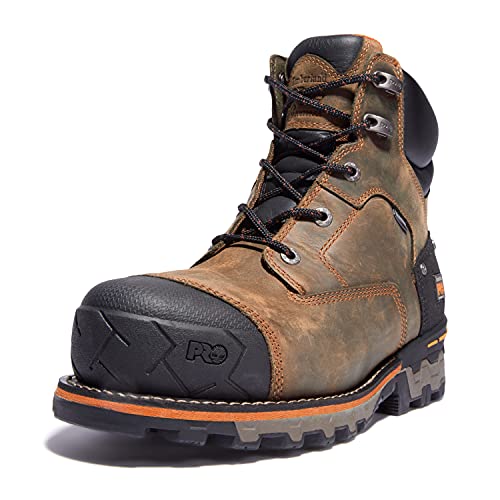
Timberland PRO has been a benchmark brand in work footwear for decades, and the Boondock 6" represents the company at its current best. This is not a budget boot — it sits at the top of the price range on this list — but it earns that position through a genuine combination of premium materials, advanced midsole technology, and the kind of long-term durability that makes the cost-per-wear calculation look very different over a two or three-year lifespan.

The toe cap in the Boondock is Timberland PRO's Carbon Shield™ nano-tube composite — a material that uses carbon nanotube reinforcement within the composite matrix to achieve the strength-to-weight ratio required for ASTM F2413 certification at a lower mass than standard fiberglass composites. The result is a composite toe that's lighter than most other composite options on the market, not just lighter than steel. Combined with Timberland PRO's Anti-Fatigue Technology™ midsole — a geometric cone design in the footbed that returns energy with each step and absorbs impact on hard surfaces — the Boondock is engineered specifically for the experience of wearing it for ten-plus hours.

The upper is premium full-grain leather with Timberland's waterproof construction, which uses sealed seams and a waterproof membrane rather than relying solely on surface treatments. The outsole is oil-, abrasion-, and slip-resistant. The boot uses a reinforced welt construction that adds structural durability at the midsole-upper junction — the part of the boot that tends to fail first on cemented constructions under heavy use. EH protection is included as standard.

If you're comparing the Boondock to the BRUNT Marin on price, the Boondock will cost more. If you're comparing them on total cost over three years of heavy daily use, the Boondock's premium materials and more durable construction often close that gap or reverse it. This is the boot for professionals who buy on quality and want to buy less often.

What we like: Carbon Shield nano-tube composite toe is among the lightest certified options; Anti-Fatigue Technology midsole is genuinely effective on hard surfaces; premium full-grain leather construction; sealed waterproofing; Timberland PRO brand reliability and warranty support; ASTM F2413 and EH rated.
Things to consider: Premium price point — not the choice for budget-conscious buyers. Some users find the break-in period longer than average for premium leather boots. Not as wide as KEEN or as adjustable as BRUNT's SWITCH-FIT.
Best for: Experienced tradespeople who buy quality and keep boots long-term; supervisors and project managers who need a boot that functions on-site and looks professional off it; anyone who has worn through cheaper boots and wants a premium step-up.
Check current price on Amazon →
7. Timberland PRO Titan 6" Safety Toe — Best Value Timberland for Indoor Work

The Timberland PRO Titan is the entry point into Timberland's professional line — it carries the Timberland PRO brand trust at a significantly lower price than the Boondock. The Titan uses an alloy toe rather than a composite, which is an important distinction. Alloy toes are lighter than steel — typically 10–15% — and maintain a narrower, lower profile that many workers prefer. They carry the same ASTM F2413 I/75 and C/75 certification as steel and composite alternatives. The only practical consideration: alloy toes do contain metal, so they'll activate metal detectors.
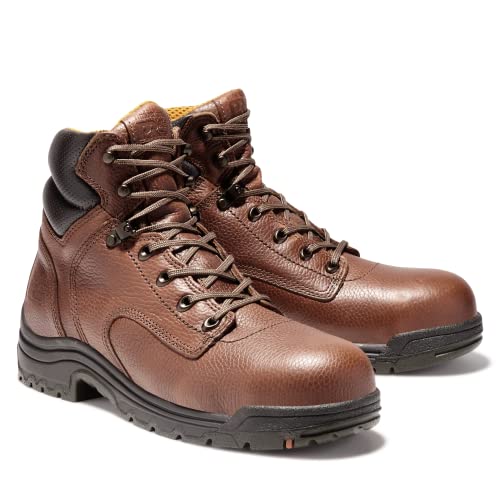
The Titan's upper is full-grain leather with Timberland PRO's anti-fatigue footbed. It's not waterproofed at this price point, which makes it more appropriate for indoor or dry-condition work than outdoor all-weather use. The outsole is oil- and slip-resistant, well-suited for warehouse, manufacturing, and light construction environments. EH protection is included. The Titan is a straightforward, reliable work boot without the premium materials stack of the Boondock — which is exactly right for buyers who want Timberland PRO reliability at a more accessible price.

One important point for workers comparing composite to alloy toes: both meet the same standard, but composite toes are typically bulkier in profile (more material needed to achieve the same strength as thinner metal). Alloy toes give you a narrower, more traditional boot silhouette while still being lighter than steel. If toe box slimness matters to your application — fitting boots into tight spaces, a more refined look — alloy is worth considering over composite for this reason.

What we like: Alloy toe is lighter than steel with same certification; Timberland PRO brand reliability at an accessible price; narrow alloy toe profile works well for workers who dislike the bulkier composite toe box; anti-fatigue footbed; EH rated; good choice for indoor or dry-weather work environments.
Things to consider: Not waterproof — strictly for indoor or dry conditions. Alloy toe will trigger metal detectors. Not as feature-rich as the Boondock. Break-in period standard for leather work boots.
Best for: Manufacturing, warehouse, light construction, retail trade workers who want the Timberland PRO name without the premium price tag.
Check current price on Amazon →
8. ARIAT Treadfast 6" Steel Toe — Best for Wide Feet and All-Day Standing

ARIAT entered the work boot market from an equestrian heritage, and that origin shows in the brand's obsessive focus on foot support technology. The Treadfast is ARIAT's core work boot at an accessible price, and it makes an important point: a steel toe boot can still be legitimately comfortable and relatively lightweight when the rest of the boot is engineered with care. This is the boot on this list that most directly challenges the stereotype that "steel toe = heavy and painful."

The Treadfast uses ARIAT's 4LR® (Four Layer Rebound) footbed — a multi-layer insole construction that combines a moisture-wicking top layer, a cushioning foam layer, a support layer, and a stabilizing base. It's one of the most comfortable insole systems available in a steel-toe work boot at this price point. The outsole features ARIAT's ATS® (Advanced Torque Stability) technology — a dual-density system designed to reduce the fatigue that comes from prolonged standing by distributing load more evenly across the foot.

The Treadfast has a notably wide and roomy toe box — a characteristic ARIAT carries over from their Western boot heritage. If you've struggled with safety boots that squeeze your foot laterally, especially at the end of the day when feet naturally swell, the Treadfast's toe room is a legitimate advantage. The upper is full-grain leather with oil and slip resistance on the outsole. The boot meets ASTM F2413 for impact and compression through its steel toe cap. The Treadfast doesn't have waterproofing in this configuration, but ARIAT's leather quality handles light moisture well.

What we like: 4LR footbed is outstanding for all-day standing comfort; wide toe box accommodates wider feet and natural foot swell; ATS stability technology reduces long-shift fatigue; ARIAT build quality at a mid-range price; appeals to agricultural workers and construction crossover audiences; ASTM F2413 steel toe certified.
Things to consider: Steel toe is heavier than composite or alloy alternatives; no waterproofing; will trigger metal detectors. Not the choice if absolute minimum weight is your priority — but steel toe comfort is where the Treadfast earns its place.
Best for: Workers on their feet all day on flat or moderately uneven surfaces; anyone with wide feet who has struggled to find comfortable safety boots; agricultural, ranch, and construction crossover workers.
Check current price on Amazon →
9. Wolverine I-90 EPX CarbonMAX Toe — Lightest Toe Cap on This List
No products found.If true minimum weight is your single most important criterion, the Wolverine I-90 EPX CarbonMAX is the boot to look at first. The differentiating feature is the CarbonMAX toe cap — a carbon-fiber safety toe that represents the current leading edge of lightweight safety toe materials. Carbon fiber achieves its required structural strength with less material mass than fiberglass composites, alloy, or steel. The result is a safety-toe boot that genuinely feels lighter than comparable options, not just marginally lighter.
No products found.Carbon fiber also has no metal content, which means no cold conduction in winter, no interference with metal detectors, and no electromagnetic concerns in certain specialized industrial settings. The CarbonMAX toe meets ASTM F2413 I/75 and C/75 requirements — same certification as steel, alloy, or standard composite. The misconception that carbon fiber toes are somehow "less safe" than steel is exactly that: a misconception. The standard requires performance outcomes, and the CarbonMAX passes them.
No products found.The I-90 EPX midsole platform uses EPX (Energy Propulsion) cushioning — a multi-zone midsole that combines cushioning at the heel strike with support and stability through the midfoot and forefoot. Wolverine also incorporates an internal metatarsal guard in some configurations of the I-90 — check the listing to confirm which version is in stock. The upper is leather with basic water resistance, though this model is not a fully waterproofed boot. The outsole is slip-resistant and durable across common job-site surfaces.
No products found.What we like: CarbonMAX carbon fiber toe is the lightest certified safety toe material available; no metal content — won't trigger metal detectors; same ASTM F2413 certification as steel at lower weight; EPX cushioning midsole; Wolverine brand durability; internal metatarsal guard available on select configurations.
Things to consider: Not waterproofed — not the choice for wet conditions. Carbon fiber can feel stiffer in the toe cap during initial break-in compared to composite alternatives. This is an older model in the Wolverine lineup — verify availability and current pricing on Amazon before purchasing.
Best for: Workers who pass through metal detectors on site; anyone who wants the absolute lightest safety toe option; electricians and utility workers who want both EH rating and no metal content.
Check current price on Amazon →
10. DEWALT Richardson BOA Steel Toe — Best Lacing System for Fast On/Off

The DEWALT Richardson BOA is on this list not primarily because it's the lightest boot available, but because it brings a genuinely different and practically useful feature that no other boot here offers: the BOA Fit System. Instead of traditional laces, the Richardson uses a dial-and-cable lacing mechanism. One quarter-turn of the dial tightens the entire boot evenly. One click releases it completely. If you've ever tried to tie boot laces while wearing work gloves, or just want to stop spending time re-tying laces that work loose during the day, this is a direct solution.
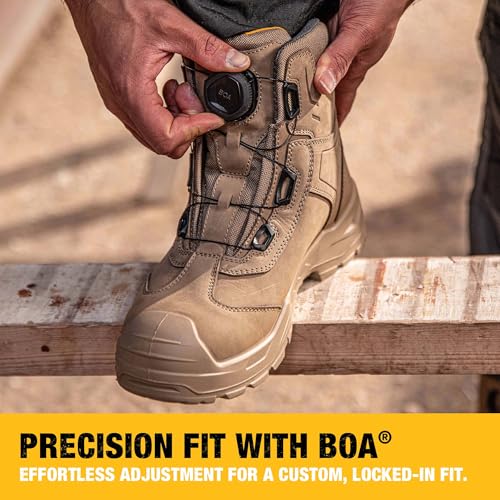
The BOA system is precision micro-adjustable across its entire range, which means you can dial in the exact fit tension throughout the day as your foot swells. The system is also covered by BOA's lifetime warranty — if the dial or cable fails, BOA will replace the hardware for free, indefinitely. That's a meaningful long-term reliability guarantee on a part of the boot that usually can't be serviced at all. DEWALT's branding resonates strongly with electricians, carpenters, and construction trades who already rely on the brand for their tools — the Richardson is a natural extension of that trust into footwear.

The steel toe meets ASTM F2413 impact and compression requirements. The upper is leather with slip-resistant outsole construction. The boot is not listed as waterproof, but the upper construction handles light moisture adequately. The Richardson's weight falls in the mid-range for steel-toe boots — the BOA hardware itself adds minimal weight, and the overall construction is reasonably light for the steel-toe category. EH protection is included.

What we like: BOA Fit System is the most convenient lacing mechanism available in a work boot; lifetime warranty on the BOA hardware; micro-adjustable fit through the day; DEWALT brand trust with trades professionals; ASTM F2413 steel toe certification; EH rated; fast on/off for workers who change footwear frequently.
Things to consider: Steel toe adds weight — if minimum weight is the priority, look at the BRUNT Marin or Wolverine I-90 instead. Not waterproof. The BOA dial mechanism is durable but represents a dependency on proprietary hardware (though BOA's warranty covers this). Steel toe triggers metal detectors.
Best for: Workers who change footwear frequently during the day; anyone who wears gloves on-site and finds traditional lace management difficult; DEWALT tool users who want brand consistency in their gear.
Check current price on Amazon →
11. LARNMERN Steel Toe Work Boots — Best Budget Lightweight Safety Boot

We close this list with the best budget option — and budget doesn't mean bad. The LARNMERN steel toe work boot achieves its weight savings through a genuinely different approach to upper construction: rather than leather, the LARNMERN uses a knit/mesh-blend upper. This is the same thinking that transformed the athletic shoe industry — move away from heavy leather uppers toward engineered textiles that are lighter, more flexible, and more breathable. The trade-off is that textile uppers are less durable and offer no waterproofing, but for the right application, they're a completely valid choice.
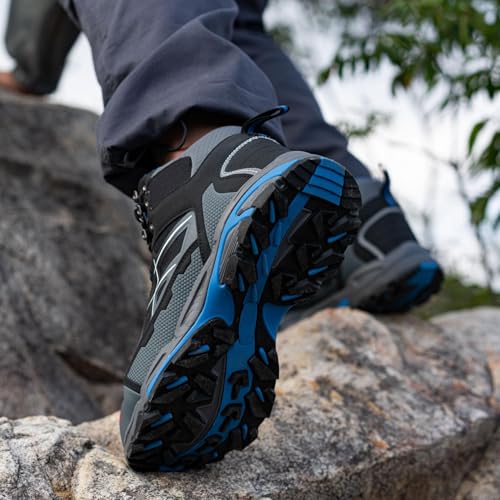
The applications where the LARNMERN makes most sense are controlled environments — warehouse, distribution, light manufacturing, retail with safety requirements, logistics facilities. These are jobs where the boot doesn't take the same abuse as outdoor construction or heavy trades work, where waterproofing isn't required, and where weight and breathability at an affordable price are the primary concerns. In those conditions, the LARNMERN is an excellent value proposition: a steel toe that meets safety certification requirements, at a lighter weight than most leather alternatives, for a fraction of the cost of the premium options on this list.

The steel toe cap meets ASTM F2413 impact and compression requirements. The outsole is slip-resistant, suitable for flat indoor surfaces. The boot includes a cushioned insole for basic comfort. The slip-on or easy-entry design of many LARNMERN configurations makes it fast to get on and off — a practical feature for jobs with frequent footwear changes or security checkpoints. The price point makes it accessible to workers who need safety certification but can't justify the investment in a premium boot.

What we like: Best price on this list by a significant margin; knit/mesh upper achieves genuinely light weight; ASTM F2413 steel toe certification; breathable construction keeps feet cooler; easy-entry design; slip-resistant outsole; good value for controlled indoor environments.
Things to consider: Textile upper is significantly less durable than leather — not appropriate for heavy construction, outdoor work, or high-abrasion environments. No waterproofing. Steel toe is heavier than composite alternatives and will trigger metal detectors. This boot will likely need replacement faster than leather alternatives in demanding conditions.
Best for: Warehouse workers, pickers, logistics staff, light manufacturing, food service environments requiring safety toe protection, and anyone who needs affordable certified safety footwear for controlled indoor conditions.
Check current price on Amazon →
How to Choose the Right Lightweight Safety Boot for Your Job
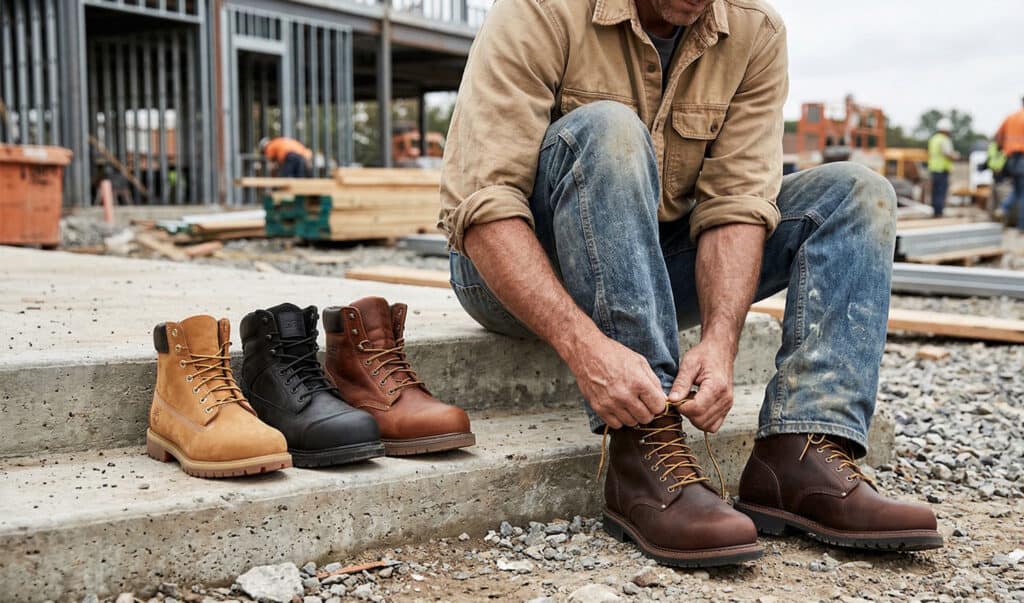
Ready to tackle the day with sturdy work boots.
With eleven solid options covered, here's a practical decision framework to match the right boot to your specific situation.
Step 1: Know Your Workplace's Required Safety Ratings
Before anything else, find out what your employer, job site, or industry standard requires. This is not guesswork — most regulated worksites post the required PPE specifications in the site safety plan or employee handbook. The minimum is almost always ASTM F2413 I/75 C/75. Some environments also require EH (electrical hazard), PR (puncture resistance), or MT (metatarsal protection). Confirm before you buy so you're not purchasing a boot that falls short of your compliance requirements.
Step 2: Match the Toe Cap to Your Hazard Level and Work Environment
Steel toe is the traditional choice — heavier, affordable, the most common safety toe you'll find. Alloy toe (Timberland PRO Titan, KEEN San Jose) is lighter than steel, narrower in profile, and carries the same certification — best for workers who want a slimmer silhouette or slightly reduced weight without going composite. Composite toe (BRUNT Marin, BRUNT Sullivan, Timberland PRO Boondock) is lighter than both, has no metal content, and is the right choice for anyone passing through metal detectors on site. Carbon fiber toe (Wolverine I-90 CarbonMAX) is the lightest certified option and also metal-free.
Step 3: Waterproof or Breathable — When Each Matters
If your job involves outdoor work in variable weather, standing in water, or regular mud and wet conditions, waterproof is a must — and worth the slight weight and breathability trade-off. If you work predominantly indoors in a climate-controlled environment, the ventilation of a non-waterproofed boot will be more comfortable over a long shift. Don't pay for waterproofing you won't use, but don't skip it if wet conditions are a real part of your workday.
Step 4: 6-Inch vs. 8-Inch Shaft Height
The weight difference between a 6-inch and 8-inch version of the same boot is minimal — typically 1–2 oz per boot. The real factor is ankle support and protection. Outdoor work, uneven terrain, roofing, framing, and any application with ankle-roll risk benefit from the 8-inch shaft. Indoor work, flat surfaces, and applications that prioritize mobility over ankle support suit the 6-inch better. Low-cut shoes (like the KEEN Atlanta) are the right choice only when ankle hazards are genuinely absent.
Step 5: Outsole Type — Wedge vs. Lug
Wedge soles (flat, minimal profile) are lighter, better suited to concrete floors, ladders, and scaffolding, and provide a more stable platform for kneeling work. Lug soles (deep tread pattern) are heavier but provide dramatically better traction on mud, loose soil, wet outdoor terrain, and uneven ground. Most of the boots on this list use outsoles suitable for mixed indoor/outdoor work. If you're primarily in mud and loose terrain, prioritize lug depth; if you're primarily on concrete and asphalt, wedge or moderate tread is the better choice.
Step 6: Fit Factors — Width, Toe Box, and Break-In Time
Width accommodation varies significantly across these boots. BRUNT's SWITCH-FIT system is the most versatile — it actively accommodates both standard and wide widths. KEEN boots are designed with a naturally wide toe box that suits wider feet without upsizing. ARIAT's Western heritage gives the Treadfast a generous toe box as well. If you're between widths or have genuinely wide feet, these are the brands to prioritize. KEEN's asymmetrical toe box is worth calling out separately — it's shaped for the actual geometry of left and right feet, which makes a meaningful difference in all-day comfort. Break-in time for full-grain leather boots (Timberland PRO, ARIAT, Wolverine) is typically 2–3 weeks of regular wear. Composite toe boots and boots with more flexible uppers generally break in faster.
Making Lightweight Work Boots Last Longer
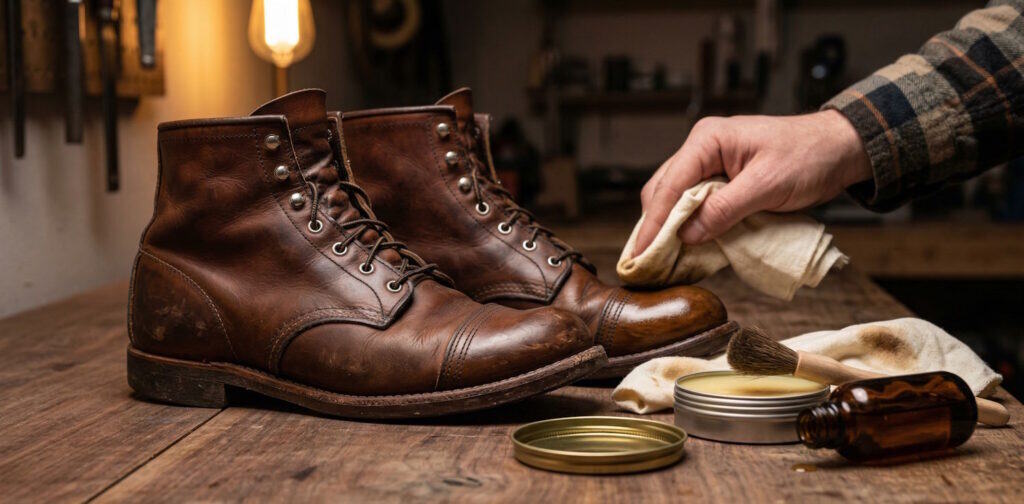
Reviving classic style—care for your leather boots.
The best lightweight work boots are still an investment. How you care for them has a direct impact on how many years of useful service you get before replacement.
Condition Leather Regularly
Full-grain leather loses natural oils through repeated wetting and drying, flexing, and contact with chemicals. That loss shows up first as stiffness, cracking at flex points, and deteriorating waterproofing. Apply a leather conditioner — beeswax-based products work well for most full-grain work leathers, while mink oil is a good general option — every 4–6 weeks during regular use, and immediately after any day of heavy exposure to water, mud, or chemicals. Don't over-condition: too much product can soften leather excessively and reduce structural support.
Rotate Pairs When Possible
The midsole foam in any work boot needs time to recover its structure after compression. A full day on your feet compresses the foam significantly — if you wear the same pair every day without a break, the foam never fully rebounds, and you're essentially walking on a progressively flatter, less cushioned platform. Rotating between two pairs, even just alternating days, significantly extends the useful life of both pairs and keeps you on better cushioning throughout.
Replace Insoles Before the Boot Gives Out
Factory insoles in most work boots, even premium ones, typically wear out in 6–12 months of daily use. The boot's upper and outsole often have significantly more life left. Replacing the insole with a quality aftermarket option (superfeet, Spenco, or similar) is a low-cost intervention that restores most of the original comfort and can add another year or more to a boot's usable life.
Understand Your Boot's Construction
Most boots on this list use cemented construction — the upper is glued to the midsole/outsole. Cemented boots cannot be practically resoled. When the outsole wears out, the boot is done. Goodyear welted boots (found on premium traditional work boots not represented here in large numbers) can be resoled multiple times, which is the key long-term cost advantage. Know what construction you're buying and plan replacement schedules accordingly.
Frequently Asked Questions
Are lightweight work boots OSHA compliant?
Yes — OSHA compliance is determined by whether a boot meets the required ASTM F2413 standard for the hazard class involved, not by the boot's weight. Any boot on this list that carries an ASTM F2413 certification stamp inside satisfies OSHA's requirement for safety toe footwear. Weight is irrelevant to the compliance determination.
How light is "lightweight" for a safety work boot?
In practical terms, a lightweight safety work boot weighs under 3 lbs per pair (under 1.5 lbs per boot) in a size 9–10. Ultra-light options like the Wolverine I-90 CarbonMAX come in under 2.5 lbs per pair. Traditional full-leather steel-toe boots often weigh 4–5 lbs per pair. The difference is noticeable within the first hour and dramatic by the end of an eight-to-ten-hour shift.
Is composite toe as safe as steel toe?
Yes. Both must pass the same ASTM F2413 I/75 impact test (50-lb drop at 75 foot-pounds) and C/75 compression test (2,500 lbs rolling load) to be certified. The ASTM standard tests outcomes, not materials. A passing composite toe and a passing steel toe provide equivalent protection against the tested hazards. The material difference affects weight, thermal conductivity, and metal detector activation — not safety certification level.
Can I wear lightweight work boots on a construction site?
Yes, provided they carry the appropriate ASTM F2413 ratings required by the site safety plan. Most general construction sites require I/75 C/75 at minimum, and may also require EH if electrical hazards are present. A lightweight composite-toe boot with those ratings is fully compliant. Always verify specific requirements with your site safety officer before purchasing.
What is the lightest safety work boot on this list?
The Wolverine I-90 EPX CarbonMAX is the lightest on this list in terms of toe cap material — carbon fiber is the lightest certified safety toe material commercially available. The LARNMERN is among the lightest overall due to its knit/mesh upper construction. The BRUNT Marin 6" offers the best balance of certified light weight with full leather upper durability.
Are waterproof lightweight work boots worth it?
Depends on your work environment. If you regularly work outdoors in wet conditions or in environments with water exposure, the comfort and foot health benefits of a waterproof boot are well worth the marginal weight and cost premium. Wet feet for eight-plus hours daily leads to blisters, skin breakdown, and fungal issues. If you work in a climate-controlled indoor environment, standard leather handles incidental moisture adequately and the extra breathability of a non-waterproofed boot is more comfortable in warm conditions.
Conclusion
The core takeaway from this guide is simple: you do not have to choose between safety certification and a boot that doesn't exhaust you by 2 p.m. Modern composite and carbon-fiber toe caps meet the same ASTM F2413 standards as steel at meaningfully less weight. Advanced midsole materials recover energy and reduce ground-impact fatigue. Improved upper leathers and membrane waterproofing do more with less bulk. The boots on this list are the practical result of that engineering progress — all certified, all legitimately lighter than traditional alternatives.
For most workers, the BRUNT Marin 6" is the place to start: best overall combination of weight, certification, comfort features, and practical versatility. If comfort and walking are your priority, the KEEN Utility San Jose is the standout. If you need the absolute lightest toe cap and metal-detector clearance, the Wolverine I-90 CarbonMAX is the pick. For the tightest budget, the LARNMERN delivers certified protection at a price that's genuinely accessible. And if you want the best that premium construction can offer for long-term value, the Timberland PRO Boondock is worth the investment.
Your feet carry everything else you do on the job site. The right boot isn't just a safety compliance checkbox — it's a direct factor in how you feel, how you perform, and how your body holds up over a career. These eleven boots are the best current options for getting both right.
Have a question about a specific boot or job application? Drop it in the comments below — we read every one.