Skechers is the third-largest athletic footwear brand in the United States — and for good reason. Their work shoe line brings the same DNA that made them famous in everyday wear: immediate out-of-the-box comfort, lightweight construction, and a silhouette that looks more like a sneaker than a traditional steel-toe boot. For workers who have spent years in heavy leather work boots, switching to a Skechers safety shoe genuinely feels like a revelation on the first day.
But there is more to know about buying Skechers work shoes than any competitor guide will tell you. Not all Skechers comfort technologies are equal — and for workers with plantar fasciitis or flat feet, choosing the wrong technology can actually make foot pain worse, not better. Not all Skechers “work shoes” carry ASTM safety certification. The toe type (steel, alloy, or composite) varies by model in ways that matter if you cross metal detectors at work. And the durability picture is more nuanced than the overwhelmingly positive marketing suggests.
This guide covers all of it honestly. Five Skechers models with verified ASTM certification, five best alternatives for when Skechers is not the right tool for the job, and the explanations no other guide provides.
Are Skechers Work Shoes OSHA Compliant? The Full Answer
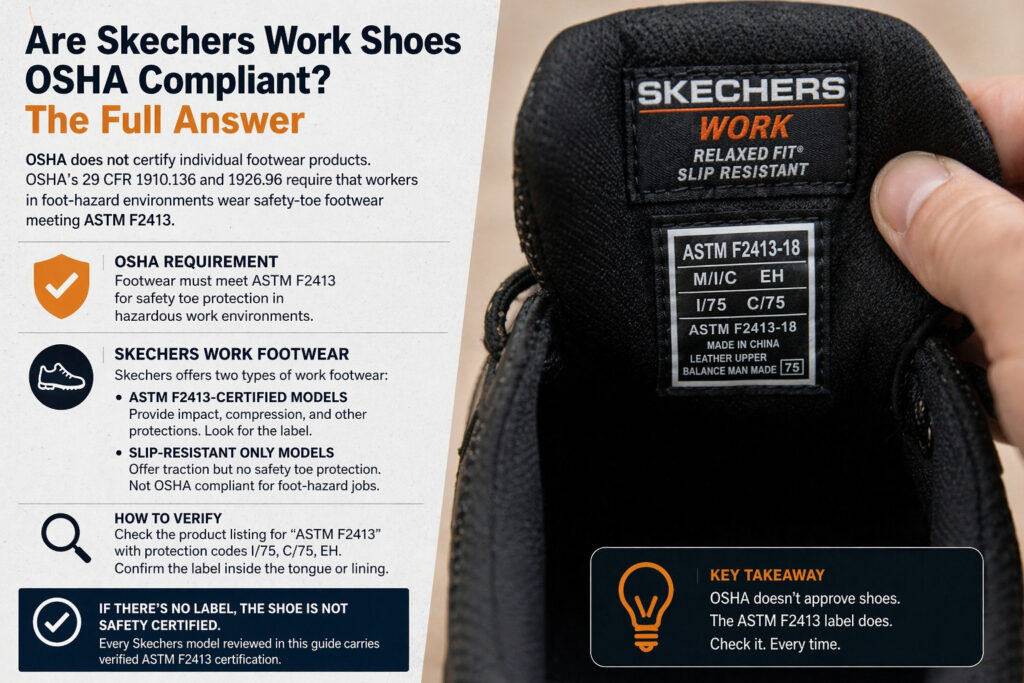
Is your Skechers footwear OSHA compliant? Find out here!
Workers search this question constantly, and most articles give a vague, incomplete answer. Here is the complete, accurate version.
OSHA does not certify individual footwear products. OSHA’s 29 CFR 1910.136 and 1926.96 require that workers in foot-hazard environments wear safety-toe footwear meeting ASTM F2413. So the question is not “does OSHA approve Skechers” but rather “does this specific Skechers model carry ASTM F2413 certification.”
The answer varies by model. Skechers sells two distinct categories of work-adjacent footwear: ASTM F2413-certified models (which carry a physical label inside the boot tongue listing the standard and protection codes) and slip-resistant-only models (which provide traction on slippery surfaces but offer no impact or compression protection and are not compliant on sites requiring safety-toe footwear). A Skechers “Squad SR” or “Cessnock” is an excellent slip-resistant work shoe — but it has no safety toe and would fail an OSHA inspection on a construction or manufacturing site that requires foot protection.
How to verify before you buy: check the product listing for “ASTM F2413” with specific protection codes — I/75 (impact), C/75 (compression), and EH (electrical hazard) if applicable. And when the boots arrive, find the physical label inside the tongue or lining. If the label does not exist, the shoe is not safety certified regardless of marketing language. Every Skechers model reviewed in this guide carries verified ASTM F2413 certification.
Memory Foam vs. Arch Fit vs. Air-Cooled Memory Foam: Which One Do You Actually Need?
This is the most important decision in the Skechers work shoe lineup, and it is the one every competitor article skips entirely. The three technologies are not interchangeable comfort options — they address fundamentally different needs, and choosing the wrong one can worsen certain types of foot pain.
Standard Memory Foam is a viscoelastic foam layer that conforms to the shape of your foot under body heat and pressure. It provides pressure relief by distributing load across the contact surface. What it does not provide is any arch support or structural posting — the foam simply molds to whatever shape your foot makes, including an overpronated or flat-arched shape. For workers with normal arch mechanics and general comfort needs on moderate shifts, Memory Foam is perfectly adequate. For workers with plantar fasciitis, flat feet, or overpronation, standard Memory Foam models allow and even encourage arch collapse under sustained load — which increases plantar fascia tension rather than relieving it.
Air-Cooled Memory Foam is the same viscoelastic foam with ventilation channels engineered into the foam structure. The cooling effect is real and meaningful in warm environments — the airflow through the channels reduces interior boot temperature and moisture accumulation. The arch support situation is identical to standard Memory Foam: there is none. If heat and moisture are your primary concerns in a work environment with normal arch mechanics, Air-Cooled Memory Foam is a genuine upgrade from standard.
Arch Fit is a fundamentally different system, not simply an upgrade of the Memory Foam line. The Arch Fit insole was developed using 120,000 foot scans and is accepted by the American Podiatric Medical Association (APMA). The key feature is a removable arch support insert that provides genuine medial arch posting — a firm, shaped wedge that physically resists the inward collapse of the arch during the stance phase of each step. This is the only Skechers technology that addresses the structural mechanics of overpronation and flat-foot arch pain. It is also the only Skechers insole that can be replaced with a custom orthotic (the insert is removable, and the insole cavity accepts standard orthotic devices). For workers with plantar fasciitis, flat feet, or arch pain who have been buying the most cushioned shoe available and wondering why their feet still hurt, Arch Fit is the correct choice — often the first Skechers technology that actually provides lasting relief.
The decision rule: normal arches and shifts under six hours — any technology works. Flat feet, plantar fasciitis, or arch pain on shifts of eight hours or more — Arch Fit only. Warm or humid work environment with normal arches — Air-Cooled Memory Foam provides meaningful additional benefit.
Steel Toe vs. Alloy Toe vs. Composite Toe in Skechers: What Each Model Actually Uses
Skechers produces models with all three toe types, and the marketing sometimes uses “safety toe” without specifying the material. The protection level under ASTM F2413 (I/75 C/75) is identical across all three. The practical differences are significant for specific work environments.
Steel toe is the heaviest option but the most widely recognised by site safety officers. It conducts heat from hot environments (desert construction, summer tarmac) and conducts cold from cold storage and winter outdoor work. It will trigger metal detectors at airports, security checkpoints, and some distribution centre entry screening systems.
Alloy/aluminum toe is lighter than steel — a meaningful advantage for workers walking 10+ miles per shift. It is still metallic. It will still trigger metal detectors. This is a commonly overlooked distinction: some workers buy alloy-toe boots expecting them to pass security scanning (as composite would) and are surprised when they trigger the detector. If metal-detector clearance is important for your job, alloy is not the answer.
Composite/nano toe is non-metallic (typically Kevlar, fibreglass, or nylon). It does not trigger metal detectors. It does not conduct heat or cold from the environment. It is the lightest option. For airport workers, workers at secure facilities, and workers in extreme temperature environments, composite is the correct choice. Skechers Arch Fit SR uses a composite toe — the best combination in this guide for most workers who need metal-detector clearance.
Relaxed Fit vs. Standard Last: Who Should Seek It and Who Should Avoid It
Skechers’ “Relaxed Fit” designation appears on many of their work shoe models and is frequently described as simply “more comfortable.” It is actually a last geometry distinction — a wider toe box and slightly higher instep volume that functions as a medium-wide fit within standard sizing. Understanding it correctly prevents both the most common Skechers return (slipping heel in Relaxed Fit for narrow-footed workers) and the most common Skechers complaint (toe cramping in standard fit for wide-footed workers).
Workers with wider-than-average feet, feet that swell significantly during long shifts, bunions, hammer toes, or workers who normally buy D-width in other brands should seek Relaxed Fit models. Workers with narrow feet or a narrow heel should specifically avoid Relaxed Fit — the wider heel cup will cause heel slippage and the friction blisters that follow. The rule: if you wear medium in most shoes and find standard work boots comfortable, choose standard Skechers sizing. If you wear wide in other brands or have wide forefoot proportions, choose Relaxed Fit in your standard length size — do not size up to get more room, as the proportions change incorrectly when you change length.
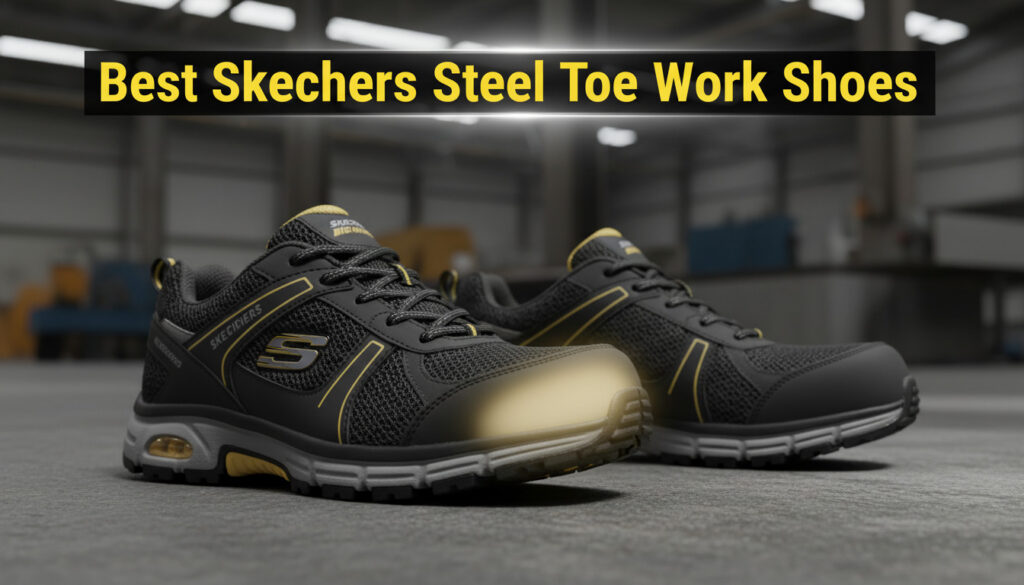
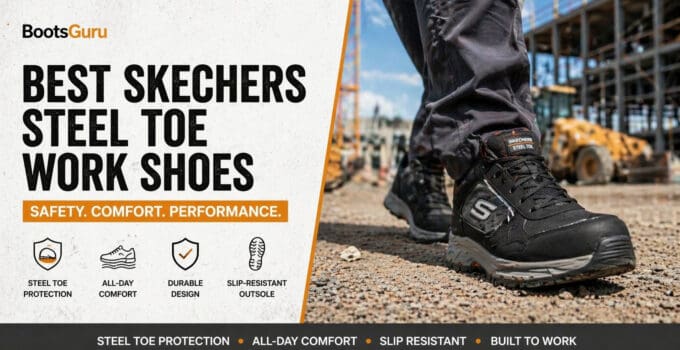
Discover the ultimate in safety and comfort with Skechers steel toe work shoes.
Quick Comparison: Best Skechers Steel Toe Work Shoes
| Boot | Technology | Toe Type | ASTM / EH | Metal Detector Safe | Best For | Price |
|---|---|---|---|---|---|---|
| Skechers Work Arch Fit SR | Arch Fit (podiatrist-designed) | Composite | F2413 EH | ✅ Yes | Best overall / arch support / healthcare | ~$90–$120 |
| Skechers Work Series (lace-up) | Air-Cooled Memory Foam | Steel or alloy (verify) | F2413 EH | ⚠️ Verify toe type | Warehouse / mobile roles | ~$75–$100 |
| Skechers Work Series (slip-on) | Memory Foam | Steel or alloy (verify) | F2413 EH | ⚠️ Verify toe type | Restaurant / retail / slip-on roles | ~$70–$95 |
| Skechers Workshire Condor | Memory Foam | Steel | F2413 EH | ❌ Steel — metallic | Boot-height / leather upper / mixed sites | ~$80–$110 |
| Skechers Soft Stride Canopy | Memory Foam | Steel | F2413 EH | ❌ Steel — metallic | Budget / entry-level / light duty | ~$70–$90 |
1. Skechers Work Arch Fit SR — Best Overall
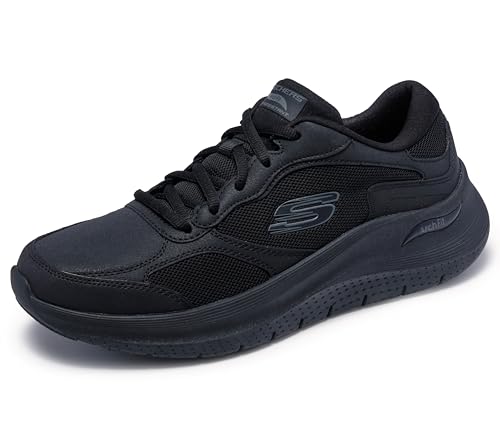
Best for: Workers with arch pain, plantar fasciitis, or flat feet who need a genuinely supportive safety shoe — and for any worker doing long shifts on hard floors who wants the most technically advanced comfort system Skechers produces.
| ASIN | B0D7QVKY9Z |
| Comfort technology | Arch Fit — podiatrist-designed, APMA-accepted, built from 120,000 foot scans |
| Toe type | Composite — non-metallic, metal-detector safe |
| ASTM certification | F2413 I/75 C/75 EH — verify on current listing |
| Metal-detector safe | Yes — composite toe is non-metallic |
| Outsole | Slip-resistant SR-rated rubber |
| Removable insole | Yes — accepts custom orthotics |
| Realistic lifespan | 14–20 months: healthcare, retail, warehouse / 8–12 months: light construction |
| Price range | ~$90–$120 |

The Arch Fit SR is the Skechers work shoe that delivers what the brand’s marketing has always promised but the Memory Foam line has not always delivered for workers with structural foot conditions. The Arch Fit insole system’s core feature — the removable, replaceable arch support insert with genuine medial arch posting — physically resists the inward collapse of the arch that makes plantar fasciitis and flat-foot pain worse in soft-foam shoes. APMA acceptance means the design has been independently evaluated by the American Podiatric Medical Association and determined to promote good foot health, a distinction that goes beyond marketing claims. Workers who have tried other Skechers models and found the comfort good but their arch or heel pain persisting will typically find the Arch Fit SR is a meaningfully different experience.

The composite toe is non-metallic and passes both standard metal detectors and body scanners without triggering alarms — a practical advantage for workers at airports, distribution centres with entry screening, and secure facilities. The EH rating provides secondary protection against accidental live-circuit contact for workers in electrical-adjacent environments. The SR slip-resistant outsole meets testing standards on both oil-contaminated steel surfaces and wet ceramic tile — the two most common slip scenarios in healthcare, food service, and warehouse environments. The removable insole clears enough depth to accommodate a standard Superfeet Green or custom orthotic device after removal, making this the correct Skechers choice for workers who manage foot conditions with orthotic devices.
Best for: Healthcare workers, airport staff, warehouse pickers, retail floor workers, and any worker with arch pain or plantar fasciitis on hard floors.
Pros: Only Skechers work shoe with genuine arch posting (not just foam cushioning), composite toe for metal-detector environments, APMA-accepted insole system, EH rated, removable insole accepts orthotics.
Cons: More expensive than other Skechers work models. Not suitable for heavy outdoor construction — mesh upper will abrade and midsole will compress faster in heavy-debris environments.
2. Skechers Work Series (Lace-Up) — Best for Warehouse and High Step Count
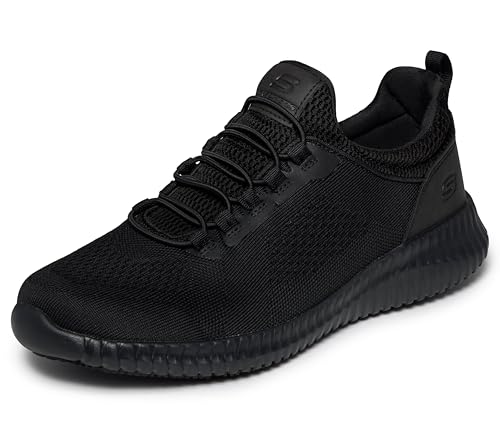
Best for: Warehouse pickers, delivery workers, and mobile industrial workers covering 8,000–15,000 steps per shift on smooth indoor floors — where lightweight construction and all-day walking comfort are the primary priorities.
| ASIN | B07FBRFCRJ |
| Comfort technology | Air-Cooled Memory Foam — ventilated foam, better heat/moisture than standard MF |
| Toe type | Steel or alloy — verify on current Amazon listing |
| ASTM certification | F2413 EH — verify on current listing |
| Metal-detector safe | ⚠️ Verify toe type — alloy is metallic and will trigger detectors |
| Construction | Athletic sneaker construction — flexible, lightweight |
| Realistic lifespan | 12–15 months in warehouse / 6–9 months in heavy outdoor construction |
| Price range | ~$75–$100 |

The lace-up Work Series is the entry point to Skechers safety footwear and the model that converts the most workers away from traditional heavy steel-toe boots. The athletic sneaker construction — flexible midsole, mesh and synthetic upper, lightweight last — is genuinely Skechers-in-feel in a way that heavier leather safety boots are not. For warehouse workers who cover 10+ miles per shift on smooth concrete floors, the weight reduction from a 28-ounce traditional work boot to a Skechers Work Series at 15–18 ounces is felt as real end-of-shift fatigue reduction within the first week of wearing. The Air-Cooled Memory Foam provides meaningful thermal management in warm warehouse environments where foot heat and moisture accumulation accelerate blister formation and discomfort.

An important note on the toe type: Skechers Work Series models are produced in both steel toe and alloy (aluminum) toe versions, and the specific ASIN may vary between them. Before ordering, verify whether the listing specifies steel, alloy, or composite — if you need to pass metal detectors as part of your work routine, alloy is metallic and will trigger screening equipment. The EH rating provides secondary electrical hazard protection, which is relevant for warehouse workers who operate near charging stations, electrical distribution panels, and powered conveyor systems. The slip-resistant outsole is rated for smooth concrete and tile — the dominant floor surface in modern fulfilment and distribution warehouses.
Best for: Warehouse and distribution workers, fulfilment centre pickers, light industrial workers on smooth clean floors.
Pros: Lightest weight option in this guide, Air-Cooled Memory Foam for thermal management, immediate comfort with no break-in, EH rated, athletic feel for workers transitioning from everyday sneakers.
Cons: Verify toe type (steel vs alloy) before ordering if metal-detector clearance is needed. Memory Foam provides no arch support — not suitable for plantar fasciitis or flat feet without insole upgrade. Not suitable for outdoor construction.
3. Skechers Work Series (Slip-On) — Best for Restaurant, Retail, and Slip-On Roles

Best for: Restaurant kitchen workers, retail floor staff, food service workers, and anyone in a role where speed of on/off matters and traditional laces create a tripping hazard or convenience problem.
| ASIN | B073WHMZPH |
| Comfort technology | Memory Foam insole — pressure relief, no arch posting |
| Toe type | Steel or alloy — verify on current listing |
| ASTM certification | F2413 EH — verify on current listing |
| Entry design | Elastic slip-on — no lace hazard, quick on/off |
| Outsole | Slip-resistant — test against wet tile and oil-contaminated surfaces |
| Realistic lifespan | 12–18 months in restaurant/retail |
| Price range | ~$70–$95 |

Loose or undone laces in a kitchen or retail stockroom are a genuine trip hazard — OSHA specifically identifies lace hazards in food service environments. The Skechers Work Series slip-on eliminates this risk entirely with an elastic entry system that provides a secure fit without laces. The Memory Foam insole provides immediate comfort for workers who stand on hard tile and polished concrete throughout a service shift, and the slip-resistant outsole handles the wet and grease-contaminated surfaces that are the primary slip hazard in kitchen environments. In restaurant service, where workers may go on and off their feet rapidly between front-of-house and kitchen roles, the slip-on convenience has a practical efficiency value beyond comfort.

The padded collar provides ankle cushioning that reduces the irritation common in slip-on styles where the collar can rub on repeated entries and exits. The Memory Foam insole conforms to the foot over the first few days of wear, personalising the pressure distribution for the individual worker’s foot shape. The EH rating provides secondary protection for workers near restaurant electrical equipment (fryers, ovens, dishwashers). The Relaxed Fit version of this model is worth seeking for workers with wider feet or foot swelling during standing shifts — the wider toe box accommodates the forefoot expansion that occurs after four or more hours of standing on hard floors.
Best for: Restaurant kitchen, food service, retail floor, any role where lace-free design is preferred and light-duty safety toe is required.
Pros: Lace-free design eliminates tripping hazard, immediate Memory Foam comfort, slip-resistant for wet kitchen floors, EH rated, quick on/off for shift changes.
Cons: Memory Foam only — no arch support. Not for plantar fasciitis or flat feet. Less secure fit than laced models for active movement and uneven surfaces. Verify toe type on listing if metal-detector clearance is needed.
4. Skechers Workshire Condor — Best Boot-Height Skechers
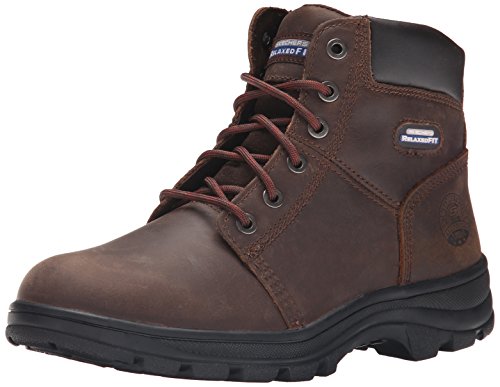
Best for: Workers who want Skechers comfort in a traditional 6-inch boot silhouette — light construction supervision, mixed indoor-outdoor work, and anyone whose job site requires a boot-height upper rather than a low-profile shoe.
| ASIN | B014UPZZXC |
| Comfort technology | Memory Foam insole — pressure relief |
| Upper | Full-grain leather — more durable than mesh/synthetic alternatives |
| Toe type | Steel — ASTM F2413 I/75 C/75 |
| ASTM certification | F2413 EH |
| Height | 6-inch — full ankle coverage and support |
| Realistic lifespan | 14–20 months indoor/mixed / 10–14 months light outdoor construction |
| Price range | ~$80–$110 |

The Workshire Condor occupies a specific position in this guide: it is the most traditionally-constructed boot in the Skechers work line, and consequently the most durable. Full-grain leather resists the abrasion, debris, and moisture exposure that degrades mesh and synthetic uppers in light outdoor and mixed-surface environments within months. The 6-inch height provides ankle coverage and lateral support that the low-profile Skechers work shoe styles cannot match — a meaningful consideration for workers on uneven surfaces, gravel, or construction sites where ankle-roll risk is a real daily hazard. The Memory Foam insole provides the characteristic Skechers immediate comfort that workers switching from traditional heavy leather work boots feel immediately.

The honest durability context for the Workshire Condor: full-grain leather upper and traditional boot construction make this significantly more robust than Skechers’ mesh-upper athletic styles, but it still uses a standard Skechers midsole and outsole system rather than the Vibram or heavy-duty compounds found in premium work boot brands. For light construction supervision, site walks, and mixed indoor-outdoor environments where the boot sees moderate daily use, the Workshire Condor is a solid performer at its price point. For active daily heavy construction — framing, roofing, concrete work — the outsole will wear faster than KEEN or Timberland PRO equivalents, and the midsole will compress sooner. It is the best Skechers for outdoor roles; it is not the best boot for outdoor roles full stop.
Best for: Site supervisors, light construction mixed roles, outdoor environments requiring ankle support, workers who want boot height with Skechers comfort.
Pros: Full-grain leather upper most durable in Skechers work range, 6-inch height for ankle support, Memory Foam comfort from day one, EH rated, better weather resistance than mesh alternatives.
Cons: Steel toe is metallic — triggers metal detectors. Memory Foam only — no arch support for structural foot conditions. Not the best choice for heavy daily outdoor construction (see alternatives section for that).
5. Skechers Soft Stride Canopy — Best Budget Skechers
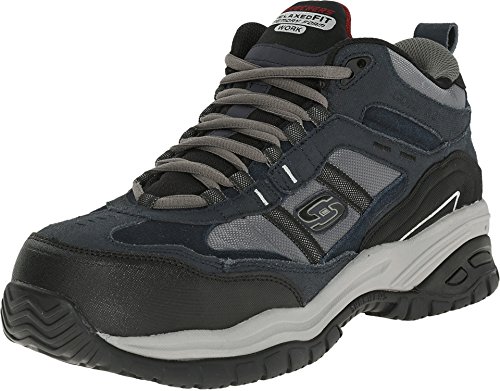
Best for: Workers who need basic ASTM-certified steel toe compliance at the lowest price point — single job site with a boot allowance, entry-level roles, or workers trying Skechers safety shoes for the first time before committing to a premium model.
| ASIN | B01J2TNT66 |
| Comfort technology | Memory Foam insole — standard pressure relief |
| Upper | Full-grain leather — classic lace-up work boot |
| Toe type | Steel — ASTM F2413 I/75 C/75 |
| ASTM certification | F2413 EH |
| Design | Traditional work boot silhouette — professional appearance |
| Realistic lifespan | 12–16 months light industrial / retail / warehouse |
| Price range | ~$70–$90 |

The Soft Stride Canopy is Skechers’ entry-level ASTM-certified work boot, and it delivers the core promise — ASTM F2413 steel toe protection, EH rating, and Skechers Memory Foam comfort — at the lowest price in this guide. The full-grain leather upper and traditional lace-up construction give it a classic work boot appearance that works in any professional environment, including those where the more athletic-looking Skechers styles might appear too casual. The Memory Foam insole provides immediate comfort compared to the flat foam insoles common in budget work boots from other brands at this price point, which is a genuine advantage for workers whose previous experience of cheap safety boots was painful break-in periods and hard footbeds.
The limitations to understand at this price point: the Memory Foam insole provides comfort but no arch posting — workers with structural foot conditions need to upgrade to the Arch Fit SR or add a Superfeet insole after purchasing. The midsole at this price tier will compress faster under heavy daily use than premium-tier alternatives, with the flat hard feeling beginning at around eight to ten months of daily warehouse or construction use. For workers who receive a fixed annual boot allowance and need to maximise ASTM compliance at minimum spend, the Soft Stride Canopy is the correct choice. For workers who wear boots daily and measure total cost across two to three years of use, the investment in an Arch Fit model or a Timberland PRO alternative typically provides better cost-per-wear.
Best for: Budget-conscious workers, first-time Skechers buyers, boot-allowance maximisers, light industrial and retail roles where basic ASTM compliance is the primary requirement.
Pros: Lowest price with genuine ASTM F2413 certification, Memory Foam comfort beats flat-foam budget competitors, full-grain leather for professional appearance, EH rated.
Cons: Memory Foam only — no arch support. Midsole will compress earlier than premium alternatives at ~8–10 months under heavy daily use. Steel toe triggers metal detectors.
The Honest Durability Guide: Where Skechers Work Shoes Excel and Where They Struggle
This section is the one every other Skechers work shoe article declines to write. Here is the complete, honest picture.
Where Skechers work shoes genuinely excel: Retail and customer-facing roles. Warehouse and distribution on smooth clean floors. Healthcare-adjacent environments. Restaurant front-of-house. Airport terminal staff. Light industrial on controlled indoor surfaces. In these environments, Skechers delivers a comfort-to-price ratio that is genuinely competitive with boots costing twice as much, and realistic lifespans of 14–20 months are achievable.
Where Skechers work shoes struggle and where you should choose something else: Active outdoor construction (framing, roofing, concrete work) — mesh uppers abrade within three to six months of exposure to lumber, rebar, and concrete rubble; outsoles wear faster on abrasive terrain than Vibram-soled alternatives. Chemical environments — mesh and standard synthetic uppers degrade under sustained oil, chemical, or solvent exposure faster than full-grain leather alternatives. Heavy static load environments (assembly line with heavy parts, heavy bag handling) — Memory Foam and standard EVA midsoles compress faster under heavy static weight than PU-midsole boots. Cold outdoor environments — standard Skechers midsoles become significantly firmer in cold temperatures, reducing the cushioning feel that makes them attractive.
The documented failure patterns from real user reviews: The most consistent 1-star pattern across thousands of Amazon reviews for Skechers work shoes is outsole separation from the upper at four to eight months in heavy construction environments. The second most common: Memory Foam compression, where the insole becomes flat, hard, and no longer provides meaningful cushioning at six to nine months under warehouse use. The third: mesh upper abrasion failure at three to six months in outdoor construction with daily contact with concrete, gravel, and sharp materials.
Realistic lifespan by environment: Healthcare, airport, retail: 16–20 months. Warehouse on smooth floors: 12–15 months. Light construction and mixed indoor-outdoor: 8–12 months. Heavy outdoor construction: 4–8 months — not recommended.
Job-Role Picker: Which Skechers for Your Work
Warehouse and distribution / high step count: Skechers Work Series lace-up (Pick 2). Maximum lightweight, Air-Cooled Memory Foam for thermal management, slip resistance on smooth concrete. If you have arch pain, upgrade to Arch Fit SR (Pick 1).
Restaurant and food service: Skechers Work Series slip-on (Pick 3) for lace-free convenience and wet-floor grip. If you need arch support for long standing shifts, Arch Fit SR (Pick 1) with lace-up design is worth the premium.
Healthcare and hospital environments: Skechers Work Arch Fit SR (Pick 1) — composite toe for metal-detector clearance near medical equipment, APMA-accepted arch support for standing shifts, EH for electrical equipment proximity.
Site supervision and light construction: Skechers Workshire Condor (Pick 4) — full-grain leather upper handles mixed surfaces better than mesh models, 6-inch height for ankle support. For active framing or heavy construction, choose the Timberland PRO alternative (Alt 1).
Airport workers and security checkpoint staff: Skechers Work Arch Fit SR (Pick 1) — composite toe is non-metallic and metal-detector safe. Any steel or alloy toe model will require removal at security screening.
Workers on a tight budget: Skechers Soft Stride Canopy (Pick 5) — full ASTM compliance at the lowest price point, Memory Foam comfort, leather upper.
Women’s Skechers Steel Toe Guide
Skechers over-indexes with female consumers compared to traditional work boot brands, and many women making their first safety shoe purchase reach for Skechers because of the brand familiarity and comfort reputation. The good news: Skechers has a genuine women’s work footwear line built on women’s-specific lasts — not simply men’s boots in smaller sizes.
Women’s Skechers work models use proportions appropriate for women’s foot anatomy: a narrower heel cup relative to forefoot width, and arch placement positioned further forward to match women’s shorter arch length. The Arch Fit SR is available in women’s sizing and carries the same APMA-accepted insole system — the composite toe, EH rating, and arch support combination is available to women workers without compromise.
The Relaxed Fit consideration is particularly relevant for women: many women’s feet have a wider forefoot relative to heel width — the exact shape that Relaxed Fit accommodates. Women who have found standard work boots cramp the toes by afternoon should specifically look for Relaxed Fit models in the Skechers work line.
When Skechers women’s is not enough: for women in heavy construction who need a boot built on genuine women’s anatomical last with robust ASTM compliance and Goodyear welt durability, the Carhartt Rugged Flex Women’s (see the alternatives section) provides a full women’s-last steel-toe boot that outperforms Skechers in durability for demanding construction environments.
When to Choose Skechers and When to Choose Something Else
Most Skechers work shoe articles will not tell you this. Skechers is the correct choice when your job involves: controlled indoor environments (warehouse, retail, healthcare, restaurant), smooth or moderately clean floors, moderate daily step counts, and a requirement for ASTM compliance without heavy construction durability demands. In these environments, Skechers competes with boots costing significantly more and often wins on comfort and accessibility.
Skechers is not the correct choice when your job involves: active outdoor construction with daily exposure to abrasive materials, chemical or solvent environments that degrade synthetic materials, heavy load-carrying that compresses lighter midsoles faster, cold outdoor environments where standard midsoles stiffen and lose cushion, or any environment where you need a boot to last reliably beyond 14 months of daily use before replacement.
The five alternatives below address these gaps specifically.
Best Alternatives: When You Need More Than Skechers Can Offer
| Boot | Best When Skechers Isn’t Right | Key Advantage Over Skechers | Price |
|---|---|---|---|
| Timberland PRO Reaxion CT | Same athletic feel but longer-lasting | Better midsole durability, composite toe standard | ~$130–$165 |
| KEEN Utility Vista Energy Lo | Breathability + wide toe box needed | KEEN asymmetric wide toe box, mesh hybrid upper | ~$120–$150 |
| Merrell Work Moab 3 Mid WP | Skechers outsole wore out, need Vibram | Vibram TC5+ outsole, air cushion heel, waterproof | ~$130–$155 |
| Wolverine Overpass 6″ CT WP | Composite + waterproof + longer midsole life | PU midsole lasts 18–24 months, true composite, waterproof | ~$110–$140 |
| Carhartt Rugged Flex 6″ Women’s | Women’s anatomical fit + heavy construction | Genuine women’s last, Rugged Flex mobility, leather durability | ~$110–$145 |
Alternative 1. Timberland PRO Reaxion CT — Same Athletic Feel, Better Durability

Best for: Workers who love the lightweight athletic Skechers feel but have experienced outsole separation or midsole compression in Skechers boots and need a more durable alternative that maintains the same low-weight, sneaker-style construction.
| ASIN | B0CLT1R54L |
| Safety toe | Composite — ASTM F2413, non-metallic, metal-detector safe |
| ASTM certification | F2413 EH — verify on current listing |
| Weight | ~13 oz per boot — lightest ASTM boot in this guide |
| Upper | Synthetic and mesh — athletic construction |
| Midsole | Anti-fatigue footbed with EVA — geometric energy return |
| Price range | ~$130–$165 |

The Timberland PRO Reaxion is what Skechers work shoes aspire to be at the durability level: same athletic sneaker construction, same synthetic and mesh upper, same immediate comfort with no break-in — but with Timberland PRO’s anti-fatigue footbed and better outsole compound integrity. Workers who have gone through two Skechers Work Series pairs in 18 months due to outsole separation or midsole compression consistently describe the Reaxion as the same feel that lasts longer. The composite toe is genuinely non-metallic — standard across the Reaxion, not a model variant — which makes it the correct choice for any site with metal detector entry requirements.

The anti-fatigue footbed uses Timberland PRO’s geometric energy-return system rather than flat Memory Foam, which provides active energy return at toe-off rather than passive cushioning — a meaningful difference for workers who walk rather than stand, as active return reduces the oxygen cost of each step. At approximately 13 ounces per boot, it is the lightest ASTM-certified safety boot in this entire guide — lighter even than comparable Skechers models while carrying ASTM certification and composite toe as standard.
Best for: Workers who want the Skechers athletic feel with better durability and composite toe standard across all models.
Pros: Lightest ASTM boot in guide at ~13 oz, composite toe standard (non-metallic), Timberland PRO anti-fatigue system, immediate comfort, available in black.
Cons: More expensive than all Skechers models. EVA midsole still compresses at 12–14 months of daily heavy use — not a permanent solution for workers needing 2+ years per pair.
Alternative 2. KEEN Utility Vista Energy Lo — Best Breathable Low-Cut
No products found.Best for: Workers who want the Skechers low-profile look and breathability but need a wider toe box, more durable upper construction, and KEEN’s asymmetric toe box geometry for forefoot comfort.
| ASIN | B08JPNVZCY |
| Safety toe | Steel — ASTM F2413 I/75 C/75 EH |
| Toe box | KEEN asymmetric wide — widest in this guide |
| Upper | Leather and open mesh hybrid — active heat venting |
| Midsole | KEEN.ReGEN — energy return compound |
| Height | Low-cut — most sneaker-like silhouette |
| Price range | ~$120–$150 |
KEEN’s asymmetric wide toe box is the defining feature for workers who have struggled with forefoot compression in Skechers standard or Relaxed Fit models. Where Skechers Relaxed Fit widens the entire boot moderately, KEEN’s asymmetric design specifically widens toward the big toe to match the natural human forefoot shape, avoiding any structural element at the first metatarsophalangeal joint. Workers with bunions, hammer toes, or severe forefoot width find the KEEN geometry provides relief that no Skechers model delivers. The KEEN.ReGEN midsole compound provides energy return that maintains performance longer than standard EVA foam — a durability advantage for workers who have experienced Skechers Memory Foam compression.
No products found.The open mesh zones in the leather-mesh hybrid upper provide active heat venting that exceeds the Air-Cooled Memory Foam’s internal thermal management — the heat leaves through the upper, not just through the insole. For workers in warm environments where Skechers models still run hot, the Vista Energy Lo’s open mesh provides meaningful thermal relief. The KEEN women’s version is available on a genuine women’s last with the same asymmetric toe box geometry.
Best for: Workers with wide forefoot or bunions, warm environment workers needing active upper ventilation, workers whose Skechers toe box has been cramping by mid-afternoon.
Pros: Widest toe box in guide, open mesh for superior heat venting, KEEN.ReGEN midsole lasts longer than EVA foam, non-marking outsole, women’s version on genuine women’s last.
Cons: Steel toe triggers metal detectors. No waterproofing — not for wet outdoor environments. Mesh upper still vulnerable to abrasion in heavy construction debris.
Alternative 3. Merrell Work Moab 3 Mid WP — Best When You Need Vibram Outsole Durability

Best for: Workers who have had Skechers outsoles separate or wear through and need a boot with a Vibram outsole rated for sustained mixed-surface use, while maintaining the athletic construction feel and lightweight build.
| ASIN | B0D97392TQ |
| Safety toe | Safety toe — verify type on current listing |
| Outsole | Vibram TC5+ — the durable outsole that Skechers cannot match |
| Waterproof | Yes — Merrell DRY membrane |
| Midsole | Air cushion heel + EVA |
| Weight | ~14 oz per boot |
| Removable insole | Yes — Kinetic Fit Base, orthotic-compatible |
| Price range | ~$130–$155 |
The Vibram TC5+ outsole is the reason to choose the Merrell Work Moab 3 over Skechers when durability is the driving concern. Vibram outsoles are an industry benchmark for outsole longevity — the compound is engineered for sustained multi-surface wear and maintains grip and structural integrity significantly longer than the standard rubber compounds in Skechers work shoes. Workers who have experienced Skechers outsole separation (the most common Skechers 1-star complaint) will find the Moab 3’s Vibram outsole a qualitatively different experience. The athletic trail-shoe construction maintains the Skechers-like low weight and flexible feel — this is not a heavy traditional work boot — while the Merrell DRY waterproof membrane adds weather protection that no Skechers athletic work shoe provides.

The air cushion heel provides heel-strike impact absorption that specifically addresses the heel impact fatigue that develops over long walking shifts on hard floors — the same type of comfort that the Skechers Memory Foam line addresses, but with Merrell’s more durable midsole construction. The removable Kinetic Fit Base insole accepts Superfeet or custom orthotics for workers who need arch support in addition to the comfort the stock insole provides. Women’s version available on a genuine women’s last.
Best for: Workers whose Skechers outsoles have separated or worn through, workers needing waterproof protection that Skechers doesn’t offer, high step-count roles where outsole longevity is the primary concern.
Pros: Vibram TC5+ outsole significantly outlasts Skechers rubber, Merrell DRY waterproof, air cushion heel, orthotic-ready, women’s version available.
Cons: More expensive than Skechers. Verify safety toe spec on current listing. EVA midsole will compress at 10–14 months under daily hard use.
Alternative 4. Wolverine Overpass 6″ Composite Toe WP — Best for Composite, Waterproof, and Longer Midsole Life

Best for: Workers who need the trifecta of genuine composite toe (non-metallic), full waterproofing, and a PU midsole that maintains cushioning performance significantly longer than Skechers Memory Foam.
| ASIN | B01MU1VO3P |
| Safety toe | Composite — non-metallic, ASTM F2413 I/75 C/75 EH, metal-detector safe |
| Midsole | Contour PU — maintains performance 18–24 months vs. 6–12 for EVA/Memory Foam |
| Waterproof | Yes — full waterproof membrane |
| Construction | ContourWelt — more flexible than traditional welted construction |
| Removable insole | Yes — orthotic-compatible |
| Price range | ~$110–$140 |

The Wolverine Overpass addresses the three gaps that Skechers athletic work shoes cannot simultaneously fill: genuine non-metallic composite toe, full waterproof construction, and a PU midsole that maintains its cushioning performance for 18–24 months under daily hard use. Skechers offers composite toe (Arch Fit SR) but without waterproofing. Skechers offers waterproofing in some models but without composite toe. And every Skechers model uses Memory Foam or EVA — not PU — which compresses at 6–12 months in heavy use. The Overpass provides all three in a single boot at a price below the Arch Fit SR.

The ContourWelt flexible construction gives the Overpass more natural foot movement than traditional rigid welted work boots — it bends at the ball of the foot and reduces the gait compensation that causes calf and arch soreness in rigid-sole boots. For workers who have been wearing rigid steel-toe boots and find Skechers’ flexibility appealing, but need waterproofing and composite toe, the Overpass delivers both the flexibility and the protection in a single boot. The PU midsole investment specifically helps workers who have experienced the Skechers Memory Foam compression problem — the Overpass will feel firm compared to fresh Skechers foam, but it will still feel firm at month 18 when the Skechers would have compressed flat.
Best for: Airport workers needing composite + waterproof, electricians needing composite + EH, workers who have experienced Skechers midsole compression and want longer-lasting cushion.
Pros: True non-metallic composite, full waterproofing, PU midsole lasts 18–24 months, ContourWelt flexibility, orthotic-ready, EH rated.
Cons: Less immediately soft than Skechers Memory Foam — firmer initial feel that improves with use. Wolverine runs slightly large; size down half a step.
Alternative 5. Carhartt Rugged Flex 6″ Women’s — Best Women’s Alternative

Best for: Women in construction, trades, and heavy industrial roles who love Skechers for everyday wear but need a women’s-specific work boot that handles demanding environments better than Skechers can — with a genuine women’s anatomical last that fits correctly.
| ASIN | B00T4ZR1BI |
| Last | Genuine women’s last — narrower heel, forward arch, women’s forefoot proportions |
| Key feature | Rugged Flex articulated sole — bends naturally, reduces compensatory gait soreness |
| Lining | FastDry moisture-wicking — manages sweat that leads to heat and blisters |
| Safety toe | Steel — ASTM F2413 I/75 C/75 EH |
| Upper | Full-grain leather — genuine construction durability |
| Price range | ~$110–$145 |

Skechers’ women’s work line is genuinely built on women’s-specific lasts — a real advantage over brands that simply scale down men’s boots. But for women in active construction, roofing, framing, or heavy industrial roles, Skechers’ mesh and synthetic uppers and lighter-duty midsoles reach their durability limits within months of heavy use. The Carhartt Women’s Rugged Flex is built specifically for women who need to work hard in their boots: genuine women’s last with correct heel cup width and arch position, FastDry moisture-wicking lining for sweaty shift management, and Rugged Flex articulated sole that bends naturally with the foot to reduce the gait compensation soreness that rigid boots cause.

The FastDry lining deserves specific attention as a Skechers comparison: Skechers Air-Cooled Memory Foam manages internal temperature somewhat, but it is a passive system. Carhartt’s FastDry actively wicks moisture away from the skin surface and distributes it for evaporation — the difference is most noticeable on long hot shifts where foot moisture accumulates. Women who have experienced blisters and hot spots in Skechers work shoes on demanding shifts will often find the FastDry lining eliminates the moisture accumulation that caused the blisters, even in a full-grain leather boot that runs warmer overall. Full-grain leather construction provides genuine outdoor and light construction durability that no Skechers synthetic model can match.
Best for: Women in construction, active trades, outdoor roles needing genuine women’s last with superior durability over Skechers alternatives.
Pros: Genuine women’s last (most Skechers women’s alternatives are narrow men’s lasts), Rugged Flex reduces gait compensation soreness, FastDry moisture management, full-grain leather durability, EH rated, under $145.
Cons: Full-grain leather requires 1-week break-in. Steel toe triggers metal detectors. Not available in composite toe — for metal-detector-safe requirements, see KEEN San Jose women’s version.
ASTM F2413 Label Decoder: Verify Before You Rely On It
Before wearing any safety shoe to a regulated job site, verify the physical label inside the boot tongue or lining. Here is what to look for.
ASTM F2413-[year]: The standard, with edition year. Current edition is -24. Older editions (-18, -11) provide equivalent protection but verify your employer’s requirements.
M or W: Men’s or Women’s last. Safety cap clearance dimensions differ by gender — ensure the label matches the boot you purchased.
I/75: Impact protection — the cap withstands a 75 ft-lb drop. Required for most safety-toe job sites.
C/75: Compression protection — withstands 2,500 lbs of rolling compression. Always paired with I/75.
EH: Electrical Hazard — sole withstands 18,000V at 60Hz for 60 seconds under dry conditions. Secondary protection; does not replace lockout/tagout procedures.
If the label is missing: The shoe is not safety certified. Return it or do not wear it to a regulated site. Skechers slip-resistant work shoes without a safety toe will not have this label — do not assume a label exists because the shoe is branded “work.”
Frequently Asked Questions
Are Skechers work shoes OSHA compliant and ASTM certified?
Only specific models are ASTM F2413 certified. OSHA references ASTM F2413 as the standard for foot protection on regulated job sites. The five Skechers models in this guide all carry ASTM F2413 certification, verified on their Amazon listings. Not all Skechers “work shoes” are certified — verify the physical label inside the boot tongue before relying on any model for compliance.
What is the difference between Skechers Memory Foam and Arch Fit for work?
Memory Foam (standard and Air-Cooled) conforms to the foot shape and provides pressure relief — it does not support the arch or prevent overpronation. Arch Fit has a removable insole with genuine medial arch posting built from 120,000 foot scans and accepted by the American Podiatric Medical Association. For workers with plantar fasciitis, flat feet, or arch pain, only Arch Fit provides the structural support needed. Memory Foam alone can worsen these conditions by allowing arch collapse.
Do Skechers steel toe shoes have real steel toes or alloy toes?
Both exist in the Skechers work line. Some models use traditional steel toe, some use aluminium alloy (lighter, still metallic), and some (including the Arch Fit SR) use composite non-metallic toe. The product listing will specify — look for “steel toe,” “alloy toe,” or “composite toe.” Alloy toe is metallic and will trigger metal detectors; composite is non-metallic and will not.
How long do Skechers work boots last in a warehouse or construction job?
In warehouse and retail environments: 12–15 months before midsole compression. In healthcare and light industrial: 14–20 months. In heavy outdoor construction: 4–8 months before outsole failure or midsole compression — Skechers is not recommended for this environment. The Workshire Condor (leather upper) lasts longer in mixed outdoor environments than mesh-upper models.
What does “Relaxed Fit” mean in Skechers work shoes?
Relaxed Fit means a wider toe box and higher instep volume — effectively a medium-wide last within standard sizing. Workers with wide feet or feet that swell during long shifts should choose Relaxed Fit. Workers with narrow feet should avoid it — the wider heel cup causes slippage. Do not size up to get more room; the proportions change incorrectly at a different length.
Are Skechers composite toe shoes metal-detector safe?
Yes — composite toe (non-metallic) does not trigger metal detectors. The Skechers Work Arch Fit SR uses a composite toe and is metal-detector safe. Steel toe and alloy toe Skechers models are metallic and will trigger screening equipment. Verify the toe type on the listing before purchasing for airport or secure-facility roles.
Are Skechers work shoes good for plantar fasciitis?
Arch Fit models — yes, meaningfully. The medial arch posting in the Arch Fit insole resists the arch collapse that worsens plantar fasciitis. Standard Memory Foam models — not for plantar fasciitis. Memory Foam allows arch collapse under sustained load, which increases plantar fascia tension. If you have plantar fasciitis and want Skechers, the Arch Fit SR is the correct choice. If you have already purchased a Memory Foam model, add a Superfeet Green insole (remove the stock insole first) as an interim solution.
What is the best Skechers work shoe for women?
For indoor roles (healthcare, retail, restaurant, warehouse) with arch support needs: Skechers Work Arch Fit SR women’s — composite toe, APMA-accepted arch support, EH rated. For indoor roles without arch issues: Skechers Work Series women’s — lighter, less expensive. For heavy construction or outdoor roles: Carhartt Rugged Flex Women’s (see the alternatives section) — genuine women’s last with construction-grade durability that Skechers cannot match.
Final Verdict: Which Skechers for Your Job
For workers with arch pain, flat feet, or plantar fasciitis on hard floors: Skechers Work Arch Fit SR — the only model with genuine medial arch support, composite toe for metal detectors, and APMA-accepted insole technology.
For warehouse and distribution workers prioritising lightweight and step-count comfort: Skechers Work Series lace-up — Air-Cooled Memory Foam, athletic construction, excellent step-count comfort.
For restaurant, food service, and quick-change roles: Skechers Work Series slip-on — lace-free design eliminates tripping hazard, wet-floor slip resistance, EH rated.
For mixed indoor-outdoor and site supervision: Skechers Workshire Condor — full-grain leather for outdoor durability, 6-inch height for ankle support.
For budget compliance: Skechers Soft Stride Canopy — full ASTM certification at the lowest price point.
When Skechers durability has let you down and you need something that lasts longer: Timberland PRO Reaxion CT (same athletic feel, better durability) or Merrell Work Moab 3 (Vibram outsole won’t separate).
For the full composite + waterproof + long-lasting midsole combination: Wolverine Overpass CT WP.
For women needing construction-grade durability on a genuine women’s last: Carhartt Rugged Flex Women’s.