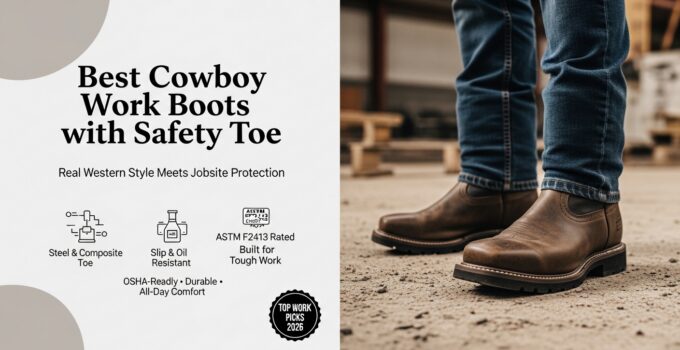

If you work in Western states, you already know: there's no practical difference between a work boot and a cowboy boot. You're wearing them for 12 hours either way. The question isn't whether to wear cowboy boots to work — it's which ones pass the safety requirements, survive the job, and don't look like they were designed in a corporate conference room.
Most cowboy boot buying guides fail working people in two ways: they recommend fashion boots with no ASTM safety ratings, or they list lace-up work boots with decorative stitching and call them "Western." Neither is acceptable if you're walking an oil lease road, sorting cattle at hour ten, or running a bead on steel with sparks flying at your feet.
This guide covers nine Amazon-available cowboy work boots with verified ASTM F2413 safety certifications, organized by trade. You'll also find the honest answer to "do cowboy boots meet OSHA requirements?" — a question that gets thousands of searches per month and almost no good answers — plus a full OSHA compliance explainer, a toe shape guide, heel height science, a women's section, a brand comparison, and a break-in protocol that prevents the injuries most guides don't mention.
All boots in this guide are designed to meet ASTM F2413 standards. Always verify the current certification on the Amazon listing before purchase — and physically check for the ASTM F2413 label printed inside the boot shaft on arrival. That label, not the product listing, is the legal compliance confirmation.
Table of Contents
- Fast Answer Box — Best Pick by Job
- Do Cowboy Boots Meet OSHA Requirements?
- Full Comparison Table — All 9 Boots
- Best Overall: Ariat Groundbreaker Wide Square Toe
- Best for Construction: Ariat WorkHog Wide Square Toe
- Best Composite / Oil Field: Ariat WorkHog XT VentTEK
- Best Waterproof: Wolverine Rancher Steel Toe Wellington
- Best for Welding: Justin Driller 11″ Square Toe
- Best Budget: Durango Rebel Steel Toe
- Best Alloy Toe: Georgia Boot Carbo-Tec LTX Wellington
- Best Women's: Ariat Women's Groundbreaker Steel Toe
- Best Premium: Thorogood Western Square Toe WP
- Square vs. Round vs. Snip Toe for Work
- The Cowboy Heel — Advantage or Fatigue Factory?
- Steel Toe vs. Composite Toe for Western Boots
- EH Rating — Who Actually Needs It?
- Best Cowboy Work Boots by Job Type
- Women's Cowboy Work Boots — Properly Addressed
- Ariat vs. Justin vs. Wolverine vs. Durango
- The Break-In Problem — Unique Danger of Cowboy Boots
- Pull-On vs. Lace-Up Western Work Boots
- Price Tier Analysis
- Boot Care for Work Conditions
- FAQ — 10 Questions Answered
- Final Verdict by Trade
🤠 Fast Answer: Best Cowboy Work Boot by Job
| Job / Use Case | Best Pick | Key Reason |
|---|---|---|
| Ranch / general work | Ariat Groundbreaker Wide Square Toe | ATS cushioning + ASTM F2413 + iconic Western look |
| Oil field / refinery | Wolverine Rancher Steel Toe Wellington | Waterproof + EH rated + oil-resistant outsole |
| Welding | Justin Driller 11″ Square Toe | Smooth leather upper, no lace holes, heat-resistant outsole |
| Construction / concrete | Ariat WorkHog Wide Square Toe Steel Toe | ATS Max anti-fatigue + ASTM F2413 + wide square toe |
| Composite toe / metal detectors | Ariat WorkHog XT VentTEK Composite | Lightweight + waterproof + ASTM F2413 |
| Budget under $135 | Durango Rebel Steel Toe | Western style + ASTM-rated steel toe + under $135 |
| Women's | Ariat Women's Groundbreaker Square Toe Steel Toe | Women's-specific last + ASTM safety + genuine Western style |
| Premium / long-term investment | Thorogood Western Square Toe Composite WP | Goodyear welt, Vibram outsole, composite toe, resoleable |
| Alloy toe / lighter weight | Georgia Boot Carbo-Tec LTX Alloy Toe Wellington | Alloy toe + waterproof + pull-on Western style |
🏛️ Do Cowboy Boots Meet OSHA Requirements? The Honest Answer
The short answer: some do. Most don't. It depends entirely on whether the specific boot carries ASTM F2413 certification — not on whether it looks like a work boot, says "steel toe" in the description, or was sold in a Western wear store.
How OSHA Actually Works for Footwear
OSHA's foot protection standard (29 CFR 1910.136) requires protective footwear on job sites where employees are exposed to falling or rolling objects, electrical hazards, or objects that could pierce the sole. OSHA does not approve or disapprove specific boot styles or brands. OSHA enforces performance standards. The relevant performance standard for protective footwear is ASTM F2413.
What ASTM F2413 Certifies
- I/75 (Impact): The toe cap must withstand 75 ft-lbs of impact force
- C/75 (Compression): The toe cap must withstand 2,500 lbs of compressive force
- EH (Electrical Hazard): The outsole provides insulation against electrical shock at 18,000 volts under dry conditions
- PR (Puncture Resistant): The sole resists upward penetration from sharp objects
How to Verify a Cowboy Boot Is OSHA Compliant
- Look for the ASTM F2413 label printed inside the boot shaft — not just in the product listing description
- The label must specify I/75 C/75 at minimum for basic toe protection
- EH rating must appear separately on the label if electrical hazard protection is required by your employer
- A boot that lists "steel toe" without an ASTM label does not meet OSHA requirements, regardless of what's inside the toe cap
⚠️ The Critical Distinction
Many fashion and decorative Western boots are described as having a "reinforced toe" or even a "steel toe" but carry no ASTM F2413 certification. On an OSHA-regulated job site, wearing a non-certified boot with a decorative steel toe is legally equivalent to wearing a soft-toe boot. The label inside the shaft is the only thing that counts.
Boots That Commonly Do NOT Meet OSHA Requirements
- Traditional riding boots (Tony Lama 3R, classic ropers without a safety toe designation)
- Fashion cowboy boots with decorative toe reinforcement but no ASTM label
- Low-cost knockoffs on Amazon without verifiable ASTM F2413 labels inside the shaft
- Any boot listed as "safety toe" in the title without a physical ASTM F2413 label inside
Boots That DO Meet OSHA Requirements (When Label Is Present)
All nine boots in this guide are designed to meet ASTM F2413 — including the Ariat WorkHog, Ariat Groundbreaker, Wolverine Rancher, Justin Driller, Georgia Boot Carbo-Tec, Thorogood Western, and Durango Rebel lines. Always verify on the current Amazon listing and confirm the physical label is inside the shaft on the pair you receive.
Note for supervisors and safety officers: Always physically inspect the inside of the boot shaft for the ASTM F2413 label during PPE audits. A boot that looks like a work boot is not sufficient documentation. The label must be present and legible.
Full Comparison Table — All 9 Boots
| Boot | Toe | EH | Waterproof | Construction | Shaft | Price |
|---|---|---|---|---|---|---|
| Ariat Groundbreaker Wide Square | Steel | ✅ | — | Cement/welt | 11″ | $140–$170 |
| Ariat WorkHog Wide Square | Steel | ✅ | — | Cement | 11″ | $160–$195 |
| Ariat WorkHog XT VentTEK Composite | Composite | ✅ | ✅ | Cement | 11″ | $190–$230 |
| Wolverine Rancher Steel Toe Wellington | Steel | ✅ | ✅ | Goodyear welt | 10″ | $150–$185 |
| Justin Driller 11″ Square Toe | Steel | ✅ | — | Goodyear welt | 11″ | $140–$175 |
| Durango Rebel Steel Toe | Steel | ✅ | — | Cement | 11″ | $110–$135 |
| Georgia Boot Carbo-Tec LTX Alloy Toe | Alloy | ✅ | ✅ | Direct attach | 11″ | $140–$170 |
| Ariat Women's Groundbreaker Square Toe | Steel | ✅ | — | Cement/welt | 11″ | $130–$165 |
| Thorogood Western Square Toe Composite WP | Composite | ✅ | ✅ | Goodyear welt | 11″ | $230–$285 |
*All boots designed to meet ASTM F2413 — verify certifications on current Amazon listing before purchase. Prices approximate.
Best Overall — Ariat Men's Groundbreaker Wide Square Toe Steel Toe

The Ariat Groundbreaker is the boot you see on every serious rancher at the feed store, on every oil lease road in Texas, and on every construction site in the Western states where cowboy boots are the default footwear. It earns that ubiquity: the ATS (Advanced Torque Stability) anti-fatigue footbed is genuinely the best comfort system in this price tier, the Duratread outsole handles oil, slip, and abrasion across varied terrain, and the wide square toe box accommodates natural toe splay on long shifts. ASTM F2413 certified, EH rated, available in multiple widths. This is the daily driver for a reason.

The wide square toe is the correct choice for serious ground work — it gives your toes room to spread naturally, which matters significantly at hour 8 when your foot has expanded from the day's loading. The Duratread outsole resists oil and slipping on the wet and muddy surfaces that ranch and farm work routinely produces. The leather upper is water-resistant for light conditions, though not waterproof for sustained wet work. If you need full waterproofing, the WorkHog XT VentTEK is the right step up. The Groundbreaker's limitation is its own success: because it's the most popular cowboy work boot on Amazon, you'll find it on job sites everywhere — but there is a reason for that.

Specs at a Glance
Toe: Steel — ASTM F2413 I/75 C/75 | EH Rated: ✅ Yes
Waterproof: — (water-resistant leather only) | Shaft: 11″
Construction: Cement/welt hybrid | Outsole: Duratread (oil, slip, abrasion resistant)
Comfort: ATS anti-fatigue footbed | Toe shape: Wide square
Best for: Ranch · Farm · General outdoor work · All-day wear
Pros: Best-in-class ATS comfort for the price; Duratread outsole handles mixed terrain; Wide square toe accommodates foot swelling; ASTM F2413 + EH; Multiple widths available; Widely trusted across Western trades.
Cons: Not waterproof — wet stall or prolonged rain work requires a different boot; Cement construction on most versions limits resolability.
❌ Skip This If: You need full waterproofing for daily wet conditions / you weld (go Justin Driller for smooth upper) / you need composite toe for metal detector sites.
Best for Construction / Concrete — Ariat Men's WorkHog Wide Square Toe Steel Toe
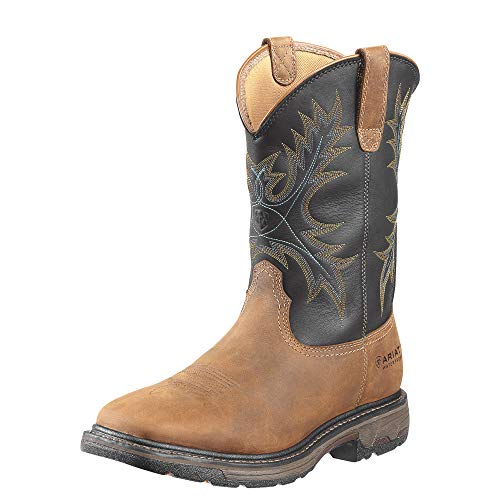
The WorkHog takes everything that makes the Groundbreaker great and upgrades the cushioning system to ATS Max — a more aggressive anti-fatigue platform that is meaningfully different on concrete over 10+ hours. If your job is primarily standing and walking on poured concrete, finished floors, or flat hard surfaces rather than ranch terrain, the WorkHog's extra cushioning investment pays back daily. It carries the same ASTM F2413 steel toe and EH certification, the same Duratread outsole, and the same wide square toe — but with a footbed engineered for the specific compressive punishment of hard, flat surface work.
The ATS Max system delivers noticeably more cushioning than the standard Groundbreaker, which is the right call for construction workers who stand on concrete for 8–12 hour shifts. The tradeoff is weight — the WorkHog is heavier than the Groundbreaker. For workers who cover significant walking distances (long ranch routes, field work), the lighter Groundbreaker may cause less end-of-day leg fatigue. For static standing on hard floors — poured concrete, finished warehouse floors, industrial sites — the WorkHog's cushioning advantage outweighs its weight penalty. The cowboy heel provides genuine ladder safety on construction sites, catching rungs the same way it catches stirrups.

Specs at a Glance
Toe: Steel — ASTM F2413 I/75 C/75 | EH Rated: ✅ Yes
Waterproof: — | Shaft: 11″
Construction: Cement | Outsole: Duratread (oil, slip, abrasion resistant)
Comfort: ATS Max — most aggressive cushioning in Ariat work line
Best for: Construction · Concrete floors · Industrial sites · Ladder work
Pros: ATS Max — best anti-fatigue in the Ariat work line; Wide square toe for long-shift foot expansion; ASTM F2413 + EH; Duratread outsole.
Cons: Heavier than the Groundbreaker — higher fatigue on long walking routes; Not waterproof; Higher price than Groundbreaker.
❌ Skip This If: You walk long distances daily (go Groundbreaker for lighter weight) / you need waterproof / you need composite toe.
Best Composite Toe / Oil Field — Ariat Men's WorkHog XT VentTEK Composite Toe Waterproof

The WorkHog XT VentTEK solves two problems simultaneously that no other boot on this list addresses at once: it is fully waterproof and genuinely breathable. Most waterproof work boots are sweat traps — the membrane that keeps water out also keeps heat and moisture in. Ariat's VentTEK technology uses mesh panels with a waterproof liner behind them, allowing heat to escape while blocking water infiltration. In July in Texas, that difference between a sealed waterproof boot and the VentTEK is the difference between wet socks from outside and wet socks from inside. The composite toe is lighter than steel, does not conduct cold or heat, and does not trigger metal detectors — the right call for oil facilities and government sites with access control.

For oil field and refinery workers, the WorkHog XT VentTEK checks every required box: ASTM F2413 composite toe, EH rating for electrical hazard environments, waterproof construction for outdoor field conditions, oil-resistant Duratread outsole for wet and oily surfaces, and composite toe that passes metal detector access points at secured facilities. The ATS Max footbed handles long shifts on hard surfaces. This is the premium end of the Ariat work line — at $190–$230, it costs more than the steel-toe alternatives. If your conditions are primarily dry, the Groundbreaker at $50 less delivers most of the same performance. The VentTEK earns its price in wet and heat-critical conditions.

Specs at a Glance
Toe: Composite — ASTM F2413 I/75 C/75 | EH Rated: ✅ Yes
Waterproof: ✅ Yes — VentTEK breathable waterproof | Shaft: 11″
Construction: Cement | Outsole: Duratread (oil, slip, abrasion resistant)
Unique feature: Mesh panels + waterproof liner — breathable waterproofing
Best for: Oil field · Refinery · Wet ranch work · Metal detector access sites
Pros: Best breathable waterproof cowboy work boot; Composite toe — lighter, no cold conduction, no metal detector issues; EH rated; ATS Max cushioning.
Cons: Premium price — if conditions are primarily dry, the standard WorkHog saves $50; Mesh panels can catch debris in heavy-dirt environments.
❌ Skip This If: Your conditions are primarily dry (save money with WorkHog) / you weld near open flame (avoid mesh panels — sparks) / budget is under $175.
Best Waterproof — Wolverine Men's Rancher Steel Toe Wellington

The Wolverine Rancher is what you wear when you know the day is going to be wet. Louisiana winter barn work, spring pasture drainage, oil field wellsite visits in the rain, early morning irrigation rounds — the Rancher is fully waterproof with sealed construction and a full-grain leather upper that sheds water rather than absorbing it. It is also one of two Goodyear-welted boots in this guide, which means it is resoleable: when the outsole wears down, a cobbler replaces it for $60–$90 instead of you replacing the whole boot.

The Goodyear welt construction is the hidden long-term value story of the Wolverine Rancher. At $150–$185, it costs roughly the same as mid-range cement-construction cowboy work boots. But a cemented boot replaced annually costs $150–$185 per year. The Rancher resoled at year 3 for $80 costs approximately $95/year over four years — and continues from there. The 10-inch shaft is slightly shorter than most 11-inch Western work boots, which some workers prefer for easier on/off and reduced shaft rub during long days. EH rated. Steel toe meets ASTM F2413. Some users report earlier-than-expected outsole wear, but the Goodyear welt makes this straightforwardly repairable by any qualified cobbler.

Specs at a Glance
Toe: Steel — ASTM F2413 I/75 C/75 | EH Rated: ✅ Yes
Waterproof: ✅ Full waterproof — sealed construction | Shaft: 10″
Construction: Goodyear welt — resoleable | Outsole: Slip-resistant lug rubber
Best for: Oil field · Winter ranch · Wet barn work · Any sustained wet conditions
Pros: Best waterproofing in the guide; Goodyear welt — resoleable for long-term value; Full-grain leather; EH rated; ASTM F2413 steel toe.
Cons: Some reports of earlier outsole wear (resolvable with Goodyear welt); Heavier than non-waterproof alternatives; 10″ shaft shorter than 11″ alternatives.
❌ Skip This If: You need composite toe for metal detector access / you need maximum comfort cushioning (go Ariat ATS) / you need VentTEK breathability for heat.
Best for Welding — Justin Men's Driller 11″ Square Toe Work Boot

For welding environments, boot selection has a critical safety dimension that most guides get wrong: they recommend steel toe as the default. For welding, steel toe is the wrong choice. If a hot slag particle or spark enters a steel-toe boot — through the gap between the upper and the sole, or over the toe cap — the steel cap conducts and retains heat, creating a burn injury that continues after the particle has landed. A composite or soft leather toe does not conduct heat this way. For welding, choose the soft-toe or composite-toe version of the Justin Driller. The steel-toe version is excellent for other work — just not at the welding table.
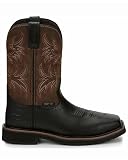
What makes the Justin Driller specifically right for welding beyond toe selection is its smooth leather upper with no lace holes. Sparks in lace eyelets are a genuine hazard — they lodge, smolder, and can ignite the lace or burn through to the foot before the welder notices. A pull-on cowboy boot with a smooth leather shaft has no such vulnerability: sparks hit the leather and fall off. Justin has been making boots since 1879, and the Driller is Goodyear-welted — resoleable when the outsole wears, which matters for workers who use the same boot daily for years. The stiffer leather requires a proper break-in period (5–7 shifts), but once broken in, it outlasts most boots in this guide.

Specs at a Glance
Toe: Steel (also available soft toe — choose soft or composite for welding) | EH Rated: ✅ Yes
Waterproof: — | Shaft: 11″
Construction: Goodyear welt — resoleable | Upper: Smooth leather — no lace holes
Outsole: Oil/slip-resistant rubber
Best for: Welding · Traditional ranch · Long-term investment buyers
⚠️ Welding note: Order the soft-toe or composite-toe version for welding environments. The steel-toe version conducts heat. For all other work applications, steel toe is fine.
Pros: Smooth leather upper — no lace holes, ideal for welding; Goodyear welt — resoleable; Traditional construction from an 1879-heritage brand; EH rated; ASTM F2413.
Cons: Longer break-in period (5–7 shifts) — do not wear first on a demanding day; Not waterproof; Less immediate cushioning than Ariat out of the box.
❌ Skip This If: You need waterproofing / you need Ariat-level comfort from day one / you need composite toe for metal detector access (steel toe version only).
Best Budget — Durango Men's Rebel Steel Toe Work Boot
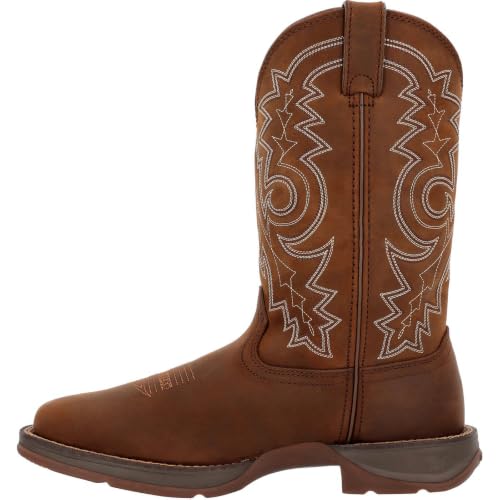
The Durango Rebel is the right answer for one specific situation: you need ASTM F2413 compliance and Western style, and your budget is under $135. It delivers exactly what it promises — steel toe, EH rating, Western aesthetic, rubber outsole — without the cushioning depth, construction quality, or durability of the premium lines. That is an honest trade-off that many workers in their first safety-certified job, apprentice tradespeople, and part-time ranch workers need to make. The Rebel is ASTM rated. It will pass your job site PPE inspection. It will last a full season of moderate work use.

The cement construction is the Rebel's primary limitation: it is not resoleable, and under demanding daily conditions it is a 12–18 month boot before outsole wear or upper breakdown requires replacement. Budget this into the cost calculation. A $125 boot replaced annually costs $125/year. An Ariat Groundbreaker at $155 that lasts 24 months with moderate care costs $77.50/year. The Durango Rebel makes financial sense for workers in light-to-moderate conditions who cannot justify the upfront cost of a premium boot. It does not make long-term financial sense for workers running hard every day.

Specs at a Glance
Toe: Steel — ASTM F2413 I/75 C/75 | EH Rated: ✅ Yes
Waterproof: — | Shaft: 11″
Construction: Cement (not resoleable) | Outsole: Rubber
Best for: Budget-conscious buyers · Apprentice workers · Light-to-moderate conditions
Pros: Most affordable ASTM-rated cowboy work boot on Amazon; Passes job site PPE inspection; Western style; Steel toe + EH; Wide size selection.
Cons: Cement construction — not resoleable; 12–18 month lifespan under heavy use; Basic comfort system; Not waterproof.
❌ Skip This If: You work hard daily (the math favours a premium boot over 2+ years) / you need waterproofing / you need maximum cushioning for concrete work.
Best Alloy Toe / Lighter Weight — Georgia Boot Men's Carbo-Tec LTX Alloy Toe Wellington
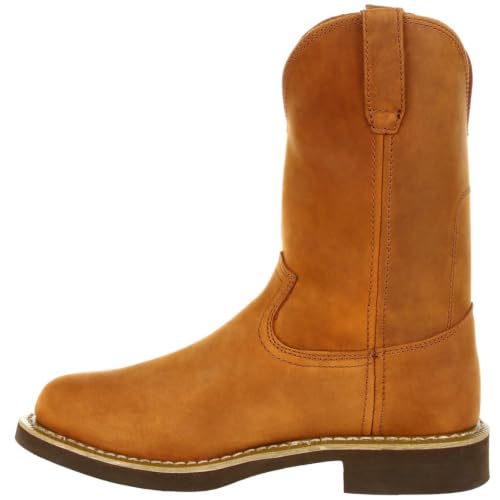
The alloy toe is the underappreciated middle option in the steel-vs-composite debate. Alloy (aluminum alloy) is metallic — it will trigger metal detectors, unlike composite — but it is approximately 30% lighter than a comparable steel toe cap while delivering identical ASTM F2413 I/75 C/75 impact and compression protection. For workers who don't cross metal detector checkpoints and are choosing between steel and composite purely on weight, alloy deserves serious consideration. On a 12-hour shift walking oil field lease roads or farm terrain, 30% less toe cap weight is a measurable fatigue difference.

The Georgia Boot Carbo-Tec LTX pairs the alloy toe with full waterproof construction and EH rating — the combination that oil field and wet-condition ranch workers need. Georgia Boot doesn't carry the brand recognition of Ariat or Justin in Western retail, but the Carbo-Tec is a serious work boot from a manufacturer with deep roots in American work boot production. The pull-on Wellington construction is fast on and off, the waterproof leather upper handles rain and mud, and the carbon-rubber outsole provides slip resistance on wet surfaces. For workers who prioritise the lightest fully waterproof ASTM-rated cowboy work boot available, the Carbo-Tec makes a strong case.

Specs at a Glance
Toe: Alloy (aluminum — 30% lighter than steel, same ASTM protection) | EH Rated: ✅ Yes
Waterproof: ✅ Yes | Shaft: 11″
Construction: Direct attach | Outsole: Carbon-rubber slip-resistant
Best for: Oil field · Farm work · Workers wanting lighter toe protection + waterproofing
Pros: Alloy toe — 30% lighter than steel with identical ASTM protection; Waterproof; EH rated; Pull-on convenience; Good value.
Cons: Alloy IS metallic — will trigger metal detectors (not suitable for sites with detector access control); Less brand recognition than Ariat/Justin in Western markets.
❌ Skip This If: You cross metal detectors on site (choose composite toe) / you need the maximum recognized brand for PPE inspection contexts / you prefer Goodyear welt construction.
Best Women's — Ariat Women's Groundbreaker Square Toe Steel Toe

Most "women's Western work boots" fall into two categories: fashion boots that look like work boots but carry no ASTM certification, or men's boots in smaller sizes with a women's label. The Ariat Women's Groundbreaker is neither. It is built on a women's-specific last — narrower heel cup, correct arch positioning for female foot geometry, wider forefoot proportioned for women's foot shape. That is not a marketing claim: it means the heel doesn't slip, the arch lands in the right place, and the forefoot doesn't swallow your foot. After 10 hours, that geometric difference is not academic.
The women's Groundbreaker carries the same ASTM F2413 steel toe and EH certification as the men's version, the same ATS cushioning platform, and the same Duratread outsole. It is available in multiple widths on Amazon — critical because women's work boot width options are often ignored in this category. The 11-inch shaft provides full Western coverage. Water-resistant leather handles light wet conditions. For women working on ranches, in oil field environments, on construction sites, and in agriculture — all trades where women are increasingly present and badly underserved by current gear guides — this is the correct starting point. It is not a fashion boot in work boot packaging. It is a work boot.

Specs at a Glance
Toe: Steel — ASTM F2413 I/75 C/75 | EH Rated: ✅ Yes
Waterproof: — (water-resistant leather) | Shaft: 11″
Last: Women's-specific — narrower heel, correct arch position | Widths: Multiple available
Outsole: Duratread (oil, slip, abrasion resistant)
Best for: Women on ranch · Farm · Oil field · Construction
Pros: Women's-specific last — not a smaller men's boot; ASTM F2413 safety toe; EH rated; ATS cushioning; Multiple widths; Widely available on Amazon.
Cons: Not waterproof — for wet conditions, seek a waterproof women's alternative; Break-in required; Limited composite toe option in women's Western work.
❌ Skip This If: You need full waterproofing for daily wet work / you need composite toe for metal detector sites / you need maximum cushioning (check WorkHog XT availability in women's).
Best Premium / Long-Term Investment — Thorogood Men's Western Square Toe Composite Toe Waterproof
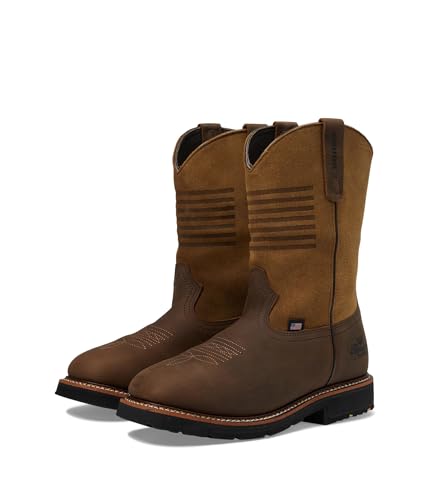
The Thorogood Western is what you buy when you are done replacing boots every year. Goodyear-welted, composite toe, fully waterproof, Vibram outsole — it is the only boot in this guide that combines all four of those features simultaneously. The Goodyear welt means when the Vibram outsole eventually wears through, a cobbler replaces it for $60–$90 and the boot continues. Resoled at year three, the Thorogood has cost approximately $105/year over four years — less annually than a $150 boot replaced every twelve months, and with a better boot under your foot every single day.

The Vibram outsole is the premium traction compound standard — it provides genuine grip on wet and varied surfaces that the Duratread alternatives match in most conditions but fall short of in technical terrain. The composite toe is ASTM F2413 certified, non-metallic for metal detector access, and does not conduct cold or heat — the right choice for oil field environments, cold-weather ranch work, and any application where steel's thermal conductivity is a disadvantage. EH rated. USA-assembled components. For most workers, the Ariat or Wolverine at $150–$185 delivers 85% of the performance at 65% of the price. The Thorogood makes financial and practical sense only if you resole it — which is exactly the point.

Specs at a Glance
Toe: Composite — ASTM F2413 I/75 C/75 | EH Rated: ✅ Yes
Waterproof: ✅ Yes | Shaft: 11″
Construction: Goodyear welt — resoleable | Outsole: Vibram (premium compound)
Origin: USA-assembled components
Best for: Long-term investment buyers · Oil field · Premium waterproof composite
Pros: Goodyear welt — resoleable for lowest long-term cost-per-wear; Vibram outsole; Composite toe — lighter, no heat/cold conduction, no metal detectors; Full waterproof; EH rated; USA-assembled.
Cons: Premium price — the investment only pays off if you resole; Longer break-in for stiff Goodyear welt construction; Heavier than non-welted alternatives.
❌ Skip This If: Your budget is under $200 / you won't have the boot resoled / you primarily need cushioning comfort over durability investment.
🦶 Square Toe vs. Round Toe vs. Snip Toe — Which Is Best for Work?
Current guides list toe styles without explaining the functional tradeoffs. For 8–12 hours on a job site, the shape of your toe box has real consequences.
Square Toe
Wider at the toe box, allowing natural toe splay across a long shift. This is the correct choice for ground work, standing on concrete, and walking heavy distances. The wider geometry accommodates natural foot swelling — it is common to gain half a shoe size in width by hour 8 under heavy load. Square toe is also easiest to fit a safety toe cap inside without creating a cramped, bulgy appearance. The only limitation: does not fit standard Western stirrups without modification. If you ride and work, check stirrup compatibility.
Round Toe (Traditional / Classic)
The traditional cowboy boot profile — narrower than square but still functional for safety toe caps. Fits standard stirrups, making it the right choice for workers who alternate between ground work and riding. Slightly less forefoot room than square for workers with wider feet or those prone to foot swelling on long shifts.
Snip / Pointed Toe
The classic Western dress silhouette is not appropriate as a primary work boot. The narrow profile makes fitting a standard safety toe cap nearly impossible without severe cramping, and very few snip-toe boots carry ASTM F2413 certification. For 10-hour work shifts, this toe shape concentrates pressure on the lesser toes and contributes to bunion formation over time. Use snip-toe boots for riding, events, and appearance — not as your daily work boot.
The Recommendation
For any serious work application — standing on concrete, walking rough terrain, or wearing boots for 8+ hours — square toe is the correct choice. Round toe is acceptable for mixed riding/ground work. Pointed/snip toe boots should not be your primary work boot.
👢 The Cowboy Boot Heel — Work Boot Advantage or Fatigue Factory?
No current top-10 result honestly discusses the functional tradeoffs of the cowboy heel in work contexts. This is a real question with real answers.
Why the Heel Was Designed
The traditional 1.5–2 inch angled cowboy heel was engineered to catch a stirrup and prevent the foot from sliding through when riding. It creates a natural stop on the stirrup iron. This is the original function — and it has practical work applications beyond riding.
Work Advantages of the Cowboy Heel
Ladder safety: The defined heel catches ladder rungs the same way it catches stirrups — providing a natural lock on standard ladder rungs. This is a genuine safety advantage over flat-soled lace-up boots for construction and any job with ladder work. Slope stability: On inclines and hillside terrain, the angled heel digs in and provides natural braking when walking down grades. Soft ground grip: In agricultural environments with soft soil, the heel acts as a natural brake and provides forward-lean stability.
Work Disadvantages of the Cowboy Heel
Concrete fatigue: Standing on flat concrete for 8–12 hours in a 1.5-inch heel shifts more weight to the ball of the foot and forefoot than a flat-soled boot. This creates measurably more forefoot fatigue over a long shift, and can contribute to metatarsalgia and plantar fasciitis over a season of concrete work. Flat surface instability: On polished concrete, finished flooring, or steel decking, a narrow cowboy heel can rock in ways a flat rubber sole does not.
Recommendation by Job Type
Outdoor terrain, ranch, farm, slope work, ladder work → cowboy heel is appropriate and advantageous. All-day flat concrete (warehouse, industrial floor) → use anti-fatigue insoles (Superfeet Work) to compensate for forefoot load shift. Welding in a shop → standard 1″ heel acceptable; avoid very high (2″+) heels that increase tip fatigue when kneeling.
🔩 Steel Toe vs. Composite Toe for Western Work Boots
| Factor | Steel Toe | Composite Toe |
|---|---|---|
| ASTM F2413 protection | Equal — I/75 C/75 | Equal — I/75 C/75 |
| Weight | Heavier (~0.5 lbs/pair more) | Lighter — meaningful on 12-hr shifts |
| Cold weather | Conducts cold — uncomfortable below 20°F | Does not conduct cold or heat |
| Welding / heat | Avoid — conducts heat from spark/slag | Preferred for welding environments |
| Metal detectors | Triggers detectors | Does not trigger |
| After severe impact | Deforms but remains protective | May crack — reduced repeat-impact protection |
| Cost | Slightly less expensive | Slightly more expensive |
| Best for oil field | Fine if no detector access | Preferred — lighter + no detector issues |
| Best for ranch / farm | Traditional preference — solid choice | Good alternative; lighter for high-mileage days |
The verdict: For most outdoor Western work — ranch, farm, livestock — either works. Choose based on personal preference and budget. For welding or fire-adjacent work, composite is safer. For oil platforms or government facilities with metal detectors, composite is operationally required.
🔌 EH-Rated Cowboy Work Boots — Who Actually Needs Them?
EH (Electrical Hazard) rating means the outsole is tested to provide insulation against electrical shock at 18,000 volts under dry conditions with an intact outsole. All nine boots in this guide carry EH ratings — verify on the current Amazon listing.
Western workers who genuinely need EH-rated boots: Oil field and refinery workers (working around electrified pumping equipment, control panels, and instrumentation — EH is standard PPE on most oil field sites); welders (working near electrical welding equipment, preventing shock transmission from accidental contact with live circuits); ranch and farm workers using electric fence systems (secondary protection against malfunctioning fence chargers); modern equipment operators (tractors, skid steers, combines with sophisticated electrical systems); any worker on an OSHA-regulated site that specifies EH PPE.
Critical EH caveat: EH rating is valid only on a dry, intact outsole. A worn, cracked, or delaminated outsole eliminates EH protection regardless of the original certification. Inspect outsoles monthly on any boot worn in electrical hazard environments, and resole or replace before significant wear-through occurs.
🔧 Best Cowboy Work Boots by Job Type
Ranch and Farm Work
Livestock handling, all-terrain traction, wet conditions, long walking distances across uneven ground. Composite toe is preferred for livestock work — it won't conduct cold in winter when working calves at 5 a.m., and it's less likely to injure an animal's hoof during close handling work. Duratread or aggressive rubber outsole for traction in pasture and barn environments. Best pick: Ariat Groundbreaker Wide Square Toe — most trusted daily driver in ranching. ATS cushioning holds up at hour 12 when you're still sorting calves.
Oil Field and Refinery
EH rating is non-negotiable on most sites. Waterproof for outdoor field conditions. Composite toe preferred for facilities with metal detector access control. Full-grain leather upper for chemical splash resistance. Defined heel for ladder safety. Best pick: Ariat WorkHog XT VentTEK Composite for wet/heat conditions, or Wolverine Rancher for maximum waterproofing on wet field sites.
Welding
Smooth leather upper with no lace holes — sparks cannot lodge in lace eyelets. Heat-resistant outsole. Composite or soft toe preferred — steel conducts heat from spark or slag entry, creating a burn injury. EH rating. Best pick: Justin Driller 11″ in soft-toe or composite-toe version — smooth leather upper, no lace holes, Goodyear welt. Do not wear the steel-toe version for welding near open flame.
Construction — Concrete and Job Site
ASTM F2413 required. Anti-fatigue support for long hard-surface shifts. EH rating. Defined heel for ladder safety. Waterproof for outdoor sites. Anti-fatigue insoles (Superfeet Work) to compensate for forefoot loading on flat concrete. Best pick: Ariat WorkHog Wide Square Toe — ATS Max specifically helps on concrete; wide square toe accommodates foot swelling on long shifts.
Livestock Handling and Equine Work
Composite toe preferred: when a 1,200 lb horse steps on a steel toe cap, the deformation crushes the toes at the sides in a way a composite cap does not — composite may crack under the same load, but it does not deform inward. Full leather upper for barn and handling environments. Oil-resistant outsole for manure and barn chemicals. Best pick: Ariat Groundbreaker (composite version) — composite preferred specifically for equine environments.
💄 Women's Cowboy Work Boots — Properly Addressed
The current state of women's Western work boot guidance is embarrassing. Field & Stream's top women's pick in a recent guide was the Ariat Fatbaby — a fashion boot with no safety toe certification. This is representative. Women working in ranching, oil field, construction, and agriculture need boots with actual ASTM ratings on women's-specific lasts, and they are chronically underserved by guides written for the default male worker.
The challenge: Women's foot geometry differs from men's — narrower heel cup, different arch position, different forefoot width-to-length ratio. A men's boot in a smaller size is not a women's boot. The heel will slip. The arch will land in the wrong place. After 10 hours, these are not minor annoyances.
Best women's cowboy work boots on Amazon:
Ariat Women's Groundbreaker Square Toe Steel Toe — Best Overall Women's Pick. ASTM F2413 certified steel toe. Women's-specific last. ATS cushioning. Duratread outsole. Multiple widths. 11″ shaft. This is a genuine work boot on a women's last — not a fashion boot with a steel cap added as an afterthought.
Durango Women's Rebel Steel Toe — The budget option for women needing ASTM compliance under $135. Same cement construction and practical limitations as the men's version. Best for light-to-moderate conditions and workers who need compliance at an entry-level price.
Honest note: Women's cowboy work boot selection on Amazon is more limited than men's. Ariat has the strongest women's safety-rated Western work line. Verify ASTM labels on all purchases — some products marketed as "women's Western work boots" carry no safety certifications.
🤠 Ariat vs. Justin vs. Wolverine vs. Durango — Brand Comparison for Work
| Factor | Ariat | Justin | Wolverine | Durango |
|---|---|---|---|---|
| Work safety credibility | Industry-leading | Strong tradition | Construction-grade | Good value |
| Comfort technology | ATS / ATS Max (best in class) | Performance insole | DuraCushion | X-Treme Comfort |
| Price (work line) | $140–$230+ | $120–$200 | $140–$185 | $110–$160 |
| Construction | Cement (most models) | Goodyear welt (Driller) | Goodyear welt | Cement (most) |
| Waterproof options | Yes (WorkHog XT VentTEK) | Limited | Yes (Rancher) | Limited |
| Women's safety line | Best available | Limited | Limited | Available |
| Break-in time | Moderate (3–5 shifts) | Longer (5–7 shifts) | Moderate | Shorter (supple leather) |
| Best for | Comfort-first, oil field, ranch | Welding, traditional ranch, long-term | Oil field, wet conditions | Budget-conscious, entry level |
The honest verdict: Ariat wins on comfort technology and is the right choice for most buyers prioritising all-day wearability. Justin wins on traditional Goodyear welt construction quality and is the better long-term investment for buyers who resole. Wolverine wins on waterproofing for sustained wet conditions. Durango is the correct pick for budget-conscious buyers who need ASTM compliance without spending $150+.
⚠️ The Break-In Problem — Why Cowboy Boots Are Uniquely Dangerous to Break In Wrong
Traditional cowboy boots — especially Goodyear-welted leather models — require a meaningful break-in period. The leather is stiff, the shaft is tall, and the heel geometry is unforgiving until the leather molds to your foot. This is addressed in almost no cowboy boot guide with the seriousness it deserves.
Why this matters more than with lace-up work boots: A pull-on cowboy boot has no adjustment mechanism. A lace-up boot can be loosened, tightened, and adjusted throughout break-in. A pull-on cowboy boot is exactly as tight as the leather allows — and for the first 5–7 shifts, that may mean heel blisters and calf rubs that turn into open wounds on long shifts. Starting a new pair of stiff leather cowboy work boots on a 12-hour day is one of the most reliable ways to end up with heel blisters severe enough to require time off work.
The Correct Break-In Strategy
- Days 1–3: Wear around the house or barn for 2–3 hours per day. Let leather begin softening to your foot shape.
- Days 3–7: Wear for half-shift days (5–6 hours) in lighter conditions — avoid the longest routes and hardest terrain.
- Condition the leather: Apply Obenauf's Heavy Duty LP, mink oil, or neatsfoot oil to the upper and shaft during break-in. Softens leather faster and reduces shaft rub significantly.
- Moleskin on heels: Apply moleskin patches to the back of your heel before putting on new boots. This prevents the heel blister that ends 90% of premature break-in attempts.
- Thick socks: Wear the thickest socks you'll use during work in the first week — pre-stretches the leather slightly and reduces heel pressure.
- Full timeline: Quality leather cowboy work boots (Ariat Groundbreaker, Justin Driller, Wolverine Rancher) need 5–10 full shifts before they're genuinely comfortable for a hard long day.
⚠️ Never Do This
Do not wear a new pair of stiff cowboy work boots for the first time on a demanding work day, a trade show, or any event where you cannot change footwear if they become painful. This is how people throw away a $180 pair of boots after day one and conclude they "don't fit." They fit. They needed break-in.
🤠 Pull-On vs. Lace-Up Western Work Boots — Which Is Right for Your Job?
Traditional cowboy boots are pull-on by design, but some Western work boots now offer lace-up configurations. This is a functional choice with real tradeoffs that nobody explains.
Pull-On Western Work Boots: Faster on and off — matters on ranch and oil field jobs where you may be removing boots several times per day. No lace holes — a significant advantage for welding since sparks cannot lodge in lace eyelets. Traditional Western aesthetic. The limitation: no adjustment — if your foot swells mid-shift or you need more ankle support, you cannot modify the fit. Best for welding, ranch, oil field, and any job where fast on/off matters.
Lace-Up Western Work Boots: Adjustable fit — tighten for more ankle support early in shift, loosen later when feet expand. Better ankle lockdown for construction and significant ladder work. Easier break-in due to adjustable lacing as leather softens. The limitations: lace holes catch sparks (not for welding), slower on/off. Best for construction, hardscaping, and jobs with significant ladder work or uneven terrain requiring precise ankle support.
💰 Price Tier Analysis — What You Get at Each Level
| Tier | Price | What You Get | Best Pick |
|---|---|---|---|
| Budget | Under $135 | Cement construction, basic safety toe, standard insole, 12–18 month lifespan under heavy conditions | Durango Rebel Steel Toe |
| Mid-Range | $135–$200 | Better leather quality, anti-fatigue footbed, waterproof options, 18–30 month lifespan | Ariat Groundbreaker · Wolverine Rancher · Justin Driller |
| Premium | $200–$285 | Goodyear welt (resoleable), best leather, advanced comfort, 3–5+ year lifespan with resoling | Ariat WorkHog XT VentTEK · Thorogood Western WP |
The cost math: A $150 mid-range boot replaced annually costs $150/year. A $250 Goodyear-welted boot resoled at $80 at year three costs approximately $110/year. The investment boot wins financially beyond year two — and is more comfortable every single day.
🧹 Caring for Your Cowboy Work Boots in Demanding Conditions
Daily: Wipe down with a damp cloth to remove dirt, manure, oil, and chemical residue. Do not leave corrosive materials on leather overnight — barn chemicals and oil field compounds degrade leather quickly if left in contact.
Weekly: Apply leather conditioner (Obenauf's Heavy Duty LP or mink oil) to the upper. Brush shaft stitching with a soft brush to remove embedded debris from seam channels.
Drying: Never dry boots near direct heat — fire, forced air, propane heaters, direct sunlight. Heat dries and cracks leather, degrades EH-rated outsoles, and weakens adhesive bonds. Air dry at room temperature.
Waterproofing maintenance: Re-treat with silicone or beeswax-based waterproofing spray every 4–6 weeks in wet work environments. Waterproofing wears off with cleaning and wear.
Outsole inspection: Check monthly for cracks, deep wear-through, or delamination. A worn or cracked outsole eliminates both slip resistance and EH protection regardless of original certification.
Resoling: Goodyear-welted boots (Justin Driller, Wolverine Rancher, Thorogood) can be resoled by any qualified cobbler for $60–$90. Cement-construction boots cannot be resoled — budget for replacement when outsoles wear.
Insole rotation: Replace factory insoles every 6–8 months in heavy daily use. Anti-fatigue insoles (Superfeet Work, approximately $55 on Amazon) significantly extend comfort life and reduce back and knee fatigue on hard surfaces.
FAQ — 10 Questions Answered
Do cowboy boots meet OSHA safety requirements?
Some do, most don't. OSHA requires footwear that meets ASTM F2413 performance standards on regulated job sites. A cowboy boot that carries the ASTM F2413 I/75 C/75 label inside the shaft meets OSHA requirements. A cowboy boot — even one with a metal toe cap — that has no ASTM F2413 label does not meet OSHA requirements, regardless of appearance. Always verify the physical label inside the shaft on the boot you receive.
What is the difference between steel toe and composite toe cowboy boots?
Both meet the same ASTM F2413 I/75 C/75 impact and compression protection standard. Steel is heavier, conducts heat and cold, and triggers metal detectors. Composite (fiberglass, Kevlar, or carbon fiber) is lighter, does not conduct temperature, and passes metal detectors. For welding and fire-adjacent work, composite is safer. For most ranch and farm work, either is appropriate.
Are square toe or round toe cowboy boots better for work?
Square toe is better for ground work and long shifts. The wider toe box allows natural toe splay, accommodates foot swelling at the end of a shift, and houses safety toe caps without cramping. Round toe is acceptable for workers who alternate between ground work and riding, as it fits standard stirrups. Snip/pointed toe should not be used as a primary work boot.
Can you weld in cowboy boots?
Yes — with the right boot. The Justin Driller is the best cowboy boot for welding: smooth leather upper with no lace holes so sparks fall off rather than lodging, appropriate outsole, and EH rating. Choose the soft-toe or composite-toe version for welding — steel toe conducts heat from spark or slag entry. Avoid boots with mesh panels, fabric vents, or lace eyelets in welding environments.
What makes a good cowboy boot for oil field work?
EH rating (required on most oil field sites), slip resistance on wet and oily surfaces, waterproof construction for outdoor field conditions, composite toe preferred for facilities with metal detector access control, full-grain leather shaft for chemical splash resistance, and defined heel for ladder safety. The Ariat WorkHog XT VentTEK and Wolverine Rancher are the top picks for oil field use.
How long does it take to break in cowboy boots for work?
Quality leather cowboy work boots — Ariat Groundbreaker, Justin Driller, Wolverine Rancher — require 5–10 full shifts before they are genuinely comfortable for a hard long day. Budget synthetic-upper boots break in faster (3–5 shifts) but also wear out faster. Use moleskin on heels and leather conditioner on the shaft during break-in. Never wear a new pair on a demanding first day.
Are there women's cowboy work boots with safety toes?
Yes, though the selection is more limited than men's. The Ariat Women's Groundbreaker Square Toe Steel Toe is the strongest option on Amazon — it is built on a women's-specific last (not a smaller men's boot), carries ASTM F2413 certification, and includes the ATS cushioning system. Verify ASTM labels on any women's Western work boot purchase — many products in this category carry no safety certification.
What heel height is best for cowboy work boots?
The traditional 1.5-inch cowboy heel is appropriate for outdoor terrain, ranch, farm, slope work, and ladder work — the defined heel catches ladder rungs and provides slope stability. For all-day flat concrete (warehouse, industrial floor), the cowboy heel shifts forefoot load and can cause fatigue; use anti-fatigue insoles to compensate. Avoid heels above 2 inches for any ground work application.
How do I know if my cowboy boots have an ASTM rating?
Look inside the boot shaft for a stamped or printed label that reads "ASTM F2413" followed by the certification codes (I/75 C/75 for impact/compression, EH for electrical hazard). This label is the legal compliance documentation — the Amazon product listing description is not sufficient. If the label is absent or unreadable, the boot does not meet OSHA foot protection requirements regardless of what the listing says.
Ariat vs. Justin — which cowboy work boots are better?
They win on different criteria. Ariat wins on comfort: the ATS and ATS Max footbed systems are the best out-of-the-box cushioning in the Western work boot market, making Ariat the right choice for workers who prioritise all-day wearability. Justin wins on construction: the Goodyear welt on the Driller line is traditional quality that can be resoled, making Justin the better long-term investment for workers who are hard on outsoles and plan to maintain their boots for years. Budget decides if both fit your needs.
Final Verdict by Trade
The right cowboy work boot is the one that matches your specific job's hazards, surface conditions, and shift length — not the one with the most well-known brand name or the most decorative stitching.
Quick Trade → Boot Reference
Ranch / Farm (daily driver): Ariat Groundbreaker Wide Square Toe Steel Toe — most trusted daily driver in the trade, ATS cushioning holds up at hour 12
Oil Field / Refinery: Ariat WorkHog XT VentTEK Composite (wet/heat/detector sites) · Wolverine Rancher Steel Toe (wet field conditions)
Welding: Justin Driller 11″ Square Toe — smooth leather upper, no lace holes, Goodyear welt. Order soft-toe or composite-toe version for welding environments.
Construction / Concrete: Ariat WorkHog Wide Square Toe Steel Toe — ATS Max for hard surface fatigue, wide square toe for foot expansion
Livestock / Equine: Ariat Groundbreaker (composite version) — preferred for equine handling environments
Women's: Ariat Women's Groundbreaker Square Toe Steel Toe — the only proper women's-last safety-rated cowboy work boot widely available on Amazon
Premium / Long-Term Investment: Thorogood Western Square Toe Composite Waterproof — Goodyear welt, Vibram outsole, resoleable; lowest cost-per-wear over 4+ years
Alloy Toe / Lighter Weight: Georgia Boot Carbo-Tec LTX Alloy Toe Wellington — 30% lighter than steel, same ASTM protection, waterproof
Budget Under $135: Durango Rebel Steel Toe — ASTM rated, Western style, passes PPE inspection
Whatever your trade: check inside the shaft for the ASTM F2413 label before your first shift. A boot that looks like a work boot isn't one until that label is there.