
Last Updated: November 27, 2025 | By: The BootsGuru Team
If you are switching from traditional steel toe boots to modern lightweight options, you probably have one burning question: How much weight can a composite toe actually hold?
There is a misconception that because "composite" means plastic or fiber, it must be weaker than steel. This is false. In the eyes of safety regulators (OSHA and ASTM), a rated boot is a rated boot.
In this guide, we break down the exact weight limits, the difference between "Impact" and "Compression" ratings, and why engineers and electricians are making the switch.
The Short Answer: The 2,500 lb Rule
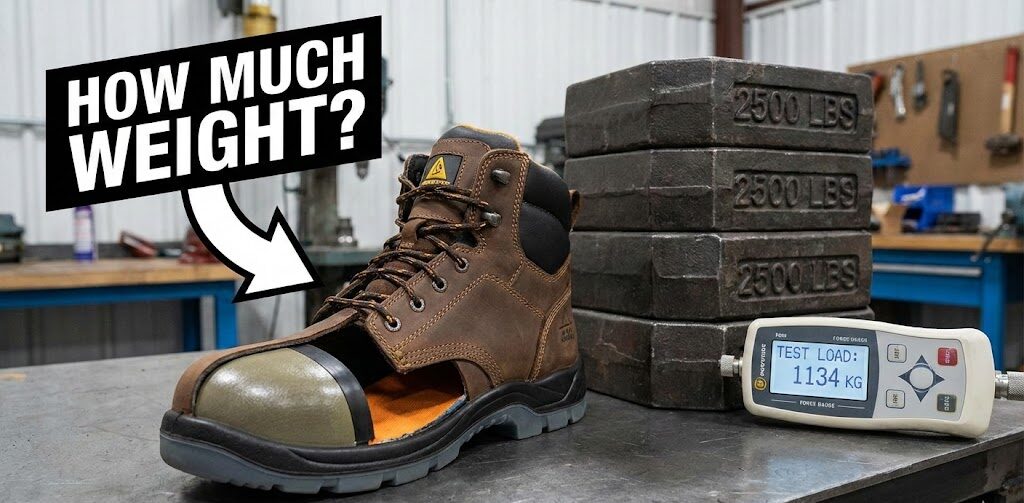
How much weight can a composite toe withstand? If the boot is ASTM F2413 certified (which is the industry standard), it can withstand exactly the same amount of force as a steel toe.
Most quality work boots carry the I/75 C/75 rating. Here is what that actually means in the real world:
- C/75 (Compression): This measures crushing force (like a truck tire rolling over your foot). A composite toe with this rating can withstand 2,500 pounds (1,133 kg) of pressure before cracking or crushing your toes.
- I/75 (Impact): This measures falling force. The toe cap can withstand an impact of 75 foot-pounds (roughly equivalent to a 50lb weight dropped from eye level) while maintaining enough clearance to save your toes.
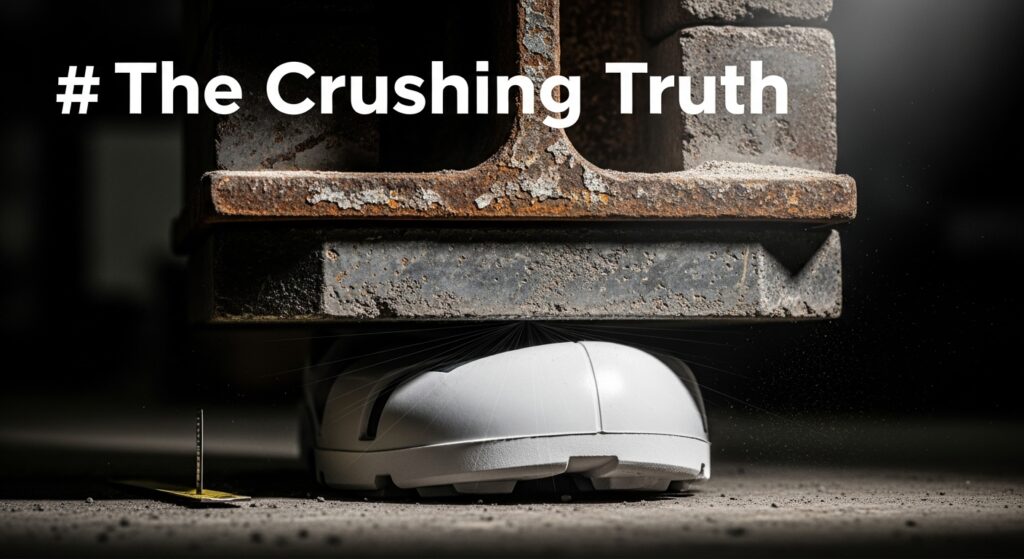
- The "Failure" Point: While 2,500 lbs is the safety rating, lab tests often show quality composite toes withstanding up to 3.5 tons before catastrophic failure, though you should never test this yourself!
Composite vs. Steel: How They "Fail" Differently
If both pass the same test, what is the difference? It comes down to physics.
1. The "Spring Back" Effect (Composite)
When a heavy object hits a composite toe, the material is designed to flex slightly to absorb the energy and then rebound to its original shape. If the weight is too extreme, the composite cap will eventually crack or shatter, but it usually does not trap your toes.
2. The "Dent" Effect (Steel)
Steel bends; it doesn't shatter. If a catastrophic weight falls on a steel toe, the metal can dent and stay bent, potentially trapping your toes inside the boot. However, steel is thinner and provides a sleeker profile.
The Material Breakdown: Carbon vs. Nano vs. Standard
Not all composite boots are created equal. "Composite" is just a catch-all term for non-metal safety caps. Here are the three main types:
1. Standard Composite (Plastic/Fiberglass)
These are the most common and affordable. They are made from layers of fiberglass or strong plastics.
Pros: Cheap, non-conductive.
Cons: They must be thick to pass safety tests, leading to a "bulbous" or chunky toe box.
2. Carbon Fiber Toes
Made from woven carbon fiber sheets (like high-end bicycle frames).
Pros: Stronger than fiberglass, allowing for a slightly thinner wall.
Cons: More expensive.
3. Nano Composite (The New King)
This is the latest tech (often called "Carbon Nanotube"). By using molecular-level carbon structures, manufacturers can make safety caps that are incredibly thin.
Pros: The lightest and thinnest option. Removes the "bulky" look of traditional composite boots.
Cons: Premium price tag.
Benefits of Composite Toes (Why Switch?)
If steel is cheaper and thinner, why is everyone buying composite? There are three specific use cases where composite wins:
- The "Airport" Factor: Composite toes are non-metallic. They do not set off metal detectors. This is a requirement for airport workers, courthouse security, and nuclear facility staff.
- The "Winter" Factor: Steel is a conductor. In freezing temperatures, a steel toe pulls heat out of your feet, making your toes freeze faster. Composite materials are insulators—they help keep your feet warm in winter.
- The "Spark" Factor: For electricians, non-metallic footwear offers secondary protection against electrical hazards (EH) because they do not conduct electricity.
FAQ: Common Myths & Questions
Does OSHA allow composite toe boots?
Yes. OSHA does not dictate the material (steel vs. composite); they dictate the performance. As long as the boot meets the ASTM F2413 standard for impact and compression, it is 100% OSHA compliant.
Can a horse crush a composite toe?
An average horse weighs 1,000 to 1,200 lbs. Since a C/75 rated boot withstands 2,500 lbs, a composite boot can easily handle being stepped on by a horse.
Is Soft Toe the same as Composite Toe?
No! Do not confuse these. A "Soft Toe" means the boot has zero safety cap. A Composite Toe is a hardened safety boot. If your job requires safety toes, do not wear soft toe boots.
What is the MythBusters verdict on toe amputation?
There is an old myth that steel toes can curl under and cut off your toes. The show MythBusters tested this and busted it. While extreme weight can crush the bones, the safety cap (steel or composite) almost always prevents amputation compared to wearing no protection at all.