
This article explains general IRS rules for informational purposes. It isn't personalized tax advice. A CPA or tax professional can confirm how these rules apply to your specific situation.
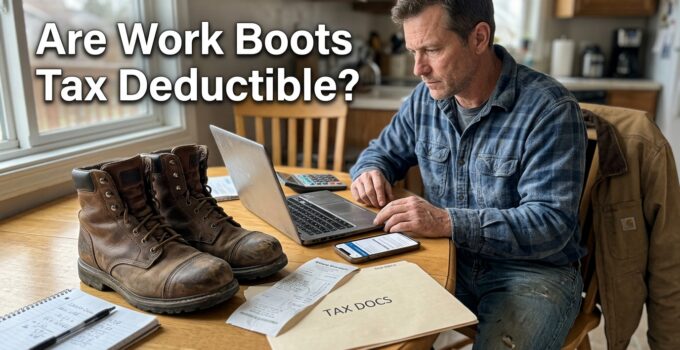
"My employer requires them" is not the test the IRS actually uses, and that misunderstanding is probably the single biggest source of confusion around this question. Whether your work boots are deductible comes down to a real, two-part legal standard, and whether you're a W-2 employee or self-employed determines whether you can claim it at all, regardless of how badly your job needs them.
The Real IRS Test
Clothing and footwear, including work boots, is only deductible as a business expense if it meets two conditions at the same time:
- It's required for your work
- It's not suitable for everyday wear
Both conditions have to be true. Meeting only the first one doesn't get you there, no matter how strict your employer's policy is.
The second condition is judged objectively, not based on your personal habits. The IRS doesn't ask whether you personally would ever wear the item outside of work, it asks whether a reasonable person could. This standard comes from a real 1980 court case, Pevsner v. Commissioner, where a boutique manager was required by her employer to wear designer clothing on the job and argued she should be able to deduct it since she couldn't otherwise afford it. The court ruled against her: the clothing was objectively suitable for everyday wear, regardless of her personal financial situation or intent, so it didn't qualify. That case still defines how this test gets applied today.
This is exactly why a business suit required by an employer isn't deductible, it's objectively wearable outside of work, even if you'd never actually wear it that way. Protective gear like a hard hat or a certified safety boot is a different story, since it doesn't function as everyday streetwear by its nature.
Why W-2 Employees Generally Can't Deduct Work Boots Anymore
This is the part that trips up the most people, and it's changed twice in less than a decade. Before 2018, W-2 employees could deduct unreimbursed work expenses, including required clothing and gear, as a miscellaneous itemized deduction. The 2017 Tax Cuts and Jobs Act suspended that deduction for tax years 2018 through 2025.
Many employees expected that suspension to expire and the deduction to return starting in 2026. Instead, the One Big Beautiful Bill Act, signed into law in July 2025, made that suspension permanent. If you're a W-2 employee, this deduction is not coming back, and it isn't a temporary gap you're waiting out.
There are narrow, specific exceptions written into the law for certain W-2 workers: armed forces reservists, qualified performing artists, fee-basis government officials, disabled employees with impairment-related work expenses, and, with some modifications, educators. These groups use Form 2106 to claim eligible unreimbursed expenses. If you don't fall into one of these specific categories, a standard W-2 job doesn't qualify for this deduction under current law, no matter how essential your boots are to the work.
A Real Alternative for W-2 Employees: Employer Reimbursement Plans
If you're a W-2 employee and this deduction doesn't apply to you, you're not entirely out of options, the more practical path is on your employer's side rather than yours. A business can cover required uniform and gear costs tax-free through a properly documented "accountable plan," where the employer requires receipts and substantiation for the expense. Structured this way, the cost is deductible to the business and tax-free to the employee. If your job requires specific boots and your employer doesn't currently reimburse for them, this is worth raising directly rather than assuming a personal tax deduction is your only avenue.
What Self-Employed Workers and Business Owners Can Claim
If you're self-employed, a contractor, or a business owner, the calculation is different. You can still deduct qualifying work boots as an ordinary business expense on Schedule C, and this path wasn't affected by the changes that eliminated the deduction for W-2 employees.
The same two-part test still applies here. Being self-employed doesn't automatically make every boot deductible, it still needs to be required for your work and not suitable for everyday wear. A contractor who buys a pair of certified safety boots for jobsite use has a straightforward case. Someone claiming a pair of boots they'd reasonably wear casually has a much weaker one.
Do Steel Toe and Safety Boots Qualify?
Generally, yes, for those who can claim this deduction at all. Steel toe and composite toe safety boots are consistently treated as qualifying protective gear across tax guidance, since they're built for jobsite protection rather than everyday wear, which clears the second prong of the test cleanly. For more on how composite and steel toe protection actually work and when each is required, our steel toe requirements explainer covers the safety side of that question in depth.
Where this gets murkier is boots that could reasonably double as casual or everyday footwear. A rugged-looking work boot that isn't actually a certified safety boot, and that someone might just as easily wear on a weekend, is a weaker case under the objective "not suitable for everyday wear" standard. The clearer the boot's purpose as protective jobsite equipment, the stronger the claim.
What You'll Need to Actually Claim It
For anyone eligible to claim this deduction, documentation is what actually holds up if the claim is ever questioned:
- Itemized receipts showing the purchase, not just a bank statement line item
- Documentation of the job requirement, a written employer policy or industry standard showing the boots are genuinely necessary for the work
- Evidence the boots are used exclusively for work, not casual wear, since personal use undermines the "not suitable for everyday wear" standard
Keeping this documentation as you go is far easier than trying to reconstruct it later.
A Note on Getting This Right
Tax law in this area has changed twice in under ten years, and the details, especially around exceptions and reimbursement structures, matter more than a general overview like this one can fully capture for any specific situation. This article explains the general rules as they stand. It isn't a substitute for a CPA or tax professional confirming how they apply to your specific employment status, industry, and circumstances.
Frequently Asked Questions
Can I deduct work boots if my employer requires them but I'm a W-2 employee?
Generally, no, not on your federal return, under current law. The requirement itself doesn't create a deduction for W-2 employees since the underlying miscellaneous itemized deduction category was permanently eliminated. A better path is asking your employer about a tax-free reimbursement arrangement instead of relying on a personal deduction.
Are steel toe boots always tax deductible?
Not automatically, and only for those who can claim this deduction category at all, generally self-employed workers and business owners. Even then, the boots still need to meet both parts of the IRS test: required for the job and not suitable for everyday wear. Certified safety boots clear that bar more reliably than boots that just look rugged.
What records do I need to claim work boots as a deduction?
Itemized purchase receipts, documentation showing the boots are required for your work, such as a written employer or industry policy, and evidence they're used exclusively for work rather than casual wear.
Can I deduct boot repairs or resoling costs too?
If the boots themselves qualify as a deductible business expense, repair and maintenance costs tied to keeping them functional for work generally follow the same treatment. Keep receipts for repair work the same way you would for the original purchase, and confirm the specifics with a tax professional given how situation-specific this can get.
Bottom Line
Two things determine whether your work boots are deductible: whether they pass the objective "required for work, not suitable for everyday wear" test, and whether you're self-employed or a W-2 employee, since that second factor now matters more than it used to. If you're self-employed and buying certified safety boots for jobsite work, you likely have a solid case on Schedule C. If you're a W-2 employee, this deduction isn't available to you under current law, and a conversation with your employer about reimbursement is a more productive path than a personal tax deduction. Either way, a CPA can confirm the specifics for your situation. For the boots themselves, our Rocky and Twisted X guides cover certified safety-toe options that clear the "not suitable for everyday wear" standard clearly.