Finding the perfect-fitting boot can feel like a guessing game. Should they be tight or loose? Is heel slippage normal? Should you size up or down from your sneaker size?
An ill-fitting boot isn’t just uncomfortable; it can lead to blisters, chafing, and even long-term foot problems like plantar fasciitis. On the job, a poor fit can be a serious safety hazard. As boot experts, we’re here to end the confusion. Here is the definitive 5-point test to ensure your next pair of boots fits perfectly, right out of the box.
The 5-Point Perfect Fit Test
Before you even try on a boot, make one crucial preparation: wear the socks you actually plan to wear with the boots. Trying on thick work boots with thin athletic socks (or vice-versa) will ruin your fit test. For the most accurate sizing, try on boots in the afternoon or evening, as your feet naturally swell during the day.
Once you have the boots on, follow these five steps.
1. The Heel: A Snug Hold, Not a Vise
This is where most people get confused. Your boot’s fit is secured by the heel and instep, not by jamming your toes into the front.
- How it Should Feel: Your heel should feel “cupped” and secure.
- The Heel Slip Test: When you walk, some minor heel slip is acceptable. A brand-new leather boot, especially a pull-on style like a Wellington or Cowboy boot, will have a stiff sole. This will cause your heel to lift about a quarter-inch (1/4″). This is normal and will decrease as the boot breaks in and the sole flexes.
- When is it too much? If your heel is lifting more than a half-inch (1/2″), or feels like it’s completely slipping out, the boot is too big.
2. The Instep & Width: The “Firm Handshake”
The fit across the top of your foot (your instep) and at its widest point is the most critical factor for comfort. This is what truly holds your foot in place.
- How it Should Feel: The boot should feel snug and secure across the instep and the ball of your foot. It should be like a firm handshake—not painfully tight, but not loose or sloppy.
- Warning Signs: If you feel pinching or painful pressure on the sides of your feet, the boot is too narrow. If your foot can slide side-to-side, it’s too wide.
3. The Toe Room: Wiggle Room is Mandatory
Your toes need space. Jamming them into the end of a boot is a recipe for disaster.
- How it Should Feel: You should be able to freely wiggle all of your toes inside the toe box.
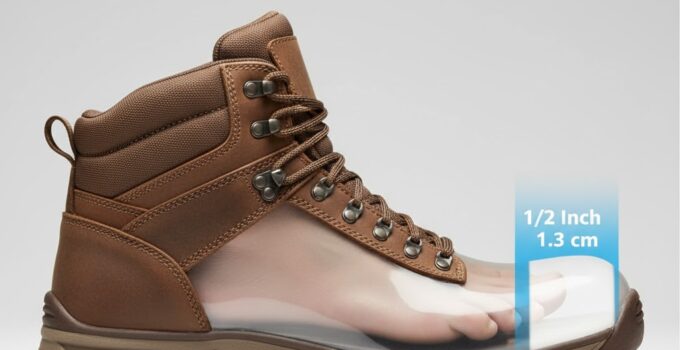
- The Finger Test: With your boot unlaced, slide your foot forward until your toes just touch the end. You should be able to slip one finger down the back of the boot, between your heel and the boot lining. This ensures you have about a half-inch (1/2″) of space, which is ideal.
- Steel Toe Exception: This is even more important in steel-toe boots. Your toes should never touch the steel cap. Unlike leather, a steel cap will not stretch.
4. The Flex Point: Does it Match Your Foot?
A boot is designed to bend at a specific spot. If this spot doesn’t align with your foot, you’ll fight the boot with every step.
- The Flex Test: Take a few steps. The boot should crease and flex naturally at the widest part of your foot (the ball of your foot).
- Warning Signs: If the boot feels like it’s creasing too far back (across your arch) or too far forward (across your toes), the boot’s arch and your foot’s arch are misaligned. This is a sign of an incorrect size, even if the length *seems* right.
5. The Final Walk: Test Them Together
Never judge a fit from just one boot. Put both boots on, lace them up securely, and walk around for several minutes. Pay attention to any rubbing, pinching, or excessive movement.
Common Boot Sizing Questions Answered
“Is my boot size the same as my shoe size?”
Almost never. This is the #1 mistake people make. Your boot size is often 1/2 to 1 full size smaller than your sneaker (athletic shoe) size. For example, if you wear a 10.5 in running shoes, you will most likely be a 10 or even a 9.5 in brands like Chippewa, Thorogood, or Red Wing.
Why? Boot manufacturers use different “lasts” (the foot-shaped molds) than sneaker companies. Boots are built with different materials and are designed to provide a more durable, structured fit.
“Should I size up for steel toes or thick socks?”
No, not usually. Don’t try to compensate by buying a larger size.
- Socks: Buy boots while wearing the socks you intend to use.
- Steel Toes: Sizing up in length will only make the boot too long, causing your heel to slip and the flex point to be in the wrong place. If a steel toe boot feels tight, the problem is the width or the shape of the toe box, not the length. Look for boots that come in wide (E, EE) sizes or have a roomier “box-toe” design.
“What should I do if my boots are too big?”
If your boots are just slightly too large (e.g., your heel slips a bit too much), you have options.
- Add an Insole: This is the best solution. A quality boot insole takes up extra volume, making the boot fit more snugly and often adding superior comfort and arch support.
- Wear Thicker Socks: A simple fix for boots that are just a fraction too roomy.
However, if your foot is sliding around and the flex point is wrong, no insole can fix it. The boot is simply the wrong size.
“Should new leather boots feel tight?”
They should feel comfortably snug, not painfully tight. A new leather boot should feel firm and supportive, especially around the instep. It will stretch and mold to your foot during the break-in period. But if it’s pinching, causing numbness, or is outright painful, it’s too small. You can’t “break in” a boot that is fundamentally the wrong size.