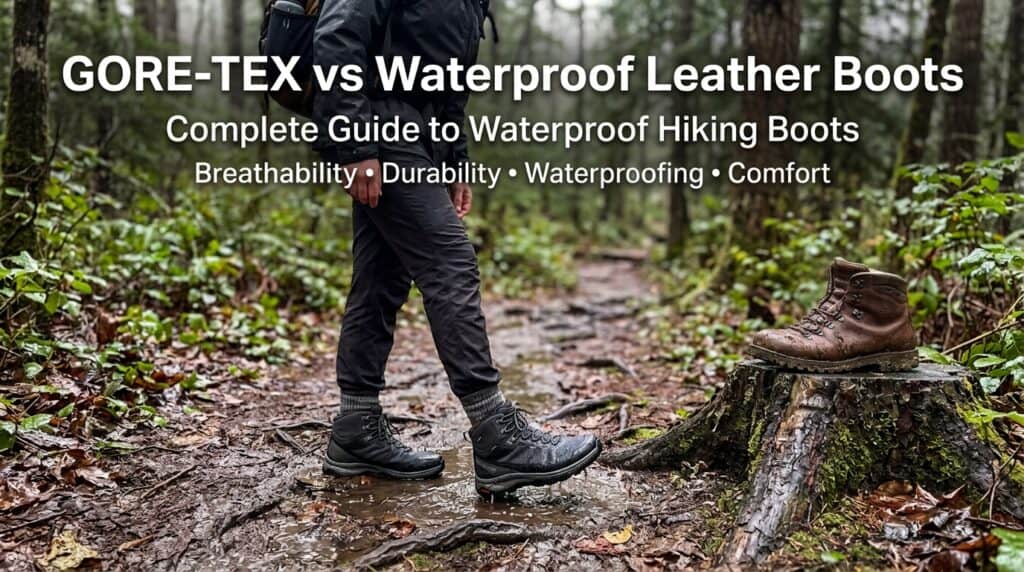

Walk into any boot aisle and you'll see two claims sitting side by side on the spec sheet: "GORE-TEX waterproof" and "waterproof leather." They sound like they do the same job. They don't. One is a guaranteed waterproof membrane. The other — technically — isn't waterproof at all.
That distinction matters more than most people realize. Choose the wrong technology for your conditions and you're either paying a premium for breathable waterproofing you don't need, or relying on a water-resistant treatment that fails two hours into a rainy day hike. Either way, the wrong choice costs money and wet feet.
This guide explains how each technology actually works at the physics level, where each one fails and why, which to choose for 13 specific real-world scenarios, and how to maintain both so they perform as intended. No vague "it depends on your needs" — just specific, honest answers.
⚡ GORE-TEX vs Waterproof Leather — The 60-Second Answer
| Factor | GORE-TEX Membrane | Waterproof Leather |
|---|---|---|
| Actually waterproof? | ✅ Yes — guaranteed waterproof membrane | ⚠️ No — water-resistant only |
| Breathability | Good when outer is dry; poor when outer saturates | Excellent when dry; poor when wet |
| Lifespan | 3–7 years (membrane degrades mechanically) | 10–20+ years with proper care and resoling |
| Maintenance | DWR re-treatment every 6–12 months | Leather conditioning every 4–6 weeks |
| Best in | Sustained wet conditions, cold climates, mud | Moderate wet, variable conditions |
| Worst in | Summer heat, high-output activity above 70°F | Deep puddles, prolonged immersion (2+ hours) |
| Upfront cost | Higher (premium for membrane) | Lower to similar |
| When it fails | Flex point cracking, seam tape delamination, pore clog | DWR/wax treatment exhaustion, leather cracking |
Bottom line: If you're regularly in sustained wet conditions — morning dew 5 days a week, frequent rain hikes, wet job sites — GORE-TEX wins. If you're in variable conditions or a hot, dry climate with occasional rain, quality waterproof leather with proper care competes well and lasts significantly longer.
What This Guide Covers
- How GORE-TEX Actually Works (The Science)
- How "Waterproof Leather" Actually Works — And Why It's Misnamed
- The GORE-TEX + Leather Combination Most Boots Use
- GORE-TEX Membrane Lifespan — What Degrades and When
- The 4 GORE-TEX Variants Explained
- GORE-TEX vs Every Alternative Membrane
- Where Each Technology Fails — The Complete Failure Mode Guide
- When NOT to Buy Waterproof Boots
- The Complete DWR Re-Treatment Protocol
- Use Case Decision Matrix — Which Technology for Your Situation
- Total Cost of Ownership Comparison
- 5 Myths Debunked
- FAQ
For leather work boots, including how to treat GORE-TEX work boots without clogging the membrane, see our how to waterproof work boots guide.
🔬 How GORE-TEX Actually Works
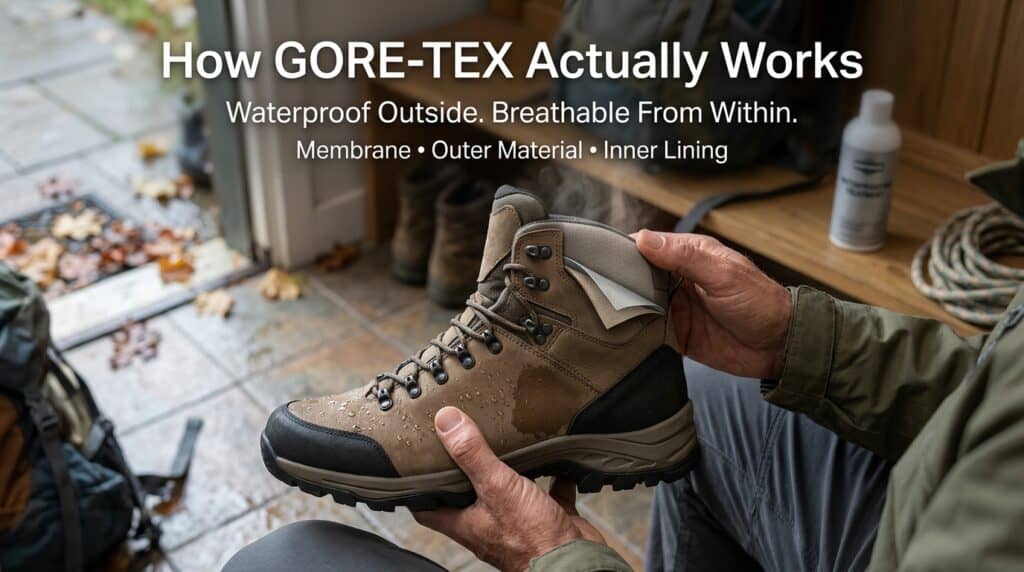
GORE-TEX was discovered accidentally in 1969 by Bob Gore, who stretched PTFE (polytetrafluoroethylene — the same material as non-stick Teflon cookware) rapidly rather than slowly. This created expanded PTFE (ePTFE), a material with an extraordinary microscopic structure. The entire waterproof-breathable premise of GORE-TEX lives in the size of the pores in this material:
- Each pore is approximately 700 times smaller than a water droplet — liquid water cannot pass through in either direction
- Each pore is approximately 70 times larger than a water vapor molecule — sweat vapor can escape outward
- A single square centimeter of GORE-TEX membrane contains approximately 9 billion of these pores
This is not a chemical treatment or a coating — it's a physical membrane with a specific pore structure. That's why GORE-TEX can make a guarantee: the physics don't change unless the membrane is physically damaged.
The Three-Layer Boot Construction
In a typical GORE-TEX boot, the membrane sits between two other layers:
- Outer upper material (full-grain leather, nubuck, or synthetic fabric) — provides abrasion resistance, structure, and appearance. Must be treated with DWR coating to function correctly with the membrane inside.
- GORE-TEX membrane (the ePTFE layer) — the actual waterproof barrier. Water cannot pass through the pores. Sweat vapor can.
- Inner lining (soft fabric) — comfort against the foot. Allows sweat vapor to pass outward through the membrane toward the outside.
The Critical Dependency Nobody Explains Properly
Here is the most important thing this guide will tell you, and the thing almost no other article explains clearly:
The GORE-TEX membrane is guaranteed waterproof. But it breathes only when the outer material is NOT saturated.
Breathability works through vapor pressure differential — moisture vapor moves from where it's concentrated (hot, sweaty inside the boot) to where it isn't (cool, dry outside). When the outer leather or fabric becomes soaked with water, that exterior is no longer dry. Sweat vapor inside the boot has nowhere to evaporate into. It builds up. Your feet feel clammy and wet — not because water got in, but because sweat vapor couldn't get out.
This is why re-treating the DWR coating on the outer leather of a GORE-TEX boot is not optional cosmetic maintenance. It is essential to maintaining the boot's breathability function. A GORE-TEX boot with degraded DWR on its leather outer will keep water out but will trap sweat vapor inside on any wet day.
Temperature Dependency
GORE-TEX breathability is stronger in cool conditions and weaker in warm ones. The vapor pressure differential — the driving force of breathability — is highest when the difference between inside temperature (warm, sweaty foot) and outside temperature (cool air) is greatest. In winter or cold shoulder seasons: GORE-TEX breathes well. In 90°F summer conditions: the differential drops, breathability drops, and feet feel hotter and wetter inside waterproof boots.
How "Waterproof Leather" Actually Works — And Why It's Misnamed
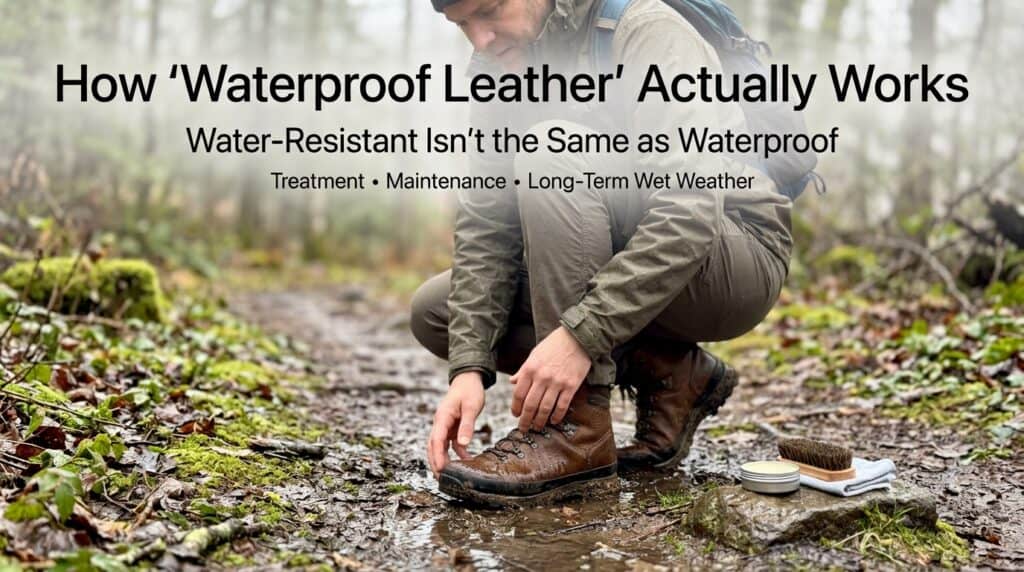
The honest truth: Full-grain leather is inherently water-resistant — not waterproof. The term "waterproof leather" is marketing shorthand for a material that resists water very well but will eventually saturate with prolonged exposure. This is not a minor distinction — it determines whether your feet stay dry on a three-hour rainy day hike.
When you see "waterproof leather" on a boot spec sheet, it typically means one of three things:
Type 1: DWR-Treated Full-Grain Leather
A factory-applied durable water repellent (DWR) chemical coating causes water to bead on the leather surface and roll off. This treatment is effective for moderate wet exposure but degrades with use, UV exposure, and abrasion. Once the DWR is gone, water saturates the leather. Maintenance required: re-treat every 4–8 weeks in active wet conditions with Nikwax Leather Proof or Sno-Seal.
Type 2: Wax-Treated Full-Grain Leather
Traditional beeswax and tallow treatments (Sno-Seal, Obenauf's Heavy Duty LP) fill the leather fibers physically, making them water-resistant for longer periods than DWR alone. This is a more durable solution — the wax must be physically worn or washed away rather than chemically degraded. The trade-off: wax partially fills the leather's natural breathability, making the boot slightly warmer.
Type 3: Oil-Tanned Leather
Some leathers are oil-tanned during the tanning process itself, incorporating oils into the fiber structure that make the leather inherently more moisture-resistant than standard chrome-tanned leather. These leathers are more water-resistant by nature but still saturate with prolonged immersion.
The Performance Cliff
For the first 1–2 hours of wet conditions, well-maintained waterproof leather performs nearly as well as a GORE-TEX membrane. This is the range where most casual hikers and workers will never notice the difference. Beyond 2 hours of sustained wet contact — heavy rain, repeated wet brush, morning dew routes — leather begins to saturate and its water resistance drops sharply. The GORE-TEX membrane maintains its waterproof barrier indefinitely, until the membrane is physically damaged or water enters from above the boot shaft.
What Happens When Leather Saturates
- The outer fibers absorb water, adding significant weight to the boot
- Any insulation layer is compromised as wet leather conducts cold
- Drying time is 12–24 hours at room temperature — boots will not be dry for tomorrow morning's shift
- Repeated saturation and drying without conditioning accelerates cracking and shortens boot life
The GORE-TEX + Leather Combination — How Most Premium Boots Actually Work
Most people think of GORE-TEX and waterproof leather as competing alternatives. In reality, the majority of quality hiking and work boots use both simultaneously. The Lowa Renegade GTX Mid, Salomon Quest 5 GTX, and Danner Mountain Light II all combine a full-grain leather upper with a GORE-TEX membrane inside.
Understanding how the combination works changes how you think about maintenance:
- The leather upper provides: abrasion resistance, structural support, and protection from sharp objects and debris
- The GORE-TEX membrane provides: a guaranteed waterproof barrier that works independently of the leather's condition
- The DWR on the leather provides: surface water repellency that prevents the leather from saturating — which maintains GORE-TEX breathability
The key insight: On a leather+GORE-TEX boot, re-treating the leather with DWR isn't primarily about protecting the leather — it's about protecting the breathability of the GORE-TEX membrane underneath. The membrane will keep water out even if the leather saturates. But saturated leather eliminates the membrane's breathability. This is the most practically important boot care fact that almost nobody communicates clearly.
When experienced hikers say their GORE-TEX boots "stopped breathing," the membrane is usually fine. The DWR on the outer leather has degraded, the leather is saturating in rain, and sweat vapor from the foot has nowhere to evaporate. The fix is a $15 bottle of Nikwax — not a new pair of boots.
⏱️ GORE-TEX Membrane Lifespan — What Actually Degrades and When
No current guide gives concrete lifespan data for GORE-TEX membranes in boots. Here it is:
Expected membrane lifespan: 3–7 years under regular boot use. The variance depends on use intensity, maintenance, storage, and specific failure mode.
Failure Mode 1: Flex Point Cracking (Timeline: 3–5 years, heavy use)
The membrane creases at the same point with every stride — typically at the toe flex point just behind the toe box. Over tens of thousands of flex cycles, microscopic cracks develop in the ePTFE structure. Water begins seeping at this point first. Sign: wet toes in conditions that previously kept feet completely dry. Solution: none that's cost-effective. Membrane damage at the flex point is mechanical and irreversible.
Failure Mode 2: Seam Tape Delamination (Timeline: 4–8 years)
The seams of the GORE-TEX bootie are sealed with adhesive tape during manufacturing. This tape can delaminate from heat cycling, compression, and chemical exposure. Sign: water entry in a linear pattern following seam lines, typically at the heel or ankle. Solution: boot replacement is usually the practical answer. Some specialized shoe repair can re-tape seams.
Failure Mode 3: DWR Degradation — The Most Common "Failure" (Timeline: ongoing)
This is not the membrane failing — but it's the most common cause of GORE-TEX boots feeling like they've stopped working. The outer DWR wears off, the outer material saturates in rain, and breathability is eliminated. Sign: water soaking into the leather outer rather than beading; clammy, sweaty interior despite no actual leak. Solution: Nikwax Fabric and Leather Proof (~$15 on Amazon). This fixes the problem in 30 minutes.
Failure Mode 4: Membrane Pore Contamination (Timeline: ongoing)
Skin oils, sunscreen, insect repellent, and improper detergents can clog membrane pores, reducing breathability without affecting waterproofing. Washing boots with regular laundry detergent is a primary cause. Sign: reduced breathability with no apparent leak. Solution: wash with Nikwax Tech Wash (~$12 on Amazon), specifically formulated to clean ePTFE without leaving residue.
Extending Membrane Lifespan
- Wash only with Nikwax Tech Wash — never regular detergent or fabric softener
- Air dry at room temperature — heat sources accelerate membrane degradation
- Re-treat outer DWR every 6–12 months in regular use
- Store away from UV light — UV degrades ePTFE over time even without use
- Do not store compressed or folded — maintain boot shape with boot trees
🌡️ The 4 GORE-TEX Boot Variants — What They Actually Mean
GORE-TEX is not one product — it's a brand with multiple variants that differ meaningfully in breathability, durability, and construction. Knowing which variant is in your boots matters.
GORE-TEX Extended Comfort Footwear
The most common variant in hiking and everyday work boots. Optimized for moderate activity levels and mixed temperatures. Provides a reliable balance of waterproofing and breathability for most use cases. Found in: Merrell Moab GTX, KEEN Targhee GTX, most mid-range waterproof hiking boots. Best for: general hiking, walking work, moderate-intensity outdoor activity.
GORE-TEX Performance Comfort Footwear
Higher breathability than Extended Comfort. Designed for high-output activities where sweat management is the primary concern. Found in trail running shoes, approach shoes, and lighter hiking boots designed for fast movement. Best for: fast hiking, trail running, high-exertion activities in cool weather where sweat production is high.
GORE-TEX Surround
360° breathability — the membrane wraps entirely around the foot including the sole area. The highest breathability of any standard GORE-TEX variant because moisture vapor can also escape through the sole. Found in select La Sportiva models. Trade-off: the sole construction required for Surround is less durable than standard boot outsoles. Best for: summer hiking where breathability is the priority and terrain doesn't demand maximum outsole durability.
GORE-TEX Invisible Fit (newest — 2023 onwards)
The membrane is bonded directly to the outer upper material rather than constructed as a separate inner bootie. This eliminates the traditional gap and seams between the outer and the membrane layer. Advantage: fewer failure points, reduced delamination risk, more consistent fit. Found in: HOKA Kaha 3 GTX. Trade-off: marginally less breathable than traditional bootie construction due to tighter outer bonding. Best for: sustained wet conditions where waterproof durability outweighs peak breathability.
🆚 GORE-TEX vs Every Alternative Waterproof Membrane
When you see "KEEN.DRY" or "M Select DRY" on a boot, you're looking at a proprietary waterproof membrane that competes with GORE-TEX. Here's the honest breakdown of every major membrane system used in boots:
| Membrane | Used By | Waterproofing | Breathability | Key Difference from GORE-TEX |
|---|---|---|---|---|
| GORE-TEX Extended Comfort | Salomon, Lowa, Danner, HOKA, La Sportiva | ★★★★★ | ★★★★☆ | Industry standard; third-party certified; backed by GORE guarantee |
| GORE-TEX Performance Comfort | Trail running / approach shoe brands | ★★★★★ | ★★★★★ | Higher breathability version — best GORE-TEX for high-output activity |
| eVent | Select niche outdoor brands | ★★★★★ | ★★★★★ | Direct-vent ePTFE — higher breathability than GORE-TEX; less common in boots; no major brand guarantee |
| OutDry (Columbia) | Columbia | ★★★★☆ | ★★★☆☆ | Membrane bonded to outer — no gap, less delamination risk; less breathable than standard membranes |
| KEEN.DRY | KEEN | ★★★★☆ | ★★★☆☆ | Reliable waterproofing; less breathable than GORE-TEX in head-to-head testing |
| Danner Dry | Danner | ★★★★☆ | ★★★★☆ | Danner's proprietary system; closer to GORE-TEX breathability than most competitors |
| M Select DRY | Merrell | ★★★★☆ | ★★★☆☆ | Reliable; less breathable than GORE-TEX; GORE-TEX version available on most Merrell models at higher price |
| B-DRY | Oboz | ★★★★☆ | ★★★★☆ | Good breathability for a proprietary membrane; less long-term data than GORE-TEX |
| Omni-TECH | Columbia | ★★★★☆ | ★★★☆☆ | Budget-friendly; adequate waterproofing; not GORE-TEX performance or breathability tier |
| TimberDry | Timberland PRO | ★★★★☆ | ★★★☆☆ | Adequate for work boot applications; less breathable than GORE-TEX |
The Honest Breathability Ranking
eVent > GORE-TEX Performance Comfort > GORE-TEX Extended Comfort > Danner Dry ≈ B-DRY > KEEN.DRY ≈ M Select DRY > Omni-TECH > OutDry
Why GORE-TEX Dominates Despite Not Winning on Every Metric
The GORE-TEX advantage isn't purely technical — it's the guarantee and certification system. A boot labeled "GORE-TEX" has passed W.L. Gore & Associates' independent testing requirements. A boot labeled "proprietary waterproof membrane" may or may not have been tested to any specific standard. For buyers who want certainty, not just a manufacturer's claim, GORE-TEX's third-party certification is a meaningful differentiator.
📍 Where Each Technology Fails — The Complete Failure Mode Guide
If your boots are leaking or feeling wet inside, this section will tell you exactly why — and whether the fix is a $15 Nikwax product or a new pair of boots.
GORE-TEX Boot Failure Modes
Failure Mode 1: Flex Point Membrane Cracking
- Location: Behind the toe box — where the boot creases with every stride
- Cause: Mechanical stress over thousands of flex cycles cracks the ePTFE membrane
- Symptom: Wet toes despite otherwise dry conditions; water entry specifically at the toe flex point
- Timeline: 3–5 years of heavy daily use
- Solution: Boot replacement. Physical membrane damage cannot be repaired cost-effectively.
Failure Mode 2: Seam Tape Delamination
- Location: Along seam lines — typically heel, ankle, or toe cap stitching
- Cause: Adhesive tape used to seal seams degrades from heat cycling, compression, and chemical exposure
- Symptom: Water entry following a linear path along a seam line
- Timeline: 4–8 years depending on conditions
- Solution: Boot replacement is usually the practical answer. Specialized cobblers can re-tape seams, but it's rarely cost-effective.
Failure Mode 3: DWR Degradation — The Most Common "Failure" (and the Fixable One)
- Location: Entire outer surface of the boot
- Cause: DWR coating wears off with use, UV exposure, and washing
- Symptom: Outer leather soaks through in rain rather than beading; interior feels clammy despite no actual water leak; "my GORE-TEX stopped working"
- Timeline: Ongoing — typically 6–12 months per treatment in regular use
- Solution: Nikwax Fabric and Leather Proof (~$15 on Amazon) for leather uppers; Nikwax Footwear Repel Plus for synthetic uppers. Fix takes 30 minutes.
Failure Mode 4: Membrane Pore Contamination
- Cause: Skin oils, sunscreen, insect repellent, and especially improper laundry detergents clog membrane pores
- Symptom: Reduced breathability without any actual water leak
- Solution: Nikwax Tech Wash (~$12 on Amazon) — formulated specifically to clean ePTFE membranes without leaving residue
Failure Mode 5: Over-the-Collar Water Entry (Not a Product Failure)
- Cause: Water entering from above the boot shaft — stepping into deep puddles, deep stream crossings, wet brush slapping the shin above the boot
- This is not a GORE-TEX failure — no waterproof boot membrane prevents water from entering over the collar
- Solution: Gaiters, a boot with a higher shaft, or accepting that deep water crossing exceeds waterproof boot design limits
Waterproof Leather Boot Failure Modes
Failure Mode 1: DWR/Wax Treatment Exhaustion
- Cause: Waterproofing treatment wears off without re-application
- Symptom: Water soaks into leather within 30–60 minutes rather than beading; wet socks from soaked leather
- Solution: Re-apply Obenauf's Heavy Duty LP (~$12 on Amazon) or Sno-Seal beeswax — the most durable leather waterproofing available
- Prevention: Re-treat every 4–8 weeks in active wet-condition use
Failure Mode 2: Leather Cracking from Improper Drying
- Cause: Drying wet boots near heat (furnace, propane heater, high-heat boot dryer) without conditioning the leather afterward
- Symptom: Surface cracks in leather; accelerated waterproofing loss; leather becoming brittle
- Solution: Condition cracked leather with Obenauf's LP; going forward, air dry at room temperature only
- Prevention: Always air dry — never near direct heat. Condition leather after every wet day.
Failure Mode 3: Seam Failure
- Cause: Stitching holes allow water penetration; factory seam sealant wears off
- Symptom: Water entry at seam lines, particularly at the welt or upper stitching
- Solution: Re-seal with Atsko Sport Wash or a dedicated seam sealer; professional cobbler seam sealing is effective and affordable
⛅ When NOT to Buy Waterproof Boots — The Honest Section
Almost every guide tells you when to buy waterproof boots. Nobody tells you when they're the wrong choice. Here is the honest answer:
1. Summer Hiking Above 70°F
In warm conditions, foot sweat production exceeds the rate at which any membrane can exhale moisture. The interior becomes wet from sweat regardless of external waterproofing. A non-waterproof boot with maximum breathability stays significantly cooler and dries faster when you sweat. The common complaint — "my GORE-TEX boots made my feet wetter than non-waterproof boots" — is physically accurate for high-output activity in warm conditions.
2. Frequent Deep Stream Crossings
If you regularly ford streams above ankle depth, a waterproof boot fills from the top and then cannot drain. A non-waterproof boot gets wet, drains within minutes, and can dry within 30–60 minutes of walking. A filled waterproof boot retains water for hours. Trail runners and approach shoes are non-waterproof specifically because designers know this: wet feet that dry fast are better than wet feet that stay wet.
3. Tropical and Very Humid Climates
GORE-TEX breathability depends on a vapor pressure differential between inside and outside. In truly humid conditions (above 80% ambient humidity), this differential nearly disappears — the outside air is almost as saturated as the boot interior. Waterproof membranes provide little breathability benefit and significant heat retention disadvantage in tropical climates. Breathable, non-waterproof footwear is the better choice.
4. Desert Hiking with Occasional Rain
Desert environments are hot and dry with infrequent rain. Non-waterproof boots keep feet significantly cooler during the 99% of time when it's not raining. When rain does come, feet get briefly wet and dry quickly in the arid air. The thermal penalty of waterproofing in desert heat typically outweighs the brief protection benefit.
The rule: If you're in sustained wet conditions — rain, morning dew, mud — for more than 2–3 hours regularly, waterproof boots are worth it. If your wet exposures are brief and infrequent, non-waterproof boots with DWR treatment often serve you better overall.
🔧 The Complete DWR Re-Treatment Protocol
Most GORE-TEX boot "failures" are DWR failures — and they're fixable with a $12–$20 Amazon purchase and 30 minutes of work. Here is the exact protocol:
Step 1: Test Whether DWR Is the Problem
Pour a small amount of water on the outer surface of the boot. Water beads and rolls off: DWR is working — the issue is elsewhere. Water soaks in: DWR is depleted — proceed to Steps 2–5. Water beads but interior still feels clammy: membrane may have pore contamination — skip to the Tech Wash step first.
Step 2: Clean the Boots with the Right Product
Use Nikwax Tech Wash (~$12 on Amazon) — not regular laundry detergent, dishwashing soap, or fabric softener. Standard detergents leave a residue that clogs ePTFE membrane pores and degrades DWR. Nikwax Tech Wash is specifically pH-balanced for technical fabrics and membranes. Apply according to package directions; rinse thoroughly.
Step 3: Choose the Right DWR Product for Your Upper Material
- Full-grain leather upper (most premium GORE-TEX boots): Nikwax Fabric and Leather Proof (~$15)
- Nubuck or suede upper: Nikwax Nubuck and Suede Proof (~$15)
- Synthetic or mesh upper: Nikwax Footwear Repel Plus (~$15)
- Mixed leather and synthetic (most common): Nikwax Fabric and Leather Proof covers both materials
Step 4: Apply While the Boot Is Still Wet
This is counter-intuitive but correct — Nikwax products are designed for application to damp boots immediately after cleaning. The moisture helps the product penetrate evenly into the leather fibers and outer material. Apply evenly across the entire boot upper, including the tongue and collar.
Step 5: Dry Correctly to Activate the Treatment
DWR treatments activate fully with gentle heat. Tumble dry on LOW heat for 20 minutes, or leave in gentle sunlight. Do NOT use high heat — high heat degrades both the newly applied DWR and the GORE-TEX membrane underneath. Air drying at room temperature also works but takes longer to fully activate the DWR.
Re-Treatment Frequency
- Recreational hiking (2–3× per month): every 6–12 months, or when the bead test fails
- Daily work use in wet conditions: every 4–8 weeks
- Infrequent use: every 12–18 months or when bead test fails
For Waterproof Leather Boots (No GORE-TEX)
- Clean with saddle soap or a dedicated leather cleaner
- Allow to dry at room temperature — not fully dry, slightly damp
- Apply Obenauf's Heavy Duty LP (~$12 on Amazon) in a thin, even coat with a clean cloth
- Allow to absorb; buff lightly; apply a second coat for heavy wet-weather exposure
- Obenauf's provides significantly more durable water resistance than DWR spray alone — lasts 4–8 weeks in active use
📊 Use Case Decision Matrix — Which Technology for Your Situation
This is the section no other guide provides: specific, defensible technology recommendations for 13 real-world scenarios.
| Situation | Recommended Technology | Reason |
|---|---|---|
| Commercial landscaping (morning dew 5 days/week) | GORE-TEX membrane | Sustained daily wet contact exceeds leather's 2-hour resistance limit |
| Oil field / refinery work (wet concrete, puddles) | GORE-TEX membrane | Sustained wet + EH-rated GORE-TEX boots meet site safety requirements |
| Construction in Pacific Northwest (persistent rain, mud) | GORE-TEX membrane | Persistent wet conditions; membrane cost justified over a full season |
| Construction in Texas / Arizona (hot, occasional rain) | Waterproof leather | Thermal penalty of membrane not worth it; leather handles brief rain well |
| Day hiking in Pacific Northwest (cold, sustained rain) | GORE-TEX membrane | Cold + sustained wet = wet feet become dangerous; membrane essential |
| Summer hiking in Rockies (dry, 80°F+) | Non-waterproof breathable | Membrane reduces breathability; brief afternoon rain not worth sweat penalty |
| Backpacking with frequent deep stream crossings | Non-waterproof or GORE-TEX (choose by climate) | GORE-TEX for persistent rain climates; non-waterproof where crossings dominate |
| Ranch and farm work (variable conditions, mud) | Waterproof leather or full rubber | Leather handles moderate wet; rubber (Bogs, Muck Boot) for chemical/heavy mud |
| Hunting (cold, wet, low activity — sitting in stand) | GORE-TEX insulated | Cold + wet + low sweat output = membrane breathability concern minimal; insulation critical |
| Cold winter work below 32°F | GORE-TEX insulated, composite toe | Cold + wet + low activity = membrane + insulation optimal; composite doesn't conduct cold |
| Tropical climate (high heat, high humidity) | Non-waterproof breathable | Breathability essential; vapor pressure differential too low for GORE-TEX effectiveness |
| Desert hiking (high heat, occasional rain) | Non-waterproof breathable | Thermal penalty of waterproofing outweighs brief rain exposure benefit |
| Trail running (all conditions) | Non-waterproof or GORE-TEX Performance | Fast drying and breathability usually superior to waterproofing for running pace |
💰 Total Cost of Ownership — The Math Nobody Does
This comparison changes the buying decision for many people who haven't thought about long-term boot economics.
| Factor | GORE-TEX Membrane Boot | Premium Waterproof Leather (Goodyear Welt) |
|---|---|---|
| Average upfront cost | $150–$230 | $180–$280 |
| Annual maintenance cost | $20–$30 (DWR re-treatment) | $40–$70 (leather conditioner + wax + resoling cycle) |
| Expected useful lifespan | 3–7 years (membrane limits) | 10–20+ years with resoling and care |
| Resole cost when needed | $70–$90 (if Goodyear welt; extends life but not membrane) | $70–$90 (extends full boot life — leather still works) |
| Total 5-year cost (estimate) | $270–$380 | $380–$630 (but boot still functional at year 5+) |
| Total 10-year cost (estimate) | $420–$760 (one replacement at year 5–7) | $580–$980 (one resole, no replacement needed) |
The Counterintuitive Finding
A well-maintained Goodyear-welted waterproof leather boot that gets resoled at year 5–7 is often less expensive over a 10-year horizon than replacing GORE-TEX boots when the membrane degrades. The premium leather boot wins on total cost of ownership if: you maintain the leather regularly, you resole when the outsole wears, and you don't need the membrane for sustained daily wet exposure.
GORE-TEX wins on total cost if: you work in sustained wet conditions where wet socks are a daily health concern, you prefer lower maintenance intensity, or you don't plan to keep boots for more than 3–5 years.
❌ 5 Myths About GORE-TEX and Waterproof Leather — Debunked
Myth 1: "GORE-TEX means the boot is waterproof forever."
False. The membrane is waterproof when physically intact. But the outer material's DWR coating degrades continuously and must be re-treated. Boots without DWR re-treatment will feel clammy and wet even when the membrane is working correctly — because the saturated outer eliminates membrane breathability.
Myth 2: "Waterproof leather is as waterproof as GORE-TEX."
False. Waterproof leather is water-resistant — it resists water effectively for approximately 1–2 hours of sustained wet contact with proper treatment. GORE-TEX is a physical membrane that blocks liquid water indefinitely while intact. These are not the same performance standard, and the difference matters significantly in sustained wet conditions.
Myth 3: "GORE-TEX boots don't breathe."
Partially false. GORE-TEX membranes breathe effectively — but only when the outer material is dry (not saturated), and less effectively in warm temperatures. In cool, wet conditions GORE-TEX breathes well. In hot conditions, all waterproof boots reduce breathability compared to non-waterproof alternatives. The complaint that "GORE-TEX doesn't breathe" is usually accurate in the conditions being described — just misdiagnosed.
Myth 4: "Washing GORE-TEX boots ruins them."
False — if you use the right product. Washing with Nikwax Tech Wash actually improves performance by removing pore-clogging oils and residue that have built up during use. Washing with regular laundry detergent or fabric softener DOES damage them by leaving residue that clogs pores. The product matters enormously.
Myth 5: "GORE-TEX lasts as long as the boot itself."
False. The GORE-TEX membrane has a mechanical lifespan of approximately 3–7 years under regular boot use. The leather upper of the same boot may last 15+ years. This is the core reason some experienced boot buyers prefer maintaining quality leather boots without GORE-TEX — the leather is indefinitely maintainable, but the membrane has a built-in obsolescence.
Frequently Asked Questions
Is GORE-TEX waterproofing worth it for boots?
Yes, for sustained wet conditions — daily morning dew, persistent rain, wet job sites. GORE-TEX provides a guaranteed waterproof barrier that leather cannot match over 2+ hours of wet exposure. In variable conditions, hot climates, or occasional-rain environments, quality waterproof leather is often sufficient and more breathable in warm conditions.
How long does GORE-TEX last in boots?
The GORE-TEX membrane typically lasts 3–7 years under regular boot use before flex point cracking or seam tape delamination allows water entry. The most common "failure" — DWR degradation causing clammy boots — is not a membrane failure and is fixable with a $15 bottle of Nikwax in 30 minutes.
What is the difference between GORE-TEX and waterproof leather?
GORE-TEX is a physical membrane with microscopic pores that block liquid water while allowing sweat vapor to escape — it is genuinely waterproof. Waterproof leather is full-grain leather treated with DWR or wax to repel water — it is water-resistant, not waterproof, and will saturate after 1–2 hours of sustained heavy rain or wet contact.
Why are my GORE-TEX boots leaking?
The most common cause is not a membrane failure — it's DWR degradation. The outer leather is saturating, which prevents sweat vapor from escaping (making boots feel wet inside), and may allow water to pool against seam areas. Re-treat with Nikwax Fabric and Leather Proof first. If water is entering at a specific point after re-treatment, the membrane may have a physical failure at that location.
How do I restore waterproofing on GORE-TEX boots?
Clean with Nikwax Tech Wash, then apply Nikwax Fabric and Leather Proof (for leather uppers) while the boot is still damp. Tumble dry on low heat or leave in gentle sunlight to activate the DWR. This restores both waterproofing performance and GORE-TEX breathability. Re-treat every 6–12 months in regular use.
Is KEEN.DRY as good as GORE-TEX?
KEEN.DRY provides reliable waterproofing comparable to GORE-TEX but is less breathable in head-to-head testing. For waterproof performance alone, both are adequate for most hiking and work boot use. GORE-TEX has the advantage of a third-party certification and guarantee; KEEN.DRY is KEEN's proprietary standard without independent testing verification.
Should I get GORE-TEX boots for summer hiking?
Usually not. In warm conditions above 70°F, foot sweat production exceeds what membranes can exhale efficiently, and the waterproofing provides little benefit if rain is brief and infrequent. Non-waterproof breathable boots or trail shoes keep feet significantly cooler and drier from sweat in summer conditions.
What is the best waterproof treatment for leather boots?
For maximum durability: Obenauf's Heavy Duty LP (~$12 on Amazon). For ease of application and good performance: Nikwax Leather Proof (~$15) applied while boots are damp. Both are significantly more effective than silicone spray products. Re-apply every 4–8 weeks in active wet-condition use.
Are GORE-TEX boots worth it for work?
Yes, for work involving sustained wet exposure — landscaping, construction in wet climates, oil field work. The membrane provides consistent protection that leather cannot match after 2 hours. For dry or variable work environments (Texas construction, warehouse work), the premium isn't justified and the breathability reduction in summer heat is a real disadvantage.
How often should I waterproof my leather boots?
Every 4–8 weeks in active wet-condition use. In dry or occasional-use environments, every 3–4 months is sufficient. Use the bead test: pour a small amount of water on the leather. If it beads and rolls off, DWR is working. If it soaks in, it's time to re-treat. Don't wait for wet socks to tell you.
Final Verdict — Which Waterproofing Technology Is Right for You?
After covering the science, the failure modes, the cost of ownership, and the 13-scenario decision matrix, the answer comes down to one question: How long are you wet, and how often?
- Sustained wet conditions, cold climates, daily wet exposure: Choose GORE-TEX. The membrane cost is justified and the temperature limitation is irrelevant when it's cold and wet.
- Variable conditions, hot climates, occasional rain: Quality waterproof leather maintained with Obenauf's Heavy Duty LP competes well and is significantly more breathable in warm weather.
- Long-term investment, maintenance-oriented buyer: Full-grain leather without GORE-TEX — maintained properly and resoled — can outlast 2–3 pairs of GORE-TEX boots on a 10-year horizon.
- Low-maintenance preference, consistent wet exposure: GORE-TEX — requires less active leather care and provides guaranteed waterproofing regardless of treatment schedule.
Whatever technology you choose, the Nikwax product line is the single most cost-effective investment to extend performance:
- GORE-TEX boots: Nikwax Tech Wash + Nikwax Fabric and Leather Proof (~$25 total on Amazon) — use twice per year minimum
- Waterproof leather boots: Obenauf's Heavy Duty LP (~$12 on Amazon) — apply every 4–6 weeks in wet-condition use