

If you've spent more than five minutes researching trail running shoes, you've already encountered the HOKA vs Salomon debate. It comes up in running store conversations, in forum threads, in YouTube reviews, and at trail race start lines where you can look down and see exactly which camp the experienced runners have chosen. The debate is real because the difference is real — and it goes deeper than "one has more cushion."
HOKA and Salomon represent genuinely different answers to the same question: what does a trail running shoe need to do? They were founded by people with different backgrounds and different problems to solve, and those founding philosophies are still visible in every shoe each brand makes today. Buying the right one isn't a matter of preference alone. It's a matter of matching the right design philosophy to your specific terrain, your body, your injury history, and the distance you run.
This guide covers all of it. We go beyond the surface-level cushion comparison to explain the biomechanical technology behind each brand, map specific models against each other for every use case, and give you the complete fit and sizing guidance that most reviews omit. We've included 16 specific products — 9 HOKA and 7 Salomon — with affiliate links for each, covering men's, women's, waterproof, wide-fit, race-day, and everyday training options.
Read the brand philosophy section first. Once you understand why each brand is built the way it is, every specific comparison that follows will make immediate sense.
Brand Origin and Philosophy - Why HOKA and Salomon Think About Trail Running Differently
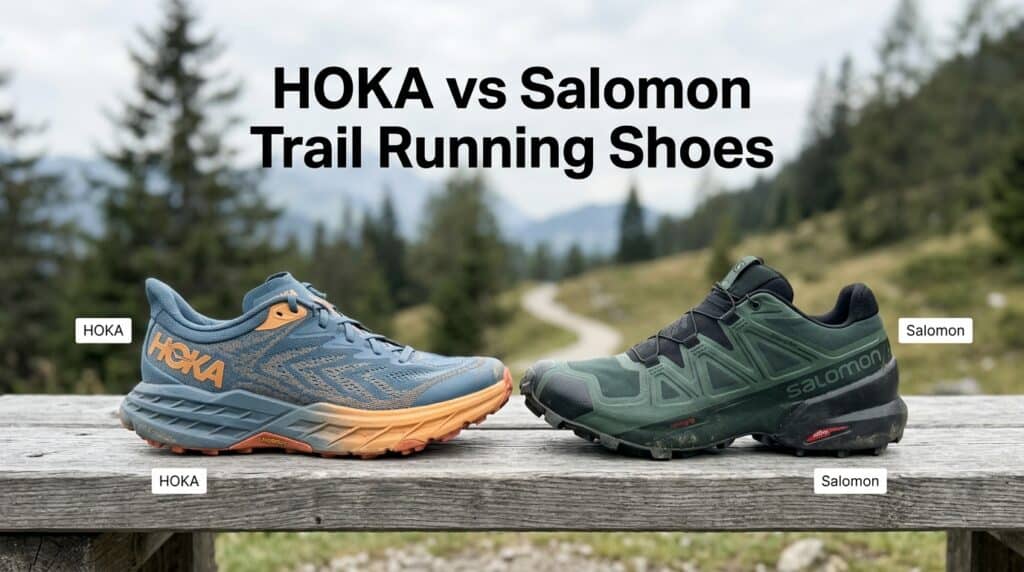
Every significant difference between HOKA and Salomon trail shoes — the cushioning, the fit, the outsole philosophy, the geometry — traces back to the founding purpose of each brand. Most comparison guides skip this context. It is the most useful thing you can understand.
HOKA was founded in 2009 by Nicolas Mermoud and Jean-Luc Diard — two men who, significantly, had both previously worked at Salomon. They left specifically because they believed the industry had the cushioning equation backwards. The prevailing wisdom in trail running at the time was that thinner, lighter, more minimal shoes gave runners better performance. Mermoud and Diard's counterargument was focused on ultra-distance mountain running: if you are running 50 or 100 miles in the mountains, the limiting factor is not weight — it is fatigue. Maximum cushion, combined with a pronounced heel-to-toe rocker geometry that rolls the foot forward through the stride and reduces the muscular work of each step, would allow runners to go further with less accumulated fatigue. They were right. HOKA became the dominant shoe at ultra-marathon events within a few years of launching, worn by runners who had no brand loyalty or sponsorship — just a genuine performance advantage over long distances. That founding insight is baked into every HOKA trail shoe made today.
Salomon was founded in 1947 in Annecy, in the French Alps — not as a running company, but as a ski binding manufacturer. The brand's entire development for its first several decades was in alpine precision engineering: bindings that hold a boot to a ski on a steep mountain face, and release it safely in a fall, require exact tolerances and reliable mechanical performance under extreme conditions. Salomon entered trail running in the 1990s bringing that alpine precision heritage with them. The Contagrip outsole system was engineered from scratch for mountain terrain grip. The Quicklace system was designed so that a runner could adjust shoe tension mid-race without stopping or removing gloves. The 3D chassis on stability models was built to provide structural ankle support on uneven ground. The design language throughout is precision, security, and technical mountain performance — not distance cushioning.
The practical consequence: HOKA dominates long-distance, runnable trail events where fatigue management matters most. Salomon dominates technical mountain terrain and muddy fell racing where grip and foot security are the primary requirements. Neither brand is universally better. They are optimised for genuinely different things, and the runner who understands this will never buy the wrong shoe for their terrain.
The Meta-Rocker Geometry Explained — HOKA's Most Distinctive Technology
Every article about HOKA mentions the "rocker sole" or "curved geometry." Almost none of them explain what it actually does at the biomechanical level — which means most buyers using HOKA trail shoes don't fully understand why they feel the way they do, or why they perform differently from other brands on technical terrain.
Meta-rocker geometry refers to the pronounced heel-to-toe curvature built into HOKA midsoles. When you hold a HOKA trail shoe sideways, you can see the curve clearly: the heel is elevated, the toe is turned up, and the midfoot sits lowest — creating a rocking chair profile rather than a flat platform. This geometry is not just visual. It has a specific biomechanical function.
On normal walking or running ground contact, the rocker geometry rolls the foot forward through the stride cycle in the same way a rocking chair rolls forward under body weight. The shoe does work that would otherwise require muscular effort from the calf, Achilles, and plantar fascia. The result is a reduction in the metabolic cost of each stride — measurable in research as a reduction in oxygen consumption — and a reduction in the muscular fatigue that accumulates in the lower leg over long distances. This is the mechanism behind HOKA's ultra-distance dominance. When you are at mile 40 of a 50-mile race, the rocker geometry that felt slightly unusual in the first few miles is actively reducing the fatigue in your legs. It is not a gimmick.
However, the same curved geometry that reduces fatigue on runnable terrain creates a specific limitation on technical ground. On a flat surface, the rocker rolls the foot predictably forward. On a rock, a root, or an uneven surface, the rocker interacts with the ground at whatever angle the surface presents — which means the shoe's curved geometry can amplify instability rather than reduce it. The high foam stack that creates the rocker also raises the runner's centre of gravity, adding a further stability challenge on uneven terrain. This is why experienced technical mountain runners sometimes find HOKA trail shoes feel less secure than lower-stack alternatives on serious rocky terrain, even when the grip itself is adequate.
The practical application: if you run primarily on runnable terrain — smooth singletrack, fire roads, groomed trails, moderate mixed surfaces — HOKA's meta-rocker geometry provides a measurable efficiency and fatigue advantage. If you run primarily on technical rocky terrain with frequent lateral steps, scrambling, and precise foot placement requirements, a lower-stack shoe with higher torsional rigidity will feel more controlled underfoot.
Outsole Technology: Contagrip vs Vibram — The Rubber Compound Guide
Salomon's Contagrip outsole is almost universally described in reviews as "excellent grip." What is almost never explained is that Contagrip is not a single rubber compound — it is a system of different compounds with different properties, matched to different terrain types. Understanding the variants changes which Salomon shoe you should buy.
Contagrip MA (Modular Application) is the standard, versatile compound used on most Salomon trail shoes including the Genesis and X Ultra range. It is a medium-hardness rubber that balances grip on both wet and dry surfaces, durability on abrasive terrain, and outsole flexibility. This is the right compound for mixed trail running where you encounter a range of surface types within a single run.
Contagrip TA (Technical Application) is the aggressive compound found on the Speedcross range. It uses deeper lugs — 6mm on the Speedcross 6 — with wider spacing between them, and a harder rubber formulation that maintains defined lug edges through repeated mud contact. The wider spacing is the critical detail: lugs with 12–15mm gaps between them self-clean as the foot strikes, shedding mud and debris rather than packing with it. A packed lug is a flat surface — all grip is lost. Wide-spaced Contagrip TA maintains lug geometry in the conditions where other outsoles fail. This is what makes the Speedcross the benchmark for muddy and fell terrain.
Contagrip TD (Trail and Dirt) is the lighter-duty compound used on lifestyle and entry trail shoes. Less relevant for serious trail running performance.
HOKA's outsole story is less unified. HOKA uses Vibram Megagrip rubber on their premium trail models — the Speedgoat line being the clearest example. Vibram Megagrip is a proprietary sticky rubber compound developed by Vibram (the Italian sole manufacturer) specifically for mountain performance. It is softer than Contagrip TA, which means it deforms slightly under load and creates adhesive friction contact with rock surfaces — the mechanism that provides grip on dry technical rock slab where lugs alone contribute little. On their mid-range models, HOKA uses their own proprietary rubber compounds, which vary in compound hardness and grip performance.
The direct comparison: Contagrip TA on the Speedcross versus Vibram Megagrip on the Speedgoat. In deep mud: Contagrip TA wins clearly — the 6mm lugs with wide self-cleaning spacing outperform the Speedgoat's 5mm lugs with closer spacing in all but the firmest soft-ground conditions. On dry technical rock slab: the comparison is much closer — Vibram Megagrip's stickier compound provides slightly better friction adhesion; Contagrip MA is broadly equivalent. On wet rock: Vibram Megagrip's rubber compound is among the best available. Both companies produce genuinely excellent outsoles. The question is which terrain your outsole needs to be excellent for.
The Master Comparison: 12 Features Head-to-Head
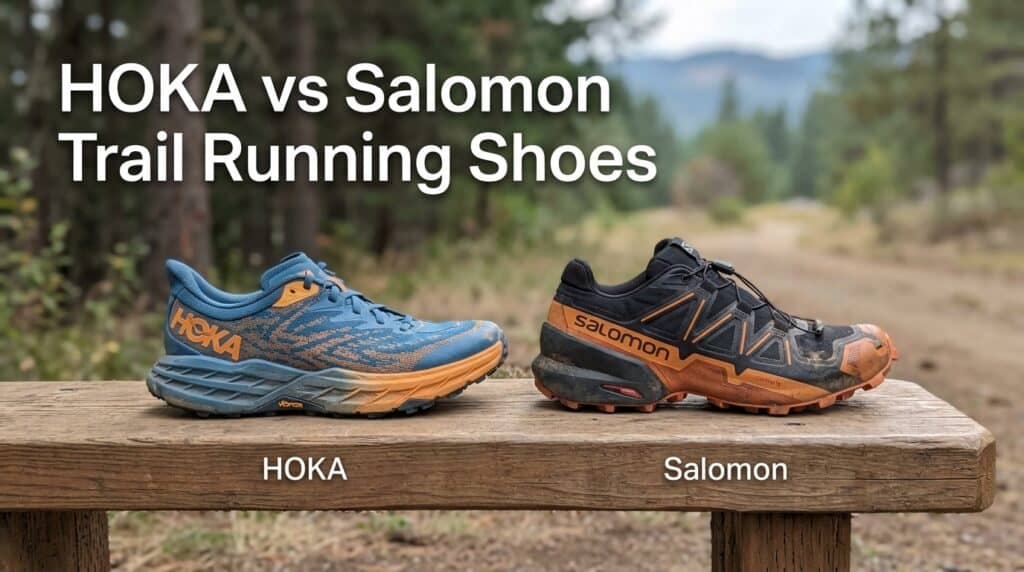
| Feature | HOKA | Salomon | Edge |
|---|---|---|---|
| Brand philosophy | Maximum cushion + meta-rocker for fatigue reduction over long distances | Precision grip + foot lock for technical mountain performance | Terrain-dependent |
| Cushioning stack | High: 28–36mm across trail range. Speedgoat 6: 32mm heel / 28mm forefoot | Low to moderate: 18–26mm. Speedcross 6: 26mm heel / 21mm forefoot | HOKA for cushioning; Salomon for ground feel |
| Outsole / grip | Vibram Megagrip on premium models; 4–5mm lug depth across most trail shoes | Contagrip system (MA for versatile, TA for mud on Speedcross); 4–6mm lugs | Salomon for mud/fell; tie on technical rock |
| Heel-to-toe drop | 5–8mm across trail range. Meta-rocker compensates with forward-rolling feel | 4–8mm. 6mm most common — the universal trail middle ground | Tie — similar range; feel differs due to rocker |
| Fit and width | Wide, roomy toe box, high volume. Standard width suits wide feet well. | Narrow to medium. Precision fit. Wide variants now available on X Ultra 5 and Outpulse lines. | HOKA for wide feet; Salomon for narrow/precision fit |
| Lacing system | Standard lace on most models. Requires manual adjustment for heel security. | Quicklace system — pull to tighten, one-click lock, tuck excess in lace pocket. Excellent heel lockdown. | Salomon Quicklace for ease and heel security |
| Torsional rigidity | Lower — high foam stack reduces rigidity; meta-rocker creates compliant platform | Higher — 3D chassis on XA Pro and X Ultra; firmer midsole maintains rigidity on uneven surfaces | Salomon for technical terrain ankle stability |
| Rock plate | Present on Speedgoat and Tecton X models. Not universal across range. | Present on technical models. 3D chassis on XA Pro provides structural protection beyond a rock plate alone. | Tie — both protect on their technical models |
| Waterproof options | Gore-Tex on select models including Anacapa Mid GTX | Gore-Tex across most lines — Speedcross GTX, X Ultra Mid GTX, Outpulse GTX | Salomon — wider and more mature GTX range |
| Price range | $130–$200 for trail models. Tecton X at premium end. | $120–$180 for trail models. Speedcross typically ~$150. | Salomon — slightly lower average for equivalent tier |
| Best terrain | Runnable hard-pack, rolling mixed terrain, long-distance ultra, moderate gradient | Mud, fell, loose ground, wet grass, technical mountain, steep gradients | Terrain-specific |
| Best runner profile | Heavier runners, joint pain, older runners, beginners, road runners transitioning to trail, ultra-distance | Lighter runners, technical mountain runners, experienced trail runners, narrow-footed runners, fell racers | Runner-specific |
Fit and Sizing Guide — The Most Practically Important Section
Fit is where HOKA and Salomon diverge most dramatically — and it is the question that generates the most forum discussion, Reddit threads, and return packages. Getting it right before you order saves a significant amount of frustration.
HOKA trail shoes fit wide. HOKA's standard trail shoe last — the foot-shaped form around which the shoe is built — is notably wider and more voluminous than most competitors, including Salomon's standard last. The toe box is particularly generous: HOKA's standard width accommodates what other brands would classify as wide. If you wear wide-width road shoes, HOKA's standard width frequently works without needing to seek out a wide variant. If you have a narrow foot, HOKA's wide construction can allow lateral movement inside the shoe — the foot slides side-to-side rather than being held precisely, which reduces the proprioceptive feedback on technical terrain and can cause the blisters associated with friction rather than pressure.
In terms of length, HOKA trail shoes typically run true to size, though most experienced trail runners size up half a size for the thumb's-width descent clearance described in any serious trail running guide. The heel cup on HOKA trail shoes is rounded and moderately deep — usually adequate for most heel shapes, but narrow-footed runners may experience some heel slip that the wide forefoot compounds.
Salomon trail shoes fit narrow to medium. Salomon's standard trail last is distinctively narrow through the midfoot and toe box — this is not accidental, it is a design choice that creates the foot-lock feel Salomon optimises for. The Quicklace system amplifies this: when you pull the lace and click it locked, it creates even, wrapping tension around the entire forefoot and midfoot that holds the foot very precisely in place. For runners with narrow-to-medium feet, this creates exceptional heel security, eliminates in-shoe movement, and provides the proprioceptive feedback that makes technical terrain feel manageable. For runners with wide feet, the same narrow construction creates compression at the forefoot — particularly at the bunion joint and fifth metatarsal — that becomes genuinely painful over long distances.
Salomon has responded to the narrow-last criticism by introducing Wide variants on several key models. The X Ultra 5 Mid Wide GTX and the Outpulse Mid GTX Wide are the most relevant for trail running — these use an expanded last with more forefoot volume while retaining the Quicklace lockdown and Contagrip outsole. If you have wide feet but want the Salomon performance characteristics, these Wide variants are the correct choice rather than the standard models.
Brand-specific sizing guidance: Size up half a size from your road shoe size in both brands as a default — the descent toe-slide rule applies to both. If you wear a women's size and are between half sizes, go up in both. For Salomon specifically, if the midfoot feels constrictive at your correct length size, try a half size up before concluding the shoe doesn't work — the Quicklace tension at a correct length sometimes feels tighter than it is when you first try the shoe standing still versus running.
Which Brand Wins by Terrain?
| Terrain | Winner | Best HOKA Pick | Best Salomon Pick | Why |
|---|---|---|---|---|
| Hard-packed dirt / fire road | HOKA | Challenger 7 or Challenger 8 | Salomon Genesis | Meta-rocker efficiency on runnable terrain; high cushion protects over long distances on firm ground |
| Deep mud / fell running | Salomon | Speedgoat 6 | Speedcross 6 | Contagrip TA + 6mm wide-spaced self-cleaning lugs are the benchmark for mud performance. No HOKA model matches this in deep mud. |
| Technical rocky mountain | Salomon | Tecton X2 | XA Pro 3D V8 Mid GTX or X Ultra 360 Mid GTX | 3D chassis + Contagrip provides structural stability on uneven rock that HOKA's rocker geometry makes difficult to replicate |
| Mixed / multi-surface | Tie | Challenger 8 | Salomon Genesis | The most competitive terrain category — choose based on fit preference above all else |
| Alpine / winter / snow | Salomon | Anacapa Mid GTX Wide | X Ultra 5 Mid GTX or Outpulse Mid GTX | Salomon's alpine heritage and wider GTX range give them the edge in cold mountain conditions |
| Ultra-distance (26+ miles) | HOKA | Speedgoat 7 | Speedcross 6 for technical ultra courses | HOKA was literally founded to solve the ultra-distance fatigue problem. The meta-rocker advantage compounds over very long distances. |
Which Brand Wins by Distance and Runner Type?
| Runner Type | Recommendation | Specific Pick | Reason |
|---|---|---|---|
| Complete beginner (first trail shoes) | HOKA | HOKA Challenger 8 or HOKA Torrent 4 | Forgiving cushion protects during the adaptation period; wide fit tolerates most foot shapes; meta-rocker assists with efficient form |
| Road runner transitioning to trail | HOKA | HOKA Challenger 8 | Familiar high-cushion feel from road running; drop similar to most road shoes; forgiving on mixed terrain while building trail-specific muscles |
| Intermediate recreational trail runner | Terrain-dependent — see terrain table above | HOKA Speedgoat 6 for runnable mixed; Salomon Speedcross 6 for wet/muddy | At this level, terrain specificity matters more than brand loyalty. Own both if you run varied terrain. |
| Technical mountain runner / alpine specialist | Salomon | Salomon XA Pro 3D V8 Mid GTX or X Ultra 360 Mid GTX | Salomon's alpine heritage translates directly to technical mountain terrain performance |
| Fell runner / mud specialist | Salomon | Salomon Speedcross 6 | Contagrip TA is the definitive mud outsole. No discussion needed on soft, wet, loose ground. |
| Ultra-distance runner | HOKA | HOKA Speedgoat 7 or Speedgoat 6 | The founding use case. Meta-rocker fatigue reduction, maximum cushion, wide toe box for late-race swelling. |
| Trail racer / competitive runner | Course-dependent | HOKA Tecton X2 for fast mixed; Salomon Speedcross 6 for technical/muddy race courses | Both brands make race-day shoes. Match outsole to course conditions. |
Which Brand Wins by Body Type and Injury History?
This section is absent from every competing HOKA vs Salomon article. It represents the most practically important guidance for runners who have specific physical considerations beyond terrain preference.
Heavier runners (over 190 lbs). HOKA. The high-stack EVA midsole provides proportionally more impact absorption at higher body weights. Salomon's lower, firmer stack transmits more ground force to the joints — acceptable for lighter runners with better intrinsic shock absorption, but a genuine fatigue and injury risk for heavier runners over longer distances. The meta-rocker geometry additionally reduces the peak force of heel strike, which is the highest-impact moment in the stride cycle. Recommendation: HOKA Speedgoat 6/7 for technical terrain, HOKA Challenger 8 for mixed, HOKA Torrent 4 for budget entry.
Runners with knee pain. HOKA. The same cushioning logic applies: maximum stack height and meta-rocker geometry reduce the impact transmitted through the ankle, knee, and hip. Salomon's firmer construction increases joint loading. For knee pain specifically, HOKA's higher stack also reduces the eccentric loading on the quadriceps during descents — the movement that generates the most knee pain in trail runners. Recommendation: HOKA Speedgoat 6 or Challenger 8.
Runners with plantar fasciitis. HOKA, with a specific caveat. Meta-rocker geometry reduces tension on the plantar fascia by doing the work of pushing off without requiring the arch to fully extend — the same principle as a rocker-bottom orthotic. The high stack also absorbs the heel impact that exacerbates plantar fasciitis. The caveat: plantar fasciitis runners should not go to zero-drop or low-drop trail shoes; HOKA's 5–8mm drop range is appropriate. Recommendation: HOKA Challenger 8 or Speedgoat 6.
Runners with Achilles tendinitis. HOKA. The meta-rocker reduces Achilles loading by eliminating the need for full plantar flexion push-off — exactly the movement that stresses an inflamed Achilles. The moderate drop (5–8mm) in HOKA trail shoes is in the range that most podiatrists recommend for Achilles management. Recommendation: HOKA Challenger 8; avoid any zero-drop trail shoe during active Achilles issues.
Runners with ankle instability or sprain history. Salomon with a mid-height GTX. The 3D chassis on models like the XA Pro 3D V8 Mid GTX provides structural lateral support that complements the Quicklace lockdown's foot security. The mid-height collar adds ankle coverage. HOKA's high-stack, compliant construction provides less structural ankle support — the softness that cushions impact also reduces the lateral rigidity that prevents ankle rolls on uneven terrain. Recommendation: Salomon XA Pro 3D V8 Mid GTX.
Older runners (50+) or those prioritising joint longevity. HOKA. The maximum cushion philosophy aligns directly with the reduced impact tolerance that comes with age and the accumulated wear on joints. The meta-rocker also reduces the muscular demand of each stride — relevant for runners whose muscular endurance has declined with age while their fitness and desire to run has not. Recommendation: HOKA Speedgoat 6/7 for performance; Challenger 8 for training.
Wide-footed runners. HOKA standard width is typically adequate for wide feet. For those who need confirmed wide: HOKA Anacapa Mid GTX Wide. For Salomon with wide feet: specifically seek the Wide variants — Salomon X Ultra 5 Mid Wide GTX is in this article's lineup and provides wide-foot accommodation with full Salomon performance.
Narrow-footed runners. Salomon. The precision-fit narrow last with Quicklace lockdown is specifically advantageous for narrow feet where HOKA's wide construction can feel loose and imprecise. The even tension of Quicklace compensates for foot volume that doesn't naturally fill a wide toe box. Recommendation: Salomon Speedcross 6 or Genesis.
Model-by-Model Comparison: Which HOKA Faces Which Salomon?
The 16 products in this article are mapped to their direct equivalents across the two brands. Each matchup covers a specific use case and helps you identify which shoe in each brand's lineup serves your particular needs.
Matchup 1: HOKA Speedgoat 6/7 vs Salomon Speedcross 6 — The Flagship Face-Off. Both are the defining trail shoe of their respective brands. The Speedgoat is HOKA's premium long-distance trail performance shoe; the Speedcross is Salomon's precision mud and technical terrain racer. If you can only understand one comparison, understand this one. Full reviews of both below.
Matchup 2: HOKA Challenger 7/8 vs Salomon Genesis — The Versatile All-Terrain Pick. Both are each brand's most versatile everyday trail training shoe — capable across multiple terrain types, appropriate for beginners and experienced runners alike, priced in the accessible mid-range.
Matchup 3: HOKA Tecton X2 vs Salomon XA Pro 3D V8 — The Technical and Stability Match. HOKA's most technical trail shoe versus Salomon's stability-chassis model. Both target runners who need more structural support than a standard cushion shoe provides on rocky, demanding terrain.
Matchup 4: HOKA Anacapa Mid GTX vs Salomon Outpulse Mid GTX / X Ultra 360 — The Waterproof Mid Match. Both are waterproof mid-height trail/hiking crossover shoes suited for wet conditions and winter trail use.
Matchup 5: HOKA Torrent 4 vs Salomon Genesis (budget tier) — The Entry-Level Pick. HOKA's most accessible trail shoe versus Salomon's most versatile new model at comparable price points.
HOKA Speedgoat 6 — The HOKA Flagship
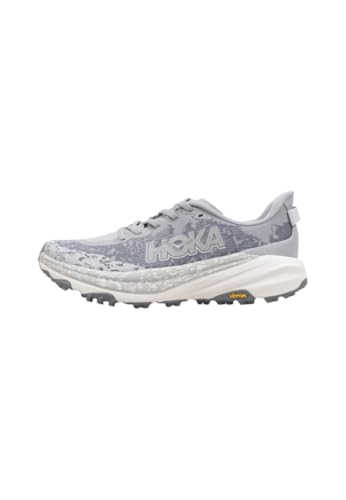
The Speedgoat is the shoe that defined HOKA's trail identity, and the sixth version refines everything that made the original successful without losing the character that attracted an entire generation of trail and ultra runners. Named after Karl Metzler — the elite trail runner nicknamed "Speedgoat" who helped develop the original model — the Speedgoat 6 is HOKA's answer to the question of what a serious trail runner should wear on the majority of their training runs and races. It is not a specialist shoe. It is a high-performance, do-everything trail shoe built on the HOKA philosophy of maximum cushion and meta-rocker efficiency, and it delivers both with remarkable consistency.

The construction is centred around a 32mm heel stack — higher than almost anything in Salomon's range — with HOKA's proprietary EVA foam that provides cushioning without the instability that early HOKA critics attributed to the high stack. The Vibram Megagrip outsole with 5mm lugs handles everything from packed singletrack to moderate technical terrain and mixed-surface running competently. A full-length rock plate protects against the point-load impacts of rocks and roots across the full outsole. The engineered mesh upper is reinforced with protective overlays at the toe and lateral zones. The 5mm heel-to-toe drop works with the meta-rocker geometry to create HOKA's characteristic rolling forward efficiency.

In the context of the HOKA vs Salomon comparison: the Speedgoat 6 is the shoe to choose when your primary terrain is runnable to moderately technical trail, your distances are long (half marathon distance and above where cushion fatigue management becomes relevant), and you have a wide or medium-width foot. It is not the correct choice for deep mud — the Salomon Speedcross 6 dominates that category — and on very technical, narrow-path mountain terrain, some runners prefer the lower-stack precision of the Salomon alternatives. Everywhere else, the Speedgoat 6 is one of the finest trail running shoes available.
Specs: Stack height 32mm heel / 28mm forefoot | Drop 5mm | Outsole: Vibram Megagrip, 5mm lugs | Rock plate: Full-length | Weight: ~9.4 oz (M9) | Width: Standard (medium-wide) | Waterproof option: Speedgoat 6 GTX available separately
✅ Best for: Long-distance trail running, mixed and runnable terrain, beginners wanting max protection, heavier runners, joint-pain management, ultra preparation.
⚠️ Not ideal for: Deep mud (Speedcross 6 wins there); very technical rocky scrambling where low-stack precision is preferred; narrow-footed runners who need snug midfoot lockdown.
Pros: Maximum cushioning for fatigue management over long distances; Vibram Megagrip is excellent on most trail surfaces; full-length rock plate; wide fit accommodates most foot types; the definitive HOKA trail shoe with a decade of refinement behind it.
Cons: Wide fit can feel loose for narrow feet; meta-rocker reduces stability feel on very technical ground; not the right tool for serious mud or fell running.
HOKA Speedgoat 7 — The Latest Generation
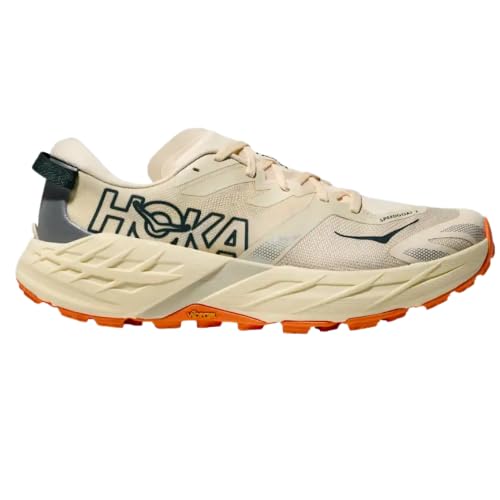
The Speedgoat 7 represents the current evolution of HOKA's flagship trail shoe, and it builds on the Speedgoat 6's foundation with targeted refinements rather than a wholesale redesign. The core philosophy is unchanged: maximum cushion, Vibram Megagrip outsole, meta-rocker efficiency, full-length rock plate. What has evolved is the fit, the upper construction, and HOKA's latest midsole compound iteration that offers marginally improved energy return over the Speedgoat 6's EVA.

For buyers choosing between Speedgoat 6 and Speedgoat 7: the Speedgoat 7 is the current model and the one to buy at full price. The Speedgoat 6 may be available at a discount as the 7 takes over shelf space, making it excellent value if you find it at a reduced price. Both deliver the full HOKA Speedgoat experience. For buyers comparing to Salomon: the Speedgoat 7 is the current state of HOKA's trail art — more cushioned, more efficient on runnable terrain, and more forgiving on wide feet than any equivalent Salomon model. The Speedcross 6 beats it in mud. The Salomon technical models beat it in precision. Everywhere else, this is one of the best trail shoes made.

✅ Best for: Current-model buyers wanting the latest HOKA trail flagship; long distances; mixed terrain; ultra preparation; runners upgrading from Speedgoat 5 or 6.
Salomon Speedcross 6 — The Salomon Flagship

If HOKA owns the ultra-distance conversation, Salomon owns the mud conversation — and the Speedcross is the shoe that made that ownership definitive. The Speedcross 6 is, by any measure, the most recognisable trail running shoe in the world. Its aggressive chevron lug pattern, its distinctive shape, and its extraordinary grip in the conditions where most trail shoes fail have made it the default choice for fell runners, obstacle course racers, and anyone whose primary trail surface is soft, wet, loose, or unpredictable.

The construction centres on the Contagrip TA outsole — the aggressive variant of Salomon's rubber system, with 6mm lugs at 12–15mm spacing. The wide spacing is the critical detail that separates the Speedcross from competitors: lugs packed closely together fill with mud after the first few strides and lose grip entirely. The Speedcross's wide-spaced lugs self-clean with every footstrike — each landing forces mud out from between the lugs before the next step — maintaining grip throughout a muddy run that would render most other trail shoes useless. The Quicklace system provides one-pull tensioning and excellent heel lockdown. The EnergyCELL midsole is firm and responsive rather than cushioned — providing energy return from the ground without the high-stack softness of HOKA.

In the HOKA vs Salomon comparison: the Speedcross 6 is the clear winner in its specific domain — mud, fell, soft ground, wet grass, loose trail — and the clear loser in cushioning, stack height, and long-distance fatigue management. It is a specialist tool rather than an all-arounder. If your trails are consistently wet and soft, or if you race events where the course is unpredictably muddy, the Speedcross 6 belongs in your rotation regardless of whether you also own a HOKA for other conditions.
Specs: Stack height 26mm heel / 21mm forefoot | Drop 8mm | Outsole: Contagrip TA, 6mm lugs with wide spacing | No rock plate | Weight: ~9.7 oz (M9) | Width: Narrow-medium (standard); Wide variant available | Lacing: Quicklace
✅ Best for: Mud, fell, soft ground, wet grass, obstacle course racing, anyone whose trails are consistently wet and loose, trail racers on technical muddy courses.
⚠️ Not ideal for: Hard-packed trails (lugs are too aggressive for firm surfaces — creates instability); long distances where cushioning matters; wide-footed runners in standard width.
Pros: Contagrip TA is the benchmark mud outsole — genuinely class-leading in its specific terrain; Quicklace for easy on-trail adjustment; firm midsole for energy return; iconic design; available in GTX waterproof version.
Cons: Aggressive lug is inappropriate for firm surfaces; narrow fit excludes wide-footed runners from the standard version; lower stack is less comfortable on long hard-pack efforts.
HOKA Challenger 7 and Challenger 8 — The Versatile HOKA
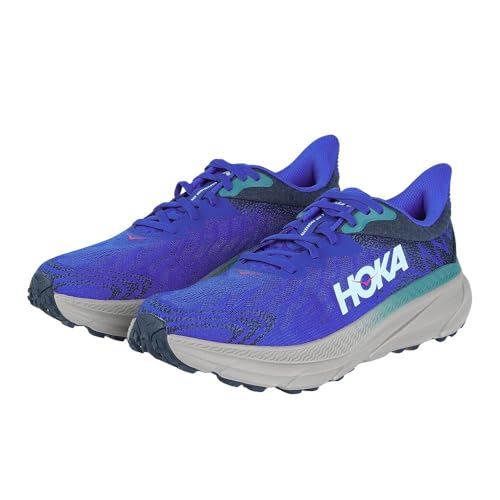
The Challenger line is HOKA's answer to the question that the Speedgoat answers with specialist performance: what if you need one trail shoe that works across all the terrain you actually run, without committing to maximum cushion or maximum lug aggression? The Challenger 7 and its successor the Challenger 8 are HOKA's most versatile trail shoes — moderate stack, moderate lug depth, appropriate for hard-pack and mixed terrain, lighter than the Speedgoat, and priced accessibly.

The Challenger's outsole uses a 4mm multi-directional lug pattern rather than the Speedgoat's 5mm Vibram Megagrip configuration — it handles firm trails, moderate mixed terrain, and light mud adequately without the specialist aggression of the Speedgoat. The stack height is slightly lower than the Speedgoat, which translates to a slightly more connected feel to the ground — useful for runners transitioning from road shoes who find the full Speedgoat stack overly disconnected from terrain feedback. The meta-rocker geometry is present, providing the characteristic HOKA forward-rolling efficiency. The wide, accommodating fit is standard HOKA.

The Challenger 8 is the current model and the one to buy new; the Challenger 7 may be available at reduced price as a previous generation. Both deliver the same core experience. In the HOKA vs Salomon comparison, the Challenger competes most directly with the Salomon Genesis — both are versatile everyday trail trainers rather than terrain specialists. The choice between them is primarily a fit choice: wide feet and cushion preference point to the Challenger; narrow-medium feet and grip-first preference point to the Genesis.
✅ Best for: Beginners, road runners transitioning to trail, mixed terrain, everyday trail training, runners who want HOKA's meta-rocker without the Speedgoat's specialist price and weight.
Pros: Most versatile HOKA trail shoe; accessible price; wide fit for most foot types; meta-rocker efficiency on mixed terrain; lighter than Speedgoat.
Cons: Less cushion than Speedgoat — not the right choice for serious ultra distances; outsole not suitable for deep mud; less precise than Salomon alternatives on technical terrain.
Challenger 7 — Check Price on Amazon →
Challenger 8 — Check Price on Amazon →
HOKA Tecton X2 — The Race-Day HOKA
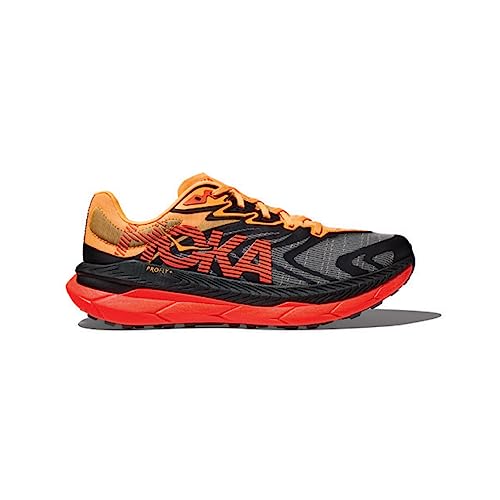
The Tecton X2 is where HOKA demonstrates that maximum cushion is not their only capability. This is HOKA's elite trail racing shoe — incorporating HOKA's version of carbon fibre plate technology within a trail-specific construction that retains the Vibram Megagrip outsole and full-length protection of the Speedgoat while adding the propulsive energy return of dual carbon fibre plates embedded in the midsole.

The dual carbon plate system — two curved carbon fibre elements positioned through the midsole — creates the kind of propulsive stiffness that road running's carbon-plate shoes deliver, adapted for the variable landing patterns of trail running. The result is a shoe that feels noticeably livelier than the Speedgoat on uphill efforts and fast flat sections, while retaining HOKA's cushion protection on technical descents. In the context of the HOKA vs Salomon comparison, the Tecton X2 most directly competes with Salomon's S-Lab racing models — the premium performance tier of each brand on technical trail race courses.
One honest note: the Tecton X2 is a race-day and fast-session shoe rather than an everyday training tool. The PEBA-adjacent foam and carbon plates deliver extraordinary performance per step but compress faster under trail-specific abuse than the standard EVA of the Speedgoat. Reserve it for events and fast efforts; train in the Speedgoat or Challenger.
✅ Best for: Trail races, fast training efforts, experienced trail runners seeking maximum performance on technical courses, runners already comfortable in HOKA's fit.
HOKA Torrent 4 — The Budget HOKA
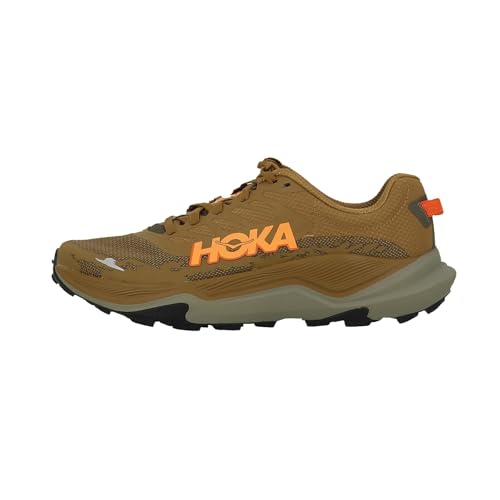
The Torrent 4 makes the HOKA trail experience accessible without stripping out the features that define it. Lighter and less expensive than the Speedgoat or Challenger, the Torrent delivers HOKA's wide fit, meta-rocker geometry, and decent mixed-terrain outsole at the most accessible price point in the trail range. The multi-directional rubber outsole handles hard-pack and moderate mixed terrain — it is not a specialist mud shoe and not a maximum-cushion ultra shoe, but it is a genuinely capable everyday trail companion for recreational runners.

The Torrent 4 sits at the bottom of HOKA's trail stack hierarchy — it has less foam, a lighter construction, and a simpler outsole than the Speedgoat or Challenger. For runners who are genuinely budget-limited, or who are testing HOKA's trail fit and feel before committing to a Speedgoat, it is the right entry point. It competes at approximately the same price as Salomon's entry-level trail options.

✅ Best for: Budget-conscious buyers, first-time trail runners testing HOKA's fit, shorter distances on mixed terrain, runners upgrading from road shoes on a tight budget.
HOKA Anacapa Mid GTX Wide — The Waterproof and Wide Pick
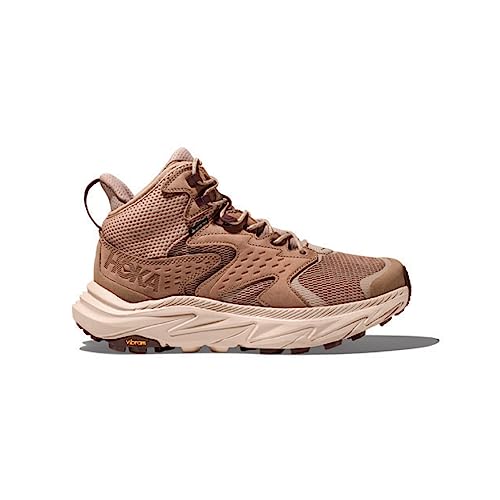
The Anacapa Mid GTX Wide occupies a specific and underserved niche: wide-footed trail runners who need waterproof performance in a mid-height construction. Most waterproof trail shoes are built on standard or narrow lasts that exclude wide-footed runners; the Anacapa Wide addresses this with an explicitly extended last that provides the forefoot and toe box room that HOKA's trail range is known for, in a Gore-Tex construction with mid-height ankle coverage.
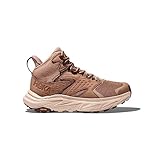
The Gore-Tex membrane provides genuine waterproofing and the mid-height collar adds ankle protection for technical terrain and cold-weather use. The outsole uses HOKA's own rubber compound with a lug pattern suited to moderate mixed terrain — this is not a Speedgoat-level technical trail shoe, but it handles most recreational trail conditions with adequate grip. In the HOKA vs Salomon waterproof comparison, the Anacapa Mid GTX Wide competes against the Salomon X Ultra 5 Mid GTX Wide and the Outpulse Mid GTX — both offer similar waterproof-mid-height trail protection with Salomon's narrower but more grip-precise construction. Choose based on foot width: wide feet point to the Anacapa Wide; medium-narrow feet point to the Salomon alternatives.
✅ Best for: Wide-footed trail runners needing waterproof; winter and wet-weather trail running; trail-hike crossover use; cold mountain conditions.
Salomon Genesis — The Versatile Salomon
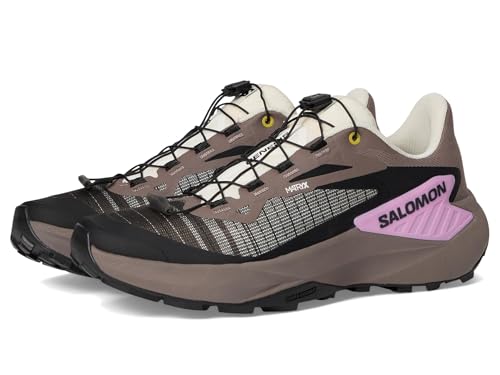
The Genesis is Salomon's newest all-terrain trail shoe, designed to be the brand's versatile everyday trainer in the same way the Challenger is HOKA's — capable across most surfaces, appropriate for recreational runners and experienced trail athletes alike, and priced accessibly within Salomon's range. It brings Salomon's Contagrip MA outsole, the Quicklace system, and the brand's characteristic precision-fit construction to a more cushioned, more forgiving package than the Speedcross.

The Genesis represents Salomon's acknowledgement that not every runner needs the Speedcross's specialist mud aggression, and that a more forgiving ride on mixed terrain — closer to what HOKA's Challenger offers — serves the majority of recreational trail runners better than a pure performance specialist. The Contagrip MA outsole handles firm, mixed, and moderately wet trails well. The midsole provides more cushioning than the Speedcross, though still firmer than any HOKA equivalent. In the comparison, the Genesis is the Salomon shoe most likely to suit a runner who has tried HOKA and found the fit too wide or the rocker geometry too disconnected — it offers a more grounded, responsive alternative on the same terrain range.

✅ Best for: Versatile recreational trail running, Salomon brand preference on mixed terrain, road runners transitioning to trail who prefer a snugger fit than HOKA offers, everyday training on non-specialist surfaces.
Salomon XA Pro 3D V8 Mid GTX — Stability and Technical Terrain
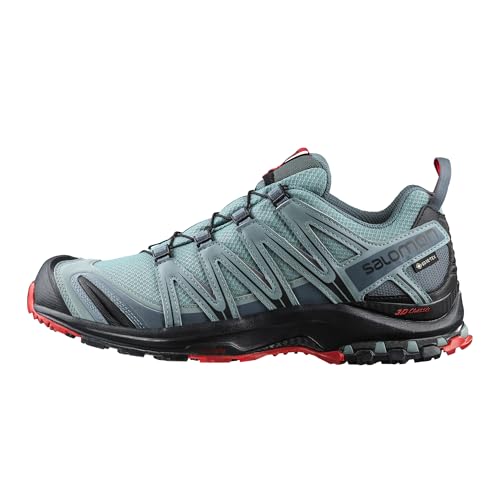
The XA Pro 3D V8 Mid GTX is the Salomon shoe for runners who specifically need structural support on technical terrain — the 3D chassis is the key differentiator here, providing torsional rigidity that the Speedcross and Genesis cannot match. The "3D" designation refers to the three-dimensional moulded chassis that runs through the midsole, providing structural resistance to the twisting and bending forces that technical rocky terrain generates in the shoe. This is the most ankle-secure Salomon trail shoe in this lineup.

The Gore-Tex waterproof construction and mid-height collar add further protection for mountain and cold-weather use. The Contagrip MA outsole handles mixed to technical terrain with adequate grip. In the HOKA vs Salomon comparison, the XA Pro 3D competes with HOKA's Tecton X2 for the "technical and structured" category — though the two achieve it very differently: HOKA through carbon plate propulsion and cushion protection, Salomon through chassis rigidity and outsole grip precision. The XA Pro 3D is the better choice for runners who prioritise ankle security and stability over energy return and cushion; the Tecton X2 is better for runners who prioritise performance and speed on technical courses.

✅ Best for: Technical rocky mountain terrain, ankle instability history, cold and wet mountain conditions, trail-hike crossover, runners who need structural support over cushioning performance.
Salomon X Ultra 5 Mid GTX and X Ultra 5 Mid Wide GTX — Trail-Hike Crossover

The X Ultra 5 Mid GTX occupies the trail-hike crossover category more explicitly than any other Salomon shoe in this lineup. It is the choice for runners who also hike, for fastpackers who run the flat and downhill sections and hike the steep climbs, and for trail runners who want the protection and waterproofing of a hiking boot with the lightness and responsiveness of a trail running shoe. The Contagrip MA outsole handles the wide variety of surfaces a mixed run-hike day encounters, and the Gore-Tex mid-height construction provides all-day waterproofing.

The Wide variant — Salomon X Ultra 5 Mid Wide GTX — is specifically significant in the context of this comparison. It demonstrates that Salomon has responded to the "Salomon runs narrow" criticism by producing a genuinely wider-last version of one of their key models. Wide-footed runners who have been excluded from Salomon's performance by the narrow standard last now have a specific model to consider. In the HOKA vs Salomon comparison for wide feet, the choice is between HOKA Anacapa Mid GTX Wide (rounder, softer, HOKA's cushion philosophy) and Salomon X Ultra 5 Mid Wide GTX (more grip-precise, firmer, Salomon's precision philosophy) — both in wide construction.

✅ Best for: Run-hike crossover, fastpacking, all-day mountain use, wet conditions across mixed terrain, wide-footed runners wanting Salomon performance.
X Ultra 5 Mid GTX — Check Price on Amazon →
X Ultra 5 Mid Wide GTX — Check Price on Amazon →
Salomon Outpulse Mid GTX — Waterproof Trail-Hike

The Outpulse Mid GTX is a waterproof mid-height trail and hiking shoe that represents Salomon's accessible entry into the waterproof-mid category — less technical and lower-priced than the XA Pro 3D, more trail-specific than the X Ultra line's hiking crossover positioning. It uses Contagrip MA outsole, Gore-Tex waterproofing, and the Quicklace system in a comfortable mid-height package appropriate for recreational trail runners and hikers running mixed conditions in wet weather.

In the HOKA vs Salomon waterproof comparison, the Outpulse Mid GTX competes directly with the HOKA Anacapa Mid GTX Wide — different fit (Salomon's precision narrow versus HOKA's wide), different stack philosophy (Salomon's firmer, lower stack versus HOKA's cushioned construction), same waterproof protection purpose. Choose based on foot width and cushion preference. For cold winter trail running in the UK or similar climates where the terrain is mixed and conditions are consistently wet, the Outpulse Mid GTX is a reliable, well-priced Salomon option.

✅ Best for: Wet weather trail running, recreational trail-hike crossover, cold autumn and winter conditions, accessible price point waterproof trail shoe.
Salomon X Ultra 360 Mid GTX — The Current Generation X Ultra

The X Ultra 360 Mid GTX is the current iteration of Salomon's X Ultra line — the model designation "360" referring to the updated chassis design that provides 360-degree structural support around the foot and ankle. This represents Salomon's most refined take on the trail-hike crossover category, with updated midsole geometry, the latest Contagrip MA outsole formulation, and Gore-Tex waterproofing in a mid-height package. It sits above the Outpulse in Salomon's trail hierarchy and offers more technical support than the standard X Ultra 5.
In the HOKA vs Salomon comparison for current-model buyers, the X Ultra 360 Mid GTX represents where Salomon's trail-hike range currently stands — more structured, more technically capable, and with updated materials compared to earlier X Ultra iterations. For buyers looking at HOKA's Anacapa Mid GTX Wide as a waterproof trail option, the X Ultra 360 Mid GTX is the current Salomon counterpart in the mid-height waterproof trail category.

✅ Best for: Current-model buyers wanting the latest X Ultra evolution, technical mountain trail running with waterproof protection, structural ankle support with full-day comfort.
Women's Trail Shoes — HOKA vs Salomon for Women
Women's trail shoe selection follows the same brand philosophy principles as men's — HOKA for cushion and wide fit, Salomon for precision grip and narrow-medium fit — but the specific models and the fit characteristics have important women's-specific differences that deserve dedicated coverage.
Women's feet, on average, have a higher arch, a narrower heel, and a wider forefoot relative to overall foot length than men's feet. HOKA's women's-specific lasts account for this with a narrower heel cup and slightly adjusted forefoot volume compared to their men's last. Salomon's women's lasts similarly adapt for the heel-forefoot proportion difference. Neither brand simply makes their women's shoes by scaling down the men's last — both invest in women's-specific construction.
HOKA ONE ONE Women's Speedgoat 6 — Best Women's HOKA Trail Shoe
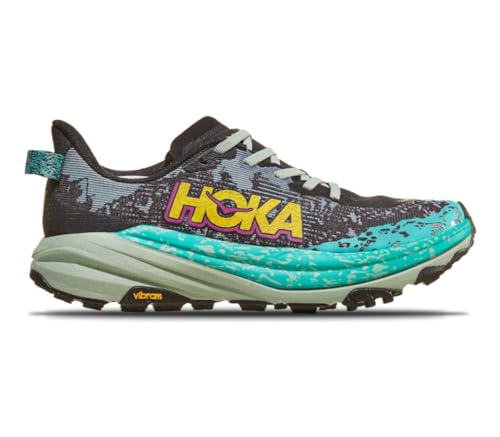
The women's Speedgoat 6 delivers everything that makes the men's version the definitive HOKA trail shoe, built on a women's-specific last that accommodates the typically narrower heel and adapted forefoot volume of women's feet. Vibram Megagrip outsole, 5mm lugs, full-length rock plate, and HOKA's maximum-cushion philosophy for long-distance trail and mixed terrain — all in a construction that works specifically with how women's feet are shaped rather than adapting a men's shoe.
For women transitioning from road running, dealing with joint pain or Achilles issues, running long distances, or simply wanting the most cushioned and comfortable trail shoe available, the women's Speedgoat 6 is the answer. The meta-rocker geometry that reduces fatigue on long efforts, the wide accommodating toe box, and the Vibram Megagrip that handles most trail surfaces competently make this the right first trail shoe for most women who are coming from road running and the right performance trail shoe for women doing serious trail distance work.

Against the Salomon women's options: the women's Speedgoat 6 provides more cushion and a wider fit than any equivalent Salomon model. Women with wide feet, joint concerns, or long-distance goals should choose it over the Salomon alternatives. Women with narrow feet who prioritise grip precision on technical terrain should look at the Salomon women's Speedcross GTX below.
✅ Best for: Women doing long trail distances, wider-footed women, women with knee or Achilles issues, road-to-trail transition, all-day mountain outings where cushion fatigue management matters.
HOKA Women's Challenger 7 — Best Women's Everyday HOKA
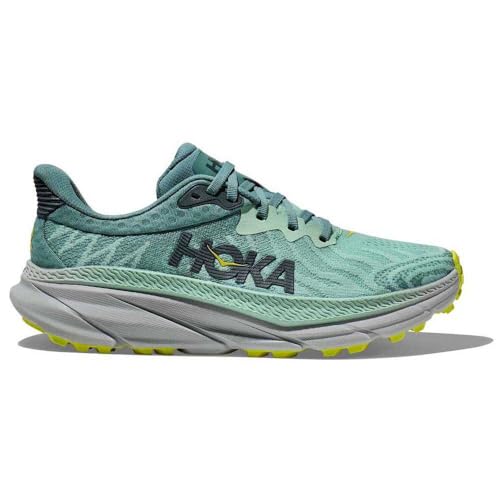
The women's Challenger 7 is HOKA's most accessible and versatile trail shoe for women — the everyday trainer for mixed terrain and moderate distances that sits below the Speedgoat in cushion and performance but above the Torrent in capability. Built on HOKA's women's-specific last with the meta-rocker geometry and wide accommodating fit that defines the brand, the Challenger 7 handles the range of terrain that most recreational women trail runners actually encounter: well-maintained singletrack, fire roads, light technical sections, and mixed surface runs that include both trail and road segments.

The women's Challenger 7 is particularly appropriate for women who are new to trail running and want a forgiving, comfortable shoe that doesn't require a commitment to a specific terrain type, and for women who run trails two to three times per week as part of a broader training programme that also includes road running. The accessible price point makes it a practical choice for building a two-shoe rotation — the Challenger 7 as the everyday mixed-terrain shoe and the Speedgoat 6 as the long-distance specialist.

Against the Salomon women's models: the Challenger 7 is wider, more cushioned, and more forgiving than the Salomon Speedcross GTX women's, and better suited for the beginner and recreational runner. Salomon's women's models have the grip edge in mud and technical terrain; HOKA's Challenger has the comfort edge everywhere else at this price level.
✅ Best for: Women beginners on trail, everyday mixed-terrain training, road runners adding trail mileage, women who want maximum versatility from a single trail shoe at accessible pricing.
Salomon Women's Speedcross 6 GTX — Women's Mud and Technical Specialist
The women's Speedcross 6 GTX combines Salomon's benchmark mud outsole with Gore-Tex waterproof construction — making it the obvious choice for women who trail run in consistently wet conditions or who regularly encounter soft, muddy, and loose terrain. The Contagrip TA outsole, 6mm self-cleaning lugs, Quicklace lockdown, and waterproof construction are all present; the women's-specific last provides an adapted fit for women's foot geometry.
In the women's HOKA vs Salomon comparison: the women's Speedcross 6 GTX wins in mud, fell, and wet conditions the same way the men's version does. Women who run UK fell races, muddy trail events, or who face consistently wet autumn and winter trail conditions should consider this their primary trail shoe. Women who run primarily on mixed or dry terrain should look at the women's HOKA Speedgoat 6 or Challenger 7 instead — the Speedcross's aggressive lug is too specialist for daily mixed-surface training.
✅ Best for: Women fell runners, muddy trail event racing, wet and loose terrain specialists, women wanting waterproof construction with maximum mud grip.
Salomon Women's X Ultra Flare Mid Gore-Tex — Women's Mountain Trail
The Women's X Ultra Flare Mid Gore-Tex is Salomon's women's-specific mid-height waterproof trail shoe for mountain and technical terrain — the women's complement to the men's X Ultra range in a design that incorporates women's-specific construction rather than adapting the men's model. Contagrip MA outsole for mixed terrain grip, Gore-Tex waterproofing, mid-height ankle collar, and the Salomon precision fit in a design created specifically for women's mountain trail use.
In the HOKA vs Salomon comparison for women who run mountain and alpine trails: the Women's X Ultra Flare Mid GTX provides the grip precision and structural support that Salomon's trail heritage delivers, in a mid-height waterproof package appropriate for serious mountain trail running and hiking. It competes against the HOKA Anacapa Mid GTX Wide for women wanting waterproof mid-height trail protection — the choice follows the same fit and philosophy lines: wide-footed cushion-preferring women toward HOKA, medium-narrow precision-preferring women toward Salomon.
✅ Best for: Women trail runners in mountain and alpine terrain, wet conditions, technical surface protection, all-day mountain use.
The Road-to-Trail Crossover Guide — If You Run in X, Start Here
The majority of people searching "HOKA vs Salomon trail running" are road runners who are considering their first trail shoe, or road runners with existing brand loyalty who want to understand which trail option extends that relationship. This section maps road running shoe identity to trail brand and model recommendation.
If your road shoe is HOKA (Clifton, Bondi, Rincon, Mach). You already know HOKA's fit, cushion level, and the characteristic meta-rocker rolling feel. Transitioning to HOKA trail shoes will feel immediately familiar. Start with the Challenger 7/8 for mixed recreational trail; move to the Speedgoat 6/7 when you're running longer distances or more demanding terrain. The meta-rocker on trail has the limitations described in the technology section — be aware on very technical terrain — but you will feel immediately at home in HOKA's trail range.
If your road shoe is Brooks (Ghost, Glycerin, Adrenaline) or Asics (Gel-Kayano, Gel-Nimbus) or Saucony (Ride, Triumph). These are moderate-to-high cushion shoes with standard lasts. HOKA trail shoes will provide a familiar cushion level with trail-specific protection; the meta-rocker geometry is a new sensation but not dramatically different from the cushioned ride you know. Salomon will feel noticeably firmer and more precise than you're accustomed to — try it before committing. HOKA Challenger 8 is the natural first trail shoe for Brooks and Asics road runners.
If your road shoe is Nike (Pegasus, Vomero, React Infinity) or a firm, responsive trainer. These shoes prioritise responsiveness and a more connected, dynamic feel over maximum cushion. HOKA's max-cushion may feel overly soft and disconnected from terrain; Salomon's firmer, more responsive midsole will feel more familiar. Try the Salomon Genesis or Speedcross 6 depending on your terrain. The Quicklace will feel very different from your road shoes — give yourself two to three runs to adapt.
If you've never owned HOKA before. HOKA's meta-rocker geometry requires an adaptation period of approximately two to three weeks of regular use before it starts to feel natural. Do not race in HOKA trail shoes the first time you wear them. The rolling forward sensation is efficient but unfamiliar; the high stack creates a slightly different balance feeling underfoot compared to lower-stack shoes. Give yourself the adaptation period and the advantage of the rocker geometry will become apparent.
Durability and Value — Which Brand Gives More Miles Per Dollar?
Cost per mile is one of the most practically relevant metrics in trail shoe selection and one of the most underreported in comparison articles. Here is the honest analysis.
HOKA's high-stack EVA midsoles — standard across the Speedgoat and Challenger range — typically last 300–400 trail miles before midsole compression becomes noticeable as reduced cushioning and heel-toe height loss. The foam is the limiting factor on most terrain; the Vibram Megagrip outsole typically outlasts the midsole. This is slightly shorter than equivalent road shoes because trail running's point-load impacts (sharp rocks and roots) compress EVA foam more aggressively than the distributed impact of road running. On very abrasive hard-pack or gravel, the outsole may wear faster than the midsole.
Salomon's lower-stack firmer midsoles tend to hold their structural properties slightly longer than HOKA's high-stack EVA because there is less foam to compress — but the EVA baseline compression still occurs. The Contagrip TA outsole on the Speedcross is among the most durable trail outsoles available on soft and mixed terrain; it wears more quickly on abrasive firm surfaces where the aggressive lug geometry grinds against hard ground.
Price comparison at approximately equivalent performance tiers: HOKA Speedgoat 6 approximately $165, Salomon Speedcross 6 approximately $150. Both lasting 300–400 miles on typical mixed trail terrain, the Salomon has a slight cost-per-mile advantage at the same mileage. However, HOKA's Torrent 4 at a significantly lower price point brings the cost-per-mile calculation in HOKA's favour at the entry tier.
Care tips for extending lifespan of both brands: clean mud from lugs after every muddy run — dried mud acts as an abrasive on subsequent steps; dry shoes at room temperature away from direct heat (radiators and direct sunlight degrade both EVA foam and adhesives); reserve trail shoes for trail use and use road shoes for road sections of your run; rotate between two pairs, which extends the lifespan of each pair by allowing full foam recovery between uses.
Waterproof Comparison — HOKA GTX vs Salomon GTX
Both brands offer Gore-Tex waterproof versions of their key trail models. The waterproofing technology — the Gore-Tex membrane — is the same in both; the differences lie in how each brand integrates the membrane into their construction and how the waterproof version's added stiffness interacts with their respective midsole philosophies.
HOKA's Gore-Tex trail shoes (Anacapa Mid GTX) use the membrane in a mid-height construction that stiffens the upper compared to the standard mesh version — this reduces the flexibility feel that HOKA's cushion construction typically provides but maintains the waterproof protection. The high stack is unchanged.
Salomon's GTX trail shoes are more numerous and more developed — the Speedcross GTX, multiple X Ultra GTX configurations, Outpulse Mid GTX, and X Ultra 360 Mid GTX all offer Gore-Tex construction within a range of heights and lug specifications. Salomon's firmer midsole construction means the stiffening effect of the Gore-Tex membrane is less noticeable in a Salomon GTX shoe than in an equivalent HOKA GTX — the shoe already has a relatively firm construction, so the membrane's stiffness is less of a departure from the non-waterproof version.
In cold conditions below 10°C with consistent rain or wet trails, both brands' GTX models are appropriate and perform well. The temperature and duration guidance from our How to Choose Trail Running Shoes guide applies: above 15°C, the waterproof membrane's sweat-trapping limitation is relevant for both brands; in sustained cold and wet, both GTX constructions provide genuine waterproof value.
The 6-Question Decision Framework — Which Brand Is Right for You?
Question 1: What is your primary terrain? Hard-packed fire roads and runnable singletrack → HOKA (Challenger 8 or Speedgoat 6). Deep mud, fell, loose ground → Salomon Speedcross 6. Technical rocky mountain → Salomon XA Pro 3D or X Ultra 360. Mixed versatile → choose by fit preference.
Question 2: How far do you run? Under 10 miles on mixed terrain: either brand. 10–26 miles: HOKA's cushion advantage grows with distance. 26+ miles / ultra-distance: HOKA strongly — the Speedgoat 6 or 7 is the founding use case for the brand. Salomon for ultra only on very technical courses where grip is the primary concern.
Question 3: How wide is your foot? Wide foot (wear EE, 2E, or Wide in road shoes): HOKA standard width fits; Salomon requires Wide variant (X Ultra 5 Mid Wide or Outpulse Wide). Standard/medium width: either brand. Narrow foot: Salomon's precision Quicklace lockdown suits narrow feet specifically well.
Question 4: Do you have joint pain or injury history? Knee pain, hip pain, plantar fasciitis, heavier build, older runner: HOKA — meta-rocker and maximum cushion reduce joint loading. Achilles tendinitis: HOKA — rocker reduces Achilles load. Ankle instability / sprain history: Salomon XA Pro 3D with mid-height collar.
Question 5: Are you a beginner or experienced trail runner? Beginner or road-to-trail transition: HOKA Challenger 7/8 — the most forgiving and familiar transition shoe. 6+ months trail experience, knows terrain preferences: specific to terrain above. Technical mountain racer: Salomon.
Question 6: What is your budget? Under $130: HOKA Torrent 4. Under $155: Salomon Speedcross 6 or Genesis. Under $175: HOKA Challenger 8 or Speedgoat 6. Premium race-day: HOKA Tecton X2.
Quick Verdict — Our Top Picks by Category
| Category | Pick | Link |
|---|---|---|
| Best overall HOKA trail shoe | HOKA Speedgoat 6 | Check Price → |
| Best overall Salomon trail shoe | Salomon Speedcross 6 | Check Price → |
| Best for beginners | HOKA Challenger 8 | Check Price → |
| Best for mud / fell | Salomon Speedcross 6 | Check Price → |
| Best for technical rocky terrain | Salomon XA Pro 3D V8 Mid GTX | Check Price → |
| Best for ultra-distance | HOKA Speedgoat 7 | Check Price → |
| Best for wide feet | HOKA Anacapa Mid GTX Wide | Check Price → |
| Best budget trail shoe | HOKA Torrent 4 | Check Price → |
| Best waterproof trail shoe | Salomon X Ultra 360 Mid GTX | Check Price → |
| Best race-day performance | HOKA Tecton X2 | Check Price → |
| Best women's HOKA trail shoe | HOKA Women's Speedgoat 6 | Check Price → |
| Best women's everyday trail shoe | HOKA Women's Challenger 7 | Check Price → |
FAQ: HOKA vs Salomon Trail Running Shoes
Is HOKA or Salomon better for trail running?
Neither brand is universally better — they are optimised for genuinely different things. HOKA is better for long-distance running, runnable terrain, heavier runners, and anyone prioritising cushion and fatigue management. Salomon is better for mud and fell terrain, technical mountain running, and runners with narrow feet who want precision grip and foot lockdown. The answer depends entirely on where you run and how far.
What is the main difference between HOKA and Salomon trail shoes?
The fundamental difference is design philosophy: HOKA was founded to deliver maximum cushion and meta-rocker geometry for long-distance fatigue reduction. Salomon was founded on alpine precision engineering for technical mountain grip and foot security. Every specific difference — cushion level, outsole design, fit width, lacing system — traces back to these different founding purposes. HOKA maximises comfort over distance; Salomon maximises precision on technical terrain.
Are Salomon trail shoes too narrow?
Salomon's standard trail shoe last is narrow to medium — genuinely narrow for runners with wide feet. However, Salomon now offers Wide variants on key models including the X Ultra 5 Mid GTX and Outpulse Mid GTX. If you have wide feet, look specifically for the Wide variant rather than concluding Salomon doesn't work for you. Wide-footed runners in standard Salomon width will experience compression at the forefoot, particularly on longer runs.
Do HOKA trail shoes have good grip?
On most trail surfaces — hard-pack, mixed, moderate technical, and dry rock — yes, particularly on models with Vibram Megagrip (Speedgoat line). In deep mud and soft fell terrain, HOKA's grip is adequate but noticeably below the Salomon Speedcross 6's Contagrip TA performance. If mud grip is your primary concern, Salomon wins clearly. For all other terrain types, HOKA's grip is competitive.
What is Salomon Contagrip?
Contagrip is Salomon's proprietary outsole rubber system, developed in-house for mountain terrain grip. It comes in three main variants: Contagrip MA (versatile medium-hardness compound for mixed terrain), Contagrip TA (aggressive high-traction compound with deep wide-spaced lugs for mud and fell — used on the Speedcross), and Contagrip TD (lighter-duty general trail use). The Contagrip TA on the Speedcross is widely regarded as the benchmark outsole for soft, muddy, and loose trail conditions.
What is HOKA meta-rocker?
Meta-rocker is HOKA's term for the pronounced heel-to-toe curvature built into their midsoles. The curved geometry creates a rocking motion through the stride that rolls the foot forward with reduced muscular effort — lowering the metabolic cost of each step and reducing lower-leg fatigue over long distances. It is the primary technology behind HOKA's dominance in ultra-distance trail running. The trade-off: on very technical uneven terrain, the rocker geometry can reduce stability compared to a flat-profiled shoe.
Should I buy HOKA or Salomon for wide feet?
For wide feet, HOKA is the default recommendation — HOKA's standard trail shoe width accommodates what other brands classify as wide. If you need a confirmed wide fit, the HOKA Anacapa Mid GTX is available in a Wide variant. For Salomon with wide feet, specifically seek the Wide variants (X Ultra 5 Mid Wide GTX) — the standard Salomon last will be too narrow for most wide-footed runners.
Which is better for mud running — HOKA or Salomon?
Salomon Speedcross 6, clearly. Contagrip TA with 6mm wide-spaced lugs that self-clean on every footstrike is the benchmark mud outsole in trail running. No HOKA model matches it in deep, soft, wet ground conditions. If your trails are consistently muddy, the Speedcross 6 is the correct choice regardless of other brand considerations.
Are HOKA trail shoes good for ultra running?
Yes — ultra-distance running is HOKA's founding use case. The brand was specifically created to help ultra-runners manage fatigue over very long distances through maximum cushion and meta-rocker efficiency. HOKA shoes are worn at UTMB, Western States, and most major ultra events by a significant proportion of the field. The Speedgoat 6 and Speedgoat 7 are the standard HOKA ultra trail recommendations.
HOKA or Salomon for knee pain and heavier runners?
HOKA, clearly. The maximum cushion stack reduces impact transmitted to the knee joint, and the meta-rocker geometry reduces the eccentric quadriceps loading on descents that is the primary cause of knee pain in trail runners. Heavier runners benefit proportionally more from the impact absorption — higher body weight amplifies the difference between a high-stack and a low-stack shoe's joint protection. HOKA Speedgoat 6 or Challenger 8 for this use case.
For more trail running footwear guidance at Bootsguru, see our complete guide to how to choose trail running shoes, our picks for the best trail running shoes overall, and our guide to the best waterproof trail running shoes.