
Trying on a boot for five minutes at the store or unboxing it at home tells you almost nothing about how it's going to feel eight hours into a real shift. If you're wondering whether the boots you already own, and have already been wearing, are too big, that's a different question from getting the size right at checkout. If you haven't bought yet, our fit guide on toe space and heel slip at the store covers that test. This one is for boots you're already living in.
This covers the signs that actually show up during real work, not a showroom try-on, the genuine safety issue that comes with an oversized safety-toe boot, how to tell the difference between normal break-in and a boot that's genuinely too big, and what to actually do about it.
Signs That Only Show Up During a Real Shift
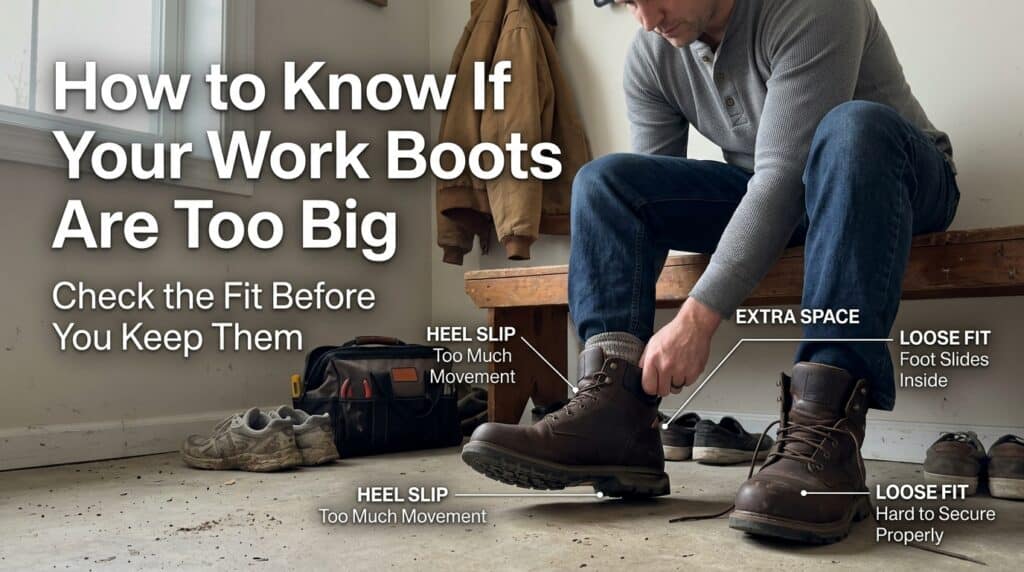
A boot can feel secure standing still in a store and still be wrong once you're moving, sweating, and on your feet for hours. These are the signs that specifically show up under real work conditions rather than a quick try-on:
- The fit changes noticeably between morning and afternoon. If a boot feels fine at clock-in and sloppy by mid-shift, that's not just swelling, a properly sized boot should stay reasonably stable through the day.
- You're compensating with your stride. Curling your toes, gripping with your feet, or noticeably changing how you walk to keep a boot from sliding is a sign your feet are doing extra work they shouldn't have to.
- Sock bunching or wrinkling by end of day. If your socks are visibly rumpled inside the boot after a shift, your foot has been sliding around inside it all day.
- You're lacing tighter than feels natural just to keep the boot on. Over-tightening to compensate for excess volume creates its own pressure points and doesn't actually fix the underlying size problem.
- Fatigue that feels disproportionate to the work. An oversized boot forces stabilizing muscles in your foot and lower leg to work harder all day just to keep your foot in place, which shows up as unusual tiredness or soreness by quitting time.
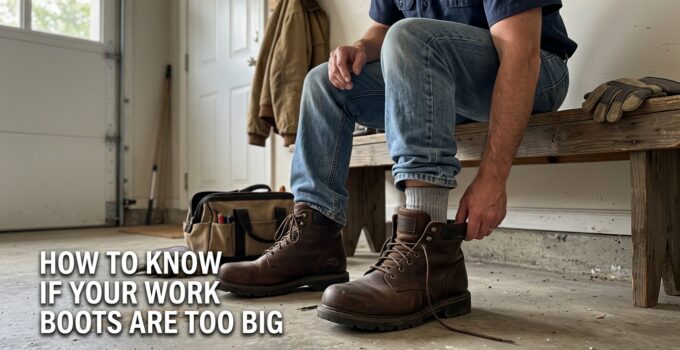
worker checking work boots fit 202608121108
Why "Fine at the Store" Doesn't Mean Fine on the Job
Feet swell measurably over a working day, and boot materials pack down and shift with real wear in a way a five-minute store try-on can't replicate. A boot that felt secure at 8 a.m. can feel loose by mid-afternoon as your foot swells and the insole and midsole compress under repeated pressure, then tighten up again once you're off your feet and the swelling goes down. That's a normal daily cycle, not necessarily a sizing problem on its own, but it's exactly why a store fit test only tells you part of the story.
If you're sizing boots for real shift work, the more reliable test is trying them on and walking around later in the day rather than first thing in the morning, and wearing the actual sock weight you'll work in. That's covered in more depth in our fit guide linked above. What this article is really about is what happens after that, once you've been wearing a pair for weeks or months and something starts to feel off.
The Safety Issue Nobody Talks About: Oversized Safety-Toe Boots
This is the part most sizing advice skips entirely, and it's specific to safety-toe boots. A composite or steel toe cap is built to protect a specific zone at the front of the boot. If your foot has room to shift inside the boot, forward, backward, or side to side, your actual toes may no longer be sitting where that protective cap is positioned. The boot can still meet ASTM F2413 on paper while not actually protecting the foot the way it's supposed to for that specific wearer, because the cap's protection zone and your toes' real position have drifted apart.
This is worth taking seriously without overstating it: it's a genuine fit consideration for anyone in certified safety footwear, not a reason to panic about boots that are only slightly roomy. But if you're noticing your foot sliding forward far enough that your toes reach the front of the boot on a downhill or ladder descent, in a safety-toe boot that's not just a comfort problem. For the full context on what ASTM F2413 actually requires and why, our explainer on why steel toe boots are required on some job sites and not others covers the certification side in more detail.
Break-In vs. Actually Too Big: How to Tell the Difference
Leather work boots, and heritage-construction boots in particular, legitimately loosen and mold to your foot over the first several weeks of wear. That's a real, expected process, not a sign something's wrong. The difference between normal break-in and a boot that's genuinely oversized comes down to pattern and timing:
- Break-in loosens gradually and evenly as the leather and insole conform to your specific foot shape, typically over two to four weeks of regular wear.
- "Too big" shows up immediately and doesn't resolve. If you're getting heel slip, toe slide, or foot movement inside the boot from day one, and it's not improving as the boot breaks in, that's a sizing issue, not a break-in stage.
- Break-in affects width and volume comfort, not length. Leather can stretch to accommodate the width and shape of your foot over time. It will not get meaningfully longer. If your toes were touching or close to the front on day one, that won't change with wear.
What To Do If Your Work Boots Are Too Big
If you're still within a return window, the honest answer is to return them and get the correct size rather than trying to engineer a fix for a full size gap. Padding and inserts can meaningfully help with a half-size gap. They don't reliably solve a full size or more.
If returning isn't an option, a few real fixes for genuine excess volume:
- Heel grips or heel liners for heel slip specifically, these add cushioning and grip right where the slipping happens without changing the rest of the fit.
- Added insoles to take up excess internal volume, particularly useful if the boot is roomy throughout rather than just at the heel.
- Heel-lock lacing (the "surgeon's knot" or runner's loop technique) to lock the heel in place without over-tightening across the rest of the foot, this specifically addresses heel lift without cramming your toes.
- Thicker work socks for a genuinely small gap, roughly a half size worth of extra volume. This is a real fix for minor roominess, not a substitute for the correct size.
Be honest with yourself about the limits here. None of these fixes a boot that's a full size or more too big, and forcing a fix onto a boot that's genuinely the wrong size is exactly how you end up with the safety-toe misalignment problem covered above.
Frequently Asked Questions
Should work boots feel tight when they're new?
Snug, not tight. A small amount of heel movement in a brand-new, stiff boot is normal and often improves as the sole and upper break in. Genuine tightness that causes pinching or numbness is a different problem and isn't something break-in will fix.
How much heel slip is normal when breaking in work boots?
A small amount, commonly described as up to around a quarter inch, is typical in a new, stiff boot before the sole has broken in. Heel lift beyond that, or slip that doesn't improve with wear, points to the boot being too big rather than simply unbroken-in.
Can insoles fix boots that are too big?
They can meaningfully help with a small gap, roughly a half size worth of extra volume, by taking up internal space and improving heel and arch contact. They're not a reliable fix for a full size or more of excess room, and relying on them to force a fit that large increases the risk of the foot still shifting inside the boot under real work conditions.
Is it worse to wear boots too big or too small?
Both cause real problems, but they're different ones. Boots that are too small cause pinching, blisters from friction against a tight upper, and can affect circulation and cause lost toenails on impact (see our companion guide on signs your boots are too small for the full picture). Boots that are too big cause sliding-related blisters, fatigue from constant foot stabilization, and, specifically in safety-toe boots, a genuine protection gap if your toes shift out of alignment with the cap. Neither is something to just tolerate long-term.
Bottom Line
If you're diagnosing boots you already own, look for signs that show up specifically during a real shift, not just a quick try-on: fit that changes noticeably through the day, compensating stride, or sock bunching by quitting time. Know the difference between normal break-in and a genuine sizing problem, and if you're in certified safety-toe boots, take toe alignment inside the boot seriously, it's a protection issue, not just a comfort one. When in doubt and still within a return window, return them. For getting the size right the next time around, our store fit-test guide and the sizing notes in our Rocky and Twisted X guides are good places to start. If you're wearing certified steel-toe footwear day to day, it's also worth reading why rotating two pairs can help keep both fit and material condition more consistent over time.