
This is the single most important question when buying new boots, and it's where most people go wrong. I've seen guys spend $300 on a pair of boots, only to hate them a month later because they got the fit wrong in the store.
The answer is confusing. Some say your toes should touch, others say you need a full inch. The truth is somewhere in the middle, and it's not just about your toes.
As your resident boot expert, I'm here to give you the simple, no-BS guide to getting a perfect fit every single time. Let's start with the golden rule.
The Golden Rule: The 1/2-Inch (Finger Width) Test
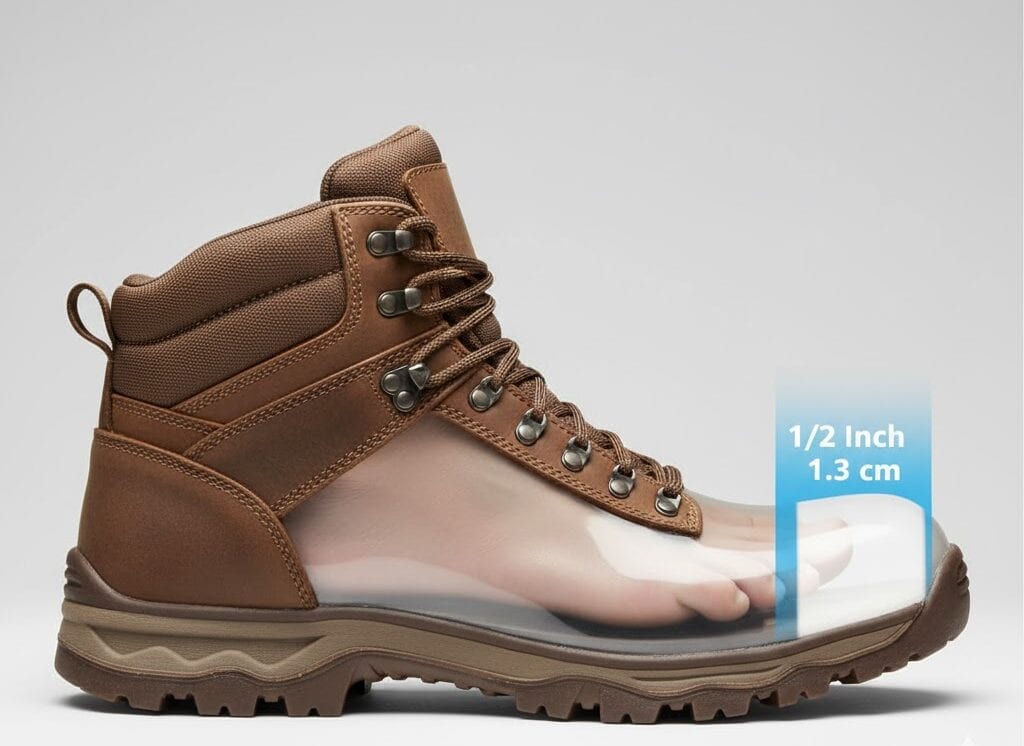
Here is the simple, definitive answer: You should have about 3/8" to 1/2" of space between your longest toe and the end of the boot.
Your toes should never be crammed against the front. That 1/2-inch gap is your "safety zone."
How to Perform the Test:
- Put the boot on, but don't lace it up yet.
- Slide your foot forward until your longest toe *just* grazes the front of the boot's toe box.
- Now, try to stick your index finger down the back of the boot, behind your heel.
- The Perfect Fit: You should be able to *just* wedge your finger in. If it's too tight to get your finger in, the boot is too small. If your finger slides in easily with room to spare, the boot is too big.
Guru Tip: Do this test at the *end* of the day. Your feet swell, and a boot that fits perfectly at 9 AM might be a torture chamber by 5 PM.
Why That 1/2-Inch Gap Is Non-Negotiable
That 1/2-inch isn't "extra room"; it's *essential* room. Your foot naturally slides forward with every step. This gets 100 times worse when you're walking downhill.
I call this the **"Downhill Test."** If your toes are already touching the front, the first time you walk down a steep hill or even a flight of stairs, your toes are going to slam into the front of that rigid toe box. This is how you get bruised, black toenails (a hiker's nightmare) and painful blisters.
That 1/2-inch gap is the "suspension travel" for your foot. You need it.
The Guru's 3-Point Fit Checklist (It's Not Just About the Toes)
Getting the toe space right is just step one. A boot that's the right length can still be a terrible fit. If you want to avoid pain, you need to check these three "hot spots."
1. The "Flex Point" (The Ball of Your Foot)
A boot is designed to bend at its widest point. Your foot is also designed to bend at its widest point (the ball of your foot). **These two points MUST line up.**
When you're trying on the boot, stand up and roll forward onto your toes. The boot should feel like it's bending *with* your foot. If the boot is flexing *on top* of your toes or *way back* in the arch, the sizing is wrong. This is the #1 cause of arch pain and fatigue.
2. The "Heel Slip" Test (Is it Too Big?)
This freaks people out, but it's important. A small amount of heel slip (about 1/4 inch) in a NEW, STIFF boot is normal. In fact, it's a good sign. The new, rigid sole hasn't broken in yet, so it's not flexing with your foot.
When to worry: If your heel is lifting 1/2-inch or more, and your whole foot is sliding around inside the boot even when it's laced up, the boot is too big. This is how you get massive heel blisters. A boot should be snug, not sloppy.
3. The "Toe Wiggle" Test (Width)
Length is one thing; width is another. The toe box should be roomy enough for you to wiggle your toes freely. Your toes should not be "crammed" or overlapping. They need to be able to splay out naturally to support your weight.
Boot Fit FAQ: Myths vs. Facts
Let's bust some common myths right now.
"Should I just buy a half size bigger?"
No. That advice is for running shoes, where you're trying to compensate for massive foot-swell over a 10-mile run. A boot is a support system. Buying it "too big" on purpose is a disaster. Your foot will slide around, your arch will be in the wrong place, and the boot's flex point won't match your foot. You'll get blisters and foot pain. Buy the size that fits, using the tests above.
"Is it better for boots to be tight or loose?"
Neither. This is the "happy medium" you're looking for.
- Too Tight: Leads to blisters, calluses, pinched nerves, and lost toenails.
- Too Loose: Your foot slides, causing friction blisters. You'll also "clench" your toes all day trying to grip the boot, leading to plantar fasciitis and arch pain.
The perfect boot fit is a firm handshake. It should be snug and secure around your midfoot and heel, with plenty of room for your toes to wiggle and splay.
"My leather boots are tight. Will they stretch?"
Yes, but only in width. A full-grain leather boot *will* stretch and mold to the *width* of your foot over time. This is the "break-in" process. However, a boot will NEVER get longer. If your toes are hitting the front, the boot is too small, and it will never get better.