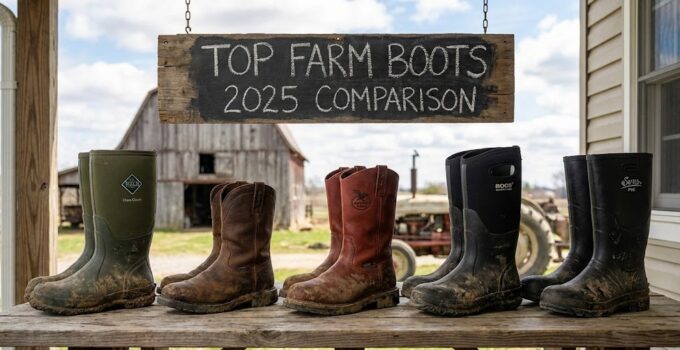

Farm boots take more abuse than almost any other footwear: manure, mud, standing water, feed dust, machinery and long days that start before sunrise. The best farm boots for men keep your feet dry and steady in the barn, hold up to ammonia and slop, and still feel good after 12 hours.
We picked these 9 farm boots by checking each Amazon listing's specs, star rating, number of ratings and bestseller rank, and by reading the patterns in buyer reviews (Amazon, retrieved 2026-09-25). We haven't worked a farm in them ourselves, so there are no invented stories here. Each pick has a clear "buy it if" and "skip it if."
Note on prices: Amazon prices change by size and color, so check the price in your size.
Quick Picks: Best Farm Boots for Men
| Boot | Best for | Type | Amazon rating |
|---|---|---|---|
| MUCK Chore Classic Steel Toe | Best overall barn boot | Rubber and neoprene, steel toe | 4.6 (2,200+) |
| Bogs Classic High | Best for winter chores | Rubber and neoprene, rated -40°F | 4.6 (3,200+) |
| MUCK Chore Cool Tall | Best for summer barns | Rubber and neoprene, breathable lining | 4.6 (7,100+) |
| Servus 14" PVC Steel Toe | Best budget | PVC, steel toe | 4.5 (7,200+) |
| Georgia Boot Georgia Giant Pull-On | Best leather pull-on | Leather Wellington | 4.4 (1,000+) |
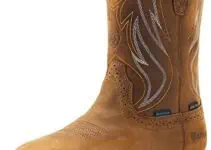
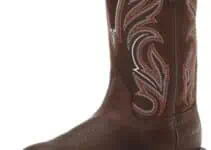
| Ariat Groundbreaker Wide Square Toe | Best western style | Leather pull-on, steel toe | 4.4 (990+) |
| Irish Setter Marshall 11" Steel Toe | Best for equipment and welding | Leather pull-on, steel toe, HRO sole | 4.6 (3,000+) |
| Irish Setter Ashby 6" Aluminum Toe | Best lightweight lace-up | Leather moc toe, aluminum toe | 4.4 (4,900+) |
| Timberland PRO Boondock 6" Composite Toe | Best heavy-duty lace-up | Waterproof leather, composite toe | 4.5 (10,100+) |
Ratings from Amazon, retrieved 2026-09-25.
Rubber or Leather? The First Decision
- Rubber and neoprene boots (MUCK, Bogs, Servus) are 100% waterproof and hose clean. Manure and ammonia don't soak in. They're the best choice for dairy barns, hog and poultry houses, and wet pens.
- Leather boots (Georgia, Ariat, Irish Setter, Timberland PRO) give better support for walking fields, climbing on equipment and working on uneven ground. They need cleaning and conditioning, because manure breaks down leather over time.
Many farmers own one of each.
Best Rubber Farm Boots
1. MUCK Chore Classic Steel Toe - Best Overall Barn Boot
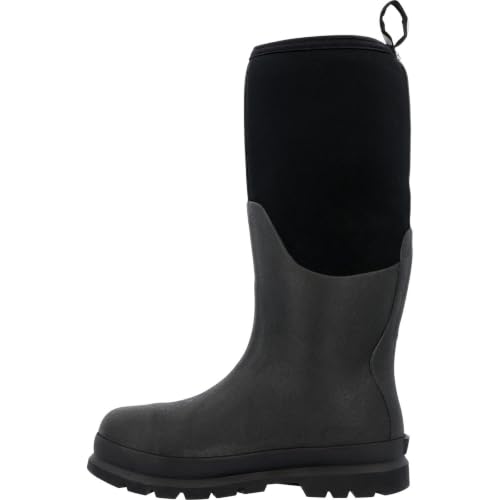
The Chore Classic is a pull-on rubber and neoprene boot with a steel toe, a stretchy upper shaft, a breathable mesh lining and quadruple rubber heel reinforcement. It has 4.6 stars from more than 2,200 ratings and lists at about $155.
Buyers call it excellent for work, especially in winter, and say it keeps feet dry and warm and feels like a slipper. Durability and waterproofing get some mixed reports over time.
Buy it if: you work in barns, pens and wet yards and want toe protection around livestock and equipment.
Skip it if: you walk miles of fields each day. Tall rubber boots are tiring over distance.
Check the MUCK Chore Classic price on Amazon
2. Bogs Classic High - Best for Winter Chores
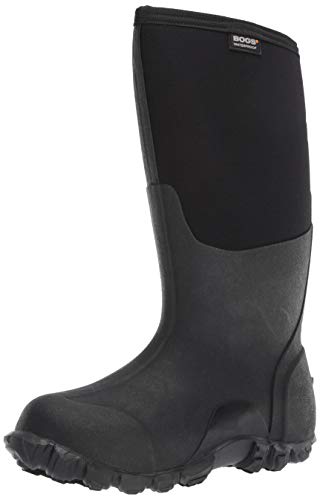
The Bogs Classic High has a 100% waterproof rubber upper, a shaft of about 13 inches and a comfort rating to -40°F. It has 4.6 stars from more than 3,200 ratings.
Buyers say it's excellent for cold-weather chores around farms and hunting leases, keeps feet dry in mud puddles, has a cushioned footbed and grips well in snow and slop.
Buy it if: you do winter feeding, calving and chores in snow and frozen mud.
Skip it if: you need a safety toe. This model is soft toe.
Check the Bogs Classic High price on Amazon
3. MUCK Chore Cool Tall - Best for Summer Barns
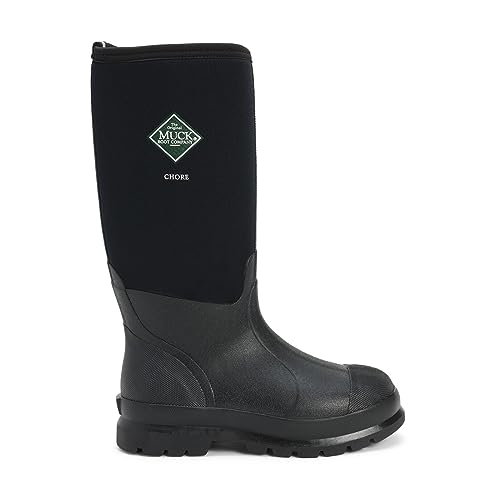
The Chore Cool is MUCK's tall barn boot with a breathable mesh lining that wicks away humidity, which makes it better for warm weather than the insulated models. It has 4.6 stars from more than 7,100 ratings.
Buyers find it versatile for farm and outdoor work and say it keeps feet dry all day.
Buy it if: you want a rubber barn boot you can wear through spring, summer and fall.
Skip it if: you need a steel toe. Choose the Chore Classic Steel Toe instead.
Check the MUCK Chore Cool price on Amazon
4. Servus 14" PVC Steel Toe - Best Budget
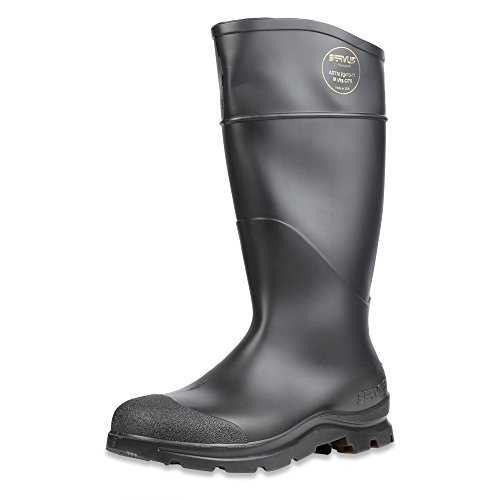
The Servus is a 14-inch seamless PVC boot with a steel toe, a cushioned contour insole, a scalloped top line for easy flexing and a deep-cleated outsole. It has 4.5 stars from more than 7,200 ratings and often costs under $40.
Buyers say it lasts up to three years, keeps feet dry through wet shifts, slips on easily with jeans and works well in mud.
Buy it if: you want a cheap, fully waterproof steel toe boot for wash-down, dairy and muddy work.
Skip it if: you need warmth. PVC boots are uninsulated.
Check the Servus price on Amazon
Best Leather Farm Boots
5. Georgia Boot Georgia Giant Pull-On - Best Leather Pull-On
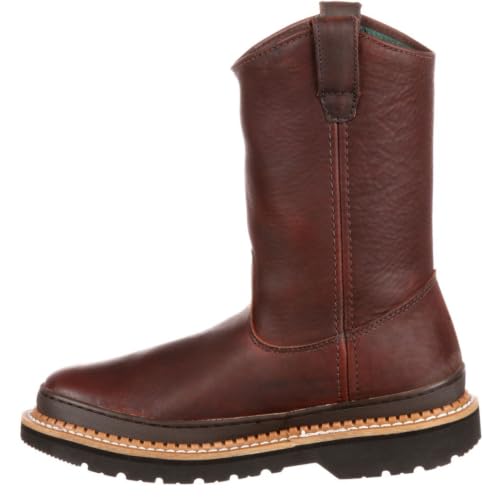
The Georgia Giant is an 11-inch leather Wellington with a padded collar and a 3/4 heel. It has 4.4 stars from more than 1,000 ratings and lists at about $164.
Buyers say it's comfortable and durable, with some reporting four years of daily wear, and like the look. Fit and construction get mixed feedback.
Buy it if: you want a classic pull-on leather work boot for mixed farm and ranch work.
Skip it if: you stand in water or manure all day. Choose rubber for that.
Check the Georgia Giant price on Amazon
6. Ariat Groundbreaker Wide Square Toe Steel Toe - Best Western Style

The Groundbreaker is a full-grain leather pull-on with a wide square steel toe and pull tabs. It has 4.4 stars from more than 990 ratings and lists at about $175.
Buyers call it good quality, comfortable and good value, and one says it works well around oil and grease.
Buy it if: you want a western-style ranch boot with a roomy square safety toe.
Skip it if: you need waterproofing for wet ground.
Check the Ariat Groundbreaker price on Amazon
7. Irish Setter Marshall 11" Steel Toe - Best for Equipment and Welding

The Marshall is an 11-inch pull-on with a steel toe and a heat-resistant (HRO) rubber outsole that the listing says meets ASTM F2413-18 M/I/C EH. It has 4.6 stars from more than 3,000 ratings and lists at about $220.
Buyers say it's comfortable and durable, stays dry in snow and rain, and is worth the price.
Buy it if: you weld, fix equipment or work around hot surfaces and machinery.
Skip it if: you want a light boot for walking fields.
Check the Irish Setter Marshall price on Amazon
8. Irish Setter Ashby 6" Aluminum Toe - Best Lightweight Lace-Up
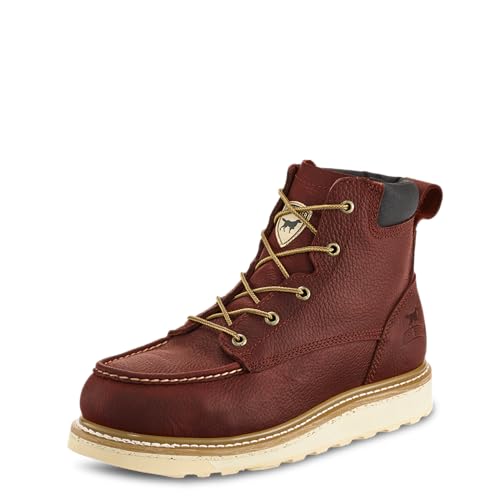
The Ashby is a 6-inch moc toe work boot with an aluminum safety toe. It has 4.4 stars from more than 4,900 ratings and lists at about $180.
Buyers say it's comfortable like a house slipper, like the moc toe look, and find it light because of the aluminum toe. Fit and durability get mixed reviews.
Buy it if: you want a light safety toe for walking fields, driving and shop work.
Skip it if: you work in deep mud. A 6-inch boot lets it in.
Check the Irish Setter Ashby price on Amazon
9. Timberland PRO Boondock 6" Composite Toe Waterproof - Best Heavy-Duty Lace-Up
More detail: our full Timberland PRO Boondock review.
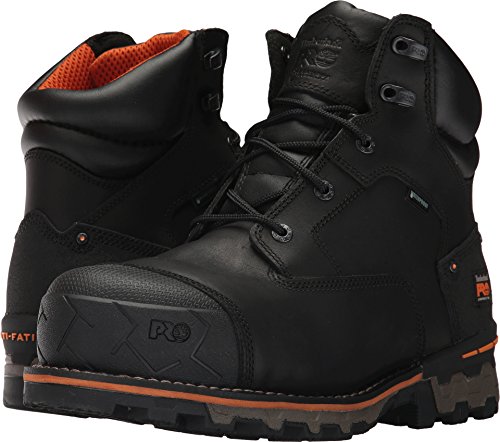
The Boondock is a waterproof leather work boot with a composite safety toe. It has 4.5 stars from more than 10,100 ratings.
Buyers say it's well built and comfortable, with no sore feet, and that it still looks new after long use.
Buy it if: you want a tough, waterproof lace-up for fencing, fieldwork and equipment.
Skip it if: you want a pull-on for quick on and off.
Check the Timberland PRO Boondock price on Amazon
How to Choose Farm Boots
Pull-on or lace-up?
Pull-ons are fast to get on and off between the house, truck and barn, and have no laces to catch on machinery. Lace-ups give a snugger fit and better ankle support on rough ground.
Safety toe
Around cattle, horses and heavy equipment, a safety toe can save your toes. Steel is cheapest, while composite and aluminum are lighter. See steel toe vs composite toe.
Shaft height
6 inches suits dry fields and shop work. 11 to 16 inches keeps out mud, manure and snow.
Outsole
Deep, self-cleaning lugs shed mud. Heat-resistant (HRO) soles suit welding and hot surfaces. Wedge soles are comfortable on concrete but slip on mud.
How to Make Farm Boots Last
- Hose off manure daily. Ammonia breaks down leather and stitching.
- Condition leather boots regularly. See wax vs spray.
- Dry boots slowly, away from direct heat.
- Store off-season boots clean and dry. Our boot storage guide explains how.
Frequently Asked Questions
What boots do farmers wear?
Most farmers own rubber boots like MUCK or Bogs for barns and wet work, plus leather pull-ons or lace-ups for fields, equipment and town.
What are the best boots for a dairy barn?
Waterproof rubber boots that hose clean, like the MUCK Chore Classic or Servus PVC boot. Leather absorbs manure and ammonia and breaks down fast.
Are MUCK boots good for farm work?
Yes. The Chore line was built for farm work, and both picks here have 4.6 stars from thousands of ratings.
What are the best winter farm boots?
The Bogs Classic High is rated to -40°F. For more, see our best winter work boots.
The Bottom Line
- Best overall barn boot: MUCK Chore Classic Steel Toe.
- Winter chores: Bogs Classic High.
- On a budget: Servus 14" PVC Steel Toe.
- Leather pull-on: Georgia Giant.
- Equipment and welding: Irish Setter Marshall 11".
See also our work boots for dairy and livestock farmers and boots for muddy fields.