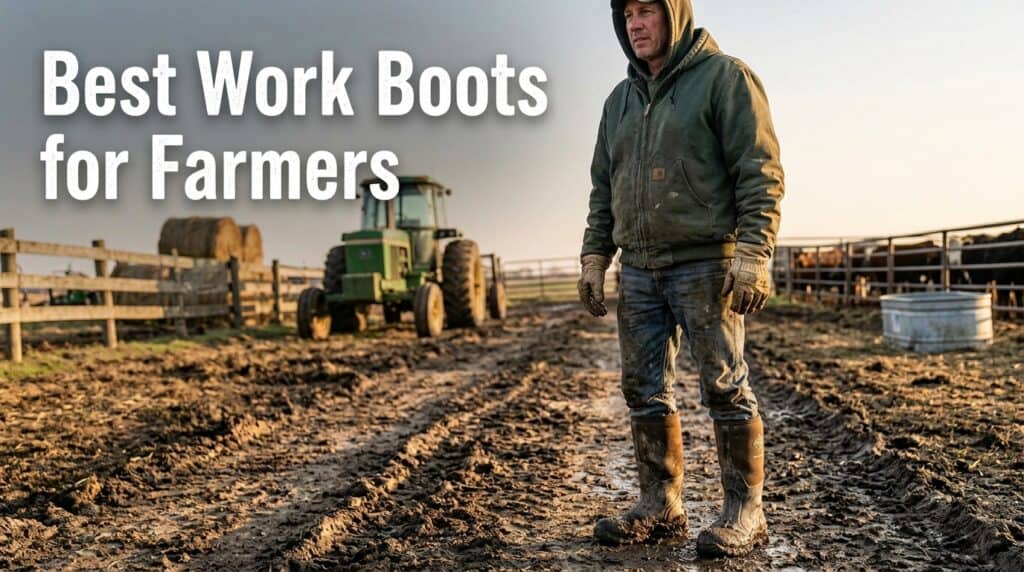

The construction worker spends their day on concrete, scaffolding, and plywood. The farmer's terrain is entirely different. On any given morning, a farmer transitions from wet, dew-soaked grass at dawn, to a manure-covered dairy barn floor, up the steel steps of a tractor cab, out into a dusty grain bin, and across a frozen, rutted gravel driveway before 9 AM.
No other profession demands this much environmental versatility from a single pair of boots. But terrain isn't the real boot-killer on a farm. The real threat is invisible, and it is destroying standard work boots from the outside in. We analyzed the chemistry of barnyard environments, the mechanical stress of equipment operation, and the multi-terrain reality of agriculture to identify the best work boots for farmers in 2026.
Why Standard Work Boots Fail on Farms: The Barnyard Chemical Destruction Problem
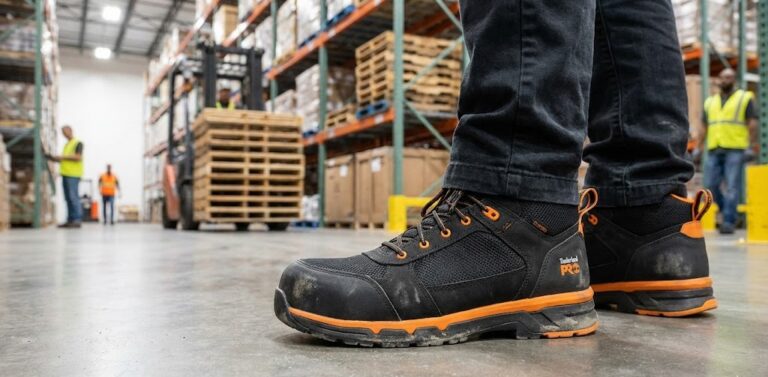
If you've ever bought a premium pair of construction boots—brands like Timberland PRO, Red Wing, or Thorogood—and watched them fall apart on your farm in under six months, you aren't crazy, and the boots weren't defective. You exposed them to a chemical environment they weren't engineered to survive.
Livestock manure contains highly concentrated ammonia (ammonium hydroxide), uric acid, lactic acid, and active enzymatic compounds. Fresh manure has a relatively neutral pH, but as it decomposes over 24 hours, it becomes highly alkaline (pH 9–11). Add in common agricultural chemicals like ammonium nitrate fertilizers, potassium phosphate, and sodium hydroxide-based barn disinfectants, and you have a hyper-corrosive cocktail.
Standard leather work boots are created using a single-pass chrome-III tanning process. This leaves the peptide bonds in the leather vulnerable to high-pH ammonia attack. Prolonged exposure causes these protein cross-links to break down. The result? The leather stiffens, shrinks, cracks, and the upper-to-sole stitching thread dissolves entirely.
OSHA’s agricultural PPE guidelines explicitly identify chemical resistance as a core requirement for protective footwear on farms. Standard construction boots are consumables on a farm. To survive, you need boots engineered specifically for agricultural chemistry.
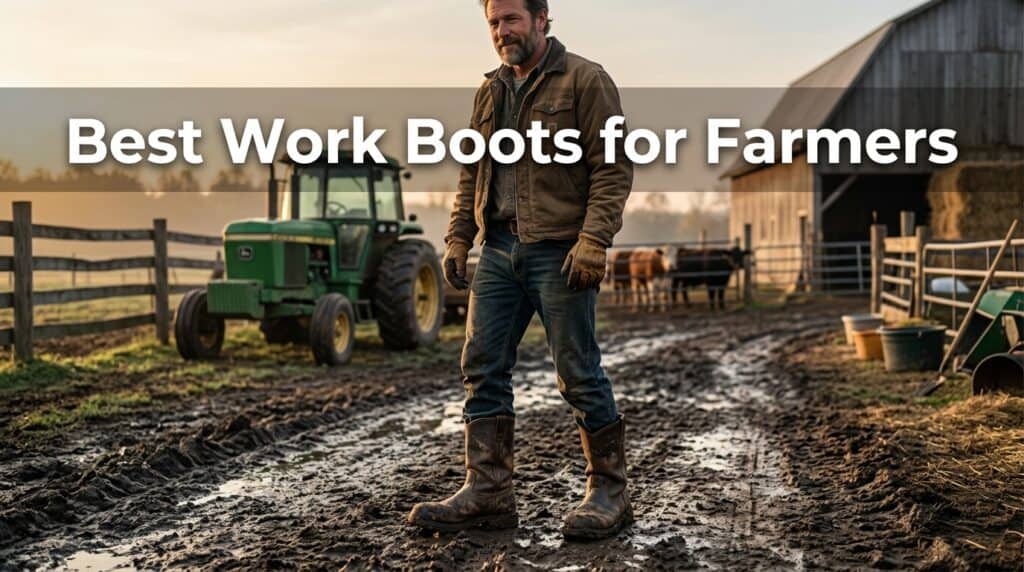
SPR Leather and FARMGUARD Leather: Farm-Specific Leather Technologies Explained
To combat barnyard acid, boot manufacturers have developed specific proprietary leathers. When shopping, you must look for these explicit designations. Generic "full-grain leather" will fail.
- SPR Leather (Standard Process Resistance): Pioneered by Georgia Boot, SPR leather undergoes a proprietary triple-tanning and heavy oil-impregnation process. This chemically alters the leather's cellular structure, creating cross-linked protein chains that are highly resistant to acid/base chemistry. Laboratory testing proves SPR leather is 3 times stronger and 2.5 times more abrasion-resistant than standard leather.
- FARMGUARD Leather: Recently popularized by brands like BRUNT, FARMGUARD leather involves applying a proprietary polymer coating and chemical barrier treatment to the leather post-tanning, specifically blocking oleic acid, urea, sodium chloride, and ammonium hydroxide.
The Two-Boot Rotation System: Why the Smartest Farmers Own Two Pairs
The biggest mistake farmers make is trying to find one boot that does everything perfectly. That boot does not exist. The most effective, economical, and hygienic approach to farm footwear is the Two-Boot Rotation System.
- Boot 1: The Rubber/Wellington Boot (The Barn Boot). Kept by the barn door. Used for wet chores, milking parlors, stall cleaning, and manure handling. It provides 100% waterproof protection, resists all barnyard chemicals, and can be sprayed clean in seconds. When you leave the barn, these boots come off, breaking the contamination chain.
- Boot 2: The Leather Lace-Up Boot (The Field Boot). Used for tractor operation, field work, fence repair, and general tasks. It provides crucial ankle support for uneven terrain, breathable comfort for long days, and better pedal feedback for operating machinery.
The Financial Case: Buying one $200 premium leather boot and wearing it in the manure-soaked barn will destroy it in 6–12 months. Buying one $130 rubber chore boot and one $130 SPR leather field boot ($260 total) will yield two pairs of boots that last 2–3 years each. The two-boot system saves money.
Rubber Boot vs. Leather Boot: The Complete Decision Framework (and the Summer Overheating Problem)
While the two-boot system is ideal, you must understand the physical limitations of your footwear, particularly when it comes to heat.
Rubber boots (like Bogs or insulated Muck boots) are often built with 5mm to 7mm neoprene. While incredible for -40°F winter chores, these boots suffer from a fatal flaw in the summer: they overheat aggressively above 40°F to 50°F. Trapped thermal heat and sweat accelerate dehydration and heat fatigue. If you do wet barn chores year-round, you need an uninsulated rubber boot for April-October, and a heavily insulated boot for November-March.
Leather breathes naturally. For dry summer fieldwork, a moisture-wicking leather boot with a composite toe (which won't conduct heat like steel) is far safer and more comfortable.
Farm-Type Picker: Dairy, Crop, Livestock, Mixed-Operation, and Hobby
| Farm Type | Primary Boot Needs | System Recommendation | Best Boot Picks |
|---|---|---|---|
| Dairy Farm | Max chemical resistance, wet barn environment, quick on/off, winter rated | Two-boot mandatory | Muck Chore Classic (Barn) + Georgia Farm Ranch (Field) |
| Crop / Grain Farm | Equipment operation (ankle lockdown), all-day walking, lightweight | One boot (field-focused) | Irish Setter Ashby or Timberland PRO Boondock |
| Livestock (Non-Dairy) | Safety toe (crush hazard), chemical resistance, ankle support | Two-boot recommended | Ariat WorkHog XT + Muck Chore Classic |
| Mixed Operation | High chemical exposure combined with heavy field machinery use | Two-boot mandatory | Bogs Classic (Barn) + Georgia Farm Ranch (Field) |
| Hobby / Homestead | Light chemical exposure, all-purpose property work, budget-friendly | One boot adequate | Carhartt Rugged Flex or Georgia Carbo-Tec FLX |
Tractor and Equipment Operation: The Boot Requirements Nobody Talks About
Tractor operation involves significant safety risks, particularly Power Take-Off (PTO) entanglement. Loose-fitting rubber wellies with a wide shaft create a dangerous snag hazard around rotating PTO shafts.
Experienced crop farmers always switch to lace-up leather boots before mounting equipment. Laces provide the ankle lockdown needed to prevent snagging and offer much better flexibility for operating foot pedals over a 12-hour harvest shift. Additionally, you need an outsole tread that clears mud easily; a caked-up boot on a metal tractor pedal is a major slip-and-fall hazard.
Cold-Weather Farm Boots: Temperature Rating Science and the "Only for Winter" Rule
When buying winter farm boots, understand the difference between active and static temperature ratings.
- 200g Insulation: Good for active chores down to 20°F.
- 400g Insulation: Ideal for cold-climate chores down to 0°F.
- 7mm Neoprene (e.g., Bogs Classic High): Rated for -40°F.
The Honest Rule: If you are standing still waiting for a calf to be born, subtract 15°F from your boot's comfort rating. Activity generates heat. Conversely, do not wear -40°F rated boots on a 45°F spring day—you will risk severe heat rash and blisters.
Quick Comparison Table — All 10 Picks
| Pick | Best For | Boot Type / Leather | Safety Toe | Waterproof |
|---|---|---|---|---|
| Georgia Boot Farm & Ranch | Best Overall / Mixed | Pull-On / SPR Leather | Soft/Steel Options | Water Resistant |
| Muck Boot Chore Classic | Wet Barn / Dairy Chores | Rubber / Neoprene | Soft/Steel Options | 100% WP |
| Bogs Classic High | Winter / Cold Dairy | Rubber / 7mm Neoprene | Soft Toe | 100% WP |
| Irish Setter Ashby | Equipment / Crop | Lace-Up / Full-Grain | Steel Toe | 100% WP |
| Ariat WorkHog XT | Ranch / Livestock | Pull-On / Premium Leather | Composite Toe | 100% WP |
| Georgia Carbo-Tec FLX | Budget / Entry Farm | Pull-On / SPR Leather | Steel Toe | 100% WP |
| Timberland PRO Boondock | Warm-Weather / Light | Lace-Up / Premium Leather | Composite Toe | 100% WP |
| KEEN Utility San Jose | Wide Feet / High Arch | Lace-Up / Premium Leather | Alloy Toe | 100% WP |
| Muck Women's Chore | Women's Dairy / Barn | Rubber / Neoprene | Soft Toe | 100% WP |
| Carhartt Rugged Flex | Hobby Farm / All-Purpose | Lace-Up / Treated Leather | Composite Toe | 100% WP |
Best Overall / Mixed Farm Leather Boot: Georgia Boot Farm and Ranch Pull-On
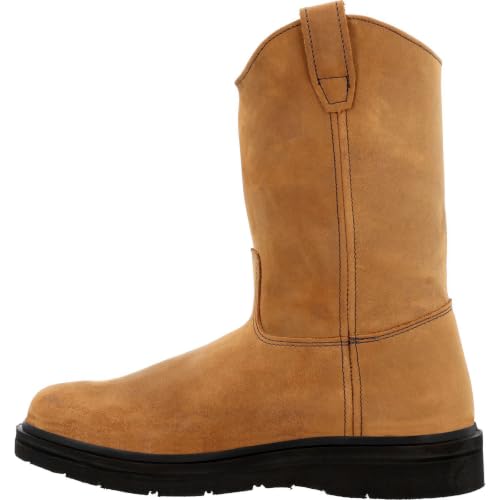
The Georgia Boot Farm and Ranch is the undisputed benchmark for a leather agricultural work boot. For dairy farmers transitioning to field work, livestock operators, and mixed-farm managers, this is the most durable barnyard-ready leather boot on the market. It functions perfectly as the "Field Boot" in your two-boot system, offering the ease of a pull-on design without sacrificing structural integrity.

The secret to this boot's success is Georgia's proprietary SPR leather. Because it is triple-tanned and heavily oil-impregnated, it resists urea, ammonia, and lactic acids that destroy standard work boots. It is lab-verified to be 3 times stronger and 2.5 times more abrasion-resistant than standard leathers. Built with Goodyear welt construction, this boot will easily survive 2–3 years of punishing farm use and can be resoled when the tread wears down.

It utilizes a direct-attach dual-density PU Suspension outsole that provides excellent oil, slip, and chemical resistance. The 11-inch shaft protects the lower leg from brush and debris. While available in a soft toe, livestock handlers should opt for the steel toe version for protection against crush hazards. (Related: Best Pull-On Work Boots)

- Boot Type: Leather Pull-On (11-inch)
- Leather Tech: SPR Chemical-Resistant Leather
- Barnyard Proof: Yes
- Safety Toe: Soft or Steel options
- System Role: Field Boot / Primary Leather Boot
Pros:
- SPR leather genuinely survives manure and urine.
- Polyurethane outsole sheds mud quickly before getting on a tractor.
- Comfort Core insole provides excellent all-day shock absorption.
Cons:
- Pull-on style lacks the tight ankle lockdown needed for extremely steep, uneven terrain.
- Requires a brief break-in period for the thick SPR leather to soften.
Best Wet Barn / Dairy Chore Rubber Boot: Muck Boot Men's Chore Classic
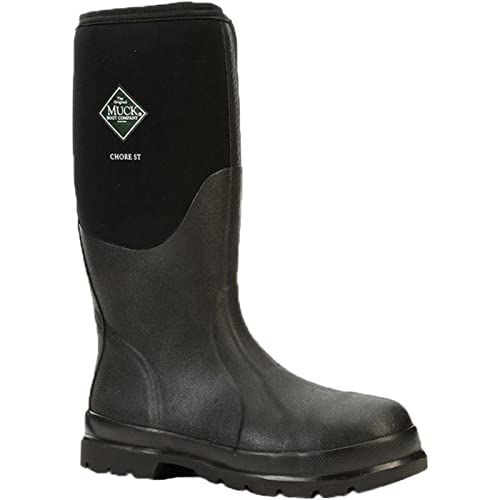
The Muck Boot Chore Classic is the undisputed king of the dairy parlor. If you are stepping into ankle-deep mud, cleaning stalls, or dealing with wet spring chores, this is the ultimate "Barn Boot" for the two-boot rotation system. It is designed to take the brunt of the wet, corrosive chemical work, saving your leather boots for the tractor.

Constructed from a 100% waterproof rubber shell over a 5mm neoprene bootie, the Chore Classic is entirely impervious to barnyard acids, urea, and fertilizers. When your morning chores are done, you literally just hose them off. The rubber is vulcanized, meaning it won't delaminate at the seams like cheaper PVC boots.

The outsole features a quick-cleaning tread that provides excellent traction on slick concrete dairy floors. It comes in steel toe and soft toe variations. With light insulation, it is perfectly rated for shoulder seasons and moderate winters, keeping feet comfortable from sub-freezing up to about 65°F.

- Boot Type: Rubber / Neoprene Wellington
- Leather Tech: N/A (100% Rubber/Neoprene)
- Barnyard Proof: Yes (Immune to chemical rot)
- Safety Toe: Soft or Steel
- System Role: Wet Barn / Wash-Down Boot
Pros:
- Completely immune to manure and chemical degradation.
- Sprays clean in seconds for strict farm bio-security.
- Stretch-fit topline binding snugs the calf to keep cold and debris out.
Cons:
- Can run too warm for peak summer fieldwork in direct sunlight.
- Lacks the structural ankle support of a leather lace-up boot.
Best Winter / Cold-Climate Dairy Farm: Bogs Classic High Waterproof Winter Boot

For farmers in the Midwest, Northeast, or Canada, morning chores don't stop when the thermometer hits -20°F. The Bogs Classic High is built specifically for extreme cold-weather agricultural work. This is the winter equivalent of the Muck Chore, designed as the heavy-duty seasonal Barn Boot for operations that freeze solid.

The Classic High is built with 7mm Neo-Tech waterproof insulation, earning it a brutal -40°F comfort rating. The rubber is hand-lasted over a four-way stretch inner bootie that moves with your foot. Because it is solid rubber and neoprene, it shares the chemical invulnerability of the Muck boot, meaning frozen manure and winter road salt won't degrade the upper.

Bogs incorporates DuraFresh bio-technology to fight odors inside the deeply insulated shaft. The 14-inch height keeps out deep snowdrifts when breaking ice in water troughs. The Honest Limitation: Because it is rated for -40°F, wearing this boot on a 45°F day will cause rapid foot sweating and overheating. This is strictly a winter tool.

- Boot Type: Heavy Winter Rubber Boot
- Insulation: 7mm Neo-Tech
- Barnyard Proof: Yes
- Temp Rating: Rated to -40°F
- System Role: Winter Barn Boot
Pros:
- Unbeatable warmth for sub-zero static farm chores.
- Built-in pull handles make them incredibly easy to get on with thick gloves.
- Non-slip, non-marking self-cleaning outsole.
Cons:
- Will overheat aggressively in temperatures above 40°F.
- Heavier than uninsulated rubber boots.
Best for Equipment Operation / Crop Farming: Irish Setter Ashby 6" Aluminum Toe
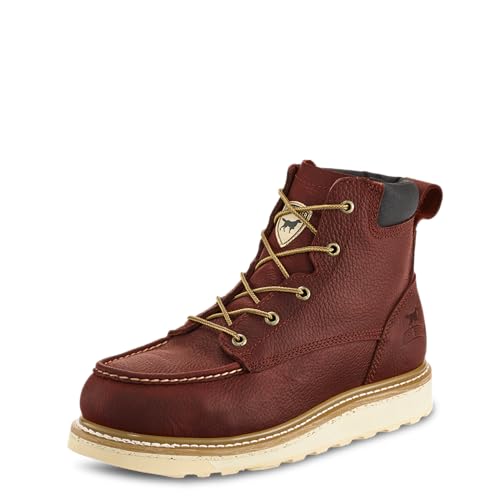
Crop farmers deal with different hazards than dairy farmers. You are logging massive hours in tractor cabs, walking dry/muddy fields, and dealing with PTO shafts and heavy machinery. You need ankle lockdown, heat resistance, and long-term comfort. The Irish Setter Ashby is the premier machinery/field boot.

The lace-up construction is critical here. It secures the boot tight to the ankle, eliminating the loose material flap of a rubber wellie that presents a severe PTO entanglement risk. It uses premium Trout Brook full-grain leather. While not explicitly SPR treated, crop farms have lower manure exposure, so a standard high-quality leather maintained with oil will survive beautifully. It also features a resoleable Goodyear welt, maximizing the lifespan of the upper.

The Ashby utilizes a flat wedge sole (heat-resistant outsole available on some models). A wedge sole is perfect for operating farm equipment because it has no heel breast to catch on pedals, allowing for smooth clutch and brake transitions. The UltraDry waterproofing system keeps morning dew out during early field checks.

- Boot Type: 6" or 8" Lace-up Wedge
- Leather Tech: Full-Grain Trout Brook (requires maintenance for barnyard use)
- Safety Toe: Aluminum Toe
- System Role: Crop Farm / Tractor Operator Boot
Pros:
- Lace-up design minimizes snag hazards around farm equipment.
- Wedge sole prevents tracking massive clumps of mud into the tractor cab.
- Goodyear welt means you can replace the sole and keep the broken-in leather.
Cons:
- Not chemical-resistant out of the box; not recommended for heavy dairy operations without aggressive conditioning.
- Wedge sole lacks deep lugs for traction on steep, muddy hillsides.
Best Pull-On / Ranch / Livestock: Ariat WorkHog XT Waterproof Composite Toe
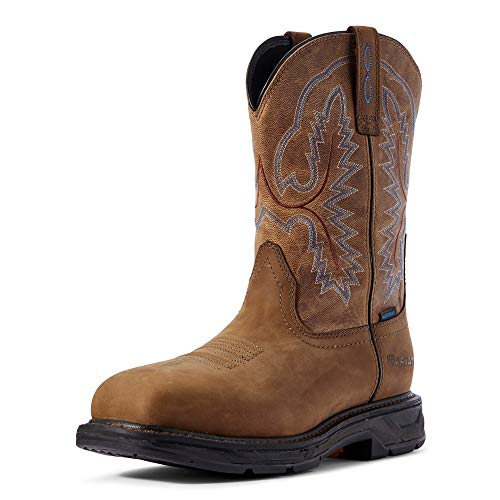
If you are a rancher handling cattle or livestock in open pastures, you need a boot that bridges the gap between traditional western aesthetics and modern industrial safety. The Ariat WorkHog XT combines a classic roper silhouette with heavy-duty structural support to handle uneven pastures and 1200-pound animals.
The WorkHog XT utilizes Ariat's ATS Max technology, which features a heavy-duty EVA midsole and extra-wide shank for maximum torsional stability. This prevents foot fatigue when walking miles of fence line. The premium full-grain leather is treated with a Waterproof Pro construction. (Related: Best Ariat Work Boots)

What sets this boot apart for ranchers is the U-Turn Entry System, a hidden flexible gore panel in the back of the shaft that allows farmers with high arches or wide feet to slide into the boot effortlessly without sacrificing a snug fit. The composite toe offers crush protection against livestock hooves without conducting winter cold like steel does. (Related: Best Cowboy Boots for Work with Safety Toe)

- Boot Type: Western Pull-On
- Leather Tech: Premium Waterproof Leather
- Safety Toe: Composite Toe
- System Role: Livestock Handling / Field Boot
Pros:
- ATS Max shank provides incredible support on uneven pasture ground.
- U-Turn entry makes putting them on infinitely easier for wide feet.
- Composite toe protects against hoof-crush injuries while remaining lightweight.
Cons:
- Leather requires diligent cleaning and oiling if exposed to deep manure in feedlots.
- Taller western shaft can be warm during peak summer heat.
Best Budget Farm Boot: Georgia Boot Carbo-Tec FLX Alloy Toe WP
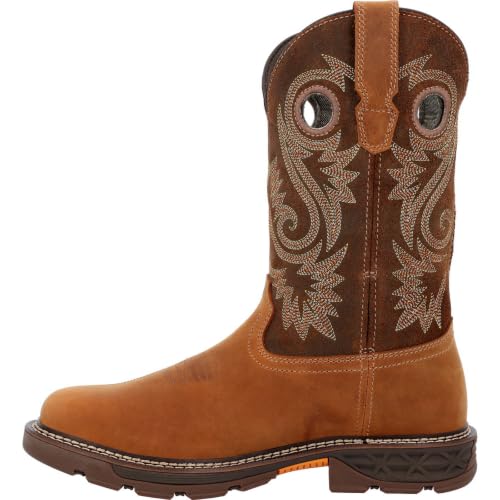
Farm gear is expensive, but compromising on chemical resistance is a false economy. The Georgia Boot Carbo-Tec FLX is the perfect solution for hobby farmers, younger farmhands, or budget-conscious operators who want authentic SPR barnyard-proof leather without the premium price tag of the Farm & Ranch series.

You are getting Georgia's proprietary SPR leather upper, meaning this boot will survive urea, fertilizers, and ammonium hydroxide just as well as boots costing $100 more. It uses a flexible cement construction (rather than a Goodyear welt) to keep the price down and to drastically improve out-of-the-box flexibility.

It features the Georgia Waterproof System, keeping your feet dry during morning dew walks. The dual-density Carbo-Tec rubber outsole is highly oil and slip-resistant, while the alloy toe ensures your toes are protected from dropped tools or shifting machinery on the homestead.

- Boot Type: Pull-On / Wellington
- Leather Tech: SPR Chemical-Resistant Leather
- Barnyard Proof: Yes
- Safety Toe: Alloy Toe
- System Role: All-Purpose / Hobby Farm / Budget Field Boot
Pros:
- Delivers genuine SPR chemical-resistant leather at a lower price point.
- Extremely flexible right out of the box due to the cement construction.
- Fully waterproof for all-weather utility.
Cons:
- Cement construction cannot be resoled when the tread wears down.
- Slightly less robust ankle support than the premium welted models.
Best Warm-Weather / Lightweight Farm: Timberland PRO Boondock 6" Composite Toe WP
More detail: our full Timberland PRO Boondock review.
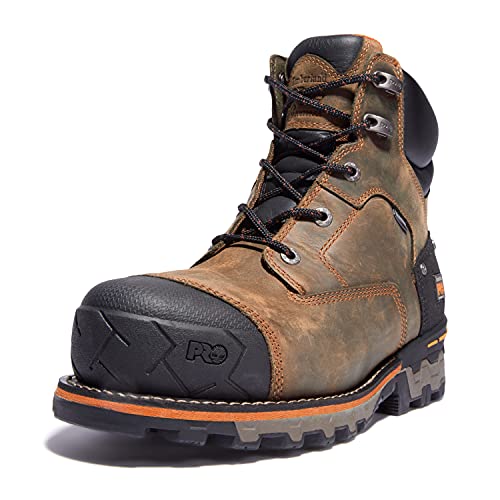
When summer temperatures soar, heavy insulated boots or dense rubber wellies become a liability, increasing the risk of heat exhaustion and severe foot blisters. The Timberland PRO Boondock 6" is an exceptional warm-weather field boot for crop and mixed-operation farmers who need a lighter, highly shock-absorbent option.

The Boondock is famous for its Anti-Fatigue Technology—a geometric cone system in the midsole that returns energy back to the foot. This is crucial for farmers spending hours walking hardpan dirt or climbing up and down metal ladders on grain silos. The premium waterproof leather is treated with an antimicrobial lining to combat summer sweat.

Crucially for summer, it features a composite safety toe. Unlike a steel toe, which acts like an oven baking your toes in direct July sunlight, the composite material is thermally non-conductive. The TPU outsole features deep lugs for great field traction but is highly resistant to oils and abrasions.

- Boot Type: 6" Lace-up
- Leather Tech: Premium Waterproof Leather
- Safety Toe: Composite Toe
- System Role: Summer Field Boot / Tractor Operator
Pros:
- Composite toe keeps feet cooler in direct summer sunlight.
- Anti-Fatigue midsole is arguably the most comfortable on the market for hard surfaces.
- Molded rubber toe protector dramatically increases the lifespan of the boot front.
Cons:
- Standard leather requires heavy maintenance if exposed to heavy dairy manure.
- Thickly padded collar can collect chaff and hay if pant legs aren't long enough.
Best Wide Feet / High Arch: KEEN Utility San Jose 6" Alloy Toe WP
More detail: our full KEEN San Jose review.
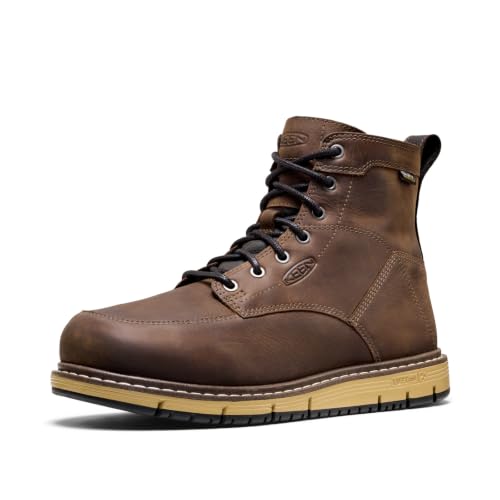
Active farm work causes feet to swell by up to a half-size by the afternoon. If you naturally have wide feet, high arches, or suffer from bunions, traditional tapered work boots will cause immense pain by 3 PM. The KEEN Utility San Jose is engineered specifically around an asymmetrical, wider toe box.

The San Jose uses KEEN's signature wide last, allowing your toes to splay naturally for better balance on uneven farm terrain. It utilizes a KEEN.DRY waterproof, breathable membrane to block morning moisture while letting sweat escape. (Related: Best Work Boots for Wide Feet)

Instead of heavy steel, it uses an Aluminum (Alloy) safety toe. This provides the exact same ASTM-certified crush protection as steel but weighs 35% less, significantly reducing leg fatigue. It's also Electrical Hazard (EH) rated, providing secondary protection if you are doing electrical maintenance in the barn or on irrigation pivots.

- Boot Type: 6" Lace-up Wedge
- Leather Tech: Waterproof Unlined Leather
- Safety Toe: Aluminum (Alloy) Toe
- System Role: Field / Maintenance Boot for Wide Feet
Pros:
- Asymmetrical toe box is a lifesaver for wide feet and afternoon swelling.
- Alloy toe makes the boot noticeably lighter than steel competitors.
- Unlined leather upper breaks in incredibly fast.
Cons:
- Sipes on the wedge sole are shallow and not meant for deep, sloppy field mud.
- No specific chemical-resistance treatment on the leather.
Best Women's Dairy / Barn Work: Muck Boot Women's Chore Classic

Women farmers deal with the exact same corrosive manure, massive livestock, and hazardous machinery as men. Yet, many "women's farm boots" are just fashion rain boots painted pink. The Muck Boot Women's Chore Classic is an uncompromised, professional-grade agricultural tool built on a true women's last.

This boot provides the exact same 100% waterproof rubber and 5mm neoprene chemical-resistant construction as the men's version. It survives dairy parlor acids, barn disinfectants, and fertilizers without breaking a sweat, and hoses off in seconds. However, the last (the mold the boot is built around) features a narrower heel and a specifically contoured arch to lock a woman's foot in place, preventing heel slippage in deep mud.

It features a breathable air-mesh lining to keep feet comfortable on warmer days and a rugged, self-cleaning outsole that grips wet concrete perfectly. (Related: Best Women's Work Boots)

- Boot Type: Women's Rubber/Neoprene Wellington
- Leather Tech: N/A (100% Rubber)
- Barnyard Proof: Yes
- System Role: Primary Women's Dairy/Barn Boot
Pros:
- Built on a true women's last, eliminating the heel blister problem of "unisex" wellies.
- Completely immune to farm chemicals and manure rot.
- Roll-down calf allows for easy temperature regulation on warmer days.
Cons:
- Only features a soft toe; not ideal if handling massive, flighty cattle.
- Neoprene will still trap heat in the dead of summer.
Best Hobby Farm / All-Purpose: Carhartt Rugged Flex 6" WP Composite Toe

If you run a homestead, hobby farm, or small plot with light livestock duty, you likely do not need the full Two-Boot System. You need one highly versatile, comfortable boot that can handle splitting firewood, light garden trenching, mucking a single chicken coop, and running to the hardware store. The Carhartt Rugged Flex hits the perfect all-purpose sweet spot.

As the name implies, the Rugged Flex system utilizes a highly flexible EVA midsole and rubber outsole that bends effortlessly while walking or kneeling in the dirt. It feels more like a heavy-duty hiking boot than a stiff industrial block. It utilizes Carhartt's Storm Defender waterproof membrane to keep you dry.

The composite safety toe is lightweight and non-conductive, while the oil-tanned leather is durable enough to withstand occasional chemical exposure (provided you rinse it off). It is the perfect single-boot solution for the weekend farmer. (Related: Trail Running Shoes vs Hiking Boots for Homesteaders)

- Boot Type: 6" Lace-up Hybrid
- Leather Tech: Oil-Tanned Waterproof Leather
- Safety Toe: Composite Toe
- System Role: Single All-Purpose Hobby Farm Boot
Pros:
- Rugged Flex tech means practically zero break-in time.
- Composite toe keeps weight down for all-day comfort.
- Excellent price-to-performance ratio for non-commercial operations.
Cons:
- Leather will degrade quickly if used for daily commercial dairy work.
- Tread is not aggressive enough for deep, slick mud.
Women's Farmer Boot Guide — Beyond "Available in Women's Sizes"
The agricultural footwear industry has historically ignored female farmers, offering "shrink it and pink it" fashion boots instead of actual safety PPE. Women in dairy, poultry, and livestock face the same chemical and crush hazards, but have specific physiological needs.
Many unisex rubber wellies lack the ankle lockdown structure required for a female foot (which generally has a narrower heel and higher arch). Loose boots create severe PTO entanglement hazards and increase the risk of rolled ankles on uneven pasture. When selecting a farm boot, women must insist on brands that use a dedicated women's last.
Top verified chemical-resistant options for women include the Muck Women's Chore Classic (for wet barn work), the Bogs Women's Classic High (for -40°F winter dairy chores), the Ariat Women's WorkHog XT (for livestock handling), and the Carhartt Women's Rugged Flex (for general homesteading).
Farm Boot Care: The Barnyard-Specific Maintenance Protocol
Every boot guide says "clean and condition." On a farm, standard care protocols aren't enough. The hostility of the barnyard requires specific interventions to extend the life of your investment.
- The Daily Rinse: Fresh manure has a neutral pH of 7-8, but becomes highly alkaline (pH 9-11) as it decomposes overnight, producing ammonia. Leaving manure on your leather boots overnight allows the ammonia to eat the leather while you sleep. Protocol: Rinse farm boots every evening, not once a week.
- Conditioning Frequency: Barnyard chemicals strip natural oils from leather twice as fast as construction dust. Condition leather farm boots every 2 to 3 weeks.
- Rubber Boot UV Care: Rubber fails via micro-cracking from UV rays and ozone. Never store rubber boots in direct sunlight (like on a porch). Store them hanging upside down or upright in a cool shed to prevent creases that turn into cracks.
- The Heat Ban: Never dry wet leather farm boots near a barn heater or forced-air vent. The heat shrinks the leather, and warming up manure residue causes it to off-gas ammonia, accelerating the destruction of the boot's stitching.
Looking for an all-round pick? See our best farm boots for men.
FAQ — 10 Farm-Specific Boot Questions
What makes farm work boots different from regular construction work boots?
Farm boots must survive a uniquely corrosive chemical environment. Standard construction boots use leathers that break down when exposed to the high-pH ammonia in livestock manure and the acids in fertilizers. Farm-specific boots use chemically resistant SPR leather, FARMGUARD coatings, or rubber/neoprene to survive these conditions.
Do I need two pairs of boots for farming?
For commercial dairy and livestock farmers, yes. The Two-Boot System—a rubber boot for wet, corrosive barn chores, and a lace-up leather boot for field and tractor work—is safer, more hygienic, and ultimately saves you money because neither boot is subjected to conditions that will destroy it prematurely.
Are rubber boots or leather boots better for farm work?
Both have specific roles. Rubber boots are superior for wet barn environments, manure handling, and spring mud because they are chemically immune and easy to sanitize. Leather boots are superior for field work, heavy equipment operation, and summer heat because they breathe, provide ankle support, and don't pose a snag hazard.
What is SPR leather and why does it matter for farm boots?
SPR (Standard Process Resistance) leather is a proprietary material engineered by Georgia Boot. It uses a triple-tanning process that cross-links the protein chains in the leather, making it highly resistant to barnyard acids, urea, and ammonia. It is tested to be 3 times stronger than standard leather.
What are the best boots for dairy farming specifically?
Dairy farming requires maximum chemical resistance and frequent wash-downs. The Muck Boot Chore Classic (rubber) is the best choice for the milking parlor and barn chores, paired with an SPR leather boot like the Georgia Boot Farm and Ranch for outdoor work.
What boots should I wear when operating a tractor?
You should wear lace-up leather or hybrid boots. Loose-fitting rubber wellingtons present a dangerous snag hazard around PTO shafts. Lace-up boots stay close to the ankle and provide the flexibility needed for operating pedals over long shifts.
How do I keep manure from destroying my work boots?
First, buy boots made of SPR leather or rubber. Second, rinse the manure off your boots every single evening. Manure becomes highly alkaline as it sits and decomposes; rinsing it off while it is fresh stops the chemical reaction that eats your stitching.
Are Muck boots worth the money for farming?
Yes. Muck Boots use vulcanized rubber and neoprene, making them completely impervious to the acidic and basic chemicals found in fertilizers and manure. They will drastically outlast cheap PVC rubber boots on a working farm.
What are the best winter boots for farm work in extreme cold?
For temperatures between -20°F and -40°F, the Bogs Classic High is the industry standard. It utilizes 7mm Neo-Tech insulation and is completely waterproof. However, it should only be used for winter; wearing it above 40°F will cause severe foot overheating.
What are the best work boots for women farmers?
Women farmers should look for boots built on a female-specific last to ensure proper heel lock and ankle support. Excellent options include the Muck Women's Chore Classic for wet chores, and the Carhartt Women's Rugged Flex for homesteading and light field work.
Final Verdict by Farm Type and Season
Stop buying standard construction boots and expecting them to survive the punishing chemistry of agriculture. Match your boots to your specific farm environment, and ideally, adopt the two-boot rotation.
- For the Commercial Dairy/Livestock Farmer: Implement the two-boot system. Use the Muck Boot Chore Classic in the barn, and the SPR-treated Georgia Boot Farm & Ranch for the tractor and field.
- For the Extreme Cold Climate Farmer: Protect your toes from frostbite with the -40°F rated Bogs Classic High.
- For the Crop Farmer & Equipment Operator: Secure your ankles and prevent PTO hazards with the Irish Setter Ashby.
- For the Hobbyist / Homesteader: Get the all-day comfort and versatility of the Carhartt Rugged Flex.