
Roughout leather looks indestructible. It is — until you grab the wrong product. Here's everything you need to know to clean, condition, and protect your roughout boots without ruining them.
Table of Contents
- Deep Clean with Suede Shampoo
- Drying Correctly (Never Use Heat)
- Nap Restoration
- Conditioning Unwaxed Roughout
- Conditioning Waxed Roughout
- Waterproofing & The Darkening Decision
- Stain Removal Guide by Stain Type
- Why Smooth Leather Products Damage Roughout
- Brand-Specific Care Protocols
- Maintenance Schedule
- Product Recommendations
- FAQ
- Quick-Reference Cheat Sheet
1. What Is Roughout Leather? Roughout vs. Suede vs. Nubuck - and Why It Matters
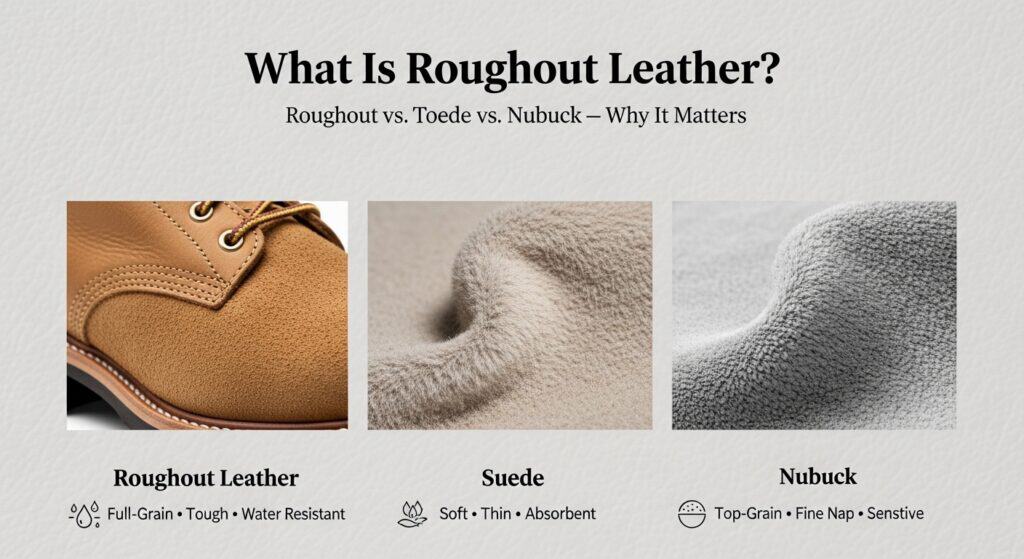
Discover the differences between roughout leather, suede, and nubuck. Learn which material suits your needs best!
Before you touch your boots with any brush, cleaner, or spray, you need to understand what you're actually working with. Roughout, suede, and nubuck all look similar in a photo. They are fundamentally different materials that respond very differently to the same product — and confusing them is the most common mistake new boot owners make.
Roughout Leather
Roughout is full-grain leather that has been flipped inside-out during construction. The corium — the dense, fibrous underside of the hide — faces outward, creating the matte, textured nap you see on boots like the Red Wing Iron Ranger Hawthorne or Thursday Boot Company's Captain. The grain side (the smooth, impermeable outer surface of a standard leather boot) faces inward, against your foot.
This inside-out construction means roughout retains all the durability and thickness of full-grain leather. It is the toughest of the three napped leathers — significantly more resilient to moisture and abrasion than suede.
Suede
Suede is a split leather. The grain layer has been removed entirely, leaving only the corium. Because suede is thinner and lacks the structural density of full-grain leather, it is softer, more breathable, and considerably more delicate. Water, oil, and staining agents penetrate suede faster than roughout, and the thinner fiber structure means it tears and wears faster under hard use.
Nubuck
Nubuck is top-grain leather that has been sanded on the grain side to produce a short velvet-like nap. Unlike roughout, the grain layer is still present — it has simply been abraded rather than flipped. This makes nubuck feel finer and smoother than roughout to the touch, but the sanding process weakens the surface, making it more vulnerable to scuffing and product damage than roughout's corium face.
🔍 Quick ID Test
Scratch a small hidden area gently with your fingernail. Roughout: coarser fibers, spring back with some resistance. Nubuck: shorter, finer fibers, slightly smoother. Suede: thinnest and softest, fibers lie flat easily.
Why the Difference Matters for Cleaning
- All three can safely use a stiff suede/nubuck brush and a silicone-free spray protector.
- Roughout tolerates moisture significantly better than suede due to its thicker base.
- Nubuck needs gentler product application than roughout — the abraded grain surface is more fragile.
- Heavy wax conditioners will mat and bond the nap on all three — but roughout will survive mink oil better than suede, even though you shouldn't use it on either if you want to preserve colour.
2. Step 1 — Identify Your Roughout: Waxed or Unwaxed? (This Changes Everything)
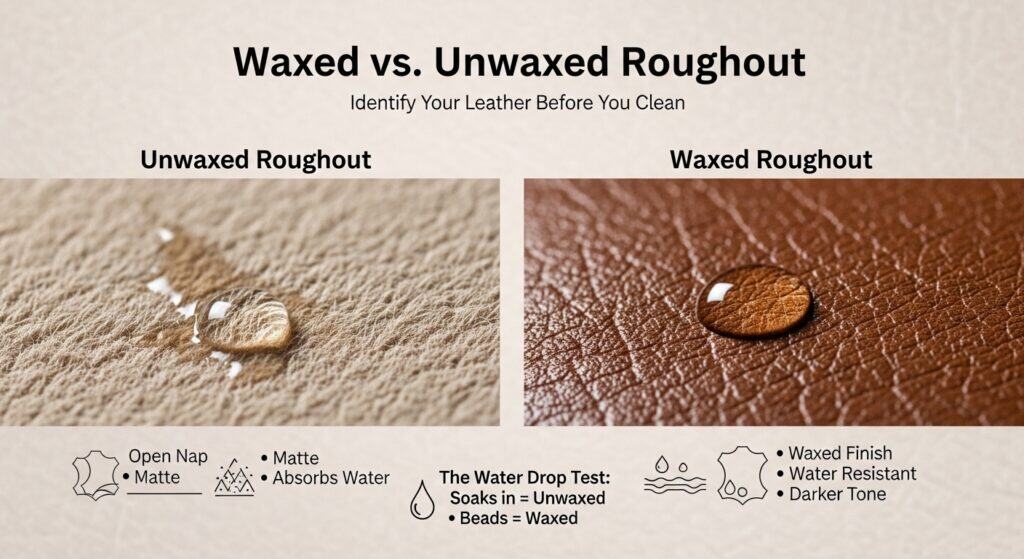
Learn to identify your leather for the best care! This comparison illustrates the differences between waxed and unwaxed roughout leather.
This is the single most important question you need to answer before choosing any care product — and it is the question that zero other roughout care guides ask you to consider.
There are two distinct categories of roughout leather, and they require completely different care protocols.
Unwaxed Roughout (Most Common)
The majority of roughout boots on the market are unwaxed. The corium fibers are open, the nap is distinctly fuzzy and matte, and water soaks in quickly. Boots in this category include most Thorogood roughout models, Thursday Boot Company roughout, standard Nicks and Whites roughout, and some Red Wing Heritage roughout styles.
Care goal: Preserve the open nap. Prevent darkening. Maintain matte texture.
Protocol: Stiff brush + suede eraser for stubborn spots + silicone-free spray protector. Avoid any wax, oil, or cream product on the exterior.
Waxed Roughout / Waxed Flesh
Waxed roughout has had a wax treatment applied during or after tanning that partially bonds the nap fibers down. The result is a slightly shiny or waxy appearance, a darker and more uniform colour, and noticeably better water resistance — water beads on the surface rather than immediately soaking in. The most well-known example is the Red Wing Muleskinner (Hawthorne colourway). Some Viberg roughout and CF Stead tannery waxed-flesh leathers also fall into this category.
Care goal: Maintain the wax patina. Keep leather supple. Enrich the existing finish without disrupting it.
Protocol: Stiff brush + light leather cream (Red Wing Leather Cream) to replenish the wax layer + leather protector spray. Avoid saddle soap and harsh cleaners that strip wax.
💧 The Water Drop Test
Place a small drop of water on a hidden area (tongue or inside shaft). Soaks in within 5 seconds = unwaxed roughout. Beads and sits = waxed roughout. This single test determines your entire care protocol.
3. Step 2 — Gather Your Tools: The Only 4 Things You Actually Need
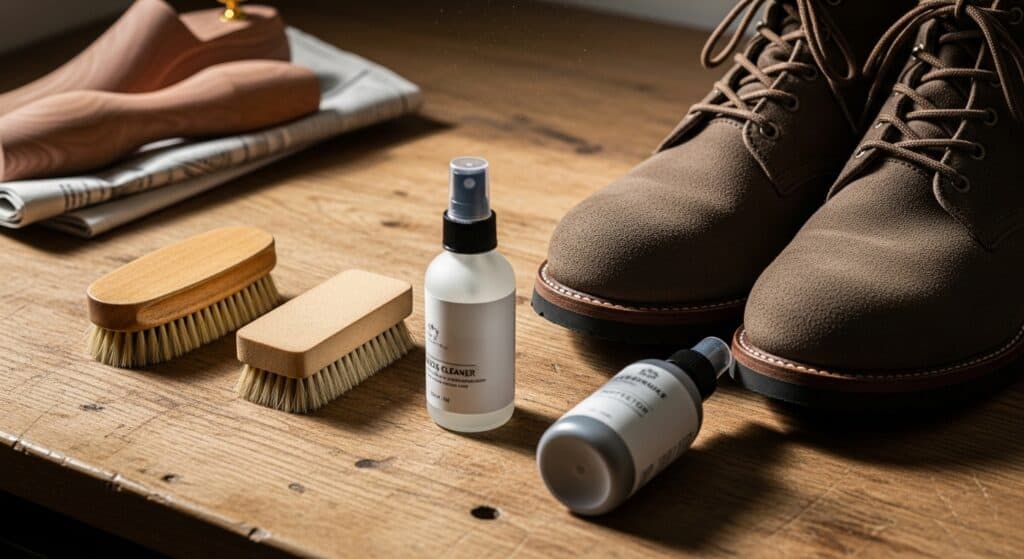
Elevate your shoe care routine with quality products.
Roughout boot care is not complicated if you have the right four tools. Everything else is optional.
- Stiff-bristled suede/roughout brush — brass wire or rubber nub. This is your primary cleaning tool for every session. Do not use a horsehair brush from your smooth-leather kit — horsehair is too soft to lift embedded dirt from roughout's corium fibers and will do essentially nothing. Recommended: Avel Ledeltechnik brass brush, Saphir suede brush.
- Suede eraser bar — a rubber block for stubborn dry stains, scuffs, and areas where the nap has been matted flat. Work it gently before brushing. Recommended: Saphir suede eraser, Jason Markk eraser.
- Suede shampoo or roughout cleaner — for deep cleaning when dry brushing is insufficient. Applied on a clean cloth or sponge, never directly onto the leather. Recommended: Saphir Omni'Nettoyant.
- Silicone-free protector spray — the finishing step that waterproofs without darkening or matting the nap. Silicone-based sprays can interfere with future conditioning and deteriorate leather over time. Recommended: Saphir Super Invulner, Tarrago Nano Protector.
Optional but useful: Cedar boot trees or crumpled newspaper — used during drying to maintain the boot's shape and absorb residual interior moisture.
4. Step 3 — Remove the Laces and Stuff the Boot
Remove laces completely before cleaning. Leaving laces in hides the tongue, eyelet area, and lower shaft — exactly where mud and salt accumulate most. Laces can be cleaned separately by hand with a small amount of suede shampoo and cold water, or simply replaced if they're too far gone.
Stuff the boot firmly with cedar shoe trees (preferred) or crumpled newspaper. A boot that is limp and uncollapsed is harder to brush evenly and is more prone to creasing during the cleaning process. Boot trees also help pull moisture out of the interior lining during drying.
5. Step 4 — Dry Brush: The Right Motion, the Right Brush, the Right Pressure
Dry brushing is the foundation of every roughout cleaning session. It should happen before every other step, and for boots with light soil, it's often all you need.
The correct motion: Start by brushing against the direction of the nap — short, firm strokes that lift embedded dust, dried mud, and surface debris out of the fibers. Then finish by brushing with the nap to even the texture and lay the fibers in a consistent direction.
Pressure: Firm enough to feel resistance from the fibers — not so hard that you're gouging the leather. On a brass-wire brush, moderate pressure with consistent short strokes is correct. On a rubber-nub brush, slightly more pressure is needed since rubber lifts by friction rather than wire teeth.
Pay attention to: the welt seam where the upper meets the sole (mud accumulates here), the toe cap, the heel counter, and anywhere the boot flexes during walking — flex creases trap more particulate than flat panels.
6. Step 5 — Eraser Bar for Stubborn Spots
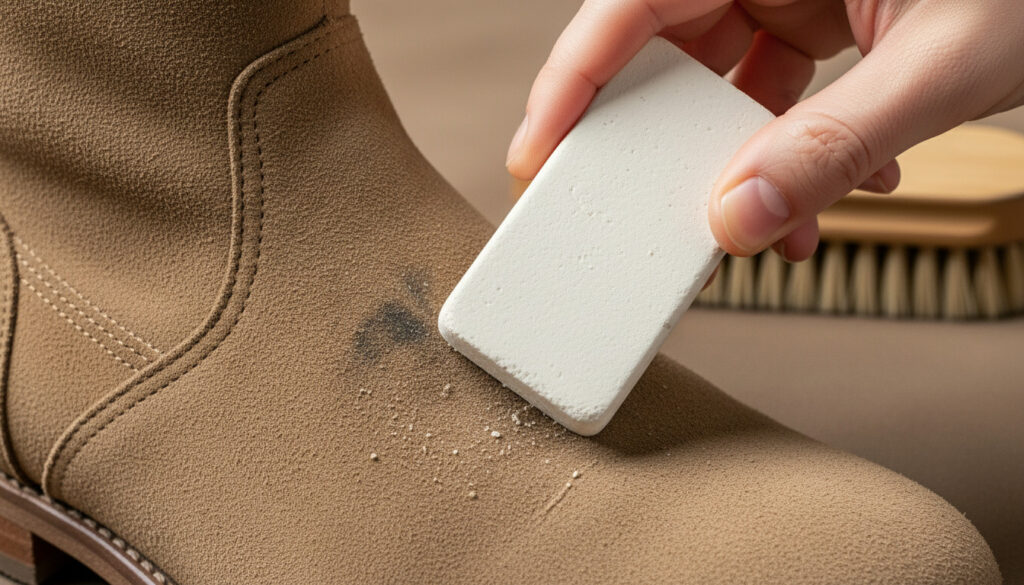
Revitalize your suede boots with simple cleaning tips!
After dry brushing, identify any spots that haven't cleared: scuffs, dried stain edges, areas where the nap looks matted and won't lift with the brush. Apply the suede eraser bar to these areas using a back-and-forth rubbing motion with moderate pressure — similar to erasing pencil on paper.
The eraser works by mechanically abrading the surface of the fiber, breaking up the bonding between compressed or stained fibers. After erasing, always follow immediately with the brush to remove eraser debris and re-lift the nap.
Do not: Apply the eraser to wet leather, or use it on large areas — it's a precision tool for localised spots, not a substitute for the brush on broad cleaning tasks.
7. Step 6 — Deep Cleaning with Suede Shampoo (When and How)
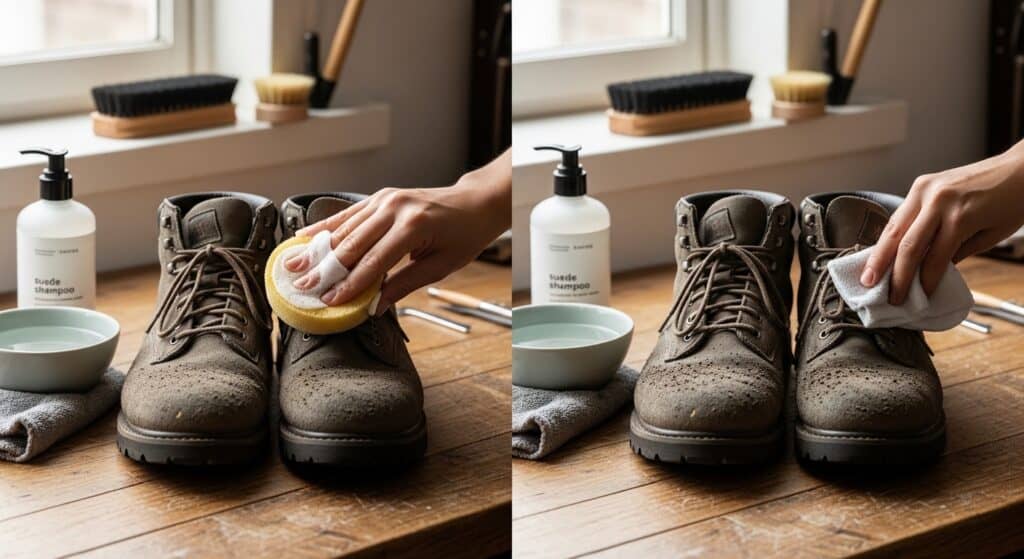
Revitalize your favorite suede boots with this easy cleaning process!
Deep cleaning with suede shampoo should be used only when dry brushing and erasing aren't sufficient — heavily soiled boots after muddy trail work, boots that have been neglected for a season, or before applying a new round of protector spray to ensure a clean surface.
Method:
- Dampen a clean cloth or cellulose sponge with water — not dripping wet, just damp.
- Apply a small amount of suede shampoo (Saphir Omni'Nettoyant) to the cloth, not directly to the boot.
- Work in small circular sections with gentle pressure, covering the entire boot evenly to avoid watermark rings.
- Use a second damp cloth with clean water to remove any shampoo residue.
- Allow to dry completely at room temperature — do not accelerate with heat.
- Brush with the stiff brush once fully dry to restore nap.
On waxed roughout: Use shampoo sparingly — it can strip the wax layer if applied aggressively. Condition with leather cream immediately after drying.
8. Step 7 — Drying Correctly (and What Never to Do with Heat)
Improper drying is responsible for more roughout boot damage than any product error. The mechanism is worth understanding — not just the rule.
Why Heat Destroys Roughout Leather
Roughout leather contains approximately 25–40% water by volume when saturated. The collagen fiber network that gives leather its strength requires a specific equilibrium moisture level to remain flexible and intact.
When you apply direct heat — a hairdryer, a radiator, direct sunlight — surface moisture evaporates faster than moisture can migrate from the inner fiber structure to replace it. The outer fibers contract while the core is still saturated, creating mechanical stress that permanently micro-cracks the collagen structure. The result: boots that feel stiff and cardboard-like, develop surface cracking, and have nap fibers that snap off rather than flex with wear.
Additionally, temperatures above 120°F can break down the adhesive bonds in welted and cemented sole constructions — meaning heat-dried boots risk sole delamination over time.
The Correct Drying Method
- Room temperature, with good airflow
- Away from radiators, direct sunlight, and any heat source
- Stuffed with newspaper or cedar boot trees to maintain shape and absorb interior moisture
- 12–24 hours depending on how saturated the leather is
⚠️ The One Exception
Gentle, distant heat (hairdryer on its lowest setting, held 12+ inches away) is used intentionally when applying wax products like Sno-Seal or Obenauf's to deliberately melt wax deeper into the fibers and convert roughout to a waxed finish. This is a finishing technique for a deliberate aesthetic choice — not a drying technique. Never use heat to dry wet roughout.
9. Step 8 — Nap Restoration: Reviving Crushed and Matted Roughout Texture
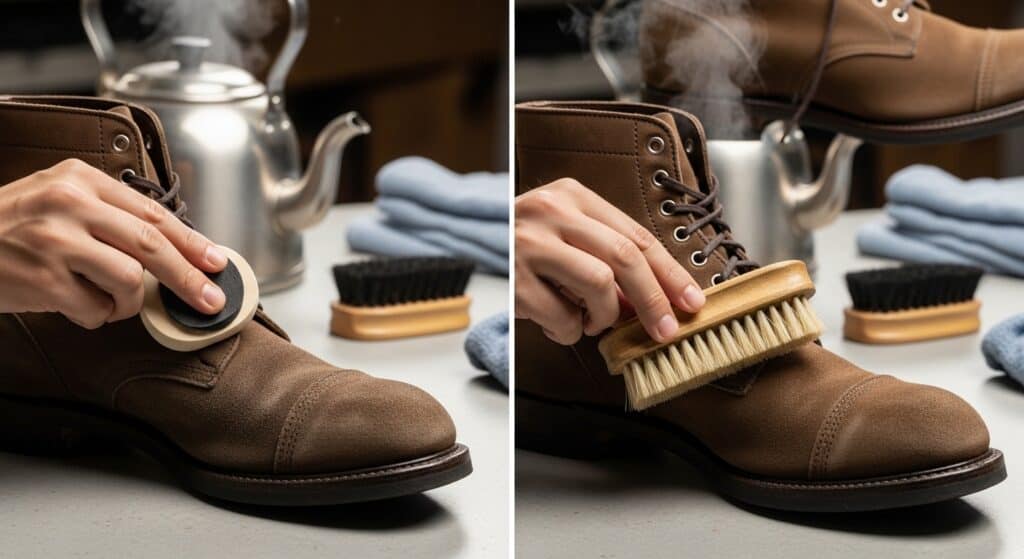
A step-by-step guide to boot care.
After months of regular wear, roughout boots develop areas where the nap is crushed flat rather than standing open. This is most visible at the toe cap (impact zone), the flex crease across the vamp, and the ankle collar where the shaft folds against itself with every step. The fibers haven't been damaged — they have developed a directional "set" from sustained compression and friction.
Standard Restoration Technique
- Apply the suede eraser bar to the matted area in gentle circular motions to mechanically loosen fiber-to-fiber bonding.
- Immediately follow with the stiff brass-wire or rubber-nub brush, brushing against the direction the nap has been pressed, in short firm strokes.
- Finish by brushing with the grain to even the texture.
- The restored area will look slightly uneven for 24 hours as fibers settle — this is normal. The open nap returns within a day.
Steam Method (Advanced)
Hold the boot 6–8 inches above a boiling kettle or pot of steam for 15–20 seconds per area. The moisture softens compressed collagen bonds, making fibers more receptive to brushing restoration. Brush immediately while still warm and slightly damp, then allow to air-dry fully. Use this technique sparingly — excessive steam can over-saturate the leather.
What Cannot Be Restored
Nap that has been coated with wax, oil, or conditioning cream cannot be restored by brushing or steam. The individual fibers are coated and bonded together — not just compressed. At that point, you either accept the waxed-roughout appearance or consult a professional cobbler about stripping treatments, which carry their own risks.
10. Step 9 — Conditioning Unwaxed Roughout: What to Use and What to Avoid
Unwaxed roughout does not need frequent conditioning the way smooth leather does. The open corium structure retains natural oils effectively, and most unwaxed roughout boots look and feel best with minimal product intervention. The goal is protection and moisture balance — not the deep nourishment protocols that full-grain smooth leather requires.
When to condition: When the leather feels noticeably dry or stiff, or when fibers look dull and brittle rather than matte and supple. In most climates with regular wear, this is every 3–6 months.
Best product for unwaxed roughout: Saphir Renovateur in aerosol form — it conditions the leather without coating or matting the nap, produces minimal colour change, and does not leave a waxy surface layer. Apply evenly from 20–25cm distance, allow to penetrate for 10 minutes, then brush lightly.
Acceptable alternatives: A silicone-free protector spray (Saphir Super Invulner, Tarrago Nano Protector) applied after every clean session provides both protection and a small amount of conditioning. Many unwaxed roughout owners use only a protector spray and nothing else — which is a legitimate approach for well-made roughout leathers.
Do not use: Mink oil, neatsfoot oil, Obenauf's Heavy Duty LP, Leather Honey, regular boot cream, or shoe polish on unwaxed roughout. See Section 14 for the full explanation of why these products permanently alter the leather.
11. Step 10 — Conditioning Waxed Roughout: A Different Protocol Entirely
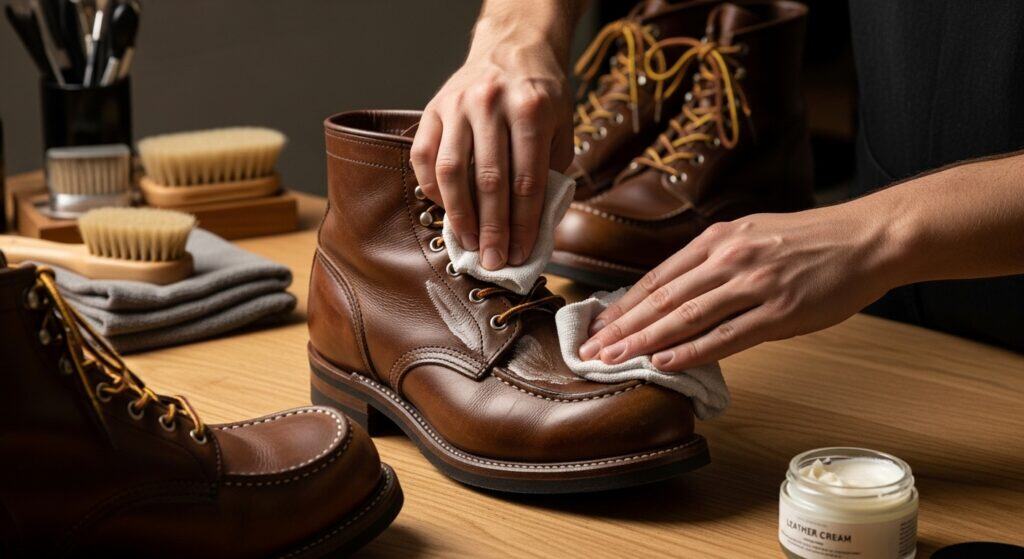
Give your leather boots the care they deserve! Discover the art of boot maintenance.
Waxed roughout (Red Wing Muleskinner, waxed flesh variants) has already had its nap bonded by a wax treatment. The conditioning goal is fundamentally different: you are replenishing an existing wax layer, not preserving an open nap.
Recommended product: Red Wing Leather Cream for Muleskinner and most waxed roughout models. Applied sparingly with a soft cloth to the surface, worked in with gentle circular motions, then buffed lightly. The cream replenishes wax and oils in the bonded fiber structure and enriches the natural patina that develops with wear.
Do not: Apply heavy wax products (Sno-Seal, Obenauf's LP) to waxed roughout that you want to maintain with a natural patina — these products overload the wax layer and can create an artificial, thick surface coating that disrupts the leather's natural aging process. Follow the specific product recommendations from your boot's manufacturer whenever possible.
Do not: Use saddle soap on waxed roughout. It strips the wax layer, potentially causing uneven colour and drying the fibers underneath. If deep cleaning is needed, use a minimal amount of suede shampoo as described in Section 7, and condition immediately after drying.
12. Step 11 — Waterproofing: The Darkening Decision and the Full Product Spectrum
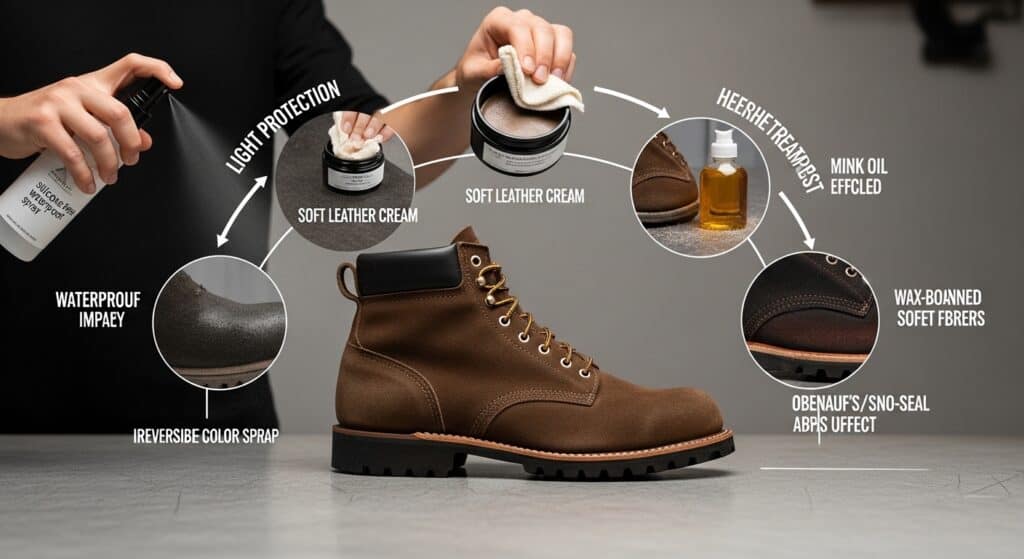
Keep your boots looking new with these care tips!
Every roughout boot owner eventually faces the waterproofing question. The complicating factor: the most effective waterproofing products also cause the most significant colour change. You need to decide which outcome you want before applying anything.
Here is the complete darkening spectrum, from least to most colour impact:
| Product | Colour Change | Nap Effect | Reversible? |
|---|---|---|---|
| Silicone-free spray (Saphir Super Invulner, Tarrago Nano) | Negligible | None | N/A |
| Saphir Renovateur aerosol | Minimal | None | N/A |
| Red Wing Leather Cream | Slight | Minimal (bonds waxed nap) | No |
| Mink oil | Significant — 2–3 shades | Partially flattened | No |
| Obenauf's Heavy Duty LP | Heavy | Fully flattened | No |
| Sno-Seal / beeswax products | Heavy | Fully bonded — converts to waxed finish | No |
Note: Darkening is not damage. Many boot owners deliberately apply heavy wax products to age and waterproof their roughout aggressively — particularly for work and outdoor use where maximum protection matters more than preserving the original colour. The key is that this is a deliberate, informed choice, because it cannot be reversed.
13. Stain Removal Guide: By Stain Type
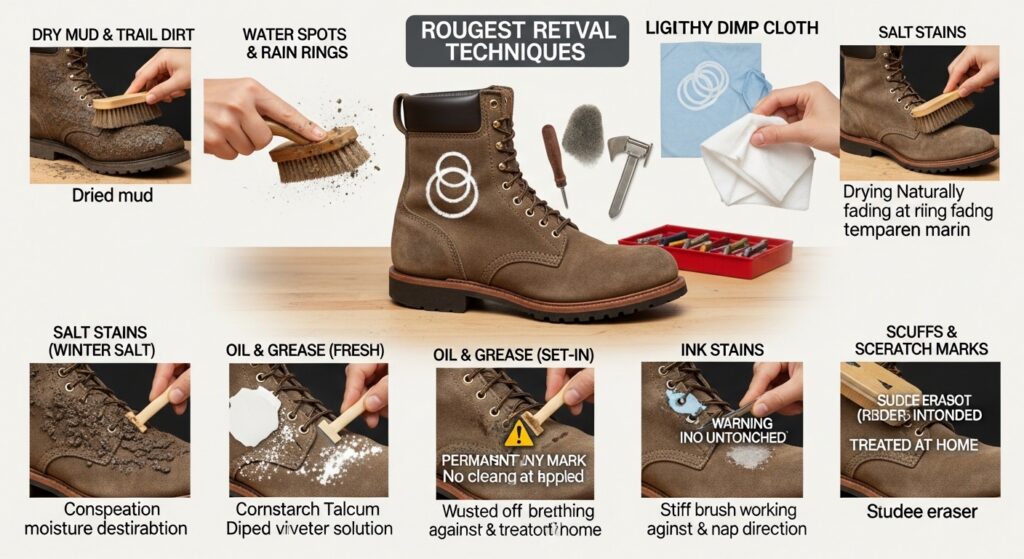
Master the art of boot care with these techniques!
Different stains require fundamentally different treatments. The standard advice — "brush off dirt and use an eraser" — works for surface dust. It is wrong for salt, oil, and water stains, and using the wrong method on the wrong stain type can set the stain permanently.
Dry Mud and Trail Dirt
Let mud dry completely — 12 to 24 hours minimum. Brushing wet mud spreads it and pushes it deeper into the fibers. Once fully dry, brush with the stiff brush against the nap direction to break up and lift the dried particles, then with the nap to clear residue.
Water Spots and Rain Rings
Counterintuitive fix: lightly dampen the entire boot evenly with a barely-damp cloth, then allow to dry completely at room temperature. Water rings form because of uneven drying, not water damage. Evening out the moisture across the full surface eliminates the ring as the boot dries uniformly.
Salt Stains (Winter Road Salt)
Mix equal parts white vinegar and cold water. Dab — never rub — with a clean cloth. The acidity of the vinegar neutralises the alkaline salt crystals. Follow with a second cloth dampened with clean water to remove vinegar residue, then full air-dry before brushing. Test on a hidden area first if you have waxed roughout — vinegar can strip wax from waxed roughout if applied aggressively.
Oil and Grease Stains (Fresh)
Act immediately. Sprinkle cornstarch or talcum powder generously over the stain and leave undisturbed for 24 hours. The powder absorbs oil from the fibers before it penetrates deeply. Brush off gently after 24 hours. If residue remains, apply a small amount of nubuck degreaser on a clean cloth and dab — do not rub — then allow to dry and brush.
Oil and Grease Stains (Set-In)
A nubuck degreaser applied carefully is your best option. Accept that some permanent darkening may remain from deep oil penetration into the fibers. A professional cobbler with access to specialised solvents can sometimes achieve better results on set-in oil than DIY methods.
Ink Stains
Do not attempt at home. Ink in roughout fibers is extremely difficult to remove without chemical solvents that will damage or discolour the surrounding leather. Take the boots to a professional cobbler.
Scuffs and Scratch Marks
Often the nap is simply compressed, not actually damaged. A suede eraser applied first, followed by the stiff brush working against the direction of the scuff mark, will frequently restore the texture completely. See Section 9 (Nap Restoration) for the full technique.
14. Why Smooth Leather Products Damage Roughout: The Chemistry Explained
The most common "I ruined my roughout boots" scenario on boot forums and Reddit follows the same pattern: the owner had a bottle of Leather Honey, Obenauf's Heavy Duty LP, or regular boot cream on the shelf, assumed leather is leather, and applied it. The boots came out darkened several shades with a flattened, almost waxy surface — and there was no going back.
Understanding why this happens prevents it from being repeated.
How Smooth Leather Conditioners Work
Products like Leather Honey, boot cream, shoe polish, and Obenauf's LP are formulated for the grain side of smooth leather. They work by penetrating the tight, impermeable grain layer and sitting in the surface wax and oil matrix of the hide. The grain layer acts as a barrier that moderates absorption — the product replenishes the leather's surface without penetrating too deeply or coating the texture.
What Happens on Roughout
Roughout's exposed corium fibers have no grain layer acting as a moderating barrier. When you apply a smooth-leather conditioner to roughout, the product coats the individual fiber shafts directly. The result:
- The spaces between fibers fill with product — eliminating the open nap that defines roughout's texture.
- Fibers bond together — permanently matting the nap into a smooth, flat surface.
- The product darkens the leather 2–3 shades as it saturates the previously dry corium fibers.
- Pigments in boot polishes stain roughout fibers permanently in a way that cannot be buffed out.
The Special Case of Saddle Soap
Saddle soap deserves specific mention because it is often recommended as a universal leather cleaner. On smooth leather, its mild alkalinity strips dirt and helps balance moisture. On roughout, it can strip the natural oils from the corium fibers, causing stiffness and brittleness — and may pull pigment unevenly from the nap, creating patchy discolouration. Saddle soap is not recommended for roughout. If you choose to use it on heavily soiled waxed roughout, use a minimal amount and condition immediately after drying.
15. Brand-Specific Care Protocols: Red Wing, Thorogood, Whites/Nicks, Thursday
The most frequently searched roughout care queries are brand-specific. General guidance applies — but each brand uses specific leathers with specific tannage and finishing processes. Here is what you need to know for the most popular roughout boot brands.
Red Wing Muleskinner (Hawthorne Roughout) — Waxed Roughout
The Muleskinner is a waxed roughout, and Red Wing is explicit about how to care for it. Use a stiff suede brush for cleaning. Apply Red Wing Leather Cream to replenish the wax layer — not Boot Oil (too darkening) and not Mink Oil (disrupts the natural patina development). Finish with Red Wing Leather Protector spray. The Muleskinner develops a distinctive wax patina with wear — the goal of care is to maintain and gradually enrich it, not to strip or over-saturate it with product.
Red Wing Standard Roughout / Heritage Models
Red Wing produces a dedicated Roughout and Nubuck Care Kit containing an eraser bar, bristle brush, Leather Cream, and Leather Protector. Their official care page specifies exactly which products to use for each leather in the Heritage lineup — follow it. The roughout and nubuck products in Red Wing's line are different from their smooth-leather products and should not be substituted.
Thorogood Roughout (American Heritage, 1957 Series)
Thorogood's roughout models use standard unwaxed roughout. The recommended protocol is the standard approach: stiff brush for cleaning, suede eraser for stubborn spots, silicone-free spray protector for waterproofing. Thorogood does not recommend conditioning roughout models as a routine step — only apply conditioning product if the leather shows visible signs of drying out or feels stiff.
Thursday Boot Company (Roughout / Rugged & Resilient Leather)
Thursday's roughout is treated during tanning for some baseline water resistance. Standard unwaxed roughout protocol applies: dry brush, eraser for spots, protector spray. Thursday Boot Company's community consistently recommends Saphir Renovateur aerosol as a conditioning option for Thursday roughout that needs moisture replenishment — it conditions without matting or significantly darkening.
Whites and Nicks Boots (Heavyweight Work/Logger Roughout)
Whites and Nicks use heavier oil-tanned roughout constructions that are noticeably more tolerant of conditioning products than the roughout on lifestyle-oriented heritage boots. Some owners deliberately apply Obenauf's LP to achieve maximum waterproofing for logging and outdoor work, accepting the significant darkening as a trade-off for protection. Others condition the interior shaft (smooth side) rather than the exterior to keep the leather supple without altering the outside appearance. Both approaches are legitimate — choose based on whether you prioritise appearance or maximum protection.
General Rule: Always check the manufacturer's official care guide before applying any product. Red Wing, Thorogood, and Thursday all publish specific roughout care recommendations that supersede general guidance when there is any conflict.
16. Maintenance Schedule
| Frequency | Action |
|---|---|
| After every wear | Quick dry brush to remove surface dust and mud before it sets. Takes 60 seconds. Prevents embedded dirt buildup that requires deep cleaning later. |
| Monthly (light use) / Weekly (heavy use) | Full dry brush + suede eraser on any stubborn spots + inspect nap condition and check for crushed areas needing restoration. |
| Every 4–8 weeks | Reapply protector spray. Waterproofing wears off with wear and cleaning. Test: put a water drop on the leather — if it soaks in rather than beading, it's time to reapply. |
| Every 3–6 months | Deep clean with suede shampoo (if needed) + full nap restoration brushing + conditioning (unwaxed: Saphir aerosol; waxed: light leather cream). |
| Seasonally | Full assessment of leather condition, sole stitching integrity, and lace wear. Re-treat before winter (road salt season) or storage if boots will sit unused. |
| When leather feels stiff or dry | Spot condition immediately — do not wait for the next scheduled interval. Dry leather deteriorates faster with continued wear. |
17. Recommended Products
| Product | Use Case | Waxed / Unwaxed |
|---|---|---|
| Brass wire suede brush (Avel, Saphir) | Primary cleaning + nap restoration | Both |
| Suede eraser bar (Saphir, Jason Markk) | Stubborn spots, scuffs, matted nap | Both |
| Saphir Omni'Nettoyant Suede Shampoo | Deep cleaning | Both (sparingly on waxed) |
| Saphir Super Invulner spray | Protection — minimal colour change | Unwaxed (primary) / Waxed (acceptable) |
| Tarrago Nano Protector spray | Protection — nanotechnology, breathable | Unwaxed (primary) |
| Saphir Renovateur aerosol | Conditioning without matting nap | Unwaxed only |
| Red Wing Roughout/Nubuck Care Kit | All-in-one for Red Wing roughout | Red Wing roughout (both) |
| Red Wing Leather Cream | Wax replenishment + light conditioning | Waxed roughout only |
| Cedar boot trees / shapers | Shape retention during drying + moisture absorption | Both |
| Mink oil / Obenauf's LP | Use only if deliberately converting to waxed finish — darkening is permanent and nap-flattening is irreversible | Intentional wax conversion only |
18. FAQ — 8 Common Roughout Care Questions
Can I use saddle soap on roughout leather boots?
Generally, no. Saddle soap is alkaline and will strip natural oils from roughout's corium fibers, potentially causing stiffness, brittleness, and uneven pigment lift. If you have heavily soiled waxed roughout and nothing else available, use a very small amount and condition the leather immediately after it dries. For unwaxed roughout, use a dedicated suede shampoo instead.
Will mink oil ruin roughout leather?
Mink oil will not structurally ruin roughout, but it will permanently darken the leather 2–3 shades and partially flatten the nap — which cannot be reversed. If you want to preserve the original colour and texture, do not use mink oil. If you are trying to aggressively condition and waterproof heavy work boots and accept the colour change, mink oil is effective. The problem is most people apply it not understanding the permanent consequences.
How do I remove salt stains from roughout boots?
Mix equal parts white vinegar and cold water. Dab the stained area with a cloth dampened in the solution — never rub. Follow with a clean damp cloth to remove residue, then allow to air-dry fully before brushing. Salt stains left untreated will eventually dry out and crack the leather fibers, so address them promptly after winter wear.
What's the best way to waterproof roughout leather without darkening it?
A silicone-free spray protector — Saphir Super Invulner or Tarrago Nano Protector — provides effective water repellency with negligible colour change. Apply to clean, dry leather from 20–25cm distance, allow to fully dry (20–30 minutes), and brush lightly. Reapply every 4–8 weeks depending on wear intensity. Avoid beeswax, Sno-Seal, and heavy oil products if colour preservation is the priority.
Can I use a horsehair brush on roughout?
No. Horsehair brushes are designed for smooth leather and are too soft to penetrate roughout's corium fibers effectively. They will not lift embedded dirt or restore crushed nap. Use a brass-wire suede brush or a rubber-nub brush instead.
How do I know if my roughout is waxed or unwaxed?
Apply a drop of water to a hidden area. If it soaks in within 5 seconds, you have unwaxed roughout. If it beads and sits on the surface, you have waxed roughout. You can also look at the nap — unwaxed roughout has a clearly open, fuzzy texture, while waxed roughout has a slightly bonded, less shaggy appearance with a subtle sheen.
Why do my roughout boots look darker after I cleaned them?
If they darkened after cleaning, the most likely cause is a product applied to the leather surface — a conditioner, oil, or protector spray that was too heavy, or the wrong type (smooth-leather product used on roughout). Water alone should not darken roughout permanently; any darkening from moisture evens out as the leather dries. If the change is permanent, a smooth-leather product has been used and the nap has been coated — see Section 14.
How often should I clean roughout boots?
Quick dry brushing after every wear prevents buildup. A full cleaning session (brush, eraser, protector spray) once a month for regular wear, weekly for heavy daily use. Deep cleaning with suede shampoo every 3–6 months, or when the boots show visible embedded dirt that brushing alone won't clear. Overcleaning roughout is rarely a problem — under-cleaning and product misuse are the more common errors.
19. Quick-Reference Cheat Sheet
Roughout Boot Care — One-Page Reference
Before anything else: Water drop test → soaks in = unwaxed · beads = waxed. Two different protocols.
Tools you need: Brass/rubber suede brush · Suede eraser bar · Suede shampoo (Saphir Omni'Nettoyant) · Silicone-free spray (Saphir Super Invulner / Tarrago Nano)
The cleaning order: Remove laces → stuff boot → dry brush (against nap, then with nap) → eraser on stubborn spots → shampoo if needed → air dry 12–24 hrs → brush nap → spray protector
NEVER use on roughout: Horsehair brush for cleaning · Leather Honey · Obenauf's LP (unless deliberately converting) · Regular boot cream · Shoe polish · Hairdryer to dry
Stain quick guide:
Mud → dry completely, then brush
Water rings → dampen whole boot evenly, air dry
Salt → vinegar/water solution, dab, don't rub
Oil (fresh) → cornstarch 24 hrs, then brush
Ink → cobbler only
Darkening scale: Silicone spray (none) → Saphir Renovateur (minimal) → Mink oil (significant, permanent) → Obenauf's LP (heavy, permanent) → Sno-Seal (heavy, converts to waxed)
Maintenance rhythm: Brush after every wear · Protector spray every 4–8 weeks · Deep clean every 3–6 months · Condition when leather feels stiff or dry
The Bottom Line
Roughout leather rewards simple, consistent care and punishes product misuse more sharply than almost any other leather type. The nap that defines roughout's character is also its vulnerability — exposed corium fibers will bond permanently if coated with the wrong product, and no amount of brushing will undo it.
Start with the water drop test. Know whether you have waxed or unwaxed roughout before you touch anything. Keep four tools on the shelf. Brush after every wear. Reapply silicone-free spray every 4–8 weeks. And stay away from the smooth-leather conditioners until you fully understand what they'll do to a napped leather surface.
Boots like the Red Wing Iron Ranger, Thursday Captain, and Thorogood American Heritage are built to last decades. With the right care protocol — and the discipline to avoid the wrong products — your roughout boots will age into something far better than what you bought.