
Welding is hard on boots. Sparks and spatter land on the toes and fall into laces, grinding throws hot slag, and dropped plate, pipe or tools can crush the top of your foot. The best welding boots have a safety toe, leather uppers, a heat-resistant outsole and either a metatarsal guard or a pull-on design that gives slag nowhere to hide.
We picked these 7 boots by checking each Amazon listing's safety specs, star rating, number of ratings and bestseller rank, and by reading the patterns in buyer reviews (Amazon, retrieved 2026-09-25). We haven't welded in them ourselves, so there are no invented shop stories here. Each pick has a clear "buy it if" and "skip it if."
Note on prices: Amazon prices change by size and color, so check the price in your size.
Quick Picks: Best Welding Boots
| Boot | Best for | Style | Key protection | Amazon rating |
|---|---|---|---|---|
| Timberland PRO External Met Guard 6" | Best overall | Lace-up | Steel toe, external met guard, EH | 4.5 (1,200+) |
| Iron Age Groundbreaker 6" | Best value met guard | Lace-up | External met guard, Vibram heat-resistant sole | 4.3 (1,000+) |
| Irish Setter Marshall 11" | Best heat-resistant pull-on | Pull-on | Steel toe, HRO sole, EH | 4.6 (3,000+) |
| Wolverine Rancher 10" Steel Toe | Most popular pull-on | Pull-on | Steel toe | 4.3 (9,200+) |
| Timberland PRO Endurance Mt PR | Met guard plus puncture protection | Lace-up | Steel toe, met guard, PR | 4.2 (210+) |
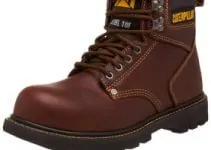
| CAT Revolver Pull-On | Best budget pull-on | Pull-on | Steel toe | 4.4 (2,900+) |
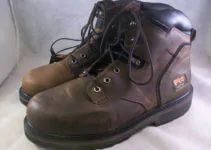
| Timberland PRO Pit Boss | Best everyday lace-up | Lace-up | Steel toe, EH, heat-resistant rubber | 4.3 (27,000+) |
Ratings from Amazon, retrieved 2026-09-25.
What Makes a Good Welding Boot
- Leather upper. Mesh and nylon melt or burn through when sparks land on them.
- Pull-on design or covered laces. Slag that falls into laces and eyelets burns through to your foot. Pull-ons have no laces, and external met guards cover them.
- Metatarsal guard if you handle heavy plate, pipe or castings. See our metatarsal guard boots guide.
- Heat-resistant (HRO) outsole for hot floors, slag and grinding.
- ASTM F2413 safety toe and EH rating for impact protection and secondary electrical protection.
The Best Welding Boots, Reviewed
1. Timberland PRO External Met Guard 6" Steel Toe - Best Overall

This Timberland PRO has an asymmetrical steel toe, an external hinged ABS metatarsal guard that also covers the laces, EH protection and a closed-cell PU footbed. It has 4.5 stars from more than 1,200 ratings and lists at about $180.
Buyers say it's durable, comfortable and fits well, including large and wide feet, and several call it perfect for welding.
Buy it if: you weld and handle heavy material and your shop requires met guards.
Skip it if: you don't need met protection. The guard adds bulk.
Check the Timberland PRO Met Guard price on Amazon
2. Iron Age Groundbreaker 6" - Best Value Met Guard

The Groundbreaker combines a leather upper, an external met guard, a memory foam footbed and a Vibram heat-resistant outsole, with ASTM F2413 protection. It has 4.3 stars from more than 1,000 ratings and lists at about $110.
Buyers call it high quality, comfortable and protective for the money. Durability is mixed, with some reporting about nine months of use, and fit gets mixed reviews.
Buy it if: you want a met guard and a heat-resistant sole for much less than Timberland PRO.
Skip it if: you need a boot that lasts years of daily heavy use.
Check the Iron Age Groundbreaker price on Amazon
3. Irish Setter Marshall 11" Steel Toe - Best Heat-Resistant Pull-On

The Marshall is an 11-inch leather pull-on with a steel toe and a heat-resistant (HRO) rubber outsole that the listing says meets ASTM F2413-18 M/I/C EH. It has 4.6 stars from more than 3,000 ratings and lists at about $220.
Buyers say it's comfortable and durable and stays dry in snow and rain.
Buy it if: you want no laces for slag to fall into and a sole built for hot surfaces.
Skip it if: you need a met guard.
Check the Irish Setter Marshall price on Amazon
4. Wolverine Rancher 10" Steel Toe - Most Popular Pull-On

The Rancher is a full-grain leather pull-on with a steel toe, a moisture-wicking mesh lining, a removable OrthoLite footbed, an ultra-light EVA midsole and a rubber lug outsole. It has 4.3 stars from more than 9,200 ratings and lists at about $150.
Buyers love the quality, comfort and look. It runs large, and some report the sole coming apart after a few months.
Buy it if: you want a comfortable, good-looking steel toe pull-on for light welding and fabrication.
Skip it if: you stand on hot slag or floors. The listing doesn't claim a heat-resistant sole. Choose the Irish Setter Marshall.
Check the Wolverine Rancher price on Amazon
5. Timberland PRO Endurance 6" Steel Toe Mt PR - Met Guard Plus Puncture Protection

This Endurance adds a metatarsal guard, puncture resistance and slip resistance to a steel toe boot with Timberland PRO's anti-fatigue technology. It has 4.2 stars from more than 210 ratings and lists at about $165.
Buy it if: you weld on construction sites where nails and sharp scrap are also a risk.
Skip it if: you want a boot with thousands of reviews behind it.
Check the Timberland PRO Endurance Mt price on Amazon
6. CAT Revolver Pull-On Steel Toe - Best Budget Pull-On
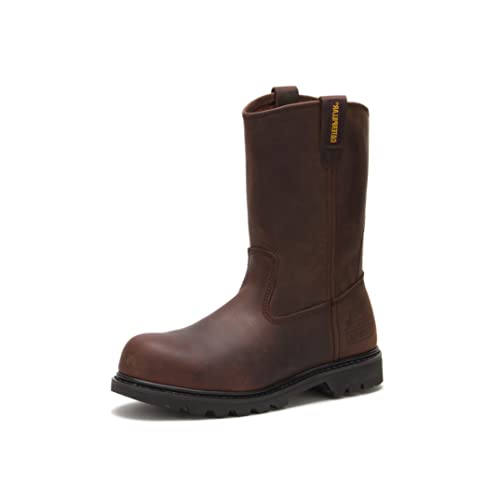
The Revolver is a full-grain leather pull-on with a steel toe, dual pull handles and a slip-resistant outsole. It has 4.4 stars from more than 2,900 ratings and lists at about $100.
Buyers find it comfortable for all-day wear. Durability, fit and traction get mixed reviews.
Buy it if: you want a lace-free steel toe for under $100.
Skip it if: you need heat-resistant soles or a met guard.
Check the CAT Revolver price on Amazon
7. Timberland PRO Pit Boss Steel Toe - Best Everyday Lace-Up
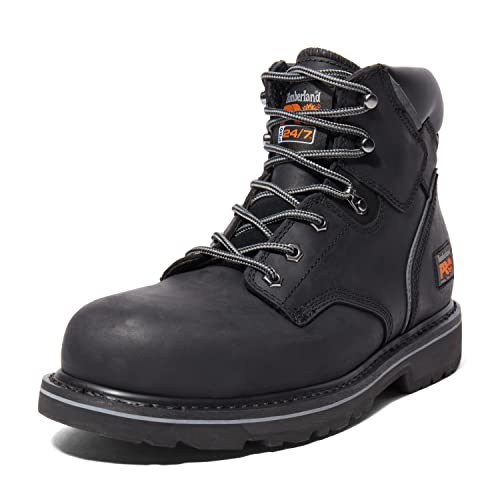
The Pit Boss has a steel toe, EH protection and Timberland PRO rubber that the listing describes as heat, slip, oil and abrasion resistant. It has 4.3 stars from more than 27,000 ratings and lists at about $127 to $130.
Buy it if: you weld occasionally and want one proven boot for general work. Add leather boot covers (spats) to protect the laces.
Skip it if: you do heavy daily welding. Exposed laces are a weak point.
Check the Timberland PRO Pit Boss price on Amazon
Pull-On or Lace-Up for Welding?
Pull-on boots are the traditional welder's choice because there are no laces or eyelets for slag to fall into, and you can kick them off fast if something hot gets inside. Lace-ups give a snugger fit and better ankle support for climbing and uneven ground, but the laces need protection from an external met guard or leather spats. For more lace-free options, see our best pull-on work boots for welders and best pull-on work boots.
How to Make Welding Boots Last
- Wear leather spats or boot covers for heavy spatter and overhead work.
- Tuck pants over boot tops, not inside, so sparks can't fall in.
- Condition the leather. Dry, cracked leather burns through faster.
- Replace boots once burn holes go through the leather or the sole is badly damaged. See when to replace work boots.
Frequently Asked Questions
What boots are best for welding?
Leather boots with a safety toe, a heat-resistant sole, and either a pull-on design or a met guard that covers the laces. The Timberland PRO External Met Guard is our top pick.
Are pull-on boots better for welding?
Many welders prefer them because there are no laces for slag to fall into. Lace-ups are fine if you cover the laces with a met guard or spats.
Do welders need metatarsal guards?
If you handle heavy plate, pipe or castings, many shops require them. Check your employer's PPE rules.
Can I weld in steel toe boots?
Yes. Steel toe boots are standard for welding. Composite toes also work and don't conduct heat as much.
The Bottom Line
- Best overall: Timberland PRO External Met Guard.
- Best value met guard: Iron Age Groundbreaker.
- Best pull-on: Irish Setter Marshall 11".
- On a budget: CAT Revolver.
See also our best steel toe boots and best work boots for pipefitters.