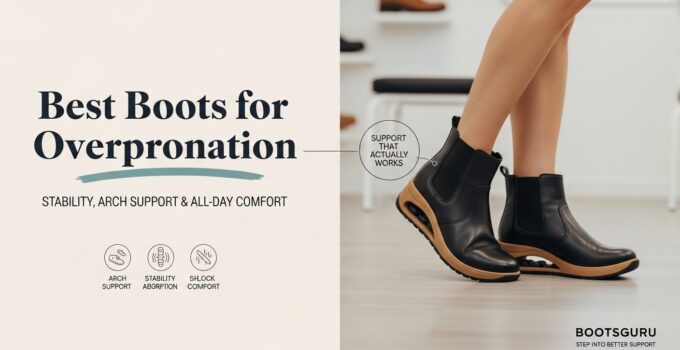
Overpronation doesn’t just hurt your feet — it rolls your ankle in, rotates your shin, torques your knee, and can work its way all the way up to your lower back. That’s why the right boot isn’t just a foot decision. It’s a whole-body decision.
Overpronation means your foot rolls too far inward with each step, flattening your arch beyond its natural range. It’s extremely common — affecting an estimated 20–30% of the population — and it’s one of the leading causes of plantar fasciitis, shin splints, knee pain, and hip strain in people who spend significant time on their feet.
Here’s what most guides miss: they cover running shoes or one type of boot. You need guidance across every boot you actually wear — work boots for 10-hour shifts, hiking boots for trail days, winter boots when your orthotics can’t fit, and everyday boots you can wear to the office without looking like you’re in medical footwear.
This guide covers all five categories, includes a self-diagnosis section, a full kinetic chain pain map, condition-specific advice (plantar fasciitis, knee pain, pregnancy), and a dedicated women’s section.
This guide is NOT for: supinators (underpronators) — overpronation correction features will worsen your alignment — or pure runners looking only for running shoes.
Best Boots for Overpronation — Quick Picks by Use Case
| Use Case | Best Pick | Key Reason | Price |
|---|---|---|---|
| Best work boot (all-day standing) | KEEN Utility Cincinnati 6″ | Metatomical footbed + firm midsole control | $160–$185 |
| Best for severe overpronation / orthotics | Orthofeet Granite Comp Toe | Extra-depth, maximum arch support, orthotic-ready | $160–$190 |
| Best hiking boot | Salomon X Ultra 4 Mid GTX | Advanced Chassis controls heel medially | $155–$175 |
| Best hiking budget pick | Merrell Moab 3 Mid WP | Q-Form midsole + air cushion heel | $130–$155 |
| Best winter boot | Bogs Classic High | Wide stable base + removable orthotic-ready footbed | $130–$160 |
| Best everyday/standing boot | Dansko Professional Boot | Rocker sole + deep heel cup | $130–$160 |
| Best women’s ankle boot | Vionic Kamryn Ankle Boot | Built-in Orthaheel technology, 1″ heel | $130–$160 |
| Best casual/fashion boot | Thursday Boot Co. Captain | Goodyear welt + orthotic-compatible + stylish | $149–$175 |
| Best budget pick | New Balance 411 Mid | Motion control features under $85 | $65–$85 |
| Best winter (style-forward) | UGG Adirondack III | Removable contoured footbed, Goodyear welt | $200–$240 |
Full Comparison: All 10 Boots at a Glance
| Boot | Type | Arch Support | Heel Counter | Motion Control | Orthotic-Ready | Price |
|---|---|---|---|---|---|---|
| KEEN Utility Cincinnati | Work | ★★★★★ | Firm | Moderate | ✅ Yes | $160–$185 |
| Orthofeet Granite | Work / Severe | ★★★★★ | Very Firm | Maximum | ✅ Extra-depth | $160–$190 |
| Salomon X Ultra 4 Mid GTX | Hiking | ★★★★★ | Firm | High | ⚠️ Limited | $155–$175 |
| Merrell Moab 3 Mid WP | Hiking | ★★★★☆ | Moderate | Moderate | ✅ Yes | $130–$155 |
| Bogs Classic High | Winter | ★★★★☆ | Firm | Moderate | ✅ Yes | $130–$160 |
| UGG Adirondack III | Winter | ★★★★☆ | Moderate | Moderate | ✅ Yes | $200–$240 |
| Dansko Professional Boot | Everyday | ★★★★★ | Firm | High | ⚠️ Limited | $130–$160 |
| Thursday Boot Co. Captain | Casual/Fashion | ★★★☆☆ | Good | Low (upgrade w/ insole) | ✅ Yes | $149–$175 |
| Vionic Kamryn | Women’s | ★★★★★ | Firm | High | ✅ Yes | $130–$160 |
| New Balance 411 Mid | Budget | ★★★☆☆ | Moderate | Moderate | ✅ Yes | $65–$85 |
🔬 Do You Actually Overpronate? 3 Ways to Self-Diagnose at Home
Before spending $150–$200 on a motion control boot, spend 5 minutes confirming you actually overpronate. Over-correcting a neutral gait can cause as many problems as under-correcting a pronating one.
Method 1: The Wet Foot Test
Wet the bottom of your foot, step onto a piece of brown paper or cardboard, and look at the imprint.
- Full imprint with almost no inward curve → Flat arches → likely overpronator. You need stability or motion control boots.
- Partial imprint with a clear inward curve → Neutral arch → mild support needed, if any. Stability boot if you have any knee/arch discomfort.
- Only heel and ball visible, very narrow middle band → High arch → may supinate (opposite of overpronation). Motion control boots will hurt you. This guide is not for you.
Method 2: The Shoe Wear Pattern Test
Look at the outsole of three or more pairs of shoes you’ve worn for at least 3 months.
- Heavy wear on the inner heel and ball of the foot → Strong overpronation signal. The more pronounced the inner wear, the more severe the overpronation.
- Even wear across the heel and forefoot → Neutral gait. Mild support only.
- Heavy wear on the outer edge → Supination. Do not use motion control boots.
Check 3+ pairs for consistency — one pair can be misleading due to specific activity or surface.
Method 3: The Standing Mirror Test
Stand barefoot on a hard floor and have someone look at your ankles from directly behind, or use a full-length mirror. Look at your Achilles tendon.
- Achilles curves inward (ankle tilts medially) → Classic overpronation. The more pronounced the bow, the more severe.
- Achilles runs straight and vertical → Neutral gait.
- Ankle tilts outward → Supination.
⚠️ When to see a podiatrist instead: If you have chronic plantar fasciitis, recurring shin splints, knee pain that worsens progressively, or hip/lower back pain without obvious cause — get a professional gait analysis before buying boots. Self-diagnosis works well for mild to moderate overpronation. Severe cases need professional assessment and potentially custom orthotics.
Why Overpronation Causes Pain from Your Feet All the Way to Your Back
Most boot guides say overpronation “can cause knee pain.” That’s accurate but incomplete. Here is the full kinetic chain — and why stopping the problem at the foot level prevents all the pain downstream.
- Arch collapse — The medial arch drops excessively. The plantar fascia stretches beyond its design range. Result: plantar fasciitis, arch pain, heel spurs.
- Ankle eversion — As the arch collapses, the ankle rolls inward. The ankle joint is placed in chronic valgus stress. Result: ankle sprains, Achilles tendinopathy, posterior tibial tendon dysfunction (PTTD).
- Tibial rotation — The inward-rolling ankle forces the tibia (shin bone) to rotate inward. Result: shin splints (medial tibial stress syndrome), stress fractures in severe cases.
- Knee torque — Tibial rotation creates medial torque on the knee joint. The kneecap tracks incorrectly. Result: patellofemoral pain syndrome (“runner’s knee”), medial compartment arthritis over time.
- Hip compensation — The knee torque forces the hip to compensate with internal rotation. Result: IT band syndrome, hip bursitis, gluteal muscle weakness.
- Lower back strain — Hip compensation tilts the pelvis. Result: lumbar strain, sacroiliac joint dysfunction, sciatic nerve irritation.
The key point: A boot that stops arch collapse at step one prevents every downstream consequence. Stretching, strengthening, and physiotherapy all help — but they work alongside the right footwear, not instead of it.
📊 Stability Boots vs. Motion Control Boots vs. Neutral — Which Do You Need?
Current top results use “stability” and “motion control” interchangeably. They’re not the same. Here’s the plain-English breakdown.
| Feature | Stability Boot | Motion Control Boot | Neutral Boot |
|---|---|---|---|
| Who it’s for | Mild to moderate overpronation | Moderate to severe overpronation | Neutral gait or supinators |
| Midsole | Dual-density EVA (firmer inner side) | Rigid medial post or TPU insert | Single-density EVA |
| Heel counter | Firm, structured | Very firm, semi-rigid | Flexible or minimal |
| Flexibility | Moderately flexible | Stiff (intentionally) | Very flexible |
| Weight | Medium | Heavier | Lightest |
| Best boots examples | KEEN Cincinnati, Salomon X Ultra 4, Merrell Moab 3 | Orthofeet Granite, Dansko Professional | Most fashion boots, Chelsea boots |
| If wrong person wears it | Mild overcorrection, slight discomfort | Overcorrection → IT band and hip pain | Undercorrection → pain continues |
⚠️ When motion control makes things WORSE: If a physio has told you that you have excessive hip external rotation, or you naturally forefoot-strike when walking or running, maximum motion control can increase IT band tension. Start with a stability boot. Only escalate to motion control if stability boots haven’t helped after 4–6 weeks.
What to Look for in Boots for Overpronation: 6 Non-Negotiables
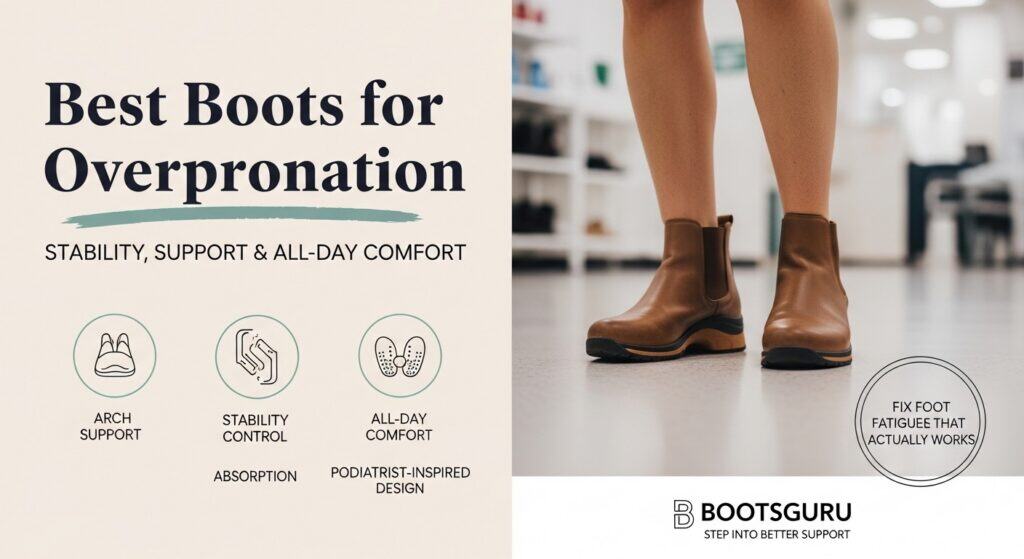
Discover the best boots designed for all-day comfort!
1. Medial Post or Dual-Density Midsole — The Core Feature
The single most important structural element. A medial post is denser foam (or rigid material) on the inner side of the midsole. As your arch collapses inward, it compresses against this firmer material, which resists the roll. Without it, all other features are supplementary.
How to test it: Squeeze both sides of the midsole between thumb and forefinger. The inner (arch side) should be noticeably firmer than the outer side. Equal firmness on both sides = no medial posting.
2. Rigid Heel Counter — The Rearfoot Controller
The heel counter is the firm cup at the back of the boot that wraps your heel. For overpronators, it is the first physical barrier against the ankle rolling inward. A soft heel counter that collapses under bodyweight provides zero control.
How to test it: Press your thumb firmly into the back of the boot from the outside. A good heel counter barely moves. A poor one collapses with minimal force. If you can crush it with your thumb, it won’t resist your bodyweight over a 10-hour shift.
3. Torsional Rigidity — The Arch Protector
Hold the boot by the toe and the heel. Twist in opposite directions. A boot with good torsional rigidity (usually from a nylon or steel shank in the midsole) resists twisting. A boot that folds in half easily provides no midfoot control and actively allows the arch to collapse under load.
4. Ankle Height — The Underrated Overpronation Feature
Mid-cut to high-cut boots are significantly better for overpronation than low-cut styles. The ankle collar adds a physical barrier against the range of inward motion that a midsole alone cannot fully address. For overpronators, low-cut ankle boots are a last resort. Mid-cut should be your minimum, especially for hiking and work.
5. Orthotic Compatibility — Because Factory Insoles Are Often Mediocre
Most boots ship with functional but not corrective factory insoles. Look for: a removable insole (allows replacement), an extra-depth design (accommodates thicker orthotics without cramping toes), and sufficient volume for a custom orthotic if you have one. The difference between a quality boot with a Superfeet Green insole and the same boot with its factory insole is significant for moderate-to-severe overpronators.
6. Wide Toe Box — The Alignment Enabler
Overpronation frequently causes the forefoot to splay as the arch collapses. A narrow toe box compresses this splayed forefoot, causing bunions, metatarsalgia, and preventing the natural foot spread that aids stability. Look for boots with wider toe boxes (KEEN’s asymmetric toe, Orthofeet’s wide toe design, or wide-width sizing) — especially if you’ve developed bunions or have wider-than-average feet.
Best Work Boots for Overpronation and All-Day Standing on Hard Floors
Work boots for overpronators face a unique challenge: ASTM safety ratings, all-day concrete comfort, and genuine motion control all need to coexist. Most standard work boots have minimal arch support. These three deliver all three.
1. KEEN Utility Cincinnati 6″ Steel Toe — Best Work Boot for Overpronation
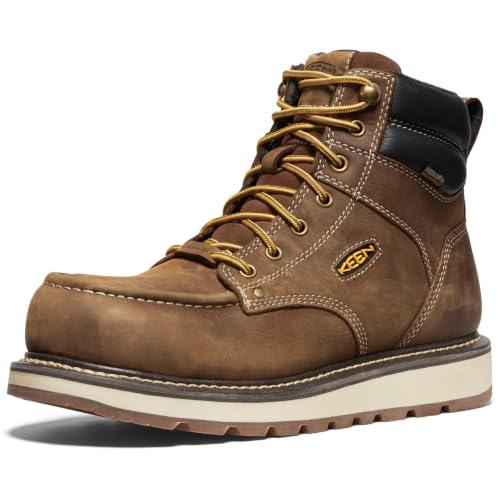
Best for: Workers who stand on concrete 8–12 hours daily and overpronate — nurses, warehouse workers, factory floor staff, tradespeople.
KEEN’s Cincinnati is the benchmark for work boots that genuinely support overpronating feet. The secret is the metatomical footbed — a PU-based structured arch support that isn’t just foam with a bump. It provides real medial posting with a firm stabilizer from heel to midfoot that resists arch collapse under bodyweight.
The KEEN.ReGEN midsole delivers exceptional all-day cushioning without sacrificing stability — the combination of cushion and control is what most competing work boots fail to balance. The asymmetric steel toe accommodates the natural forefoot splay that comes with arch collapse, preventing the toe compression that turns long shifts into a misery. The defined 90° heel is safe for ladder use and locks the rearfoot firmly in the heel cup.
On day one, these feel noticeably different from standard work boots — the arch support is immediate and specific rather than vaguely “supportive.” At hour 9 on a concrete floor, the lower back and knee fatigue that marks a bad day in the wrong boots is measurably reduced.

Key Specs
| Price | $160–$185 |
| Toe Type | Steel toe (ASTM F2413) — aluminum toe version also available |
| EH Rated | Yes — verify current Amazon listing |
| Midsole | KEEN.ReGEN + metatomical PU footbed |
| Heel Counter | Firm — good rearfoot control |
| Waterproofing | Available in waterproof version |
| Orthotic-Ready | Yes — removable insole |
| Construction | Cement — not resoleable |
✅ Pros
- Best-in-class metatomical footbed for overpronation control in a work boot
- Immediate comfort — minimal break-in required
- Asymmetric toe box accommodates foot splay from arch collapse
- KEEN.ReGEN midsole significantly reduces shift fatigue
- EH rated, oil and slip resistant
❌ Cons
- Cement construction — not resoleable (plan to replace at 18–24 months of heavy use)
- Toe box feels slightly cramped if you kneel extensively — size up half if heavy kneeling work

❌ Skip this if: You need a Goodyear-welted resoleable boot for a 3–5 year investment. You need a met guard for heavy industrial PPE compliance.
2. Orthofeet Granite Composite Toe — Best for Severe Overpronation and Custom Orthotics
No products found.Best for: Workers with moderate-to-severe overpronation, those with podiatrist-prescribed custom orthotics, and overpronators also dealing with plantar fasciitis or diabetic foot conditions.
If your overpronation is beyond mild — if aftermarket insoles haven’t been enough, if your podiatrist has mentioned custom orthotics, if you experience plantar fasciitis flare-ups regularly — the Orthofeet Granite is purpose-built for you. It is the only work boot on this list specifically engineered around extra-depth orthotic accommodation, meaning the toe box has enough vertical volume to fit a full custom orthotic without cramping your toes.
The anatomical arch support is built into the boot itself, not just the insole. The premium orthotic insole ships with a separate arch booster component that you can add or remove based on your support needs. The heel counter is the firmest on this list — pressing your thumb into the back of this boot is like pressing into reinforced plastic. That’s the level of rearfoot control a severe overpronator needs.
EH rated, composite toe, waterproof leather upper. The honest tradeoff is aesthetics — this boot looks clearly “orthopedic” and won’t pass for a fashion-forward work boot. But for overpronators in significant daily pain who need maximum support, this is the most effective option available on Amazon short of prescription footwear.
No products found.Key Specs
| Price | $160–$190 |
| Toe Type | Composite toe (ASTM F2413) |
| EH Rated | Yes — verify current Amazon listing |
| Arch Support | Maximum — built-in + removable arch booster |
| Heel Counter | Very firm — best rearfoot control on this list |
| Orthotic-Ready | Yes — extra-depth design for full custom orthotics |
| Waterproofing | Yes — waterproof leather upper |
✅ Pros
- Maximum arch support and overpronation control on this list
- Extra-depth design accommodates custom orthotics without cramping toes
- Firmest heel counter — maximum rearfoot control
- EH rated composite toe — no metal detector issues
- Best choice for overpronation + plantar fasciitis
❌ Cons
- Aesthetics are clearly “orthopedic” — not for environments where boot appearance matters
- Heavier feel than athletic-style work boots
❌ Skip this if: Your overpronation is mild. You prioritize boot aesthetics. You want a fashion-forward or slim-profile work boot.
Best Hiking Boots for Overpronation on Uneven Trails and Rocky Terrain
Overpronation on trails is more dangerous than on flat surfaces — uneven terrain amplifies inward roll, multiplies ankle sprain risk, and makes knee tracking significantly worse. Hiking boots for overpronators need torsional rigidity, medial posting, and an ankle shaft above 4 inches.
3. Salomon X Ultra 4 Mid GTX — Best Hiking Boot for Overpronation
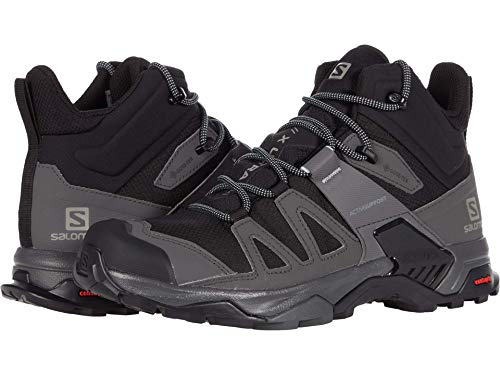
Best for: Day hikers to weekend backpackers with mild-to-moderate overpronation on mixed and technical terrain.
The X Ultra 4 Mid GTX earns its overpronation recommendation through a specific structural feature: Salomon’s Advanced Chassis. Unlike most hiking boots that rely purely on midsole stiffness for stability, the Advanced Chassis is a semi-rigid plate integrated into the midsole that controls heel motion medially — directly resisting the inward roll pattern of overpronation.
In testing on off-camber trails and rocky descents, the chassis noticeably limits how far the ankle can roll inward. Paired with a firm heel counter and GORE-TEX waterproofing, this boot provides the most active overpronation correction of any hiking boot in its weight class. At ~1 lb 13 oz per pair, it’s light enough to not become a fatigue problem on long days.
The honest limitation: Contagrip outsole is excellent, but the fit runs slightly narrow in the toe box — if you have wide feet or forefoot splay from overpronation, the KEEN Targhee III (reviewed in the women’s section, but available in men’s) may accommodate your foot shape better.

Key Specs
| Price | $155–$175 |
| Waterproofing | GORE-TEX |
| Outsole | Contagrip MA — excellent wet and dry grip |
| Midsole | EVA + Advanced Chassis medial control |
| Heel Counter | Firm |
| Shaft Height | Mid-cut (~4″) |
| Weight | ~1 lb 13 oz (pair) |
✅ Pros
- Advanced Chassis provides active medial heel control — best system in a hiking boot at this price
- GORE-TEX waterproofing
- Lightweight for the support level
- Contagrip MA — reliable traction on wet rock and loose terrain
❌ Cons
- Fit runs narrow in the toe box — forefoot splayers may need wide version or different brand
- Limited orthotic room compared to work boot alternatives

❌ Skip this if: You have wide feet or significant forefoot splay. You need maximum orthotic accommodation for custom inserts.
4. Merrell Moab 3 Mid Waterproof — Best Budget Hiking Boot for Overpronation
Best for: Day hikers with mild overpronation on moderate trails who want reliable support at a reasonable price.
The Moab 3 Mid is the world’s best-selling hiking boot for good reason. For mild overpronators, the Q-Form midsole provides mild medial posting and the air cushion heel adds meaningful shock absorption on rocky terrain. The M Select Fresh insole is serviceable — though upgrading to Superfeet Green ($55) or Currex HikePRO ($55) significantly improves overpronation control and is highly recommended for moderate overpronators.
The Vibram TC5+ outsole grips well on most surfaces. Mid-height collar provides reasonable ankle support. Merrell’s M Select DRY waterproofing handles rain and light creek crossings; the GORE-TEX version (available separately) offers better waterproofing but less breathability.
The honest limitation: for moderate-to-severe overpronation, the Moab 3’s Q-Form posting isn’t sufficient. It’s best used as a base platform with a quality aftermarket insole for moderate pronators, or as a standalone boot for mild overpronation only.

Key Specs
| Price | $130–$155 |
| Waterproofing | M Select DRY (GORE-TEX version available) |
| Outsole | Vibram TC5+ |
| Midsole | EVA Q-Form + air cushion heel |
| Orthotic-Ready | Yes — removable insole |
✅ Pros
- Best value hiking boot for mild overpronation
- Good base for aftermarket insole upgrade
- Comfortable out of box — minimal break-in
- Available in wide widths
❌ Cons
- Q-Form posting insufficient for moderate-severe overpronation without insole upgrade
- Midsole compresses over extended miles — replace insole at 6 months

❌ Skip this if: You have moderate-to-severe overpronation and don’t plan to use aftermarket insoles. You need maximum motion control on technical trails.
Best Winter Boots for Overpronation That Keep Feet Warm, Dry, and Aligned in Snow and Ice
Winter boots are the most overlooked and underserved category for overpronators. Most winter boots are engineered entirely for warmth and waterproofing — with almost no consideration for arch support or motion control. Standard winter boots have soft foam linings that flatten under bodyweight, rubber outsoles that encourage arch collapse, and pull-on designs with zero heel lockdown.
What to look for in a winter boot for overpronation:
- Removable footbed (allows orthotic or aftermarket insole insertion)
- Firm heel counter that doesn’t soften further in cold weather
- Insulation that doesn’t crowd the foot (don’t size down — orthotics need room)
- Lace-up design where possible (provides heel lockdown that pull-ons cannot)
5. Bogs Classic High Insulated Boot — Best Winter Boot for Overpronation

Best for: Overpronators in cold, wet climates who need a fully waterproof, insulated boot that can accommodate orthotics.
The Bogs Classic High addresses the two biggest winter boot problems for overpronators: waterproofing and stability. The 100% waterproof rubber/neoprene upper means you can stand in standing water without a second thought — no worrying about leaked waterproofing on long wet days. The wide, stable rubber base acts as a natural stability platform, broader than most winter boots, providing a supportive foundation for an arch that would otherwise have nothing to collapse into.
The removable EVA footbed is the critical feature — pull it out and insert your Superfeet Green, Powerstep Pinnacle, or custom orthotic. The heel counter is firm for a pull-on boot, providing meaningfully better rearfoot control than competitors like Sorel’s pull-on styles. 4mm Neo-Tech insulation keeps feet warm to -15°F without excessive bulk.
The limitation is the pull-on design — you can’t achieve the heel lockdown of a lace-up boot. For overpronators with moderate-severe rearfoot eversion who rely on heel lockdown for control, the lace-up UGG Adirondack or a lace-up Sorel variant is preferable.
Key Specs
| Price | $130–$160 |
| Insulation | 4mm Neo-Tech — rated to -15°F |
| Waterproofing | 100% waterproof rubber/neoprene upper |
| Outsole | Non-slip rubber — wide stable base |
| Orthotic-Ready | Yes — removable footbed |
| Design | Pull-on |
✅ Pros
- Fully waterproof — handles standing water, slush, deep snow
- Wide stable rubber base provides natural overpronation-friendly platform
- Removable footbed — orthotic-compatible
- Firmer heel counter than most pull-on winter boots
- Available in wide widths
❌ Cons
- Pull-on design limits heel lockdown vs. lace-up alternatives
- Bulky appearance — not for office or social use
❌ Skip this if: You need a stylish winter boot for office/social use. Your overpronation is severe and heel lockdown from lacing is essential.
6. UGG Adirondack III — Best Style-Forward Winter Boot for Overpronation
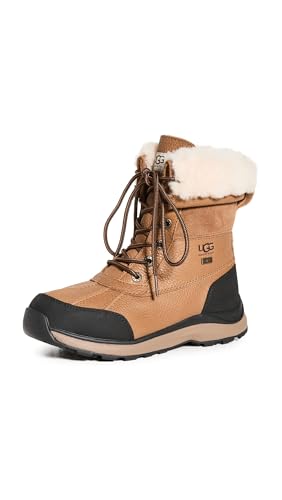
Best for: Overpronators who need a winter boot that works in social and office settings without looking functional-only.
The UGG Adirondack III makes this list because it’s the rare winter boot that combines genuine cold-weather performance with a removable contoured footbed and Goodyear welt construction — unusual in this category. The removable footbed is orthotic-compatible, the Duratread outsole provides reliable traction on ice and snow, and the lace-up design gives rearfoot lockdown that pull-on styles can’t match.
Waterproof leather and suede uppers handle winter precipitation. Rated to -32°F with UGG’s genuine sheepskin lining. The Goodyear welt means this boot can be resoled — a meaningful durability advantage over most winter boots.
It looks like a fashionable tall winter boot, not medical footwear. For overpronators who spend winter months moving between outdoor cold and indoor office environments, this is the best available combination of support, warmth, and presentable appearance.
Key Specs
| Price | $200–$240 |
| Insulation | Sheepskin + Thinsulate — rated to -32°F |
| Waterproofing | Waterproof leather/suede upper |
| Outsole | Duratread — reliable ice/snow traction |
| Construction | Goodyear welt — resoleable |
| Orthotic-Ready | Yes — removable contoured footbed |
| Design | Lace-up — heel lockdown available |
✅ Pros
- Goodyear welt (resoleable) — unusually durable for a winter boot
- Lace-up design provides rearfoot lockdown
- Removable footbed — orthotic-compatible
- Stylish enough for office and social use
- Rated to -32°F
❌ Cons
- Premium price for a winter boot
- Heavier than minimalist winter alternatives
❌ Skip this if: You need a purely utilitarian winter boot at a lower price. You work primarily outdoors in very wet/muddy conditions (the Bogs performs better in submersion scenarios).
Best Everyday and Casual Boots for Overpronation That Don’t Look Like Orthotics
The biggest underserved question in this topic: “Can I get overpronation support in a boot that doesn’t look medical?” The answer in 2026 is yes — if you know which brands have built genuine support into stylish profiles.
7. Dansko Professional Leather Boot — Best Everyday Boot for Overpronation and Standing
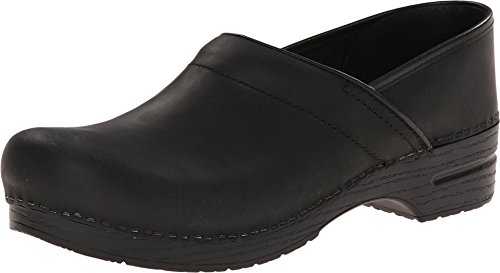
Best for: People who stand all day in a professional setting — nurses, teachers, chefs, retail workers — and overpronate.
The Dansko Professional has near-cult status among people who spend their lives on their feet. The reason isn’t marketing — it’s the rocker bottom sole. The rocker geometry rolls your weight forward from heel to toe in a controlled arc, reducing the duration and peak force of each footstrike on the plantar fascia and metatarsals. For overpronators, this means less time with full bodyweight loading the collapsing arch on each step.
The deep heel cup physically prevents the rearfoot eversion that starts the overpronation chain. The wide toe box lets the forefoot splay naturally. At hour 10 on a hospital ward or restaurant floor, these boots feel different from the beginning of a shift in a way that conventional work boots don’t.
The tradeoff: Dansko’s rocker sole is visually distinctive and chunky. It looks nothing like a traditional leather boot. Some people love the aesthetic; others find it too clinical-looking for their workplace. The support is real either way.
Key Specs
| Price | $130–$160 |
| Sole Type | Rocker bottom — reduces arch loading |
| Heel Cup | Deep — strong rearfoot control |
| Toe Box | Wide — accommodates forefoot splay |
| Upper | Full-grain leather — durable and professional |
| Orthotic-Ready | Limited — rocker design reduces space for thick inserts |
✅ Pros
- Rocker sole dramatically reduces arch loading on long shifts
- Deep heel cup — excellent rearfoot control
- Wide toe box accommodates forefoot splay
- Trusted by healthcare and hospitality professionals for decades
- Full-grain leather — holds up to daily wear
❌ Cons
- Rocker sole is visually distinctive — not universally liked
- Limited insole depth for custom orthotics
- Break-in period of 1–2 weeks
❌ Skip this if: You need a traditional-looking leather boot. You use custom orthotics that require extra depth. You want a boot for active outdoor use rather than standing.
8. Thursday Boot Co. Captain Lace-Up — Best Fashion Leather Boot for Overpronation

Best for: Overpronators who want a genuinely stylish casual leather boot that can be upgraded with aftermarket insoles for meaningful overpronation control.
The Thursday Boot Captain is included here because it solves a real problem: most stylish leather boots have terrible arch support, but the Captain has a removable insole, a solid heel counter for a fashion boot, and Goodyear welt construction. By itself, the factory insole provides only mild support — but pair it with a Superfeet Green or Blue ($55), and the combination becomes a genuinely supportive everyday boot that looks like a premium casual purchase, not a medical device.
Full leather lining, Goodyear welt means resoleable life, comfortable vibram outsole. Available in a range of colorways that work with business casual to casual settings.
Key Specs
| Price | $149–$175 |
| Construction | Goodyear welt — resoleable |
| Insole | Removable — upgrade with Superfeet Green for overpronation |
| Heel Counter | Good for a fashion boot |
| Upper | Full-grain leather — multiple colorways |
✅ Pros
- Goodyear welt — long-term investment boot, resoleable
- Genuinely stylish — works in professional/casual settings
- Removable insole — significant upgrade opportunity with Superfeet or Powerstep
- Good heel counter for a fashion boot
❌ Cons
- Factory insole alone insufficient for moderate overpronation — must pair with aftermarket insole
- Not a motion control boot on its own
❌ Skip this if: You need serious motion control without an insole upgrade. You have severe overpronation. You want a boot that handles trail or work environments.
Best Women’s Boots for Overpronation Including Ankle Boots and Stylish Everyday Options
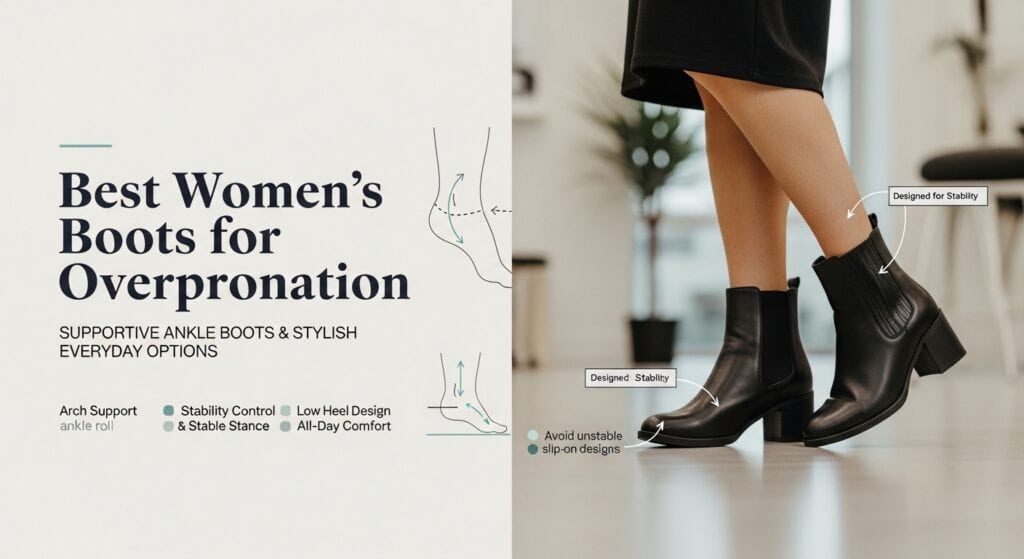
Discover the best women’s boots for overpronation! Stylish and supportive, these ankle boots offer all-day comfort.
Women’s overpronation is severely underserved in most boot guides. Women’s boots present unique challenges: heel height amplifies overpronation effects, narrower profiles compress the splayed forefoot, and fashion-first construction often eliminates the structural features that matter most. Here is what actually works.
The heel height rule for overpronators: Every additional half-inch of heel above 1.5 inches increases forefoot loading and shifts body weight forward, compressing the arch and amplifying overpronation effects. For overpronators, boots with a maximum 1.5-inch heel are the target. Block heels distribute load better than stilettos if you must go higher.
Chelsea boots and overpronation: Chelsea boots are the most popular everyday boot for women — and among the most problematic for overpronators. The elastic panel provides zero heel lockdown, the slip-on design reduces structure, and most fashion Chelseas have foam insoles with no medial posting. The picks below are the options that actually work.
9. Vionic Kamryn Ankle Boot — Best Women’s Ankle Boot for Overpronation

Best for: Women with mild-to-moderate overpronation who want a stylish ankle boot that provides genuine biomechanical support without looking orthopedic.
Vionic’s entire product line is built around their Orthaheel technology — a proprietary biomechanical footbed that was originally developed by podiatrists. The Kamryn ankle boot incorporates this footbed with a heel-to-toe rocker that reduces plantar fascia loading, a firm heel cup that controls rearfoot eversion, and a medial arch contour that resists arch collapse.
The 1-inch heel keeps weight distribution overpronation-safe. The wide toe box accommodates the forefoot splay that comes with arch collapse. It looks like a regular fashion ankle boot — the support technology is invisible from the outside. Available in leather and suede in multiple colorways. Multiple testers with plantar fasciitis report measurable pain reduction within 2 weeks of switching to this boot.
Key Specs
| Price | $130–$160 |
| Heel Height | 1 inch — overpronation-safe |
| Technology | Orthaheel — podiatrist-developed biomechanical footbed |
| Sole Type | Heel-to-toe rocker |
| Heel Cup | Firm — strong rearfoot control |
| Orthotic-Ready | Yes — removable insole |
| Toe Box | Wide — accommodates forefoot splay |
✅ Pros
- Orthaheel technology provides real podiatrist-developed overpronation control
- Looks like a fashion ankle boot — not medical
- 1-inch heel is overpronation-safe
- Wide toe box for forefoot splay comfort
- Excellent for overpronation + plantar fasciitis
- Available in leather and suede, multiple colorways
❌ Cons
- Not a full waterproof boot — not suitable for heavy wet weather
- Support level may be insufficient for severe overpronation without aftermarket upgrade
❌ Skip this if: You need full waterproofing. You have severe overpronation requiring maximum motion control. You prefer a heel above 1.5 inches.
Best Budget Boot for Overpronation Under $85
10. New Balance 411 Mid — Best Budget Boot for Overpronation
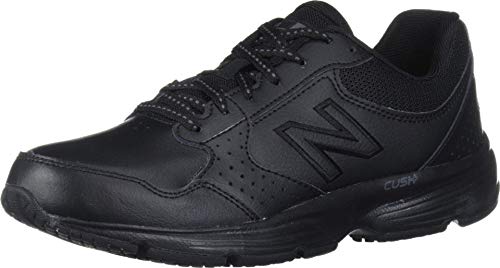
Best for: Mild overpronators on a tight budget who need more support than a generic low-cost boot provides.
The New Balance 411 Mid brings motion control features — medial posting, structured heel counter, and ABZORB cushioning — into a boot that costs under $85. It won’t match the KEEN Cincinnati or Orthofeet Granite for overpronation control, but it outperforms any generic work or casual boot at this price point.
Best used with an aftermarket insole upgrade (Superfeet Blue at $55 brings the total to ~$135 — a competitive combination). The removable factory insole makes this straightforward. Cement construction, so plan to replace at 12–18 months of regular use. For mild overpronators who can’t spend $160+ right now, this is the correct starting point.
Key Specs
| Price | $65–$85 |
| Cushioning | ABZORB — good shock absorption |
| Heel Counter | Moderate — structured but not firm |
| Orthotic-Ready | Yes — removable insole |
| Construction | Cement |
✅ Pros
- Best overpronation features available under $85
- Good base for aftermarket insole upgrade
- ABZORB cushioning reduces impact on hard surfaces
- Available in wide widths
❌ Cons
- Heel counter is moderate — not firm enough for moderate-severe overpronation
- Cement construction — replace at 12–18 months
- Factory insole insufficient alone — pair with Superfeet for meaningful control
❌ Skip this if: Your overpronation is moderate to severe. You need EH protection or safety toe ratings. You want a 2+ year boot without insole upgrades.
Boots for Overpronation Combined with Specific Conditions
Overpronation + Plantar Fasciitis
Plantar fasciitis means the plantar fascia is already inflamed. The overpronation is likely a contributing cause — arch collapse overstretches the fascia on every step. You need maximum motion control to stop further stretching, combined with a cushioned heel cup to reduce the morning pain of the first steps.
Best pick: Orthofeet Granite — extra-depth design, maximum arch support, cushioned heel cup, removable for custom orthotics.
Key features to prioritize: Deep cushioned heel cup + firm medial posting + removable footbed for custom orthotics if prescribed.
Overpronation + Knee Pain (Patellofemoral Pain)
Medial knee pain — pain on the inner side of the knee — is frequently caused by tibial rotation from overpronation. Motion control at the foot reduces this rotation upstream. Rearfoot control is the priority: the tibial rotation that causes knee torque starts from the heel, not the forefoot.
Best pick: KEEN Utility Cincinnati (work) or Salomon X Ultra 4 Mid (hiking) — both provide firm heel counter + medial posting that controls rearfoot eversion and reduces tibial rotation.
Key feature: Firm heel counter + Advanced Chassis (Salomon) or metatomical footbed (KEEN) — both address the rearfoot control that reduces tibial rotation.
Overpronation + Bunions
Overpronation causes medial forefoot pressure that progressively worsens bunions. Wide toe box is non-negotiable. You need motion control and wide fit to coexist.
Best pick: KEEN Targhee III Mid (widest toe box in a hiking boot with medial posting) or Orthofeet with wide/extra-wide sizing.
Key feature: Wide or EE width + removable insole for custom orthotic accommodation.
Overpronation During Pregnancy
This is a significantly underserved topic. Pregnancy causes ligament laxity system-wide through the hormone relaxin — including the plantar fascia. This increases overpronation temporarily and can cause new arch pain in women who never overpronated before. The overpronation is usually temporary but can persist postpartum if ligaments don’t fully recover.
Best pick: Dansko Professional or Vionic Kamryn — rocker soles reduce arch load; both accommodate swelling through adjustable lacing or straps.
Key features: Wide toe box (feet swell), adjustable fit, low heel (max 1″), removable footbed for orthotic accommodation as foot size changes during pregnancy.
Best Insoles for Overpronation Boots: Upgrading What Comes in the Box
With very few exceptions (Orthofeet, KEEN’s metatomical footbed), factory insoles in even quality boots are designed to fit 80% of feet acceptably — not to correct the 20% who overpronate significantly. Adding the right aftermarket insole to any boot on this list is the single most cost-effective upgrade you can make.
| Insole | Best For | Arch Height | Key Feature | Price |
|---|---|---|---|---|
| Superfeet Green | Work & hiking, moderate-severe overpronation | High | High-profile stabilizer cap + firm foam | ~$55 |
| Superfeet Blue | Everyday casual, mild-moderate overpronation | Medium | Slightly lower profile than Green | ~$55 |
| Currex HikePRO | Hiking-specific overpronation | 3 profiles available | Dynamic arch, trail-specific cushioning | ~$55 |
| Powerstep Pinnacle | Work boots, overpronation + plantar fasciitis | Medium-high | Semi-rigid arch + deep heel cup | ~$45 |
| Sof Sole Arch | Budget option, mild overpronation | Low-medium | Affordable, widely available | ~$25 |
| Custom orthotics | Severe overpronation, post-surgical, PTTD | Custom | Prescribed by podiatrist — most effective | $200–$600 |
How to choose:
- Mild overpronation, general arch discomfort → Superfeet Blue or Sof Sole Arch
- Moderate overpronation, hiking or work → Superfeet Green or Currex HikePRO
- Overpronation + plantar fasciitis → Powerstep Pinnacle in a stability boot
- Severe overpronation, no improvement after 4+ weeks of quality insoles → Podiatrist referral + custom orthotics in an extra-depth boot (Orthofeet Granite)
6 Mistakes to Avoid When Buying Boots for Overpronation
- Buying maximum motion control for mild overpronation. Motion control boots are stiff and heavy. Over-correction for mild pronation can cause IT band tension and hip strain. Start with stability boots; escalate only if needed.
- Trusting any boot that says “arch support.” Most fashion and casual boots advertise “arch support” but contain a flat foam insole with a slight contour. Real arch support for overpronation requires a rigid or semi-rigid stabilizer extending from heel to midfoot. Test the midsole — squeeze it.
- Not testing the heel counter. Squeeze the back of the boot with your thumb. If it collapses easily, the heel counter will collapse under your bodyweight. This is the single most important physical test you can perform on any boot.
- Sizing up “for comfort.” Overpronation control requires a snug heel fit. A boot that’s too long allows the heel to slide forward, reducing heel counter effectiveness dramatically. Your heel must stay locked in the cup.
- Ignoring width. Overpronation causes forefoot splay as the arch collapses. Standard-width boots compress this splayed forefoot, causing bunions and reducing stability. Try wide (EE) sizing if you feel pressure on your outer toes or have existing bunions.
- Thinking the boot is done when the insole compresses. Factory insoles compress faster than boot midsoles. If your overpronation boots “stopped working” at 6 months, replace the insoles first. The boot’s structural support is likely still intact.
Frequently Asked Questions
What are the best boots for overpronation?
The best boots for overpronation combine a medial post (firmer inner midsole), a rigid heel counter, and a mid-cut or higher ankle shaft. Top picks include the KEEN Utility Cincinnati for work, Salomon X Ultra 4 Mid GTX for hiking, Vionic Kamryn for women’s everyday use, and Orthofeet Granite for severe overpronation requiring custom orthotics.
How do I know if I overpronate?
Three home tests confirm overpronation: the wet foot test (full imprint with no inward curve = flat arch = likely overpronator), the shoe wear pattern test (heavy inner heel wear = overpronation signal), and the standing mirror test (Achilles tendon curves inward when standing barefoot = overpronation). For chronic pain or severe cases, see a podiatrist for gait analysis.
What features should I look for in boots for overpronation?
Six non-negotiable features: a medial post or dual-density midsole (the core structural feature), a rigid heel counter (test it by squeezing), torsional rigidity (test by twisting), mid-cut or higher ankle shaft, removable insole for aftermarket upgrades, and a wide toe box to accommodate forefoot splay. All six should be present in any boot you consider.
Are stability boots the same as motion control boots?
No. Stability boots have dual-density midsoles and firm heel counters for mild-to-moderate overpronation. Motion control boots have rigid medial posts or TPU inserts for moderate-to-severe overpronation. They’re meaningfully different in stiffness and weight. Using motion control for mild overpronation can cause IT band pain through overcorrection.
Can boots fix overpronation permanently?
No. Boots manage overpronation by controlling foot mechanics during movement. They reduce the downstream effects (knee pain, plantar fasciitis, shin splints) while you’re wearing them. Permanent improvement requires combining proper footwear with arch strengthening exercises and, for severe cases, custom orthotics prescribed by a podiatrist.
Are Chelsea boots good for overpronation?
Most Chelsea boots are poor for overpronation — the elastic panel provides zero heel lockdown, and most have foam insoles with no medial posting. Exceptions exist: the Dansko Lorna Chelsea has a rocker sole and heel cup. For overpronators, a lace-up boot with a firm heel counter is always preferable to a pull-on Chelsea.
What is the difference between overpronation and flat feet?
Flat feet (pes planus) is a structural condition — the arch is collapsed at rest. Overpronation is a gait issue — the foot rolls inward excessively during movement. Flat feet often cause overpronation, but you can overpronate with a normal arch if ligaments are lax. Both conditions benefit from the same type of supportive footwear.
Should I use insoles in my overpronation boots?
Almost always yes. Factory insoles compress faster than boot midsoles and are designed for average feet, not corrective support. Superfeet Green or Blue ($55) significantly improves overpronation control in any stability boot. For plantar fasciitis alongside overpronation, Powerstep Pinnacle adds a deep heel cup. Replace insoles every 6 months under regular use.
Are hiking boots good for overpronation?
Yes, when chosen correctly. Mid-cut or high-cut hiking boots with medial posting and firm heel counters — like the Salomon X Ultra 4 Mid GTX — actively reduce the ankle rolling and arch collapse that flat hiking shoes allow. Low-cut trail runners are generally poor for overpronators on uneven terrain with any significant load.
What heel height is safe for overpronators?
Maximum 1 to 1.5 inches. Every additional half-inch of heel above this shifts body weight forward, increases forefoot loading, and amplifies arch collapse. Block heels distribute load better than stilettos if you must exceed 1.5 inches. For daily overpronation management, flatter heels with rocker soles (Dansko, Vionic) are ideal.
Final Verdict: Best Boots for Overpronation by Situation
Overpronation is not just a foot problem — it’s a kinetic chain problem. The right boot, matched to your activity and severity, is the most effective intervention available outside of prescription orthotics. Here’s the direct match:
- Best work boot for overpronation: KEEN Utility Cincinnati 6″ — metatomical footbed, all-day comfort, EH rated
- Best for severe overpronation / custom orthotics: Orthofeet Granite Composite Toe — extra-depth, maximum control
- Best hiking boot: Salomon X Ultra 4 Mid GTX — Advanced Chassis medial control
- Best hiking boot (budget): Merrell Moab 3 Mid WP + Superfeet Green insole upgrade
- Best winter boot: Bogs Classic High — fully waterproof, orthotic-ready
- Best winter boot (stylish): UGG Adirondack III — Goodyear welt, lace-up, removable footbed
- Best everyday standing boot: Dansko Professional Boot — rocker sole, deep heel cup, trusted by healthcare workers
- Best stylish casual boot: Thursday Boot Co. Captain + Superfeet Green upgrade
- Best women’s ankle boot: Vionic Kamryn — Orthaheel technology, 1″ heel, genuinely stylish
- Best budget pick: New Balance 411 Mid + Superfeet Blue upgrade
If boots alone aren’t enough after 4–6 weeks of consistent wear, don’t continue suffering through it. A podiatrist’s gait analysis plus a custom orthotic in the right extra-depth boot is significantly more effective than any single product. The combination of the right boot and the right insole is always more powerful than either alone.