Your boots hit the ground before sunrise and don’t stop until after dark. They wade through mud, manure, wet grass, and concrete. They support your ankles in stirrups, protect your toes from falling equipment, and somehow need to stay comfortable through a 12-hour shift. Most boots simply aren’t built for that kind of punishment — but these are.
After researching dozens of models, cross-referencing safety certifications, material specs, and real-world user reviews from working farmers and ranchers, we’ve narrowed it down to the 8 best boots for farmers and ranchers — all available on Amazon, covering every major use case and budget.
Quick Comparison: Best Farm & Ranch Boots at a Glance
| Boot | Best For | Toe Type | Waterproof | Style | Check Price |
|---|---|---|---|---|---|
| Ariat WorkHog Waterproof | Best Overall | Soft toe | Yes | Western pull-on | Amazon → |
| Muck Boot Muckmaster Tall | Best Rubber Boot | Soft | 100% | Rubber pull-on | Amazon → |
| Georgia Boot Farm & Ranch Pull-On | Best Wellington | Soft toe | Yes | Wellington pull-on | Amazon → |
| Justin Boots 3001 Farm & Ranch | Best Western Style | Soft toe | No | Western roper | Amazon → |
| Ariat WorkHog XT Met Guard | Best Safety Protection | Steel toe + met guard | Yes | Western pull-on | Amazon → |
| Georgia Boot Farm & Ranch Lacer | Best Lace-Up | Soft toe | No | Lace-up work boot | Amazon → |
| Justin Women’s F&R Equestrian | Best for Women | Soft toe | No | Western pull-on | Amazon → |
| Georgia Boot Carbo-Tec Wellington | Best Budget | Soft toe | No | Wellington pull-on | Amazon → |
What to Look for in Farm & Ranch Boots
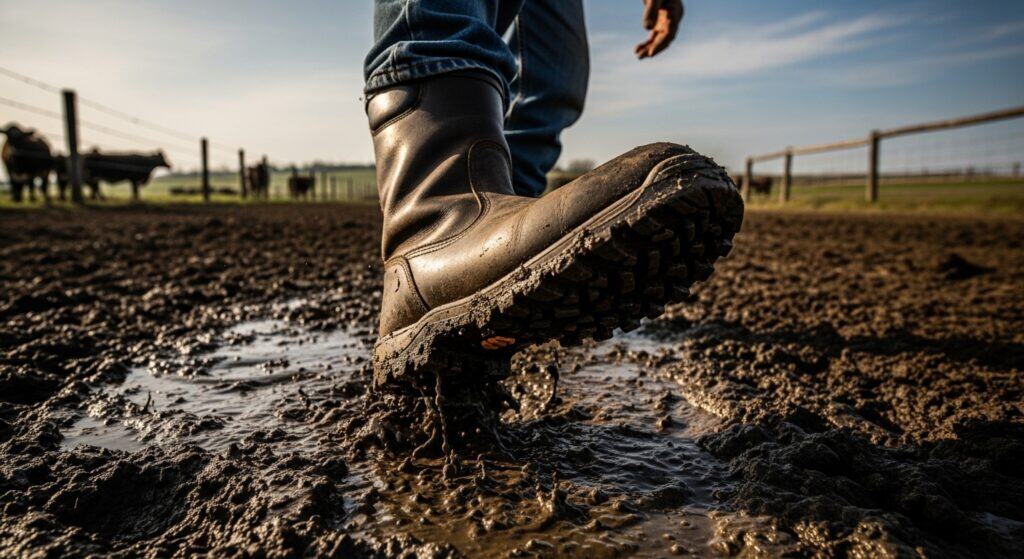
Embrace the farm life, one step at a time!
Before jumping into the reviews, here are the six factors that matter most when choosing boots for farm and ranch work:
Upper Material. Full-grain leather offers the best durability and chemical resistance, especially SPR leather (used by Georgia Boot), which is three times stronger and 2.5 times more abrasion-resistant than standard leather. Rubber uppers are completely impermeable and ideal for consistently wet or muddy conditions. Neoprene provides flexibility and insulation in cold weather.
Waterproofing. Not all waterproofing is equal. Rubber boots are inherently waterproof. Leather boots rely on membranes (like Gore-Tex or proprietary systems such as Ariat’s DRYShield), sealed seams, and treated leathers. Check whether the waterproofing covers the full boot or just the lower section.
Toe Protection. Steel toes (ASTM F2413 rated) protect against falling objects and compression from livestock or equipment. Composite toes are lighter and don’t conduct cold or heat. Soft toes are fine for low-hazard environments but offer no impact protection. Met guards add extra protection across the top of the foot.
Sole Construction. Goodyear welt construction is the gold standard — the upper and sole are sewn together, making the boot resoleable and far more durable. Direct-attach soles are bonded with adhesive, which is less expensive but not resoleable. Oil- and slip-resistant outsoles are essential on farms where surfaces can be wet, muddy, or chemical-contaminated.
Chemical & Barnyard Resistance. Farms expose boots to fertilizers, animal waste, caustic alkalis, and acids. SPR leather from Georgia Boot is specifically engineered to resist these substances. Rubber boots offer natural resistance. Standard leather without treatment degrades quickly in agricultural environments.
Comfort & Shaft Height. For all-day wear, look for cushioned insoles, a supportive steel shank, and a padded collar. Shaft height matters for mud protection — 10″ to 16″ is ideal for wet and muddy conditions. For drier environments or riding, a standard 10″–11″ western boot works well.
The 8 Best Boots for Farmers & Ranchers
1. Ariat WorkHog Waterproof — Best Overall

If you could only own one pair of boots for farm and ranch work, the Ariat WorkHog Waterproof would be the smartest choice. Ariat built this boot from the ground up for people who spend their entire working day on their feet in demanding conditions — and it shows in every design detail.

The WorkHog runs on Ariat’s ATS Max technology, which delivers exceptional side-to-side stability and serious arch support — something your body will notice after hour eight in the saddle or on uneven ground. The DRYShield waterproof system uses a full-grain leather upper with an impermeable moisture barrier and a three-row stitch pattern, keeping your feet dry through wet fields, morning dew, and unexpected downpours. The Duratread outsole is oil- and slip-resistant, passes hot contact tests at 572°F, and delivers excellent multi-surface traction.

The U-Turn Entry System makes pulling these on effortless even with high arches or wide feet — a small detail that becomes a big deal when you’re putting boots on at 5am every morning. The Goodyear welt construction means this boot can be resoled, extending its working life significantly beyond cheaper alternatives. It meets ASTM F2892 standards for electrical hazard resistance, adding an extra layer of safety around agricultural equipment.
Key Features:
- ATS Max platform — maximum torsional stability and arch support
- DRYShield waterproof breathable construction
- Full-grain leather upper with three-row stitch pattern
- Duratread outsole — oil/slip-resistant, hot contact rated to 572°F
- Goodyear welt construction — resoleable
- ASTM F2892 EH (electrical hazard) rated
- U-Turn Entry System for easy on/off
Pros:
- Exceptional all-day comfort — noticeably reduces foot fatigue on long shifts
- Reliable waterproofing across the entire boot
- Resoleable Goodyear welt for long-term value
Cons:
- Soft toe only — no steel or composite toe protection in this version
- Higher price point than budget alternatives
Bottom Line: The Ariat WorkHog Waterproof is the best all-around farm and ranch boot on the market. It handles wet fields, long days, and rough terrain better than any other boot in its class. If you work outdoors daily, this is where your money belongs.
2. Muck Boot Muckmaster Tall — Best Rubber Boot
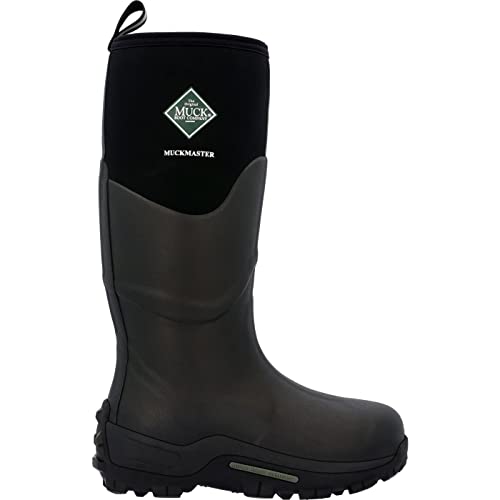
When you’re wading through mud, muck, standing water, or the kind of conditions that would ruin leather boots in a season, the Muck Boot Muckmaster Tall is the tool you need. This boot was literally designed for farmers — it’s been a staple on working farms for over two decades for good reason.

The Muckmaster is built around a vulcanized rubber outer shell that is 100% waterproof — not water-resistant, completely waterproof. Extended rubber overlays run up the calf to add an extra layer of puncture resistance, protecting against sharp debris, wire, and sticks. Inside, a 5mm neoprene bootie with four-way stretch nylon conforms to the foot’s natural shape and retains warmth, while a 2mm thermal foam underlay adds insulation at the instep. The breathable Airmesh lining wicks away moisture and keeps air circulating, preventing the sweaty discomfort that’s common in full-rubber boots.

The Stretch-Fit Comfort Topline seals around the calf to keep cold, water, and debris out. The contoured EVA footbed provides cushioning for extended wear. The molded rubber MS-1 outsole offers aggressive, durable traction on wet grass, mud, and uneven terrain. At 16 inches tall, this boot gives you serious height protection without having to tuck your pants in.
Key Features:
- 100% waterproof vulcanized rubber construction
- Extended rubber overlays for puncture resistance
- 5mm neoprene bootie — insulates to sub-freezing temperatures
- 2mm thermal foam underlay at instep
- Breathable Airmesh lining
- Contoured EVA footbed with molded rubber outsole
- 16″ shaft height with Stretch-Fit Comfort Topline
Pros:
- Absolute waterproof protection — no exceptions
- Warm enough for cold weather, breathable enough for warmer days
- Easy to hose clean after barn and field work
Cons:
- Not suited for all-day walking on hard surfaces like concrete
- Heavier than leather boots — takes adjustment if switching from leather
Bottom Line: If your daily work involves consistently wet, muddy, or mucky conditions — barn cleaning, livestock feeding in wet weather, irrigation work — the Muck Boot Muckmaster Tall is unbeatable. This is what rubber boots look like when they’re built specifically for hard agricultural use.
3. Georgia Boot Farm & Ranch Pull-On Wellington — Best Wellington
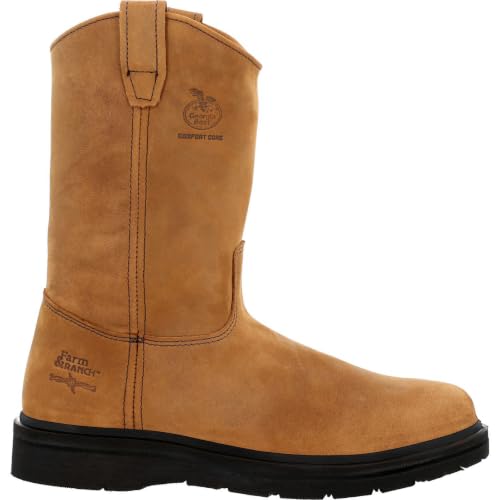
Georgia Boot has been making boots specifically for farm and ranch workers since 1937, and the Farm & Ranch Pull-On Wellington is the direct descendant of that original farm boot. It’s a classic for a reason — this boot solves the specific problems that agricultural environments create for footwear.

The standout feature is the upper material: SPR leather. This is Georgia Boot’s proprietary tanning process that produces leather three times stronger and 2.5 times more abrasion-resistant than standard leathers. More importantly for farm use, SPR leather is specifically engineered to resist barnyard acids and caustic chemicals — sulfuric acid, calcium hydroxide, caustic alkali, potassium phosphate, and the various corrosive substances your boots encounter daily on a working farm. Standard leather degrades rapidly in these conditions; SPR leather doesn’t.

The sole is a direct-attached, dual-density polyurethane Suspension wedge outsole — it resists chemicals, abrasions, and oils, while remaining flexible and cushioned underfoot. The pull-on wellington design means no laces to get clogged with mud. The 11-inch shaft height provides solid ankle and lower leg coverage. A steel shank runs through the midsole for arch support and steady footing on uneven terrain, which matters when you’re climbing in and out of tractors or navigating muddy paddocks all day.
Key Features:
- SPR leather upper — 3× stronger, 2.5× more abrasion-resistant than standard leather
- Resistant to barnyard acids and caustic chemicals
- Dual-density polyurethane Suspension wedge outsole
- Pull-on wellington design — no laces
- 11″ shaft height
- Steel shank for arch support
- Oil- and chemical-resistant outsole
Pros:
- SPR leather is genuinely superior for chemical-heavy farm environments
- Easy pull-on design — practical for multiple daily boot changes
- Excellent long-term durability
Cons:
- Requires a break-in period before reaching full comfort
- Not the most insulated option for cold climates
Bottom Line: The Georgia Boot Farm & Ranch Pull-On is the workhorse wellington for people who deal with chemicals, animal waste, and barnyard conditions every day. The SPR leather genuinely outperforms standard materials in agricultural environments. This is a boot built specifically for your job.
4. Justin Boots 3001 Farm & Ranch 10″ — Best Western Style

The Justin Boots 3001 Farm & Ranch has been a go-to boot for working cowboys and ranchers since Justin Boot Company first put it on the market. It’s the kind of boot you can wear from sunrise chores to a night out in town without changing — a genuinely versatile all-rounder that blends ranch-ready practicality with authentic western style.

Justin’s J-Flex Comfort System is the core of what makes this boot work for long days. The triple-density insole board and memory foam midsole work together to conform to your individual foot shape, reducing friction and providing custom-like cushioning without the custom price. The break-in period is noticeably shorter than many western work boots. The synthetic rubber outsole offers multi-surface traction and holds up well on dirt, gravel, and packed earth, though it’s not ideal for deep mud.

The 10-inch shaft height hits the sweet spot between ankle protection and ease of movement. The roper toe gives more room at the front than a traditional pointed cowboy boot — important for wide feet or when you’re on your feet all day. The leather upper is durable and breaks in to a personalized fit. For ranchers who ride and work on foot, this boot transitions between both tasks naturally.
Key Features:
- J-Flex Comfort System with triple-density insole board
- Memory foam midsole for personalized cushioning
- 10″ shaft height with roper toe
- Synthetic rubber utility outsole
- Full leather upper
- Pull-on design with leather pull straps
Pros:
- Genuinely comfortable from early in the break-in period
- Versatile enough for riding, ranch work, and casual wear
- Authentic western styling made by a brand with 145 years of boot-making history
Cons:
- Not waterproof — not suitable for consistently wet conditions
- Tread pattern not ideal for thick mud
Bottom Line: The Justin 3001 is the right boot for ranchers and farmers who work in drier conditions and want a boot that handles the workday and still looks the part. It’s a classic western work boot that earns its place in any barn.
5. Ariat WorkHog XT Met Guard — Best for Heavy Safety Requirements

When your work environment involves heavy machinery, falling equipment, or significant foot hazard risk, you need more than a standard work boot. The Ariat WorkHog XT Met Guard is built for the most demanding farm and ranch safety requirements — it combines the comfort and western functionality of the WorkHog line with serious protective hardware.

The defining feature here is the metatarsal guard — a protective component built over the top of the foot that guards against impact and compression across the metatarsal bones, which are among the most commonly injured bones in agricultural equipment accidents. The steel safety toe meets ASTM F2413 standards for impact and compression protection. The DRYShield waterproof construction uses full-grain leather and an impermeable moisture barrier to keep water out across the entire boot, not just the toe box.

Ariat’s ATS Max platform provides the same industry-leading stability and arch support that makes the WorkHog line the benchmark for ranch footwear. The extra-wide stability shank paired with a lightweight EVA midsole delivers all-day cushioning without adding significant weight. The Duratread outsole is oil- and slip-resistant with maximum wear resistance, and it passes hot contact tests — relevant if you’re working near welding operations or hot surfaces on farm equipment. The U-Turn Entry System makes getting in and out of the boot straightforward despite the safety hardware.
Key Features:
- Metatarsal guard for top-of-foot protection
- ASTM F2413 steel safety toe
- DRYShield waterproof breathable construction
- ATS Max platform — maximum stability and arch support
- Full-grain leather upper with Cordura reinforcement
- Duratread outsole — oil/slip-resistant, hot contact rated
- Goodyear welt construction
- EH (electrical hazard) rated
Pros:
- Comprehensive protection — steel toe, met guard, and EH rating in one boot
- Waterproof with Ariat’s reliable DRYShield system
- Comfortable enough for all-day wear despite the safety features
Cons:
- Heavier than non-safety versions due to protective components
- Premium price reflects the level of protection
Bottom Line: If you work around heavy farm equipment, tractors, loaders, or any situation where foot and metatarsal injuries are a real risk, the Ariat WorkHog XT Met Guard gives you the best protection available in a western work boot format. It doesn’t compromise comfort to deliver that protection.
6. Georgia Boot Farm & Ranch Lacer — Best Lace-Up
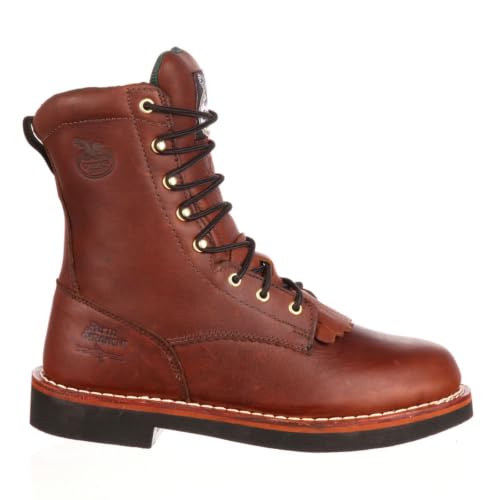
Not every farmer or rancher prefers a pull-on boot. For those who want the locked-in, adjustable fit of a lace-up work boot, the Georgia Boot Farm & Ranch Lacer delivers all of the same agricultural engineering that makes Georgia Boot’s Farm & Ranch line exceptional — in a traditional lace-up format.

Like all Farm & Ranch series boots from Georgia, the Lacer uses SPR leather — the proprietary tanning process that makes the upper three times stronger and 2.5 times more abrasion-resistant than standard leather, with genuine resistance to barnyard acids and caustic chemicals. The upper also features flex-notched quarters, which allow the boot to flex naturally when you crouch, kneel, or bend — important when you’re doing hands-on work with animals or equipment all day.

The brush guard kiltie protects the lace area from debris, mud, and plant material getting down into the boot — a thoughtful detail for field work. Inside, a cushioned insole covered in soft mesh material provides comfort on long shifts. A steel shank supports the arch and provides steady footing. The genuine leather welt construction adds durability and strength. The X-10 polyurethane outsole is oil- and chemical-resistant, non-marking, and provides good flexibility. The removable kiltie allows a more traditional work boot look if you prefer it.
Key Features:
- SPR leather upper — chemical and barnyard acid resistant
- Goodyear welt construction with genuine leather welt
- Flex-notched quarters for natural crouching and bending
- Brush guard kiltie to keep debris out of the lace area
- Steel shank for arch support
- X-10 polyurethane outsole — oil, chemical, and non-marking
- Cushioned insole with mesh lining
- 8″ shaft height
Pros:
- Adjustable lace-up fit — better ankle support than pull-on designs
- SPR leather holds up exceptionally well to agricultural chemicals
- Kiltie keeps debris away from laces during field work
Cons:
- Laces can get muddy and clogged in very wet conditions
- Lower shaft than the wellington version — less mud protection
Bottom Line: The Georgia Boot Farm & Ranch Lacer is the best lace-up option for agricultural workers who want a precise, adjustable fit along with genuine chemical resistance. It’s built to the same exacting standards as the rest of Georgia Boot’s Farm & Ranch line.
7. Justin Women’s Farm & Ranch Equestrian Boot — Best for Women
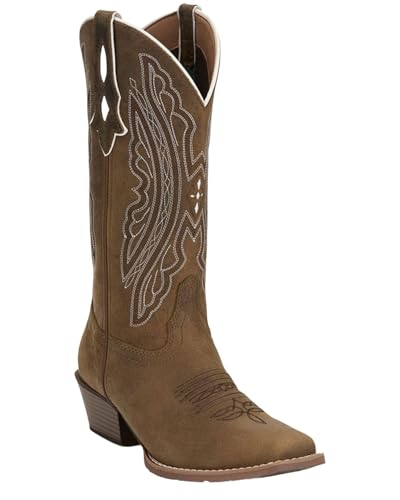
Female farmers and ranchers have long been underserved by the work boot market, forced to size down in men’s boots that don’t fit correctly. Justin Boots addressed this directly with the Women’s Farm & Ranch Equestrian Boot — a boot designed from the ground up for the female foot, not adapted from a men’s model.

The last (the form over which the boot is constructed) is built specifically for women’s foot anatomy — narrower heel, different arch placement, and a fit through the instep that works with how a woman’s foot is actually shaped. This matters enormously for all-day comfort. Justin’s J-Flex Comfort System provides cushioning through the triple-density insole and memory foam midsole, conforming to the individual foot over time. The leather upper is genuine quality — durable enough for daily farm work and barn chores.

The rubber outsole provides practical multi-surface traction on the varied terrain that farm and ranch work involves — dirt, gravel, concrete, and grass. The pull-on design with leather pull tabs makes getting in and out of the boot straightforward, even when muddy hands are involved. The boot height provides good ankle coverage without restricting movement. For women who ride and work on foot, this boot handles both tasks effectively.
Key Features:
- Designed specifically on a women’s last — not a scaled-down men’s boot
- J-Flex Comfort System with triple-density insole
- Memory foam midsole for custom cushioning
- Full leather upper
- Rubber outsole for multi-surface traction
- Pull-on design with leather pull tabs
- Justin’s 145+ year heritage of western boot craftsmanship
Pros:
- True women’s fit — significantly better comfort than sized-down men’s boots
- J-Flex system delivers excellent all-day comfort
- Versatile enough for riding, working, and off-the-farm wear
Cons:
- Not waterproof — not ideal for consistently wet conditions
- May require a short break-in period
Bottom Line: The Justin Women’s Farm & Ranch Equestrian Boot is the go-to recommendation for female farmers and ranchers who want a boot that fits correctly, works hard, and looks the part. A properly fitting women’s last makes a genuine difference after a full day on your feet.
8. Georgia Boot Carbo-Tec Wellington — Best Budget Pick
No products found.Not everyone needs — or wants to spend — top dollar on farm boots. The Georgia Boot Carbo-Tec Wellington proves that you don’t have to sacrifice quality for budget. This is Georgia Boot’s agricultural engineering applied to a more accessible price point, and it delivers serious value for the cost.
No products found.The upper is still SPR leather — the same proprietary material used in Georgia Boot’s premium Farm & Ranch line, three times stronger and 2.5 times more abrasion-resistant than standard leather, with resistance to barnyard acids and caustic chemicals. This is not a corners-cut situation. Where the Carbo-Tec differs is in its unique outsole system: the Carbo-Tec outsole is highly flexible — more so than the suspension outsoles found on pricier models — and is specifically formulated to resist slipping, chemicals, and oil exposure. It’s a softer, more flexible ride that some farmers actually prefer for long hours on their feet.
No products found.The Comfort Core insole provides cushioning with an integrated air flow system that pushes air through the insole with each step, helping regulate temperature during long shifts. A fiberglass shank (rather than steel) provides arch support while being lighter underfoot. The 11″ pull-on wellington shaft offers good mud and debris protection. For part-time farmers, seasonal agricultural workers, or anyone who needs reliable farm footwear at a sensible price, this boot punches well above its cost.
Key Features:
- SPR leather upper — barnyard acid and chemical resistant
- Carbo-Tec outsole — highly flexible, slip/oil/chemical resistant
- Comfort Core insole with integrated air flow system
- Fiberglass shank for lightweight arch support
- 11″ pull-on wellington shaft
- No-lace pull-on design
Pros:
- SPR leather at a budget price — genuine agricultural protection
- Highly flexible Carbo-Tec outsole — unusually comfortable for the price
- Great value for part-time or seasonal farm use
Cons:
- No waterproof membrane — less protection in very wet conditions
- Fiberglass shank provides less support than steel for very heavy work
Bottom Line: The Georgia Boot Carbo-Tec Wellington is the best bang-for-buck farm boot on this list. You get Georgia Boot’s proven SPR leather and agricultural engineering at a price that makes sense for farmers who need a reliable spare pair, seasonal workers, or anyone working a smaller operation.
How We Selected These Boots
Our selection process for the best boots for farmers and ranchers was built around the specific demands of agricultural work, not general work boot criteria. We evaluated each boot against six core factors: upper material quality and chemical resistance, waterproofing system reliability, safety toe certification and protection level, sole construction durability and resoleability, slip and oil resistance, and long-term comfort for all-day wear on uneven terrain.
Safety ratings were verified against ASTM standards. Material specs were cross-referenced with manufacturer documentation. We prioritized boots from brands with a track record in agricultural footwear, and weighted user reviews from verified purchasers who identified themselves as working in farming, ranching, or agricultural settings.
All products were selected exclusively from Amazon.com to ensure straightforward purchasing, reliable shipping, easy returns, and consumer protection through Amazon’s buyer guarantee.
Frequently Asked Questions
Are rubber boots or leather boots better for farm work?
It depends on your conditions. Rubber boots are the superior choice for consistently wet, muddy, or mucky environments — they’re completely waterproof and easy to clean. Leather boots (especially those using SPR leather) are better for varied conditions, chemical resistance on drier days, all-day comfort on hard surfaces, and situations where you need both a work boot and something you can wear off the farm. Many farmers own both — rubber for the barn and wet season, leather for general ranch work.
Do I need steel toe boots for farming?
It depends on your specific tasks. If you work regularly around heavy equipment — tractors, loaders, ATVs, PTO equipment — or handle heavy loads that could be dropped on your feet, steel or composite toe protection is strongly recommended and may be legally required in some commercial farming operations. For lighter farm work like livestock handling, garden farming, or field work where heavy equipment isn’t a major factor, a quality soft-toe boot is often more comfortable for long days on your feet.
How do I clean and maintain farm boots?
After each use, rinse mud, manure, and debris with a hose. For leather boots, wipe down with a damp cloth and mild soap, then apply a leather conditioner to maintain flexibility and prevent cracking. Never use petroleum-based products on leather. For rubber boots, a gentle detergent and water works well — let them air dry out of direct sunlight. Store all boots upright in a cool, dry area. Inspect regularly for sole separation, cracking rubber, or worn heel blocks, and address wear early before it becomes a bigger problem.
What shaft height is best for muddy conditions?
For consistently muddy environments, a shaft height of 11″ to 16″ is recommended. The Muck Boot Muckmaster Tall at 16″ gives you the most protection against mud and water entry. Georgia Boot’s wellington models at 11″ are a good middle ground — enough height for most field and barn conditions without the weight and heat of a taller rubber boot. For drier ranch work, a standard 10″ western boot provides good ankle coverage without the excess height.
Can I use cowboy boots for ranch work?
Traditional western cowboy boots — including the Justin 3001 on this list — are genuinely functional for ranch work, particularly for tasks that involve riding. The angled heel seats well in a stirrup, and the shaft provides ankle support. However, for demanding foot-protection scenarios involving heavy equipment, wet conditions, or chemical exposure, a purpose-built work boot or an agricultural wellington will serve you better. The best ranchers often have both: a western boot for riding and lighter work, and a heavy-duty work boot or rubber boot for the tougher jobs.
How should farm boots fit?
Farm and ranch boots generally run true to size, but there are a few important considerations. Pull-on western boots often benefit from going a half size down compared to your sneaker size, as leather stretches over time. Leave enough room to wear a thick work sock — your toes should have about a thumb’s width of space at the front. The heel should feel snug with minimal slip when walking (some heel slip when new is normal and will reduce as the boot breaks in). For rubber boots, some wearers prefer a slightly larger size to accommodate thick insulating socks in cold weather.
Final Verdict
The right boot for your farm or ranch depends on your specific conditions, tasks, and priorities. Here’s a quick recap to help you decide:
- Best overall choice for most farmers and ranchers: Ariat WorkHog Waterproof — exceptional comfort, reliable waterproofing, and Goodyear welt durability for daily use.
- Best for wet and muddy conditions: Muck Boot Muckmaster Tall — unbeatable 100% waterproof protection for barn work and wet-season farming.
- Best for chemical-heavy farm environments: Georgia Boot Farm & Ranch Pull-On — SPR leather purpose-engineered to resist barnyard acids and caustic chemicals.
- Best western style for riding and ranch work: Justin Boots 3001 Farm & Ranch — 145 years of western boot heritage with genuine all-day comfort.
- Best for heavy equipment safety: Ariat WorkHog XT Met Guard — steel toe, met guard, and EH rating for the most hazardous farm environments.
- Best lace-up for precise fit: Georgia Boot Farm & Ranch Lacer — adjustable fit with the same SPR leather protection as the wellington.
- Best for women: Justin Women’s Farm & Ranch Equestrian Boot — a true women’s last that fits correctly from day one.
- Best budget pick: Georgia Boot Carbo-Tec Wellington — Georgia Boot’s agricultural-grade SPR leather at an accessible price point.
Whatever you choose, the right boots aren’t a luxury in this line of work — they’re a tool. Invest in a pair that matches your conditions, and your feet will thank you at the end of every long day.