There is nothing—and I mean nothing—more frustrating than waiting a week for a new pair of boots, ripping open the box, and finding out they crush your pinky toe or flop around your heel. Sizing issues are one of the leading causes of online footwear returns, costing you time, money, and endless frustration.
Here’s the hard truth: You probably don’t know your real boot size.
Most people guess based on the sneakers they’ve worn for the last five years. But boots are different beasts. A size 10 in a running shoe is almost never a size 10 in a heritage leather boot. And that’s before we even talk about width, which most people never measure at all.
This comprehensive guide will teach you how to measure both your foot length and width at home, convert those measurements into actual boot sizes, and understand how different brands fit. By the end, you’ll know your exact measurements and how to use them to find boots that actually fit—the first time.
Let’s start measuring.
Quick Action Menu
Don’t have time to read the whole guide? Jump straight to what you need:
Why You Should Never Guess Your Boot Size
you should never guess your boot size
The biggest mistake I see? People assuming their “Nike size” is their universal foot size.
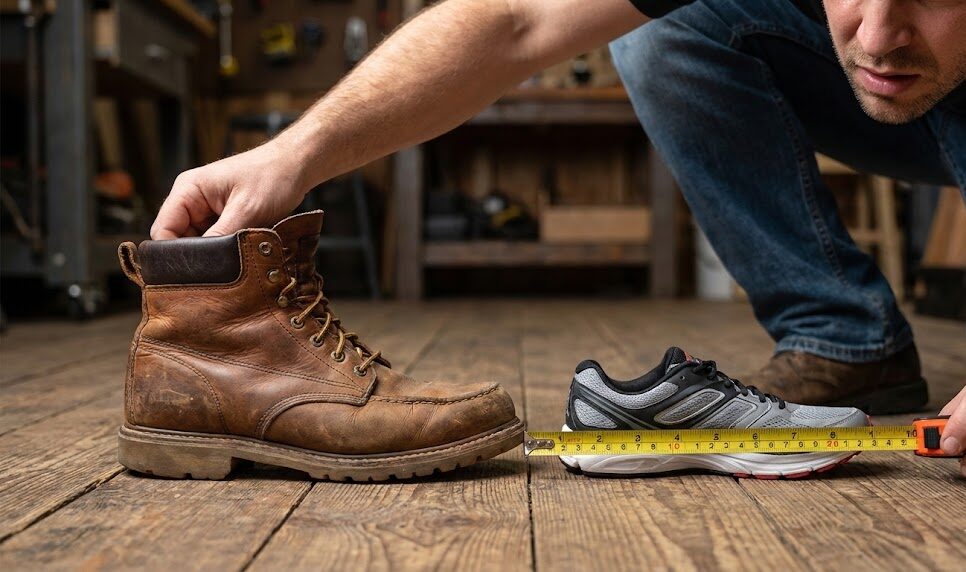
Sneakers and boots are built on completely different “lasts”—the foot-shaped molds used to shape the shoe. Sneakers have thick padding, flexible knit uppers, and forgiving materials that mask sizing errors. Boots—especially leather work boots or heritage boots—are structured, stiff, and unforgiving. If you get the size wrong, the boot won’t just be uncomfortable; it can cause long-term damage to your feet.
The “Size 10” Myth
You might be a 10.5 in Nike running shoes, a 9.5 in Red Wing Iron Rangers, a 10 in Timberland hiking boots, and a 11 in Dr. Martens. All of these could fit the same foot perfectly.
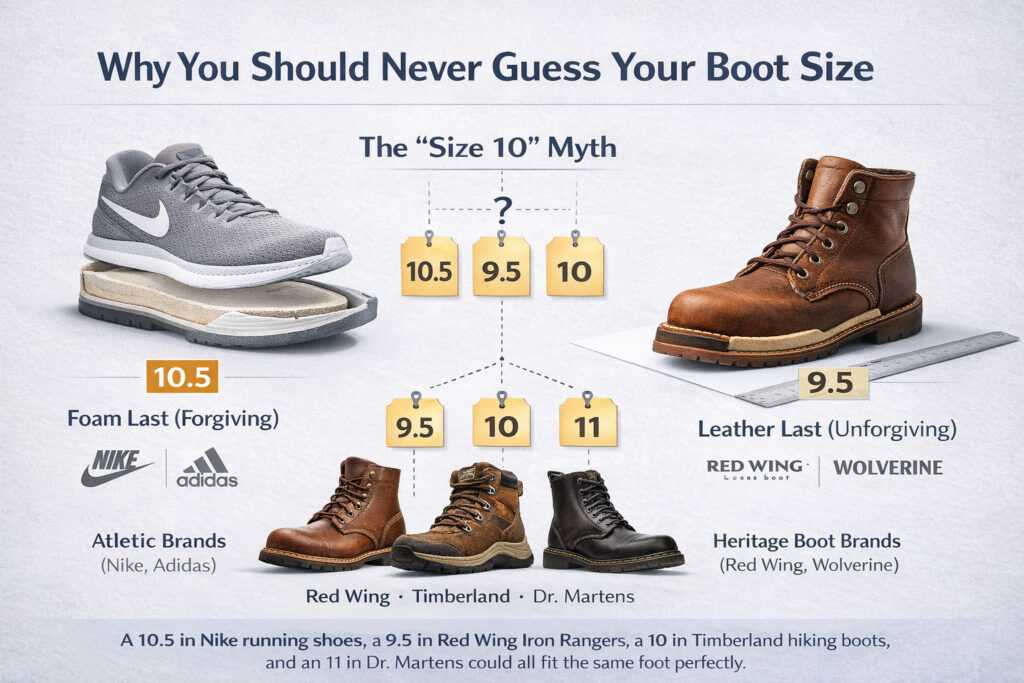
never guess your boot size
Why Such Dramatic Differences?
- Athletic brands (Nike, Adidas) design around athletic lasts with generous toe boxes and lightweight construction.
- Heritage boot brands (Red Wing, Wolverine) use traditional lasts developed decades ago for work or military use.
- Western boot makers (Ariat) use a fitting philosophy where the instep fit matters more than toe room.
If you guess based on your gym shoes, you will likely end up with boots that are too big, too narrow, or awkwardly proportioned. Spending 10 minutes measuring your feet today will save you weeks of blister management later.
Why Proper Boot Sizing Matters
Getting your boot size right isn’t just about comfort—though that matters plenty. It’s about your health, safety, and getting the full value from your purchase.
- Health Implications: Boots that are too narrow can cause ingrown toenails, corns, bunions, and nerve compression. If they’re too short, you risk bruising your toes (“toe bang”) when hiking downhill.
- Performance & Safety: In work environments, loose boots are a trip hazard. If your foot slides inside the boot, you lack stability on uneven ground.
- Financial Benefits: Properly fitted boots last longer. When boots fit right, the wear patterns are even, and the leather doesn’t crease prematurely.
When to Measure Your Feet
Your feet are shapeshifters. They are not the same size at 8:00 AM as they are at 5:00 PM.
Due to gravity and blood flow, your feet swell throughout the day. Always measure your feet in the late afternoon or evening. If you measure first thing in the morning, you’ll buy boots that feel great at breakfast and like a vice grip by dinner.
Other Important Timing Considerations:
- Wear the right socks: Measure while wearing the type of socks you plan to wear with your boots. Thick wool hiking socks can add a full half-size compared to thin dress socks.
- Measure both feet: About 60% of people have one foot larger than the other. Always size your boots to fit the larger foot.
Materials You Need
You don’t need a fancy Brannock device. You can get an accurate measurement with household items:
- Blank sheet of paper (larger than your foot)
- Pencil or pen
- Ruler or measuring tape (inches and centimeters)
- Hard, flat surface (tile or wood, not carpet)
- Wall or straight edge
- The socks you plan to wear
How to Measure Foot Length: Step-by-Step
There are two reliable methods. The Wall Method is generally the most foolproof for DIY measurement because it reduces the chance of the paper slipping.
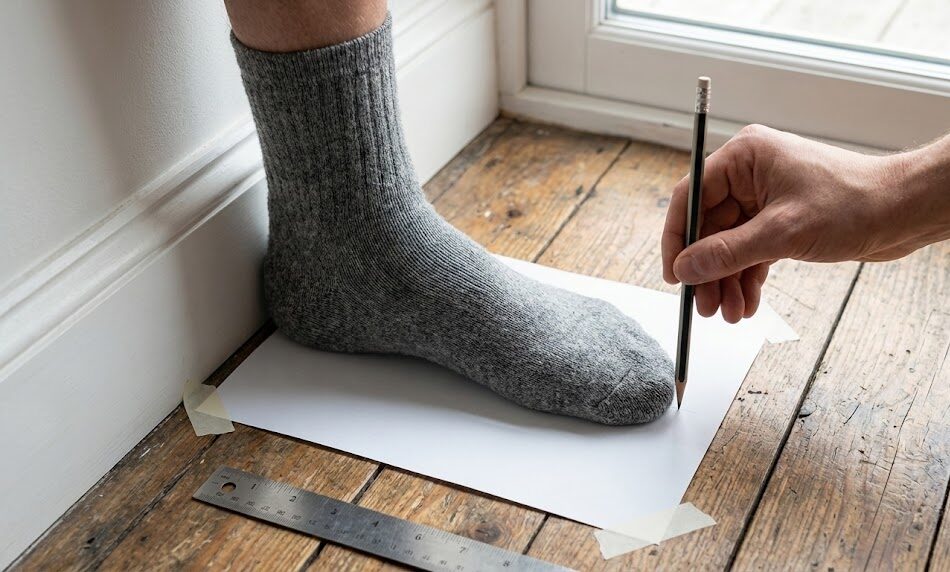
the wall method
Method 1: The Wall Method (Recommended)
- Prep Your Surface: Tape your paper to the floor so one short edge is flush against a wall.
- Position Your Foot: Place your heel against the wall with your foot centered on the paper. Stand up straight. (Sitting gives an inaccurate reading).
- Mark Your Longest Toe: Have a helper use the pencil to mark the tip of your longest toe.Pro Tip: The 90-Degree Rule. Keep the pencil absolutely vertical. If you angle it inward, you’ll undercut the measurement and buy boots that are too small.
- Measure: Step off and measure from the edge of the paper (heel) to the mark (toe).
- Record: Write down the measurement in centimeters for maximum accuracy.
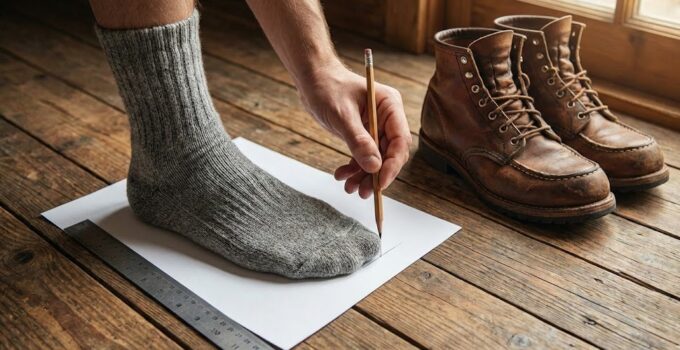
Method 2: The Paper Tracing Method
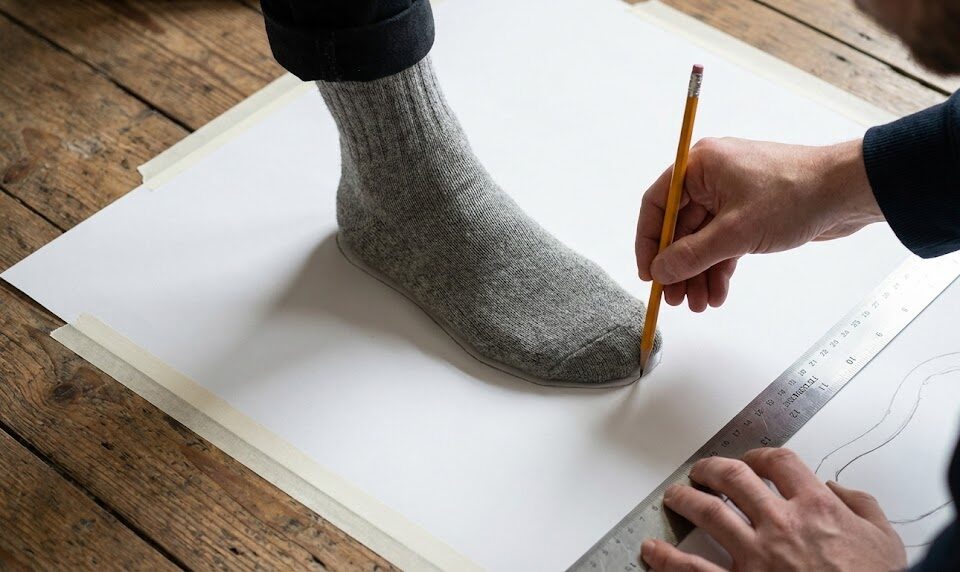
paper tracing method
- Trace: Stand on the paper and have a friend trace your entire foot. Keep the pencil perpendicular to the floor.
- Measure: Find the longest distance from heel to toe on the outline.
- Repeat: Do this for both feet.
How to Measure Foot Width (and Arch Length)
Length is only half the battle.
Step 1: Find Width
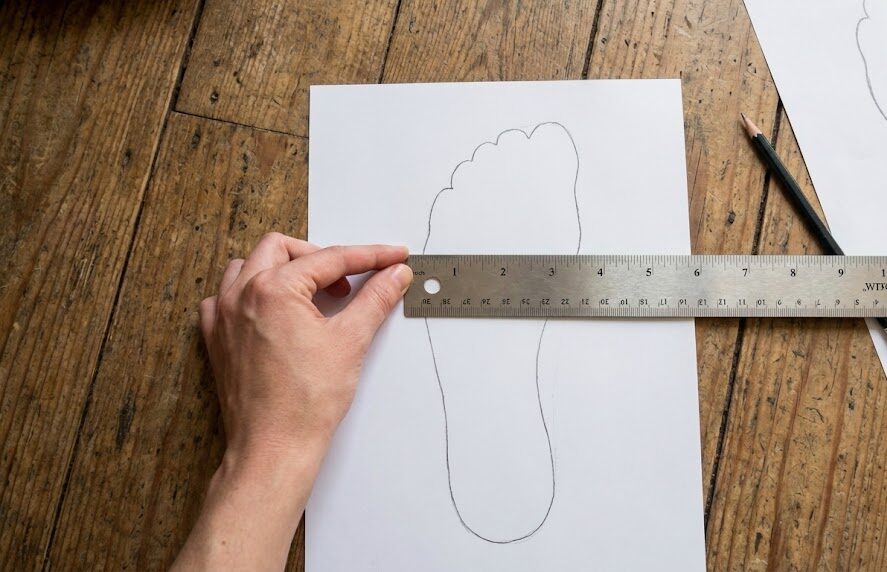
measure foot width
- Using your traced outline, find the widest part of your foot (usually the “ball” of the foot).
- Measure the straight-line distance between the inside and outside of the outline at this widest point.
Step 2: The “Guru” Step – Arch Length (Heel-to-Ball)
This is the secret to perfect fit that most guides miss.
Boots are designed to flex at a specific point (the widest part). Your foot also flexes at the ball. These two flex points must line up.
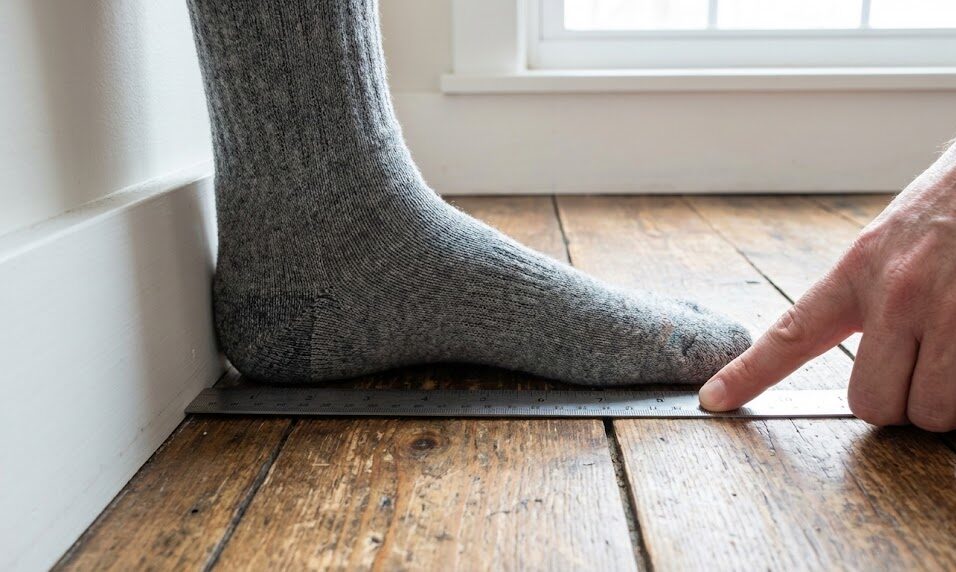
measure from the heel
- Measure from the wall (heel) to the center of the ball of your foot (the large joint at the base of your big toe).
- Why this matters: If you have short toes but a long arch, your total length might be size 10, but your arch length is size 11. You need the size 11 to prevent the steel shank from bruising your arch.
US Size Conversion Charts
Use your Centimeter measurement to find your baseline US size.
Men’s Size Conversion
| Foot Length (CM) | US Men’s Size |
|---|---|
| 23.5 cm | 6 |
| 24.1 cm | 6.5 |
| 24.4 cm | 7 |
| 24.8 cm | 7.5 |
| 25.2 cm | 8 |
| 25.7 cm | 8.5 |
| 26.0 cm | 9 |
| 26.5 cm | 9.5 |
| 26.8 cm | 10 |
| 27.3 cm | 10.5 |
| 27.8 cm | 11 |
| 28.3 cm | 11.5 |
| 28.6 cm | 12 |
| 29.4 cm | 13 |
Women’s Size Conversion
| Foot Length (CM) | US Women’s Size |
|---|---|
| 21.6 cm | 6 |
| 21.9 cm | 6.5 |
| 22.2 cm | 7 |
| 22.5 cm | 7.5 |
| 23.0 cm | 8 |
| 23.5 cm | 8.5 |
| 23.8 cm | 9 |
| 24.1 cm | 9.5 |
| 24.6 cm | 10 |
Understanding Width Categories
Boot widths are designated by letters. Note that men’s and women’s scales are different.
| Category | Women’s Code | Men’s Code |
|---|---|---|
| Narrow | AA / 2A | B |
| Standard | B | D |
| Wide | C / D | E / 2E |
| Extra Wide | E / 2E | 3E / 4E |
Note: Width is proportional to length. A size 12D is physically wider than a size 8D, even though both are “Standard.”
Brand-Specific Sizing Comparison Table
This is the cheat sheet you’ve been looking for. Compare your baseline measurement against these brand tendencies.
| Brand | Fit Verdict | Widths Available | Key Advice |
|---|---|---|---|
| Nike | Baseline | Standard | Use this as your reference. Most boots run bigger than Nikes. |
| Red Wing (Heritage) | Runs Large | B-EEE | Size down 0.5 to 1 full size from sneaker size. |
| Red Wing (Work) | True to Size | D-EEE | Fits more consistently than the Heritage line. |
| Wolverine (1000 Mile) | Runs Large | D, E | Size down 0.5 size from sneakers. |
| Timberland (Classic 6″) | Runs Large | Med, Wide | Often runs 0.5 to 1 size large. |
| Timberland PRO | True to Size | Med, Wide | Designed for consistent fit with work socks. |
| Danner | True to Size | Narrow-Wide | Known for narrow lasts. If in doubt, go Wide (EE). |
| Thorogood | True to Size | D-EEE | Very consistent sizing, but toe box can feel narrow. |
| Dr. Martens | Runs Large | Standard | Whole sizes only. If you are a 10.5, size down to 10. |
| Ariat | True to Size | B-EE | Focus on the “pop” at the instep when pulling them on. |
| Keen | Runs Small | Reg, Wide | Massive toe box, but length often runs 0.5 short. |
Testing Boot Fit at Home
The box has arrived. Before you cut any tags or wear them outside, do these tests indoors.
- 1. The Thumb Test (Length): Stand up. You should have approximately 1/2 inch (thumb width) of space between your longest toe and the end of the boot.
- 2. The Heel Test: Walk around. Lace-up boots should have minimal lift. Pull-on/Western boots need 1/4 to 1/2 inch of slip for proper break-in.
- 3. The Width Test: Your foot should feel “hugged” firmly, like a handshake. Red Flags: Bulging over the sides, numbness, or toes curled up.
- 4. The Flex Test: Walk normally. The boot should crease at the ball of your foot. If it creases near your toes or back by your arch, the boot length is wrong for your foot anatomy.
Frequently Asked Questions
Q: Should I measure my feet every time I buy boots?
A: Remeasure every 1-2 years, or after weight changes of 20+ lbs. Gravity flattens arches over time, making feet longer and wider as we age.
Q: Can I use my sneaker size for boots?
A: No. Sneakers have padding that masks fit issues. For heritage boots, you usually need to size down 0.5 to 1 size from your sneaker size.
Q: Should boots feel tight when new?
A: Snug, yes. Tight, no. You should be able to wiggle your toes. If your toes are touching the front or you feel sharp pinching, the boot is too small. “Breaking in” will fix stiffness, but it will never fix a boot that is too short.
Q: Do all brands offer wide widths?
A: No. Fashion brands usually only offer one width. If you have wide feet, stick to American heritage work brands (Thorogood, Red Wing, Danner) which typically offer E, EE, and even H widths.
Conclusion
Finding the perfect boot size isn’t magic—it’s just measurement. You now have the tools to measure your length, width, and arch length, and the data to convert that into the right size for your favorite brands.
Measure twice. Buy once. Walk comfortably.