
Welders have worn pull-on boots for decades for one simple reason: slag can't fall into laces that aren't there. A good pull-on welding boot also comes off fast if something hot gets inside, and a smooth leather shaft sheds sparks better than eyelets and tongues.
We picked these 5 pull-on boots by checking each Amazon listing's safety specs, star rating, number of ratings and bestseller rank, and by reading the patterns in buyer reviews (Amazon, retrieved 2026-09-25). We haven't welded in them ourselves, so there are no invented shop stories here.
Note on prices: Amazon prices change by size and color, so check the price in your size.
Quick Picks: Best Pull-On Work Boots for Welders
| Boot | Best for | Toe | Amazon rating |
|---|---|---|---|
| Irish Setter Marshall 11" | Best overall (heat-resistant sole) | Steel | 4.6 (3,000+) |
| Wolverine Rancher 10" | Most comfortable | Steel | 4.3 (9,200+) |
| Ariat Groundbreaker Wide Square Toe | Best for wide feet | Steel | 4.4 (990+) |
| Ariat WorkHog H2O 400g | Best for winter and outdoor welding | Composite | 4.5 (200+) |
| CAT Revolver | Best budget | Steel | 4.4 (2,900+) |
Ratings from Amazon, retrieved 2026-09-25.
The Best Pull-On Boots for Welders, Reviewed
1. Irish Setter Marshall 11" Steel Toe - Best Overall

The Marshall is an 11-inch leather pull-on with a steel toe and a heat-resistant (HRO) rubber outsole that the listing says meets ASTM F2413-18 M/I/C EH. It has 4.6 stars from more than 3,000 ratings and lists at about $220.
Buyers say it's comfortable, durable and stays dry in snow and rain.
Buy it if: you weld daily and stand on hot floors, slag or grinding debris.
Skip it if: your shop requires a met guard. See our best welding boots for met guard picks.
Check the Irish Setter Marshall price on Amazon
2. Wolverine Rancher 10" Steel Toe - Most Comfortable

The Rancher has a full-grain leather upper, a steel toe, a moisture-wicking mesh lining, a removable OrthoLite footbed and a lightweight EVA midsole. It has 4.3 stars from more than 9,200 ratings and lists at about $150.
Buyers love the comfort and look. It runs large, and some report the sole coming apart after a few months.
Buy it if: you want a comfortable pull-on for fabrication and light welding.
Skip it if: you work on hot surfaces. The listing doesn't claim a heat-resistant sole.
Check the Wolverine Rancher price on Amazon
3. Ariat Groundbreaker Wide Square Toe Steel Toe - Best for Wide Feet

The Groundbreaker is a full-grain leather pull-on with a wide square steel toe and pull tabs. It has 4.4 stars from more than 990 ratings and lists at about $175.
Buyers call it good quality, comfortable and good value, and one says it handles oil and grease well.
Buy it if: you have wide feet or want a roomy square toe box.
Skip it if: you need waterproofing.
Check the Ariat Groundbreaker price on Amazon
4. Ariat WorkHog H2O 400g Composite Toe - Best for Winter and Outdoor Welding
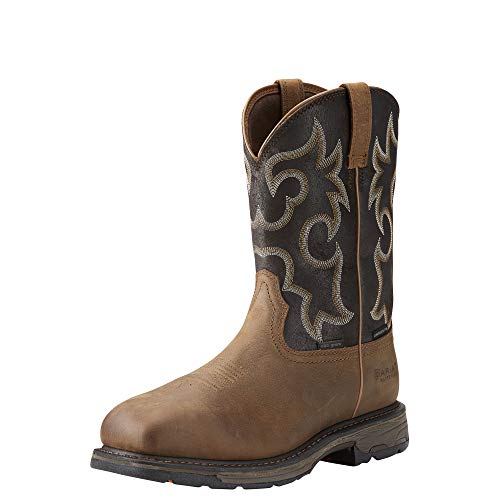
The WorkHog H2O is a waterproof pull-on with a non-metallic composite toe, 400g insulation and Ariat's DuraTread outsole. It has 4.5 stars from more than 200 ratings and lists at about $265.
Buyers find it comfortable, good-looking, waterproof and warm in winter. Some wish it were wider.
Buy it if: you weld outdoors on pipelines, farms or job sites in cold weather.
Skip it if: you weld indoors in a hot shop. Insulated boots will overheat.
Check the Ariat WorkHog H2O price on Amazon
5. CAT Revolver Steel Toe - Best Budget
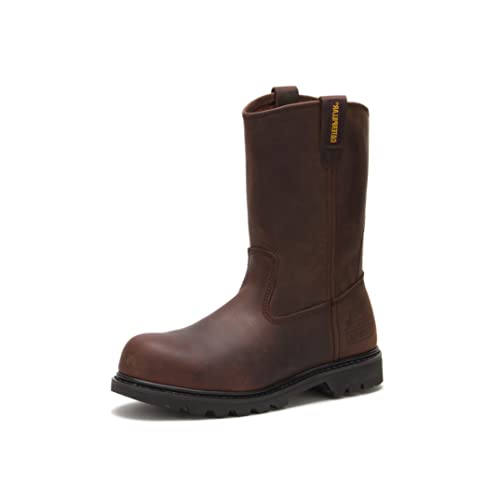
The Revolver is a slightly distressed full-grain leather pull-on with a steel toe, dual pull handles and a slip-resistant outsole. It has 4.4 stars from more than 2,900 ratings and lists at about $100.
Buyers find it comfortable for all-day wear. Durability, fit and traction get mixed reviews.
Buy it if: you want a lace-free steel toe for about $100.
Skip it if: you need a heat-resistant sole.
Check the CAT Revolver price on Amazon
Pull-On Welding Boot Tips
- Wear pants outside the boot shaft so sparks can't fall inside.
- Pick leather, not synthetic, for the shaft and vamp.
- Get a snug heel fit. Pull-ons with too much heel slip cause blisters. Try them with your work socks.
- Add leather spats for overhead or heavy spatter work.
Frequently Asked Questions
Why do welders wear pull-on boots?
There are no laces or eyelets for slag to fall into, and they come off fast if something hot gets inside.
Are pull-on boots safe for welding?
Yes, as long as they have a safety toe your site accepts and a leather upper. A heat-resistant sole adds protection on hot floors.
Do pull-on work boots come with met guards?
Some do, but most met guard boots are lace-ups with an external guard that covers the laces. See our metatarsal guard boots.
The Bottom Line
- Best overall: Irish Setter Marshall 11" for its heat-resistant sole.
- Most comfortable: Wolverine Rancher.
- On a budget: CAT Revolver.
For lace-up and met guard options, see our best welding boots. For general pull-ons, see best pull-on work boots.