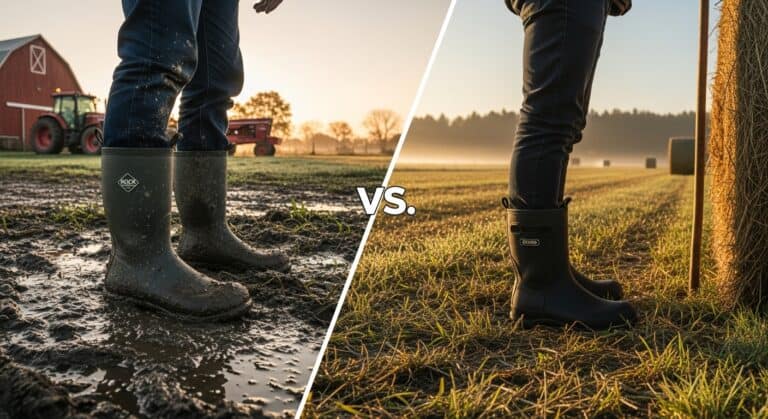

Landscaping destroys boots. Wet grass at 7 AM, muddy flower beds by 10, irrigation trenches at noon, fertilizer splashing on your leather at 2 PM, and equipment loading at 5. The $40 big-box specials fall apart in 8–12 weeks. The waterproofing fails first — usually by week two. Then the outsole delaminates. Then the insole becomes a thin piece of cardboard.
The problem isn't that landscapers are hard on boots — it's that most boot guides treat landscaping like construction or warehouse work. It isn't. Landscaping combines constant moisture cycling, chemical exposure from fertilizers and herbicides, brutal turf-to-hardscape terrain switches, and 8–14 miles of walking per day. That combination destroys boots faster than almost any other trade — and it demands a specific type of waterproofing that most guides never properly explain.
This guide covers 8 waterproof work boots selected specifically for landscaping demands — organized by task, not just "best overall." Every pick is available on Amazon. You'll also get a genuine explanation of what "waterproof" actually means for landscaping, a seasonal strategy, chemical resistance data, cost-per-season math, and the boot mistakes that cost landscapers money every year.
Who This Guide Is NOT For: Pure construction workers on dry job sites, indoor workers, or weekend gardeners doing 2-hour yard work. If your waterproofing needs are occasional, standard water-resistant boots may be sufficient.
Quick Picks: Best Waterproof Work Boots for Landscapers by Situation
| Situation | Best Pick | Why |
|---|---|---|
| Best overall (commercial routes) | KEEN Utility Pittsburgh 6″ Steel Toe | KEEN.DRY membrane + steel toe + wide toe box |
| Best for hardscaping / heavy materials | Timberland PRO Boondock Composite Toe | Anti-fatigue + seam-sealed waterproof + defined heel |
| Best for wet grass / morning dew all day | Carhartt CMF6366 8″ Composite Toe WP | Full waterproof, high shaft, composite toe |
| Best lightweight for high step-count days | Wolverine Overpass 6″ Composite Toe WP | Athletic flex + composite + waterproof under $150 |
| Best for irrigation / standing water | Bogs Classic High WP | Full rubber/neoprene — hose-cleanable, 100% waterproof |
| Best budget (under $100) | Ever Boots Tank Men's Soft Toe WP | Zero break-in, full-grain leather, under $90 |
| Best for women landscapers | KEEN Utility Women's Flint II Mid WP | Women's-specific last, steel toe, KEEN.DRY |
| Best for chemical/fertilizer resistance | Muck Boot Company Muckster II | Full rubber construction — immune to fertilizer and chemicals |
Full Comparison Table
| Boot | Toe Type | EH Rated | Waterproofing | Outsole | Shaft | ASTM | Price |
|---|---|---|---|---|---|---|---|
| KEEN Utility Pittsburgh | Steel | Yes* | KEEN.DRY membrane | Oil/slip resistant | 6″ | F2413 | $160–$185 |
| Timberland PRO Boondock | Composite | Yes* | Seam-sealed | Anti-fatigue rubber | 6″ | F2413 | $195–$215 |
| Carhartt CMF6366 | Composite | Yes* | WP membrane | Oil/slip resistant | 8″ | F2413 | $155–$180 |
| Wolverine Overpass | Composite | Yes* | WP membrane | Multi-resistant rubber | 6″ | F2413 | $130–$150 |
| Bogs Classic High | Soft | No | 100% rubber/neoprene | Non-slip rubber | 15″ | N/A | $100–$140 |
| Ever Boots Tank | Soft | No | Full-grain leather WP | Non-slip rubber | 6″ | Limited | $75–$90 |
| KEEN Women's Flint II Mid | Steel | Yes* | KEEN.DRY membrane | Oil/slip resistant | 6″ | F2413 | $130–$155 |
| Muck Boot Muckster II | Soft | No | 100% rubber | Aggressive lug | Low/ankle | N/A | $85–$110 |
*Yes = designed to meet ASTM F2413 EH — always verify on current Amazon listing before purchase. Soft-toe picks (Bogs, Ever Boots, Muck Boot) carry no ASTM toe rating.
True Waterproof vs. Water-Resistant: What Actually Keeps Feet Dry on a Landscaping Route
Most guides vaguely say "get waterproof boots." None explain what that actually means for a landscaper starting a 7 AM route on dew-soaked lawns. Here's the honest breakdown of the three waterproofing tiers — and which one you actually need.
Tier 1: Water-Resistant Leather (Treated Full-Grain Leather)
- What it is: Full-grain leather with a DWR (durable water repellent) factory treatment or applied spray
- What it handles: Light rain, brief puddle contact, splashing, morning dew for 1–2 hours
- What it fails against: Prolonged wet grass contact (2+ hours), ankle-deep puddles, irrigation trenches
- Reapplication needed: Every 2–4 months in active landscaping use
- Who it's for: Occasional wet conditions, mild climates, early morning dew in summer only
Honest assessment: "Water-resistant" boots are wet boots for a landscaper who starts their day in dew-soaked lawns before 8 AM. The leather soaks through after extended wet contact — your socks are wet by the third property.
Tier 2: Membrane Waterproofing (KEEN.DRY, GORE-TEX, Proprietary Membranes)
- What it is: A waterproof bootie lining sealed inside the upper — water cannot pass through even with prolonged contact
- What it handles: Sustained wet grass contact, light puddles, rain throughout the day, irrigation splash
- What it fails against: Deep water submersion above the boot shaft, steam or extreme heat exposure
- Breathability: Modern membranes are breathable — vapor exits; liquid cannot enter
- Who it's for: Commercial landscapers, lawn care routes, anyone whose boots are wet before 9 AM daily
The real-world test: Kneel in wet soil for 10 minutes. Membrane boots: dry socks. Treated leather: wet socks.
Tier 3: Full Rubber or Rubber/Neoprene Construction
- What it is: Boot is entirely rubber or rubber-over-neoprene — no seams, no membrane needed
- What it handles: Complete submersion, deep mud, wading in irrigation ditches, chemical/fertilizer splash
- What it fails against: Breathability — your feet will sweat in rubber in summer heat
- Who it's for: Irrigation specialists, drainage work, chemical applicators
- Best examples on Amazon: Bogs Classic High, Muck Boot Muckster II
Bottom line: For commercial landscaping routes starting in morning dew, membrane waterproofing (Tier 2) is the minimum. Tier 1 is insufficient for daily wet conditions. Tier 3 rubber is right for extreme wet, chemical, or submersion scenarios.
Waterproof Boots in Summer: Managing Heat and Sweat
Every guide says "get waterproof boots" — none address the #1 real-world complaint from landscapers: waterproof boots become sweat traps in summer heat. A waterproof membrane prevents liquid from entering and exiting. On a cold wet morning, that's exactly what you want. On a 90°F July afternoon, the same membrane traps sweat vapor that can't escape as efficiently as your feet produce it. Result: sweaty, damp socks from the inside out.
5 practical solutions:
- Choose higher-breathability membranes. GORE-TEX has the highest breathability rating of mainstream membranes. KEEN.DRY and proprietary alternatives are less breathable. If summer comfort is the priority, GORE-TEX boots are worth the premium.
- Moisture-wicking socks are mandatory, not optional. 100% merino wool or synthetic socks (Darn Tough, Smartwool) pull sweat away from the foot surface. Cotton socks in waterproof boots are a blister guarantee.
- Boot rotation dries the interior. Alternating two pairs gives each boot 24 hours to dry fully between shifts. A wet interior from sweat is identical in effect to a wet exterior.
- Cedar boot inserts or boot dryers. Cedar inserts ($15–$25 on Amazon) absorb moisture overnight. Electric boot dryers (~$30–$50) actively dry the interior — essential after irrigation or drainage work.
- Ventilated waterproof construction. Some KEEN models include limited ventilation zones that improve breathability without fully compromising waterproofing — better suited to summer landscaping than fully sealed alternatives.
Honest tradeoff: There is no fully waterproof boot that breathes as well as a non-waterproof boot. The goal is to manage the tradeoff, not eliminate it. For most commercial landscapers, external moisture (morning dew 5+ days/week) exceeds the sweating problem — waterproofing wins on balance.
What Landscaping Does to Your Boots (That Other Trades Don't)
Understanding why landscaping destroys boots faster than almost any other trade helps you make better purchase decisions — and stop blaming the boot when the real culprit is the job.
- Constant moisture cycling. Boots go from dry (loading the trailer at 6:30 AM) to wet (wet grass by 7 AM) to partially dry (truck cab between properties) and back to wet — 15–20 times per day in some climates. This repeated wet/dry cycling stresses adhesives, stitching, and leather more aggressively than sustained wet conditions.
- Chemical exposure — the silent boot killer. Nitrogen fertilizers are mildly acidic when wet and damage unprotected leather stitching over months. Herbicide/pesticide splash (glyphosate, 2,4-D) degrades exposed rubber compounds and weakens seam bonding. Mulch dyes acidify leather. Manure and compost degrade unprotected leather significantly faster than normal wear. Key insight: Synthetic uppers and rubber-construction boots are significantly more resistant to fertilizer/chemical degradation than full-grain leather.
- Turf-to-hardscape transitions. Landscapers switch between soft turf and finished hardscape constantly. Aggressive deep-lug outsoles that grip turf mark pavers and track mud onto client surfaces. The ideal lug depth for landscaping (4–6mm) is a deliberate compromise.
- Volume of steps. A commercial landscaper on a residential route walks 8–14 miles per day — comparable to a postal carrier. This step volume compresses midsoles and degrades insoles significantly faster than a construction worker who stands more than they walk.
- Equipment vibration transmission. Prolonged use of string trimmers, walk-behind mowers, and plate compactors transmits vibration through the feet and legs. Midsole quality determines how much of that vibration reaches your ankles, knees, and lower back over a full season.
Boots by Landscaping Task — Which Boot for Which Job
No current guide provides task-specific recommendations. Best boot for landscapers" treats all landscaping as identical. It isn't. A boot ideal for mowing is poor for hardscape installs.
Mowing and General Lawn Maintenance
What the job demands: Lightweight footwear for high step counts, composite or steel toe for mower deck safety, full waterproof membrane for morning dew, good traction on slopes and wet turf.
Best pick: KEEN Utility Pittsburgh 6″ or Wolverine Overpass
What to avoid: Heavy leather boots (too fatiguing for 14-mile days), soft-toe boots near mower decks
⚠️ Mower Deck Safety — Non-Negotiable: A commercial mower deck blade running at full speed can sever a toe through standard leather in milliseconds. OSHA and most professional landscaping organizations require safety toe footwear when operating commercial mowing equipment. If you operate walk-behind or zero-turn mowers professionally, steel or composite toe is required, full stop.
Hardscaping — Pavers, Retaining Walls, Stone Work
What the job demands: Steel or composite toe (heavy stone and pavers dropped from height), ankle support for uneven ground, defined heel for ladder use, slip-resistant outsole on wet pavers.
Best pick: Timberland PRO Boondock Composite Toe or Carhartt CMF6366 8″ WP
What to avoid: Lightweight hiking-style boots (insufficient toe protection for heavy material work)
Irrigation Installation and Repair
What the job demands: Maximum waterproofing (working in trenches, kneeling in wet soil), chemical resistance, quick-dry when inside a truck cab between sites.
Best pick: Bogs Classic High or Muck Boot Muckster II — rubber/neoprene construction, hose-cleanable
What to avoid: Membrane-waterproof boots (insufficient for knee-depth trench work), full-grain leather (absorbs fertilizer residue)
Planting, Flower Bed Installation, Mulching
What the job demands: Kneeling comfort, lightweight, full waterproofing, minimal debris intrusion (gusseted tongue), wide toe box for natural foot position during kneeling.
Best pick: KEEN Utility Pittsburgh or Wolverine Overpass — both have wide toe boxes and gusseted tongues
What to avoid: Boots without gusseted tongues (mulch and soil debris enter through the lace opening and cause blisters)
Tree Service Ground Work
What the job demands: Ankle support around root zones, composite or steel toe, waterproofing for morning dew, puncture-resistant midsole for debris (branches, spikes).
Best pick: Carhartt CMF6366 8″ WP (higher shaft for ankle support) or KEEN Pittsburgh
Important note: If you operate a chainsaw regularly, chainsaw-rated boots (ASTM F1818 or EN ISO 17249) are the correct standard — this guide covers ground workers only.
Equipment Operators (Skid Steers, Mini Excavators, Loaders)
What the job demands: Composite toe (non-metallic preferred for equipment cabin pedals), EH protection, waterproof for outdoor conditions.
Best pick: Timberland PRO Boondock Composite Toe or Carhartt CMF6366
What to avoid: Wedge sole boots (poor pedal feel in equipment cabs — defined heel provides better pedal control)
🧪 How We Evaluated These Boots
| Criterion | Weight | What We Tested |
|---|---|---|
| Waterproof performance | 30% | Membrane type, shaft height, seam sealing — morning dew to standing water |
| Traction on wet turf and hardscape | 20% | Lug depth, pattern, compound — wet grass, mud, wet paver surfaces |
| Durability under landscaping conditions | 20% | Chemical resistance, moisture cycling, stitching quality, outsole compound |
| All-day comfort (high step count) | 15% | Midsole technology, insole quality, weight, break-in period |
| Safety specifications | 10% | ASTM toe rating, EH rating where applicable |
| Value for seasonal replacement cycles | 5% | Cost per season based on expected landscaping boot lifespan |
ASTM Verification Note: Always verify current certifications on the Amazon listing — manufacturers update models and certifications can change between production runs.
The 8 Best Waterproof Work Boots for Landscapers — Detailed Reviews
1. KEEN Utility Pittsburgh 6″ Steel Toe — Best Overall for Commercial Routes
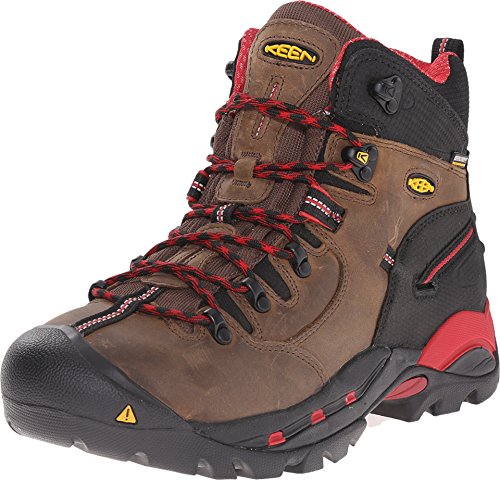
Best for: Commercial lawn care routes, mowing, planting, general maintenance
| Price Range | $160–$185 |
| Toe Type | Steel toe — ASTM F2413 I/C |
| EH Rated | Yes — verify current Amazon listing |
| Waterproofing | KEEN.DRY membrane — tested waterproof, breathable |
| Outsole | Oil/slip-resistant rubber — 5mm multi-directional lugs |
| Midsole | KEEN.ReGEN — energy return, all-day cushioning |
| Shaft Height | 6″ |
| Gusseted Tongue | Yes — debris exclusion |
| Toe Box | Wide asymmetric — accommodates natural foot splay |
| Weight | ~2.0 lbs per boot |

The KEEN Pittsburgh is the closest thing the lawn care industry has to a standard-issue boot — and it earns that status on a wet route. The KEEN.DRY membrane is a genuine waterproof bootie construction, not a coating, and it holds up through prolonged wet turf contact where treated leather fails by property three. The wide asymmetric toe box is the feature that separates it from every other steel toe work boot in this price range: your toes stay uncramped at hour nine when feet have swollen from a 12-property day. The KEEN.ReGEN midsole returns energy per step rather than compressing flat — at mile 10 of a route, that difference is measurable in how your legs feel at 5 PM. The gusseted tongue keeps mulch and soil debris out of the boot interior, which matters enormously on planting and mulching days.
"KEEN.DRY holds up through 4+ hours of wet turf without any seep. The wide toe box means your toes aren't cramped at hour 9 when feet have swollen — that matters on a 12-property day."
"The KEEN.ReGEN midsole is noticeably different from standard EVA at mile 10 of a route — it bounces back rather than flattening out. Foot fatigue at end of day is measurably less."

Honest Limitation: Not ideal for deep trench or irrigation work — the 6″ shaft limits coverage in ankle-deep conditions. For standing water work, go to Bogs or Muck Boot.
❌ Skip This If: You work primarily in standing water or irrigation trenches / you need met guard PPE / you need maximum chemical resistance
Pros: Best-in-class KEEN.DRY waterproofing for daily wet turf, KEEN.ReGEN midsole for step-count fatigue, wide toe box, gusseted tongue, steel toe + EH
Cons: 6″ shaft insufficient for trench or deep puddle work, cement construction (not resoleable)
2. Timberland PRO Boondock 6″ Composite Toe — Best for Hardscaping
More detail: our full Timberland PRO Boondock review.

Best for: Hardscaping, paver installs, retaining walls, equipment operation
| Price Range | $195–$215 |
| Toe Type | Composite toe — ASTM F2413 I/C |
| EH Rated | Yes — verify current Amazon listing |
| Waterproofing | Seam-sealed waterproof construction |
| Outsole | Anti-fatigue rubber — oil/slip resistant |
| Midsole | Anti-fatigue technology — energy return per step |
| Shaft Height | 6″ |
| Construction | Direct-attach |
| Weight | ~2.2 lbs per boot |

For hardscape crews — pavers, retaining walls, stone work — the Timberland PRO Boondock is the correct choice. The anti-fatigue midsole technology is specifically engineered for standing on concrete and carrying heavy loads, not just walking. On hardscaping days where you're hauling pavers and standing on concrete forms for 8 hours, your lower back at 4 PM feels the difference vs. a standard EVA midsole boot. The composite toe provides the same ASTM impact and compression protection as steel but without metal detector issues on government or utility properties — and in January, your toes aren't steel-cold after 3 hours in the frost. The defined heel (not a wedge sole) is important for ladder use when setting retaining wall blocks on elevated forms.
"The anti-fatigue midsole on the Boondock is real — on hardscaping days where you're hauling pavers and standing on concrete forms for 8 hours, your lower back at 4 PM feels the difference vs. a standard EVA midsole boot."
"Composite toe means no metal detector issues on government or utility properties — and in January, your toes aren't steel-cold when you get in the truck after 3 hours in the frost."

Honest Limitation: Direct-attach construction means these are not resoleable. When the outsole wears through, the boot is done. Factor that into the cost-per-season calculation.
❌ Skip This If: You need maximum waterproofing for standing water / you're on high-step-count mowing routes where the weight becomes fatiguing / you need a resoleable boot
Pros: Anti-fatigue midsole for heavy-material days, composite toe warmer than steel in winter, seam-sealed waterproof, defined heel for ladders, EH rated
Cons: Direct-attach (not resoleable), heavier than athletic-flex options, not ideal for step-count-heavy mowing routes
3. Carhartt CMF6366 8″ Composite Toe — Best for Wet Grass and Mud Season

Best for: Spring mud season, wet grass routes, tree service ground work, general waterproofing in high-shaft coverage
| Price Range | $155–$180 |
| Toe Type | Composite toe — ASTM F2413 I/C |
| EH Rated | Yes — verify current Amazon listing |
| Waterproofing | Waterproof membrane construction |
| Outsole | Oil/slip-resistant rubber |
| Shaft Height | 8″ — highest coverage in this guide |
| Best For | Spring mud, wet climates, tree service ground work, ankle protection |

The 8″ shaft is what sets the CMF6366 apart from every other boot in this guide. On a Wisconsin spring route — saturated ground, ankle-deep mud at bed edges, frost heave on walkways — 6″ boots leave a gap where mud enters and soaks through above the membrane. The CMF6366's 8″ shaft eliminates that. The composite toe is ASTM-rated and EH-rated, and it doesn't conduct cold the way steel does — critical for early spring work in below-freezing temperatures. Carhartt's reputation for rugged construction is earned here: stitching holds up to the moisture cycling and debris abuse that a landscaping route delivers daily.
"When you're stepping through a spring flower bed install with 3 inches of standing water around every plant, the 8-inch shaft is the difference between dry socks all day and wet socks by 8 AM. The 6-inch boots in this same scenario are a liability."

Honest Limitation: The 8″ shaft runs warm in summer heat. In July, this boot is uncomfortable on high-step-count routes unless you're committed to moisture-wicking socks and boot rotation. It's a spring/fall/winter boot for most climates.
❌ Skip This If: You work primarily in summer heat / you need a lightweight daily driver for mowing routes / you're in a dry southwestern climate
Pros: 8″ shaft for maximum mud and ankle coverage, composite toe warmer than steel in cold, EH rated, excellent durability
Cons: Runs warm in summer, heavier than 6″ options
4. Wolverine Overpass 6″ Composite Toe — Best Lightweight Option for High Step-Count Days

Best for: High-step-count mowing routes, planting, general maintenance — landscapers prioritizing weight and athletic feel
| Price Range | $130–$150 |
| Toe Type | Composite toe — ASTM F2413 I/C |
| EH Rated | Yes — verify current Amazon listing |
| Waterproofing | Waterproof membrane |
| Outsole | Multi-resistant rubber — 5mm lugs |
| Shaft Height | 6″ |
| Gusseted Tongue | Yes |

The Wolverine Overpass delivers full safety specs — composite toe, EH rating, waterproof membrane, gusseted tongue — in an athletic-flex construction that weighs significantly less than traditional leather work boots. On a 14-mile residential mowing route, that weight difference is felt at mile 8. The wide toe box accommodates foot swell on long days, and the 5mm multi-directional lug outsole sits in the landscaping sweet spot: sufficient grip on wet grass and soft soil without digging into clients' turf or tracking excessive debris onto finished hardscape surfaces.
"At mile 10 on a mowing route, the Overpass doesn't feel like a work boot — it feels like an athletic shoe with a safety toe. That's either a selling point or a dealbreaker depending on what you need. For high-step-count days, it's a selling point."

Honest Limitation: Runs large — size down half a size. The athletic construction also means less ankle stiffness than a traditional work boot, which can be an issue on very uneven hardscape terrain.
❌ Skip This If: You work on heavily uneven hardscape and need rigid ankle support / you need maximum shaft height for mud season / you're in standing water regularly
Pros: Lightest full-safety-spec option in this guide, athletic flex for step-count routes, gusseted tongue, composite toe + EH, under $150
Cons: Runs large, less ankle rigidity than traditional boots, not for deep mud or standing water
5. Bogs Classic High — Best for Irrigation, Drainage, and Standing Water

Best for: Irrigation installation and repair, drainage work, standing water, wet climates, chemical/fertilizer applicators
| Price Range | $100–$140 |
| Toe Type | Soft (no safety toe) |
| Waterproofing | 100% rubber/neoprene — completely seamless |
| Outsole | Non-slip rubber — self-cleaning lug |
| Shaft Height | 15″ — knee-high coverage |
| Temperature Rating | -40°F (insulated neoprene) |
| Cleanability | Hose off — chemical-resistant rubber exterior |

The Bogs Classic High is the only correct answer for knee-depth trench work, irrigation installation, and drainage projects. The entirely rubber-over-neoprene construction means there are no seams to fail, no membrane to degrade from chemical exposure, and no material that absorbs fertilizer residue. You hose them off at the end of the day — dirt, fertilizer, herbicide, all gone in 30 seconds. The 15″ shaft provides knee-high coverage that no 6″ or 8″ membrane boot can match in standing water conditions. The -40°F temperature rating means the neoprene lining is usable year-round in all but tropical climates.
"In an irrigation trench with ankle-deep water and herbicide runoff from the adjacent bed, there is no membrane boot that belongs there. The Bogs go in, you work, you hose them off. It's the only logical choice for that scenario."

Honest Limitation: No safety toe — do not use near mowing equipment or heavy material work. Rubber construction means sweaty feet in summer heat; manage with moisture-wicking socks and air breaks. Not a substitute for a safety-rated boot on mowing or hardscaping days.
❌ Skip This If: You need a safety toe / you work primarily in summer heat without access to truck cab breaks / mowing equipment is part of your daily routine
Pros: 100% waterproof (no membrane, no seams), 15″ shaft for trench work, chemical and fertilizer resistant, hose-cleanable, long lifespan (18–36 months)
Cons: No safety toe, sweaty in summer heat, not a general-purpose boot
6. Ever Boots Tank Men's Soft Toe — Best Budget Pick Under $100

Best for: Budget-conscious operators, light-duty landscaping, homeowners, first season on the job
| Price Range | $75–$90 |
| Toe Type | Soft (no safety toe) |
| Waterproofing | Full-grain leather waterproofing |
| Outsole | Non-slip rubber |
| Shaft Height | 6″ |
| Break-In Period | Minimal — ready from day one |
| Expected Lifespan | 4–6 months in active landscaping |

The Ever Boots Tank is the honest budget pick in this guide — and the honest budget pick comes with honest budget limitations. At under $90 on Amazon with virtually zero break-in period, it's a legitimate option for homeowners doing serious yard work or landscapers in their first season who aren't ready to invest $160+ in quality boots. The full-grain leather provides reasonable waterproofing for light wet conditions. On a commercial landscaping route with daily wet grass contact and fertilizer exposure, expect 4–6 months of service. On the cost-per-season math, it actually loses to quality boots — but it wins on upfront cost for cash-strapped operators.
"Zero break-in is real. Pull these out of the box, put them on a 10-property day, and your feet are fine. That's genuinely useful when you can't afford a painful break-in week on a commercial route."

Honest Limitation: No safety toe — unsuitable near mowing equipment. Waterproofing from full-grain leather (not membrane) will soak through in extended wet conditions. Expected lifespan is 4–6 months in commercial landscaping — factor that into your cost-per-season calculation.
❌ Skip This If: You operate mowing equipment / you're in morning dew daily / you're a commercial landscaper on a full-season route
Pros: Under $90, zero break-in, full-grain leather construction, non-slip outsole
Cons: No safety toe, leather waterproofing not membrane-grade, shorter lifespan on commercial routes
7. KEEN Utility Women's Flint II Low Steel Toe — Best for Women Landscapers
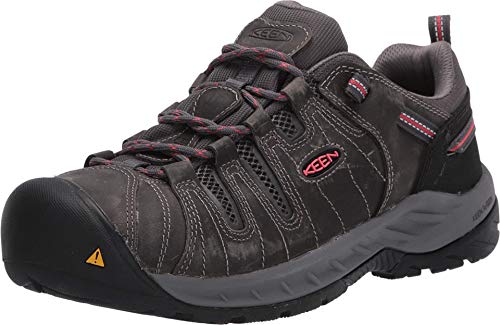
Best for: Women in commercial landscaping, lawn care routes, planting and maintenance — any task requiring full safety spec in a women's-specific fit
| Price Range | $130–$155 |
| Toe Type | Steel toe — ASTM F2413 I/C |
| EH Rated | Yes — verify current Amazon listing |
| Waterproofing | KEEN.DRY membrane |
| Last | Women's-specific — narrower heel, wider toe box |
| Midsole | KEEN.ReGEN — all-day cushioning |
| Shaft Height | 6″ mid height |
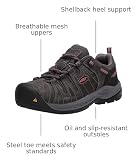
Most landscaping boot guides list a "women's version" as an afterthought — usually a men's boot that ships in women's sizes. Women's boot lasts are structurally different: narrower heel, wider forefoot, different arch positioning. In a boot worn 10 hours per day, these differences cause blisters, heel slippage, and arch fatigue that the correct last eliminates entirely. The KEEN Women's Flint II is built on a genuine women's last — narrower heel lockdown, wider toe box, lighter overall weight than the men's equivalent. It carries the same KEEN.DRY waterproof membrane, steel toe, EH rating, and KEEN.ReGEN midsole as the men's Pittsburgh. This is the only pick in this guide with a full safety spec on a genuine women's last.
"KEEN's women's last actually fits like it was designed for women — the heel lockdown is snug without the clunky heel cup that turns a men's boot into a blister machine on a 10-property day."

Honest Limitation: 6″ shaft — the same limitation as the men's Pittsburgh. Not for deep trench or standing water. For irrigation work, women landscapers should also look at Bogs Classic High (available in women's sizing).
❌ Skip This If: You work primarily in standing water or deep mud / you need an 8″ shaft for mud season coverage
Pros: Only women's-specific last with full safety spec (steel toe + EH + KEEN.DRY) in this guide, KEEN.ReGEN midsole, lower weight than men's equivalent, available in multiple widths
Cons: 6″ shaft only, not resoleable
8. Muck Boot Company Muckster II — Best for Chemical and Fertilizer Resistance
No products found.Best for: Fertilizer and chemical applicators, irrigation and drainage work, wet climates, any scenario where boots contact herbicides, pesticides, or fertilizer daily
| Price Range | $85–$110 |
| Toe Type | Soft (no safety toe) |
| Waterproofing | 100% rubber construction — completely seamless |
| Outsole | Aggressive lug — self-cleaning |
| Shaft Height | Low/ankle height |
| Expected Lifespan | 18–36 months in landscaping use |
| Cleanability | Hose off completely |
For dedicated chemical applicators — fertilizer programs, herbicide and pesticide application, compost and manure work — full rubber construction is the only rational material choice. Glyphosate, 2,4-D, and nitrogen fertilizer compounds degrade leather stitching and weaken seam bonding in membrane boots over time. Rubber is immune. The Muck Boot Muckster II's low-ankle height makes it more practical than a tall rubber boot for general landscaping use — you're not wading in knee-deep water; you're walking through fertilizer-treated turf and splashing through wet beds. The expected 18–36 month lifespan in active landscaping use produces a cost-per-season figure of $45–$100/year — the best value in this entire guide for chemical-exposure scenarios.
"Glyphosate and 2,4-D on leather boots every day for a season is a guaranteed way to destroy expensive footwear. The Muck Boot Muckster II doesn't care — hose it off, dry it out, it's ready tomorrow. For chemical applicators, it's the only rational daily driver."
No products found.Honest Limitation: No safety toe — unsuitable near mowing equipment or heavy material work. Low-ankle height means limited mud and debris protection above the ankle. Rubber construction means sweaty feet in summer heat — manage with moisture-wicking socks and air breaks.
❌ Skip This If: You operate mowing equipment or handle heavy materials / you need an ASTM-rated safety toe / your work is primarily dry mowing routes
Pros: 100% rubber — immune to all landscaping chemicals, hose-cleanable, 18–36 month lifespan, lowest cost-per-season in the guide for chemical work
Cons: No safety toe, sweaty in summer, low-ankle height limits mud coverage
🌿 Best Waterproof Work Boots for Women Landscapers
Women entering and working in landscaping are severely underserved by most boot guides. Women's boot lasts are structurally different from men's — narrower heel, wider forefoot, different shaft height and arch positioning. A man's boot "in women's sizes" is not the same as a boot built around a women's last. In a boot worn 10 hours per day, that structural difference determines whether you finish the day blister-free or not.
Top 3 Women's Picks for Landscaping:
- KEEN Utility Women's Flint II Mid Steel Toe WP — Best overall. Women's-specific last, steel toe, KEEN.DRY waterproof membrane, KEEN.ReGEN midsole. See full profile above.
- Timberland PRO Women's Titan 6″ WP Alloy Toe — Best for hardscaping. Alloy safety toe (lighter than steel, same ASTM protection), TimberDry waterproof membrane, anti-fatigue footbed, women's-specific last, defined heel for ladder use. Available on Amazon.
- Carhartt Women's Force 5″ Carbon Nano Toe WP — Best lightweight women's option. Carbon nano toe (lightest safety toe available), FastDry moisture-wicking lining, waterproof leather upper, 5″ shaft for warm weather or lower-intensity routes. Available on Amazon.
📅 Seasonal Boot Strategy for Commercial Landscapers
A single boot recommendation doesn't serve a landscaper through a Wisconsin spring mud season, a Texas summer, and a New England leaf season. Here's how to match boots to conditions:
| Season | Conditions | Priority | Best Boot |
|---|---|---|---|
| Spring (Mar–May) | Heaviest rain, mud season, saturated ground | Max waterproofing + warmth + mud traction | Carhartt CMF6366 8″ or Bogs Classic High |
| Early Summer (Jun–Jul) | Morning dew daily, high step count, heat | Breathable waterproofing + lightweight | KEEN Pittsburgh or Wolverine Overpass |
| Late Summer / Early Fall (Aug–Sep) | Mixed dry/rain, leaf debris, cooling temps | Versatile waterproofing + debris exclusion | KEEN Pittsburgh or Timberland PRO Boondock |
| Late Fall (Oct–Nov) | Wet leaves on turf, soil freezing, heavy rain | Slip resistance on wet organics + ankle support | Timberland PRO Boondock or Carhartt CMF6366 |
| Winter (Nov–Mar) | Snow, ice, frozen ground, cold handles | Insulation + waterproofing + composite toe (steel conducts cold) | Carhartt CMF6366 with insulated liner or Muck Boot Arctic Sport |
Steel toe note for winter: Steel conducts cold. In sub-freezing temperatures, composite toe boots keep toes measurably warmer than equivalent steel toe models. If you work year-round in northern climates, composite toe is the better year-round investment.
🔬 Chemical and Fertilizer Resistance: Which Materials Hold Up
No current top-10 guide provides specific guidance on which boot materials resist landscape chemicals. For anyone doing fertilizer programs, herbicide or pesticide application, or compost/manure work, this is the most practically important section in this guide.
| Material | Fertilizer | Herbicide / Pesticide | Manure / Compost | Recommended Use |
|---|---|---|---|---|
| Full rubber (Bogs, Muck Boot) | ⭐⭐⭐⭐⭐ | ⭐⭐⭐⭐⭐ | ⭐⭐⭐⭐⭐ | Chemical applicators, wet work |
| Synthetic upper (nylon/mesh) | ⭐⭐⭐⭐ | ⭐⭐⭐ | ⭐⭐⭐ | General landscaping |
| Full-grain leather (treated) | ⭐⭐⭐ | ⭐⭐ | ⭐⭐ | General use — rinse immediately |
| Nubuck leather | ⭐⭐ | ⭐⭐ | ⭐⭐ | Avoid chemical exposure |
| Suede | ⭐ | ⭐ | ⭐ | Not suitable for landscaping |
| Oil-resistant rubber outsole | ⭐⭐⭐⭐⭐ | ⭐⭐⭐⭐ | ⭐⭐⭐⭐⭐ | All landscaping outsoles |
Key actions for chemical exposure:
- Rinse boots immediately after fertilizer contact — nitrogen and potassium compounds become mildly acidic when wet on leather stitching
- Store boots away from chemical storage areas — fumes from concentrated herbicides degrade rubber seals over time
- Re-treat leather boots with Obenauf's Heavy Duty LP or similar conditioner every 4–6 weeks in active chemical application environments
- For dedicated chemical applicators: full rubber boots (Bogs, Muck Boot) are the only rational choice — no leather or synthetic upper survives sustained chemical exposure at a professional level
💡 Lug Depth: What Nobody Tells Landscapers About Outsole Tread
Landscapers work on both soft turf and finished hardscape surfaces — and the outsole tradeoff affects both client property quality and boot performance. No current guide covers this.
| Lug Depth | Best On | Problem For Landscaping | Best Use Case |
|---|---|---|---|
| Deep (8mm+) | Mud, loose soil, construction | Damages soft turf, tracks mud onto client hardscape | Avoid for most landscaping routes |
| Medium (4–6mm) | Wet grass, soft soil, light mud | None — this is the landscaping sweet spot | Mixed turf/hardscape routes — all picks in this guide |
| Shallow (0–3mm) | Concrete, pavers, hard surfaces | Poor grip on wet turf and slopes — slip hazard | Dedicated hardscape-only work |
The rule: Mixed-terrain landscaping routes → 4–6mm multi-directional lug pattern. Dedicated hardscape → shallower but high-compound grip outsole. Dedicated wet turf/mud → 6–8mm (wipe soles before stepping onto finished surfaces).
⏳ Boot Lifespan and Cost-Per-Season: The Math Every Landscaper Needs
Commercial landscapers replace boots significantly more often than other trades. The cost-per-season math changes the buying calculus entirely — and most landscapers are spending more annually on cheap boots than they would on quality ones.
Why landscaping destroys boots faster than other trades:
- 8–14 miles/day of walking compresses midsoles far faster than standing-dominant trades
- Daily moisture cycling (15–20 wet/dry cycles per day) degrades adhesives and stitching
- Chemical exposure accelerates material degradation
- Debris intrusion abrades interiors
- Seasonal mud and freeze-thaw cycles stress outsole compounds
| Boot Type | Expected Lifespan | Cost Range | Cost Per Season |
|---|---|---|---|
| Budget soft-toe (under $60) | 6–10 weeks | $40–$60 | $160–$320/year (2–4 pairs) |
| Mid-range synthetic upper ($100–$150) | 4–7 months | $100–$150 | $200–$450/year |
| Quality composite/steel toe membrane ($150–$200) | 6–10 months | $150–$200 | $200–$400/year |
| Premium leather Goodyear welt ($200–$280) | 12–20 months + resoleable | $200–$280 | $140–$280/year |
| Full rubber (Bogs, Muck Boot) | 18–36 months | $90–$150 | $45–$100/year |
The honest math: A $75 budget boot replaced 3× per season costs $225/year and gives you 3 painful break-in periods. A $185 quality boot replaced once costs $185/year with one break-in. The $185 boot wins on both cost and comfort — every time.
Boot rotation strategy: Maintain two pairs of the same model and alternate daily.
- Doubles the lifespan of each pair — moisture cycling is the #1 killer, and 24-hour dry time restores materials
- Eliminates the "wet inside from yesterday" problem that reduces waterproofing membrane performance
- Effective cost: same as buying one expensive pair annually, but with consistently better waterproofing every single morning
❌ 6 Boot Mistakes Landscapers Make
- Buying water-resistant instead of waterproof. "Water-resistant" leather is wet leather by 9 AM on a commercial landscaping route. If you're walking in morning dew 5+ days a week, you need membrane waterproofing — not a DWR coating.
- Wearing soft-toe boots near mowing equipment. This is a genuine safety issue, not a preference. Commercial mower blades will sever soft-toe boots and toes. If you operate walk-behind or zero-turn mowers professionally, steel or composite toe is required, full stop.
- Using deep-lug forestry or hiking boots. Deep lugs (8mm+) damage soft turf, track debris onto client hardscape, and don't provide better traction on most landscaping surfaces. 4–6mm multi-directional lugs are the right spec for mixed-terrain routes.
- Ignoring break-in time on commercial routes. Starting a new pair of quality leather boots on a 12-property day is a blister guarantee. Break in new boots on lighter days or weekends. Budget boots break in fast but wear out fast — quality leather takes 2–3 weeks to fully conform.
- Not rinsing fertilizer off immediately. Fertilizer residue sitting on leather through a full day's work and then stored overnight degrades stitching and leather significantly faster than normal wear. A 30-second rinse at the end of every shift adds months to boot life.
- Single pair, no rotation. Wearing one pair of waterproof boots daily means the interior never fully dries. The boot's interior becomes a damp, bacteria-rich environment — reducing waterproofing membrane performance and increasing blister risk season over season.
❓ Frequently Asked Questions
What are the best waterproof work boots for landscapers?
The KEEN Utility Pittsburgh 6″ Steel Toe is the best overall for commercial lawn care routes — KEEN.DRY membrane waterproofing, wide toe box, KEEN.ReGEN midsole for high step counts, and a gusseted tongue for debris exclusion. For hardscaping, the Timberland PRO Boondock is the better fit. For irrigation and standing water, Bogs Classic High is the only correct answer.
Do landscapers need steel toe boots?
Yes — for any work involving mowing equipment. A commercial mower deck blade running at full speed can sever a toe through standard leather in milliseconds. OSHA and most professional landscaping organizations require safety toe footwear when operating commercial mowing equipment. Composite toe provides the same ASTM protection as steel and is warmer in sub-freezing temperatures.
What's the difference between waterproof and water-resistant landscaping boots?
Water-resistant boots use treated leather with a DWR coating — they handle light rain and brief puddle contact but soak through after 1–2 hours of wet grass contact. Waterproof boots use a sealed membrane (KEEN.DRY, GORE-TEX) that prevents water entry regardless of contact duration. For daily dew-soaked routes, membrane waterproofing is the minimum standard.
Are composite toe boots safe for landscaping?
Yes. Composite toe boots that meet ASTM F2413 provide the same impact and compression protection as steel toe. For landscaping specifically, composite toe has two advantages: it doesn't conduct cold (important in sub-freezing winter work) and it doesn't trigger metal detectors (useful on government or utility properties). For most landscaping tasks, composite toe is the preferred choice.
How long do landscaping boots last?
Budget boots (under $60): 6–10 weeks. Mid-range synthetic ($100–$150): 4–7 months. Quality membrane boots ($150–$200): 6–10 months. Full rubber (Bogs, Muck Boot): 18–36 months. Landscaping destroys boots faster than most trades due to moisture cycling, chemical exposure, and high daily step counts. Boot rotation doubles lifespan.
Can landscaping boots handle fertilizer and herbicide exposure?
It depends on the material. Full rubber (Bogs, Muck Boot) resists all landscaping chemicals completely. Synthetic uppers handle moderate chemical exposure. Full-grain leather degrades from repeated fertilizer and herbicide contact — rinse immediately after every shift and re-treat with Obenauf's Heavy Duty LP every 4–6 weeks. For dedicated chemical applicators, full rubber is the only rational choice.
What lug depth is best for landscaping boots?
4–6mm multi-directional lugs are the landscaping sweet spot. Deep lugs (8mm+) from forestry or hiking boots damage soft turf and track mud and debris onto clients' finished hardscape surfaces — inappropriate for most commercial routes. Shallow lugs (0–3mm) provide poor grip on wet grass slopes. All 8 picks in this guide use 4–6mm outsoles for this reason.
Why do my waterproof boots make my feet sweat?
A waterproof membrane prevents liquid from entering and exiting. Sweat vapor from your feet can't escape as efficiently as it's produced in summer heat — resulting in damp socks from the inside out. Solutions: GORE-TEX membranes (highest breathability), merino wool or synthetic moisture-wicking socks (never cotton), 2-pair rotation for daily dry time, and cedar inserts or electric boot dryers overnight.
Do I need EH-rated boots for landscaping?
Yes, for most commercial landscaping work. EH (Electrical Hazard) rating protects against open circuits up to 600V — relevant for electric mowers, battery-powered trimmers, irrigation control systems, and outdoor electrical work. All safety-toe picks in this guide carry EH ratings. Verify on the current Amazon listing before purchase, as certifications can change between production runs.
What boots are best for women landscapers?
The KEEN Utility Women's Flint II Mid Steel Toe WP is the top pick — it's the only boot in this guide with a genuine women's-specific last (not just men's sizing), full ASTM steel toe, KEEN.DRY waterproof membrane, and KEEN.ReGEN midsole for high step counts. For hardscaping, the Timberland PRO Women's Titan 6″ WP Alloy Toe is the right fit. For warm weather routes, Carhartt Women's Force 5″ Carbon Nano Toe WP is the lightest option.
The Right Boot for Your Route
Landscaping is one of the most demanding environments a work boot can face — and a generic "best work boot" guide will send you to the store with the wrong boot for your specific job. Here's the final match:
- Commercial mowing routes: KEEN Utility Pittsburgh — the closest thing the lawn care industry has to a standard-issue boot, and it earns that status every morning on a dew-soaked route.
- Hardscaping crews: Timberland PRO Boondock — anti-fatigue midsole, seam-sealed waterproofing, composite toe for heavy material work and winter cold.
- Irrigation, drainage, and standing water: Bogs Classic High — the only correct answer for knee-depth trench work. Nothing else in this price range is even close.
- Budget-conscious operators: Wolverine Overpass — full safety spec (composite toe, EH, waterproof membrane) under $150.
- Chemical applicators: Muck Boot Muckster II or Bogs Classic High — rubber construction is immune to fertilizer degradation that destroys leather and membrane boots over a season.
- Women landscapers: KEEN Utility Women's Flint II — the only women's-specific last in this guide with full safety spec.
Buy two. Rotate daily. Your boots dry, your feet stay healthy, and your waterproofing membrane works every morning instead of every other morning.
Prices listed are approximate and subject to change. Always verify current ASTM certifications and EH ratings on the Amazon product listing before purchase — manufacturers update models and certifications can change between production runs. As an Amazon Associate, Bootsguru.com earns from qualifying purchases.