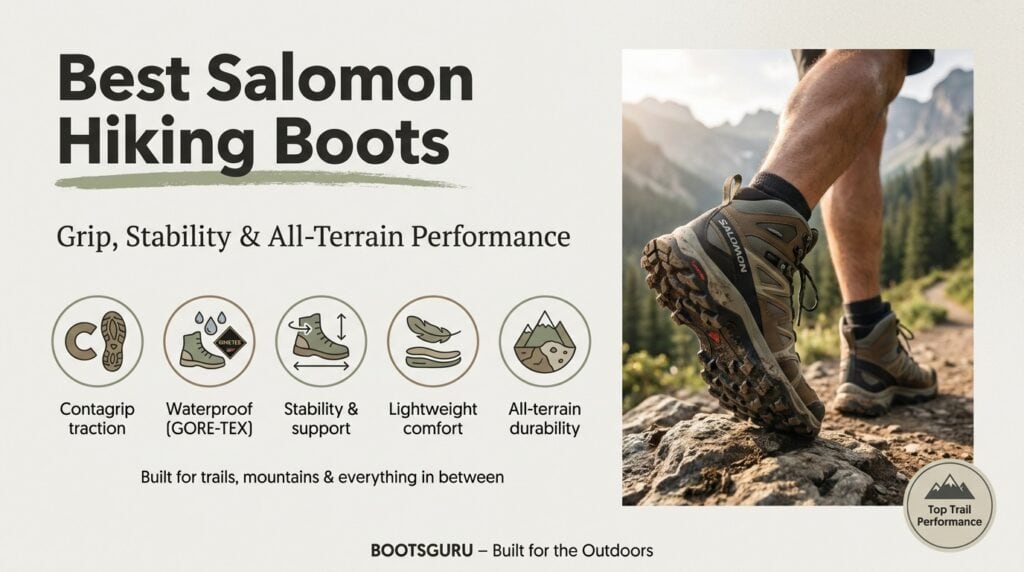

Salomon is the most recommended hiking boot brand of 2026 — and for good reason. Their French-Alps engineering heritage, proprietary Advanced Chassis torsional stability system, and Contagrip outsoles have produced a lineup that dominates every category from ultralight day hiking to technical backpacking. GearJunkie chose the Salomon Quest 5 as their top overall hiking boot. REI chose the Salomon X Ultra 5 as their top agility boot. RunRepeat's lab confirmed the X Ultra 5 as their best Salomon overall. The brand's reputation is earned rather than marketed.
But Salomon's lineup is not one-size-fits-all. The X Ultra 5 and the Quest 5 are fundamentally different boots — different weight, different chassis stiffness, different outsole compound, different use case — and choosing the wrong one leads to ankle soreness under a heavy pack or unnecessary fatigue on easy trails. The Contagrip outsole comes in three distinct formulations (MA, TA, TD) that perform differently on different terrain. The Quicklace system is excellent for most hikers and requires a specific field repair protocol for others. And the brand's narrow last fits some feet exceptionally well and does not fit others at all.
This guide covers all of it: ten verified picks across every Salomon hiking boot category, the technology decoded in plain English, the honest caveats including the Quest 4 sole delamination issue that most articles bury, and the hiker-type picker that helps you choose the right Salomon before you buy rather than after you try.
Salomon Technology Decoded: What It Actually Does
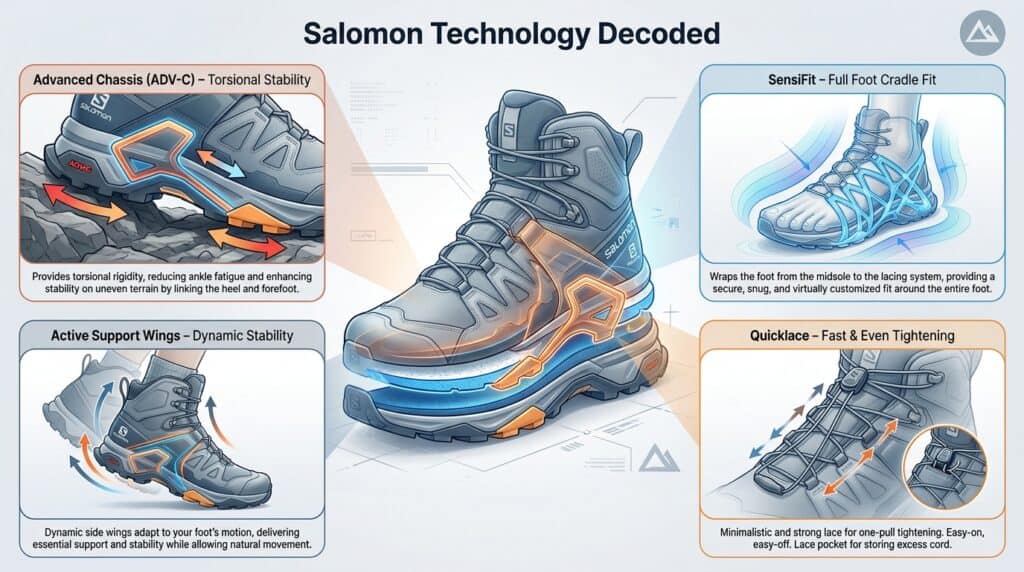
Before looking at any specific boot, understanding Salomon's four core technologies makes every product comparison clearer and every purchase decision more confident.
Advanced Chassis (ADV-C): A rigid plastic frame embedded within the midsole that provides torsional rigidity — resistance to the twisting forces that off-camber and uneven terrain create. The chassis acts as a lateral buttress between the outsole and the upper, keeping the foot stable when the boot contacts an irregular surface at an angle. RunRepeat's lab tests confirm the chassis's measurable contribution to lateral stability and ankle protection. The Quest 4 has the stiffest chassis tested (5/5 by RunRepeat), appropriate for heavy pack loads on technical terrain. The Quest 5's chassis is slightly less rigid for improved comfort. The X Ultra 5's chassis is more flexible, appropriate for day hiking agility. This technology is genuinely effective — not marketing language.
SensiFit: Not a lacing system — an engineered foot-cradle construction that integrates from the sole plate through all lacing eyelets, so that tightening the laces uniformly wraps the entire cradle around the foot. Where most boots rely on lace tension alone (which creates local pressure at each eyelet), SensiFit distributes the tightening force across the entire upper. The "snug, secure feel without pressure points" that Salomon hikers consistently describe comes from SensiFit, not from lacing technique.
Active Support Wings: Mobile polymer wings on the lateral side of the boot that fold over the foot during lacing, providing ankle support during the landing phase without restricting natural foot flex in the forefoot. Most relevant for backpackers carrying heavy loads where ankle roll risk is highest. For day hikers with light packs, the difference is marginal.
Quicklace: Single-pull Kevlar-strength cord lacing. Pull the toggle to tighten the entire shoe evenly, lock it in place, tuck the excess into the tongue pocket. Fastest on/off in hiking. Distributes tension evenly, eliminating hot spots. One tester at TreelineReview has used 10+ Salomon pairs with Quicklace — zero failures. The honest caveat: cannot be zone-adjusted (mid-foot independently from ankle) the way traditional lacing allows, and requires a specific field repair protocol for remote trips. Salomon sells replacement kits; the lace loops in the X Ultra 5 are large enough to thread a thin conventional lace through as an emergency backup. Carry paracord on multi-week backcountry trips.
Contagrip MA vs TA vs TD: Which Outsole Is in Your Boot
Salomon's Contagrip outsole is not a single rubber compound. Three distinct formulations exist, each optimised for different terrain, and knowing which is in which boot changes how you evaluate grip performance.
Contagrip TA (Trail All-terrain): The most widely used hiking variant. Medium-density rubber with a multidirectional lug pattern balanced for grip across rock, dirt, and mixed trail surfaces. Used in the X Ultra 5 and Quest 5. The correct choice for most hikers on most terrain. Excellent on rock — wet and dry — and competent on moderate mud.
Contagrip TD (Trail Durable): Firmer, more abrasion-resistant compound with an aggressive lug pattern designed for technical terrain under heavy pack loads. Used in the Quest 4. Prioritises long-term durability over adhesion — specifically less adhesive on smooth rock surfaces than TA, which is the correct trade-off for backpackers whose primary concern is outsole longevity across 500+ miles. If you have ever noticed that a Quest 4's grip feels slightly firmer and less "tacky" on smooth granite than an X Ultra 5's, you are observing the TA vs TD difference — not a defect.
Contagrip MA (Mud-Aggressive): Softer, tackier compound with deep, widely spaced chevron lugs that self-clean in mud and loose terrain. Used in the Speedcross trail runner. Not used in the hiking boots reviewed here, but included for context — if a competitor article recommends a Speedcross for hiking, its MA outsole is not optimal for mixed trail use.
The Narrow Fit Warning: Who Salomon Fits and Who It Does Not
Salomon's hiking boots run notably narrow compared to brands like KEEN, Merrell, and Oboz — and understanding where the narrowness is located makes this warning more useful than a generic "runs narrow" note.
The narrowness is primarily in the midfoot and heel, not the toe box. Salomon has widened their toe boxes in recent generations — MountaineerJourney measured the X Ultra 5 toe box at over 4 inches wide, close to average for the category. The constraint is in the midfoot cradle and heel cup, which are built from Salomon's trail running heritage to prevent foot slippage rather than accommodate high foot volume.
For hikers with normal to narrow feet, this is a comfort advantage. The SensiFit cradle provides a custom-like hold that eliminates the heel slip and blistering that roomier boots produce. Many hikers specifically choose Salomon for this secure hold. For hikers with wide midfoot volume, the Quest 4 and Quest 5 (standard width only) will feel constrictive regardless of toe box sizing. The X Ultra 5 is available in a Wide (2E) variant that addresses midfoot volume more effectively.
The sizing protocol: order true to size in standard width for a first Salomon purchase. If wide-footed, specifically seek the Wide variant before buying standard. Salomon wide sizing is often listed as a separate ASIN — confirm you have the correct variant.
Hiker-Type Picker: Which Salomon for Your Hike
The single most useful thing this guide can do is help you pick the right Salomon before you buy rather than after you return. Use this framework before reading any individual review.
Day hiker, established trails, light or no pack (under 20 lbs): X Ultra 5 Mid GTX (Pick 1). Agility, low weight, Contagrip TA, immediate comfort. The correct boot for 80% of Salomon buyers.
Fast light hiker, trail-to-town crossover, trail-runner feel: Outpulse Mid GTX (Pick 4) or X Ultra 360 (Pick 6). Even lighter, softer midsole. Not for heavy packs or sustained technical terrain.
Trail runner transitioning to hiking, technical agility priority: XA Pro 3D V8 Mid GTX (Pick 5). More aggressive chassis, deeper lugs, shorter stack, closer ground feel.
Multi-day backpacker, 25–45 lb pack, technical terrain: Quest 5 GTX (Pick 2). Current model, improved outsole, widened midfoot, OrthoLite insole. The correct heavy-load Salomon.
Budget backpacker, accepting known delamination risk: Quest 4 GTX (Pick 3) at current clearance pricing. Exceptional support and stability — one documented issue covered honestly below.
Summer hiking, breathability priority, dry climate: X Ultra 5 Mid non-GTX (available separately). Same boot without the GTX membrane for meaningfully better ventilation.
Wide midfoot, cannot fit standard Salomon: X Ultra 5 Mid GTX Wide (Pick 9).
Women — day hiking: Women's X Ultra Flare Mid Gore-Tex (Pick 8). Women — backpacking: Quest Echo GTX (Pick 7). Women — aggressive trail: Women's Speedcross GTX (Pick 10).
Quick Comparison: Best Salomon Hiking Boots (2026)
| Boot | Best For | Weight | Contagrip | Chassis | Waterproofing | Width Options | Price |
|---|---|---|---|---|---|---|---|
| X Ultra 5 Mid GTX | Best overall / day hiking | ~15.4 oz | TA (versatile) | Flexible ADV-C | Gore-Tex | Standard + Wide | ~$175–$200 |
| Quest 5 GTX | Best backpacking / heavy pack | ~22 oz | TA (improved) | Stiff ADV-C | Gore-Tex | Standard only | ~$230–$250 |
| Quest 4 GTX | Best value backpacking | ~23 oz | TD (durable) | Stiffest ADV-C | Gore-Tex | Standard only | ~$170–$190 |
| Outpulse Mid GTX | Best trail-runner feel / lightweight | ~13.6 oz | TA | Minimal | Gore-Tex | Standard | ~$135–$160 |
| XA Pro 3D V8 Mid GTX | Best technical trail / agility | ~16 oz | TA (deeper lugs) | 3D ADV-C | Gore-Tex | Standard | ~$150–$175 |
| X Ultra 360 Mid GTX | Best budget / casual hiking | ~16 oz | Contagrip | Simplified | Gore-Tex | Standard | ~$150–$175 |
| Quest Echo GTX (W) | Best women's backpacking | ~20 oz | TA | ADV-C women's | Gore-Tex | Standard | ~$175–$200 |
| X Ultra Flare Mid GTX (W) | Best women's day hiking | ~14 oz | TA | ADV-C women's | Gore-Tex | Standard | ~$160–$185 |
| X Ultra 5 Mid GTX Wide | Best wide feet | ~15.4 oz | TA | Flexible ADV-C | Gore-Tex | Wide (2E) | ~$175–$200 |
| Women's Speedcross GTX | Best women's technical / aggressive trail | ~13 oz | MA (aggressive) | SensiFit | Gore-Tex | Standard | ~$155–$180 |
1. Salomon X Ultra 5 Mid GTX — Best Overall Salomon Hiking Boot

Best for: Day hikers and light overnight backpackers who want the best balance of agility, protection, and traction across mixed trail terrain — the X Ultra 5 is the top pick from RunRepeat, REI, and HikingFeet in 2026, and represents the evolutionary peak of Salomon's most successful hiking boot lineage.
| ASIN | B0D82C71P8 |
| Weight | ~15.4 oz per boot (437g) — 17.7% lighter than average per RunRepeat lab |
| Stack height | 32.5mm heel / 19.8mm forefoot — below average, grounded trail feel |
| Drop | ~4.5mm — trail-running influenced, natural feel |
| Contagrip | TA (Trail All-terrain) — versatile medium-density rubber, multidirectional lugs, 3.5mm depth |
| Chassis | Advanced Chassis (flexible) + Active Support Wings — trail agility without sacrificing lateral stability |
| Upper | Matryx — Kevlar-reinforced woven nylon, highly abrasion-resistant |
| Waterproofing | Gore-Tex — most durable waterproof membrane for multi-season use |
| Lacing | Quicklace — single pull, Kevlar cord, winged eyelet connects lacing to midsole |
| Forefoot flexibility | 34.3% higher than average (RunRepeat bend test) — flows with foot movement |
| Width options | Standard + Wide (2E) — see Pick 9 for Wide variant |
| Break-in | Minimal — immediate comfort from first wear |
| Best hiker | Day hikers, light overnight, fast hikers, trail-to-town crossover |
| Price range | ~$175–$200 |

The X Ultra 5 is Salomon's most refined expression of a specific hiking philosophy: a boot that is light enough to move fast, stable enough to handle technical sections, and durable enough to outlast most competitors. The Matryx upper — Kevlar-reinforced woven nylon — is the headline upgrade from the X Ultra 4. One REI tester who covered 25+ miles in various conditions including mud, ocean water, and steep oceanside boulder scrambles reported the boot still "looks like new" and mud washed right off cleanly. This durability is not incidental — the Kevlar reinforcement specifically addresses the upper abrasion and delamination at the toe area that plagued lightweight trail shoes and earlier X Ultra generations.

The updated chassis in the X Ultra 5 is slightly more rigid than the X Ultra 4 — TreelineReview tested both on the Stawamus Chief, a steep grind of rocks and roots, and rolled an ankle in the X Ultra 4 while staying stable throughout in the X Ultra 5. The increased lateral support from the updated chassis is directly responsible for this difference. Yet the boot remains 34.3% more flexible in the forefoot than the average hiking boot — it moves with the foot on varied terrain rather than fighting it. The Contagrip TA outsole provides 0.48 on RunRepeat's wet-condition traction test (solid), and at 3.5mm lug depth handles mixed terrain including light mud without the aggressive lug depth that creates discomfort on flat sections. One honest limitation: the tongue can feel bulkier than the X Ultra 4 and may let in some debris on particularly technical trail. This is a minor issue relative to the boot's overall capability.
Best hiker type: Day hikers and light backpackers on mixed terrain who want the agility of a trail runner with the protection and support of a mid-cut boot.
Pros: Best overall Salomon per RunRepeat, REI, and GearJunkie 2026, Matryx Kevlar upper exceptional durability, Contagrip TA versatile on rock and dirt, 34.3% more forefoot flexible than average for trail agility, Gore-Tex, Wide variant available, minimal break-in.
Cons: Wrong boot for backpackers with 30+ lb packs on sustained technical terrain — the flexible chassis lacks the Quest's load-bearing rigidity. Tongue can admit debris on very technical trail. Narrow fit — wide-footed hikers should specifically order the Wide variant (Pick 9).
2. Salomon Quest 5 GTX — Best Salomon for Backpacking
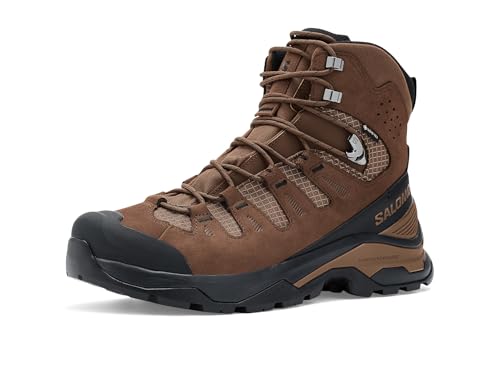
Best for: Multi-day backpackers carrying 25–45 lb packs on technical terrain — the Quest 5 is GearJunkie's top overall hiking boot pick for 2026, the most capable load-bearing boot in the Salomon lineup, and the model that directly addresses the Quest 4's documented limitations.
| ASIN | B0FH37D1FZ |
| Weight | ~22 oz per boot — heavier than X Ultra 5, appropriate for the protection it provides |
| Contagrip | TA — improvement over Quest 4's TD; better adhesion on smooth rock, double medial/lateral lugs, reverse heel for descent traction |
| Chassis | Advanced Chassis — stiff, appropriate for heavy pack loads; slightly more flexible than Quest 4 for comfort |
| Active Support Wings | Yes — mobile polymer wings for lateral ankle support under load |
| Key improvements vs Quest 4 | TA outsole, widened midfoot, OrthoLite sockliner, reverse heel lug pattern, improved descent traction |
| Waterproofing | Gore-Tex |
| Width options | Standard only — no wide available in Quest line |
| Insole | OrthoLite — added vs Quest 4's minimal insole |
| Best hiker | Heavy-pack multi-day backpackers on technical and off-trail terrain |
| Price range | ~$230–$250 |

The Quest 5 is what happens when Salomon applies five generations of backpacking boot feedback to a complete redesign. GearJunkie tested the Quest 4 through alpine desert in Western Colorado and on the Tour du Mont Blanc, then used it as a hunting boot in the Rocky Mountains — and found it "one of the more perfectly balanced hiking boots on the market." The Quest 5 carries this reputation forward while addressing the three consistent Quest 4 complaints: the narrow midfoot, the minimal stock insole, and the delamination risk of the TD outsole. The widened midfoot in the Quest 5 makes the boot accessible to a broader range of hikers without losing the secure Salomon lockdown that distinguishes the platform. The OrthoLite sockliner means the boot feels good from the first wear rather than requiring an aftermarket insole purchase to achieve reasonable cushioning.

The outsole change from Contagrip TD to TA is the most functionally significant Quest 5 upgrade. MountaineerJourney's field testing of the Quest 5 specifically calls out the double medial and lateral edge lugs as "a game-changer" for edging on rocky uneven terrain — a capability the Quest 4's standard lug pattern did not match. The reverse lug pattern at the heel provides more friction on steep descents with improved controlled landing. For hikers whose Quest 4 occasionally felt "skatey" on steep smooth rock during wet descents, the Quest 5's TA compound with improved lug pattern directly addresses this. The Active Support Wings provide the lateral ankle support that heavy backpacking demands, keeping the ankle secure during the off-camber landing events that cause the slow-motion ankle rolls that end trips. Standard width only — hikers with wide midfoots should understand this limitation before purchasing.
Best hiker type: Multi-day backpackers, 25–45 lb pack, technical and off-trail terrain, demanding conditions.
Pros: GearJunkie top overall pick 2026, Contagrip TA with improved lug pattern for descent traction, widened midfoot addresses Quest 4 narrowness, OrthoLite sockliner from first wear, Active Support Wings for heavy-load ankle support, Gore-Tex, addresses Quest 4's delamination issue.
Cons: Heavy at ~22 oz — overkill for day hiking with light packs. Standard width only — no wide option. Premium price at $230–$250. Wrong boot for hikers who want trail-running agility.
3. Salomon Quest 4 GTX — Best Value Backpacking Boot

Best for: Backpackers who want the Quest's legendary stability and support at a meaningful discount now that the Quest 5 is the current model — with clear awareness of the documented sole delamination issue that exists in a minority of units.
| ASIN | B0D82MZC12 |
| Weight | ~23 oz per boot |
| Drop | 18mm — notably high (RunRepeat: "jaw-dropping" vs 12.4mm average); excellent PF and Achilles protection but less natural feel for some hikers |
| Contagrip | TD (Trail Durable) — firmer than TA, more abrasion-resistant, less adhesive on smooth rock |
| Chassis | Stiffest Advanced Chassis tested — 5/5 per RunRepeat heel counter stiffness test |
| Active Support Wings | Yes |
| Forefoot width | 116.5mm at forefoot — 2.7mm wider than average, RunRepeat lab confirmed |
| Known issue | Sole delamination documented in minority of units by REI, Switchback Travel, and multiple verified purchasers |
| Waterproofing | Gore-Tex |
| Price range | ~$170–$190 (clearance pricing post Quest 5 launch) |

The Quest 4 is an exceptional boot with one documented problem — and the honest treatment of that problem is what distinguishes this review from every other guide that recommends it without caveat. In every dimension other than sole delamination, the Quest 4 is outstanding: RunRepeat's heel counter stiffness test rated it 5/5, the stiffest they have tested. The 18mm heel drop (significantly above the category average of 12.4mm) provides exceptional protection for hikers with plantar fasciitis or Achilles sensitivity. The Advanced Chassis delivers verified torsional stability. The nubuck leather upper with robust nylon weave withstood RunRepeat's Dremel abrasion test with only minor surface scratching — genuinely durable upper construction. GearJunkie tested it across the Tour du Mont Blanc and described the Quest as "one of the more perfectly balanced hiking boots on the market."

The delamination issue: REI explicitly notes "a striking number of users have had durability issues, particularly with the sole." Switchback Travel reports similar feedback from their testing community. The Quest 5 appears to have resolved this through a revised sole attachment process, which is reflected in the absence of widespread delamination reports in early Quest 5 reviews. The practical guidance for Quest 4 buyers: inspect the sole bond on all surfaces immediately upon receipt, applying firm pressure around the perimeter where sole meets upper. Return immediately if any separation is present. Salomon's warranty covers manufacturing defects — document and report within the warranty period. For hikers who primarily hike on dirt and mixed terrain (where the Contagrip TD's durability advantage over TA specifically matters), and who are willing to inspect and accept the delamination risk at $60–$80 savings versus the Quest 5, the Quest 4 remains a defensible purchase.
⚠️ Delamination notice: Documented sole delamination in a minority of units. Inspect on receipt. Salomon warranty covers manufacturing defects. Quest 5 at ~$60–$80 more resolves this issue.
Best hiker type: Budget backpackers who accept delamination risk; hikers with PF or Achilles sensitivity who benefit from the 18mm drop.
Pros: Exceptional stability (5/5 stiffest chassis tested), 18mm drop for PF/Achilles protection, durable nubuck upper, Contagrip TD for sustained abrasive terrain, significant price reduction vs Quest 5, Gore-Tex.
Cons: Documented sole delamination issue. Contagrip TD less adhesive on smooth rock vs Quest 5's TA. Standard width only. Narrower midfoot than Quest 5. 18mm drop may feel unnatural for hikers used to lower-drop footwear.
4. Salomon Outpulse Mid GTX — Best for Trail-Runner Feel in a Hiking Boot

Best for: Fast light hikers and trail runners who want the agility and feel of their trail running shoes with just enough mid-cut structure for ankle protection — the Outpulse is Salomon's most running-adjacent hiking boot and the lightest GTX option in this guide.
| ASIN | B0BRKP9GPQ |
| Weight | ~13.6 oz per boot — lightest in this guide, 20.6% lighter than average per RunRepeat |
| Midsole | Fuze Surge — Salomon's softest foam compound, 27.1% softer than average per RunRepeat durometer |
| Feel | Trail-running adjacent — springy, smooth ride; RunRepeat: "can easily be mistaken for a sneaker" |
| SensiFit | Yes — foot cradle construction for secure snug feel |
| Arch support | Good per RunRepeat — "keeps our arches from falling" |
| Outsole | Contagrip TA — adequate for mixed terrain, shallow lugs for this weight class |
| Waterproofing | Gore-Tex |
| Caveat | Not suitable for technical terrain or heavy packs — designed for light to moderate hiking |
| Best hiker | Fast light hikers, trail runners transitioning to hiking, trail-to-town crossover |
| Price range | ~$135–$160 |

The Outpulse exists for a specific hiker type that the X Ultra 5 and Quest series do not fully serve: the trail runner who wants a mid-cut boot for occasional hiking without giving up the springy, close-to-ground feel they are accustomed to. At 13.6 oz per boot and with a midsole compound that RunRepeat measured as 27.1% softer than the hiking boot average, the Outpulse moves and feels more like an elevated trail running shoe than a traditional hiking boot. The Fuze Surge foam's spring is noticeable and energetic — not the firm, stable platform of the Quest or even the X Ultra 5, but a genuinely bouncy ride that trail runners find immediately familiar. The SensiFit upper cradles the foot with the secure, slippage-free hold that distinguishes all Salomon hiking boots regardless of weight class.

The limitations of the Outpulse are inherent to its design philosophy and should be understood before purchase. The outsole lugs are on the shallow end for a hiking boot — adequate for established trail and moderate terrain but insufficient for the sustained mud and technical scrambling that deeper-lugged alternatives handle. The soft midsole provides insufficient lateral stability for hikers carrying heavy packs — the Fuze Surge compound compresses under load in ways that the Advanced Chassis in the X Ultra 5 and Quest series resist. This is not a deficiency — it is the correct design for fast light hiking where cushioning and weight savings matter more than maximum stability. For hikers who have tried heavier Salomon boots and found them unnecessarily stiff for their easy trail use, the Outpulse is the correct step down.
Best hiker type: Fast light hikers, trail runners using hiking boots occasionally, trail-to-town crossover — day hiking only, light pack.
Pros: Lightest in guide, Fuze Surge soft springy midsole for trail-runner feel, SensiFit secure cradle hold, Gore-Tex, good arch support, excellent for casual to moderate established trail.
Cons: Shallow outsole lugs — not for deep mud or sustained technical terrain. Soft midsole insufficient for 30+ lb pack stability. Not the right boot for technical backpacking terrain.
5. Salomon XA Pro 3D V8 Mid GTX — Best for Technical Trail Agility
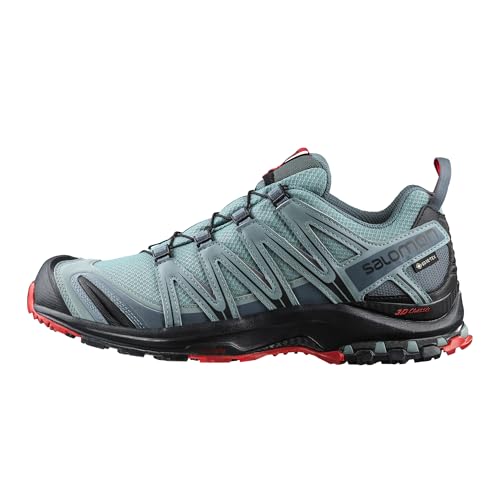
Best for: Hikers who want maximum agility on technical and muddy trail — the XA Pro's 3D Advanced Chassis, TrailProtect pad, and deeper Contagrip lugs provide more technical performance than the X Ultra 5 in environments where grip and ground protection matter more than lightness.
| ASIN | B07KQRQV7J |
| Weight | ~16 oz per boot |
| Chassis | 3D Advanced Chassis — provides lateral rigidity from multiple angles |
| Outsole | Contagrip TA with deeper, wider-spaced chevron lugs — better mud performance than X Ultra 5 |
| TrailProtect | Protective pad under the forefoot for underfoot protection on rocky technical trail |
| SensiFit | Yes — aggressive foot-cradle hold for technical terrain security |
| Lacing | Traditional lace option available on some variants — check listing |
| Stack | Lower than X Ultra 5 — closer to ground, more connected trail feel |
| Waterproofing | Gore-Tex |
| Best hiker | Technical single-track, muddy trail, trail runners transitioning to hiking, aggressive terrain |
| Price range | ~$150–$175 |

The XA Pro 3D V8 is Salomon's heritage model — the XA Pro series has been in production since the brand launched trail footwear, and the V8 represents the eighth iteration of what began as a trail running shoe and has evolved into one of the most capable technical hiking shoes in the mid-weight category. The 3D Advanced Chassis provides lateral rigidity from multiple angles rather than the standard single-plane chassis of the X Ultra 5 — specifically effective for off-camber terrain where the foot is loading the lateral edge of the boot rather than the flat bottom. The deeper, more widely spaced Contagrip lugs provide better mud performance than the X Ultra 5's moderate tread — the lugs self-clean in soft surfaces more effectively, maintaining grip through conditions that would cause the X Ultra 5 to slip.

The TrailProtect forefoot pad addresses the underfoot bruising that technical rocky trail causes in lighter hiking shoes without a rock protection system — a stone strike under the forefoot on a sharp rock delivers a concentrated impact that thin-soled footwear transmits directly to the foot. The XA Pro's pad distributes this impact across a wider surface, protecting the metatarsal heads that are most vulnerable to trail debris contact. The SensiFit cradle on the XA Pro is notably aggressive — the boot grips the foot securely for technical movements including scrambling, sidehilling, and rapid direction changes that smooth established-trail hiking never demands. For hikers who regularly cover technical, muddy, or loose terrain where the X Ultra 5 begins to feel insufficiently grippy, the XA Pro is the more correct Salomon choice.
Best hiker type: Technical trail, muddy terrain, scrambling, trail runners wanting more protection than a trail shoe without the weight of the Quest.
Pros: 3D Advanced Chassis for multi-angle lateral stability, deeper Contagrip lugs for mud and technical terrain, TrailProtect forefoot pad, SensiFit aggressive cradle, lower stack for ground feel, Gore-Tex.
Cons: Lower cushioning than X Ultra 5 for long-distance established trail comfort. Not the Quest's load-bearing capability for heavy packs. Slightly heavier than Outpulse for light fast hiking where agility is the priority.
6. Salomon X Ultra 360 Mid GTX — Best Budget Salomon Hiking Boot

Best for: Casual to moderate day hikers who want Salomon's design DNA and Gore-Tex waterproofing at a lower price point — the X Ultra 360 is HikingFeet's recommended "more all-around" Salomon at $25 less than the X Ultra 5, designed for trail-to-town use and occasional hiking.
| ASIN | B0D823737P |
| Architecture | X Ultra 5 DNA with simplified features — same general platform, reduced specification |
| Key differences vs X Ultra 5 | Less premium insole, no winged eyelet connecting lacing to midsole, reduced chassis rigidity |
| Outsole | Contagrip — versatile grip for mixed terrain |
| Waterproofing | Gore-Tex |
| Lacing | Quicklace |
| Best use | Casual hikes, trail-to-town, occasional day hiking, not for technical terrain or heavy packs |
| Width options | Standard |
| Price range | ~$150–$175 |
The X Ultra 360 is HikingFeet's recommended entry into the Salomon X Ultra ecosystem — "designed for more all-around use, from casual hikes to occasional day hikes to trail-to-town wear" at a price that makes the X Ultra platform accessible to hikers who don't need the full X Ultra 5 specification. The simplified features represent genuine trade-offs rather than arbitrary cost reduction: the absence of the winged eyelet that connects the lacing system to the midsole reduces the SensiFit integration precision — the X Ultra 360 still fits well, but with slightly less of the cradle-like uniformity that the X Ultra 5 achieves. The less premium insole is the most immediately noticeable simplification — hikers who plan to use an aftermarket insole will not notice; those relying on the stock insole for arch support will find less of it than the X Ultra 5 provides.

For the intended use case — casual hiking, trail walks, occasional mountain day hikes on established trail — the X Ultra 360 is more than capable. Gore-Tex waterproofing keeps the full membrane protection regardless of the simplified upper construction. The Contagrip outsole delivers the traction that Salomon's trail heritage produces. The Quicklace system provides the same fast, even on/off convenience. For hikers who are new to Salomon and unsure whether the brand's narrow-to-moderate fit works for their feet, the X Ultra 360 at $25 less than the X Ultra 5 reduces the cost of a potential return. If the fit works, the serious hiker can then invest in the full X Ultra 5 specification with confidence that Salomon fits them correctly.
Best hiker type: Casual to moderate day hikers, trail-to-town users, first Salomon buyers at a reduced price.
Pros: Gore-Tex at a lower price than X Ultra 5, Salomon X Ultra DNA and design language, Quicklace, Contagrip outsole, good entry point for first-time Salomon buyers.
Cons: Less SensiFit integration precision than X Ultra 5. Less premium insole — aftermarket insole recommended for arch support needs. Reduced chassis rigidity — not for technical terrain or heavy packs. Only standard width.
7. Salomon Quest Echo GTX — Best Women's Salomon for Backpacking
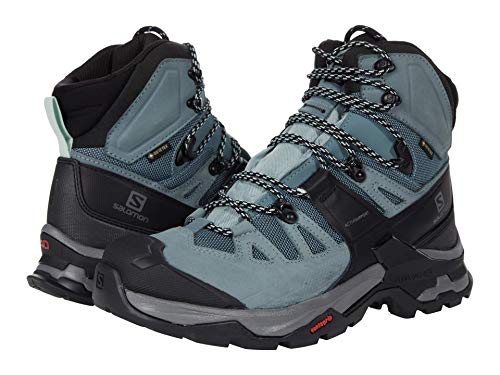
Best for: Women backpackers who need the Quest platform's load-bearing stability and ankle protection — GearJunkie explicitly recommends the Quest Echo as the women's equivalent of the men's Quest series, built on a genuine women's last with the full Quest technical specification.
| ASIN | B08LG6LJ7T |
| Last | Genuine women's last — narrower heel, adjusted arch position, women's foot proportions |
| Chassis | Advanced Chassis — load-bearing stability for heavy packs |
| Outsole | Contagrip — technical mixed terrain traction |
| Active Support Wings | Yes — lateral ankle support for heavy-load backpacking |
| SensiFit | Yes — women's foot-cradle construction |
| Waterproofing | Gore-Tex |
| Width | Standard — same narrow-to-moderate midfoot as men's Quest line |
| Best hiker | Women multi-day backpackers, 25–40 lb pack, technical terrain |
| Price range | ~$175–$200 |

The Quest Echo addresses the single most important problem in women's hiking boot design: the genuine women's last. Women's feet have a narrower heel relative to forefoot width, an arch positioned further forward, and different calf and ankle proportions than men's feet. A hiking boot on a men's last in women's sizing creates heel slippage from the too-wide heel cup, arch support in the wrong position, and a general fit that feels loose in some areas and tight in others simultaneously. Salomon builds the Quest Echo on a women's-specific last that matches women's foot anatomy rather than scaling down the men's version. The heel cup, arch position, and overall foot-cradle geometry are calibrated for women's proportions.

The full Quest technical specification — Advanced Chassis for load-bearing torsional rigidity, Active Support Wings for lateral ankle protection under heavy packs, Gore-Tex for sustained waterproofing across multi-day exposure — is carried into the women's version without compromise. For women who have hiked in men's Quest series boots in smaller sizes and experienced heel slippage or arch fatigue, the Quest Echo provides the same technical performance in a correctly-fitted platform. The narrow-to-moderate midfoot fit warning applies equally to women: Salomon's midfoot cradle is narrow regardless of the gendered version, and women with wide midfoot volume may find the standard width constrictive. The Women's X Ultra Flare Mid GTX (Pick 8) in its wide variant is the alternative for women who need more midfoot room.
Best hiker type: Women multi-day backpackers on technical terrain who need the Quest's load-bearing capability on a genuine women's last.
Pros: Genuine women's last for correct anatomical fit, full Quest technical specification, Advanced Chassis for heavy pack stability, Active Support Wings, Gore-Tex, GearJunkie recommended women's backpacking pick.
Cons: Standard width only — narrow-to-moderate midfoot fit. Same heavy-trail-boot weight as men's Quest for applications where lighter options would suffice. Not for day hikers who don't need heavy pack support.
8. Salomon Women's X Ultra Flare Mid Gore-Tex — Best Women's Day Hiking Boot
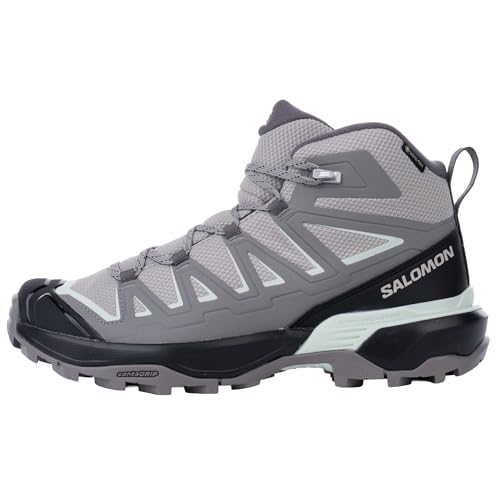
Best for: Women day hikers and light overnight backpackers who want the X Ultra's agility and lightness in a women's-specific boot designed for women's trail hiking requirements — the Flare is Salomon's current women's X Ultra equivalent built from the ground up for women's foot anatomy.
| ASIN | B0FBRLVW3J |
| Last | Women's specific — appropriate heel cup, arch position, and forefoot geometry |
| Weight | ~14 oz per boot — lightweight, close to X Ultra 5 men's weight |
| Chassis | Advanced Chassis — women's trail agility with lateral stability |
| Outsole | Contagrip TA — versatile mixed terrain, women's hiking pattern |
| SensiFit | Yes — women's foot cradle construction |
| Waterproofing | Gore-Tex |
| Lacing | Quicklace |
| Best hiker | Women day hikers, light overnight, fast trail hikers |
| Price range | ~$160–$185 |

The Women's X Ultra Flare Mid GTX is Salomon's current women's day hiking boot — a platform designed for women's trail hiking from the last up rather than being a gendered colour variant of the men's boot. The women's-specific last calibrates the heel cup width to women's narrower heel anatomy, positions the arch support for women's more forward arch placement, and proportions the overall fit for women's wider forefoot-to-heel ratio. Women who have tried the men's X Ultra 5 in smaller sizes and experienced heel slippage — the most common fit problem when women wear men's hiking boots — will find the Flare's women's last eliminates this immediately.

The lightweight platform — approximately 14 oz per boot — delivers the day hiking agility that the women's trail hiking market consistently prioritises. The Contagrip TA outsole provides the same reliable wet and dry traction that makes the men's X Ultra 5 trusted on mixed terrain. Gore-Tex waterproofing maintains full-season capability across all weather. The Advanced Chassis provides torsional stability for technical sections without adding the weight of the Quest platform that women carrying light day packs do not need. The Quicklace system operates identically to the men's version — the same field repair protocol applies, and the same Salomon replacement kits are compatible. For women hiking established trails to moderate technical terrain with packs under 25 lbs, the Flare is the correct Salomon.
Best hiker type: Women day hikers and light overnight hikers on mixed terrain with light packs.
Pros: Genuine women's last for anatomically correct fit, lightweight at ~14 oz, Contagrip TA for mixed terrain, Advanced Chassis for lateral stability, Gore-Tex, Quicklace.
Cons: Not the load-bearing capability of the Quest Echo for heavy-pack backpacking. Narrow-to-moderate midfoot fit — same Salomon width consideration as men's models.
9. Salomon X Ultra 5 Mid GTX Wide — Best for Wide Feet
Best for: Hikers with wide midfoot volume who want the X Ultra 5's performance specifications — Contagrip TA, Advanced Chassis, Matryx upper, Gore-Tex — in a 2E wide platform that accommodates the midfoot width that standard Salomon sizing cannot.
| ASIN | B0D82C4F8D |
| Width | Wide (2E) — wider midfoot than standard X Ultra 5 |
| Specification | Identical to standard X Ultra 5 Mid GTX in all other dimensions |
| Contagrip | TA |
| Chassis | Advanced Chassis (flexible) |
| Upper | Matryx — Kevlar-reinforced |
| Waterproofing | Gore-Tex |
| Weight | ~15.4 oz per boot (similar to standard) |
| Best hiker | Wide-midfoot hikers who cannot fit standard Salomon and want to stay in the Salomon ecosystem |
| Price range | ~$175–$200 |
Salomon's narrow-to-moderate fit is the brand's primary limitation for hikers with wider feet — and the Wide variant of the X Ultra 5 is the specific solution for hikers who want Salomon's performance technology without the midfoot compression that standard Salomon sizing creates. Understanding where the width difference matters: MountaineerJourney measured the standard X Ultra 5 toe box at over 4 inches wide — the boot is not narrow in the toe area. The constraint is in the midfoot cradle and heel cup, which are the dimensions that the Wide variant specifically addresses. For hikers who have tried standard Salomon boots and found the toe box acceptable but the midfoot constrictive after 3–4 hours of hiking, the Wide variant targets exactly this issue.
The full X Ultra 5 specification — Matryx Kevlar-reinforced upper, Contagrip TA outsole, Advanced Chassis, Gore-Tex — carries over to the Wide variant without modification. The additional width is in the midfoot platform construction, not a looser lacing system or a changed SensiFit configuration. For hikers who have been told to buy KEEN or Merrell because Salomon doesn't come in wide, this variant provides the Salomon option. Availability varies by colourway and market — verify the specific Wide ASIN matches the width variant you require before ordering, as standard and wide ASINs are distinct products that can look identical in product photos.
Best hiker type: Hikers with wide midfoot who want X Ultra 5 specification without midfoot compression.
Pros: Full X Ultra 5 specification in Wide (2E) fit, Matryx upper, Contagrip TA, Advanced Chassis, Gore-Tex — everything the standard X Ultra 5 delivers with wider midfoot accommodation.
Cons: Availability varies — verify 2E variant specifically. Wide option not available in Quest line — hikers with wide feet needing heavy backpacking boot capability may need to look outside Salomon (KEEN, Lowa Renegade in wide).
10. Salomon Women's Speedcross GTX — Best Women's Aggressive Trail Boot
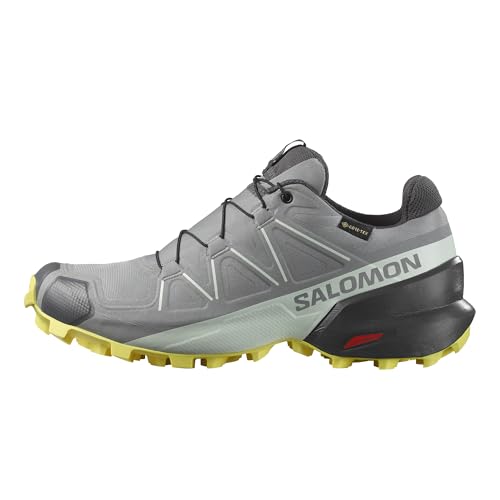
Best for: Women who run or hike aggressive technical and muddy trail and want the Speedcross platform's best-in-class mud grip in a Gore-Tex waterproof mid-cut boot — the Speedcross GTX brings the trail running community's most trusted mud outsole to a waterproof hiking boot format.
| ASIN | B0C46LC5MP |
| Contagrip | MA (Mud-Aggressive) — deepest lugs in this guide, widest spacing, best self-cleaning in mud |
| Weight | ~13 oz per boot — lightest in this guide alongside Outpulse |
| Lug depth | ~8mm chevron pattern — significantly deeper than other picks |
| SensiFit | Yes — aggressive foot cradle for technical terrain security |
| Waterproofing | Gore-Tex — waterproof protection for wet trail conditions where mud is present |
| Last | Women's specific |
| Terrain caveat | Deep lugs are uncomfortable and wear faster on road and pavement — specialist trail shoe |
| Best hiker | Women who hike or trail-run on muddy, loose, technical terrain where traction is the primary requirement |
| Price range | ~$155–$180 |
The Speedcross has sold over 10 million pairs since 2006 for a specific reason: on muddy, loose, and soft trail terrain, its Contagrip MA outsole with deep 8mm chevron lugs provides grip that no other outsole in the category matches. The widely spaced lugs self-clean — mud is expelled from between the lugs with each step rather than packing in and turning the outsole into a flat mud-coated platform. For women who hike and trail-run in the muddy seasons where every other outsole slips, the Speedcross GTX provides the traction confidence that makes wet-season hiking genuinely safe rather than genuinely risky. The Gore-Tex waterproofing pairs correctly with the mud-terrain outsole — conditions that create mud are the same conditions where waterproofing matters most.

The honest terrain caveat: the Contagrip MA outsole is a specialist. On hard-packed dirt, rock, and pavement, the deep 8mm lugs create an uncomfortable rolling sensation — the same wide spacing that self-cleans in mud creates uneven contact points on firm surfaces. On smooth rock, the softer MA compound wears faster than the TA and TD compounds used in the other picks. The Speedcross GTX is not the correct everyday trail boot — it is the correct boot for conditions where traction on mud and loose terrain is the primary requirement. Women who split time between muddy trail seasons and dry rocky seasons would be better served by the X Ultra Flare Mid GTX (Pick 8) for general use and keeping the Speedcross for consistently wet-season outings.
Best hiker type: Women hikers and trail runners on muddy, loose, and soft terrain — the specialist mud and technical wet trail boot.
Pros: Contagrip MA best-in-category mud grip, 8mm self-cleaning chevron lugs, lightweight at ~13 oz, Gore-Tex for wet-season waterproofing, SensiFit secure hold for technical terrain, women's specific last.
Cons: Specialist outsole — uncomfortable and faster-wearing on road, pavement, and hard-packed surfaces. Not the all-terrain versatility of Contagrip TA. Not the load-bearing capability for heavy backpacking. Mud specialist, not mud-capable generalist.
Quest 5 vs Quest 4: The Complete Comparison
The Quest 5 launched in early 2026 and made the Quest 4 the "previous model" — which means the Quest 4 is now available at meaningful discount while the Quest 5 carries a $230–$250 price tag. This is the comparison every serious Salomon backpacking boot buyer needs to make in 2026.
Outsole: Quest 5 uses Contagrip TA with a new double medial/lateral lug pattern and reverse heel lugs for improved descent traction. Quest 4 uses Contagrip TD — firmer, more durable, but less adhesive on smooth rock. For rocky technical terrain where adhesion matters: Quest 5 wins clearly. For sustained abrasive terrain on dirt and loose rock where outsole longevity matters: Quest 4's TD durability may be preferable at its lower price.
Midfoot width: Quest 5 is noticeably wider in the midfoot than Quest 4. The narrow midfoot of the Quest 4 was the most consistent complaint across multiple review sources. Quest 5 wins for standard-width hikers with any midfoot volume concerns.
Insole: Quest 5 includes an OrthoLite sockliner — a genuine improvement that provides immediate cushioning comfort. Quest 4 has a minimal insole that most serious hikers replaced with aftermarket options. Quest 5 wins out of box.
Chassis: Quest 5 is slightly less rigid than Quest 4 for improved comfort without meaningful loss of stability for most backpacking loads. Quest 4 retains the maximum rigidity for hikers who specifically prioritise absolute stiffness.
Delamination: Quest 4 has documented sole delamination in a minority of units. Quest 5 appears to have resolved this. Quest 5 wins on reliability.
Price: Quest 5 at $230–$250 vs Quest 4 at $170–$190 — approximately $60 difference. For buyers who primarily hike dirt and mixed terrain (TD durability advantage) and accept the delamination risk with proper inspection: Quest 4 represents value. For buyers who want the best current Salomon backpacking boot without the delamination concern: Quest 5 is worth the premium.
X Ultra 5 vs Quest: Getting This Decision Right
This is the most consequential Salomon buying decision — and getting it wrong leads to real problems on the trail. The X Ultra 5 and Quest are not light and heavy versions of the same boot. They are fundamentally different tools.
The X Ultra 5 weighs approximately 15.4 oz per boot. The Quest 5 weighs approximately 22 oz per boot. That 6–7 oz per boot difference — roughly 0.85 lbs per pair — compounds across 10 miles into measurable energy expenditure. Over a week of mountain hiking covering 60 total miles, the weight difference is felt as genuine cumulative fatigue.
The X Ultra 5 has a forefoot flexibility 34.3% higher than average (RunRepeat lab). The Quest's stiff chassis provides maximum torsional rigidity at the cost of forefoot flex. Under a 35 lb pack on technical terrain, the X Ultra 5's flex creates ankle instability that the Quest's chassis prevents. On easy established trails with a 15 lb daypack, the Quest's stiffness creates unnecessary fatigue.
The decision rule that works: if you would feel comfortable running downhill in the boot, the X Ultra 5 is your boot. If running downhill in your hiking boot is not a movement you would ever attempt, the Quest's additional stability weight is justified. Pack weight over 25 lbs on technical terrain: Quest. Pack under 25 lbs on established trails: X Ultra 5.
Women's Salomon Hiking Boot Guide
Women represent a significant and growing portion of the hiking boot market, and Salomon's women's lineup is built from genuine women's lasts rather than sized-down men's boots. Understanding the difference matters for avoiding the most common fit failures women experience in hiking footwear.
Women's feet have a narrower heel relative to forefoot width than men's feet of the same length. A men's hiking boot last in women's sizing creates a heel cup that is too wide — causing heel slippage, the Achilles blisters that follow, and the gradual sock bunching that ruins long hikes. Salomon's women's last calibrates the heel cup for women's narrower heel anatomy, positions arch support for women's more forward arch, and proportions the overall cradle for women's foot geometry.
The narrow-to-moderate midfoot fit warning applies to women's Salomon boots equally. Women's feet often have a wider forefoot relative to heel than men's — Salomon's SensiFit cradle, designed around trail running efficiency, may feel constrictive for women with wide midfoot volume even in women's sizing. Try on or order with a clear return policy if buying online for the first time.
The women's Salomon decision: Multi-day backpacking with heavy pack → Quest Echo GTX (Pick 7). Day hiking and light overnight → Women's X Ultra Flare Mid GTX (Pick 8). Aggressive muddy technical trail → Women's Speedcross GTX (Pick 10). Wide midfoot and want to stay in Salomon → Women's X Ultra in Wide variant where available on current listings.
Salomon Boot Care and Break-In
Salomon hiking boots are built with athletic-influenced construction that requires minimal traditional leather break-in. The X Ultra 5, Outpulse, XA Pro, and X Ultra 360 are comfortable from near first wear — the synthetic and woven uppers flex with the foot without the stiff leather adaptation period that traditional hiking boots require. Plan for 5–10 hours of progressive wear before a demanding hike with any new pair.
The Quest series (leather and nubuck upper) requires a proper break-in of 15–25 hours. Apply leather conditioner or Nikwax Leather Conditioner on day one and after every 10 hours of early use. The leather collar and ankle crease areas are the primary break-in zones — wear the boot for 3–4 hour sessions in the first week before committing to a full-day demanding hike.
Gore-Tex care: when water soaks into the upper surface rather than beading off, the DWR (Durable Water Repellent) treatment has degraded. Re-apply Nikwax TX.Direct (spray-on for the upper) while the boot is slightly damp after cleaning. Do not use Mink Oil on Gore-Tex-lined boots — Mink Oil degrades the Gore-Tex membrane. Use Nikwax Leather Conditioner specifically for Gore-Tex leather boots.
Expected lifespan: X Ultra 5 and similar athletic construction — 400–600 miles of trail use before outsole wear becomes significant. Quest series leather — 500–700 miles with proper conditioning. Outsole wear, not upper degradation, is typically the primary end-of-life indicator for Salomon hiking boots.
Salomon vs. Competitors: Where It Wins and Where It Doesn't
Salomon wins on torsional stability at light weight (Advanced Chassis provides rigidity that competitors achieve only by adding weight), Contagrip TA versatility on rock (wet and dry performance that Vibram MegaGrip matches but does not consistently exceed), and lacing system speed (Quicklace is the fastest, most even-tension system in the category). REI's 2026 description of the X Ultra 5 — "encourages you to surge, jump, ricochet" — captures the agility advantage that Salomon's trail running heritage produces in a hiking boot context that competitors do not match.
Salomon loses on width options (KEEN and Merrell provide genuine wide options across their full lineup, including backpacking boots; Salomon's wide options are limited to the X Ultra 5), leather upper durability (Lowa Renegade's PU-soled leather construction outlasts Salomon's synthetic uppers in sustained abrasive backcountry use), and insole quality (Oboz's proprietary O FIT insole included standard is notably better than the stock insoles of most Salomon hiking boots, though the Quest 5's OrthoLite is an improvement), and cushioning plushness (HOKA's Kaha 3 GTX and Anacapa provide more cushioned ride for hikers who prioritise impact absorption over ground feel).
Frequently Asked Questions
What is the difference between the Salomon X Ultra 5 and Quest 5?
Fundamental differences, not just size. X Ultra 5: 15.4 oz, flexible chassis, 4.5mm drop, designed for day hiking agility. Quest 5: ~22 oz, stiff load-bearing chassis, higher drop, designed for multi-day backpacking with heavy packs. The wrong choice leads to ankle soreness (X Ultra 5 under heavy pack on technical terrain) or unnecessary fatigue (Quest on easy trails with light pack). Pack under 25 lbs on established trails: X Ultra 5. Pack over 25 lbs on technical terrain: Quest 5.
Are Salomon hiking boots good for wide feet?
For wide midfoot specifically, standard Salomon sizing is narrow to moderate — a limitation of their trail running heritage last. The X Ultra 5 is available in a Wide (2E) variant that addresses midfoot volume. The Quest 4 and Quest 5 come in standard width only — hikers with wide midfoot needing a heavy-load boot may need to look at Lowa Renegade or KEEN Targhee for wide options in that category. The toe box in recent Salomon models is adequately wide; the constraint is in the midfoot cradle.
What is Salomon Quicklace and what happens if it breaks?
Quicklace is a single-pull Kevlar-strength cord that tightens the entire shoe evenly in one motion, locks, and tucks away. Field repair: Salomon sells replacement kits; the lace loops in the X Ultra 5 are large enough to thread a thin conventional lace as a backup; carry paracord on multi-week backcountry trips. In practice, Quicklace failures are rare — testers with 10+ Salomon Quicklace pairs report zero failures in field use.
Is the Salomon Quest 4 still worth buying in 2026?
Yes, with awareness of the documented sole delamination issue. The Quest 4 is exceptional in stability, upper durability, and torsional rigidity. At current clearance prices ($170–$190 vs Quest 5's $230–$250), it represents value for hikers who primarily hike dirt and mixed terrain (where Contagrip TD's durability advantage matters), inspect the sole bond on receipt, and understand the delamination risk. For hikers who want the best current Salomon backpacking boot without this concern: Quest 5.
What does Contagrip mean in Salomon boots?
Contagrip is Salomon's outsole system — developed in the French Alps since 2002. Three variants in hiking context: Contagrip TA (Trail All-terrain, medium density, versatile on rock and dirt — used in X Ultra 5 and Quest 5); Contagrip TD (Trail Durable, firmer and more abrasion-resistant — used in Quest 4, better longevity but less adhesion on smooth rock); Contagrip MA (Mud-Aggressive, softer with deep self-cleaning lugs — used in Speedcross, specialist mud grip).
Are Salomon hiking boots true to size?
Generally yes — order your standard hiking shoe size. The fit runs narrow in the midfoot, not small in length. If you are between sizes, go up half a step. If you have wide feet, specifically seek the Wide variant of the X Ultra 5 rather than sizing up in standard width — sizing up adds length but not midfoot width, and creates heel slippage.
What is the difference between the X Ultra 5 GTX and non-GTX?
The only difference is the Gore-Tex waterproof membrane. GTX: keeps water out in creek crossings, rain, and wet grass; runs warmer due to reduced breathability; correct for three-season hiking in variable weather. Non-GTX: significantly more breathable; dries faster when wet; correct for summer hiking in dry climates above 70°F where foot sweat accumulation inside a GTX boot is the primary comfort problem.
Which Salomon hiking boot is best for women?
Depends on use case. Multi-day backpacking with heavy pack: Quest Echo GTX (Pick 7) — GearJunkie's recommended women's backpacking pick, genuine women's last, full Quest specification. Day hiking and light overnight: Women's X Ultra Flare Mid GTX (Pick 8) — lightweight, agile, women's-specific last. Muddy aggressive technical trail: Women's Speedcross GTX (Pick 10) — Contagrip MA best mud grip. Wide midfoot: seek Women's X Ultra in Wide variant on current listings.
Final Verdict: The Right Salomon for Your Hike
For most hikers — day hiking established to moderate trails with a light to moderate pack: Salomon X Ultra 5 Mid GTX — Contagrip TA, Advanced Chassis, Matryx Kevlar upper, Gore-Tex. The correct boot for approximately 80% of Salomon buyers.
For multi-day backpackers with heavy packs on technical terrain, current model: Salomon Quest 5 GTX — improved Contagrip TA, widened midfoot, OrthoLite insole, GearJunkie top overall pick 2026.
For backpackers who want Quest capability at clearance pricing with delamination awareness: Salomon Quest 4 GTX — exceptional stability, inspect sole on receipt, accept the risk.
For the lightest, most trail-running-adjacent Salomon: Salomon Outpulse Mid GTX — 13.6 oz, Fuze Surge soft midsole, for fast light hikers only.
For technical and muddy trail with more aggressive grip than the X Ultra 5: Salomon XA Pro 3D V8 Mid GTX — 3D chassis, deeper lugs, TrailProtect pad.
For the budget-conscious Salomon first-timer on casual trail: Salomon X Ultra 360 Mid GTX — X Ultra DNA at $25 less.
For women backpacking with heavy packs: Salomon Quest Echo GTX — GearJunkie recommended, genuine women's last, full Quest spec.
For women day hiking on mixed terrain: Salomon Women's X Ultra Flare Mid Gore-Tex — lightweight, women's-specific last, Contagrip TA.
For hikers with wide midfoot who want to stay in the Salomon ecosystem: Salomon X Ultra 5 Mid GTX Wide — full X Ultra 5 specification in 2E wide.
For women on muddy and aggressive technical trail: Salomon Women's Speedcross GTX — Contagrip MA, best mud grip in the lineup, Gore-Tex.