You did everything right. You bought the latest $160 neutral-cushioned running shoes. So why do your shins feel like they’re on fire after three miles? Why is that nagging pain under your heel getting worse, not better?
Here’s what the shoe brands won’t tell you: the insole that came with your shoe is a thin piece of foam. It’s designed to feel soft in the store, not to support your foot’s alignment over hundreds of miles of repetitive impact. It offers zero structural support.
The fix isn’t more cushion — your midsole already provides that. The fix is structure. A good aftermarket insole controls your foot’s motion, prevents your arch from collapsing on impact, and keeps your entire kinetic chain — foot, ankle, knee, hip — properly aligned. That’s what stops injuries before they start.
Running insoles for improved comfort and support, ideal for athletes and runners. Designed to reduce fatigue and prevent injuries during training and races.
Quick Picks: 5 Best Running Insoles in 2026
| Award | Insole | Best For | Key Feature | Price |
|---|---|---|---|---|
| 🏆 Best Overall | Currex RunPro | All-around performance, athletic feel | Dynamic flexible arch plate, 3 arch heights | $$$ |
| 🛡️ Best for Plantar Fasciitis | PowerStep Pinnacle | Overpronation, arch pain, flat feet | Semi-rigid shell + deep heel cup | $$ |
| 💪 Best Max Support | Superfeet ADAPT Run | Runners needing structure + cushion | Adaptive heel cup + responsive foam | $$ |
| ☁️ Best Max Cushion | Hoka Performance Insole | Recovery runs, heavier runners, joint protection | Dual-layer PU/EVA plush foam | $$ |
| 💰 Best Thin / Race Day | Superfeet Carbon | Snug shoes, race day, minimalist runners | Carbon-fibre stabilizer cap, ultra-thin profile | $$$ |
What to Look for in a Running Insole: The Complete 2026 Guide
The three features every good running insole must have
1. A deep heel cup. This is the single most important feature. Your heel’s natural fat pad needs to be cradled and contained — when it spreads under impact without being held, the shock travels straight up your leg. A deep heel cup locks the fat pad in place and activates your foot’s natural shock absorption system. This is what stops shin splints, plantar fasciitis, and knee pain at the source.
2. A structured arch — not a soft gel pad. A squishy gel arch feels good in the store and does almost nothing on the road. Your arch needs to be supported as it flexes, not simply cushioned after it collapses. Look for either a semi-rigid shell (like PowerStep) that braces the arch, or a dynamic flexible plate (like Currex) that moves with the arch while preventing collapse. Both work; they suit different runners.
3. A low-friction top sheet. Running generates heat and repetitive friction across the top of the insole. A moisture-wicking, low-friction top fabric reduces blister formation — especially on long runs or races where you can’t stop to adjust your shoes.
Rigid vs dynamic support: which is right for you?
This is the most debated topic in running insoles in 2026 — and both approaches have genuine merit. Here’s how to choose:
Rigid / semi-rigid (Superfeet, PowerStep): Acts like a corrective brace. It holds your foot in proper alignment regardless of what your muscles are doing. This is the right choice for runners with overpronation, plantar fasciitis, flat arches, or any structural issue that needs consistent corrective support. The trade-off: it can feel firm and takes 1–2 weeks to adapt to fully.
Dynamic / flexible (Currex RunPro): Acts like a responsive spring. The arch plate flexes with your foot’s natural movement while preventing collapse — you get support without losing ground feel. iRunFar’s testing team (updated May 2026) rated Currex RunPro as their overall best pick for exactly this reason: it doesn’t change how your running shoe feels, it just makes it better. Best for neutral runners and those who find rigid insoles too restrictive.
The volume problem: will it actually fit?
Running shoes are low-volume and snug by design. A thick high-volume insole designed for work boots will cramp your toes in a racing trainer and make the fit feel completely wrong. This is the most common insole buying mistake. The rule: look for low-profile or medium-profile insoles specifically designed for athletic shoes. Each review below notes the volume level so you can match it to your shoe.
How often to replace running insoles
Insoles are not permanent. The foam compresses and the supportive structure breaks down — often before any visible wear. Most quality running insoles are rated for 300–500 miles or 12 months, whichever comes first. The sign your insoles need replacing: you start feeling discomfort that wasn’t there before, or you can press the arch area and it doesn’t spring back. Replace them on the same schedule as your running shoes.
Running insoles for improved comfort and support, ideal for athletes and runners. Designed to reduce fatigue and prevent injuries during training and races.
The 5 Best Running Insoles of 2026: Full Reviews
🏆 1. Currex RunPro — Best Overall Running Insole

- FEEL BETTER, PERFORM BETTER: Flexible support and shock absorbing cushioning from heel to toe help reduce fatigue, prevent common running injuries such as shin splints, and boost performance everywhere you run, from the trails to the track; the insoles also fold at the flex point, enabling maximum flexibility with movement
- 3D Dynamic Arch Technology & Multiprofile Arch Support: Our dynamic arch support insoles come in low, medium and high arch support profiles; they feature a deep decoupled heel cup that fits, wraps and locks the heel in place, improving stability, reducing pressure, and providing a perfect fit
- Engineered to Energize Your Running: Rebound cushioning and controlled power transmission provide faster regeneration and powerful propulsion with every stride; plus, a zero heel drop provides a great fit in most running shoes with optimized motion for all running foot strikes (insoles can also be trimmed to fit for the perfect fit)
- Moisture Management & Breathability: Top layer mesh and PORON premium foam design help dehumidify the inside of shoe, keeping the feet dry and running shoes fresh throughout exercise; note you should replace your CURREX insoles after 500+ miles or 12 months, whichever comes first
- Made for What Moves You: CURREX is the only insole company that offers a full line of activity-specific insoles customized to help improve how men and women move; whatever you or your family loves to do, from the workday through the weekend, CURREX makes moving more comfortable, leading to better performance and more fun
Support: ★★★★☆ (Dynamic) | Cushion: ★★★★☆ | Durability: ★★★★☆ | Volume: Low profile
Why it’s our top pick in 2026: The Currex RunPro has earned back-to-back overall wins from iRunFar (tested through May 2026) and remains Bootsguru’s top recommendation for most runners — and the reason comes down to one key design decision. Instead of a rigid plastic shell, Currex uses a dynamic flexible arch plate that moves with your foot rather than fighting it. You get genuine arch support that prevents collapse on impact, without losing the natural feel of your shoe beneath your foot.
It’s also the most versatile insole in this guide: available in three arch heights (High, Medium, Low) for a semi-custom fit based on your arch type, low enough in profile to fit in any running shoe without cramping the toe box, and light enough that you won’t feel it adding weight. Durability holds up well across the 300–500 mile rated lifespan. The one caveat: if you have severe overpronation or active plantar fasciitis, the dynamic arch may not provide sufficient corrective force — the PowerStep Pinnacle below is a better starting point for that profile.
| Pros | Cons |
|---|---|
| Dynamic flexible support — works with your foot Very lightweight and breathable Low profile — fits all running shoes 3 arch heights for custom fit iRunFar #1 overall pick (May 2026) |
Less corrective than Superfeet for severe overpronators Premium price point |
→ Check current price on Amazon
🛡️ 2. PowerStep Pinnacle — Best for Plantar Fasciitis and Overpronation
Support: ★★★★★ (Semi-rigid) | Cushion: ★★★★☆ (Dual layer) | Durability: ★★★★☆ | Volume: Medium
Why it’s the plantar fasciitis pick: If you’re actively managing plantar fasciitis, flat feet, or significant overpronation, this is the insole your podiatrist will most likely recommend — and it consistently earns podiatrist endorsements in 2026 reviews across multiple independent testing sources. The semi-rigid arch shell provides controlled, consistent support that braces the plantar fascia against the inward rolling motion that causes the condition to flare. Unlike a fully rigid insole, the PowerStep’s semi-rigid construction has just enough flex to feel natural while still delivering the corrective force that flat arches and overpronating feet need.
The dual-layer foam cushioning — EVA base plus a plush top layer — provides excellent comfort above the supportive shell. The deep heel cup locks the rearfoot in place from the first stride. No significant break-in period is reported by most users, which makes it a good choice if you need relief quickly. The main limitation: the medium-volume profile means it won’t fit into every race-day or minimalist shoe — check the volume compatibility before ordering.
| Pros | Cons |
|---|---|
| Podiatrist-recommended design Excellent for plantar fasciitis and flat feet Good balance of firm support + dual-layer comfort Minimal break-in period Well-priced for the spec level |
Medium volume — may be tight in snug shoes Top fabric wears at 6–8 months with heavy mileage |
→ Check current price on Amazon
💪 3. Superfeet ADAPT Run — Best for Maximum Support with Running Comfort
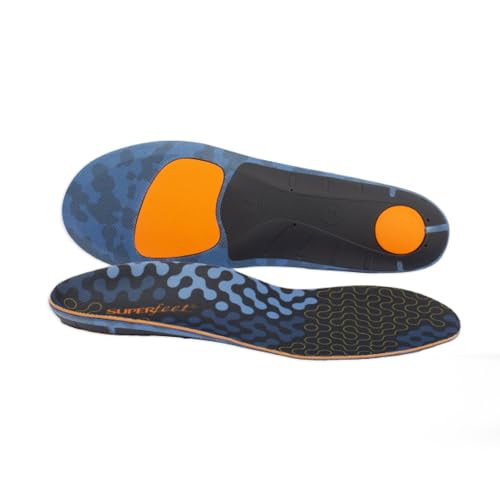
- How structured is the arch support? Medium arch exible orthotic support cushions the foot while running; made to fit well in running shoes and athletic footwear, including zero-drop running shoes
- What makes this insole stand out? Patented design, made to help feet move the way they're supposed to, flexing with the foot for efficient heel-to-toe turnover and a smooth, easy ride
- How cushioned are these insoles? Blends cushioning and rebound to maximize energy transfer and help runners get the most out of every step
- Can these help with plantar fasciitis? Helps disperse impact with every heel strike, reducing excess vibration to fight fatigue and minimize stress and strain that can lead to conditions like plantar fasciitis and shin splints
- What type of cushioning do these use? Helps the foot relax in the shoe and provides optimal cushioning for sore arches
Support: ★★★★☆ (Structured/flexible) | Cushion: ★★★★☆ (Responsive foam) | Durability: ★★★★☆ | Volume: Medium
Why it bridges the support/comfort gap: Superfeet’s Green and Blue insoles are legends in the support category — but they were designed for work boots and hiking shoes, not the snug confines of modern running shoes. The ADAPT Run is Superfeet’s answer to that problem: it retains the deep signature Superfeet heel cup (still the best on the market for rearfoot control) but replaces the rigid stabilizer cap with Adaptive Comfort Technology — a construction that flexes with your foot during the running gait rather than fighting it.
The result is Superfeet’s legendary heel lockdown combined with a forefoot that moves more naturally on impact. If you’ve tried Superfeet Green in a running shoe and found it too hard, the ADAPT Run resolves that specific complaint while keeping the support framework that makes the brand’s reputation. The responsive foam forefoot absorbs impact effectively, and the construction is durable across a full season of training mileage.
| Pros | Cons |
|---|---|
| Signature Superfeet heel cup — best rearfoot control Flexible arch — designed for running gait Good cushion + support balance Durable across heavy mileage Made by one of the most trusted insole brands |
Less rigid than classic Superfeet models Firmer than a cushion-only insole — adjustment period needed |
→ Check current price on Amazon
☁️ 4. Hoka Performance Insole — Best for Maximum Cushioning
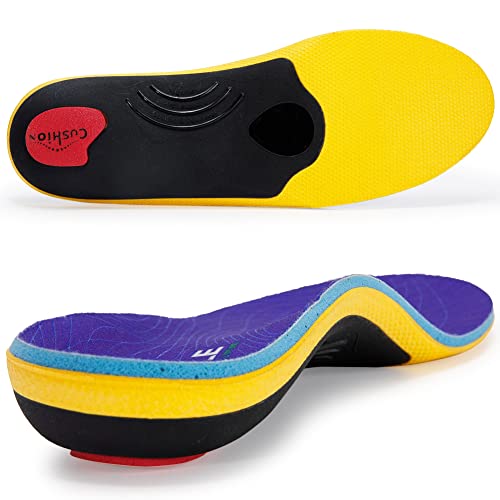
- 【HEAVY DUTY SUPPORT INSOLES】Orthotic Shoe Inserts for Men Women designed for over 220lbs, provide extra stong high arch support plus shock guard technology to relieves foot & leg fatigue and reduces lower bak pain and distribute weight and reduce the impact of each step.
- 【FOOT PAIN RELIEF&PREVETION】:Orthotic inserts offers rigid arch support reduce the overstretch of Plantar Fasciitis.Helps ease stress and pain caused by flat feet,fallen arch,bunions, low back pain and diabetes.Achilles Tendonitis and also Ball of Foot pain.Provides moderate control and support in working and standing, comfort and cushioning for everyday use.
- 【COMFORT MATERIAL FOR STANDING ALL DAY】:Poron heel pad excellent for shock absorption and pain relief. The black hard TPU material supports the arch of your foot and wraps your heel when you running or jogging.And good fabric reduces odor and keeps the feet fresh.
- 【Strong arch support】: VALSOLE metatarsal pain insole adjusts the body by supporting subtalar joints to prevent excessive valgus or supine. Super high arch support and deep heel cup structure support with maximum cushioning keep the foot bones vertical and balanced, providing stability.
- 【TRIM TO FIT & DESIGN FOR DAILY USE】:These insoles for plantar fasciitis is adaptable for work boot.You can also tailor the insole to fit your all shoes better.Our orthotics provides moderate control and support in walking or sports shoes, work shoes and boots. Fit For Most shoes such as running shoes, work shoes and boots, high volume dress shoes, hiking shoes.
Support: ★★☆☆☆ (Minimal) | Cushion: ★★★★★ (Plush) | Durability: ★★★☆☆ | Volume: Medium/High
Why it exists and who actually needs it: This is the most important insole to understand correctly. The Hoka Performance Insole is not a support insole — it will not fix overpronation or plantar fasciitis and shouldn’t be used as one. What it does is add Hoka’s characteristic plush cushioning feel to any shoe that lacks it. If you have a pair of shoes you love but find undercushioned for recovery runs or long slow days, this insole transforms them.
The dual-layer PU and EVA foam construction provides maximum shock absorption for heavier runners who need to protect joints on high-mileage weeks, or for runners coming back from stress fractures where impact reduction is the primary goal. It’s also useful in shoes with stiff, thin stock footbeds that feel harsh underfoot. The limitation is clear: medium-to-high volume means it won’t fit in every shoe, and it provides essentially no structural arch support. Use it for cushion; use something else for structure.
| Pros | Cons |
|---|---|
| Maximum plush cushioning — genuine shock absorption Durable PU/EVA blend Great for recovery runs and high-mileage weeks Works well in roomy neutral trainers |
Very little arch or structural support Medium/high volume — won’t fit snug or minimalist shoes Not for plantar fasciitis or overpronation |
→ Check current price on Amazon
💰 5. Superfeet Carbon — Best for Race Day and Minimalist Shoes
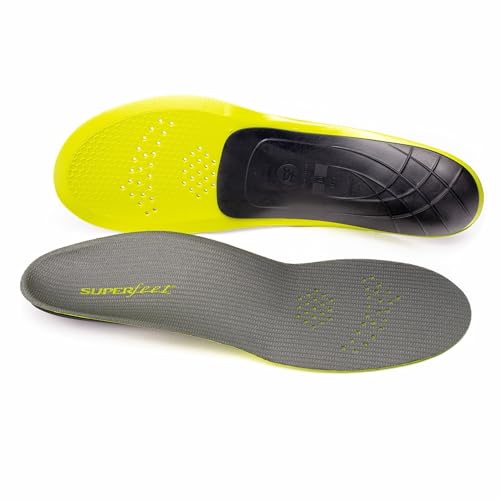
- Do these insoles need to be cut to size? Yes, these are trim-to-fit. Superfeet insoles are made to be trimmed to fit your shoes and boots; follow cutting instructions before use, and if you're between sizes, size up and trim down to fit
- Are these good for low arches? Low arch orthotic support helps stabilize the foot while running, reducing stress on feet, ankles, knees, and back
- How do these stabilize the heel? Heel cup positions and cradles the heel to optimize natural shock absorption and minimize fatigue; designed for slim-fitting athletic shoes
- Do these help control odor and moisture? Moisturewick top cover helps reduce odors and keeps feet fresh; beveled foam edge fits in many running and walking shoes
- Is this the same product I used to buy? Yes — formerly sold as Superfeet CARBON, this is the same trusted insole you know and love, now with a new name. Run Support Low Arch (Carbon) insoles are the same great arch support insoles you love, now with a new name
Support: ★★★★★ (Rigid) | Cushion: ★★☆☆☆ (Minimal) | Durability: ★★★★★ | Volume: Very low (ultra-thin)
Why thin matters more than you think: Race-day shoes, carbon plate trainers, and minimalist running shoes are engineered with almost no extra volume inside the shoe. Putting a standard-thickness insole into these shoes creates a pressurised fit that makes them less comfortable and less effective. The Superfeet Carbon solves this by using a carbon-fibre stabilizer cap — the same material that makes racing bikes and aerospace components stiff — in an insole thin enough to fit in virtually any shoe without changing the fit at all.
The carbon fibre provides rigid, uncompromising structural support in a package that’s lighter and thinner than any foam-based insole can achieve. There is essentially no cushioning — this is a structure insole, not a comfort insole. If you need cushion, choose a different pick. But if you’re an experienced runner who wants structural support in their race shoe, triathlon flat, or carbon-plated trainer without sacrificing fit — the Superfeet Carbon is the only insole that delivers. Durability is exceptional; carbon fibre doesn’t compress or degrade the way foam does.
| Pros | Cons |
|---|---|
| Ultra-thin — fits in any shoe without affecting fit Rigid carbon-fibre support — never compresses Exceptionally durable — outlasts foam alternatives Lightweight Perfect for race shoes and carbon plate trainers |
Premium price Minimal cushioning — can feel hard for comfort-focused runners Takes adjustment if you’re used to cushioned insoles |
→ Check current price on Amazon
Which Insole Is Right for Your Situation? Quick Matcher
| Your situation | Best pick | Why |
|---|---|---|
| Shin splints getting worse | Currex RunPro | Dynamic arch prevents the collapse that sends shock up the tibia |
| Plantar fasciitis / heel pain | PowerStep Pinnacle | Semi-rigid arch controls inward rolling that strains plantar fascia |
| Flat feet / significant overpronation | PowerStep Pinnacle or Superfeet ADAPT | Both provide corrective semi-rigid support; PowerStep is firmer |
| Neutral runner wanting better feel | Currex RunPro | Dynamic support improves alignment without changing shoe feel |
| Recovery runs / joint protection | Hoka Performance Insole | Maximum cushioning absorbs impact on hard recovery days |
| Race day / snug or carbon plate shoe | Superfeet Carbon | Ultra-thin carbon fibre fits where nothing else can |
| Runner’s knee / IT band pain | Superfeet ADAPT Run | Heel cup + arch control prevents the hip drop that causes lateral knee pain |
How to Install and Break In Running Insoles (Do It Right the First Time)
Getting this wrong means blisters, arch pain, and dismissing an insole that would have worked if installed correctly.
- Remove the stock insole first. This is the #1 mistake. Do not put your new insole on top of the existing one — it fills the shoe’s volume, cramps your toes, and makes the fit completely wrong. Pull out the old insole entirely before inserting the new one.
- Trace and trim. Place the old insole on top of your new one, aligning the heels. Use sharp scissors to trim only the toe section of the new insole to match the outline. Most insoles are designed to be trimmed — the marking lines are there for a reason.
- Check the fit before running. Put the trimmed insole in, lace the shoe, and check that your toes have adequate space and your heel doesn’t lift. The insole should sit flat with no edges lifting.
- Break in over 1–2 weeks. Your feet have never had proper structural support before — going from zero to a structured insole on a 10-mile run is a recipe for arch soreness. Wear them for 1–2 hours on day one. Do a short 1–2 mile run on day two. Add mileage gradually over 7–14 days. The arch area may feel “hard” initially — that’s the insole working, not failing. Your feet will adapt.
Frequently Asked Questions
Will insoles actually fix my shin splints?
They’re the most effective non-medical intervention available. Shin splints are most commonly caused by overpronation — your arch collapsing on impact sends excessive rotational shock up the tibia bone. A structured insole with a good arch and deep heel cup stops that collapse, reducing the tibial stress load. Combined with a graduated return-to-running plan and calf stretching, a good insole addresses the mechanical root cause rather than just the symptom. Results are typically felt within 2–3 weeks of consistent use.
My new insoles feel hard and uncomfortable. Is something wrong?
Nothing is wrong — this is the expected adaptation period. If you’ve been running on the flat foam liners that come with most shoes, your feet have never experienced proper structural support. A semi-rigid or dynamic arch will feel like there’s a “golf ball” under your arch initially. This is the insole correctly positioning your arch in its supported position. Your foot’s soft tissue adapts over 7–14 days. Follow the break-in plan above and the discomfort resolves for almost all runners. If pain persists beyond two weeks, the arch height may be wrong for your foot type.
How long do running insoles last?
300–500 miles or 12 months of regular use, whichever comes first. The foam compresses and the support structure fatigues even when there’s no visible wear — the insole will look fine but provide significantly reduced support. The tell: you start experiencing discomfort that wasn’t present before, or the arch area doesn’t spring back when you press it with your thumb. Replace on the same schedule as your running shoes.
Do I need different insoles for different shoes?
For most runners, one pair of insoles that you swap between training shoes is sufficient. If you race in a different shoe (particularly a tight, low-volume racing flat or carbon plate shoe), a separate thin-profile insole like the Superfeet Carbon is worth considering — stuffing a medium-volume training insole into a race shoe changes the fit in ways that can compromise performance and cause blisters.
Can I use these insoles in trail running shoes?
Yes — the same principles apply on trail. The Currex RunPro is particularly popular among trail runners for its dynamic arch that adapts to varied terrain rather than feeling rigid on uneven ground. Note that trail shoes often have less internal volume than road shoes due to their structured uppers — verify the volume compatibility before ordering.
The Bottom Line: A $50 Upgrade That Prevents $500 in Physio Bills
Your running shoe’s midsole provides cushion. The insole provides structure. Most running injuries — shin splints, plantar fasciitis, runner’s knee, IT band syndrome — are biomechanical problems caused by poor foot alignment, not a lack of cushion. Fixing the structure fixes the problem.
The five insoles in this guide cover every runner type in 2026. For most runners, the Currex RunPro is the right starting point — flexible support that improves your alignment without changing how your shoe feels. For active plantar fasciitis and flat feet, start with the podiatrist-endorsed PowerStep Pinnacle. For race day in a snug shoe, nothing fits where the Superfeet Carbon can.
Stop running on those flimsy foam liners. The upgrade costs $40–50. The injuries it prevents cost significantly more — in physio, in time off running, and in the compounding frustration of chasing a problem that has a straightforward solution.