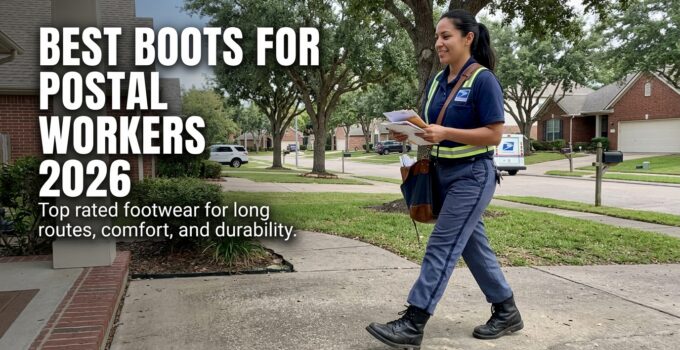
A letter carrier covers 8 to 15 miles per shift, five or six days a week, across 250 or more working days a year. That is 2,000 to 3,750 miles annually — equivalent to walking from New York to Los Angeles and back in a single career year. The surfaces are unforgiving: concrete sidewalks, wet asphalt, icy patches, wet grass, and loose gravel. The consequences of the wrong boot are not minor discomfort — they are plantar fasciitis that ends careers, slip-and-fall injuries that hospitalise carriers, and cumulative foot damage that makes every afternoon shift progressively harder.
This guide is different from every other postal worker boot guide for one reason: it starts by telling you which rules apply to your specific role. A USPS city letter carrier has strict certified footwear requirements that can result in a fine for non-compliance. A rural carrier has more flexibility. A FedEx or Amazon driver has none of these restrictions at all. Getting this distinction right before recommending any boot is the only honest way to write this guide.
Ten picks. A mix of USPS-certified options for carriers who need them and high-performance alternatives for carriers who have flexibility. The mileage math that explains why a $185 PU-midsole boot is cheaper per year than a $120 EVA-midsole boot. The slip-resistance surface guide that the ASTM F489 certification does not cover. And the medical exception pathway for carriers with plantar fasciitis who cannot find adequate support in any certified boot.
Last updated: May 2026.
Regulatory note: USPS footwear policies are subject to change. Verify the current approved footwear list with your postmaster before purchasing any certified boot. This article is for informational purposes and does not constitute official USPS guidance.
Boots for Postal Workers
Who Are You? Your Role Determines Your Boot Requirements
Before reading any product review, identify which category you belong to. The footwear rules are different for each.
USPS City Letter Carrier (NALC career or CCA): You are required to wear footwear bearing the SR/USA label — boots certified to USPS-89D or USPS-89E specifications with a black leather upper, Berry Amendment compliant domestic manufacturing, and ASTM F489 slip-resistant outsole. Wearing non-certified footwear on route can result in disciplinary action. Your uniform allowance ($557–$702 depending on career status under the 2024–2027 NALC contract) can be applied to certified footwear at USPS-licensed vendors. Your picks in this guide: Picks 1, 2, 3, 8, and 9.
Rural Carrier (NRLCA): Rural carriers historically have more footwear flexibility than city carriers — many rural routes involve significant vehicle time with shorter walking distances. Check your current NRLCA contract for specific footwear language. Rural carriers often use high-performance non-certified boots. Your picks: Picks 4, 5, 6, 7, 10, and the waterproof certified (Pick 8) if you prefer the certified option.
Private carrier (FedEx, UPS, Amazon Flex, DHL): Not subject to USPS regulations. Your employer may require slip-resistant, black or dark footwear, and sometimes a safety toe — verify with your employer. You have full freedom to choose the highest-performance boot for your mileage. Your picks: Picks 4, 5, 6, 7, 10.
Indoor postal clerk or processing worker: Different requirements from outdoor carriers. Slip resistance on smooth facility floors is the primary concern. A heavy outdoor boot may be unnecessary — verify your facility’s footwear requirements and consider indoor-optimised slip-resistant footwear.
Any carrier with documented plantar fasciitis or specific medical foot conditions: USPS ELM Section 939 allows non-certified footwear when medically required and documented. See the medical exception section below. Pick 7 in this guide is the specific recommendation for this situation.
The SR/USA Green Tag System: What Certified Really Means
postal worker examining boot tag
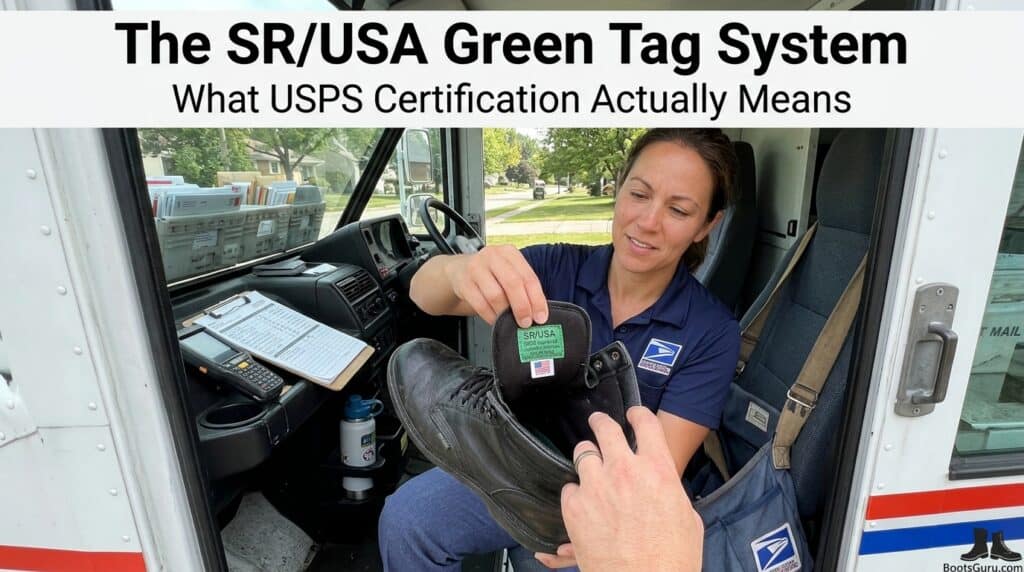
The “green tag” is the informal name for the SR/USA label physically sewn into USPS-approved footwear — typically inside the tongue or boot lining. It is not a marketing claim on a website. It is a physical label indicating the boot has passed independent testing and met USPS requirements. Here is what the system actually means.
SR/USA: SR = slip-resistant, meeting ASTM F489 test standard. USA = manufactured in the United States, complying with the Berry Amendment.
USPS-89D: The USPS internal specification for low-cut shoes (ankle height or lower). Covers the required black leather upper, water-resistant construction, ASTM F489 slip resistance, and Berry Amendment domestic manufacturing.
USPS-89E: The equivalent specification for boots (above ankle height). Same core requirements as 89D with additional ankle coverage and boot-specific construction requirements.
ASTM F489: The standardised test for slip resistance on wet quarry tile. This is the laboratory reference surface — it predicts performance on wet concrete and asphalt sidewalks reasonably well. It does not specifically cover wet grass, icy surfaces, or smooth lobby floors. This is why some certified boots that pass ASTM F489 can still be slippery on wet apartment lobby tile or on ice — the test was not designed for those surfaces.
Berry Amendment: A federal statute (10 USC 2533a) requiring that PPE for certain federal employees be manufactured domestically. For postal workers, this means certified boots must be made in the USA. US manufacturing costs significantly more than overseas production — this is the primary reason USPS-certified boots are expensive ($150–$250+) compared to equivalent-performing boots made overseas.
Three-year recertification: Approved postal footwear is tested at the US Navy Clothing and Textile Research Facility and must be recertified every three years. A boot approved in 2022 may not currently be on the approved list if it was not recertified. Always verify the current approved list with your postmaster rather than relying solely on older articles or vendor websites.
The Mileage Math: Why Midsole Type Is the Most Important Buying Decision
This calculation changes every postal boot purchasing decision — and no competitor guide runs it.
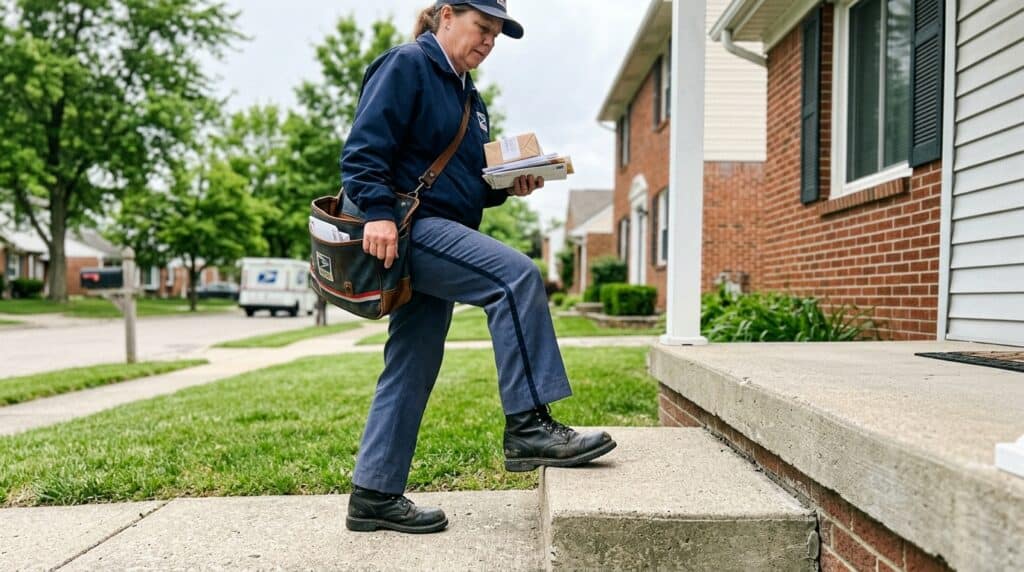
A city letter carrier covering 10 miles per shift, 250 days per year, travels 2,500 miles annually in their boots. EVA foam midsoles — the standard cushioning in most boots — lose 20–40% of their shock-absorbing capacity at 300 to 500 miles of hard use. For a carrier, this happens at 6 to 8 weeks of routes. By month four, the EVA midsole is substantially compressed and providing significantly less protection against the 2,000+ heel strikes per mile of pavement walking. The carrier does not feel a dramatic change — the degradation is gradual. What they notice is that foot pain increases progressively through the second half of a shift, that plantar fasciitis symptoms worsen, and that the boots that felt comfortable in week one feel hard and unsupportive by month five.
PU (polyurethane) midsoles maintain their cushioning performance at 800 to 1,200 miles of similar use — two to three times longer than EVA. A carrier who buys a $185 PU-midsole certified boot and gets 18 to 24 months of cushioning performance spends approximately $92 to $123 per year on midsole cushioning. A carrier who buys a $120 EVA-midsole boot and replaces it every 6 to 8 months spends $180 to $240 per year. The PU boot is the lower cost per year of service despite its higher upfront price — and it provides meaningfully better foot protection for the vast majority of its service life.
The practical buying rule: choose PU midsole over EVA even at a price premium when the alternative is available. Thorogood’s certified postal boots use PU midsoles. The Reebok Work CP 8101’s PU midsole is the primary comfort durability advantage over budget alternatives.
Slip, Trip, and Fall: The Surface Guide Beyond ASTM F489
postal carrier navigating route
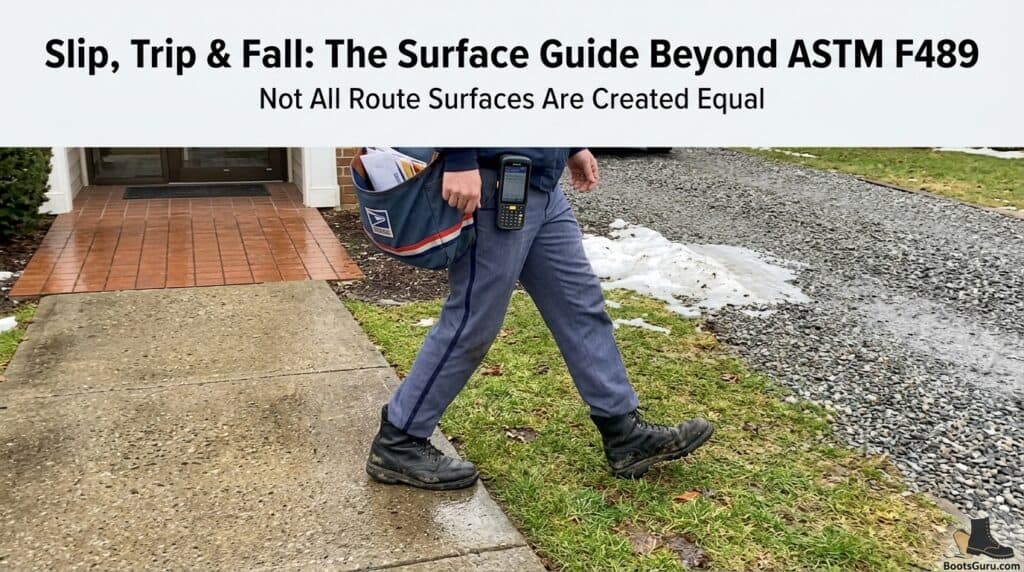
NIOSH research on USPS carrier injuries found that slips, trips, and falls are the leading cause of carrier injuries. ASTM F489 certification is necessary but not sufficient for all the surfaces carriers actually encounter. Understanding which surfaces your route involves helps you choose the most protective boot beyond minimum certification.
Wet concrete and asphalt: The core carrier surface. ASTM F489-certified outsoles are specifically tested for this environment. Any certified postal boot addresses this surface. Premium Vibram or SRC-rated outsoles exceed the minimum standard.
Wet grass and lawns: ASTM F489 does not cover this surface. Standard slip-resistant flat outsoles can skate on wet turf. Multi-directional lug patterns provide better traction on wet grass — the HOKA Anacapa’s Vibram Megagrip outsole performs significantly better on wet turf than most flat-soled certified boots.
Wet smooth floors (apartment lobbies, federal buildings): SoleReview’s extended carrier testing specifically found that outdoor-optimised outsoles can be “slippery on smooth floors.” A flat-soled certified boot’s outsole compound may actually outperform aggressive trail outsoles on this surface.
Ice and packed snow: ASTM F489 certification does not cover icy surfaces. This is the highest-injury-risk surface for northern-climate carriers. Standard certified postal boots are not engineered for ice. The Muck Boot Arctic Ice (Pick 6) with its ice-rated outsole is the correct tool for persistent ice on route — either as the primary boot for rural/private carriers or as a supplement to certified boots for city carriers in postmaster-approved winter situations.
Loose gravel and stone: Driveways, rural approaches, and park paths. Shallow lug patterns typical of certified postal boots provide limited grip. Rural carriers covering extensive gravel driveways benefit from 4 to 5mm lug depth.
Waterproof or Breathable? The Seasonal Decision
postal carrier comparing work boots
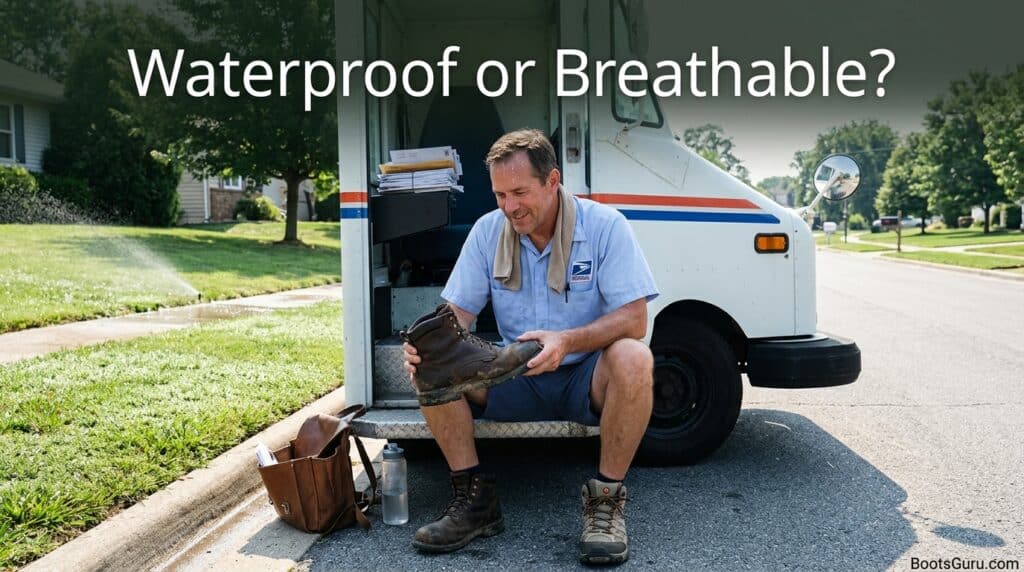
USPS certification requires water-resistant uppers — black leather construction inherently provides this. But for carriers in specific climates, the choice between full waterproofing and breathability is the most important summer comfort decision.
A sealed waterproof boot (Gore-Tex, PTFE membrane) in 90°F summer conditions traps foot perspiration that can reach 500ml to 1,000ml per foot per shift of hard carrier use. The boot keeps rain out, but the internal environment becomes hot and wet from foot sweat, creating the blistering, fungal, and heat accumulation conditions that make afternoon shifts miserable. SoleReview’s two-month postal carrier test found that a non-waterproof breathable boot (HOKA Anacapa in non-GTX version, though our Pick 4 is the GTX version) provided better overall foot dryness in summer than waterproof alternatives because the reduced sweating outweighed the occasional moisture ingress from dew and puddles.
The decision framework: wet climates with year-round significant rain (Pacific Northwest, Gulf Coast, Northeast) → waterproof membrane justified year-round. Dry summer climates with occasional rain → DWR-treated leather without membrane provides adequate weather resistance with better breathability in summer months; switch to waterproof for wet season. Winter routes everywhere → waterproof and insulated essential regardless of summer choice.
The Two-Boot Strategy: What Experienced Carriers Actually Do
Every boot guide recommends one boot. Experienced carriers who have been on route for 10+ years almost universally use two boots: a lighter breathable option for warm-weather routes and a waterproof insulated option for winter. This is not a luxury — it is the most cost-effective and foot-protective approach available.
Beyond seasonal logic, the rotation has a documented health benefit. A 2024 Journal of Clinical Medicine study found that rotating between two different shoe models significantly reduces plantar fasciitis recurrence. Different boots create different load distribution patterns across the foot, reducing the repetitive stress concentration that daily identical loading creates. For carriers at high PF risk — which includes most carriers after several years on route — the two-boot rotation is a clinical recommendation supported by research.
For career city carriers using their uniform allowance: the allowance typically covers one to two pairs per year depending on model pricing. Planning purchases seasonally — certified lightweight boot in spring, waterproof certified boot in fall — maximises allowance utilisation across both seasons. USPS-licensed vendors (MyPostalUniforms.com, UniformBonus.com, and others) accept the allowance card and often offer 10% additional discounts.
Quick Comparison: Best Boots for Postal Workers (2026)
| Boot | USPS Certified | Best Role | Midsole | Waterproof | Price |
|---|---|---|---|---|---|
| Thorogood 834-6342 | ✅ Yes (SR/USA) | City carrier (NALC/CCA) | PU — long-lasting | Yes + insulated | ~$150–$200 |
| Reebok Postal Express CP8101 | ✅ Yes (SR/USA) | City carrier (NALC/CCA) | PU | No — breathable | ~$130–$170 |
| Rocky TMC Public Service | ✅ Yes (certified) | City carrier / budget | PU/EVA | No | ~$100–$140 |
| HOKA Anacapa 2 Mid GTX | ⚠️ Not certified | Rural / private carrier | EVA (high-stack) | Yes — Gore-Tex | ~$200–$240 |
| Merrell Moab 3 Mid WP | ⚠️ Not certified | Rural / private carrier | Air cushion + EVA | Yes — Merrell DRY | ~$130–$155 |
| Muck Boot Arctic Ice | ⚠️ Not certified | Winter / ice routes (all roles) | Neoprene/rubber | Yes — rubber | ~$140–$180 |
| HOKA Kaha 3 GTX | ⚠️ Not certified | PF / medical exception | CMEVA high-stack | Yes — Gore-Tex | ~$200–$250 |
| Thorogood Deuce 6″ WP | ✅ Yes (tactical/postal) | City carrier waterproof | PU | Yes — waterproof | ~$150–$195 |
| Reebok Women’s Postal Express | ✅ Yes (USPS approved) | Women’s city carrier | PU | Varies — verify | ~$120–$160 |
| New Balance Fresh Foam 1080 WP | ⚠️ Not certified | Private carrier / rural | Fresh Foam | Yes — WP | ~$130–$160 |
1. Thorogood Men’s 6″ Waterproof/Insulated Sport Boot 834-6342 — Best Certified Overall
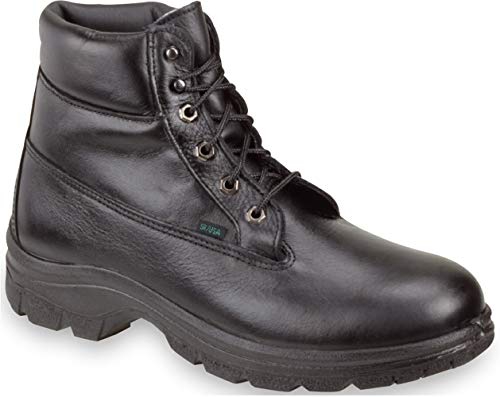
✅ USPS-Certified — SR/USA label, Berry Amendment compliant, USPS-89E specification. Uniform allowance eligible at USPS-licensed vendors.
Best for: Career USPS city letter carriers (NALC) who need waterproof protection and insulation for wet or cold weather routes — this boot meets full certification requirements while providing the insulated, waterproof construction that protects carriers through the season changes that mark the hardest stretches of carrier work.
| ASIN | B001Y8WP78 |
| USPS certified | SR/USA label — USPS-89E, Berry Amendment, ASTM F489 |
| Made in USA | Yes — Berry Amendment compliant |
| Midsole | PU (polyurethane) — estimated 18–24 month cushioning lifespan vs 6–8 months for EVA |
| Waterproofing | Yes — waterproof construction |
| Insulation | Yes — insulated for cold weather routes |
| Upper | Black leather — meets USPS black leather upper requirement |
| Height | 6 inches |
| Uniform allowance | Eligible at USPS-licensed vendors |
| Note | Listed as CLOSEOUT — verify current availability before ordering |
| Price range | ~$150–$200 |
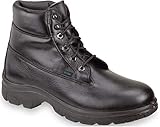
Thorogood is one of the most trusted names in certified postal footwear — their USA-made construction meets Berry Amendment requirements and their postal-certified line specifically engineers for the demands of carrier route work rather than being a general work boot repurposed for postal use. The 834-6342’s PU midsole is the defining long-term value feature: where an EVA-midsole certified boot compresses to near-flat cushioning within 300 to 500 miles of hard route walking (6 to 8 weeks for a typical carrier), the PU compound maintains its shock-absorbing performance at 800 to 1,200 miles. For a carrier who covers 2,500 miles annually, this means one to two Thorogood boots per year versus two to three replacements of budget EVA alternatives — at a lower total annual cost despite the higher per-pair price.
The waterproof and insulated construction makes this boot the correct choice for carriers in wet-climate zones and for the extended autumn and winter periods where morning dew, rain, and cold temperatures combine to create the conditions that non-waterproof boots cannot handle. The 6-inch height provides ankle support for the step-up and step-down movements at curbs, steps, and vehicle entry that accumulate across a route day. CLOSEOUT status on this listing means stock is limited — if it is unavailable when you are purchasing, Thorogood’s current production postal certified boot (verify the current model at their website or a licensed postal vendor) is the correct substitute.
Best for: Career city letter carriers (NALC) and CCAs in wet or cold weather climates who require SR/USA certified footwear and want the long-term midsole durability of PU construction.
✅ USPS Certified: Yes — uniform allowance eligible.
Pros: Full SR/USA certification for city carrier compliance, PU midsole for 18–24 month cushioning durability vs EVA alternatives, waterproof and insulated for wet/cold routes, USA-made Berry Amendment compliant, Thorogood’s postal-specific engineering.
Cons: Closeout item — verify availability. Insulation adds warmth penalty in summer — not the correct choice for summer-only route use. Higher upfront cost than budget certified alternatives.
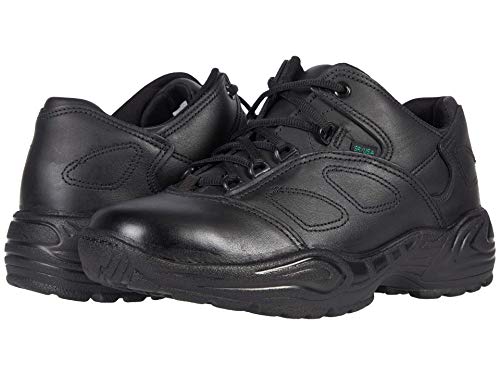
2. Reebok Work Men’s Postal Express CP8101 — Best Certified for Everyday Comfort
✅ USPS-Certified — SR/USA label, Berry Amendment compliant. Uniform allowance eligible.
Best for: City letter carriers who want the most comfortable daily-wear certified boot available — the CP8101’s PU midsole and Reebok’s athletic comfort heritage provide better day-in, day-out wearability than traditional heavy leather certified alternatives, without sacrificing any certification requirement.
| ASIN | B0022I4PT0 |
| USPS certified | SR/USA label — Berry Amendment, ASTM F489 slip resistance |
| Made in USA | Yes — Berry Amendment compliant |
| Midsole | PU — sustained cushioning for high-mileage route days |
| Upper | Black leather — USPS upper requirement met |
| Construction | Postal Express series — Reebok’s specifically postal-engineered line |
| Removable insole | Yes — removable cushion insert for orthotic compatibility |
| Uniform allowance | Eligible |
| Price range | ~$130–$170 |

Reebok’s Postal Express series occupies a specific and important position in the certified postal boot market: it provides the certification compliance city carriers require while delivering a comfort profile closer to athletic footwear than traditional heavy-duty welted leather work boots. The PU midsole provides the sustained cushioning that high-mileage carrier routes demand — holding its performance significantly longer than EVA foam alternatives. The round metal eyelets make lacing easy and secure across the quick on-off movements that carrier route logistics require. Carriers who have worn heavier traditional certified boots and found them causing knee and lower back fatigue from the weight accumulating across 10+ hours consistently report a significant comfort improvement when switching to the Reebok Postal Express series.

The removable cushion insert is the feature that matters most for carriers with arch conditions, plantar fasciitis, or any foot condition requiring orthotics. Most certified postal boots have bonded insoles that block orthotic use without modification — the CP8101’s removable insert allows aftermarket arch support installation without any modification. Remove the stock insert, place a Superfeet Green (for overpronation/flat feet) or OrthoLite replacement (for general cushion upgrade) directly, and the boot immediately provides better arch support than any certified boot provides out of the box. This feature alone justifies the CP8101 as the top everyday comfort recommendation for the certified boot category.
Best for: City letter carriers (NALC) and CCAs who want maximum certified boot comfort for daily high-mileage routes, especially those with arch conditions who need orthotic compatibility.
✅ USPS Certified: Yes — uniform allowance eligible.
Pros: Reebok athletic comfort heritage in a certified postal boot, PU midsole for mileage durability, removable insole for orthotic compatibility — critical for carriers with PF, USA-made Berry Amendment, ASTM F489 certified slip resistance.
Cons: Not waterproof — carriers in wet climates should consider the Thorogood waterproof certified option (Pick 1 or 8) for rainy season. Athletic-profile styling, while more comfortable, is less traditional-looking than some postmaster preferences — verify current postmaster’s visual standards.
3. Rocky Men’s TMC Public Service Boot — Best Certified Budget Option

✅ USPS-Certified — Berry Amendment compliant. Uniform allowance eligible.
Best for: New carriers, CCAs, or budget-limited carriers who need certified compliance at the lowest qualified price — Rocky’s TMC Public Service Boot provides full certification requirements without the premium price of Thorogood or Reebok Work alternatives.
| ASIN | B001OOU0I8 |
| USPS certified | Berry Amendment compliant — verify SR/USA label on current listing |
| Made in USA | Yes — Berry Amendment compliant |
| Upper | Black leather — meets USPS upper requirement |
| Construction | Rocky’s public service/postal build |
| Uniform allowance | Eligible at licensed vendors — verify Rocky is current approved vendor |
| Price range | ~$100–$140 |

Rocky is a well-established certified postal boot manufacturer with a long history of supplying USPS-approved footwear through licensed vendors. The TMC Public Service Boot fills the budget tier in the certified market — providing the compliance requirements at a lower price point than the Thorogood and Reebok Work alternatives, which matters significantly for new carriers who have not yet built up uniform allowance balance, CCAs who have more limited allowance entitlements, and carriers who are between allowance cycles and purchasing out-of-pocket. The black leather upper meets the USPS visual standard and the certification meets the compliance standard.

The honest durability context: the budget price reflects a lower specification in some construction elements, and midsole longevity at this price point may be closer to the EVA end of the spectrum than the PU end. Carriers who budget for the Rocky and plan for earlier insole replacement (at 5 to 6 months rather than 9 to 12) can manage the cushioning decline cost-effectively. The insole replacement protocol applies here more urgently than for the premium certified boots: remove the stock insole, check for permanent compression with the thumb test, and replace at the first sign of significant compression rather than waiting for pain to develop. An OrthoLite or Superfeet replacement insole at $25 to $45 extends the comfort life of the Rocky significantly at minimal additional cost. Verify the current SR/USA certification status on this specific listing before purchasing, as certifications are updated on a three-year cycle.
Best for: New carriers, CCAs, budget-limited carriers needing certified compliance at the lowest qualified price point.
✅ USPS Certified: Yes — verify current SR/USA label and approved vendor status.
Pros: Lowest price among certified options in this guide, Berry Amendment USA made, certified compliance for USPS requirements, uniform allowance eligible, established Rocky postal brand.
Cons: Budget construction — plan earlier insole replacement than premium alternatives. Verify current SR/USA certification status on listing. Lower midsole durability means higher effective annual cost for high-mileage carriers compared to premium certified options.
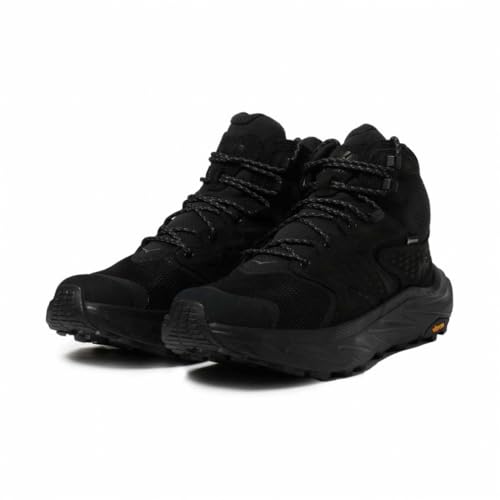
4. HOKA Anacapa 2 Mid GTX — Best Performance Boot for Rural and Private Carriers
⚠️ NOT USPS-Certified — For rural carriers, private carriers (FedEx/UPS/Amazon), and city carriers with approved medical exceptions only. City carriers (NALC) cannot wear this on route without postmaster approval.
Best for: Rural carriers, FedEx, UPS, and Amazon drivers who have full footwear flexibility and want the highest-rated comfort boot for carrier-level daily mileage — SoleReview’s two-month postal carrier testing identified the HOKA Anacapa as one of the top-performing carrier boots when certification is not required.
| ASIN | B0CNS83GPG |
| USPS certified | No — not SR/USA certified |
| Midsole | HOKA EVA high-stack with Meta-Rocker — maximum cushioning with rocker geometry |
| Outsole | Vibram Megagrip — premium wet and dry traction beyond ASTM F489 minimum |
| Waterproofing | Yes — Gore-Tex |
| Height | Mid-cut — ankle support without full 6-inch shaft heat |
| Key technology | HOKA Meta-Rocker — reduces toe-off plantar fascial tension, critical for carriers |
| Removable insole | Yes |
| Price range | ~$200–$240 |

The HOKA Anacapa 2 Mid GTX represents the performance ceiling of what’s available to postal workers when certification requirements don’t apply. SoleReview, which conducted one of the most rigorous postal worker footwear tests available (two-plus months of actual carrier use), identified HOKA products as among the top performers for letter carrier use. The HOKA’s high-stack EVA midsole and Meta-Rocker geometry specifically address the two primary foot injury mechanisms for carriers: cumulative heel-strike impact on concrete (addressed by the high-stack cushioning) and plantar fascia peak tension at toe-off (reduced by the rocker geometry’s rolling heel-to-toe motion that decreases the angular load on the fascia at the critical stride phase).

The Vibram Megagrip outsole significantly exceeds ASTM F489’s minimum requirements on wet concrete and asphalt — the surfaces that comprise the majority of carrier route walking. On wet grass and uneven ground, Megagrip’s multi-directional pattern outperforms the flat slip-resistant soles of most certified postal boots on these non-ASTM-tested surfaces. The Gore-Tex membrane provides all-weather waterproofing for carriers who work through rain daily. The limitation: the high-stack EVA midsole is excellent at initial cushioning but will show compression at 300 to 400 miles of carrier use — earlier than PU alternatives. Plan insole replacement at that interval to maintain the cushioning performance that makes this boot worthwhile. For rural carriers covering significant vehicle time with shorter walking distances, the mileage compression timeline is extended considerably.
Best for: Rural carriers, private delivery drivers (FedEx/UPS/Amazon), and city carriers with approved medical exceptions who want the highest-rated carrier comfort boot when certification is not required.
⚠️ Not USPS-certified: City carriers (NALC) cannot wear without postmaster approval or medical exception.
Pros: SoleReview field-tested as top-performing for carrier use, HOKA Meta-Rocker reduces PF risk, Vibram Megagrip outsoles exceed ASTM F489 on all tested surfaces, Gore-Tex all-weather waterproofing, removable insole for orthotic upgrade.
Cons: Not USPS-certified — cannot be used by city carriers without exception. EVA midsole compresses at 300–400 miles — plan insole replacement. Higher price than certified options. Cannot be purchased with uniform allowance.
5. Merrell Moab 3 Mid WP — Best Lightweight Waterproof for Rural and Private Carriers

⚠️ NOT USPS-Certified — For rural carriers, private carriers, and flexible roles only.
Best for: Rural carriers and private delivery drivers who cover high daily step counts and want the Vibram outsole’s pavement durability advantage in a lightweight waterproof platform — the Moab 3’s air cushion heel specifically addresses the walking fatigue that accumulates across carrier-level daily mileage.
| ASIN | B0C18RF3HV |
| USPS certified | No |
| Key feature | Vibram TC5+ outsole — significantly outlasts standard rubber on concrete and asphalt |
| Midsole | Air cushion heel + EVA foam |
| Waterproofing | Yes — Merrell DRY membrane |
| Weight | ~14 oz per boot — light for a waterproof mid-cut |
| Removable insole | Yes — Kinetic Fit Base, orthotic-compatible |
| Height | Mid-cut |
| Women’s version | Yes — genuine women’s last |
| Price range | ~$130–$155 |

The Merrell Moab 3 Mid WP earns its position in the postal worker guide specifically through the Vibram TC5+ outsole — a feature that directly addresses one of the most frustrating recurring problems for high-mileage delivery workers. Standard rubber outsoles on athletic-construction boots wear through at 6 to 10 months of daily pavement walking. The Vibram TC5+ compound is engineered for sustained mixed-terrain wear, maintaining its traction and structural integrity significantly longer on the concrete and asphalt that constitute most carrier route surfaces. For a private carrier or rural carrier who covers 8 to 12 miles per day, this outsole difference is the primary reason the Moab 3 outlasts alternatives in its price range.

The air cushion heel addresses the walking fatigue that accumulates specifically from heel-strike loading on hard surfaces across high step-count days. This is distinct from general midsole cushioning — the air pocket in the heel zone provides targeted impact absorption at the landing phase that flat foam midsoles cannot replicate as specifically. Combined with the Merrell DRY waterproof membrane providing all-weather moisture protection, the Moab 3 is a well-rounded solution for rural carriers and delivery drivers who want quality without the premium HOKA price. The Kinetic Fit Base removable insole accepts custom orthotics or aftermarket arch support for carriers managing arch conditions. Women’s version available on genuine Merrell women’s last.
Best for: Rural carriers and private delivery drivers on mixed terrain who want Vibram outsole durability and waterproofing in a lightweight mid-cut at a moderate price.
⚠️ Not USPS-certified: For rural carriers, private carriers, and flexible roles only.
Pros: Vibram TC5+ outsole significantly outlasts standard rubber on pavement, air cushion heel for high step-count fatigue, Merrell DRY waterproofing, lightweight at ~14 oz, Kinetic Fit removable insole for orthotics, women’s version available.
Cons: Not certified — cannot be worn by NALC city carriers without exception. EVA midsole compresses at 10–14 months of heavy daily use. Not the maximum cushioning of HOKA alternatives.
6. Muck Boot Arctic Ice — Best for Winter and Icy Routes

⚠️ NOT USPS-Certified — Best used as supplemental winter boot for rural/private carriers, or for USPS city carriers with postmaster approval for extreme winter conditions.
Best for: Carriers in northern climates where ice and packed snow represent the highest injury risk on route — the Muck Arctic Ice addresses the specific surface that ASTM F489 certification does not cover and that causes the most serious carrier injuries in winter.
| ASIN | B072JBGGCG |
| USPS certified | No |
| Outsole | Vibram Arctic Grip — ice-specific compound rated for wet ice traction |
| Construction | Neoprene/rubber — waterproof by nature |
| Temperature rating | -40°F — appropriate for extreme cold stationary and active carrier use |
| Waterproofing | Rubber/neoprene — no membrane to fail |
| Best season | Winter only — supplemental to primary boot rotation |
| Price range | ~$140–$180 |

The critical safety context for this boot: ASTM F489 — the slip resistance standard that all certified postal boots must meet — was not designed for icy surfaces. Wet quarry tile (the ASTM F489 test surface) and wet ice have fundamentally different friction coefficients and require different outsole rubber compounds to grip reliably. Standard certified postal boots, regardless of their ASTM F489 rating, are not engineered for icy sidewalks and can be genuinely dangerous on the ice patches and packed snow that northern climate carriers encounter from November through March. NIOSH research on postal carrier injuries shows slips, trips, and falls as the leading injury category — the winter months are when this risk peaks. The Muck Boot Arctic Ice’s Vibram Arctic Grip outsole is specifically formulated for wet ice traction, where standard rubber compounds stiffen in the cold and lose grip completely.

For USPS city carriers who are required to wear certified footwear: discuss the winter supplement option with your postmaster. Many postmasters in northern climates are aware of the ice traction limitation of standard certified boots and have accommodation processes for winter-specific supplemental footwear. For rural carriers and private carriers: the Arctic Ice is the correct dedicated winter boot for ice-prevalent routes. Use it as the winter boot in a two-boot rotation — primary certified or performance boot for spring through autumn, Arctic Ice for December through February. The neoprene construction provides thermal protection down to -40°F for carriers who cover slow-walking postal routes in extreme cold conditions.
Best for: Carriers in northern climates where icy routes represent the highest injury risk, as the primary or supplemental winter boot in a two-boot rotation.
⚠️ Not USPS-certified: Discuss with postmaster for city carrier winter use; fully appropriate for rural and private carriers.
Pros: Vibram Arctic Grip addresses the specific ice traction gap that ASTM F489 certification does not cover, -40°F temperature rating, rubber/neoprene waterproof by nature (no membrane to fail), addresses the leading carrier injury category in winter.
Cons: Not certified — requires accommodation for USPS city carriers. Heavy — not the correct primary boot for high-mileage walking routes; best as supplemental winter-specific boot. Seasonal use only — not needed in mild-winter climates.
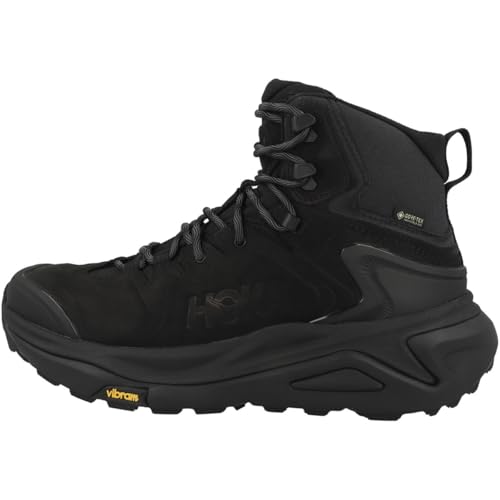
7. HOKA Kaha 3 GTX — Best for Carriers with Plantar Fasciitis
⚠️ NOT USPS-Certified — Requires medical exception under USPS ELM 939 for city carriers with documented plantar fasciitis. For rural and private carriers, use freely.
Best for: Carriers with plantar fasciitis — the most common career-limiting foot condition for letter carriers — who need maximum heel-strike cushioning, genuine rocker geometry, and Gore-Tex waterproofing in a boot that has been specifically engineered for the high-stack, maximum-protection requirements that PF management demands.
| ASIN | B0D5FQF4V4 |
| USPS certified | No — requires medical exception for NALC city carriers |
| Midsole | CMEVA high-stack — maximum protection for concrete impact on PF-affected feet |
| Key technology | HOKA Meta-Rocker — reduces peak plantar fascia tension at toe-off, the most painful PF stride phase |
| Waterproofing | Yes — Gore-Tex |
| Outsole | Vibram Megagrip — reliable traction for carrier routes |
| Removable insole | Yes — accepts Superfeet Green or custom orthotic |
| Best condition | Active PF management; high-mileage carrier routes where cumulative concrete impact is the primary PF driver |
| Price range | ~$200–$250 |

Plantar fasciitis is the most common career-affecting foot condition among letter carriers — not because carriers are unlucky, but because daily concrete walking at 8 to 15 miles per shift, 250 days per year, creates exactly the impact loading conditions that develop plantar fasciitis in predisposed anatomy. The certified postal boot that most city carriers wear does not prioritise the specific boot features that manage PF: adequate heel drop, rocker geometry to reduce toe-off fascial tension, maximum heel cushioning, and removable insole for custom orthotic device use. The HOKA Kaha 3 GTX addresses all four. The CMEVA high-stack provides the maximum available cushioning against concrete heel-strike impacts. The Meta-Rocker geometry specifically reduces the peak tension on the plantar fascia at toe-off — the stride phase where PF pain is most severe.

For USPS city carriers with documented plantar fasciitis: USPS ELM Section 939 allows non-certified footwear when medically required. The process is specific: obtain a written letter from your podiatrist or physician documenting the PF diagnosis and recommending specific footwear requirements (specific heel drop, specific midsole height, specific rocker geometry, or custom orthotic requirement). Submit this documentation to your supervisor for approval. The medical exception is granted on a case-by-case basis — it is not automatic, but documented PF with a podiatrist’s recommendation is among the most commonly approved grounds. Do not wear this boot on route before receiving approval — document the exception properly to protect yourself. For rural carriers and private carriers: no approval needed, use freely as the primary PF management boot.
Best for: Carriers managing active plantar fasciitis who need maximum protection from concrete impact — USPS city carriers via ELM 939 medical exception; rural and private carriers freely.
⚠️ Not USPS-certified: Requires documented medical exception for NALC city carriers — see ELM 939 process above.
Pros: HOKA Meta-Rocker specifically reduces toe-off fascial tension (the primary PF pain mechanism), CMEVA high-stack maximum concrete impact protection, Vibram Megagrip reliable traction, Gore-Tex waterproofing, removable insole for custom orthotic.
Cons: Requires medical exception documentation for city carriers — do not assume approval. Premium price. High stack may feel unusual initially for carriers transitioning from lower-stack certified boots.
8. Thorogood Deuce 6″ Waterproof Side-Zip — Best Certified Waterproof Boot

✅ USPS-Certified / Tactical/Postal specification. Uniform allowance eligible at licensed vendors.
Best for: City letter carriers in wet-climate zones who need full waterproof protection alongside certification compliance — and for any carrier who finds traditional pull-on or full-lace entry impractical and wants the speed of a side-zip entry without sacrificing any compliance or protection feature.
| ASIN | B0041DO6N4 |
| USPS certified | Yes — Thorogood certified postal/tactical specification |
| Made in USA | Yes — Berry Amendment compliant |
| Key feature | Side-zip entry — fast on/off without unlacing; significant practical advantage on multi-vehicle routes |
| Waterproofing | Yes — full waterproof construction |
| Height | 6 inches |
| Construction | Thorogood USA-made tactical/postal construction |
| Gender | Men and Women — verify current sizing on listing |
| Uniform allowance | Eligible at USPS-licensed vendors |
| Price range | ~$150–$195 |

The Thorogood Deuce’s side-zip feature addresses a specific practical issue in carrier route work that no other certified boot on this list solves: the multiple vehicle entries and exits that LLV (Long Life Vehicle) driving routes require. Carriers who regularly enter and exit their delivery vehicle can loosen and tighten boot entry efficiently with the side zip — not a trivial convenience when the movement is repeated 50 to 100+ times across a route day. The zip closure also allows rapid boot removal during breaks without completely unlacing and relacing a full 6-inch boot. This practical convenience is entirely separate from the boot’s primary certification and waterproofing credentials, which are full Thorogood USA-made quality.

The full waterproof construction addresses the wet climate requirement for certified boots — carriers who need both the SR/USA label and genuine waterproofing have fewer options than those who need either individually. Thorogood’s USA manufacturing and postal certification heritage combined with the side-zip convenience make this boot the most practical certified waterproof option in this guide. The 6-inch height provides ankle support and the full shaft coverage that USPS-89E specification requires. Available in both men’s and women’s sizing — verify the current listing for women’s size availability if ordering for female carriers. Uniform allowance eligible at USPS-licensed vendors.
Best for: City carriers in wet climates who need both waterproof protection and certification compliance; LLV driving carriers who benefit from side-zip quick entry and exit.
✅ USPS Certified: Yes — uniform allowance eligible.
Pros: Side-zip entry reduces daily time lost to boot lacing/unlacing across multiple vehicle entries, full waterproof construction for wet climates, Thorogood USA-made certified quality, Berry Amendment compliant, men’s and women’s sizing available.
Cons: Side-zip adds a potential failure point in the zip mechanism over time — inspect zip regularly and replace if zip integrity decreases. Higher price than non-waterproof certified options.
9. Reebok Women’s Postal Express — Best Certified Boot for Women Carriers
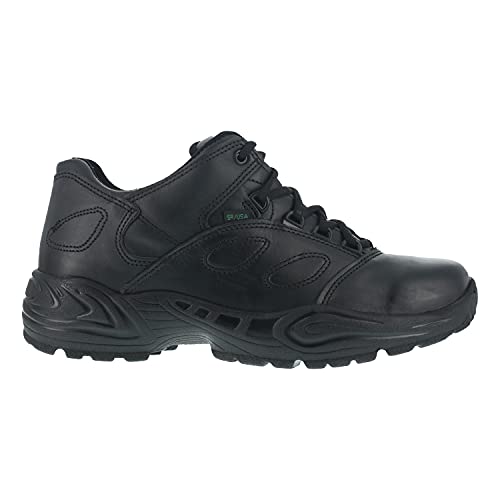
✅ USPS Approved for Women — USPS approved, SR-rated. Uniform allowance eligible.
Best for: Female USPS city letter carriers who require approved postal footwear and need a boot built for women’s foot anatomy rather than a men’s boot scaled to smaller sizes — the Reebok Women’s Postal Express addresses the heel slippage, arch position mismatch, and forefoot proportion failures that women’s feet experience in men’s-last certified alternatives.
| ASIN | B0BVH7M3TC |
| USPS certified | USPS approved — women’s SR-rated postal footwear |
| Gender | Women’s — verify women’s last geometry on current listing |
| Brand heritage | Reebok Work postal line — specifically engineered for carrier use |
| Construction | Postal-engineered slip-resistant construction |
| Uniform allowance | Eligible at licensed vendors |
| Price range | ~$120–$160 |

Women represent approximately 40% of the USPS carrier workforce, and yet the certified postal boot market has historically been vastly better served on the men’s side. The practical problem: many “women’s” certified postal boots are men’s boots in smaller sizes without meaningful anatomical modification — the heel cup remains proportioned for men’s narrower heel-to-forefoot ratio, the arch support lands in the wrong position for women’s more forward arch placement, and the forefoot volume is wrong for women’s wider forefoot-to-heel proportion. The result is heel slippage (too-wide heel cup), arch pain (support positioned 0.5 to 0.75 inches behind where women’s arch sits), and forefoot cramping — all of which persist through break-in because they are structural, not adaptation problems.

The OSHA regulatory context is relevant here: OSHA’s January 2025 update to 29 CFR 1926.95(c) explicitly requires that PPE must properly fit each affected employee. Women who are provided men’s boots in smaller sizes and experiencing the fit failures described above have regulatory backing to request properly fitting certified footwear — specifically boots built on women’s lasts. When requesting women’s certified boots from your employer or when using your uniform allowance: specifically confirm the boot is built on a women’s last, not a men’s last in a smaller size. Women who cannot find certified boots that fit correctly should investigate the medical exception pathway under ELM 939 with a podiatrist’s documentation of fit-related foot injury risk.
Best for: Female USPS city letter carriers requiring USPS-approved footwear who need women’s-specific construction rather than a men’s boot in a smaller size.
✅ USPS Approved: Yes — uniform allowance eligible.
Pros: USPS approved for women carriers, Reebok Work postal heritage, women’s-specific construction addresses the fit failures of men’s certified boots in smaller sizes, uniform allowance eligible.
Cons: Verify women’s last geometry on current listing — confirm it is not a men’s last in women’s sizing. Women who cannot find adequate fit in certified options have the medical exception pathway and the OSHA 2025 PPE fit requirement as regulatory support for requesting better options.
10. New Balance Fresh Foam 1080 WP — Best Budget Non-Certified for Private Carriers
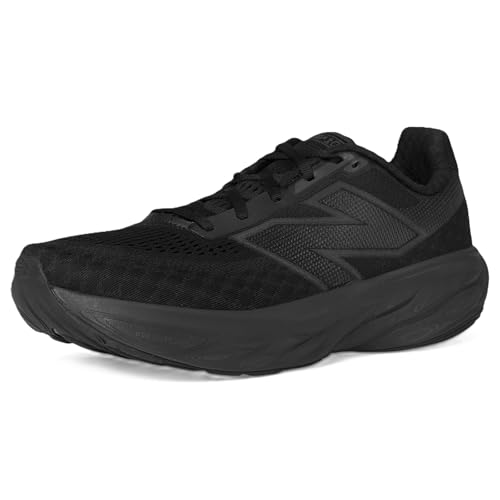
⚠️ NOT USPS-Certified — For private carriers (FedEx/UPS/Amazon) and rural carriers with footwear flexibility. Not for USPS city carriers (NALC) without exception.
Best for: Private delivery drivers and rural carriers who want high-quality cushioning and waterproofing at a more accessible price than HOKA alternatives — the New Balance Fresh Foam provides genuine performance midsole technology in a waterproof package that handles the daily demands of delivery route walking.
| ASIN | B0CNKZR9XK |
| USPS certified | No |
| Midsole | Fresh Foam — New Balance’s proprietary cushioning, better durability than budget EVA |
| Waterproofing | Yes — WP waterproof construction |
| Slip resistance | Slip-resistant outsole — appropriate for delivery route surfaces |
| Brand position | New Balance performance heritage applied to delivery worker comfort |
| Price range | ~$130–$160 |

New Balance’s Fresh Foam technology positions the 1080 WP between budget EVA-midsole alternatives and premium HOKA options. Fresh Foam is a proprietary foam compound that provides better shock absorption longevity than standard EVA while maintaining a cushioned, responsive feel that delivery workers covering many daily miles on varied surfaces appreciate. The waterproof construction handles the rain, morning dew, and puddle contact that outdoor delivery work regularly involves. The slip-resistant outsole meets the grip requirements for delivery route surfaces without requiring the additional Berry Amendment or certification premium that USPS-certified boots carry.

For Amazon Flex drivers, FedEx Ground carriers, UPS drivers, and other private delivery workers who need a comfortable, waterproof, slip-resistant boot at an accessible price without the certified boot premium: the New Balance Fresh Foam 1080 WP delivers genuine performance brand quality at a price point that private carrier compensation levels make more practical than premium HOKA alternatives. The Fresh Foam midsole will outlast budget EVA in comparable shoes, reducing the effective cost per month of use. The waterproof construction is a genuine weather protection system rather than a marketing claim — appropriate for the all-weather delivery route demands that private carriers face across the year.
Best for: Private delivery drivers (FedEx/UPS/Amazon/DHL) and rural carriers who want genuine performance cushioning and waterproofing at a more accessible price than HOKA alternatives.
⚠️ Not USPS-certified: For private and flexible-role carriers only.
Pros: Fresh Foam midsole outlasts budget EVA for delivery-level mileage, waterproof for all-weather delivery, slip-resistant outsole for delivery surfaces, New Balance performance heritage at accessible price, good overall value for private carrier use.
Cons: Not certified — cannot be used by NALC city carriers. Not as high a performance ceiling as HOKA alternatives. Cannot be purchased with USPS uniform allowance.
Using Your USPS Uniform Allowance for Footwear
Career USPS letter carriers receive an annual uniform and clothing allowance under the NALC contract. Under the 2024–2027 agreement, career city carrier allowances are in the range of $557 to $702 depending on career status and years of service (verify your specific entitlement with your local union representative or the current contract). This allowance can be applied to certified footwear purchases at USPS-licensed vendors.
The key rules: the allowance must be spent at USPS-licensed vendors — MyPostalUniforms.com, UniformBonus.com, and other postal uniform retailers that accept the USPS allowance card are the correct channels. Only SR/USA certified footwear qualifies for allowance purchase — non-certified performance boots (HOKA, Merrell, New Balance) cannot be purchased with the allowance regardless of their quality. Some licensed vendors offer an additional 10% discount when using the allowance card — ask specifically when placing an order.
The value maximisation strategy: plan allowance purchases seasonally. Use one allocation for a lightweight certified boot in spring (your dry-season primary boot) and a second allocation for a waterproof certified boot in early autumn (your wet-season and winter boot). This creates the two-boot rotation that experienced carriers recommend without requiring out-of-pocket spending. The allowance typically covers one to two pairs at the premium certified price range ($150 to $200 per pair) or two to three pairs at the budget certified range ($100 to $130). Premium certified boots with PU midsoles provide better value per day of use than budget certified alternatives — the higher upfront cost is offset by longer service life, and the allowance covers most or all of the difference.
The Medical Exception: Non-Certified Boots for Carriers with Foot Conditions
USPS ELM Section 939 provides the pathway for carriers who cannot wear standard certified footwear due to medical conditions. This is not a workaround — it is a legitimate accommodation process that allows carriers to protect their long-term health when the certified boot options do not meet their medical needs.
The process: obtain written documentation from your podiatrist or physician identifying the specific condition (plantar fasciitis, flat feet requiring specific orthotics, specific ankle conditions, unusually sized feet not accommodated by certified options) and specifying the footwear requirements the condition necessitates. This documentation should be specific about boot features — heel drop requirements, midsole height, orthotic device depth, or rocker geometry — rather than just naming a brand or model. Submit the documentation to your supervisor for review and approval. The exception is granted on a case-by-case basis. Do not begin wearing non-certified footwear on route before receiving formal approval.
The most commonly approved medical exception reasons: plantar fasciitis requiring specific orthotic depth or midsole geometry not available in certified boots; overpronation requiring specific stability features; unusually sized feet (very small, very large, very narrow, or very wide) that cannot be accommodated within the certified boot sizing range; and specific medical conditions where the treating physician documents that standard certified boot construction is contraindicated. Women who cannot find certified postal boots that properly fit their anatomy — due to the limited women’s certified boot market — can also cite the OSHA 2025 PPE fit requirement (29 CFR 1926.95(c)) as additional support for their accommodation request.
Insole Upgrade Protocol for Carriers
The most cost-effective comfort improvement for any postal worker at any experience level is an insole replacement. Most certified and non-certified postal boots come with basic foam insoles that compress within 200 to 400 miles of carrier use. The boot midsole may still be structurally sound while the insole has already flattened to near-zero cushioning — and most carriers do not separate these two systems, attributing all their discomfort to the boot when the insole is often the primary failure point.
The thumb test: remove the insole and press firmly with your thumb. If it leaves a permanent indent, the insole is dead — replace it for $25 to $45 before concluding the boot needs replacement. Never stack a new insole on top of an old one — always remove the stock insole first.
Match the aftermarket insole to your specific condition: flat feet or overpronation → Superfeet Green (firm fiberglass shell with medial arch post, the most commonly recommended by sports podiatrists for this condition). High arches → Superfeet Blue or Tread Labs Pace (cushioning with moderate arch support). General cushion upgrade → OrthoLite replacement or Spenco Polysorb (designed for high-activity walking). Custom orthotics → verify the specific boot has adequate depth to accept the device without pushing the foot too high in the shaft.
The replacement schedule for carriers: plan insole replacement at 6 months of daily route use regardless of whether pain has returned. Proactive replacement maintains comfort before degradation begins rather than responding to pain that has already developed. For a carrier covering 250 shifts per year, six months is approximately 1,000 to 1,500 route miles — the point at which standard foam insoles are meaningfully compressed even if the boot midsole remains adequate.
Boot Care for Carriers
Certified postal boots with black leather uppers reward maintenance with extended service life. The care protocol: clean with a damp cloth after each route day to remove salt, bird debris, and surface contamination before they damage the leather. Apply leather conditioner (Bick 4, Neatsfoot Oil, or Nikwax Leather Conditioner for waterproof-membrane boots) monthly or after extended wet exposure. For waterproof certified boots: use Nikwax Fabric and Leather Proof — not Mink Oil, which degrades Gore-Tex and PTFE membranes. When water soaks into the leather surface rather than beading off, the DWR treatment has degraded — reapply treatment while the boot is slightly damp after cleaning.
Allow wet boots to air dry at room temperature — never use direct heat (heat vents, boot dryers on high settings) which accelerates leather cracking and degrades adhesive bonds. Store insoles separately overnight to allow both insole and boot interior to dry fully — this significantly slows the moisture accumulation that degrades insole foam and promotes fungal conditions.
Frequently Asked Questions
What does the SR/USA green tag mean on postal worker boots?
The SR/USA label is the physical certification tag sewn into USPS-approved footwear — typically inside the tongue or boot lining. SR = slip-resistant, certified to ASTM F489 standard. USA = manufactured domestically, meeting Berry Amendment requirements. This physical tag (not a website claim) is what city letter carriers need to show compliance with USPS footwear requirements. The green tag informal name comes from the colour of early versions of this certification tag.
Can USPS city letter carriers wear any boot they want?
No. USPS city letter carriers (NALC career employees and CCAs) are required to wear footwear bearing the SR/USA label, with a black leather upper, slip-resistant outsole meeting ASTM F489, and Berry Amendment domestic manufacturing. Wearing non-certified footwear on route can result in disciplinary action. Medical exceptions under USPS ELM 939 are available for documented medical conditions. Rural carriers and private delivery drivers (FedEx, UPS, Amazon) have more flexibility — check your specific employer’s requirements.
How do I use my USPS uniform allowance to buy certified boots?
Career city carriers receive an annual uniform allowance under the NALC contract. Purchase certified boots at USPS-licensed vendors (MyPostalUniforms.com, UniformBonus.com, and others that accept the allowance card). Only SR/USA certified footwear qualifies for allowance purchase. Some vendors offer additional 10% discounts with the allowance card. Plan allowance purchases seasonally — lightweight certified boot in spring, waterproof certified boot in autumn — to maximise the two-boot rotation approach within your allowance.
Can I wear non-certified boots if I have plantar fasciitis?
Yes, but you need to follow the USPS ELM 939 medical exception process. Obtain written documentation from your podiatrist or physician specifying the condition and the footwear requirements it necessitates. Submit to your supervisor for approval. Do not wear non-certified footwear on route before receiving formal approval. The HOKA Kaha 3 GTX (Pick 7) is the specific recommendation for PF management under a medical exception.
What is the Berry Amendment and why do postal boots cost so much?
The Berry Amendment (10 USC 2533a) requires that PPE for certain federal employees be manufactured in the United States. For postal workers, certified boots must be made in the USA. US manufacturing costs significantly more than overseas production — this is the primary reason USPS-certified boots cost $150 to $250+ compared to equivalent-performing boots made overseas. The domestic manufacturing requirement is not optional for certified postal footwear.
What is the difference between USPS-89D and USPS-89E?
USPS-89D covers low-cut shoes (ankle height or lower). USPS-89E covers boots (above ankle height). Both specifications require the same core elements: black leather upper, water-resistant construction, ASTM F489 slip resistance, and Berry Amendment domestic manufacturing. The boot specification (89E) adds requirements for shaft construction and ankle coverage appropriate to boot height.
Are rural carriers required to wear certified boots like city carriers?
Rural carriers have historically had more footwear flexibility than city carriers — they deliver primarily from a vehicle with shorter walking distances on many routes. Check the current NRLCA contract for specific language, as this varies and may have been updated. Many rural carriers use high-performance non-certified boots (HOKA, Merrell, New Balance) without issue under their current contract terms. If in doubt, verify with your local NRLCA representative.
How long should postal worker boots last?
It depends primarily on midsole type and daily mileage. EVA midsole boots at carrier-level mileage: 6 to 12 months before significant cushioning loss. PU midsole boots: 18 to 24 months. Vibram outsoles outlast standard rubber significantly on concrete and asphalt. The insole typically fails before the midsole — replace at 6 months regardless of how the boot feels. A carrier covering 10 miles per day, 250 days per year, travels 2,500 miles annually — an EVA boot covers this in one season; a PU boot covers it in one to two seasons. The PU boot provides lower annual cost despite its higher price.
Final Verdict: The Right Boot for Your Role
For career USPS city letter carriers (NALC) who need SR/USA certified footwear: Thorogood 834-6342 Waterproof Insulated for wet and cold weather routes (verify current availability — listed as closeout). Reebok Postal Express CP8101 for everyday certified comfort with orthotic-compatible removable insole. Rocky TMC Public Service for budget-priority certified compliance. Thorogood Deuce 6″ Waterproof Side-Zip for certified waterproof with practical side-zip entry for LLV route carriers.
For female USPS city letter carriers: Reebok Women’s Postal Express — USPS approved women’s certified footwear. Verify women’s last geometry before ordering.
For rural carriers, private carriers (FedEx/UPS/Amazon), and flexible roles: HOKA Anacapa 2 Mid GTX for the highest-rated carrier comfort boot when certification is not required. Merrell Moab 3 Mid WP for Vibram outsole durability and waterproofing at a moderate price. New Balance Fresh Foam 1080 WP for budget-conscious private carriers who want genuine performance midsole technology.
For winter and icy routes in all carrier roles: Muck Boot Arctic Ice — the ASTM F489 certification does not cover icy surfaces; this is the correct tool for the highest-injury-risk winter surface that standard postal boots were not engineered to address.
For carriers with plantar fasciitis via medical exception or rural/private use: HOKA Kaha 3 GTX — the Meta-Rocker and high-stack CMEVA specifically address the two primary PF mechanisms for carriers on concrete routes. Document the medical exception before wearing on a certified route.
All prices are approximate and subject to Amazon changes. USPS footwear policies may change — verify the current approved footwear list with your postmaster before purchasing any certified boot. The medical exception process under USPS ELM 939 requires formal approval before non-certified footwear is worn on route — do not assume approval. As an Amazon Associate, Bootsguru.com earns from qualifying purchases.