The right hunting boot does not exist. There is only the right hunting boot for your specific hunt — and every “best hunting boots” guide that recommends the same boots to whitetail tree-stand hunters and western elk spot-and-stalk hunters is doing you a disservice.
A rubber boot is the correct choice for a whitetail hunter who walks 400 yards to a tree stand and sits all day in cold weather. That same rubber boot is wrong for an elk hunter covering 8 miles per day on steep mountain terrain. A 1200-gram insulated boot is mandatory for a late-season ground blind hunter sitting still at zero degrees Fahrenheit. That same boot will soak your feet with sweat if you try to hike to a western ridge in September.
This guide gives you the framework first — the moving vs. sitting decision, the insulation chart, the rubber vs. leather honest comparison — then the ten picks, each matched to a specific hunt type, terrain, and hunting style. The educational sections explain what no competitor guide provides: what gram weights actually mean in real temperatures, what scent control technology does and does not accomplish, and how to choose a waterproofing membrane that lasts more than one season.
The Most Important Decision: How Much Do You Walk vs. Sit?
This single question determines more about your boot requirements than any other variable — and it is never framed as a decision framework in competing guides.
When you walk, your muscles generate heat. A hunter covering 5 miles of mountain terrain in September generates enough body heat that 400-gram insulation will cause sweating and subsequent chilling — uninsulated leather is the correct choice. A hunter walking 400 yards on a flat morning to a tree stand in November generates moderate heat and then stops completely — 400–800 grams is the correct range. A hunter driving to a box blind and sitting still for six hours at 10°F generates essentially no body heat — 1200 grams minimum is the correct requirement.
This is the moving vs. sitting split that determines everything. Active hunter covering 3+ miles per day: prioritise breathability and light weight over insulation. Moderate hunter walking 0.5–2 miles to a stand: the 400-gram compromise works. Stationary hunter sitting all day: maximum insulation regardless of weight, because you are not carrying it — you are sitting in it.
The two-boot solution used by serious hunters: a lightweight breathable boot for the walk in, and a heavily insulated rubber boot stored at the stand. Swap at the stand, walk out in the lighter boot. No single boot serves both phases equally well.
Insulation Guide: What the Gram Weights Actually Mean
Every hunting boot article lists gram weights without explaining what they mean for real temperatures and real activity levels. Here is the complete guide.
| Insulation | Temperature Range | Activity Level | Best Hunt Type |
|---|---|---|---|
| 0g (uninsulated) | 50°F and above | High — hiking, spot-and-stalk | Early season elk, warm-climate upland, summer scouting |
| 200g | 30–50°F | Moderate to high | Early season whitetail walk-in, shoulder season elk, cool upland |
| 400g | 20–40°F | Moderate | Most fall hunting — the general-purpose choice; too warm for hard hiking, too cold for long sits below 20°F |
| 600–800g | 0–20°F | Low to moderate | Late season whitetail moderate sits, cold-morning elk approaches, duck hunting |
| 1200g | -10 to 10°F | Stationary | Late season all-day tree stand, waterfowl decoy setup, cold box blind |
| 1600g+ | -20°F and below | Completely stationary | Extreme cold late season, subarctic hunting, ice fishing adjacent |
The critical nuance that no article explains: these ratings assume a specific activity level. A 400-gram boot rated for 20–40°F applies to a moderately active hunter. If you are sitting completely still at 30°F for six hours, 400 grams will leave you cold. If you are hiking aggressively at 30°F, 400 grams will leave you sweating. The activity level column above is as important as the temperature range.
On insulation types: Primaloft retains approximately 90% of its insulation value when wet — the correct choice for waterfowl, marsh, and wet-weather hunting where moisture is unavoidable. Thinsulate loses effectiveness when saturated — appropriate for dry-condition hunts but wrong for standing-water environments. When hunting near water, Primaloft is worth the price premium.
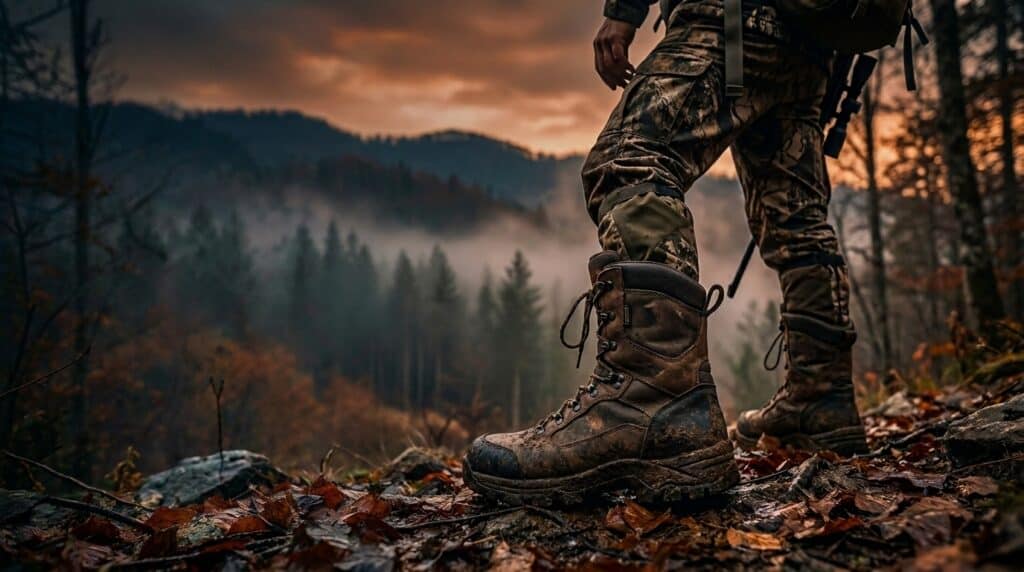
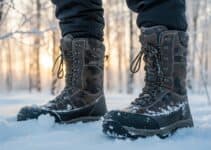
hunting boots in wilderness
Rubber vs. Leather: The Honest Decision
This debate has divided hunters for decades. Both materials are correct — for different situations.
Choose rubber when: Scent control is your top priority (whitetail, bear); you are hunting in standing water (waterfowl, marsh); your walk to the stand is under one mile; you are sitting stationary in wet or cold conditions; and when you want minimal maintenance between hunts (hose off and done). Rubber is non-porous — it cannot absorb or retain odour molecules the way leather and fabric can. A rubber boot washed with scent-free soap and stored with natural cover material is functionally scent-neutral. No leather boot, regardless of scent control technology, achieves this level of neutrality.
Choose leather when: You are covering 3+ miles per day (western elk, upland bird); ankle support on steep or uneven terrain is required; breathability matters more than waterproofing; and when you expect to use the boots for 5–10 seasons with proper maintenance. Leather moulds to the foot over time, provides superior ankle support on rough terrain, and is significantly lighter than rubber — which matters across a week of western mountain hunting covering 50+ total miles.
The honest limitations: Rubber boots typically weigh 3–4 lbs per boot — 6–8 lbs per pair. Leather hunting boots weigh 1.5–2.5 lbs per boot. Over 5 miles of mountain terrain, this weight difference is felt as real cumulative fatigue. Rubber boots also provide limited breathability — your feet will sweat more during active movement, and wet feet cool rapidly when you stop. Leather absorbs and retains odours over multiple seasons even with scent-control treatments.
Scent Control: What Actually Works
Scent control is the most marketing-saturated topic in whitetail hunting. Here is what the technology actually does.
Rubber is scent-neutral by nature. Wash with unscented soap after each hunt, rinse completely, air dry away from synthetic odour sources, and store in a bag with natural material from your hunt area. This protocol achieves functional scent neutrality at the boot level. Deer that pattern human entry routes can detect a leather boot user at scent concentrations that rubber cannot produce.
ScentBan (Irish Setter’s proprietary technology) is an antimicrobial coating that kills odour-causing bacteria inside the boot. It prevents new odour production but does not prevent the boot fabric from absorbing external odours. It meaningfully extends the time before a leather boot becomes detectably scented, but it does not make leather equivalent to rubber. As the antimicrobial coating degrades with washing and use, its effectiveness reduces.
Carbon-lined boots adsorb (bind) odour molecules to carbon surfaces throughout the lining. Carbon becomes saturated after each hunt and must be reactivated by tumbling in a heated dryer for 30–60 minutes. Hunters who consistently reactivate their carbon-lined boots achieve meaningful scent reduction. Hunters who forget this step are hunting in saturated carbon — which provides false confidence rather than actual scent control.
Waterproofing Membranes: Gore-Tex vs. Proprietary Systems
Gore-Tex is widely considered the most durable waterproof-breathable membrane for hunting boots used across multiple seasons. It has the most extensive independent testing data and maintains its waterproofing longer than most proprietary alternatives before requiring retreatment. For a hunter who will use the same leather boots for 5+ seasons, Gore-Tex is worth the price premium.
Kenetrek’s WindTex membrane is well-regarded in the western hunting community and has a strong multi-season durability record in mountain conditions. Irish Setter’s UltraDry is a competent proprietary system at a lower price point, appropriate for moderate hunting conditions. Danner Dry provides reliable waterproofing and performs well in the short term, though long-term seam integrity requires monitoring in heavy-use conditions.
Rubber boots sidestep membrane discussions entirely. They are waterproof by their material nature, with no membrane to fail, no DWR treatment to reapply, and no seam to degrade. For hunting in standing water or consistently wet marsh terrain, rubber is the only correct choice — no membrane can substitute for the depth of waterproofing that a rubber tall boot provides.
Quick Comparison: Best Hunting Boots (2026)
| Boot | Best For | Material | Insulation | Waterproofing | Height | Scent Control | Price |
|---|---|---|---|---|---|---|---|
| Irish Setter VaprTrek | Best overall / versatile whitetail | Leather/nylon hybrid | Uninsulated or 400g | UltraDry | 8 inch | ScentBan | ~$175–$210 |
| Kenetrek Mountain Extreme 400 | Best western elk / mountain | 2.8mm full-grain leather | 400g | WindTex | 10 inch | None (leather) | ~$380–$450 |
| LaCrosse Alphaburly Pro | Best rubber / whitetail scent control | Full rubber | Uninsulated or 800g | Rubber (no membrane) | 18 inch | Excellent (rubber) | ~$195–$240 |
| Muck Boot Arctic Ice Tall | Best extreme cold sits | Neoprene/rubber | Fleece + neoprene | Rubber (no membrane) | 15 inch | Good (rubber) | ~$140–$180 |
| Danner Pronghorn 8″ | Best upland bird / active hunting | Full-grain leather | 400g PrimaLoft | Gore-Tex | 8 inch | None (leather) | ~$220–$260 |
| Irish Setter Elk Tracker 600g | Best insulated leather / late season | Trout Book leather | 600g PrimaLoft | UltraDry | 9 inch | ScentBan | ~$195–$240 |
| Rocky Core Waterproof Insulated | Best budget hunting boot | Leather/synthetic | 400g | Rocky Waterproof | 8 inch | None | ~$100–$130 |
| LaCrosse Wetlands | Best waterfowl / marsh | Full rubber | Uninsulated or 800g+ | Rubber (no membrane) | 16–18 inch | Excellent (rubber) | ~$120–$170 |
| Irish Setter Women’s VaprTrek | Best women’s hunting boot | Leather/nylon hybrid | Uninsulated or 400g | UltraDry | 8 inch | ScentBan | ~$170–$205 |
| Danner Recurve | Best lightweight / backcountry | Full-grain leather | Uninsulated or 200g | Danner Dry | 7 inch | None (leather) | ~$225–$250 |
1. Irish Setter VaprTrek — Best Overall Hunting Boot
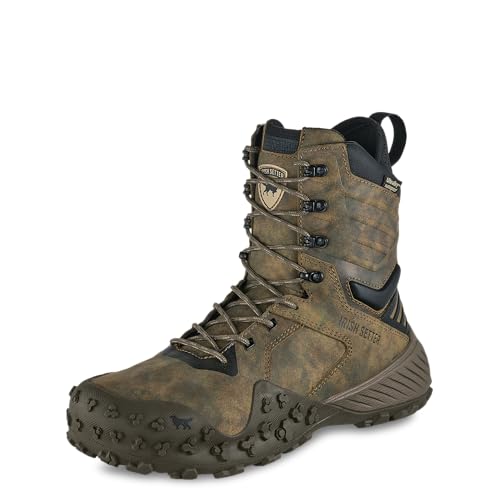
Best for: Whitetail hunters who walk 1–3 miles to a stand and need a boot that handles the walk without overheating and provides enough insulation for a moderate sit — the VaprTrek’s combination of ScentBan, UltraDry waterproofing, and wrap-around outsole makes it the most versatile hunting boot in this guide for the most common hunting scenario in North America.
| ASIN | B0FJNCCJ17 |
| Material | Full-grain leather and nylon honeycomb ripstop hybrid upper |
| Insulation | Uninsulated or 400g — verify current variant on listing |
| Waterproofing | UltraDry waterproof breathable membrane |
| Height | 8 inches |
| Outsole | Aggressive tapered lugs — designed to bite hard and release mud; wrap-around design grips tree-stand rungs and ATV footholds |
| Scent control | ScentBan antimicrobial lining — kills odour-causing bacteria |
| Weight | Lightweight for a hunting boot — specific to variant; verify on listing |
| Break-in | Moderate — leather/nylon hybrid is faster than full-grain leather alone |
| Best hunter profile | Moderate activity — walking 1–3 miles to stand, moderate sit duration |
| Price range | ~$175–$210 |

The Irish Setter VaprTrek earns the overall position by solving the most common hunting boot problem: the boot that works during the walk to the stand but becomes a liability once you stop moving. The full-grain leather and nylon honeycomb ripstop upper combination provides durability against briars and brush while keeping total weight low enough for extended walking. The UltraDry membrane provides reliable waterproofing against morning dew, creek crossings, and autumn rain without trapping the sweat that accumulates during the walk. The key is the ScentBan antimicrobial lining — it kills the bacteria that produce odour inside the boot, significantly extending the time before the leather upper develops the detectable human scent that deer pattern over a season of repeated entry along the same trail.

The outsole is specifically designed for the whitetail hunter’s daily reality rather than just trail traction. The tapered lug design bites hard for grip on slippery leaves and wet ground but releases mud cleanly rather than packing into the lug channels — a critical feature for hunters who cover muddy bottomland terrain in early November. The wrap-around outsole extends up the sides of the boot specifically to grip tree-stand rungs and ATV footholds — the two most common non-ground-contact surfaces in a whitetail hunter’s daily routine. This specific outsole design is not found on hiking boots or general outdoor boots at this price point. The boot is available in insulated and uninsulated variants — for hunters who walk aggressively to a warm-weather stand, the uninsulated version with heavyweight wool socks provides better thermal regulation than any fixed-insulation boot. For moderate-temperature sits, the 400-gram version is the correct choice.
Best for: Whitetail hunters walking 1–3 miles to stand in mixed terrain and moderate temperatures. Best hunter profile: moderate activity.
Pros: ScentBan extends scent life of leather boot, wrap-around outsole grips tree-stand rungs, UltraDry breathable waterproofing, lightweight for a hunting boot, available in insulated and uninsulated versions.
Cons: Leather upper absorbs odour over multiple seasons — rubber remains superior for scent control. Not the correct boot for western mountain hunting covering 5+ miles of steep terrain daily.
2. Kenetrek Mountain Extreme 400 — Best for Western Elk and Mountain Hunting
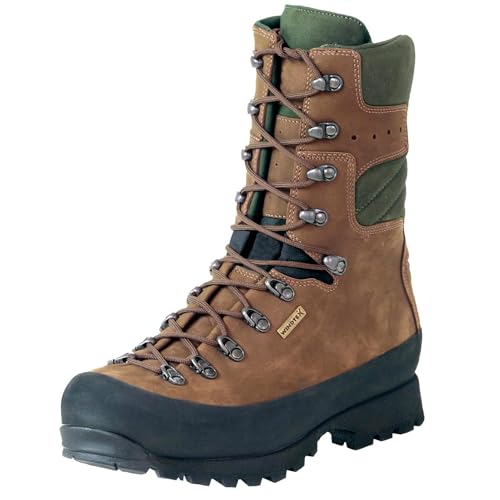
Best for: Western hunters — elk, mule deer, mountain goat, bighorn sheep — who cover 5–10 miles per day on steep rocky terrain and need a boot that provides serious ankle support, long-term durability across multiple seasons, and the traction to handle scree, loose rock, and mountainous terrain reliably.
| ASIN | B002MXYSBU |
| Material | 2.8mm full-grain leather upper — one-piece construction with no tongue seam |
| Insulation | 400g Thinsulate — appropriate for active mountain hunting in 20–40°F conditions |
| Waterproofing | WindTex waterproof breathable membrane |
| Height | 10 inches — maximum ankle coverage and support |
| Outsole | K-Talon Vibram — excellent traction on rock, scree, and alpine terrain |
| Construction | Reinforced double and triple stitching in high-wear areas |
| K-straps | Internal ankle support straps — prevent ankle rolling on technical terrain without restricting flex |
| Break-in | 3–5 weeks — 2.8mm full-grain leather requires genuine break-in investment |
| Expected lifespan | 5–10+ seasons with proper maintenance — investment boot |
| Best hunter profile | Active — covering 5–10+ miles per day on steep mountain terrain |
| Price range | ~$380–$450 |

The Kenetrek Mountain Extreme is not a boot you buy casually — it is a boot you invest in once and use for a decade. The 2.8mm full-grain leather upper is thicker than the leather used in most competing hunting boots, and the one-piece construction eliminates the tongue seam that allows water infiltration in conventional multi-piece uppers. After 20+ years in the western hunting market, the Mountain Extreme has earned a reputation that is earned through repeated field verification rather than marketing: guides, outfitters, and serious backcountry hunters who cannot afford to have their footwear fail on a 7-day spike camp elk hunt consistently return to Kenetrek. The K-straps — internal ankle stabilising straps — are the feature that sets Kenetrek apart from competitors. They connect the base of the boot to the heel and upper, providing ankle roll resistance without the rigid external brace that would limit the natural flex needed for long-distance mountain hiking.

The 400-gram Thinsulate insulation is the correct level for active mountain elk hunting in September through November at elevations where morning temperatures range from 15–35°F. This insulation level keeps feet warm during the approach hike when the hunter is moving but does not overheat during the sustained effort of climbing 2,000 feet of vertical. Hunters who sit in a glassing position for 3–4 hours at altitude in October may want to carry a pair of lightweight camp booties to supplement the 400-gram boot during stationary periods. The K-Talon Vibram outsole provides the traction on wet rock and scree that western mountain terrain demands — the outsole is specifically formulated for the rock contact loads of mountain hunting rather than the flat-terrain traction of general hiking. The break-in investment is real: plan 3–5 weeks of progressively longer wear before a demanding hunt. The Mountain Extreme is not comfortable in the first 20 hours. It is one of the most comfortable boots on the mountain after 60 hours.
Best for: Western elk, mule deer, mountain hunting — active hunters covering 5–10+ miles per day on steep rocky terrain.
Best hunter profile: High activity — the weight and stiffness investment is only justified for hunters covering serious mountain miles.
Pros: 2.8mm full-grain leather for 5–10 season durability, K-straps prevent ankle roll on technical terrain, K-Talon Vibram outsole for alpine traction, 10-inch height for maximum ankle support, WindTex waterproofing, 3–5 insulation level options available.
Cons: Premium price ($380–$450) — not for casual or budget-limited hunters. 3–5 week break-in is a genuine commitment. 400g Thinsulate not ideal for wet environments — Primaloft would be preferable for waterfowl crossover use.
3. LaCrosse Alphaburly Pro — Best Rubber Boot for Whitetail Scent Control

Best for: Whitetail hunters who prioritise scent control above all other considerations — and for any hunter in swampy, wet, or creek-crossing terrain where rubber’s intrinsic waterproofing eliminates the membrane-failure risk of leather alternatives.
| ASIN | B07T6HZW9S |
| Material | 100% rubber upper — non-porous, scent-neutral after washing |
| Insulation | Available uninsulated (early season) and 800g (late season) — verify variant on listing |
| Waterproofing | Rubber by nature — no membrane to fail, no seam to leak |
| Height | 18 inches — maximum shaft coverage for deep vegetation and creek crossings |
| Outsole | Burly multi-directional lug — field-tested on slick rocks, mud, and light snow |
| Interior | Neoprene bootie — provides structure similar to leather boot, ergonomic fit |
| Ankle support | Higher than typical rubber boot — neoprene bootie provides structured support |
| Scent profile | Excellent — non-porous rubber achieves scent neutrality with proper washing protocol |
| Weight | Heavy — 3–4 lbs per boot (6–8 lbs per pair) |
| Best hunter profile | Stationary to moderate — not for 3+ mile mountain approaches |
| Price range | ~$195–$240 |

The LaCrosse Alphaburly Pro is what the rubber boot category looks like when it is done correctly — and it is the rubber boot that field testers consistently describe as providing support and ergonomics comparable to a quality leather boot, rather than the clunky, unsupportive rubber boot stereotype. GearJunkie field testing confirmed: “phenomenal support, similar to that of a leather boot, and very ergonomic.” The neoprene bootie interior is the engineering decision behind this: rather than a loose rubber shell around a simple foam liner, the Alphaburly wraps a structured neoprene bootie that fits the foot, with the rubber outer providing weatherproofing. The result is a boot that grips the foot with the secure lockdown hunters associate with leather, not the slop-around looseness of most rubber alternatives.
The 18-inch shaft height is not excessive — it is functional. Whitetail hunters walking through tall November grass, cattail marshes, and creek bottoms routinely encounter vegetation and water that exceeds the height of a standard boot. The Alphaburly’s 18-inch rubber shaft provides protection that no 8-inch or 10-inch boot achieves. For hunters who access their stands via creek crossings or swampy bottomland, this height eliminates the boot-filling water event that ruins a hunt and risks hypothermia. The Burly outsole has demonstrated durability in field tests that extends well past the point where competing outsoles show significant wear: on slick creek rocks, wet hardwood leaves, mud, and light snow, the multi-directional lugs provide grip that maintains confidence. Scent protocol: wash with unscented soap after each hunt, air dry away from synthetic odours, store in a bag with soil or leaves from your hunting area.
Best for: Whitetail hunters prioritising scent control; hunters in swampy, wet, and creek-heavy terrain; early and late season with available insulation variants.
Best hunter profile: Stationary to moderate — the weight of this boot is a liability for walks over 1 mile.
Pros: True scent neutrality (rubber), no membrane to fail, 18-inch height for creek crossings and deep vegetation, neoprene bootie provides leather-like support, Burly outsole outlasts competing outsoles in field testing.
Cons: Heavy (6–8 lbs per pair) — not for active hunting involving long walks. Limited breathability causes foot sweating during movement. Less ankle support than quality leather for steep mountain terrain.
4. Muck Boot Arctic Ice Tall — Best for Extreme Cold Stationary Hunting
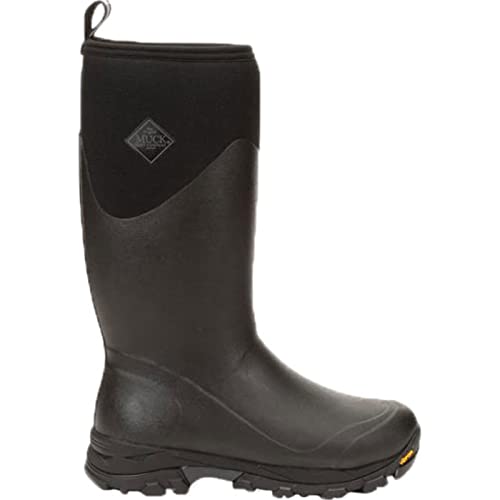
Best for: Hunters sitting completely stationary in extreme cold — late-season all-day tree stands at or below zero degrees, cold marsh duck blinds, ground blinds in deep snow — where body heat generation is minimal and maximum insulation is the dominant comfort requirement.
| ASIN | B08T6CGH7L |
| Material | Neoprene upper with rubber overlay — neoprene provides inherent insulation |
| Insulation | Fleece lining + XpressCool bootliner + neoprene — rated to -40°F |
| Waterproofing | Rubber and neoprene — waterproof by nature |
| Height | 15 inches |
| Outsole | Vibram Arctic Grip — engineered for wet ice and icy terrain traction |
| Construction | Muck’s patented triple-layer reinforcement at stress zones |
| Scent profile | Good — rubber/neoprene reduces absorption vs leather |
| Weight | Heavy — neoprene insulation adds substantial weight |
| Best hunter profile | Stationary — not for extended walking |
| Price range | ~$140–$180 |

The Muck Arctic Ice Tall addresses the specific and unforgiving thermal challenge of sitting completely still in extreme cold for extended periods. When a hunter stops moving entirely — settled into a stand or blind at first light with hours ahead — the body’s heat generation drops dramatically. The muscles that generate heat during walking are at rest. Body heat production falls to basal metabolic rate. In sub-zero conditions, any insulation system that is inadequate for this heat generation rate will produce cold feet within 30 minutes, and there is no recovery while remaining stationary. The Arctic Ice’s neoprene construction combined with fleece lining provides a different thermal mechanism than traditional insulated boots: neoprene itself is an insulator, not just a carrier for insulating materials. The XpressCool bootliner manages moisture from the minimal sweating that occurs even in stationary hunters, maintaining the dry environment that insulation systems require to perform at rated temperature.

The Vibram Arctic Grip outsole is specifically formulated for the wet ice and icy terrain surfaces that late-season hunters encounter — frozen marsh edges, icy steel ladder stand rungs, frozen creek banks, and snow-covered parking areas. Standard rubber compounds stiffen dramatically in extreme cold and lose grip on ice; the Arctic Grip compound maintains flexibility and traction at the temperatures where this boot is used. For hunters who arrive at their stand or blind before first light in sub-zero darkness, this outsole prevents the slip that is the most common serious injury in late-season hunting. The 15-inch shaft provides coverage above the ankle for hunters walking through snow. These boots are unambiguously heavy and unambiguously warm — they are the correct tool for the specific scenario of extreme cold stationary hunting, and the wrong tool for any hunt requiring more than 0.5 miles of walking.
Best for: Late-season all-day tree stands, frozen marsh duck blinds, ground blinds in extreme cold — any stationary hunting at or below zero degrees Fahrenheit.
Best hunter profile: Completely stationary — not for active hunting or extended walking.
Pros: -40°F rating for extreme cold stationary hunting, Vibram Arctic Grip for icy terrain, neoprene construction is waterproof by nature, XpressCool manages moisture from minimal activity, 15-inch height for snow walking.
Cons: Heavy — not for any hunting requiring extended walking. Not a breathable boot — foot sweating during any activity is significant. Overkill for temperatures above 20°F.
5. Danner Pronghorn 8″ — Best for Upland Bird Hunting and Active Hunting
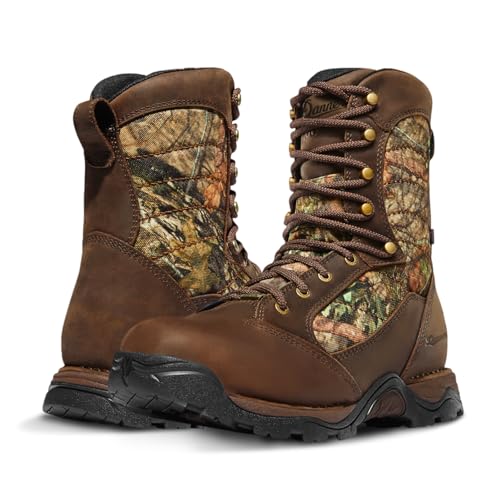
Best for: Upland bird hunters (pheasant, grouse, quail, chukar) who cover many miles across open grasslands, fields, and agricultural terrain — and for any active hunter who needs a high-quality leather boot with Gore-Tex waterproofing and a proven outsole for varied terrain in cool-to-cold conditions.
| ASIN | B07RWJM8RD |
| Material | Full-grain leather upper — durable and abrasion-resistant |
| Insulation | 400g PrimaLoft — retains warmth when wet, correct for variable moisture upland conditions |
| Waterproofing | Gore-Tex — the most durable waterproof-breathable membrane for multi-season hunting boot use |
| Height | 8 inches |
| Midsole | Polyurethane footbed with bi-fit board shank — arch support and torsion control |
| Outsole | Vibram Pronghorn with rubberized Vibram midsole |
| Shank system | Internal/external shank provides optimal arch support across long days of walking |
| Warranty | 365-day warranty — Danner stands behind this boot aggressively |
| Break-in | 2–3 weeks — full-grain leather requires genuine break-in |
| Best hunter profile | Active — covering 5–10+ miles per day on open terrain |
| Price range | ~$220–$260 |

Upland bird hunting is one of the most physically demanding hunts from a footwear perspective: hunters often cover 8–15 miles per day across grasslands, picked corn, and agricultural terrain, working dog patterns across open ground for hours. A boot that works for 3 miles will feel like a liability at mile 12. The Danner Pronghorn’s design is specifically optimised for this high-mileage application: the polyurethane footbed with bi-fit board shank and internal/external shank system provides the arch support and torsion control that prevents the foot fatigue that accumulates across a full upland day. The Vibram Pronghorn outsole with rubberised Vibram midsole maintains the cushioning properties of EVA across long distances while providing the durability that traditional EVA cannot sustain at upland hunting mileage. Field and Stream’s long-term testing has consistently placed the Pronghorn among their top picks — not because it is the newest or most technical hunting boot, but because it performs reliably across hundreds of miles over multiple seasons.

The 400-gram PrimaLoft insulation is specifically correct for upland hunting conditions: PrimaLoft retains approximately 90% of its insulation value when wet, which is critical for upland hunting in heavy dew, light rain, and wet grass. A hunter walking through heavy wet grass in September or October encounters substantial moisture that saturates standard insulation; PrimaLoft’s performance-when-wet advantage directly addresses this. Gore-Tex is the correct waterproofing choice for a boot that will see 5+ seasons of upland use — the membrane’s durability advantage over proprietary alternatives becomes significant over multiple seasons of wet-grass walking. The 365-day warranty is a genuine statement of confidence: Danner’s willingness to replace the boot within the first full hunting season reflects the quality of construction rather than being a marketing footnote.
Best for: Upland bird hunters covering high daily mileage on open terrain; any active hunter who needs Gore-Tex durability across multiple seasons.
Best hunter profile: Active — the shank system and midsole are designed for high mileage, not stationary sitting.
Pros: Gore-Tex for multi-season waterproofing durability, 400g PrimaLoft retains warmth when wet, shank system for all-day arch support, Vibram Pronghorn outsole, 365-day warranty, full-grain leather upper for multi-season durability.
Cons: Leather absorbs odour — not the correct choice for scent-sensitive whitetail hunting without ScentBan or equivalent. 2–3 week break-in required. Not insulated heavily enough for stationary late-season hunting below 20°F.
6. Irish Setter Elk Tracker 600g — Best Insulated Leather Boot for Late Season

Best for: Late-season whitetail and elk hunters who need more insulation than general-purpose boots provide without moving to a heavy rubber boot — the 600-gram PrimaLoft hits the sweet spot between walking warmth and stationary protection for moderate cold-weather hunting.
| ASIN | B0D81HGKNH |
| Material | Trout Brook full-grain leather — abrasion-resistant for rough terrain |
| Insulation | 600g PrimaLoft — retains warmth when wet, appropriate for 10–25°F moderate activity |
| Waterproofing | UltraDry waterproof breathable membrane |
| Scent control | ScentBan antimicrobial lining |
| Height | 9 inches |
| Outsole | Vibram — multi-terrain traction |
| Break-in | 2–4 weeks — full-grain leather construction |
| Best hunter profile | Moderate — walking 1–2 miles in moderate cold, moderate sit duration |
| Price range | ~$195–$240 |

The Irish Setter Elk Tracker represents the mature evolution of the insulated leather hunting boot — a category that has existed for decades but has been consistently refined toward better waterproofing, better insulation longevity, and better foot odour management. The 600-gram PrimaLoft insulation falls between the 400-gram general-purpose boot and the 800-gram+ rubber boot, and it is correct for the hunting scenario that the name implies: late October and November elk hunting in the Rocky Mountain region, where morning temperatures are in the teens to low twenties but the hunter is active enough across varied terrain that heavier insulation would create heat-driven sweating issues. PrimaLoft’s performance-when-wet advantage is specifically relevant for western elk hunting where morning creek crossings, wet brush, and unpredictable precipitation are routine.

The Trout Brook full-grain leather upper provides the abrasion resistance that western mountain elk hunting requires — contact with rocks, deadfall, and rough terrain that would degrade lighter-weight uppers over the course of a 7-day hunt. The ScentBan antimicrobial lining extends the scent life of the leather upper between conditioning and cleaning sessions. The 9-inch height provides additional ankle coverage and support beyond the standard 8-inch hunting boot, which is meaningful for hunters sidehilling on steep terrain where lateral ankle load is sustained across miles of approach. Mountain Weekly News field testing in the Tetons confirmed the boot’s performance in the mountain hunting context for which it is specifically designed. Vibram outsole provides the multi-terrain traction that mountain and mixed-terrain elk hunting requires.
Best for: Late-season elk and whitetail hunters in moderate cold (10–25°F) with mixed walking and sitting.
Best hunter profile: Moderate activity — walking 1–2 miles with moderate to extended stand time.
Pros: 600g PrimaLoft correct for late-season moderate activity, PrimaLoft retains warmth when wet for wet mountain conditions, ScentBan extends scent life, Trout Brook leather for mountain abrasion resistance, 9-inch height for additional ankle support, Vibram outsole.
Cons: Leather absorbs odour over multiple seasons. 2–4 week break-in required. Not sufficient for extreme cold (-10°F and below) stationary hunting.
7. Rocky Core Waterproof Insulated — Best Budget Hunting Boot
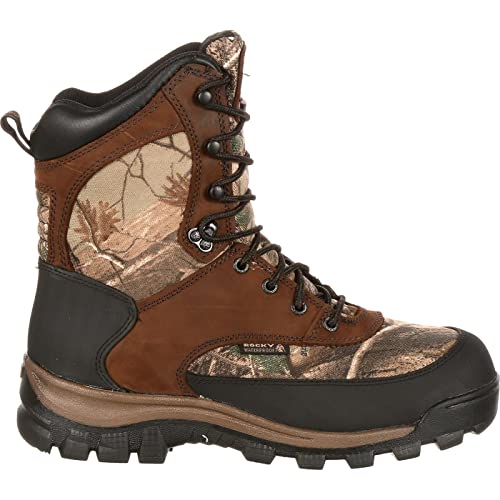
Best for: First-time hunters, youth hunters, and budget-limited hunters who need a functional waterproof insulated hunting boot without the premium spend of the Irish Setter, Danner, or Kenetrek alternatives — and for hunters who are uncertain of their specific needs and want to learn what works before investing in a premium pair.
| ASIN | B008DDF3M6 |
| Material | Leather and synthetic upper — competent construction for the price point |
| Insulation | 400g — appropriate for moderate fall hunting conditions |
| Waterproofing | Rocky waterproof construction |
| Height | 8 inches |
| Outsole | Rocky outsole — general hunting terrain |
| Scent control | None specifically marketed |
| Break-in | 1–2 weeks — lighter construction than full-grain alternatives |
| Expected lifespan | 2–4 seasons with proper care — budget construction |
| Best hunter profile | Moderate activity — general fall hunting |
| Price range | ~$100–$130 |

The honest case for a budget hunting boot: most first-season hunters do not know yet what type of hunting they will commit to long-term, what terrain they will hunt most often, or whether a premium boot investment is justified by their actual hunting frequency. A new hunter who buys a $400 Kenetrek, hunts twice, and then loses interest in the activity has made a poor financial decision. The Rocky Core provides the fundamental requirements — waterproof, 400-gram insulation, adequate outsole — at a price that reflects an appropriate level of commitment for a hunter whose needs and preferences are not yet established. For hunters who discover that they hunt 15+ days per season and want to invest in premium footwear after understanding their specific needs, the Rocky provides a serviceable first boot while they develop that understanding.

The realistic expectations for the Rocky Core: competent waterproofing that is adequate for rain and moderate wet terrain but should not be expected to perform at the level of Gore-Tex across 4+ seasons. The 400-gram insulation is appropriate for moderate fall temperatures and moderate activity. The outsole will show wear faster than premium Vibram alternatives on abrasive terrain. The leather and synthetic upper is lighter and less stiff than full-grain leather, which means faster break-in and less foot fatigue for a new hunter — a genuine advantage at this experience level. The expected lifespan of 2–4 seasons is honest: this is not a 10-year boot, and it should not be evaluated against boots that are. At its price point, it is a competent entry into hunting footwear.
Best for: First-time hunters, youth hunters, budget-limited hunters testing hunting for the first time, hunters unsure of their specific needs.
Best hunter profile: Moderate activity — general fall hunting across varied terrain.
Pros: Full waterproof construction at the lowest price in this guide, 400g insulation for moderate fall conditions, faster break-in than full-grain leather alternatives, appropriate investment level for uncertain commitment.
Cons: Budget construction — 2–4 season lifespan. No specific scent control technology. Waterproofing will not maintain Gore-Tex durability over multiple seasons. Not the correct boot for serious western mountain hunting or extreme cold.
8. LaCrosse Wetlands — Best for Waterfowl and Marsh Hunting
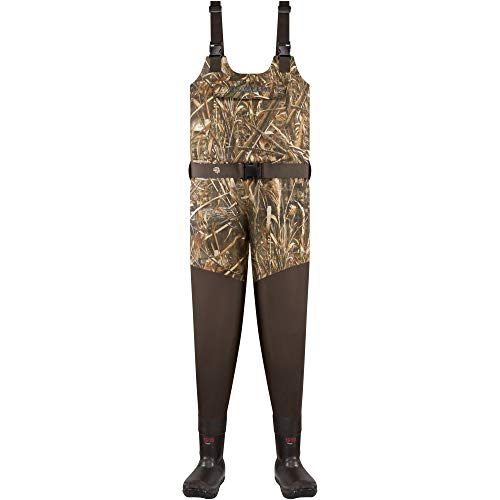
Best for: Waterfowl hunters — duck, goose, teal — who stand in water up to knee depth for extended periods, wade through marsh mud, and need a boot that is genuinely waterproof at the shaft height required for this specific hunting environment.
| ASIN | B07FWM518X |
| Material | Full rubber — non-porous, true waterproofing at all contact depths |
| Insulation | Available in uninsulated and insulated variants — verify on current listing |
| Waterproofing | Rubber by nature — no membrane to fail, no seam to leak at any standing water depth within shaft height |
| Height | 16–18 inches — designed for standing water up to mid-shin |
| Outsole | Aggressive lug pattern for marsh mud, slippery banks, and wet boat deck |
| Scent control | Good — rubber reduces odour absorption vs leather |
| Fit | Adjustable neoprene top strap — cinches shaft for secure fit and debris exclusion |
| Best hunter profile | Stationary to moderate — waterfowl hunting involves minimal walking but extended standing in water |
| Price range | ~$120–$170 |

Waterfowl hunting has one absolute boot requirement that no membrane technology can substitute for: waterproofing at the water depth the hunter will stand in. A hunter in a flooded corn field standing in 10 inches of water wearing an 8-inch waterproof leather boot with Gore-Tex lining has a boot that is 2 inches shorter than the water depth. The Gore-Tex membrane is irrelevant. The boot is flooding. The LaCrosse Wetlands’ 16–18-inch rubber shaft is the only correct answer for this scenario — genuine waterproofing at the full standing water depth that waterfowl hunting regularly encounters. Rubber’s intrinsic waterproofing by material (not by membrane or treatment) means the boot will remain waterproof across years of use without retreatment, without membrane degradation, and without seam failure at the ankle — the location where leather boot waterproofing most commonly fails in sustained standing-water use.

The aggressive outsole lug pattern is specifically designed for the terrain challenges of waterfowl hunting: marsh mud that suctions with each step, slippery wet clay banks at the water’s edge, wet boat decks, and icy mud during late-season duck hunting. Standard hunting boot outsoles designed for forest and mountain terrain lose grip on the slick, variable surfaces of waterfowl environments. The adjustable neoprene top strap cinches the shaft to the calf, preventing debris and water from entering the boot from above during particularly deep wading and keeping the shaft fitted to the individual hunter’s calf circumference rather than slapping loosely with each step. For duck hunters who also hunt whitetail, the rubber Wetlands provides the scent control advantage on mornings when the same hunter moves from the marsh blind to a tree stand between hunts.
Best for: Waterfowl hunters (duck, goose, teal) standing in water; marsh hunters; any hunter in flooded terrain where standing water exceeds 8 inches.
Best hunter profile: Stationary — waterfowl hunting involves extended standing rather than active walking.
Pros: True waterproofing at full standing water depth (no membrane can substitute for rubber in standing water), 16–18-inch height for deep marsh wading, aggressive outsole for slick marsh terrain, adjustable top strap, good scent reduction vs leather.
Cons: Heavy — rubber construction not for walking-intensive hunts. Limited breathability in warm weather waterfowl seasons. Verify insulation level on current listing for cold vs. warm weather use.
9. Irish Setter Women’s VaprTrek — Best Women’s Hunting Boot

Best for: Women hunters who have worn men’s hunting boots in smaller sizes and experienced heel slippage, arch fatigue, and calf looseness on rubber boots — the Women’s VaprTrek is built on a genuine women’s last with proportions appropriate for women’s foot anatomy rather than a scaled-down men’s boot.
| ASIN | B07V6623ML |
| Last | Genuine women’s last — narrower heel, appropriate arch placement, women’s foot proportions |
| Material | Full-grain leather and nylon honeycomb ripstop hybrid — same as men’s VaprTrek |
| Insulation | Uninsulated or 400g — verify variant on current listing |
| Waterproofing | UltraDry waterproof breathable membrane |
| Scent control | ScentBan antimicrobial lining |
| Height | 8 inches |
| Outsole | Wrap-around aggressive lug — tree-stand grip and mud release |
| Break-in | Moderate — leather/nylon hybrid breaks in faster than full-grain leather alone |
| Best hunter profile | Moderate activity — same use profile as men’s VaprTrek |
| Price range | ~$170–$205 |

Women represent approximately 20% of American hunters and this demographic has grown consistently over the past decade. Yet most hunting boot guides acknowledge this audience with a single sentence about colour options. The anatomical reality of women’s foot geometry creates hunting boot problems that no amount of sock adjustment corrects: women’s feet have a narrower heel relative to forefoot width than men’s, an arch that is positioned further forward, and different calf circumference proportions that cause rubber boot shafts to slop loosely in men’s sizing. A woman wearing a men’s hunting boot in a smaller size experiences heel slippage — the heel cup is too wide — and the arch hits in the wrong position, creating fatigue at a different point than where the support is designed to act. These are fit failures that persist through break-in because they are structural, not adaptation problems.

The Women’s VaprTrek addresses these issues at the design level by building on a genuine women’s last — the foot-shaped form around which the boot is constructed. The heel cup is proportioned for women’s narrower heel width. The arch is positioned for women’s forward arch placement. The forefoot accommodates women’s wider forefoot-to-heel ratio. The result is a boot that fits correctly from day one rather than requiring the foot to adapt to a boot that was designed for a different anatomy. The ScentBan antimicrobial lining and UltraDry waterproofing are identical to the men’s version — women hunters deserve the same functional technology in a correctly fitted boot. The wrap-around outsole provides the same tree-stand grip and mud-release performance that makes the men’s VaprTrek effective for whitetail hunting.
Best for: Women hunters in any terrain — the correct first hunting boot for any woman who has previously worn men’s boots and experienced fit problems.
Best hunter profile: Moderate activity — same use profile as the men’s VaprTrek.
Pros: Genuine women’s last corrects the anatomical fit problems of men’s boots in smaller sizes, ScentBan and UltraDry provide same technology as men’s version, wrap-around outsole for tree-stand grip, available in insulated and uninsulated.
Cons: Same limitations as men’s VaprTrek — leather absorbs odour over seasons, not the correct boot for extreme cold or western mountain hunting. Women needing rubber boots for waterfowl should look at LaCrosse women’s rubber options.
10. Danner Recurve — Best Lightweight Backcountry Hunting Boot

Best for: Backcountry hunters and western hunters who prioritise low weight and out-of-the-box comfort over maximum ankle stiffness — GearJunkie’s “best value” hunting boot, field-tested across two full seasons of elk, waterfowl, deer, and upland bird hunting in varied terrain without the tester wishing for a different boot.
| ASIN | B085BX3TD9 |
| Material | Full-grain leather — lighter grade than Kenetrek’s 2.8mm, appropriate for the price point |
| Insulation | Uninsulated or 200g — verify variant on listing |
| Waterproofing | Danner Dry — reliable membrane with monitoring recommended at high mileage |
| Height | 7 inches — lighter and lower than traditional 10-inch mountain boots |
| Outsole | Vibram outsole — multi-terrain performance |
| Weight | ~45 oz per pair (1.9 lbs per boot) — among the lightest full-leather hunting boots available |
| Midsole | Pliable sole — more flexible than traditional stiff mountain hunting boots |
| Break-in | Minimal — described by GearJunkie as “comfortable out of the box” compared to traditional full-leather hunting boots |
| Best hunter profile | Active to high activity — the lightweight makes it suitable for distance hunting |
| Price range | ~$225–$250 |

The Danner Recurve occupies a position in the hunting boot market that is genuinely underserved: a full-leather waterproof hunting boot at a fair price that is light enough to cover real distance without the weight penalty of traditional mountain hunting boots. At approximately 45 ounces per pair (roughly half the weight of a typical pair of rubber hunting boots and significantly lighter than a 10-inch stiff mountain boot), the Recurve changes the physical calculus of a full-day backcountry hunt. Western hunters who have experienced the cumulative fatigue of heavy boots across a week of mountain hunting understand this intuitively — two pounds less on your feet across 50 miles of mountain terrain is meaningful. GearJunkie’s extensive two-season field test across elk, waterfowl, deer, and upland hunting at temperatures from the teens to the low sixties produced the kind of result that no single-use test can: consistent performance across varied conditions without the tester ever wishing they had brought a different boot.

The pliable sole and moderate ankle support reflect a deliberate design philosophy that differs from the Kenetrek’s maximum stiffness: the Recurve prioritises comfort and natural foot movement over the rigid ankle containment that steep technical terrain demands. For hunters covering varied mountain terrain — some technical, some not — this balance works well and produces the minimal break-in period that the GearJunkie tester noted. For hunters specifically on technical scree and steep sidehilling for multiple consecutive days, the Kenetrek’s additional stiffness and ankle containment is the more correct choice. For hunters who want a capable, light, all-around backcountry hunting boot without the Kenetrek price tag or break-in investment, the Recurve is the most honest answer at its price point. The Vibram outsole provides reliable multi-terrain traction without the weight penalty of the most aggressive mountain outsoles.
Best for: Backcountry hunters, western hunters who prioritise low weight, all-around hunting boot for hunters who cover varied terrain types across a season.
Best hunter profile: Active — the lightness advantage is most valuable for hunters covering 5+ miles per day.
Pros: Lightest full-leather hunting boot in this guide at 45 oz per pair, GearJunkie field-tested across two full seasons in varied conditions, minimal break-in vs traditional mountain boots, Vibram outsole, fair price for a Danner full-grain leather boot.
Cons: Less ankle stiffness than Kenetrek for maximum-technical terrain. Not the correct insulation level for extreme cold stationary hunting. Leather absorbs odour — not the primary choice for scent-sensitive whitetail.
The Rubber Boot Weight Problem
Every hunting article mentions that rubber boots are heavy. None quantifies what this means for specific hunting scenarios — so here is the honest calculation.
A quality rubber hunting boot weighs 3–4 lbs per boot — 6–8 lbs per pair. A quality leather hunting boot weighs 1.5–2.5 lbs per boot — 3–5 lbs per pair. Research on footwear weight and walking fatigue is consistent: each additional 100 grams of footwear weight increases the oxygen cost of walking by approximately 1%. The 2–4 lb weight difference per pair between rubber and leather represents 4–8% more energy expended on walking across an equivalent distance.
For a whitetail hunter driving to within 400 yards of their stand and sitting all day: this weight difference is irrelevant. You are sitting. The rubber boot’s superior scent control and warmth for stationary sitting dwarf the weight consideration entirely.
For a western elk hunter covering 8 miles per day for 7 consecutive days: 56 total miles of mountain terrain. The 4–8% additional energy expenditure for each of those miles compounds into real cumulative fatigue that affects physical capability on day 5, 6, and 7 of the hunt — the days when most opportunities occur after long stalks. This is why professional elk guides wear leather boots, not rubber, for active mountain hunting.
The rubber boot weight problem is only a problem for hunters who walk significant distances. For stationary and low-mileage hunters, it does not apply.
The Sock System: As Important as the Boot
Experienced hunters know that sock selection matters as much as boot selection for thermal comfort and blister prevention — and this is never discussed in hunting boot guides.
The most important rule: never cotton socks in hunting boots. Cotton holds moisture against the skin, conducts heat away from the foot, and provides zero insulation when wet. Cotton in hunting boots in cold or wet conditions is a cold-feet guarantee regardless of how good the boot is.
Merino wool is the correct hunting sock material. It retains warmth when wet (unlike cotton), manages moisture away from the skin, and is naturally odour-resistant for multi-day backcountry hunts without repeated washing. Smartwool Hunt Heavy Over-the-Calf, Darn Tough Hunt Boot Full Cushion, and Wigwam Ultimax Hunter are the specific sock picks worth knowing.
Sock weight by temperature: liner socks (100-weight merino) for warm weather early season hunting. Medium weight (150–200 weight) for moderate fall conditions. Heavy weight (250 weight) for late season cold. The layering system — thin liner sock under heavy wool sock — moves moisture faster than a single thick sock and insulates better. This is the standard recommendation from experienced cold-weather hunters who have tested both approaches across real hunting seasons.
The critical fit protocol: if you plan to wear heavyweight wool socks (which are thick), size your hunting boot while wearing those socks. A boot fitted in a store or ordered online sized for thin dress socks will cramp painfully when worn with thick hunting wool. Size up if you are between sizes and plan to wear heavy wool. This is the single most common hunting boot fit mistake that causes returns and dissatisfaction.
Carry a dry pair of merino socks for a mid-day swap. Removing accumulated moisture at midday resets thermal comfort and dramatically reduces afternoon blister formation — particularly important for rubber boot users whose limited breathability causes more foot sweating than leather.
Women’s Hunting Boots: Genuine Fit Considerations
Women now represent approximately 20% of American hunters — a demographic that has grown consistently and that most hunting boot guides acknowledge with a colour option and a smaller size range. The anatomical reality deserves more attention.
Women’s feet have a narrower heel relative to forefoot width than men’s feet of the same length. A hunting boot on a men’s last in a women’s size creates a heel cup that is too wide for women’s narrower heel anatomy, causing heel slippage with every step and the Achilles blisters that follow. The arch in a men’s last hits at a different position than women’s arch anatomy — arch support built for men’s arch placement provides support in the wrong location for women’s feet, creating arch fatigue rather than arch relief.
For rubber hunting boots specifically, calf circumference fit is critical. Rubber boot shafts are designed around men’s average calf circumference. A woman wearing a men’s rubber boot in a smaller size will have excessive shaft looseness that allows debris and water entry at the boot opening and causes the shaft to slap against the leg with each step, creating fatigue and noise that can affect hunting effectiveness.
The Irish Setter Women’s VaprTrek (Pick 9) addresses all three of these issues with a genuine women’s last. For women who need a rubber boot for waterfowl or whitetail scent control, LaCrosse produces women’s-specific rubber hunting boots with women’s shaft proportions — look for these specifically rather than ordering a men’s rubber boot in a women’s size.
Break-In Guide: What to Expect by Boot Type
Full-grain leather hunting boots (Kenetrek, Danner Pronghorn, Irish Setter Elk Tracker): Plan 3–6 weeks of progressive break-in before a demanding hunt. Start with 2-hour sessions around the house or on short walks, increasing to full-day use over 3–4 weeks. Apply leather conditioner on the first day and after every 10 hours of use during break-in to accelerate the softening of the leather upper and collar. Do not attempt a full mountain hunt on day one with a stiff leather boot — Achilles blisters and shin irritation from the leather collar are the result. The investment in break-in produces a boot that is custom-formed to the individual foot and will perform reliably for 5–10 seasons.
Rubber hunting boots (LaCrosse Alphaburly, Muck Arctic, LaCrosse Wetlands): Minimal break-in. The neoprene bootie interior conforms to the foot within 2–3 wearing sessions. Wear the boots for a full day hunt within the first week without concern. The only break-in consideration is the initial stiffness of the rubber collar — which softens within 2–3 full-day wearings.
Leather/synthetic hybrid boots (Irish Setter VaprTrek, Danner Recurve): Moderate break-in, 1–2 weeks. The nylon honeycomb ripstop and synthetic components of hybrid uppers flex more readily than full-grain leather, requiring less conditioning and adaptation. A typical hunter can achieve full-day comfort in a hybrid boot within 2 weeks of progressive wear.
Boot Care and Maintenance: Double Your Boot’s Service Life
Quality hunting boots last 5–10 seasons with proper care and 2–3 seasons without it. The maintenance investment is minimal relative to the cost of replacement.
Leather boot conditioning: Apply Obenauf’s Heavy Duty LP or Bickmore Bick 4 after each extended wet hunt and before seasonal storage. Do not use Mink Oil on Gore-Tex-lined boots — Mink Oil contains lanolin that degrades Gore-Tex membrane integrity over time. For Gore-Tex lined leather boots, use Nikwax Leather Conditioner specifically.
DWR retreatment: When water soaks into the boot surface rather than beading off in drops, the DWR (Durable Water Repellent) treatment has degraded. Retreat with Nikwax Fabric and Leather Proof while the boot is still slightly damp after cleaning — the treatment bonds better to moist material. Do not wait until the membrane itself allows water through; treat at the first sign of surface saturation.
Rubber boot care: Wash with unscented soap after each hunt, rinse thoroughly, and air dry away from synthetic odour sources. Store away from direct sunlight, vehicle exhaust, and ozone sources — garage storage near a car accelerates rubber cracking. Inspect the ankle flex zone for cracking annually. Treat with rubber conditioner to slow degradation.
Replacement signs: Waterproofing fails despite retreatment. Sole separation begins at the welt or bond. Ankle support diminishes noticeably — the boot bends laterally with less force than when new. Midsole feels flat and unresponsive underfoot. The boot upper shows cracking at the flex zones despite conditioning.
Frequently Asked Questions
How much insulation do I need in hunting boots?
Depends on temperature and activity level. 0–200g for 30°F+ active hunting. 400g for most general fall hunting at 20–40°F with moderate activity. 600–800g for 0–20°F with moderate sits. 1200g+ for extended stationary hunting in sub-zero temperatures. The activity level is as important as the temperature — active hunters need less insulation than stationary hunters at the same temperature because moving muscles generate significant body heat.
Are rubber hunting boots better than leather for deer hunting?
For scent control, yes — rubber is superior. For hunters who walk more than 1 mile to their stand, no — rubber is too heavy for extended walking. For stationary hunters in wet or cold conditions, rubber is the better all-around choice. The correct answer depends on your specific hunt — how far you walk, how long you sit, and whether scent control is your primary requirement.
Do rubber boots really control scent better than leather?
Yes, significantly. Rubber is non-porous — it cannot absorb or retain odour molecules. Leather and fabric absorb and retain sweat, food, and environmental odours that accumulate with repeated use. With the correct washing protocol, rubber boots achieve functional scent neutrality. ScentBan and carbon-lined leather boots reduce but do not eliminate scent — they do not achieve the scent neutrality of clean rubber.
What is the difference between Gore-Tex and regular waterproof hunting boots?
Gore-Tex is a specific waterproof-breathable membrane with the most extensive long-term durability data and the most consistent multi-season performance of any hunting boot membrane. Proprietary alternatives (UltraDry, WindTex, Danner Dry) are competent but have less durability data and may require more frequent retreatment over time. For a hunter who will use the same boots for 5+ seasons, Gore-Tex is worth the premium.
Can I wear hiking boots for hunting?
For early season, dry-condition hunting in moderate terrain — yes. Hiking boots lack specific hunting features: scent control technology, tree-stand rung grip outsole geometry, and insulation levels appropriate for cold stationary hunting. For any hunting in wet, cold, or scent-sensitive conditions, dedicated hunting boots provide meaningfully better performance than general hiking boots.
How do I break in hunting boots before season?
Start 4–6 weeks before the season opens. Wear for 2-hour sessions initially, increasing to full-day use over 3–4 weeks. Apply leather conditioner on day one and after every 10 hours of use. Do not attempt the first hard hunt in brand-new full-grain leather boots — the break-in investment prevents the blisters and soreness that can end a hunt early. Rubber and hybrid boots require only 1–2 weeks.
What socks should I wear with hunting boots in cold weather?
Merino wool — never cotton. Cotton holds moisture and has no insulation value when wet. Medium-weight merino for general fall hunting. Heavy-weight merino for late season cold. The layering system (thin liner under heavy wool) provides better moisture management and insulation than one thick sock alone. Always size your boot with the socks you plan to wear — heavyweight wool socks require a larger boot than thin socks.
How long should hunting boots last?
Quality leather hunting boots with proper conditioning and waterproofing maintenance: 5–10 seasons. Budget leather or synthetic hunting boots: 2–4 seasons. Quality rubber boots: 3–7 seasons (heavily dependent on UV and ozone storage exposure — garage storage near vehicles degrades rubber significantly faster). Budget rubber boots: 2–4 seasons. Signs that replacement is needed: waterproofing fails despite retreatment, sole separation, diminished ankle support, cracked upper at flex zones.
Final Verdict: The Right Boot for Your Hunt
For most whitetail hunters who walk to a stand and need a versatile all-season boot with scent control: Irish Setter VaprTrek — ScentBan, UltraDry, wrap-around outsole for tree-stand grip, available in insulated and uninsulated.
For western elk and mountain hunting covering serious daily mileage: Kenetrek Mountain Extreme 400 — the 5–10-season investment boot that the western hunting community has validated over decades of field use.
For whitetail hunters who prioritise scent control above all else and walk under 1 mile to the stand: LaCrosse Alphaburly Pro — true rubber scent neutrality with neoprene bootie support that rivals leather.
For extreme cold stationary hunting at or below zero degrees: Muck Boot Arctic Ice Tall — -40°F rated, Vibram Arctic Grip for icy terrain.
For upland bird hunting covering high daily mileage with Gore-Tex durability: Danner Pronghorn 8″ — 365-day warranty, Gore-Tex, PrimaLoft, shank system for all-day arch support.
For late-season elk and whitetail in 10–25°F with mixed walking and sitting: Irish Setter Elk Tracker 600g — 600g PrimaLoft performs when wet, ScentBan, Vibram, 9-inch height.
For first-time hunters and budget-limited buyers: Rocky Core Waterproof Insulated — full waterproofing and 400g insulation at the lowest price in this guide.
For waterfowl and marsh hunting in standing water: LaCrosse Wetlands — rubber waterproofing at the depth that matters, 16–18-inch shaft, marsh-specific outsole.
For women hunters who need a boot built on genuine women’s anatomy: Irish Setter Women’s VaprTrek — genuine women’s last, ScentBan, UltraDry, wrap-around outsole.
For backcountry and lightweight western hunting at a fair price: Danner Recurve — 45 oz per pair, field-tested across two seasons in varied conditions, out-of-the-box comfort without Kenetrek’s break-in investment.