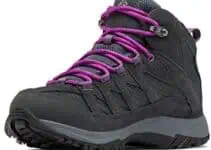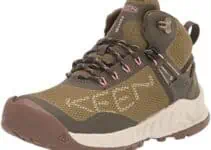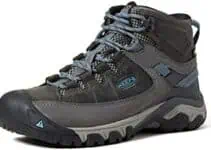
Here is the uncomfortable truth about buying hiking boots: the shop floor is the worst possible place to judge them. Standing in a carpeted store, both boots feel fine. The cushioning feels adequate. The ankle collar feels supportive. Nothing hurts. You buy them, drive to the trailhead, lace them up, and three hours later on a long rocky descent you have a blister on your left heel and your right toenails are protesting loudly. The boots that felt perfect standing still feel like instruments of punishment at mile seven going downhill with 25 pounds on your back.
This happens because the properties that matter most in a hiking boot — how the heel holds on a steep descent, how the shank supports the foot under load, whether the midsole foam will still be functional at mile 500, whether the waterproof membrane will trap sweat in warm weather — are invisible on a flat surface in a comfortable shop. They reveal themselves gradually, over miles, on terrain. The purpose of this guide is to make those properties visible before you buy, so you can make a decision based on what actually matters rather than what happens to feel good standing still.
We’ve chosen 12 boots across every price point and use category — from budget-friendly everyday hikers to premium leather investment boots for serious multi-day backpacking. Every pick is preceded by the technical context you need to understand why it’s the right choice for its category. The buying guide sections are not filler — they contain specific guidance on shank stiffness, lacing technique, upper material longevity, and waterproof decision-making that is absent from most competitor guides. Read them before the product picks, and every recommendation will make immediate sense.
four hiking boot categories
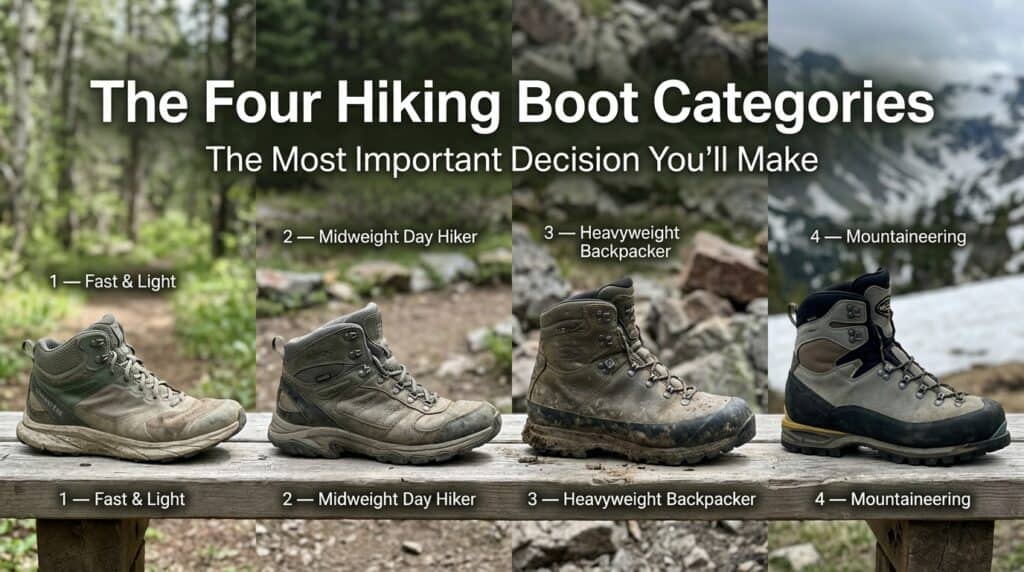
The Four Hiking Boot Categories — The Most Important Decision You’ll Make
Before brand names, before price, before waterproofing — the first decision in buying a hiking boot is which category of boot you need. The category determines stiffness, weight, upper material, and appropriate use case. Buying the wrong category is the most common and most consequential mistake men make when choosing hiking boots.
| Category | Weight (per pair) | Shank | Upper | Best For | Pack Weight |
|---|---|---|---|---|---|
| 1 — Fast and Light | Under 1 lb 10 oz | None or minimal | Synthetic mesh | Day hiking on maintained trails, fastpacking | 0–15 lbs |
| 2 — Midweight Day Hiker | 1 lb 10 oz – 2 lb 8 oz | Half or ¾ shank | Synthetic, split-grain leather, or hybrid | Day hiking all terrain, weekend backpacking | 15–35 lbs |
| 3 — Heavyweight Backpacker | 2 lb 8 oz – 3 lb 8 oz | Full-length shank | Full-grain or nubuck leather, reinforced synthetic | Multi-day backpacking, technical terrain, off-trail | 35–50+ lbs |
| 4 — Mountaineering | 3 lb 8 oz+ | Rigid crampon-compatible | Full-grain leather or plastic shell | Alpine routes, glacier travel, crampon use | Any |
Most recreational hikers need Category 2. Most day hikers with light packs could use Category 1 or 2. Serious backpackers with 40+ pound loads need Category 3. Category 4 is a specialist tool for technical mountaineering — outside the scope of this guide.
The mistake most men make is buying Category 3 boots for Category 2 hiking because heavier boots feel more serious and more protective in the shop. A Category 3 boot worn on easy day hikes with no pack weight is unnecessarily heavy, requires a long break-in period, and provides ankle support that isn’t necessary — while feeling stiff and clunky on terrain that doesn’t require it. Match the boot to your actual hiking, not to your aspirational hiking.
The Shank Stiffness Guide — The Specification That Changes Everything
hands testing hiking boot stiffness 202605312037
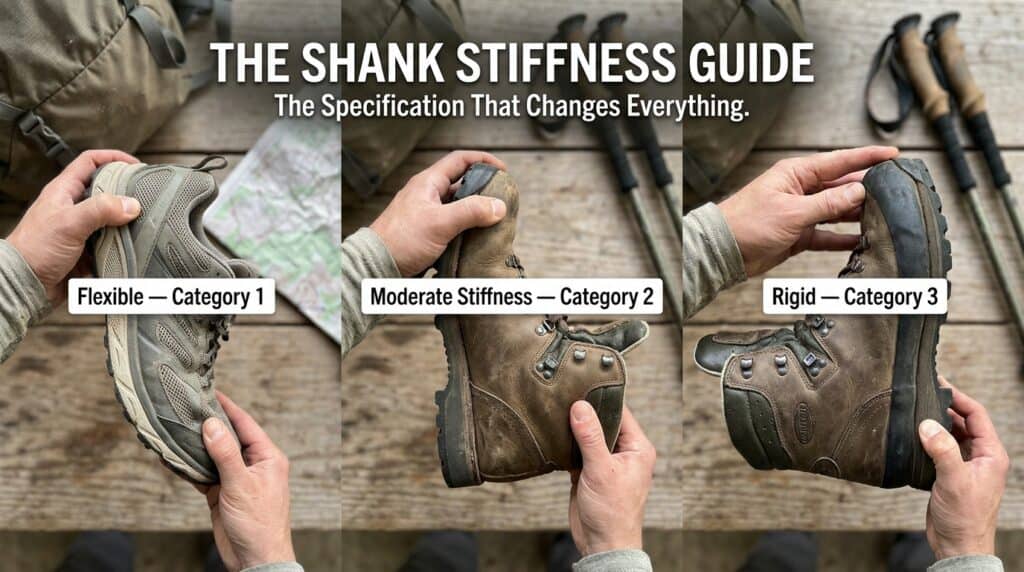
A shank is a rigid or semi-rigid plate embedded between a hiking boot’s midsole and outsole. It is the single most important structural feature in a hiking boot and the least discussed in most buying guides. Understanding it changes how you evaluate every boot you try.
The shank serves three functions. First, it provides longitudinal stiffness — resistance to bending from toe to heel — which reduces the muscular effort required on ascents and prevents excessive foot flex under load. When you’re climbing a steep slope with a heavy pack, a stiff shank means the energy of your step goes into forward movement rather than bending your foot. Second, it provides torsional rigidity — resistance to twisting — which prevents the boot from rolling on uneven surfaces and provides the edge support needed when kicking steps in loose scree. Third, on Category 3 and above boots, the full-length shank allows the boot to be compatible with crampons and provides the structural platform for heavy load carrying over long days.
The bending test you can do in any shop or during an Amazon return window: Pick up the boot and hold the toe in one hand, the heel in the other. Push up firmly on the toe. A Category 1 boot bends easily through the middle — the whole boot folds like a thick athletic shoe. A Category 2 boot bends only in the front third, with clear resistance through the arch. A Category 3 boot barely bends at all — there is firm resistance throughout the length. This test takes ten seconds and tells you more about a boot’s appropriate use case than any specification in the product description.
| Hiking Type | Pack Weight | Required Shank | Correct Category |
|---|---|---|---|
| Day hiking, maintained trail | 0–15 lbs | None to partial | Category 1–2 |
| Day hiking, technical terrain | 10–20 lbs | Half shank | Category 2 |
| Weekend backpacking | 20–35 lbs | Half to ¾ shank | Category 2 |
| Multi-day backpacking | 35–50 lbs | Full-length shank | Category 3 |
| Heavy expedition | 50+ lbs | Full rigid shank | Category 3–4 |
Upper Materials — Leather vs Synthetic vs Hybrid, With Mileage Expectations
The upper material determines how long your hiking boots last, how they behave in wet conditions, how long they take to break in, and how much they weigh. The choice between leather and synthetic is not simply about preference — it is about matching the material’s properties to your hiking frequency, terrain, and budget.
Full-grain leather is the most durable upper material available. High-quality full-grain leather boots — the Lowa Renegade, the Danner Trail 2650, quality La Sportiva models — can last 1,000 to 2,000 miles or more with regular conditioning and proper care. The leather thickness resists abrasion from rocks and brush at approximately three to five times the rate of synthetic materials. Full-grain leather is also naturally water-resistant, improving with conditioning over time. The trade-offs are real: these boots are heavy, they require conditioning to stay supple, and they need a genuine break-in period of 40 to 60 miles before the leather moulds to your foot and the stiffness reduces to trail-ready levels.
Nubuck leather is full-grain leather with the surface buffed to a softer, suede-like texture. It is used on the HOKA Anacapa, KEEN Targhee, and many midweight boots. Nubuck lasts approximately 600 to 1,200 miles with care — more durable than synthetic, less durable than thick full-grain. It accepts conditioner and DWR treatments well and is naturally more supple than full-grain, requiring less break-in time.
Split-grain leather with synthetic panels — the Merrell Moab range is the most familiar example — lasts approximately 400 to 700 miles. The leather sections handle abrasion well; the synthetic mesh panels are the failure point, abrading faster on rocky terrain and off-trail use. This construction is excellent for price-to-performance at moderate mileage but will not survive the long-term abuse that full-grain leather handles comfortably.
Synthetic mesh and technical weave uppers (Salomon X Ultra 5 uses Matryx technical weave, a Dyneema and polyamide construction) last approximately 300 to 600 miles. They are the lightest option, dry fastest after water exposure, and require minimal break-in. Their durability limitation is the fabric’s resistance to abrasion — acceptable on trail-running and day-hiking, less adequate for heavy off-trail use through rock and scrub.
Care instruction that doubles lifespan regardless of material: brush mud from the upper and outsole immediately after each muddy hike. Dried mud acts as an abrasive on subsequent steps, accelerating lug and upper wear. Dry at room temperature — never on radiators or in direct sun, which degrades both leather and adhesives. Condition leather uppers every 3 to 5 uses in wet conditions. Reapply DWR spray to synthetic uppers whenever water stops beading on the surface.
Midsole Guide — EVA vs PU and Why It Matters for Heavier Hikers
hiking boot midsole comparison e… 202605312038
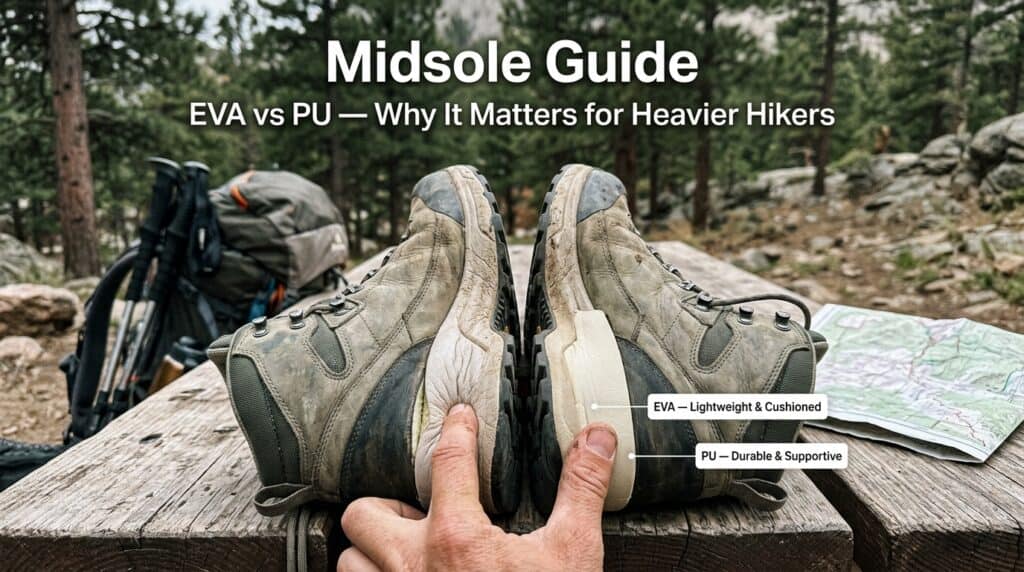
Most hiking boot guides mention EVA and PU midsoles without explaining why the distinction matters. For light recreational hikers, it doesn’t matter much. For heavier men and serious backpackers, it is an important purchase consideration.
EVA (ethylene-vinyl acetate) is the foam in most hiking boot midsoles. It is lightweight, provides good initial cushioning, and is comfortable from early in the break-in process. The limitation: EVA compresses under body weight over time and does not fully recover. A boot with 500 miles on its EVA midsole provides measurably less cushioning than a new boot. The compression rate accelerates with body weight — a 200-pound hiker compresses EVA midsoles approximately 30% faster than a 160-pound hiker. This is why midsole lifespan matters as a replacement indicator: the upper and outsole may look fine while the midsole has lost most of its protective function.
PU (polyurethane) is denser and slightly heavier than EVA but maintains its cushioning properties through significantly more compression cycles. Lowa specifies PU midsoles in the Renegade GTX Mid specifically because the boot is designed for heavy load carrying over many thousands of miles — PU’s longevity under sustained load makes it the correct midsole choice for a boot that costs $250 and is expected to last a decade. The trade-off is that PU boots feel firmer underfoot initially. They also take longer to warm up in cold conditions — PU stiffens in the cold more than EVA, which is noticeable on early morning alpine starts.
The practical test for midsole wear: press your thumb firmly into the exposed edge of the midsole and hold for three seconds. Release. If the indent springs back immediately, the foam is still functional. If the indent persists for more than three to five seconds, the foam has compressed beyond its useful life and the boot should be replaced regardless of how the upper looks.
Waterproof or Not? The Honest Temperature and Duration Guide
The case for waterproof hiking boots is often stated as if it is obvious. It is not obvious — and buying Gore-Tex boots for the wrong conditions produces reliably wetter, hotter feet than the non-waterproof alternative would have.
Gore-Tex membranes work by blocking liquid water entry from outside while transmitting water vapour (sweat) from inside. The vapour transmission rate — even in the best Gore-Tex membranes — is approximately 3,000 grams per square metre per 24 hours. At moderate hiking effort in temperatures above 15°C (59°F), a man’s feet produce sweat at a rate that exceeds this transmission capacity. The result: sweat accumulates inside the boot faster than the membrane can remove it, and your feet are wet from inside. The rain would have produced less total moisture.
| Conditions | Recommendation | Reason |
|---|---|---|
| Below 5°C (41°F) + rain or wet trail | Waterproof — clearly correct | Cold reduces foot perspiration rate; membrane keeps external moisture out; damp-cold is where Gore-Tex provides unambiguous benefit |
| 5–15°C + sustained rain, hike over 2 hours | Waterproof justified | Prolonged rain exposure at moderate temperatures; membrane advantage outweighs breathability cost |
| 5–15°C + light rain, hike under 2 hours | DWR-treated non-waterproof acceptable | DWR sheds light precipitation; boot dries quickly at moderate temperature; breathability advantage for short hike |
| Above 15°C (59°F) + any conditions | Non-waterproof preferred | Sweat accumulation inside waterproof boot exceeds external moisture; mesh dries faster than sweat accumulates |
| Stream and river crossings planned | Non-waterproof | Waterproof boots fill with water in crossings deeper than the ankle collar; membrane traps water inside; mesh drains in 5–10 minutes |
| Winter and snow hiking | Waterproof — non-negotiable | Snow melts immediately into mesh; cold temperature management and waterproofing are both required |
| Hot desert or arid summer hiking | Non-waterproof | No precipitation; heat and breathability are the primary requirements |
The DWR (durable water repellent) middle option: most quality trail boots ship with a DWR coating on the exterior fabric that causes light rain to bead and run off rather than soaking through immediately. This coating wears off with use but can be reapplied with spray products like Nikwax TX.Direct. A DWR-treated non-waterproof boot handles light intermittent rain, wet grass, and brief damp trail contact adequately — and breathes far better than a Gore-Tex equivalent in warm conditions. For three-season hikers who face varied weather, a DWR-maintained non-waterproof boot plus a separate pair of waterproof overboots or gaiters for genuinely wet days can be a more versatile system than a single pair of Gore-Tex boots.
The Complete Fit Guide — Volume, Width, and the Lacing Zone System
Most fit guides tell you to measure your foot length and check for a thumb’s width of toe clearance. This is necessary but far from sufficient. The reason so many men end up with blisters in correctly-sized boots is that fit has three dimensions — length, width, and volume — and most buyers check only one of them.
Boot volume is the total interior space of the boot. It is influenced by the depth of the toe box (vertical room above the toes), the height of the instep (space above the top of the foot), and the depth of the heel cup. Two boots labelled “size 10 medium” can have dramatically different volumes. Men with high arches have high instep volume needs — the top of the foot presses against the lace area and creates numbness or hot spots regardless of how correct the length and width are. Men with low-volume narrow feet may find the same boot too loose at the heel despite a correct length. Recognising the volume issue — rather than assuming length or width is wrong — is the first step to diagnosing fit problems correctly.
The five fit tests that actually reveal hiking boot suitability:
First, the length test: unlace the boot, push your foot forward until your toes touch the front, and check the gap behind your heel — one finger should fit. This is more accurate than the thumb-at-the-toe test when the boot is unlaced.
Second, the width test: lace up fully and stand. Your foot should not be squeezed sideways, and you should not be able to slide your foot significantly side-to-side. If either applies, the boot is wrong in width.
Third, the volume test: lace up and press the top of your foot upward against the tongue. There should be no sharp pressure or numbness. If pressure builds immediately, the boot has insufficient instep volume for your foot.
Fourth, the heel security test: lace up and walk up and down stairs or a slope. Your heel should lift less than one quarter of an inch. More lift than this will create blisters regardless of fit in any other dimension.
Fifth, the descent test: the only test that matters for toenails. Walk down a slope or stairs at pace. Your toes should not contact the front of the boot. If they do, either the boot is too short or your heel is not locked — try the lacing technique below before concluding the boot is the wrong size.
The Four Lacing Zones — How to Tension Each Section Correctly
Zone 1 — Toe to ball of foot (base eyelets). Keep this zone loose. The toe box needs to accommodate natural foot splay — the widening of the forefoot that occurs with every step — and forward foot movement on descents. Over-tightening Zone 1 causes toe numbness, toenail damage, and forefoot blisters. If instinct tells you to lace tight from the bottom, resist it.
Zone 2 — Arch and midfoot. Tighten this zone snugly. This is the structural support zone where the boot provides arch stability and prevents lateral foot movement. Tighten here and consider a surgeon’s knot — a double pass of the lace through a single eyelet — to lock this tension before moving up to the next zone. Without Zone 2 tension locked, the lacing loosens from the bottom upward through the day.
Zone 3 — Instep. Adjust based on your foot’s volume. High-arch, high-volume feet need more slack here — tightening through the instep on a high-volume foot creates the numbness on top of the foot that ruins long hikes. Standard-volume feet should be snug through the instep. If you feel burning or numbness on the top of your foot on a hike, loosen Zone 3 before making any other adjustment — this is the most common cause.
Zone 4 — Ankle lockdown (top hooks). This zone determines whether you get heel blisters. The heel-lock technique: lace normally to the second-to-last eyelet or hook; thread each lace straight up into the top eyelet on the same side, creating a loop; cross the laces and thread each through the opposite loop; pull firmly before tying. This creates a mechanical pulley system that draws the ankle collar down around the heel, eliminating the 1 to 3mm of heel lift per step that causes nearly all hiking boot blisters. It takes ten seconds to learn and five seconds to apply. It is the single most effective blister-prevention technique available and costs nothing.
Hiking Boots vs Trail Runners — When to Choose Each
An increasing number of experienced hikers — including many thru-hikers on long-distance routes — have moved to trail running shoes rather than traditional hiking boots. This is not a fad. It reflects a genuine trade-off that is worth understanding before committing to a boot purchase.
Trail runners win when: the terrain is well-maintained and not technical; pack weight is under 20 pounds; you are covering high mileage where cumulative foot weight matters (approximately 1.8 calories burned per mile per pound on foot — a 1-pound lighter shoe saves real energy over 20+ mile days); you have strong ankles from regular trail running and don’t need the ankle collar support; hot-weather conditions where breathability and fast-drying are more important than waterproof durability.
Hiking boots win when: terrain is technical, loose, rocky, or off-trail where torsional rigidity and edge support matter; pack weight exceeds 25 to 30 pounds and ankle support from a stiffer boot reduces fatigue and injury risk; you have a history of ankle instability; multi-day hiking in cold or wet conditions where waterproof durability across repeated soakings matters; any terrain where kicking steps in scree or steep loose ground requires a stiff-soled platform.
The practical guide: if you are primarily doing day hikes on well-maintained trails with a light pack, a quality trail runner or fast-and-light hiking shoe may serve you as well as a midweight hiking boot while being more comfortable and requiring zero break-in. If you are doing weekend backpacking with 30+ pounds or hiking technical mountain terrain, a Category 2 or 3 hiking boot is the correct tool.
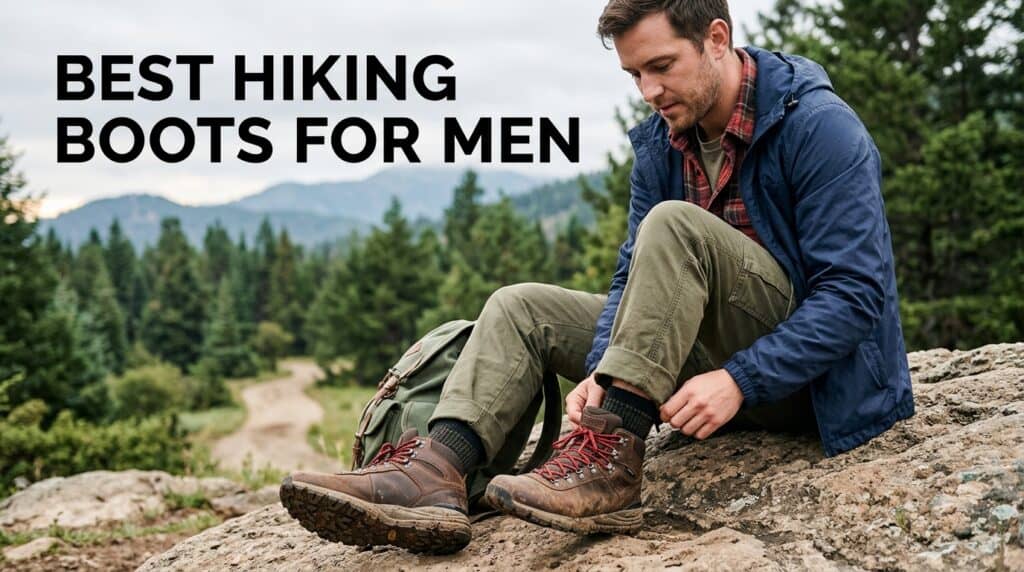
A man preparing for a hike, tying his sturdy hiking boots in a lush forest environment, emphasizing the importance of quality footwear for outdoor activities.
Quick Comparison — All 12 Picks
| Boot | Category | Upper | Midsole | Waterproof | Weight (pair) | Width Options | Best For | Price | Link |
|---|---|---|---|---|---|---|---|---|---|
| Salomon X Ultra 5 Mid GTX | 2 | Matryx synthetic | EVA | Gore-Tex | ~2 lb 0 oz | Standard + Wide | Best overall | $160–$185 | → |
| Merrell Moab 3 Mid GTX | 2 | Split-grain + mesh | EVA | Gore-Tex | ~2 lb 2 oz | Standard + Wide | Best day hiking | $150–$170 | → |
| Lowa Renegade GTX Mid | 3 | Nubuck leather | PU | Gore-Tex | ~2 lb 10 oz | Narrow/Standard/Wide | Best premium / backpacking | $230–$260 | → |
| Salomon Quest 4 GTX | 3 | Synthetic + leather | EVA | Gore-Tex | ~2 lb 10 oz | Standard | Best heavy backpacking | $220–$250 | → |
| HOKA Anacapa Mid GTX Wide | 2–3 | Nubuck leather | EVA (rocker) | Gore-Tex | ~2 lb 6 oz | Standard + Wide | Best cushioned / joint pain | $200–$230 | → |
| KEEN Targhee IV Mid WP | 2 | Nubuck + mesh | EVA | KEEN.DRY | ~2 lb 4 oz | Standard + Wide | Best wide toe box | $160–$185 | → |
| La Sportiva Ultra Raptor 3 Mid GTX | 1–2 | Synthetic mesh | EVA | Gore-Tex | ~1 lb 14 oz | Standard | Best technical fast-hiker | $200–$230 | → |
| Danner Trail 2650 Mid GTX | 1–2 | Full-grain leather | EVA | Gore-Tex | ~2 lb 0 oz | Standard | Best leather day hiker | $185–$215 | → |
| Salomon X Ultra 360 Mid GTX | 2 | Matryx synthetic | EVA | Gore-Tex | ~2 lb 2 oz | Standard | Best technical / ankle stability | $175–$200 | → |
| Altra Lone Peak 9 WP Mid | 1 | Synthetic mesh | EVA | Waterproof | ~1 lb 12 oz | Standard (wide toe box) | Best zero-drop / natural | $175–$200 | → |
| Merrell Moab 3 Mid Wide | 2 | Split-grain + mesh | EVA | Waterproof | ~2 lb 4 oz | Wide | Best budget wide | $120–$145 | → |
| Columbia Newton Ridge Wide | 1–2 | Synthetic | EVA | Waterproof | ~2 lb 0 oz | Wide | Best budget entry | $80–$110 | → |
1. Salomon X Ultra 5 Mid GTX — Best Overall Men’s Hiking Boot

If you want one recommendation that covers the widest range of men’s hiking and does it at a weight and price that makes sense for recreational to serious use, the Salomon X Ultra 5 Mid GTX is that boot. It has been the most-tested and most-recommended midweight hiking boot across OutdoorGearLab, BetterTrail, CleverHiker, and MountaineerJourney for a reason: it delivers the combination of lightweight construction, adequate support, reliable Gore-Tex waterproofing, and versatile Contagrip MA outsole performance that the majority of men actually need for the hiking they actually do. This is a Category 2 boot — half-shank, 2-pound weight, versatile across day hiking and moderate backpacking — at a price point that represents genuine value for its construction quality.

The X Ultra 5 Mid uses Salomon’s Matryx upper — a technical weave incorporating Dyneema fibres for strength with polyamide for flexibility, significantly more abrasion-resistant than standard synthetic mesh while remaining lighter than leather. The Gore-Tex lining provides waterproofing appropriate for cold and wet conditions, with the temperature trade-off described in the waterproof guide above applying: this boot works best in cold to moderate wet conditions rather than warm summer rain. The Contagrip MA outsole handles most trail surfaces — hard-pack, mixed terrain, moderate technical ground — with adequate grip. The EVA midsole cushions well when new and for several hundred miles of regular use. The Advanced Chassis system provides torsional stability that prevents the ankle rolling that makes less-structured boots hazardous on uneven ground.

Fit note: Salomon runs narrow in their standard last. Men with wider-than-average feet should specifically seek the Wide variant (Salomon X Ultra 5 Mid Wide GTX) rather than sizing up, which misaligns the arch support. True to size in length for most men; half size up if you have wide feet in a standard last. The Quicklace system requires learning once — it creates excellent heel lockdown when used correctly, which makes the Zone 4 lacing technique described above straightforward to apply.
Specs: Category 2 | Upper: Matryx synthetic | Midsole: EVA + Advanced Chassis | Outsole: Contagrip MA | Drop: 11mm | Weight: ~2 lb 0 oz (pair) | Waterproof: Gore-Tex | Width: Standard + Wide available | Shank: Half with Advanced Chassis
✅ Best for: Most recreational hikers as a single all-conditions boot; day hiking all terrain; weekend backpacking up to 35 lbs; cold and wet three-season use.
⚠️ Not ideal for: Very wide feet in standard width; warm summer hiking where Gore-Tex breathability becomes a problem; 40+ lb loads where a Category 3 boot is more appropriate.
Pros: The best balance of weight, support, grip, and waterproofing at this price; Matryx upper more durable than standard synthetic; Quicklace system excellent for midday fit adjustments; Advanced Chassis prevents torsional ankle rolling on uneven terrain.
Cons: Narrow standard last — wide feet need Wide variant; EVA midsole lifespan limited for heavy backpackers vs PU alternatives; Gore-Tex breathability limitation in warm conditions.
2. Merrell Moab 3 Mid GTX — Best for Day Hiking
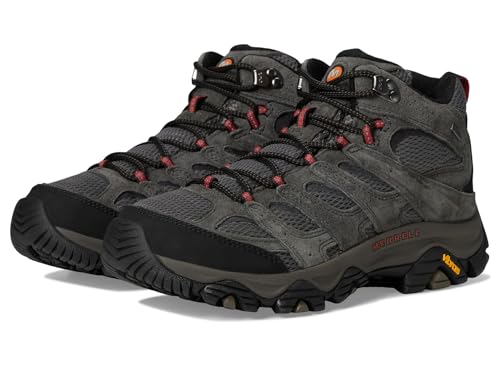
The Merrell Moab has been the most consistently recommended recreational hiking boot for over a decade, and the Moab 3 Mid GTX maintains that position for a straightforward reason: it does everything a day hiker needs, it does it reliably, it fits the widest range of feet, and it is priced accessibly enough that replacing it at 500 miles doesn’t require deliberation. The “Moab” acronym — Mother of All Boots — is the product of genuine performance rather than marketing, and the third generation refines the construction without altering what made the original so broadly effective.

The Moab 3 Mid GTX uses a split-grain leather and mesh upper that balances durability with breathability — the leather sections handle rock and brush abrasion well, and the mesh panels keep weight down and improve ventilation in warm conditions. The Gore-Tex lining provides waterproofing throughout. Merrell’s Kinetic Fit insole and M-Select GRIP outsole handle moderate trail terrain adequately on most surfaces. The EVA midsole provides cushioning for day hikes at recreational pace. The boot runs medium-wide in its standard last, which suits the majority of men’s feet without requiring a wide variant — this broad fit accommodation is part of why it has been recommended so consistently across so many buyer demographics.

The honest limitations of the Moab 3 Mid GTX are important: it is not a Category 3 boot and it should not be used as one. The split-grain upper is adequate for trail use but will not survive heavy off-trail use in rock and scrub the way full-grain leather does. The outsole performs well on moderate terrain but is not in the same class as a Vibram Megagrip or Contagrip MA compound on technical wet rock. For day hiking on maintained to moderately technical trails — which describes the vast majority of recreational hiking in the US and Europe — it is a genuinely excellent, broadly accessible boot. For serious backpacking, look at the Lowa Renegade or Salomon Quest instead.
Specs: Category 2 | Upper: Split-grain leather + mesh | Midsole: EVA | Outsole: M-Select GRIP | Drop: 12mm | Weight: ~2 lb 2 oz (pair) | Waterproof: Gore-Tex | Width: Standard + Wide available | Shank: Half
✅ Best for: Day hiking on maintained to moderately technical trails; recreational hikers who want a proven, versatile, widely-fitting boot; first hiking boot purchase; men who hike several times per month at accessible difficulty.
⚠️ Not ideal for: Heavy backpacking loads over 35 lbs; serious off-trail use through rock and scrub where full-grain leather durability matters; technical wet rock where Vibram or Contagrip outsoles outperform M-Select GRIP.
Pros: The most broadly recommended hiking boot across all experience levels for good reason; medium-wide fit suits most feet without size adjustment; Gore-Tex waterproofing; accessible price; reliable track record across millions of miles of use.
Cons: Split-grain upper less durable than full-grain for serious use; outsole not as grippy as Vibram or Contagrip alternatives on technical terrain; not suitable as a load-carrier for heavy backpacking.
3. Lowa Renegade GTX Mid — Best Premium Boot and Best for Backpacking
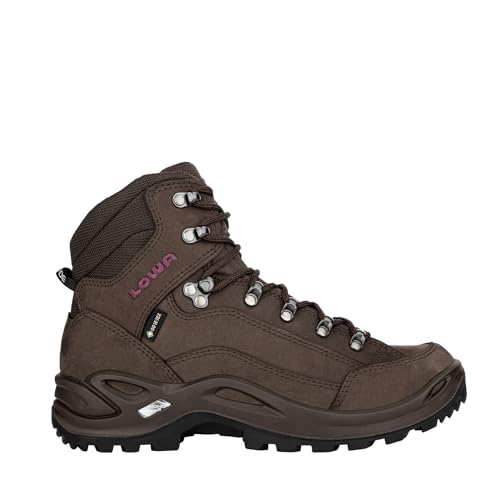
The Lowa Renegade GTX Mid is the boot that experienced hikers and backpacking guides recommend when someone asks for the best hiking boot without qualification. It has been in production in substantially the same form for decades because it has never needed a fundamental redesign — the combination of nubuck leather upper, PU midsole, Gore-Tex lining, and Vibram outsole delivers Category 3 performance and durability that justifies its premium price over years rather than months. This is the investment hiking boot: the one you buy once and wear for a decade with proper care.
The critical technical differentiator is the PU midsole. As detailed in the midsole guide above, PU (polyurethane) maintains its cushioning properties through significantly more compression cycles than EVA — the midsole in a well-cared-for Lowa Renegade after 1,000 miles is performing closer to new-boot spec than an EVA midsole at the same mileage. Combined with the nubuck leather upper that develops character and moulds to the foot over hundreds of miles, the Renegade is a boot that improves with use rather than simply wearing out. The Vibram outsole handles technical terrain, wet rock, and off-trail surfaces with the confidence that the premium rubber compound provides. The high ankle collar with angled cuff provides the lateral stability and ankle support that Category 3 hiking requires.

The honest caveats are two. First, the break-in period is real — plan for 40 to 60 miles of graduated hiking before the leather fully moulds and the PU midsole reaches optimal performance. Do not attempt your first significant mountain hike in new Renegades. Second, the price is a genuine barrier: at $230 to $260, this is an investment that makes sense for men who hike regularly in serious terrain and will use the boots long enough to amortise the cost. For casual hikers doing two or three day hikes per year, the Merrell Moab 3 or Salomon X Ultra 5 are more appropriate investments. For men who backpack regularly and need a boot that will outlast multiple pairs of cheaper alternatives, the Renegade’s total cost of ownership is competitive. Lowa also offers this boot in narrow, regular, and wide widths — one of the few premium hiking boots with genuine width options.
Specs: Category 3 | Upper: Nubuck leather | Midsole: PU (polyurethane) | Outsole: Vibram | Drop: ~10mm | Weight: ~2 lb 10 oz (pair) | Waterproof: Gore-Tex | Width: Narrow / Regular / Wide | Shank: Full-length
✅ Best for: Serious backpacking with 35–50+ lb loads; men who hike frequently in demanding terrain; investment purchase for multi-year use; heavy hikers who need PU midsole durability; anyone who wants the definitive traditional leather hiking boot.
⚠️ Not ideal for: Casual hikers who don’t hike enough to justify the price; men unwilling to commit to a 40–60 mile break-in period; hot-weather hiking where the full-grain leather and Gore-Tex restrict breathability more than lighter alternatives.
Pros: PU midsole maintains cushioning for 1,500+ miles; nubuck leather durability outlasts synthetic alternatives by 2–3x; Vibram outsole is the benchmark for technical terrain; genuine width options (narrow/regular/wide); the boot that experienced hikers recommend when asked for the best.
Cons: Premium price requires significant hiking frequency to justify; long break-in period; heavier than Category 2 alternatives for day hiking; less breathable than synthetic boots in warm conditions.
4. Salomon Quest 4 GTX — Best for Heavy Backpacking Loads

Where the Salomon X Ultra 5 Mid GTX is the right boot for most hikers, the Quest 4 GTX is the right boot for a specific and demanding subset: men carrying heavy loads over multi-day routes in serious terrain. Salomon’s Advanced Chassis technology reaches its fullest expression in the Quest — a structural support system that extends through the boot’s midsole and provides a level of torsional rigidity and load distribution that lighter boots cannot match when the pack weight climbs above 40 pounds.

The Quest 4’s construction is noticeably stiffer than the X Ultra 5 — apply the bending test described in the shank section and you will feel the difference immediately. This stiffness is not a comfort compromise; at 40+ pound pack weights, a stiffer boot reduces the muscular fatigue of each step by providing a more stable platform, reduces ankle fatigue on technical terrain by resisting lateral torsion, and provides the edge support needed on steep loose ground where a flexible boot would allow the arch to collapse. The synthetic-leather hybrid upper provides adequate durability for the mountain terrain this boot is designed for. Gore-Tex waterproofing is appropriate for the multi-day cold-weather use where this boot excels.

The Quest 4 is heavy — approximately 2 lb 10 oz per pair — and that weight is overkill for light day hiking. Men who buy this boot for casual trail use will find it clunky and fatiguing on easy terrain where the structural stiffness provides no advantage. This is a specialist tool: correct and excellent for its intended use case, wrong for applications outside it. For the serious backpacker, it is one of the best boots available in its category. For the Salomon fan who wants to upgrade from the X Ultra 5 for more demanding use, the Quest 4 is the natural progression.
Specs: Category 3 | Upper: Synthetic + leather reinforcement | Midsole: EVA + Advanced Chassis | Outsole: Contagrip | Drop: ~12mm | Weight: ~2 lb 10 oz (pair) | Waterproof: Gore-Tex | Width: Standard | Shank: Full Advanced Chassis
✅ Best for: Multi-day backpacking with 40–50+ lb loads; technical mountain terrain; serious off-trail travel; men who need maximum structural support for heavy use.
⚠️ Not ideal for: Day hiking with light or no pack — weight and stiffness become a liability on easy terrain; wide feet — standard last only.
Pros: Advanced Chassis provides the best load-carrying structural support in Salomon’s trail range; Contagrip outsole handles mountain terrain; Gore-Tex for serious multi-day weather exposure; built for sustained demanding use.
Cons: Heavy for day hiking; standard last only — wide-footed men have limited options; stiffer than necessary for moderate use; premium price.
5. HOKA Anacapa Mid GTX Wide — Best for Cushioning, Joint Pain, and Heavier Hikers
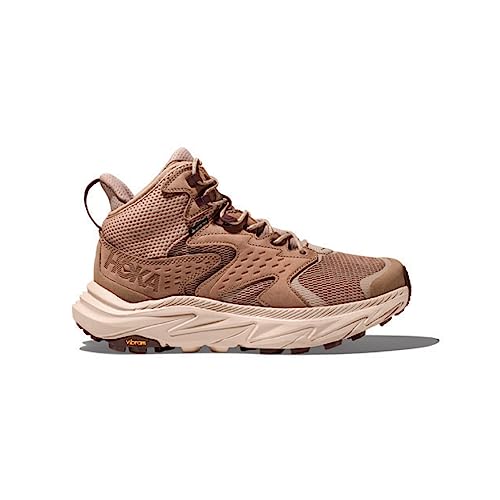
HOKA built its reputation in trail running on the proposition that maximum cushion and meta-rocker geometry help runners sustain performance over long distances. The Anacapa Mid GTX applies that same philosophy to hiking, and it produces a boot that is genuinely distinctive on the market: more cushioned than any comparable hiking boot, with the characteristic rolling forward feel that reduces the muscular work of each step and specifically reduces the eccentric loading on the knee during descents. For men with knee pain, joint issues, or heavier builds who have found conventional hiking boots increasingly uncomfortable over long days, the Anacapa is the first boot worth trying.
The nubuck leather upper provides adequate durability for trail use. The Gore-Tex lining handles wet conditions. The HOKA midsole — substantially thicker and more cushioned than the competition — is where this boot’s character lies. The meta-rocker geometry creates the rolling stride that HOKA’s running shoes are known for, in a hiking boot context: the boot moves the foot forward through the stride with less plantar flexion work, reducing the Achilles and calf demand that conventional boots create on long ascents. For men with plantar fasciitis, Achilles tendinitis, or general posterior chain stiffness, this is a meaningful functional advantage. The wide variant specifically accommodates men who have been frustrated by standard hiking boot widths — HOKA’s wide last provides genuine forefoot room that addresses the toe compression that causes many fit failures in other brands.
The technical limitations are real and worth stating. The high foam stack that provides the cushioning advantage also raises the centre of gravity, reducing stability on very technical narrow-ridge terrain compared to lower-stack alternatives. The meta-rocker geometry that assists on runnable terrain becomes less predictable on very uneven surfaces where every step lands at a different angle. For most recreational hiking on maintained to moderately technical trails, these limitations are immaterial. For serious technical mountain terrain with scrambling and narrow footing, a more rigid, lower-stack option like the Salomon Quest 4 or Lowa Renegade is more appropriate.
Specs: Category 2–3 | Upper: Nubuck leather | Midsole: EVA (max-cushion + meta-rocker) | Outsole: Vibram | Drop: ~5mm | Weight: ~2 lb 6 oz (pair) | Waterproof: Gore-Tex | Width: Standard + Wide | Shank: Partial with rocker geometry
✅ Best for: Men with knee pain, joint issues, or plantar fasciitis; heavier hikers (over 200 lbs) who need maximum impact absorption; wide-footed men; long-distance day hiking where fatigue management is the priority; men transitioning from HOKA road shoes to trail.
⚠️ Not ideal for: Very technical rocky terrain where low-stack precision is preferred; narrow-footed men for whom the wide last allows too much lateral movement; heavy load carrying where chassis rigidity matters over cushioning.
Pros: Best-in-class cushioning for men with joint pain; meta-rocker reduces knee and Achilles load on long descents; wide fit accommodates high-volume feet; Vibram outsole; genuine HOKA comfort advantage for long hiking days.
Cons: High stack reduces stability on technical terrain; meta-rocker geometry requires brief adaptation; heavier than lightweight alternatives; Gore-Tex breathability limitation in warm conditions.
6. KEEN Targhee IV Mid WP — Best Wide Toe Box

KEEN’s ESS Shank and their characteristic wide, rounded toe box have made the Targhee line the default recommendation for men with wide feet for years. The Targhee IV Mid WP continues this tradition with a fourth-generation design that refines fit and outsole performance while maintaining the spacious forefoot that has made it the most consistently recommended boot for men who cannot comfortably fit standard-last hiking boots. The toe box width is genuine — this is not “marketed as wide” with marginal differences from standard; the KEEN forefoot is visibly and measurably wider than most competitors.

The Targhee IV’s nubuck leather and mesh upper handles light to moderate trail use well. KEEN.DRY waterproofing — KEEN’s proprietary membrane — provides waterproof protection adequate for wet trail use; it is comparable to Gore-Tex in practical hiking conditions though not identical in breathability testing. The KEEN All-Terrain rubber outsole with multi-directional lugs handles hard-pack, mixed terrain, and light technical ground. The EVA midsole provides adequate day-hiking cushioning. The ESS Shank (Exoskeleton Support System) provides midfoot torsional stability that keeps the boot stable on uneven surfaces without the full rigidity of a Category 3 construction.

The wide toe box advantage extends beyond comfort: on long descents, a toe box that allows natural foot splay prevents the forward compression that causes toenail damage and descent blisters. Men who have repeatedly lost toenails in other hiking boots often find the Targhee resolves the problem not through sizing up but through the genuine width accommodation. For men with bunions alongside their wide foot requirement, the KEEN Targhee IV is the most natural fit in this price range. The standard-width Targhee IV is available for men with normal-width feet who want the KEEN construction without the extra width.
Specs: Category 2 | Upper: Nubuck leather + mesh | Midsole: EVA | Outsole: KEEN All-Terrain rubber | Drop: ~5mm (KEEN traditional low drop) | Weight: ~2 lb 4 oz (pair) | Waterproof: KEEN.DRY | Width: Standard + Wide | Shank: ESS Shank
✅ Best for: Men with wide feet; bunion sufferers; men who lose toenails on descents in other boots; KEEN brand preference; day hiking on moderate terrain.
⚠️ Not ideal for: Very technical or off-trail terrain where the Targhee’s outsole is outperformed by Vibram or Contagrip alternatives; heavy backpacking loads where Category 3 stiffness is required.
Pros: Genuinely wide toe box — the benchmark for wide-footed men; KEEN.DRY waterproofing comparable to Gore-Tex for most conditions; low drop suits natural foot strike; durable nubuck leather; available in wide width.
Cons: Outsole less grippy than Vibram or Contagrip on technical wet rock; not suitable as a heavy load carrier; KEEN.DRY slightly less breathable than Gore-Tex in some testing.
7. La Sportiva Ultra Raptor 3 Mid GTX — Best Technical Fast-Hiker
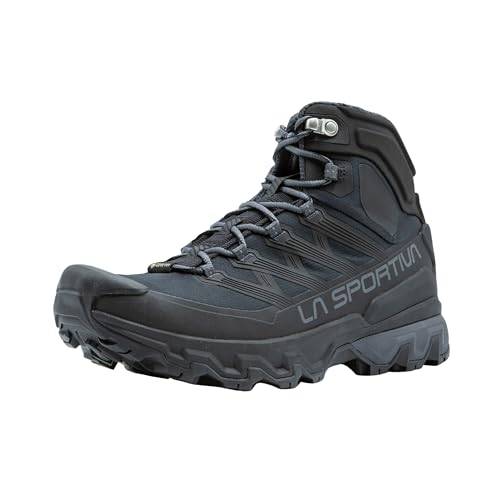
La Sportiva is an Italian mountain boot company with a heritage in technical alpine footwear that spans nearly a century, and the Ultra Raptor 3 Mid GTX represents their most accessible crossover point between trail running performance and hiking boot protection. This is the correct boot for men who move fast on technical terrain — who trail run on easier sections, hike the technical parts, and need a boot that handles both without compromise. At just under 2 pounds per pair, it is one of the lightest boots on this list with genuine ankle coverage and protection.
The technical credentials are substantial. The FriXion XF 2.0 rubber outsole is La Sportiva’s proprietary high-friction compound — exceptionally grippy on dry and wet rock, competitive with Vibram Megagrip on technical surfaces, and notably better than standard rubber compounds on the type of steep rocky terrain that Italian mountain shoes are specifically designed for. The Gore-Tex lining provides waterproofing. The Trail Rocker geometry creates a natural forward-rolling gait that suits fast hiking and running sections. The mid-height collar provides ankle support appropriate for technical terrain at speed. This is the boot that mountain guides and serious technical hikers reach for when they want protection without the penalty of a heavy Category 3 construction.
The limitation is fit: La Sportiva boots run narrow and are built on a performance-specific last that suits narrow-to-medium feet with low-to-medium volume. Men with wide feet or high insteps will find La Sportiva’s standard construction restrictive. This is not a boot to buy without trying or testing during a return window — the narrow last that provides the precision feel on technical terrain is the same last that creates problems for high-volume feet. If the fit works for you, the Ultra Raptor 3 Mid GTX is one of the finest fast-hiking boots available. If it doesn’t, the Salomon X Ultra 5 Mid GTX is the closest equivalent with a more accommodating last.
Specs: Category 1–2 | Upper: Synthetic mesh | Midsole: EVA + Trail Rocker | Outsole: FriXion XF 2.0 | Drop: ~6mm | Weight: ~1 lb 14 oz (pair) | Waterproof: Gore-Tex | Width: Standard (narrow-medium last) | Shank: Partial
✅ Best for: Technical mountain terrain at fast pace; men who trail run and fast-hike on the same outing; narrow to medium feet; anyone prioritising technical rock grip and light weight together.
⚠️ Not ideal for: Wide feet or high insteps — the narrow La Sportiva last is a real limitation; heavy backpacking loads where more rigid Category 3 construction is required; budget-conscious buyers.
Pros: FriXion XF 2.0 outsole is exceptional on technical rock — among the best grip available in this weight class; lighter than most mid-height hiking boots with similar protection; Italian mountain heritage in the construction; Gore-Tex; fast-hiker versatility.
Cons: Narrow last excludes wide-footed and high-instep men; premium price; not suitable for heavy loads; verify fit carefully before committing.
8. Danner Trail 2650 Mid GTX — Best Leather Day Hiker

Danner is an American boot manufacturer based in Portland, Oregon, and the Trail 2650 Mid GTX is their most successful attempt to bring full-grain leather durability to a trail running-influenced lightweight construction. The result is a boot that looks and functions like a traditional leather hiking boot while weighing closer to a synthetic trail shoe — approximately 2 pounds per pair, which is remarkable for a full-grain leather construction. For men who want the durability and character of leather in a day hiking context without the Category 3 weight and break-in period of the Lowa Renegade, the Trail 2650 Mid GTX is the natural answer.

The full-grain leather upper is Danner’s Chromexcel leather — a full-grain hide treated during the tanning process that results in a leather that is naturally more supple and requires less break-in than standard full-grain leather, while retaining the durability advantages of the material. The result is a leather boot that is wearable earlier than the Lowa Renegade and still dramatically more durable than the split-grain alternatives. The Gore-Tex lining provides waterproofing. The Vibram Fuga outsole handles day hiking terrain well — it is not the most aggressive trail outsole available but handles the surfaces a day hiker encounters consistently. The EVA midsole cushions adequately for the Category 1–2 application this boot is designed for.

The Trail 2650 Mid GTX sits at a particularly useful market position: it is more durable than synthetic hiking boots, more stylish and wearable off-trail than traditional leather work-style hiking boots, and lighter than Category 3 leather boots by a significant margin. Men who want to invest in a leather hiking boot without committing to the full Lowa Renegade premium, or who want a leather hiking boot that doesn’t feel like a tactical piece of equipment in town, will find the Trail 2650 Mid GTX occupies exactly that space.
Specs: Category 1–2 | Upper: Full-grain Chromexcel leather | Midsole: EVA | Outsole: Vibram Fuga | Drop: ~5mm | Weight: ~2 lb 0 oz (pair) | Waterproof: Gore-Tex | Width: Standard | Shank: Partial
✅ Best for: Men who want leather durability at lighter-than-typical leather weight; day hiking and moderate trail use; men who want a hiking boot that looks good off the trail too; leather enthusiasts who don’t need a full Category 3 boot.
⚠️ Not ideal for: Heavy backpacking loads (Category 1–2 construction only); wide feet — standard last only; very technical terrain where more aggressive outsoles outperform the Vibram Fuga.
Pros: Full-grain Chromexcel leather provides durability significantly exceeding synthetic alternatives; lighter than traditional leather hiking boots; Gore-Tex waterproofing; Vibram outsole; Danner build quality and heritage; wearable off-trail.
Cons: Standard width only; Category 1–2 stiffness limits load-carrying; Vibram Fuga not as aggressive as Contagrip or Megagrip on technical terrain; premium price for day hiking use.
9. Salomon X Ultra 360 Mid GTX — Best for Technical Terrain and Ankle Stability

The X Ultra 360 Mid GTX is the current evolution of the X Ultra line, with the “360” designation referring to an updated chassis system that provides structural support around the full circumference of the foot rather than just through the midfoot. For men who need more ankle stability than the standard X Ultra 5 provides — those with a history of ankle sprains, those who hike regularly on loose and rocky terrain, or those carrying moderate loads over technical ground — the 360 is the natural upgrade path within the Salomon range.
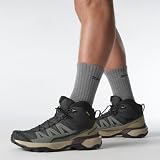
The structural difference is palpable when you apply the bending test: the X Ultra 360 resists torsional twist more firmly than the X Ultra 5, reflecting the more comprehensive chassis construction. The updated Contagrip MA outsole provides reliable grip across mixed trail surfaces. The Gore-Tex lining and Matryx upper follow the same construction approach as the X Ultra 5. The principal advantage is the structural 360° support that makes this boot more appropriate for the men who use it on demanding terrain where ankle security is not optional. It is heavier than the X Ultra 5 as a consequence of the more comprehensive chassis — the stiffness comes at a weight cost that day hikers on easy terrain will find unnecessary.

This is also the pick within this list for men who have had ankle sprains and are returning to hiking. The structural support provided by the 360° chassis directly reduces the inversion and eversion movement that causes ankle sprains on uneven ground — the same mechanism as the medical advice to wear supportive footwear after ankle injury. It is not a substitute for ankle rehabilitation, but it is the correct boot to wear during the return to full hiking activity on technical terrain.
Specs: Category 2 | Upper: Matryx synthetic | Midsole: EVA + 360° Chassis | Outsole: Contagrip MA | Drop: ~11mm | Weight: ~2 lb 2 oz (pair) | Waterproof: Gore-Tex | Width: Standard | Shank: Full with 360° Chassis
✅ Best for: Men with ankle instability history; technical rocky terrain with loose footing; moderate backpacking on demanding ground; Salomon users wanting more structure than the X Ultra 5 provides.
⚠️ Not ideal for: Easy day hiking where the extra structure and weight add nothing; wide feet — standard last only; men who prefer ground feel over structural support.
Pros: 360° chassis provides comprehensive ankle support; Contagrip MA outsole; Matryx upper durability; Gore-Tex waterproofing; direct upgrade path from X Ultra 5 for structural support needs.
Cons: Heavier than X Ultra 5; standard width only; structural stiffness is unnecessary on easy terrain; premium over X Ultra 5 for the chassis upgrade.
10. Altra Lone Peak 9 WP Mid — Best Zero-Drop and Natural Movement

Altra occupies a specific and growing niche in the hiking footwear market: the zero-drop, wide toe box philosophy that prioritises natural foot position and movement over the elevated-heel platform that conventional hiking boots use. The Lone Peak 9 WP Mid brings this philosophy to a waterproof mid-height construction that provides genuine ankle coverage and protection alongside Altra’s FootShape toe box — the widest standard toe box available in any mainstream hiking boot brand.

Zero-drop means the heel and forefoot sit at exactly the same height — no platform elevation. For men whose feet, calves, and Achilles tendons have adapted to zero-drop or minimal footwear, this is the natural choice. For men transitioning from conventional hiking boots with 8 to 12mm heel drops, the same transition protocol described in the trail running guide applies: match your current drop first, then gradually decrease. Suddenly switching to zero-drop hiking from 10mm-drop boots creates Achilles and calf strain from the sudden change in loading. The transition must be gradual — several months of increasing zero-drop exposure rather than an immediate full switch.

For men who are already zero-drop adapted, or who have wide feet that conventional toe boxes compress regardless of size, the Lone Peak 9 WP Mid is one of the best hiking boots available in its specific category. The FootShape toe box allows natural toe splay on every step and on descents, eliminating the toenail and blister issues that narrow toe boxes create. The waterproof construction handles wet conditions. The outsole provides adequate grip for maintained trail use. This is a Category 1 fast-and-light construction rather than a Category 2 midweight — appropriate for day hiking and light loads, not for 40-pound backpacking.
Specs: Category 1 | Upper: Synthetic mesh | Midsole: EVA (zero drop) | Outsole: MaxTrac rubber | Drop: 0mm | Weight: ~1 lb 12 oz (pair) | Waterproof: Yes | Width: Standard with FootShape (wide toe box) | Shank: Minimal
✅ Best for: Men already adapted to zero-drop footwear; wide feet needing maximum toe box room; fast and light day hiking on maintained trails; natural movement advocates.
⚠️ Not ideal for: Men transitioning directly from conventional hiking boots — requires a gradual adaptation period; heavy backpacking loads; technical terrain where sole stiffness provides edge support.
Pros: FootShape toe box is the widest standard construction available; zero-drop for natural foot alignment; lightweight; waterproof; removes toenail damage risk for appropriately adapted wearers.
Cons: Zero-drop requires Achilles and calf adaptation — not for immediate transition; minimal shank limits load-carrying; outsole less aggressive than technical alternatives.
11. Merrell Moab 3 Mid Wide — Best Budget Boot for Wide Feet

Wide-footed men have historically faced a frustrating choice: accept the discomfort of standard-width hiking boots, or pay a premium for specialist wide-fit options. The Merrell Moab 3 Mid Wide resolves this at the most accessible price point on this list — under $145 in most configurations — by offering the broad construction that wide feet require in the proven Moab 3 chassis that has been field-tested across millions of miles of hiking. This is the budget wide-fit answer that needs no qualification: it works, it fits wide feet, and it costs less than any comparable alternative.

The construction mirrors the standard Moab 3 Mid reviewed above: split-grain leather and mesh upper, EVA midsole, M-Select GRIP outsole, waterproof construction. The wide last extends through the forefoot and toe box, providing the additional width that prevents the side-of-foot blisters and fifth metatarsal pressure that standard-width boots create for wide-footed men. The limitations are the same as the standard Moab 3: adequate for day hiking and moderate trails, not suitable for heavy backpacking loads or serious off-trail use. At this price point and for its intended use case, the Moab 3 Mid Wide is the obvious first recommendation for wide-footed men on any budget.

✅ Best for: Wide-footed men on a budget; day hiking on maintained trails; men who have struggled to find comfortable standard-width hiking boots; first hiking boot purchase for wide feet.
Pros: Best value wide-fit hiking boot available; proven Moab construction with wide last; adequate for day hiking use; accessible price for budget-conscious buyers.
Cons: Not suitable for heavy loads; split-grain upper less durable than leather alternatives for serious use.
12. Columbia Newton Ridge Wide — Best Budget Entry Hiking Boot

The Columbia Newton Ridge Wide is the recommendation for men who want to start hiking without spending over $100 on footwear. Columbia’s brand recognition, wide last construction, and adequate waterproofing make the Newton Ridge the accessible entry point that introduces hiking boot fit and function without a significant financial commitment. This is not the boot for demanding terrain or heavy loads — it is the boot for men who want to hike well-maintained trails on weekends and need a reliable, correctly-fitted, waterproof option at the lowest available price point.
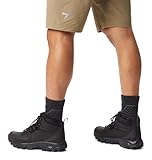
The synthetic upper handles light to moderate trail use. Columbia’s own waterproof construction provides basic protection in wet conditions. The EVA midsole cushions day hiking adequately. The wide last makes this boot a credible option for men with wide feet who want to enter the activity at minimal cost before investing in a premium wide-fit option. The expected lifespan is at the lower end of the range — 300 to 500 miles for typical use — which is appropriate for the price: a boot that provides two to three years of recreational use at this cost represents good value even accounting for its eventual replacement.

✅ Best for: Budget-conscious first-time hikers; men who hike infrequently on easy terrain; those testing whether hiking is worth investing in before buying a premium boot.
Pros: Lowest price point on this list; wide construction for budget-level wide-foot accommodation; adequate for easy to moderate maintained trails; accessible entry to hiking boot category.
Cons: Shortest expected lifespan on this list; not suitable for technical terrain, heavy loads, or serious use; basic outsole grip.
The Boot Break-In Protocol — Category by Category
Every hiking boot requires some break-in time. The amount varies dramatically by boot category and construction, and the protocol for each is different. The one universal rule: never attempt your first significant hike — something remote, long, or technically demanding — in new boots. Every year men end up with serious blisters and ruined trips because they wore new boots on a long challenging hike rather than building up gradually.
Category 1 — Fast and light boots: Minimal break-in needed. Synthetic construction and flexible design means the boot adapts quickly. Three to five miles on easy terrain is sufficient to identify any fit problems. The primary purpose of break-in for these boots is not softening materials but confirming the fit — identifying hot spots or pressure points before committing to a longer hike.
Category 2 — Midweight boots: Plan for 15 to 25 miles of graduated hiking. Start with three to five mile day hikes for the first week — enough to identify fit issues and begin compressing the EVA midsole to your natural foot pressure pattern. Build to six to eight miles in the second week. By miles 15 to 25, the midsole has adapted, any leather sections have begun softening, and the boot’s fit has settled to its hiking-use configuration. If hot spots develop during break-in, treat them as lacing problems first — Zone 3 adjustment resolves most instep hot spots, Zone 4 heel-lock resolves most heel hot spots.
Category 3 — Heavyweight and leather boots: Forty to sixty miles minimum, spread over at least four weeks. Full-grain leather needs significant wear time to soften and mould. The PU midsole in boots like the Lowa Renegade requires compression to reach its optimal support configuration. The lacing system needs multiple adjustments across varying conditions to find its optimal tension. Week one: two to three mile hikes with light or no pack. Weeks two and three: four to six miles with increasing gradient. Week four onwards: eight to ten miles with approaching-normal pack weight. Apply leather conditioner after the first five miles and regularly throughout the break-in period to accelerate softening. If the leather is stiff and causing heel friction, concentrate the conditioner at the heel counter and flex the boot manually at the natural bend points each evening.
The Hiking Sock Guide — The Purchase That Determines Blister Rates
No hiking boot guide for men includes a sock guide. This is a serious omission. The sock you wear with a hiking boot affects fit, blister rate, temperature management, and moisture handling — and the wrong sock in a correctly-fitted boot can create the same blisters the wrong boot in a correctly-socketed foot would cause.
Cotton socks are the worst possible hiking sock. Cotton retains moisture — as you sweat, the sock saturates and stays wet. Wet fabric against skin creates the warm, moist friction environment where blisters form fastest. If you currently hike in standard cotton athletic socks and experience blisters, changing to a technical hiking sock will often resolve the problem without any change to the boot.
Merino wool hiking socks — Darn Tough, Smartwool Hike, Icebreaker Hike — are the best all-around choice for most conditions. Merino regulates temperature effectively in both warm and cold conditions, wicks moisture away from the skin faster than cotton, and crucially, remains relatively comfortable and low-friction even when wet. It is also naturally antimicrobial — merino socks worn for multiple days smell significantly better than synthetic alternatives. For medium-weight merino socks, expect approximately 300 to 500 miles before wear-through in the heel and toe areas. Premium brands like Darn Tough offer lifetime guarantees.
Thickness matters for fit. A boot sized with thin road running socks and worn with thick hiking socks will fit differently — the additional sock volume reduces toe clearance and increases forefoot pressure. Always try hiking boots with the socks you intend to hike in. A 2mm difference in sock thickness is enough to change the effective fit of the boot measurably.
For ultra-distance and high-blister-risk hiking: double-layer anti-blister socks (Wrightsock Coolmesh II, WrightSock Trail) move friction between the two sock layers rather than between sock and skin — the primary mechanism of most blister formation is displaced away from the foot entirely. They are worth trying for any man who experiences persistent blisters despite correct boot fit and lacing.
When to Replace Your Hiking Boots — Six Structural Indicators
The standard advice is to replace hiking boots at 500 to 1,000 miles. This is useful as a rough guide but too imprecise for the reasons outlined in the midsole section: trail shoes wear differently from road shoes, EVA compresses at different rates depending on body weight and terrain, and the outsole lug may be the failure point rather than the midsole in some constructions. Here are the six specific indicators that a hiking boot has reached end of functional life.
1. Midsole compression creases. Inspect the midsole from the side. Horizontal wrinkle lines that persist when the boot is not being worn indicate permanent foam compression — the cushioning is below functional level and the impact protection that justifies wearing the boot over a lighter shoe is gone. Replace regardless of how the upper or outsole looks.
2. The thumb press test. Press your thumb firmly into the exposed midsole edge and hold for three seconds. Release. If the indent remains visible for more than three to five seconds, the foam no longer springs back — it has lost its cushioning capacity and the boot has reached end of functional midsole life.
3. Outsole lug depth. Insert a penny into the lug channels. Lincoln’s head should be at least partially covered by the lug edge. If the full head is visible above the lug surface, the lug depth has worn below approximately 2mm — a level at which traction on wet and loose surfaces is significantly reduced. The boot is still usable on hard-pack but has lost the grip that makes it appropriate for the technical terrain it was purchased for.
4. Upper delamination. Inspect the welt — the seam where the upper meets the midsole — by pressing the upper away from the midsole around the full circumference of the boot. Any separation greater than 1 to 2mm indicates structural failure that cannot be reliably repaired. The boot has reached end of structural life.
5. Heel counter collapse. Squeeze the heel counter firmly between thumb and forefinger. A functional heel counter resists this pressure firmly — it is the structural cup that holds the heel in correct alignment. If it flexes or collapses easily, the ankle support that the boot was providing is gone. A collapsed heel counter in a hiking boot is analogous to a worn brake pad — the function it was providing has been lost.
6. Waterproof membrane failure. Water beading on the exterior surface is DWR — reapplicable with Nikwax or similar spray. Water entering the boot interior through the lining — rather than over the ankle collar — indicates Gore-Tex membrane failure. This is typically irreversible: the microscopic structure of the membrane has been compromised by contamination, compression, or age. If waterproofing is required for your hiking conditions, membrane failure means the boot should be replaced.
FAQ: Best Hiking Boots for Men
What are the best hiking boots for men in 2026?
For most men, the Salomon X Ultra 5 Mid GTX is the best all-around choice — lightweight, versatile, waterproof, and capable across most day hiking and moderate backpacking terrain. For serious backpacking, the Lowa Renegade GTX Mid is the most durable and supportive option. For budget-conscious buyers, the Merrell Moab 3 Mid GTX is the most consistently recommended entry-level boot. See the complete picks above for category-specific recommendations.
How should hiking boots fit for men?
A hiking boot should have approximately a thumb’s width of space between the longest toe and the front of the boot when standing. The heel should lift less than one quarter of an inch when walking on a flat surface. There should be no lateral sliding of the foot inside the boot and no sharp pressure on the instep. The boot should feel snug through the midfoot with room for toe splay in the forefoot. Use the four-zone lacing technique described in this guide — particularly the heel-lock in Zone 4 — to secure the heel before concluding a boot fits poorly.
Are waterproof hiking boots worth it for men?
In cold (below 15°C) or wet conditions over extended duration: yes. In warm conditions (above 15°C) in any weather: often no — sweat accumulation inside the waterproof membrane makes feet wetter from inside than rain from outside. For three-season hikers in varied climates, a DWR-maintained non-waterproof boot plus a separate waterproof option is often more versatile than a single Gore-Tex boot. See the waterproof decision table in this guide.
What is the difference between lightweight, midweight, and heavyweight hiking boots?
The three categories differ in shank stiffness, upper material, weight, and appropriate pack weight. Lightweight (Category 1): no shank, flexible, under 1 lb 10 oz, for day hiking with no pack. Midweight (Category 2): half to ¾ shank, split-grain or synthetic upper, 1 lb 10 oz to 2 lb 8 oz, for day hiking and backpacking to 35 lbs. Heavyweight (Category 3): full-length shank, full-grain leather or reinforced synthetic, over 2 lb 8 oz, for multi-day backpacking with 35–50+ lb loads.
How long do men’s hiking boots last?
500 to 1,000 miles is the general guideline, but lifespan varies significantly by upper material and use intensity. Full-grain leather boots with proper care can last 1,500 to 2,000+ miles. Split-grain leather and mesh boots typically last 400 to 700 miles. Synthetic boots last 300 to 600 miles. Use the six replacement indicators described in this guide — particularly the midsole thumb press test — rather than relying solely on mileage.
Should I buy hiking boots or trail runners for day hiking?
For day hiking on well-maintained trails with a light pack (under 20 lbs), trail runners or fast-and-light hiking shoes often work as well as traditional hiking boots while being lighter and requiring no break-in. Hiking boots win when pack weight exceeds 25 to 30 pounds, terrain is technical or off-trail, conditions are cold and wet requiring durable waterproofing, or ankle instability history makes structural support necessary.
What is a hiking boot shank and do I need one?
A shank is a rigid plate embedded between the midsole and outsole that provides longitudinal and torsional stiffness. For day hiking with light or no pack, a shank is optional — flexible Category 1 boots work well on maintained trails. For backpacking with 25+ pound loads or technical terrain where edge support is needed (kicking steps in loose scree, navigating narrow ridges), a shank provides the structural platform that reduces fatigue and prevents ankle rolling under load.
What hiking boots are best for wide feet men?
The KEEN Targhee IV Mid WP has the widest standard toe box of any boot on this list and is the benchmark wide-fit hiking boot for most men. The Merrell Moab 3 Mid Wide is the best budget wide-fit option. The Salomon X Ultra 5 Mid Wide GTX is the performance-focused wide-fit option. HOKA Anacapa Mid GTX Wide suits men who need maximum cushioning alongside width.
How do I break in hiking boots?
Category 1 flexible boots: 3 to 5 miles to confirm fit. Category 2 midweight boots: 15 to 25 miles over two to three weeks of graduated hiking. Category 3 leather boots: 40 to 60 miles minimum over four or more weeks, starting with short hikes and building to full pack weight use. Never attempt a long or remote hike in new boots regardless of how comfortable they feel standing still. For leather boots, apply conditioner before first use and after early hikes to accelerate softening.
What hiking boots are best for men with bad knees?
The HOKA Anacapa Mid GTX Wide is the specific recommendation for men with knee pain. HOKA’s meta-rocker geometry reduces the eccentric quadriceps loading on descents — the movement that generates the most knee pain in hiking — and the maximum-cushion construction reduces the impact transmitted to the knee joint. Additionally, trekking poles are the single most effective knee-pain intervention for hiking, reducing knee joint load by up to 25% on descents regardless of boot choice.