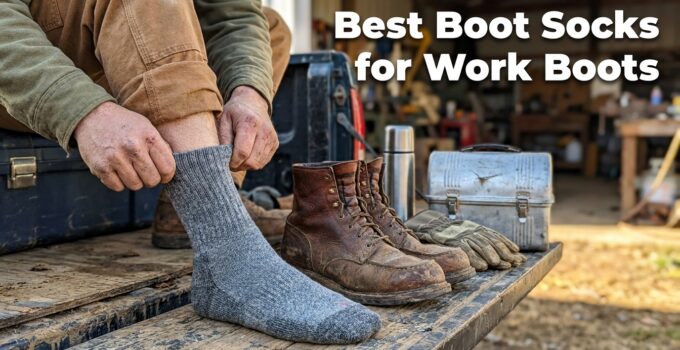
Here is something most workers never hear but should know before their next shift: your socks are causing more of your foot pain than your boots are. The blisters forming on your heel by hour six, the cold feet that arrive by lunch in winter, the swampy heat that makes your boots feel like a punishment by August — these are sock failures, not boot failures. And the reason almost every worker experiences them is that they are wearing the one material that absolutely cannot handle a long work shift: cotton.
Cotton absorbs moisture and holds it against your skin. Merino wool and performance synthetic blends absorb moisture and wick it away. This is not a minor technical distinction — it is the difference between a foot that is damp and cooling itself throughout a shift, and a foot that is soaking in accumulated sweat inside a waterproof boot for eight hours straight. The latter produces blisters, odour, cold feet in winter, and the chronic foot fatigue that workers blame on their boots when the actual culprit is a $3 pack of cotton tube socks.
This guide covers seven work boot socks organised by job type — because the construction worker standing on concrete needs different specifications from the Alaska logger in insulated boots, and both of them need something completely different from the summer warehouse worker in steel-toe sneakers. The cotton question answered, the thickness guide explained, the Darn Tough lifetime guarantee cost maths worked out, and a women’s section for the work boot audience that most sock guides ignore entirely.
⚡ Quick Picks — Best Boot Socks for Work Boots 2026
| Best For | Sock | Material | Cushion | Price |
|---|---|---|---|---|
| Best overall / steel toe boots | Darn Tough Men’s Steely Boot Sock | Merino wool blend | Full cushion toe | ~$25–28 |
| Best concrete standing / heavy cushion | Thorlos Unisex 12-Hour Shift Work Crew | Acrylic/nylon blend | Maximum terry | ~$18–22 |
| Best all-round / most versatile | Darn Tough John Henry Boot Sock | Merino wool blend | Mid + lace guard | ~$25–28 |
| Best budget / multi-pack | Carhartt Men’s Steel Toe Work Sock | Cotton/nylon/poly | Medium cushion | ~$10–14/pair |
| Best hot weather / moisture control | Dickies Dri-Tech Moisture Control Crew | Polyester blend | Light | ~$6–8/pair |
| Best cold weather / outdoor workers | Smartwool Work Heavy Crew Sock | Merino wool blend | Heavy cushion | ~$22–26 |
| Best women’s work boot sock | Darn Tough Women’s Work Boot Sock | Merino wool blend | Full cushion | ~$25–28 |
Table of Contents
- The Cotton Problem: Why Your Socks Are Causing Your Foot Pain
- Merino Wool vs. Synthetic vs. Wool Blend Explained
- Cushion Thickness Guide: How to Match Thickness to Your Job
- Sock Length Guide: Boot Height Matters
- Job-Type Sock Picker
- Best Overall / Steel Toe: Darn Tough Men’s Steely
- Best Concrete Standing: Thorlos 12-Hour Shift Work Crew
- Best All-Round: Darn Tough John Henry Boot Sock
- Best Budget: Carhartt Men’s Steel Toe Work Sock
- Best Hot Weather: Dickies Dri-Tech Moisture Control
- Best Cold / Outdoor: Smartwool Work Heavy Crew
- Best Women’s: Darn Tough Women’s Work Boot Sock
- The Darn Tough Lifetime Guarantee: The Cost Maths Nobody Runs
- Steel Toe Boot Socks: The Pressure Point Problem
- Sock Care: How to Make Expensive Socks Last
- FAQ — 5 Questions Answered
- Final Verdict by Job Type
The Cotton Problem: Why Your Socks Are Causing Your Foot Pain
Cotton is the default sock material because it is cheap, widely available, and familiar. It is also the worst possible choice for a work boot environment. Understanding why requires understanding one basic fact about how cotton behaves in contact with moisture.
Cotton fibres absorb liquid and hold it. When you sweat in a cotton sock, the moisture absorbs into the fibres and stays there, pressed against your skin, for the remainder of your shift. A cotton sock worn in a waterproof work boot for an 8-hour shift becomes, effectively, a wet compress wrapped around your foot from hour two onward. Wet skin blisters at dramatically lower friction thresholds than dry skin — the same rubbing that a dry foot ignores will produce a blister on a macerated, moisture-soaked foot.
The alternative materials work on a completely different principle. Merino wool fibres have a crimped structure that pulls moisture away from the skin surface and distributes it through the fabric, where it evaporates through any available ventilation in the boot. Synthetic blends (polyester, nylon, acrylic) use capillary action to wick moisture away from the skin through the fabric layers. Neither material holds moisture against your skin. Both keep the foot in a drier, lower-friction environment throughout the shift.
⚠️ The Waterproof Boot + Cotton Sock Problem
Waterproof work boots are sealed environments. There is no air circulation, no moisture escape pathway, and no drying mechanism once sweat accumulates. A cotton sock in a waterproof boot is the worst possible combination: the cotton absorbs and holds sweat, the waterproof membrane prevents any evaporation, and the foot spends its entire shift in contact with warm, wet material. If you wear waterproof work boots, switching from cotton to merino wool or synthetic wicking socks is the single most effective improvement you can make to your daily foot comfort.
Merino Wool vs. Synthetic vs. Wool Blend: What the Material Actually Means for Your Feet
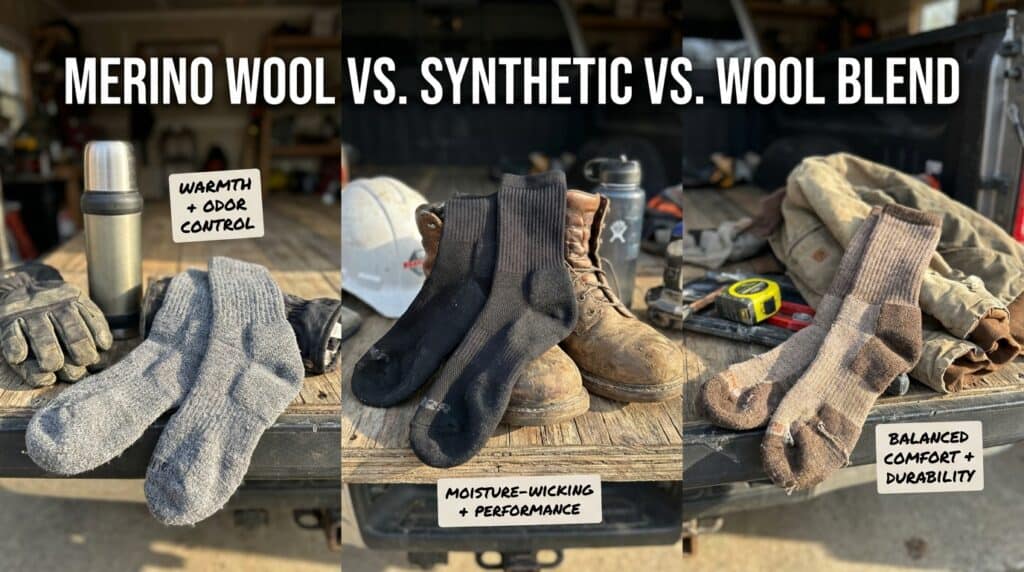
work boot sock comparison materials 202605222135
Once you accept that cotton is the wrong material, the decision between the alternatives depends on your working conditions and priorities.
Merino Wool
The premium option. Merino wool fibres are finer than standard wool — no scratching, no itching. They have a natural crimp structure that wicks moisture efficiently, provide meaningful thermal regulation in both hot and cold conditions (wool insulates even when damp), and are naturally odour-resistant because the wool fibre’s protein structure inhibits bacterial growth. A merino wool sock worn for two consecutive days smells significantly less than a synthetic sock worn for one day. For workers who cannot always change socks mid-shift, merino’s odour resistance is practically important. Darn Tough and Smartwool are the two most respected brands in merino work socks.
Synthetic Blends (Polyester, Nylon, Acrylic)
The performance option at accessible price points. Synthetics wick moisture well, dry fast, and maintain their shape and cushioning over many washes better than wool. They are not as warm as wool in cold conditions and not as odour-resistant. In summer construction and hot-climate work, synthetics frequently outperform wool because they ventilate and dry faster in warm conditions where evaporation is the primary comfort mechanism. Dickies Dri-Tech and Thorlos use high-performance synthetic blends specifically engineered for work environments.
Wool-Synthetic Blend
The pragmatic choice and the most common construction in premium work socks. Merino wool provides the thermal regulation and odour resistance; nylon provides the durability and abrasion resistance; elastane provides the stretch and form-fitting comfort. Most Darn Tough socks are approximately 65–75% merino wool with the balance in nylon and elastane. This blend delivers the merino benefits with the durability that pure wool cannot match in the abrasive environment of a work boot.
| Material | Moisture Wicking | Odour Resistance | Cold Insulation | Durability | Price |
|---|---|---|---|---|---|
| Cotton | ❌ Poor | ❌ Poor | ❌ None when wet | ⚠️ Medium | ✅ Low |
| Merino wool | ✅ Excellent | ✅ Excellent | ✅ Best | ⚠️ Medium | ⚠️ High |
| Synthetic blend | ✅ Very Good | ⚠️ Moderate | ⚠️ Moderate | ✅ Good | ✅ Medium-Low |
| Merino-synthetic blend | ✅ Excellent | ✅ Very Good | ✅ Very Good | ✅ Best | ⚠️ High |
Cushion Thickness Guide: Matching Sock Thickness to Your Job and Boot Fit
Cushioning in work socks is not a comfort luxury — it is a fatigue management system. The terry-loop cushioning underfoot in a quality work boot sock absorbs impact energy that would otherwise transmit to the foot and accumulate across thousands of steps per shift. For workers covering significant daily mileage on hard surfaces, the right cushioning level measurably reduces end-of-day fatigue. The wrong cushioning level causes a different problem: a sock that is too thick for your boot fit compresses your foot against the boot interior, reducing circulation and creating the pressure points that feel like a boot fit problem when it is actually a sock thickness problem.
Light cushion: For work shoes and 6″ boots with a snug fit, or for hot-weather summer work where sock bulk creates heat. Best for workers who have found medium cushion socks make their boots tight.
Medium cushion: The most versatile option — provides meaningful impact absorption without the thickness that affects fit in most standard work boots. Correct for the majority of work boot wearers in 6–8″ boots.
Full / heavy cushion: For workers on concrete for 8+ hours, heavy construction work, and anyone who covers significant mileage on hard surfaces per shift. Also the correct choice for boots with a little extra room — the additional sock volume fills the boot for a more precise fit. For cold-weather workers, heavy cushion plus high merino content is the maximum insulation combination short of a dedicated winter sock.
The Boot Fit + Sock Thickness Rule
Always try work boots on wearing the socks you actually intend to wear at work. A boot that fits with a thin sock will be tight with a heavy cushion sock, reducing circulation and causing the foot pain you bought thick socks to prevent. If you are buying new socks for existing boots: choose the cushion level that maintains the same effective fit as your current socks. If you have room in your boot: step up to fuller cushion to fill the space and improve stability. If your boot fits precisely: stay at the same thickness or go lighter.
Sock Length Guide: Why Sock Height Matters as Much as Boot Height
A sock that is shorter than the boot collar creates a chafing disaster. The boot’s collar, tongue, and lacing hardware rubs directly against bare skin rather than sock-covered skin — producing blisters on the ankle and lower calf that are entirely preventable with the correct sock length.
Ankle / low cut: Only appropriate for low-cut work shoes (under 4″ height) and safety sneakers. Never wear ankle socks in any work boot with a collar above the ankle bone.
Crew length (mid-calf, 6–8″): The minimum for 6″ work boots. The sock should extend above the boot collar by at least 1 inch when the boot is laced. For 8″ work boots, crew length is borderline — a boot height sock is safer.
Boot height (9–12″): The correct choice for 8″ lace-up work boots. Extends well above the collar, covers the lacing hardware, and eliminates all chafing contact points. The Darn Tough John Henry Boot Sock has lace guard cushioning in the leg specifically because Darn Tough understands where work boots produce friction on the sock.
Over-the-calf: For tall pull-on work boots (10–11″ western pull-on, logger boots), for steel-toe wearers who experience sock slippage, and for workers who need maximum compression and support in the lower leg.
Job-Type Sock Picker: Different Jobs Need Different Socks
| Job Type | Primary Need | Best Pick |
|---|---|---|
| Steel toe boot wearer | Cushioned toe box to pad the rigid cap pressure point | Darn Tough Steely — designed specifically for steel-toe boot use |
| Concrete / hard floor standing 8+ hours | Maximum cushion underfoot for impact absorption throughout shift | Thorlos 12-Hour Shift — purpose-built for standing fatigue |
| General construction / mixed terrain | All-day versatility, boot-height coverage, lace guard | Darn Tough John Henry — the most versatile work boot sock |
| Budget-conscious / multi-pack rotation | Good performance without premium price, multiple pairs | Carhartt Steel Toe Work Sock — best budget multi-pack |
| Summer / hot climate / warehouse | Maximum moisture wicking in heat, lightweight feel | Dickies Dri-Tech — best moisture management at budget price |
| Cold weather / outdoor / logger / ranch | Maximum thermal insulation, moisture management in cold | Smartwool Work Heavy Crew — maximum merino warmth |
| Women’s work boot wearers | Women’s-specific sizing and fit, same quality as men’s premium | Darn Tough Women’s Work Boot Sock — women’s last, lifetime guarantee |
Best Overall / Steel Toe: Darn Tough Men’s Steely Boot Sock
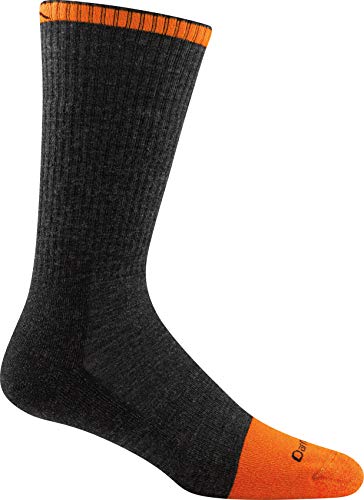
The Darn Tough Steely is the sock that most directly addresses the specific problem that steel toe boot wearers experience — and it was designed with that specific problem in mind. The “Steely” name is not a branding decision; it is a functional specification statement. Steel toe boot caps create a hard, unforgiving contact surface at the toe box that conventional socks do not adequately pad. The Darn Tough Steely provides a full-cushion toe box — additional terry-loop padding specifically in the toe area — that creates a softer interface between the rigid steel cap and the toes. For workers who have experienced toe bruising, nail blackening, and forefoot fatigue in steel-toe boots, the Steely’s cushioned toe box is a specific solution to those specific problems.

The base construction is Darn Tough’s standard: approximately 65% merino wool, 34% nylon, 1% Lycra. The merino wool provides moisture wicking, odour resistance, and thermal regulation. The nylon blend provides the durability that pure merino lacks in the abrasive environment of a work boot — specifically at the heel and ball-of-foot where the most friction occurs. The result is a sock that maintains its cushioning and moisture management properties across hundreds of washes rather than the gradual degradation that cotton and lower-quality synthetic socks show from the first month of use. Made in Vermont. Every Darn Tough sock comes with their lifetime unconditional guarantee — if a pair wears out, they replace it.

The boot height (approximately 9″) is correct for 8″ lace-up work boots — the sock extends above the boot collar, covering all lacing hardware and preventing the chafing that occurs when a sock is too short for the boot height. The graduated compression in the arch provides additional support for workers on their feet for long shifts. Sizing: Darn Tough sizing is based on shoe size ranges — check the size chart before ordering; their sizing does not directly correspond to standard sock sizes. Machine washable; see care section for wool-safe washing guidance.

Work Boot Sock Specs
Material: ~65% merino wool, 34% nylon, 1% Lycra | Height: Boot height (~9″) | Cushion: Full cushion toe box (steel-toe specific)
Guarantee: ✅ Lifetime unconditional | Made in: Vermont, USA
Best for: Steel toe boot wearers · 8″ lace-up work boots · Workers with toe bruising history
Pros: Full-cushion toe box designed specifically for steel-toe boot use; merino wool moisture wicking and odour resistance; lifetime guarantee; made in USA; boot height prevents chafing at collar.
Cons: Premium price per pair (offset by lifetime guarantee — see cost analysis below); sizing based on shoe size range, not standard sock sizes — check chart.
Best Concrete Standing / Heavy Cushion: Thorlos Unisex 12-Hour Shift Work Crew Sock
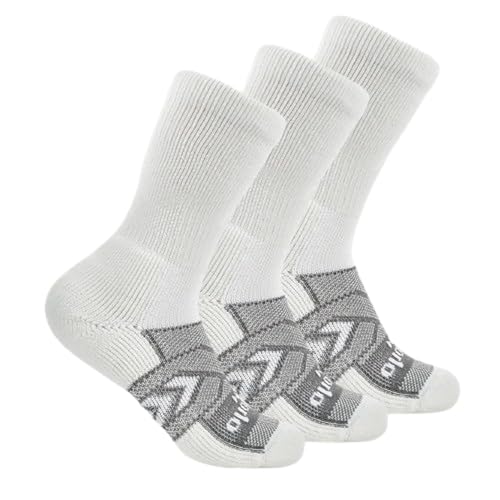
Thorlos has been engineering activity-specific sock cushioning since 1980, and the 12-Hour Shift Work Crew Sock is their response to the specific question: what does a worker need from a sock when they are standing on concrete for 12 hours straight? The answer involves more underfoot cushioning than any other sock in this guide. The thick terry loop construction across the heel and ball-of-foot is Thorlos’ proprietary THORlon fibre — an acrylic-based performance fibre engineered specifically for moisture management and impact absorption. For workers whose primary complaint is foot fatigue from sustained hard-floor standing — manufacturing, assembly, healthcare on hard floors, meat processing, warehouse packing stations — the Thorlos 12-Hour provides the most direct cushion response of any work boot sock available at its price point.

The 12-Hour designation is not marketing; Thorlos designed this sock around the specific physiology of extended shift standing. The cushion distribution is specifically weighted toward the areas that bear load during sustained standing: the heel (primary impact zone during standing), the ball of foot (pressure concentration point), and the arch (support structure under sustained load). The moisture management combines wicking with relatively fast dry time compared to standard terry socks — maintaining a drier foot environment even as sweat accumulates during a long shift. The crew length covers standard 6″ work boots and safety shoes.

The Thorlos 12-Hour does not have the merino wool thermal regulation or odour resistance of the Darn Tough options — the THORlon fibre is performance acrylic rather than wool. For workers in temperature-controlled indoor environments (which describes most of the standing-all-day roles this sock targets), the lack of wool insulation is not a limitation. For outdoor workers in cold conditions, the Smartwool Work Heavy (Pick 06) is the more appropriate choice. The Thorlos’ specific advantage — maximum cushion for sustained standing — makes it the correct choice for workers whose primary foot problem is fatigue from hard floor contact rather than temperature management or steel-toe pressure.

Work Boot Sock Specs
Material: THORlon acrylic/nylon performance blend | Height: Crew | Cushion: Maximum terry (heel + ball + arch)
Designed for: 12-hour sustained standing | Indoor/outdoor: Indoor primarily (no wool insulation)
Best for: Manufacturing · Assembly lines · Warehouse packing · Healthcare on hard floors · Any role with 8+ hours standing on concrete
Pros: Purpose-built for 12-hour standing fatigue; maximum cushion distribution at specific high-load zones; THORlon moisture management; affordable compared to premium merino alternatives.
Cons: No wool — less odour resistance and thermal management than merino options; crew height may be borderline for 8″ work boots — verify length suits your boot height.
Best All-Round / Most Versatile: Darn Tough John Henry Boot Sock
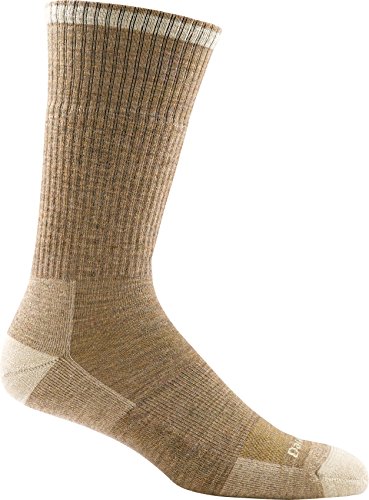
The Darn Tough John Henry is the flagship Darn Tough work boot sock — the model that best represents what the brand’s design philosophy delivers in a single product. Where the Steely is specific to steel-toe use, the John Henry is designed as the most capable all-around work boot sock for the broadest range of trades and conditions. The boot height (approximately 9–10″) with lace guard cushioning in the leg is the specific design choice that makes it the most versatile option: the extended height covers 8″ lace-up work boots fully, and the lace guard padding in the leg section — additional cushioning at the calf where boot hardware contacts the sock — eliminates the pressure point that shorter socks leave exposed when lace hardware contacts bare sock fabric at the collar.

The same merino-nylon-Lycra construction as the Steely provides the wicking, odour resistance, and durability that define Darn Tough’s quality proposition. The cushion level is mid-weight with full cushion in the foot — enough impact absorption for active construction and trades work without the bulk that creates fit issues in precisely-fitted boots. For workers who cannot decide which specific Darn Tough sock to choose, the John Henry is the answer: it covers the most ground, from daily construction to ranch work to manufacturing, without specialising so narrowly that it underperforms in any of those contexts.

As with all Darn Tough socks, the lifetime unconditional guarantee applies: if the sock wears out under normal use, Darn Tough replaces it free. This is not a promotional claim — it is a manufacturing confidence statement. Darn Tough stands behind the John Henry specifically because their Vermont mill knits it at 2,200 revolutions per minute with a tighter-than-standard knit density that they know will outlast the alternatives. The guarantee is the maths in action, not marketing. Sizing: same shoe-size-range based system as all Darn Tough — check the chart.

Work Boot Sock Specs
Material: Merino wool/nylon/Lycra blend | Height: Boot height (~9–10″) | Cushion: Mid with lace guard in leg
Guarantee: ✅ Lifetime unconditional | Made in: Vermont, USA
Best for: General construction · Mixed trades · The most versatile work boot sock in guide — if unsure, choose this one
Pros: Most versatile work boot sock — handles the widest range of trades and conditions; lace guard cushioning in leg for 8″ boot compatibility; lifetime guarantee; merino wool odour and moisture management.
Cons: Premium price (offset by guarantee); not the most specialised for concrete standing (Thorlos) or extreme cold (Smartwool) — choose those picks if your primary need is specifically either of those.
Best Budget / Multi-Pack: Carhartt Men’s Steel Toe Work Sock

Carhartt is a brand that working men trust because it has earned that trust over generations of building gear that actually handles the demands of physical work. The Carhartt Steel Toe Work Sock brings that same no-nonsense approach to the sock category: reinforced toe and heel, moisture control in a cotton/nylon/polyester blend, and the availability in multi-packs that makes daily sock rotation practical for workers who go through socks hard. For the worker who is not ready to invest $25–28 per pair in premium merino socks — or who wants a larger rotation of quality socks for a lower per-pair cost — the Carhartt multi-pack is the honest best answer.

The blend includes cotton — which is the limitation that distinguishes this from the merino options in this guide. However, it also includes nylon and polyester, which provides meaningfully better moisture management than a pure cotton sock. A Carhartt work sock is significantly better than a generic cotton tube sock; it is not as good as Darn Tough or Smartwool for moisture wicking and odour management in a long work shift. The reinforced toe and heel address the specific failure points that work boot wear accelerates — the abrasion between the heel and boot heel counter, and between the toe area and the safety cap. These reinforced zones extend service life compared to standard-construction socks under the same wear conditions.
The honest positioning: the Carhartt Steel Toe Work Sock is the correct choice for workers who rotate through multiple pairs per week — the lower cost per pair makes a daily rotation system financially sustainable where the premium socks would require a higher initial investment for the same number of pairs. Daily rotation (different pair each day, allowing each pair to dry fully between wears) extends sock service life significantly regardless of sock quality — and for workers who want to implement a rotation system without a premium per-pair cost, Carhartt multi-packs are the correct starting point.
Work Boot Sock Specs
Material: Cotton/nylon/polyester blend — reinforced toe and heel | Cushion: Medium | Value: Multi-pack — lowest cost per pair with decent performance
Best for: Budget-conscious workers · Multi-pair rotation system · Daily replacement cycle preference
Pros: Carhartt brand reliability; reinforced toe/heel for work boot abrasion; best budget price per pair; available in multi-packs for daily rotation; better than pure cotton tube socks.
Cons: Cotton content limits moisture wicking vs. merino options — feet will be wetter in long shifts; no lifetime guarantee; service life shorter than premium alternatives under daily heavy use.
Best Hot Weather / Moisture Control: Dickies Dri-Tech Moisture Control Crew Sock
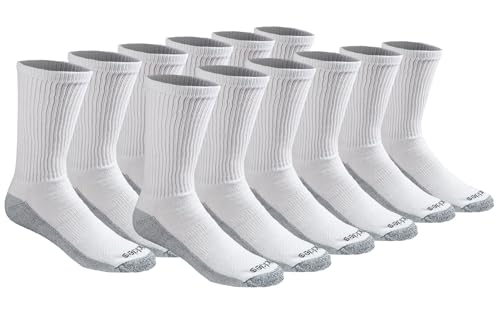
For summer warehouse workers, hot-climate construction crews, and any worker whose primary foot problem is heat rather than cold, the Dickies Dri-Tech delivers the best moisture management at the most accessible price point in this guide. The Dri-Tech’s polyester-dominant construction is specifically optimised for the evaporation-based moisture management that hot conditions demand. In summer heat, synthetic fibres wick sweat to the sock’s outer surface where it can evaporate — and in warm environments with any air circulation, that evaporation happens faster than in cold, sealed boot environments. The result is a noticeably cooler, drier foot throughout the shift compared to cotton socks under the same hot conditions.

The Dri-Tech’s light cushion profile is the correct choice for summer use: heavy cushion creates additional thermal mass that retains heat in already-warm conditions. Light cushion manages the moisture without the insulating bulk. For workers in steel-toe boots in summer heat, the combination of Dri-Tech moisture management and a lighter sock profile keeps feet significantly more comfortable than either a heavy cushion wool sock (too warm) or a cotton sock (too wet). The crew length covers 6″ work boots and standard safety shoes correctly.

The multi-pack availability — large packs of 6 or more pairs — makes the Dri-Tech the most practical choice for workers who want to establish a daily rotation system without significant upfront cost. The per-pair cost at multi-pack pricing is among the lowest in this guide, making it possible to have 7 pairs for a full week’s rotation for the cost of a single pair of premium merino socks. The trade-off versus merino: less odour resistance (synthetics harbour odour bacteria faster than wool), less thermal management in cold conditions, and a shorter service life under heavy abrasion. For hot-climate summer use, these limitations are largely irrelevant.

Work Boot Sock Specs
Material: Polyester performance blend — optimised for evaporation-based wicking | Cushion: Light — correct for summer heat
Price: Lowest per-pair in guide at multi-pack pricing
Best for: Hot climate construction · Summer warehouse · Any hot-weather work boot use · Budget summer rotation
Pros: Best moisture management at budget price; light cushion ideal for summer heat; large multi-packs for rotation system; polyester wicking outperforms cotton significantly in hot conditions.
Cons: No wool — less odour resistance than merino; not for cold conditions; shorter service life than premium alternatives; crew length borderline for 8″ boots.
Best Cold Weather / Outdoor Workers: Smartwool Work Heavy Crew Sock
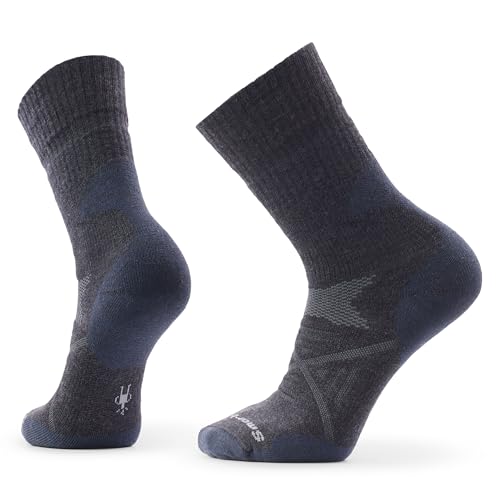
For loggers, ranchers, outdoor construction workers, and anyone whose work boot is their primary cold-weather protection, the Smartwool Work Heavy Crew delivers the maximum thermal management of any sock in this guide. Smartwool’s merino wool specification is high — the Work Heavy Crew is one of their highest-merino-content work socks, providing both the thermal regulation needed for sustained cold-weather outdoor work and the moisture management that keeps feet from getting wet and cold from sweat accumulation. Wool insulates even when damp, which is the critical property that distinguishes it from synthetics in outdoor cold conditions: a wet merino sock maintains insulating capacity, a wet synthetic sock does not.

The heavy cushion underfoot provides both impact absorption for outdoor terrain work and additional thermal mass that helps maintain foot temperature during cold static periods — waiting for equipment, checking fences in winter, standing on frozen ground during outdoor construction. The cushion also adds fit volume, which works well in the slightly-roomier fit that cold-weather work boots typically have to accommodate thick socks — if you already wear your cold-weather work boots with thick socks, the Smartwool Work Heavy will fit correctly without requiring a size adjustment.

The crew height is appropriate for 6–8″ work boots. For taller pull-on western-style farm boots and logger boots, consider a taller over-the-calf option from Smartwool’s lineup. The Smartwool Work Heavy care requirements are the same as all merino wool socks: cool/warm wash, no fabric softener, air dry or tumble dry low. The investment in a quality merino sock pays back over many seasons of use — Smartwool socks are not covered by a Darn Tough-style lifetime guarantee, but their quality construction delivers service lives that substantially outlast cheap wool alternatives.

Work Boot Sock Specs
Material: High merino wool content blend | Cushion: Heavy — maximum insulation and impact absorption
Height: Crew | Thermal: Best cold-weather rating in guide
Best for: Loggers · Ranchers · Outdoor winter construction · Any cold outdoor work where foot warmth is the primary concern
Pros: Maximum thermal protection for cold outdoor work; high merino content insulates even when damp; heavy cushion for terrain impact and cold standing; Smartwool merino quality standard.
Cons: Heavy cushion may make boots tight for workers with precise boot fit; crew height borderline for 8″ boots — may need to go over-the-calf for taller work boots; no lifetime guarantee like Darn Tough.
Best Women’s Work Boot Sock: Darn Tough Women’s Work Boot Sock
Women in work boots are a growing segment of the trades workforce — and a segment that most sock guides either ignore entirely or address with a footnote that says “the men’s sock also comes in smaller sizes.” The Darn Tough Women’s Work Boot Sock is built on a women’s-specific sizing model with the narrower heel cup and proportionally different arch position that women’s feet require. A men’s sock in a women’s size addresses only the length dimension — the heel excess volume creates slippage that accumulates into blisters over a long shift, and the arch support position in a men’s-proportioned sock lands behind most women’s actual arches. The Darn Tough women’s version is built from the correct anatomical starting point.
The same merino-nylon-Lycra construction and lifetime unconditional guarantee as the men’s Darn Tough socks apply to the women’s version. The same moisture wicking, odour resistance, and durability characteristics that make the men’s Steely and John Henry the benchmark in their category apply equally here. For women in steel-toe work boots, composite-toe construction boots, or any lace-up women’s work boot, the Darn Tough Women’s provides the most capable work boot sock available in women’s sizing, backed by the same guarantee that makes the men’s versions the best long-term sock value in the market.
Sizing: Darn Tough women’s socks use women’s shoe size ranges — check their size chart before ordering. The women’s sizing system is genuinely different from the men’s — ordering women’s medium does not mean the same shoe size range as men’s medium in Darn Tough sizing. Multiple colour options available. Machine washable on cool/warm; no fabric softener; air dry or low tumble dry.
Work Boot Sock Specs
Material: Merino wool/nylon/Lycra blend | Sizing: Women’s-specific last — not a men’s sock in smaller sizes
Guarantee: ✅ Lifetime unconditional | Made in: Vermont, USA
Best for: All women in lace-up work boots · The best work boot sock for the female trades workforce
Pros: Women’s-specific last — correct heel, arch, and foot geometry; same Darn Tough quality and lifetime guarantee as men’s line; merino wool moisture wicking and odour resistance; made in USA.
Cons: Premium price per pair (offset by lifetime guarantee); verify women’s size chart before ordering — not interchangeable with men’s sizing.
The Darn Tough Lifetime Guarantee: The Cost Maths Nobody Runs
Every premium sock guide mentions Darn Tough’s lifetime guarantee. Almost none of them actually calculates what it means for your annual sock budget — and the maths is more compelling than the marketing language suggests.
A $25 pair of Darn Tough work boot socks, worn daily for 5 days a week, with a 7-day rotation of pairs, gives each pair approximately 50–60 wears per year. Under normal wear conditions with correct care, Darn Tough socks typically last 3–5 years before showing meaningful wear. If a pair does wear out, you send it back and they send you a new pair. Free. No receipt required. No questions asked.
The comparison: a $3 cotton work sock from a multi-pack typically shows degradation (thinning heel, pilling, loss of cushioning) within 6–8 months of daily work wear. A 6-pack for $18 ($3 each) replaced every 8 months = approximately $27/year for a single pair equivalent. A $25 Darn Tough pair lasting 3 years before any replacement = $8.33/year. If it gets replaced free under the guarantee, that replacement begins a new service life at zero additional cost.
💰 The Annual Cost Comparison
| Sock Type | Cost/pair | Service life | Annual cost |
|---|---|---|---|
| Generic cotton 6-pack | ~$3/pair | 6–8 months | ~$4.50–6/year/pair |
| Carhartt work sock | ~$11/pair | 12–18 months | ~$7–11/year/pair |
| Darn Tough (lifetime guarantee) | ~$25/pair | 3–5+ years (guaranteed) | ~$5–8/year/pair (and falling) |
The upfront price of a Darn Tough pair is real and it is more than the alternatives. But the lifetime cost — especially for workers who wear boots 5 days a week — makes the premium sock the cheaper option over any 2+ year period. This is the maths that most workers have not run when they look at the per-pair sticker price and choose the multi-pack instead.
Steel Toe Boot Socks: The Pressure Point Problem and How the Right Sock Solves It
Steel toe boot caps are rigid — they do not flex with the foot. The interior of the cap is a hard surface that contacts the toes with every step. In the correct boot fit, this contact is minimal. In any fit where the foot is pressing forward — which happens on descents, on ladders, and when boots are slightly too long — the toe cap creates direct pressure on the longest toe and, under sustained contact, produces subungual haematoma (blood pooling under the toenail) and the black toenail that every steel-toe boot wearer has experienced at least once.
The sock’s role in steel-toe boot use: the cushioned toe box of a properly designed steel-toe work sock — specifically the Darn Tough Steely, which was engineered for this context — creates a softer, padded interface between the rigid cap and the toe. This does not eliminate the pressure entirely, but it reduces the contact force per unit area, and it reduces the friction that occurs when the toe repeatedly contacts the cap surface on descents. The combination of full-cushion toe box and moisture-wicking merino construction is the correct sock specification for steel-toe boots specifically because it addresses both the pressure problem and the moisture problem simultaneously.
For composite and alloy toe boots: the same principle applies, though composite cap interiors are typically slightly softer than steel. A cushioned toe box sock remains the correct choice, but the Darn Tough John Henry’s full-cushion foot (without the specifically reinforced toe box) is adequate for composite toe users who don’t experience the same degree of pressure point issues that steel creates.
Sock Care: The Mistakes That Destroy Expensive Work Socks
Turn inside out before washing. The exterior of a work sock accumulates more surface abrasion in the wash drum than the interior. Turning socks inside out before washing reduces pilling on the exterior surface that contacts the boot, maintaining the sock’s cushioning performance longer.
Never use fabric softener. Fabric softener coats wool fibres with a hydrophobic film that directly destroys the moisture-wicking mechanism. A merino wool sock treated with fabric softener loses its wicking ability within a few washes. Use only standard detergent, ideally wool-safe (Woolite, Eucalan), in cool or warm water. Hot water shrinks wool and breaks down elastane — never wash quality work socks in hot.
Air dry or tumble dry low. High heat in a dryer degrades merino wool fibres and shrinks the sock. Air drying is ideal; if machine drying, use the lowest heat setting. A sock air-dried overnight has lost none of its cushioning or fibre integrity; a sock tumble-dried at high heat has.
The Darn Tough guarantee care note: The lifetime guarantee covers wear and tear under normal use — it does not cover care damage. Washing a Darn Tough sock in hot water, using fabric softener, or tumble drying at high heat consistently and then claiming the sock under guarantee is not covered. Following the care instructions protects both the sock’s performance and the guarantee’s validity.
FAQ — 5 Work Boot Sock Questions Answered
What are the best socks to wear with work boots?
Merino wool or synthetic blend crew or boot-height socks with cushioning matched to your job. For steel-toe boots: Darn Tough Steely with full-cushion toe box. For concrete floor standing: Thorlos 12-Hour Shift with maximum terry cushion. For cold weather outdoor work: Smartwool Work Heavy Crew. For hot climate or summer work: Dickies Dri-Tech for moisture management at accessible price. For budget multi-pack rotation: Carhartt Steel Toe Work Sock.
Should I wear thick or thin socks with work boots?
Match thickness to your boot fit. If your boots fit precisely with your current thin socks, medium cushion maintains that fit. If there’s a little extra room in the boot, full cushion fills the boot better and actually improves fit and stability. Never size your boots tightly and then switch to thick socks — compression reduces circulation and accelerates fatigue. The thickness decision should always be made with the boots on, not just based on preference.
Can I wear cotton socks with work boots?
Technically yes. Practically, you are choosing blisters, odour, and cold wet feet by mid-shift. Cotton absorbs sweat and holds it against your skin. Merino wool and quality synthetics wick it away. The one acceptable cotton context: the Carhartt Steel Toe Work Sock’s cotton blend is significantly improved by the nylon and polyester content — it is not a pure cotton sock. For pure cotton tube socks in work boots, the answer is simply: don’t, the performance difference is immediate and significant.
Are Darn Tough socks worth the money?
Yes — with the lifetime guarantee, they are the cheapest quality work sock available over any multi-year period. Run the maths: $25/pair × 3–5+ year service life = $5–8/year. A $10 cotton sock replaced every year = $10/year and worse performance every day. The comfort difference is immediate; the cost advantage builds over time. The only argument against Darn Tough is the upfront price — which the guarantee makes irrelevant over the medium term for anyone who plans to keep working in boots.
What length socks should I wear with work boots?
Boot height (9–12″) for 8″ lace-up work boots — must clear the collar by at least 1″ to prevent hardware chafing on bare skin. Crew length for 6″ work boots and safety shoes. Over-the-calf for tall pull-on and logger boots, and for steel-toe wearers prone to sock slippage. Never wear ankle socks in any boot with a collar above the ankle bone — the collar will blister bare skin within half a shift.
Final Verdict: Best Work Boot Sock by Job Type
Job Type → Best Work Boot Sock
Steel toe boot wearer / general construction: Darn Tough Men’s Steely Boot Sock — full-cushion toe box, merino wicking, lifetime guarantee
Concrete and hard floor standing (manufacturing, healthcare, assembly): Thorlos Unisex 12-Hour Shift Work Crew — purpose-built for standing fatigue, maximum terry cushion
General trades / mixed conditions / “if unsure, choose this”: Darn Tough John Henry Boot Sock — most versatile work boot sock, lace guard, lifetime guarantee
Budget conscious / multi-pack rotation: Carhartt Men’s Steel Toe Work Sock — best budget per-pair with real work boot performance
Summer / hot climate / warehouse: Dickies Dri-Tech Moisture Control Crew — best moisture management at budget summer pricing
Cold weather / outdoor / logger / ranch: Smartwool Work Heavy Crew Sock — maximum merino thermal protection for cold outdoor work
Women’s work boot wearers (all trades): Darn Tough Women’s Work Boot Sock — women’s-specific sizing, same Darn Tough quality and lifetime guarantee
The boot you chose did most of the work. The sock makes the boot work for your feet. Stop wearing cotton in a waterproof boot and you will notice the difference within the first shift. Step up to merino wool and you will wonder why it took you this long. And once you have run the lifetime guarantee cost maths on a pair of Darn Tough, you will not look at the $25 price tag the same way again.