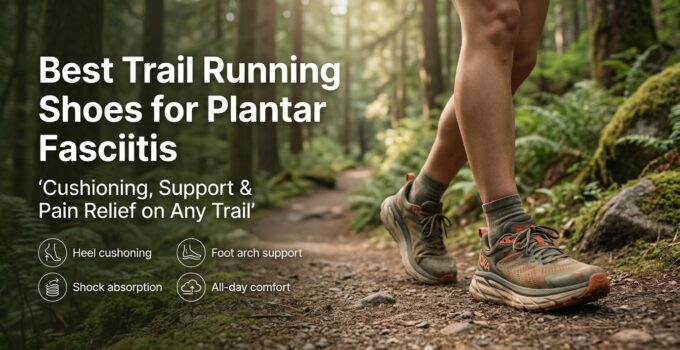
If you have plantar fasciitis and you run trails, you have been given bad advice. Almost every “best running shoes for plantar fasciitis” guide on the internet is written for road running and then quietly includes one or two trail shoes without explaining why trail terrain changes the entire equation.
Trail surfaces do something flat roads cannot: they create lateral load on the plantar fascia with every irregular landing. When you land on a tilted rock, a cambered root, or an angled slope, your foot rolls before it corrects — and the plantar fascia absorbs a torsional force that no flat road ever produces. This means a trail shoe for plantar fasciitis needs torsional rigidity as much as it needs cushioning — and many maximum-cushion trail shoes that look like the obvious choice are actually too soft and too flexible to protect the fascia on uneven terrain.
This guide is trail-specific. Every pick is chosen for its performance on trail surfaces, mapped to the specific type of plantar fasciitis it addresses (because not all PF is the same), and reviewed against the five-feature checklist that every PF trail shoe must pass. It also covers the information every competitor article leaves out: the soft foam trap, the zero drop danger, the rocker geometry science, and — critically — how to keep running trails while you manage the injury, because we know you are not going to stop.
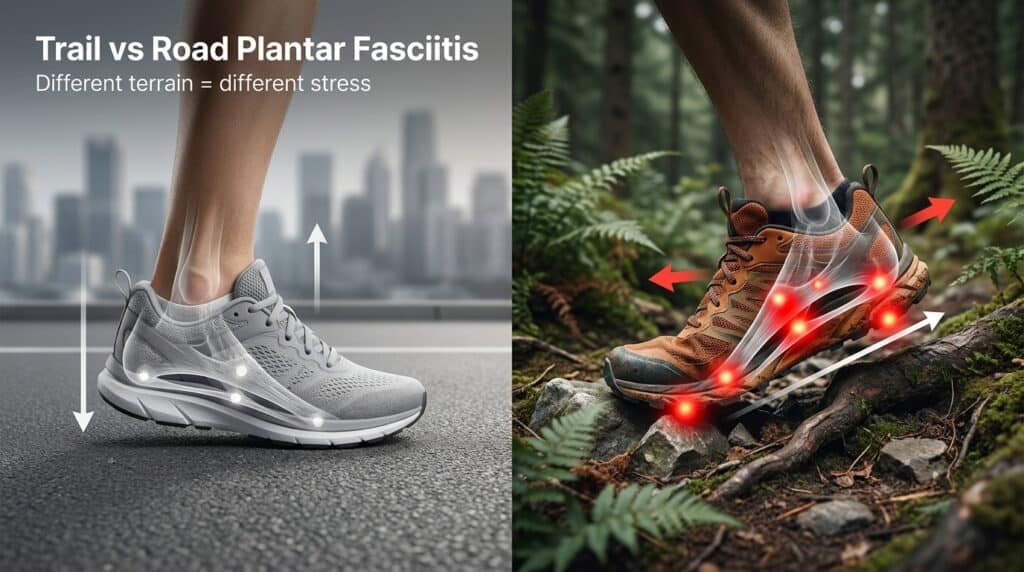
Trail Plantar Fasciitis Is Not the Same as Road Plantar Fasciitis
trail running shoes for plantar 202605032106
Understanding this distinction will save you from buying the wrong shoe — and it is the reason this guide exists separately from a generic PF running shoe roundup.
On flat pavement, your plantar fascia absorbs impact primarily in one plane: vertical. The surface is predictable, your foot lands the same way on every step, and the fascia stretches and releases in a consistent pattern. A well-cushioned shoe with adequate drop addresses this load effectively.
On trail, three additional load types appear that road running never creates. First, torsional load: every landing on an irregular surface — a tilted rock, a cambered slope, a root crossing the trail at an angle — causes the foot to roll laterally before correcting. The plantar fascia absorbs this torsional force at its insertion on the heel bone. A flexible trail shoe that allows this roll provides no protection; a torsionally rigid shoe resists it. The RunRepeat lab identifies torsional rigidity of at least 3 out of 5 as essential for plantar fasciitis shoes. Many high-cushion trail shoes rate 2 or lower. Second, rock strike: rock debris creates concentrated point-load impacts at the heel and midfoot that flat road surfaces never produce. These point loads transmit directly up the fascial structure. Third, effective drop variation: on a flat road, a 6mm drop shoe provides 6mm of heel elevation on every single step. On trail, a downhill section reduces the effective drop the runner experiences — a 6mm nominal drop shoe on a 5% descent may provide only 3–4mm of effective heel elevation. The minimum heel drop for trail PF is higher than for road PF for this reason: aim for 8mm minimum, preferring 10mm for runners whose PF has a calf-tightness component.
These trail-specific mechanisms determine every recommendation in this guide.
Find Your PF Type Before Buying Anything
Plantar fasciitis presents differently depending on your arch mechanics, and buying the wrong shoe for your specific PF type will make the pain worse, not better.
Flat feet and overpronation: Your arch collapses inward during the stance phase — the fascia is repeatedly overstretched from the medial (inner) side. A maximum-cushion neutral shoe allows this collapse to continue and amplifies it on uneven trail surfaces. You need stability features — GuideRails, J-Frame, medial posting — that resist the inward roll. Best pick: Brooks Cascadia 18 (Pick 3).
High arches and supination: Your rigid arch does not distribute load across the footprint — impact concentrates on the heel and ball without the arch’s natural shock absorption. You need maximum cushioning without medial posting that would force your already-high arch further upward. Best picks: HOKA Speedgoat 6 (Pick 2), HOKA Challenger 7 (Pick 1).
Tight calves and Achilles: Your calf tightness pulls on the heel bone, which in turn increases tension on the plantar fascia insertion. Zero drop and low drop shoes require maximum calf recruitment and specifically worsen this mechanism. You need 10mm+ drop. This rules out Altra and most 4–6mm drop shoes during active flare-ups. Best picks: Salomon Speedcross 6 at 10mm (Pick 5), HOKA Challenger 7 at 8mm (Pick 1).
Impact-driven PF (normal arches): PF from overuse and excessive mileage ramping without structural arch abnormality. Needs cushioning, adequate drop (8mm+), torsional rigidity for trail terrain, and moderate rocker to reduce toe-off fascial tension. Most picks in this guide address this type.
The 5-Feature Checklist: Every Trail PF Shoe Must Pass All Five
1. Heel drop at or above 8mm. Lower drops require more Achilles and calf recruitment, increasing fascial tension. Zero drop and 4mm drop shoes are contraindicated for active plantar fasciitis in most runners. Minimum 8mm; 10mm preferred for tight-calf mechanism.
2. Torsional rigidity at or above 3 out of 5. Hold the shoe at the heel and toe and try to wring it like a towel. A PF-appropriate trail shoe resists this strongly. A shoe that twists easily allows lateral fascial load from uneven trail surfaces. This is the feature most often traded away for ground feel in trail shoe design — and the feature most important for trail-specific PF protection.
3. Firm heel counter. Press firmly on the heel counter from the outside. It should resist compression without collapsing inward. A soft heel counter allows the calcaneus to move laterally on each step, transmitting rotational force into the plantar fascia insertion at the heel.
4. Midsole firmness — not too soft. The soft foam trap is real: ultra-plush memory foam and cloud-type foams that fall below approximately 33 AC durometer allow the arch to sink unpredictably on irregular trail terrain, stretching the fascia excessively on each lateral landing. The correct midsole is firm enough to resist arch collapse on uneven surfaces while soft enough to absorb primary heel impact. CMEVA and firm EVA compounds pass; memory foam and most sub-10-dollar insole replacements fail.
5. Removable insole. Custom orthotics are a front-line plantar fasciitis treatment recommended by most podiatrists. A trail shoe with a bonded (glued-down) footbed blocks this option. Verify the insole removes cleanly before purchasing if orthotics are part of your treatment plan.
The Soft Foam Trap: Why Maximum Cushion Often Makes Trail PF Worse
The universal advice for plantar fasciitis is “get more cushioning.” For trail running specifically, this advice is frequently wrong — and understanding why prevents the most common expensive mistake in this category.
Very soft midsole foam allows the arch to collapse inward under bodyweight during the stance phase. On a flat road, this collapse is moderated by the predictable surface — the foot pushes back against consistent ground and the collapse is controlled. On trail, each irregular landing surface shifts the direction of potential collapse: a rock tilted to the left causes the foot to roll medially; a root crossing the trail at an angle causes an unpredictable rotational event; a cambered downhill slope creates sustained lateral loading. Soft foam amplifies each of these irregular events by providing no resistance to the collapse direction. The result is excessive fascial stretch from unpredictable arch movement on every step — worse than the controlled cushioning of a firmer shoe would produce.
The RunRepeat lab quantifies this with a minimum durometer threshold of 33 AC for plantar fasciitis shoes. Memory foam typically measures 15–25 AC. Ultra-plush EVA in maximum-cushion trail shoes sits at the boundary. Firm CMEVA (as in the HOKA Speedgoat 6) and structured DNA foam (as in the Brooks Cascadia) reliably pass. The buying criterion for trail PF is not “which shoe is softest” — it is “which shoe has firm-enough cushioning to resist irregular arch collapse while soft enough to absorb primary impact.”
Rocker Geometry: What It Is, How It Helps, and the Trail Caveat
Rocker geometry is the upward curve of the midsole at the heel and toe that promotes a rolling heel-to-toe motion. It helps plantar fasciitis by reducing the peak tension at the plantar fascia’s critical load point: toe-off. The fascia reaches maximum tension when the heel rises and the foot pushes forward off the toes — this is the moment that causes the most pain in active PF. A genuine rocker curve reduces the angular change at the metatarsophalangeal joints at toe-off, decreasing the peak fascial tension at this phase.
How to identify genuine rocker: place the shoe on a flat surface and view from the side. The heel and toe should both angle upward with a curve between them, and the shoe should rock slightly when tipped. A shoe with genuine rocker geometry rocks even in static position. A shoe with cosmetic rocker styling sits flat on the surface without rocking.
The trail caveat: aggressive rocker geometry reduces ground feel and proprioception — the runner’s ability to sense and respond to the surface underfoot. On technical rocky trail, this reduced proprioception increases ankle roll risk. HOKA’s Challenger 7 and Speedgoat 6 have moderate rocker appropriate for trail. HOKA’s road Bondi 9 has aggressive rocker appropriate only for flat surfaces. Match rocker intensity to terrain technicality.
The Zero Drop Warning: Why Altra Is the Wrong Choice for Active PF
This is the most dangerous gap in the competitor articles — and it needs to be stated clearly. Altra makes excellent trail running shoes. Their FootShape wide toe box is genuinely beneficial for forefoot freedom. Their cushioned platforms are well-designed. And Altra appears in virtually every trail running guide.
For plantar fasciitis, Altra’s 0mm drop across essentially their entire lineup is specifically contraindicated for most runners during an active flare-up. Zero drop requires the Achilles tendon and calf muscles to absorb the full load of each landing without any heel elevation. For runners whose plantar fasciitis has a calf-tightness component — a documented and very common mechanism — zero drop dramatically increases calf recruitment demand and worsens the pulling force on the plantar fascia insertion. Bayshore Podiatry explicitly notes that Altra “requires careful consideration for people with any history of heel pain” and is “inappropriate for many people with heel pain or plantar fasciitis.” Multiple physical therapists and podiatrists in the published literature make the same observation.
Altra may be appropriate for experienced zero-drop runners in full PF remission whose PF is not calf-driven, transitioning back to lower drop with physio guidance. Altra is not appropriate for runners with an active flare-up, runners who are new to low drop, or runners whose calf or Achilles tightness contributes to their PF symptoms.
Quick Comparison: Best Trail Running Shoes for Plantar Fasciitis (2026)
| Shoe | Best For | Drop | Stack (H/F) | Torsional Rigidity | Rocker | Best PF Type | Price |
|---|---|---|---|---|---|---|---|
| HOKA Challenger 7 | Best overall trail PF | 8mm | 36/28mm | High | Meta-Rocker | All types, mixed terrain | ~$145–$165 |
| HOKA Speedgoat 6 | Max cushion / severe heel pain | 5mm | 40/35mm | Moderate | Meta-Rocker | High arch / impact-driven | ~$123–$155 |
| Brooks Cascadia 18 | Flat feet / overpronation PF | 8mm | ~35/27mm | High (4/5) | Moderate | Flat feet / overpronation | ~$130–$150 |
| Saucony Peregrine 14 | High arches / technical trail | 6mm | ~30/24mm | Moderate–High | Slight | High arch / impact-driven | ~$135–$150 |
| Salomon Speedcross 6 | Rocky technical / tight calves | 10mm | ~32/22mm | Very High | Slight | Tight calf / all on rocky trail | ~$130–$150 |
| Topo Athletic MTN Racer 3 | Wide toe box | 5mm | ~30/25mm | Moderate | Slight | Normal arch / wide forefoot | ~$140–$160 |
| New Balance Hierro v8 | Lightweight / early recovery | 8mm | ~32/24mm | Moderate | Slight | Impact-driven / wide feet | ~$120–$140 |
| Merrell MTL Skyfire 2 | Soft forest floor / dirt singletrack | 6mm | ~28/22mm | Moderate | Slight | Impact-driven / soft terrain | ~$130–$155 |
| Merrell Agility Peak 5 | All-terrain / arch support insole | 8mm | ~32/24mm | Moderate–High | Moderate | All types / cushioned arch support | ~$110–$140 |
| HOKA Tecton X2 | Ultra distance / maximum protection | 5mm | ~36/26mm | Very High (carbon plate) | Meta-Rocker | All types / ultra distance | ~$175–$215 |
1. HOKA Challenger 7 — Best Overall Trail Running Shoe for Plantar Fasciitis
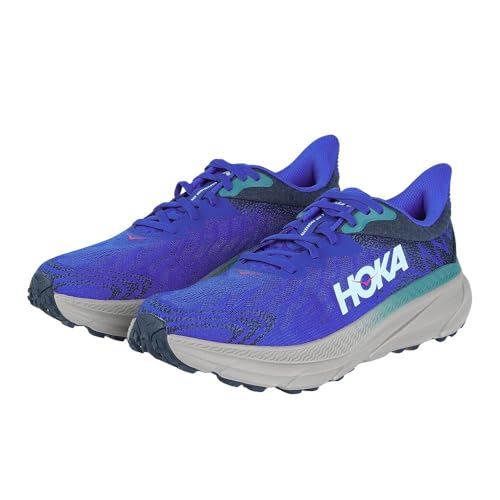
Best for: Trail runners with plantar fasciitis who want the best single-shoe solution for mixed terrain — the Challenger 7 passes all five PF checklist features with 8mm drop, genuine Meta-Rocker, high torsional rigidity, and firm-enough cushioning that avoids the soft foam trap.
| ASIN | B0CPBZTFXP |
| Heel drop | 8mm — at the minimum threshold, preferred for PF |
| Stack height | ~36mm heel / 28mm forefoot — substantial protection |
| Midsole | CMEVA — firm enough to resist arch collapse on trail surfaces |
| Rocker | Meta-Rocker — genuine geometric rocker, reduces toe-off fascial tension |
| Torsional rigidity | High — resists twisting on irregular trail surfaces |
| Outsole | Vibram Megagrip — wet and dry rock traction |
| Heel counter | Firm — Active Foot Frame anchors calcaneus |
| Removable insole | Yes — orthotic-compatible depth |
| Best PF type | All arch types on mixed terrain |
| Women’s version | Yes |
| Price range | ~$145–$165 |

The HOKA Challenger 7 earns the top position because it is the HOKA trail shoe that best balances the competing demands of plantar fasciitis management on technical trail: enough stack height for impact protection, genuine Meta-Rocker for reduced toe-off fascial tension, and sufficient torsional rigidity to resist the lateral fascial load that irregular trail terrain creates. Where the Speedgoat 6 prioritises maximum stack height for maximum cushion, the Challenger 7 prioritises the balance of cushioning, weight, and trail performance that makes it the more versatile everyday trail training shoe. The 8mm drop hits the minimum PF threshold while remaining comfortable for runners transitioning from road shoes, and it is high enough to protect against the calf-tightness PF mechanism that zero-drop and low-drop shoes aggravate.

The Meta-Rocker is genuine — place the Challenger 7 on a flat surface and the heel and toe both angle upward with a curve between them, producing a rocking motion under light pressure. This geometry specifically reduces the peak tension on the plantar fascia at toe-off — the stride phase where fascial tension is highest — without producing the aggressive rocking that would reduce proprioception on technical trail. The Vibram Megagrip outsole provides reliable traction on the wet and dry rock that mixed trail involves, and the Challenger 7’s weight is meaningfully less than the Speedgoat 6 for runners who need a lighter shoe for longer efforts. The Active Foot Frame that wraps the heel provides the firm heel counter that the PF checklist requires.
Best PF type: All arch types on mixed trail. Particularly good for normal-arch and high-arch impact-driven PF. For flat feet, pair with a Superfeet Green insole.
Pros: Passes all 5 PF checklist features, genuine Meta-Rocker reduces toe-off tension, 8mm drop appropriate for all PF types, Vibram Megagrip for reliable mixed-terrain traction, removable insole accepts orthotics, women’s version available.
Cons: Not as cushioned as the Speedgoat 6 for severe heel pain — runners with very severe PF who need maximum protection may prefer the Speedgoat 6. Torsional rigidity is lower than the Salomon Speedcross 6 for very rocky technical terrain.
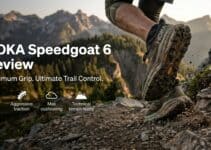
2. HOKA Speedgoat 6 — Best for Maximum Cushion and Severe Heel Pain
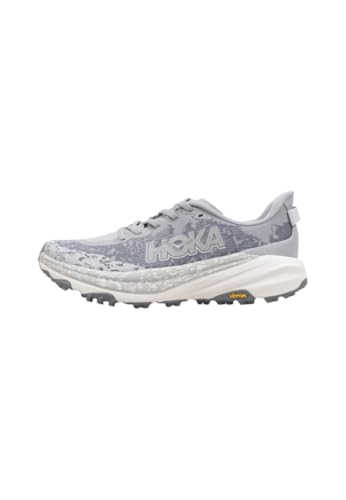
Best for: Trail runners with severe heel pain or high arches who need the maximum available stack height for impact protection — the 40mm heel stack and CMEVA midsole provide the highest level of fascial impact absorption available in a trail-specific shoe.
| ASIN | B0D5GBR472 |
| Heel drop | 5mm — below 8mm minimum; caveat for calf-driven PF |
| Stack height | 40mm heel / 35mm forefoot — maximum cushion trail shoe |
| Midsole | CMEVA — firm enough (passes soft foam threshold), more durable than supercritical EVA |
| Rocker | Meta-Rocker — genuine, reduces toe-off tension |
| Outsole | Vibram Megagrip with 5mm Traction Lugs |
| Torsional rigidity | Moderate — adequate for mixed terrain, not for maximum-tech rocky trail |
| Best PF type | High arches / impact-driven / severe cushion need — NOT for tight-calf PF |
| Women’s version | Yes |
| Price range | ~$123–$155 |

The Speedgoat 6’s 40mm heel stack is the highest available in a trail running shoe with genuine Vibram Megagrip traction — and for trail runners with severe plantar fasciitis whose primary need is maximum protection from heel-strike impact, this stack height is clinically relevant. Every millimetre of additional midsole foam between the heel and the ground reduces the peak compressive force transmitted to the plantar fascia insertion on each step. The CMEVA compound passes the midsole firmness threshold (it is firm enough to resist arch collapse on irregular terrain, unlike memory foam alternatives) while absorbing primary impact effectively. The Meta-Rocker reduces toe-off fascial tension through genuine geometric rocker, not cosmetic styling.

The important caveat: the Speedgoat 6’s 5mm drop falls below the 8mm minimum recommended for most PF cases. For runners whose plantar fasciitis has a calf-tightness or Achilles-tightness component — a very common PF mechanism — the 5mm drop increases calf recruitment demand and may worsen the root cause. The Speedgoat 6 is specifically appropriate for high-arch runners with impact-driven PF whose calf flexibility is adequate; it is not the first choice for runners with tight calves or Achilles, who should choose the HOKA Challenger 7 (8mm) or Salomon Speedcross 6 (10mm) instead. Bootsguru’s full Speedgoat 6 review is available if you want the complete breakdown of this shoe.
Best PF type: High arches and impact-driven PF on mixed and rocky trail. NOT recommended for tight-calf PF.
PF drop caveat: ⚠️ 5mm drop — below 8mm minimum for runners with calf-driven PF. Choose Challenger 7 instead if calves are tight.
Pros: Maximum 40mm heel stack for severe PF protection, genuine Meta-Rocker, CMEVA firm enough to avoid soft foam trap, Vibram Megagrip traction, removable insole, women’s version.
Cons: 5mm drop — not for calf-driven PF. Known tongue compression issue requiring lacing adjustment (covered in full Bootsguru Speedgoat 6 review). Heavier than Challenger 7 for lighter-weight preferences.
3. Brooks Cascadia 18 — Best for Flat Feet and Overpronation PF
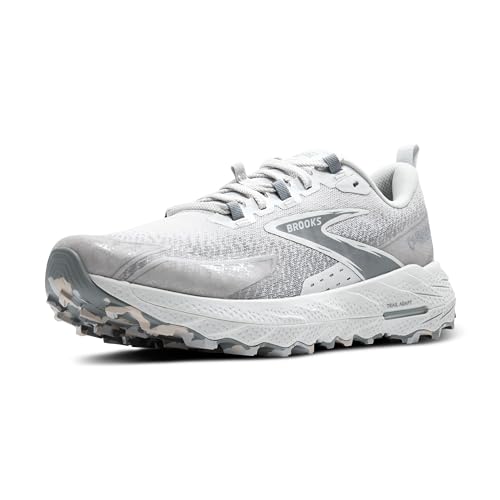
Best for: Trail runners with flat feet or overpronation whose plantar fasciitis is driven by medial arch collapse — the GuideRails stability system directly resists the inward arch roll that is the root cause of this PF type, rather than simply cushioning the symptoms.
| ASIN | B0CPN1JTN1 |
| Heel drop | 8mm — at the minimum threshold, appropriate for PF |
| Key stability feature | GuideRails — raised midsole sidewalls resist medial arch collapse without hard medial post |
| Torsional rigidity | High (4/5) — critical for flat-footed runners on uneven trail terrain |
| Outsole | TrailTack rubber — excellent grip on mixed trail surfaces |
| Midsole | DNA Loft v3 — firm enough for PF arch support without soft foam trap |
| Heel counter | Firm — provides calcaneal stability throughout landing cycle |
| Removable insole | Yes — confirmed depth for standard orthotics |
| Best PF type | Flat feet / overpronation — medial arch collapse mechanism |
| Women’s version | Yes |
| Price range | ~$130–$150 |

For flat-footed trail runners with plantar fasciitis, buying a maximum-cushion neutral shoe is the most common and most costly mistake. A neutral shoe allows and even encourages the medial arch collapse that overpronation-driven PF depends on for its symptom generation. Adding soft foam underneath a collapsing arch simply cushions the bottom of a problem that is happening above the midsole. The Cascadia 18’s GuideRails technology addresses the overpronation mechanism directly: raised midsole sidewalls on both the medial and lateral sides create a guide channel that resists excessive arch collapse without the invasive feeling of a traditional hard medial post. The result is arch stability that is felt as support rather than correction — the foot is guided into a neutral position rather than forced into one.

The high torsional rigidity (rated 4 out of 5 in RunRepeat’s lab) is particularly important for the flat-footed trail runner — every irregular landing surface creates a lateral roll that soft, flexible shoes amplify. The Cascadia 18 resists this roll through its rigid platform, directly reducing the fascial torsional load that trail surfaces create. The TrailTack rubber outsole with multidirectional lugs provides confident grip on the mixed surfaces — rock, dirt, roots, and wet trail — that the typical trail runner encounters. The DNA Loft v3 midsole is firm enough to pass the soft foam threshold while providing genuine cushioning for heel impact absorption. Confirmed orthotic compatibility: the insole removes cleanly and the shoe depth accommodates standard aftermarket arch support devices.
Best PF type: Flat feet and overpronation — the medial arch collapse mechanism that neutral shoes cannot address.
Pros: GuideRails directly resists arch collapse (addresses root cause, not just symptoms), high torsional rigidity for irregular trail terrain, 8mm drop at PF minimum, firm heel counter, removable insole accepts orthotics, women’s version available.
Cons: Not the lightest option for speed-focused trail runners. GuideRails guidance system may feel intrusive for runners with normal or high arches — this shoe is specifically for overpronators.
4. Saucony Peregrine 14 — Best for High Arches and Technical Trail
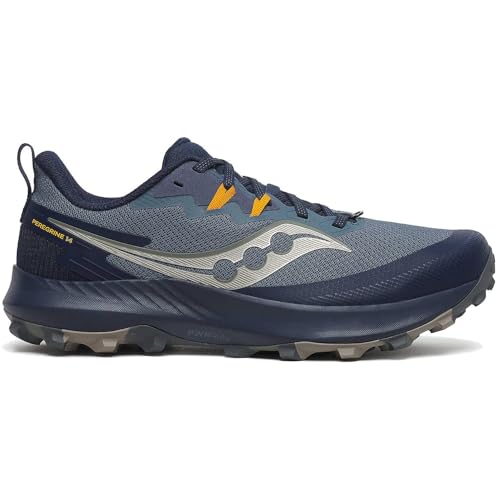
Best for: Trail runners with high arches whose plantar fasciitis is impact-driven — the Peregrine 14’s PWRRUN cushioning, rock plate protection, and neutral platform specifically address the high-arch PF mechanism where the rigid arch concentrates impact rather than distributing it.
| ASIN | B0CMBFMC3H |
| Heel drop | 6mm — slightly below 8mm minimum; PF caveat applies for calf-driven PF |
| Midsole | PWRRUN — responsive, firm-cushioned, passes soft foam threshold |
| Rock plate | Yes — PWRTRAC rock protection plate reduces point-load impact on heel/midfoot |
| Outsole | PWRTRAC rubber — excellent technical trail traction |
| Torsional rigidity | Moderate to high — adequate for rocky technical trail |
| Heel counter | Firm — good calcaneal stability |
| Removable insole | Yes |
| Wide option | Available on select models — verify on listing |
| Best PF type | High arch / impact-driven / technical rocky trail |
| Women’s version | Yes |
| Price range | ~$135–$150 |

High-arch runners with plantar fasciitis have a specific cushioning need that stability shoes do not address: their rigid arch does not naturally distribute impact load across the footprint, concentrating heel strike forces at the point of fascial insertion. Maximum cushioning in a neutral platform directly addresses this — the foam absorbs the concentrated impact before it reaches the fascia. The Peregrine 14’s PWRRUN midsole provides firm, responsive cushioning that passes the soft foam threshold while absorbing the primary impact of each heel strike. The integrated rock protection plate — a feature many high-cushion trail shoes lack — distributes rock-strike impact across the full footprint rather than allowing it to concentrate at the most loaded fascial attachment points.

The PWRTRAC rubber outsole provides reliable grip on the rocky, mixed technical terrain that is the Peregrine’s primary design environment. The firm heel counter provides calcaneal stability through the landing cycle. The 6mm drop is a mild caution for runners with calf-driven PF — 2mm below the 8mm minimum — and runners in this category should consider the HOKA Challenger 7 (8mm) as a safer drop choice. For high-arch runners whose PF is purely impact-driven and who have adequate calf flexibility, the 6mm drop is manageable and delivers all the other PF-relevant features effectively. Wide option availability improves accommodating the wide forefoot that often accompanies high-arch supinating feet.
Best PF type: High arches and supination on rocky technical trail.
PF drop caveat: ⚠️ 6mm drop — slightly below 8mm minimum. Choose Challenger 7 if calves are tight.
Pros: PWRRUN firm cushioning for impact-driven high-arch PF, rock plate for technical trail rock strike protection, PWRTRAC outsole for technical traction, neutral platform correct for high arches, removable insole, women’s version.
Cons: 6mm drop is below the PF 8mm minimum — not the best choice for calf-driven PF. Less stable than the Cascadia 18 for overpronating runners.
5. Salomon Speedcross 6 — Best for Rocky Technical Trail and Tight-Calf PF

Best for: Runners with tight-calf or Achilles-driven plantar fasciitis who need maximum torsional stability on rocky technical terrain — the 10mm drop is the highest in this guide and directly addresses the calf-tension PF mechanism, while the Speedcross’s torsional rigidity is best-in-guide for irregular rocky surfaces.
| ASIN | B0B318GJVG |
| Heel drop | 10mm — highest in guide, specifically correct for tight-calf PF |
| Torsional rigidity | Very high — best in guide for lateral fascial protection on rocky terrain |
| Outsole | Contagrip MA with 8mm chevron lugs — aggressive, self-cleaning mud grip |
| Midsole | EnergyCell+ EVA — firm, responsive, passes soft foam threshold |
| Sensifit upper | Cradles foot for secure heel lockdown — reduces heel movement that strains PF |
| Heel counter | Very firm — outstanding calcaneal stability |
| Removable insole | Yes — OrthoLite included, accepts aftermarket |
| Best PF type | Tight-calf / Achilles-driven PF; all types on very rocky technical terrain |
| Women’s version | Yes |
| Price range | ~$130–$150 |

The Salomon Speedcross 6’s 10mm heel drop is the specific reason it earns its position for calf-driven plantar fasciitis. When the plantar fasciitis mechanism involves tight calves or Achilles pulling on the heel bone — one of the most common PF presentations in runners — the shoe’s heel drop directly reduces the demand on the calf-Achilles complex with each step. Runners with this mechanism who have been wearing zero-drop or 4mm-drop trail shoes have been working against their own recovery on every training run. The 10mm drop provides immediate relief from the calf-load component that lower-drop shoes impose. Additionally, the Speedcross 6’s torsional rigidity is the highest in this guide — the rigid platform resists the lateral roll that irregular rocky terrain creates, providing the most complete torsional fascial protection available in a trail shoe.

The Sensifit upper system wraps the foot in a cradle of overlapping synthetic panels that lock the foot — particularly the heel — into position with exceptional security. For plantar fasciitis, heel movement within the shoe creates repetitive micro-stress at the fascial insertion that accumulates across a run. The Sensifit’s secure heel lockdown eliminates this internal movement. The OrthoLite insole included in the Speedcross 6 provides initial arch support that can be replaced with a custom device or Superfeet Green for runners who need stronger medial posting. The 8mm chevron lugs provide aggressive mud-shedding capability — a feature that benefits muddy Scottish highland runners more than dry American desert runners but that adds to the shoe’s technical trail versatility. Note: the Speedcross 6 is a specialist shoe for trail — its deep lugs are uncomfortable and accelerate wear on road or pavement sections.
Best PF type: Tight calf / Achilles-driven PF on all trail types; all PF types on very rocky technical terrain.
Pros: Highest drop in guide (10mm) — best for calf-driven PF; best torsional rigidity for rocky trail lateral load; Sensifit heel lockdown eliminates in-shoe heel movement; very firm heel counter; OrthoLite insole removable for upgrade; women’s version.
Cons: Deep 8mm lugs are uncomfortable on road and pavement — pure trail shoe. Not the lightest option. The aggressive lug profile adds some leverage arm to heel strike on flat rocky surfaces.
6. Topo Athletic MTN Racer 3 — Best Wide Toe Box Trail Shoe for PF
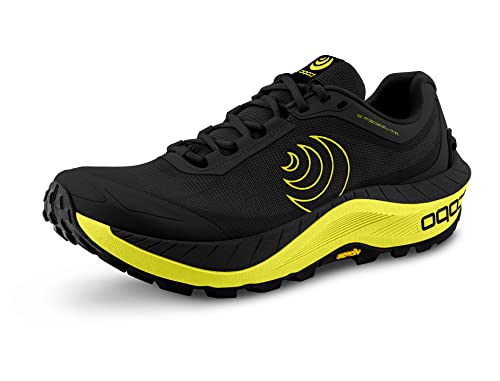
Best for: Trail runners with a wide forefoot or forefoot pain alongside plantar fasciitis who need the wide toe box that Altra provides — but at a 5mm drop rather than zero drop, making it the responsible wide-toe-box recommendation for most PF runners.
| ASIN | B0C45PWKW1 |
| Heel drop | 5mm — below 8mm minimum; PF caveat applies |
| Key feature | Wide toe box — natural toe splay, forefoot pressure relief |
| Outsole | Vibram Megagrip — wet and dry trail traction |
| Midsole | Topo ZipFoam — firm, adequate cushioning for moderate PF |
| Upper | Engineered mesh with TPU overlays — secure midfoot, roomy forefoot |
| Removable insole | Yes |
| Best PF type | Normal arch with wide forefoot — NOT for calf-driven PF |
| Women’s version | Yes |
| Price range | ~$140–$160 |

The wide toe box recommendation for plantar fasciitis runners addresses a secondary but real contributor to fascial tension: forefoot compression. When the toes are crowded into a tapered toe box, the forefoot musculature tightens in response to compression — a tension that travels through the plantar fascia and adds to the primary heel-origin pain. A wide toe box allows the toes to splay naturally during the push-off phase, reducing this secondary forefoot tension. Topo Athletic’s MTN Racer 3 provides this wide toe box geometry with a 5mm drop — a meaningful improvement over Altra’s zero-drop for PF runners who are not ready for, or cannot tolerate, zero heel-toe differential. The Vibram Megagrip outsole provides the same reliable wet-and-dry rock traction that makes the Speedgoat 6 and Challenger 7 effective on technical trail.

The honest PF caveat for the MTN Racer 3: the 5mm drop is below the 8mm minimum for most PF cases, and significantly below the 10mm that calf-driven PF requires. Runners with tight calves or Achilles should not choose this shoe as their primary PF solution — the drop is insufficient to protect the calf-tension mechanism. For runners with normal arches and wide feet whose PF is purely impact-driven and whose calf flexibility is adequate, the MTN Racer 3’s combination of wide toe box and Vibram traction fills a gap that the other picks in this guide cannot address. Wide option availability should be verified on the current listing — Topo produces multiple width options across their line.
Best PF type: Normal arch, wide forefoot, impact-driven PF without tight calf component.
PF drop caveat: ⚠️ 5mm drop — not for calf-driven PF. Choose Challenger 7 (8mm) or Speedcross 6 (10mm) if calves are tight.
Pros: Wide toe box reduces secondary forefoot fascial tension, Vibram Megagrip for technical trail traction, better drop than zero-drop Altra alternatives, removable insole, women’s version.
Cons: 5mm drop is insufficient for calf-driven PF. Less cushioning than HOKA alternatives for severe heel pain. Not a stability shoe for overpronating runners.
7. New Balance Fresh Foam X Hierro v8 — Best Lightweight Option for Early Recovery
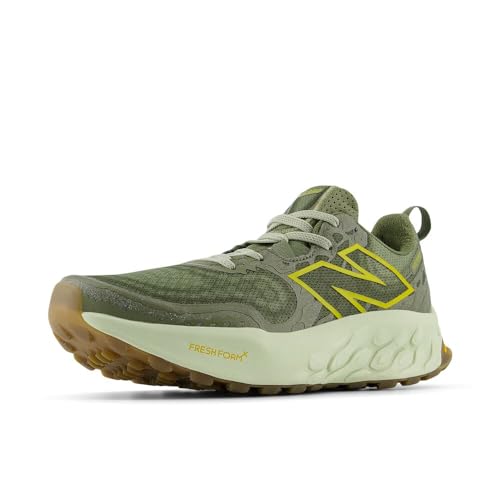
Best for: Trail runners in the early stages of PF recovery who need a lighter shoe for shorter trail runs — the Hierro v8 meets the 8mm drop minimum, offers wide and extra-wide sizing that accommodates foot swelling, and provides Fresh Foam cushioning in a lighter platform than the HOKA alternatives.
| ASIN | B0C34Z2MCK |
| Heel drop | 8mm — at the minimum threshold, appropriate for all PF types |
| Midsole | Fresh Foam X — responsive and firm, passes soft foam threshold |
| Width options | Wide and extra-wide (4E) available — unique in this guide |
| Outsole | Vibram Megagrip — reliable mixed terrain traction |
| Weight | Lighter than HOKA alternatives — better for shorter recovery runs |
| Removable insole | Yes — orthotic-compatible |
| Best PF type | All types with wide feet; early recovery shorter trail runs |
| Women’s version | Yes |
| Price range | ~$120–$140 |

For trail runners returning to running after a PF flare-up, a lighter shoe for shorter runs reduces the cumulative load on the recovering fascial tissue. The Hierro v8’s Fresh Foam X midsole is firm enough to pass the soft foam threshold while providing the cushioning that PF recovery runs require. The 8mm drop meets the minimum threshold for all PF types including the calf-driven mechanism. The Vibram Megagrip outsole ensures traction confidence on technical trail surfaces, which is important for a runner whose gait may be slightly altered by heel pain and who cannot afford an ankle roll on compromised terrain. The Fresh Foam X’s responsiveness supports a smoother toe-off that reduces peak fascial tension at the critical stride phase.

The most distinctive feature of the Hierro v8 in this guide is the width range: wide (2E) and extra-wide (4E) options are available — making it the only shoe in this guide with genuine 4E extra-wide sizing for trail runners whose feet are simply too wide for every standard or D-width alternative. Runners who have struggled to find any trail shoe that doesn’t cramp their forefoot by mid-run will find the Hierro v8’s 4E option an uncommon gift. Verify the wide variant ASIN on the current listing before ordering — width options vary by colourway in the New Balance trail line. The Hierro v8 is also the most budget-accessible pick in this guide among the trail-specific shoes, making it a practical entry point for runners who are not yet certain which level of PF-specific features their condition requires.
Best PF type: All arch types — specifically the best choice for genuinely wide feet on any trail terrain.
Pros: 8mm drop meets PF minimum for all types, wide and 4E sizing for runners no other shoe fits, Vibram Megagrip, Fresh Foam X firm enough for trail PF, most affordable HOKA alternative in guide, removable insole, women’s version.
Cons: Less cushioning than HOKA alternatives for severe PF. Lower torsional rigidity than Cascadia 18 or Speedcross 6 for very technical rocky terrain. Verify wide variant ASIN before ordering.
8. Merrell MTL Skyfire 2 — Best for Soft Forest Floor and Dirt Singletrack
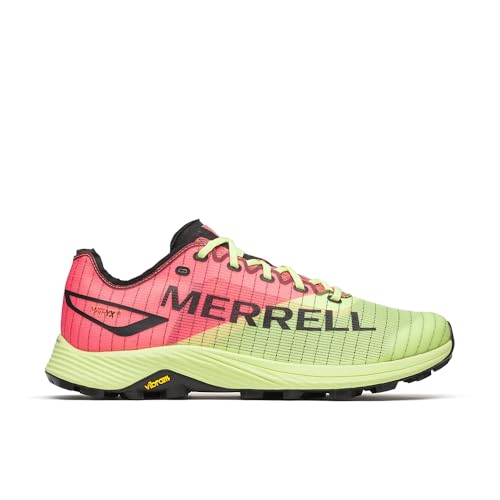
Best for: Trail runners who primarily run on forgiving soft terrain — forest floor, dirt singletrack, packed earth — where the softer surface reduces rock-strike load and the priority shifts from maximum torsional rigidity to lightweight comfort and cushioning efficiency.
| ASIN | B0F3JRLJM8 |
| Heel drop | 6mm — slight PF caveat for calf-driven mechanism |
| Design focus | Lightweight speed trail — Merrell’s racing-oriented platform |
| Midsole | FloatPro foam — responsive, firm-enough for soft terrain PF |
| Outsole | Vibram Megagrip — effective on dirt and moderate rock |
| Weight | Lightest option in this guide — suitable for speed-focused trail runners |
| Removable insole | Yes |
| Best terrain | Forest floor, dirt singletrack, packed earth — not for deep rocky terrain |
| Women’s version | Yes |
| Price range | ~$130–$155 |

Not all plantar fasciitis trail runners run on rocky technical terrain. Runners who primarily cover forest floor, packed dirt singletrack, and soft earth trails — common in the American Southeast, the Pacific Northwest lowland trails, and most European forest trail networks — encounter a fundamentally different load profile than rock-and-scree mountain runners. Soft terrain absorbs a portion of each heel strike before the midsole engages, reducing the peak fascial load per step. The torsional rigidity requirement is lower on predictable soft terrain than on irregular rocky surfaces. In this context, a lighter shoe with efficient cushioning performs better than a heavier maximum-protection alternative.

The Merrell MTL Skyfire 2’s FloatPro foam provides responsive cushioning in the lightest package in this guide — useful for trail runners who are managing PF while maintaining training volume and who find heavier shoes increasing their fatigue and altering their gait. The Vibram Megagrip outsole handles dirt singletrack and moderate rock confidently, though it is not the maximum-tech choice for sustained rocky technical trail. The 6mm drop is a mild caveat for calf-driven PF — runners in this category should consider the Challenger 7 instead. For runners on soft terrain with impact-driven normal-arch PF who want the lightest shoe in this guide, the MTL Skyfire 2 is the correct choice.
Best PF type: Impact-driven PF on soft forest floor and dirt singletrack.
PF drop caveat: ⚠️ 6mm drop — marginally below 8mm minimum. Choose Challenger 7 for calf-driven PF or if on rocky terrain.
Pros: Lightest shoe in guide — reduces fatigue-driven gait alteration, Vibram Megagrip, FloatPro cushioning efficient on soft terrain, removable insole, women’s version.
Cons: 6mm drop insufficient for calf-driven PF. Less torsional rigidity than Cascadia 18 or Speedcross 6 for rocky terrain — wrong choice for technical mountain running.
9. Merrell Agility Peak 5 — Best All-Terrain with Built-In Arch Support
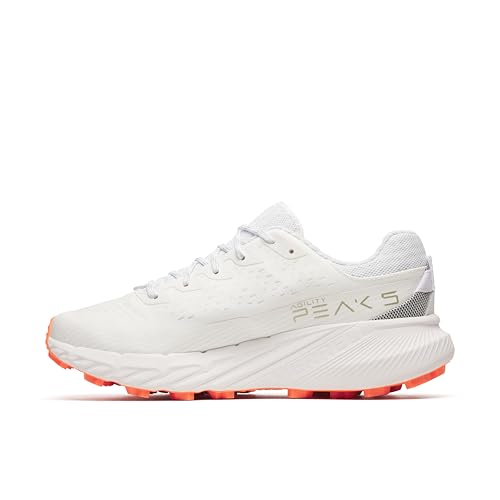
Best for: Trail runners who want a capable all-terrain shoe with better out-of-the-box arch support than the stock insoles of most trail shoes provide — the Agility Peak 5’s Kinetic Fit PRO insole delivers structured arch support that directly addresses fascial load without requiring an immediate aftermarket insole upgrade.
| ASIN | B0DT19V23G |
| Heel drop | 8mm — at PF minimum, appropriate for all types |
| Key feature | Kinetic Fit PRO insole — structured arch support included standard |
| Midsole | FloatPro foam — firm, cushioned, passes soft foam threshold |
| Outsole | Vibram Megagrip — mixed terrain traction |
| Torsional rigidity | Moderate to high — Trail Protect midsole plate for stability |
| Heel counter | Firm — good calcaneal stability |
| Removable insole | Yes — Kinetic Fit PRO removable for custom orthotic replacement |
| Best PF type | All types — the best option if you want insole-level arch support standard |
| Women’s version | Yes |
| Price range | ~$110–$140 |

Most trail shoes come with a basic flat foam insole that provides no arch support — runners with PF need to purchase an aftermarket insole separately. The Merrell Agility Peak 5 includes the Kinetic Fit PRO insole as standard equipment — a structured insole with genuine arch support geometry that addresses fascial load directly from the first wear. For runners who have not yet been to a podiatrist for custom orthotics, or who want to assess whether arch-support insole intervention helps their specific PF before investing in custom devices, the Agility Peak 5 provides the most immediate arch-support value of any shoe in this guide. The Kinetic Fit PRO is also removable — runners who eventually receive a custom orthotic can replace it without any modification.

The Trail Protect midsole plate provides the torsional stability that PF trail runners need for irregular surfaces, and the Vibram Megagrip outsole delivers the reliable mixed-terrain traction that characterises the best picks in this guide. The 8mm drop meets the PF minimum for all arch types including the calf-driven mechanism. The FloatPro foam passes the soft foam threshold. At $110–$140, the Agility Peak 5 is the most accessible price in this guide among the fully PF-appropriate picks (all 5 checklist features), making it an excellent first trail shoe for a runner new to managing PF on trail who is not yet certain of their arch type or PF mechanism. The women’s version uses a genuine women’s last.
Best PF type: All arch types — the best pick for runners who want structured arch support standard without a separate insole purchase.
Pros: Kinetic Fit PRO insole provides arch support from first wear, 8mm drop appropriate for all PF types, Trail Protect plate for torsional stability, Vibram Megagrip, most accessible price in guide for fully compliant PF shoe, women’s version on genuine women’s last.
Cons: Less maximum cushioning than HOKA alternatives for severe heel pain. Kinetic Fit PRO arch support may be insufficient for runners with strong overpronation (upgrade to Superfeet Green or custom orthotic for severe cases).
10. HOKA Tecton X2 — Best for Ultramarathon Distance and Maximum Protection
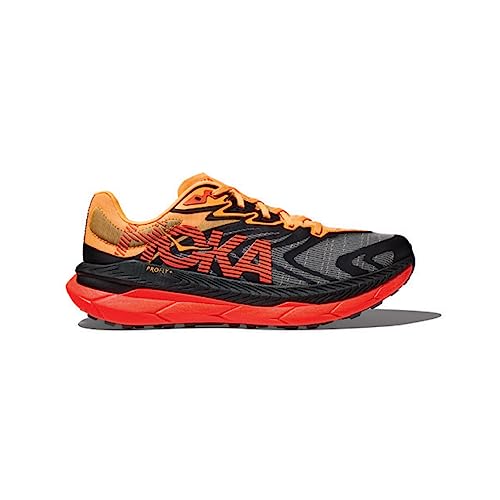
Best for: Ultramarathon trail runners managing chronic plantar fasciitis who need maximum fascial protection across 50+ mile events — the Tecton X2’s dual carbon plate system provides both the torsional rigidity and the per-step energy management that reduce cumulative fascial load at ultra distances.
| ASIN | B0C93ZBQGM |
| Heel drop | 5mm — PF caveat; appropriate for impact-driven PF but not calf-driven |
| Key feature | Dual carbon fiber plates — carbon on top AND bottom of midsole, unique system |
| Torsional rigidity | Very high — carbon plate system provides maximum lateral stability |
| Stack height | ~36mm heel / 26mm forefoot — substantial protection |
| Midsole | PEBA supercritical foam + CMEVA — dual layer |
| Outsole | Vibram Megagrip — technical trail traction at race pace |
| Rocker | Meta-Rocker — reduces toe-off fascial tension across many hours |
| Removable insole | Yes |
| Best PF type | All types at ultra distance — particularly high-arch impact-driven PF |
| Women’s version | Yes |
| Price range | ~$175–$215 |

Plantar fasciitis at ultramarathon distances presents a specific challenge that shorter-distance shoes are not designed to address: cumulative fascial load. At mile 50 of a trail ultra, the plantar fascia has absorbed approximately 50,000–70,000 individual impact events, each at a reduced efficiency because the midsole foam has compressed and the runner’s form has degraded. The HOKA Tecton X2’s dual carbon plate system — a unique design with carbon fiber plates embedded both above and below the midsole foam — maintains propulsive energy efficiency and torsional stability far later into a long run than foam-only systems. The plates resist torsional deformation that accumulated foam compression would otherwise allow, protecting the fascia from the lateral load that is most dangerous when the runner is fatigued and ground contact is least consistent.
The PEBA supercritical foam combined with CMEVA in the dual-layer midsole provides both the immediate energy return of supercritical foam and the sustained durability of CMEVA — a pairing that maintains cushioning performance significantly later in a race than either foam alone. The Meta-Rocker reduces per-step fascial tension across hours of running, compounding into meaningful total fascial stress reduction at ultra distances. The 5mm drop is the guide’s familiar caveat — not appropriate for calf-driven PF — and runners with this mechanism who race ultras should use the Challenger 7 as their base trainer and consult a physio about drop management for race-day footwear. The Tecton X2 is the most expensive shoe in this guide; it is a specialist tool for a specific and demanding use case where its advantages justify the premium.
Best PF type: High arch and impact-driven PF at ultra distances. Not for calf-driven PF (5mm drop).
PF drop caveat: ⚠️ 5mm drop — not for calf-driven PF. Use Challenger 7 if calves are tight.
Pros: Dual carbon plate provides maximum torsional stability at ultra distances, PEBA + CMEVA maintains cushioning performance late in long runs, Meta-Rocker reduces per-step cumulative fascial tension, Vibram Megagrip for race-pace traction, women’s version.
Cons: Most expensive pick in guide — specialist ultra shoe price. 5mm drop not for calf-driven PF. Overkill for runners who are not racing ultras — the Challenger 7 or Speedgoat 6 are more appropriate for training distances.
The Insole Upgrade Protocol: When the Shoe Is Not Enough
Even the best trail shoe for plantar fasciitis may need aftermarket insole support for moderate-to-severe cases — particularly for runners with overpronation or flat feet whose arch collapse mechanism requires structural correction beyond what any stock insole provides.
The first step: try the shoe with its stock insole for two to three weeks of trail running. If heel and arch pain persists despite the PF-appropriate shoe features, the insole is the next intervention before considering custom orthotics.
Match the insole to your PF mechanism. For overpronation and flat feet: Superfeet Green — the firm fibreglass shell with deep heel cup and medial arch post directly resists the inward arch collapse that drives this PF type. This is the most commonly recommended OTC insole by sports podiatrists for flat-foot PF. For high arches: Superfeet Blue or Tread Labs Pace — moderate arch support with plush top cushioning, appropriate for the high-arch runner who needs cushioning without forcing the arch higher. For impact-driven normal arch: the Spenco Polysorb Trail insole is specifically designed for trail running loads and provides cushioning with basic arch support.
Critical protocol: always remove the stock insole before inserting an aftermarket insole. Never stack. Stacking reduces toe box volume, pushes the foot upward in the shoe, and creates forefoot compression that generates new problems alongside the PF it attempts to address. Remove the factory insole cleanly, insert the replacement, and verify the heel seats correctly in the heel cup with no upward pressure on the Achilles.
Stack height note: adding a 4–6mm aftermarket insole to a trail shoe that has limited vertical volume — common in performance-oriented trail shoes — raises the foot in the shoe, potentially reducing toe box clearance and creating dorsal toe friction. If the toe box feels cramped after insole insertion, the shoe may not have adequate volume for the device. This is the most common reason custom orthotics fail in trail shoes — always verify fit with the device inserted before your first run.
Can I Keep Running Trails With Plantar Fasciitis?
Most trail runners with plantar fasciitis are not going to stop running regardless of what any article recommends. The more useful question is: what modifications allow continued trail running while reducing fascial load enough for recovery to progress?
Terrain adjustment: Soft trail surfaces — forest floor, packed dirt, grass — absorb a portion of each heel strike before the midsole engages, reducing peak fascial load compared to rocky trail, tarmac, and compacted gravel. During active PF management, prioritise soft terrain trail sections and avoid tarmac approach roads where alternatives exist.
The 60-minute cap: Cumulative fascial load increases with run duration. Most physical therapy protocols for active PF recommend keeping runs under 60 minutes until you have been pain-free for two consecutive weeks. After that, increase duration by 10 minutes per week. Shorter, more frequent trail runs produce less total fascial stress than fewer long runs at the same weekly volume.
Walk the first mile: The plantar fascia needs tissue temperature to rise before it tolerates high-impact loading. The characteristic first-step-in-the-morning heel pain of PF occurs because the tissue is cold and tight. Applying this logic to running: walk the first 10–15 minutes of every trail run to allow fascial tissue to warm, increase circulation, and reach the temperature at which it tolerates dynamic loading. Runners who run from the car door see dramatically more pain than those who walk a mile before transitioning to running.
Pre-run protocol — the three interventions with best evidence: Plantar fascia stretch (seated, pull toes back firmly, hold 30 seconds, repeat three times per foot); straight-leg calf stretch (30 seconds each, three repetitions); bent-knee calf stretch targeting the soleus (30 seconds each, three repetitions). These take six minutes total and meaningfully reduce morning and post-activity PF pain in published clinical studies.
The shoe rotation strategy: A 2024 Journal of Clinical Medicine study found that rotating between two different shoe models — different drop, different cushion profile — significantly reduces plantar fasciitis recurrence. The mechanism: different shoes create different load distribution patterns, reducing the repetitive stress concentration on the same fascial attachment point that single-shoe daily training creates. Practically: rotate between your primary PF trail shoe and a slightly different model on alternating trail sessions.
Night splinting: Wearing a dorsiflexion night splint — which keeps the plantar fascia in a mildly stretched position during sleep — is one of the highest-evidence interventions for reducing first-step morning heel pain. It is not a shoe choice, but it is the single intervention most likely to make your first mile of trail running each morning less painful. Available on Amazon; discuss with a physiotherapist before use if you have other lower-limb conditions.
Terrain-Type Matching Guide
Rocky and technical trail (granite, sandstone, scree): Maximum torsional rigidity and a firm platform are the priorities. Rock strike and irregular lateral loading are the primary fascial threats. Best picks: Salomon Speedcross 6 (maximum torsional rigidity, 10mm drop), Brooks Cascadia 18 (GuideRails + high torsional rigidity), HOKA Tecton X2 (dual carbon plates for ultra races on technical terrain).
Soft forest floor and dirt singletrack: Terrain absorbs a portion of impact load. Lighter shoe with efficient cushioning performs better than heavy maximum-protection alternative. Torsional rigidity requirement is lower. Best picks: Merrell MTL Skyfire 2 (lightest in guide, efficient on soft terrain), Merrell Agility Peak 5 (Kinetic Fit PRO arch support for any arch type on soft terrain), New Balance Hierro v8 (wide sizing for any foot shape on soft terrain).
Mixed trail (typical mountain trail with both rock and earth sections): Balance of cushioning and torsional stability needed. Best overall picks: HOKA Challenger 7 (best all-rounder), HOKA Speedgoat 6 (maximum cushion for severe PF on mixed terrain), Brooks Cascadia 18 (overpronators on mixed terrain).
Women’s Trail Shoe Guide for Plantar Fasciitis
Women represent a significant portion of trail runners with plantar fasciitis, and the shoe recommendations differ from men’s for anatomical reasons that most guides ignore. Women’s feet have a narrower heel relative to forefoot width, a more forward arch position, and different overall proportions than men’s feet. A trail shoe on a men’s last in women’s sizing creates the same PF problems that all wrong-last shoes create — heel slippage from too-wide heel cup, arch fatigue from misplaced arch support.
Every pick in this guide has a genuine women’s version. Priority recommendations for women: HOKA Challenger 7 Women’s (best all-terrain PF shoe with women’s last proportions), Brooks Cascadia 18 Women’s (flat feet and overpronation — GuideRails in women’s geometry), Merrell Agility Peak 5 Women’s (Kinetic Fit PRO on genuine women’s last, most accessible price).
Women with PF should specifically confirm that the insole arch position in their chosen shoe hits at the correct point of their arch — women’s arch position is further forward than men’s. A men’s arch support insole placed in a women’s shoe will miss the arch contact point. Superfeet’s women’s Green insole is trimmed to women’s arch geometry; confirm the insole trim is women’s-specific before purchasing.
Frequently Asked Questions
Can I run trails with plantar fasciitis or do I need to rest completely?
Most trail runners with PF can continue running with modifications — terrain adjustment to softer surfaces, the 60-minute duration cap, walking the first mile, and the pre-run stretch protocol. Complete rest is rarely necessary for mild-to-moderate PF and can actually allow the fascia to tighten further between sessions. Consult a physiotherapist for specific guidance on your case.
Is zero drop bad for plantar fasciitis?
For most runners with active plantar fasciitis, yes — particularly for those with tight calves or Achilles, which is a very common PF mechanism. Zero drop requires maximum calf and Achilles recruitment to absorb landing forces, worsening the tension that the tight calf-Achilles complex places on the plantar fascia insertion. The minimum recommended drop for PF is 8mm; 10mm for tight-calf PF. Experienced zero-drop runners in complete PF remission with no calf tightness may return to zero drop with physio guidance.
What heel drop do trail shoes for plantar fasciitis need?
Minimum 8mm for most PF types. 10mm specifically for runners with tight calves or Achilles tightness as their PF mechanism. This is higher than the road running PF minimum because trail terrain reduces effective drop on downhill sections — a 6mm nominal drop shoe on a 5% descent may provide only 3–4mm of effective heel elevation.
Are HOKA trail shoes good for plantar fasciitis?
The HOKA Challenger 7 is the best overall trail PF shoe in this guide. The HOKA Speedgoat 6 is excellent for severe heel pain and high arches. The HOKA Tecton X2 is the best for ultra distances. The important caveat: both the Speedgoat 6 (5mm) and Tecton X2 (5mm) have drops below the 8mm minimum for calf-driven PF. Runners with tight calves should choose the Challenger 7 (8mm) or confirm with their physio before using the lower-drop HOKA models.
Can I wear custom orthotics in trail running shoes for plantar fasciitis?
Yes, provided the shoe has a removable insole and sufficient depth. All picks in this guide have removable insoles. Remove the stock insole completely before inserting the orthotic — never stack. Verify the heel sits correctly in the heel cup with no upward pressure on the Achilles after insertion. Shoes with confirmed orthotic depth in this guide: HOKA Challenger 7, Brooks Cascadia 18, Saucony Peregrine 14, Merrell Agility Peak 5, New Balance Hierro v8.
Why does my plantar fasciitis get worse when I run trails but not roads?
Trail terrain creates lateral torsional fascial load that flat roads never produce. Every irregular landing — on a tilted rock, a cambered slope, a root crossing the trail — creates a rotational force that the plantar fascia absorbs. If your trail shoe lacks torsional rigidity, this force is amplified on every step. Switch to a torsionally rigid trail shoe (Salomon Speedcross 6, Brooks Cascadia 18) and verify you are landing consistently rather than compensating for irregular terrain with altered gait.
What is the best trail running shoe for flat feet with plantar fasciitis?
The Brooks Cascadia 18. Its GuideRails stability system directly resists the medial arch collapse that drives overpronation-related PF — addressing the root cause rather than cushioning the symptoms. Maximum-cushion neutral shoes allow and amplify arch collapse for flat-footed runners on uneven trail terrain, worsening this specific PF type. Pair the Cascadia 18 with a Superfeet Green insole for the highest level of structural arch control available without custom orthotics.
How long do trail running shoes for plantar fasciitis last before replacement?
Trail shoes for PF should be replaced at 300–400 miles for mixed terrain use, earlier if significant road sections are included. The key indicator is the midsole, not the outsole: when the midsole no longer provides a cushioned feel underfoot and the foot can feel the heel strike transmitting through the shoe, the midsole has compressed and the PF protection it provided is compromised. Runners who experience PF pain returning after a previously successful period in the same shoes should check midsole compression before buying a new model — a replacement may solve the problem without a brand change.
Final Verdict: The Right Trail Shoe for Your PF Type and Terrain
The most important thing to take from this guide is the matching principle: your specific plantar fasciitis mechanism determines which shoe features you need, and buying for the wrong mechanism makes the pain worse rather than better.
For most trail runners with plantar fasciitis on mixed terrain: HOKA Challenger 7 — 8mm drop, genuine Meta-Rocker, Vibram Megagrip, the best all-terrain PF trail shoe available.
For severe heel pain and maximum cushion protection: HOKA Speedgoat 6 — 40mm heel stack, CMEVA firm enough for trail, Meta-Rocker. Check the full Bootsguru Speedgoat 6 review for the lacing tips that solve its tongue and heel issues.
For flat feet and overpronation-driven PF: Brooks Cascadia 18 — GuideRails directly resists arch collapse, high torsional rigidity, 8mm drop. Add Superfeet Green insole for maximum control.
For high arches and technical trail: Saucony Peregrine 14 — neutral platform, PWRRUN cushioning, rock plate for rocky technical trail.
For tight-calf PF and rocky terrain: Salomon Speedcross 6 — 10mm drop (highest in guide), maximum torsional rigidity, Sensifit heel lockdown.
For wide feet: Topo MTN Racer 3 for forefoot-focused wide toe box; New Balance Hierro v8 for 4E extra-wide on any terrain.
For soft forest floor and dirt singletrack: Merrell MTL Skyfire 2 — lightest in guide, efficient on soft terrain.
For all-terrain arch support without a separate insole purchase: Merrell Agility Peak 5 — Kinetic Fit PRO insole standard, 8mm drop, most accessible price in guide.
For ultramarathon distances: HOKA Tecton X2 — dual carbon plates for sustained torsional stability and energy management across 50+ mile efforts.