Stand on a worn 3-tab shingle in a lugged work boot and you’ll feel it immediately — not solid grip, but something greasy and shifting underfoot. Those are loose ceramic granules behaving exactly like micro-ball-bearings, rolling between your lug voids and the shingle surface below. It’s not a traction problem you can muscle through. It’s a physics problem, and the fix is a specific sole geometry. Asphalt shingles cover roughly 80% of U.S. residential roofs — and yet most “best roofing boots” articles treat them as an afterthought rather than the primary surface most roofers spend their careers on.
If you also work metal, tile, or low-slope roofs, our complete roofing boots guide covers every surface type. This article focuses entirely on granular asphalt shingles: what makes them uniquely dangerous, which sole designs actually work, and the 8 boots worth putting on your feet in 2026.
Below you’ll find 8 field-tested picks with real-world notes on granule behavior, heat, morning dew, and pad wear — plus a comparison table, shingle-specific safety tips, and a FAQ that addresses the questions roofers actually ask.
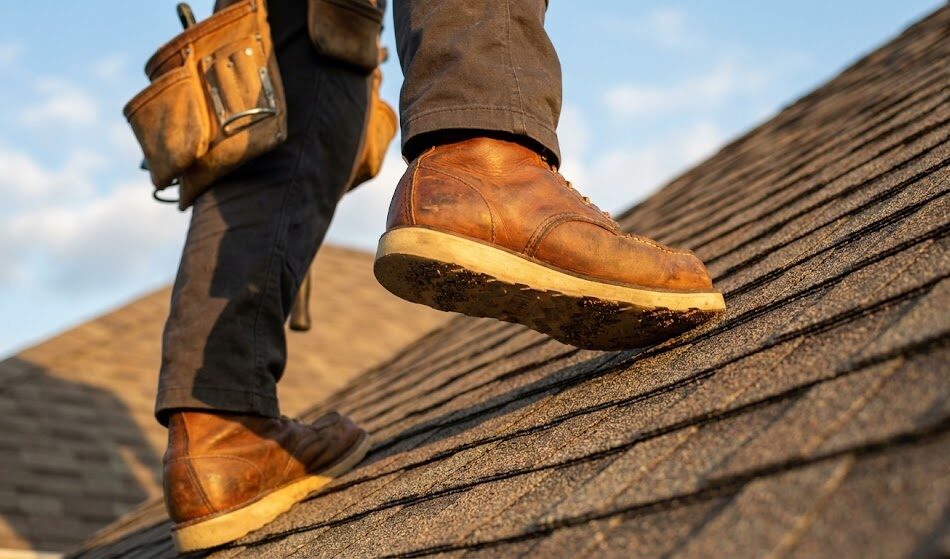
Up of a worker wearing durable roofing boots walking on a shingled roof during daytime.
Why Shingle Roofs Demand a Different Boot
The Granule Problem
Asphalt shingles are coated in ceramic-coated mineral granules — typically 1 to 3mm in diameter — that shed continuously under UV degradation and foot traffic. On a pitched surface, these loose granules act as micro-ball-bearings between your sole and the shingle below. Lug soles compound the problem: those deep void channels, designed to shed mud on a job site, become granule traps on a roof. Within 20–30 minutes of shingle work, lug voids pack with compressed granules and the boot is effectively riding on a layer of ball-bearings rather than gripping the surface. The more weathered the shingle, the worse this gets.
Why Wedge Soles Win on Shingles
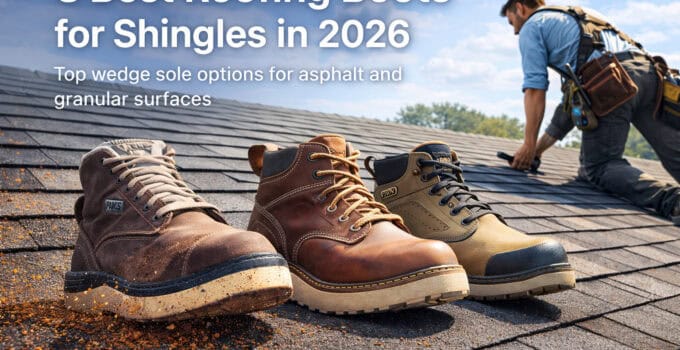
Wedge and flat soles maximize continuous rubber contact across the shingle face. With no lug voids to trap granules, the entire sole presses uniformly against the granule layer and the shingle surface beneath it. Softer rubber compounds — Cougar Paws’ replaceable pad system, the Vibram EV compound used in select Timberland PRO models — grip the granule texture rather than riding over it. The result is genuine traction instead of the false confidence a lugged sole gives you for the first few minutes before the voids pack.
The honest tradeoff: wedge soles sacrifice ladder rung hook grip and perform poorly on muddy ground-level surfaces. Both are real limitations worth knowing before you commit.
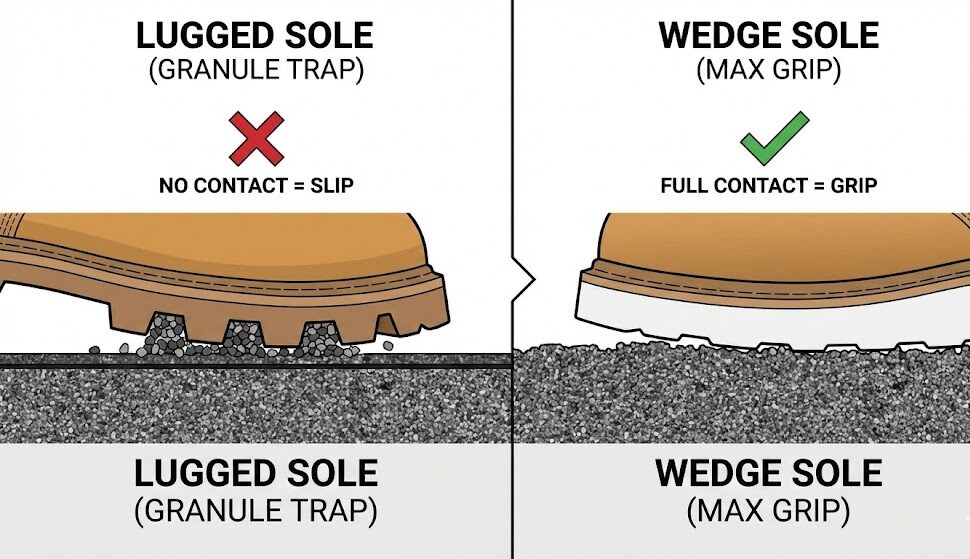
Roofing boots with lugged soles and wedge soles are compared for grip and slip resistance, essential for safe roofing work on asphalt and granular surfaces.
Pitch Angle Matters
Grip requirements escalate sharply as pitch increases: 4/12 is walkable with moderate grip, 8/12 demands maximum continuous rubber contact, and 12/12 and above is specialist territory. The comparison table below includes a “best pitch range” column for every boot. For pitches above 10/12 where ladder transitions are frequent and aggressive, see our steep roof boots guide — the balance between pitch grip and ladder hook changes significantly at those angles.
What to look for in a shingle roofing boot:
- Outsole: Soft wedge compound or replaceable pads (Cougar Paws system)
- Weight: Under 2 lbs per boot for full-day pitch work
- Shaft height: 6–8″ padded collar for ankle support and debris exclusion
- Toe: Composite or soft toe — steel toe adds unnecessary weight on residential jobs
- Waterproofing: Membrane + treatment for morning dew and wet-season roofing
Quick Comparison: 8 Best Roofing Boots for Shingles
Use this table to cross-reference the specs that matter most for your shingle work — pitch angle, boot weight, outsole compound, and whether you need replaceable grip pads. Full reviews follow below.
| Model | Outsole Type | Compound | Weight (per boot) | Waterproof | Best Pitch Range | Price | Link |
|---|---|---|---|---|---|---|---|
| Cougar Paws Premium Series | Replaceable pad | Soft rubber | ~1.8 lbs | No (pad venting) | 6/12–12/12 | $$$ | View Deal |
| Timberland PRO Gridworks | Flat wedge | Soft | ~1.9 lbs | Yes | 4/12–9/12 | $$ | View Deal |
| KEEN Utility Cincinnati | Flat wedge | Medium-soft | ~2.0 lbs | Yes | 4/12–8/12 | $$ | View Deal |
| Thorogood Heritage Wedge | MAXwear Wedge | Medium-hard | ~2.0 lbs | No | 4/12–7/12 | $ | View Deal |
| Irish Setter Ashby 6″ | Wedge | Medium-soft | ~1.85 lbs | Yes | 4/12–8/12 | $$ | View Deal |
| Danner Bull Run Moc Toe | Thin wedge | Soft-medium | ~1.75 lbs | No | 5/12–10/12 | $$$ | View Deal |
| Wolverine I-90 DuraShocks Wedge | Wedge | Medium | ~1.9 lbs | Yes | 4/12–7/12 | $$ | View Deal |
| Ariat Workhog XT Wedge | ATS wedge | Soft heat-stable | ~2.0 lbs | Yes | 4/12–9/12 | $$ | View Deal |
The 8 Best Roofing Boots for Shingles: Full Reviews
1. Cougar Paws Premium Series — Best Overall for Shingle Roofing
Best for: Dedicated shingle roofers who want maximum granule grip and work steep pitches daily
No boot on this list grips granular asphalt shingles the way Cougar Paws does, and the reason is the replaceable pad system. When grip degrades — and it will — you swap pads rather than replace boots. That’s a fundamentally different economics model from every other pick here, and it’s what makes Cougar Paws the choice of professional roofing crews rather than weekend warriors.
Weight: ~1.8 lbs/boot
Toe: Soft toe
Waterproof: No (pad venting system)
Best pitch: 6/12–12/12
Field notes: Pads last roughly 100–150 hours on standard 3-tab shingles. Switch to architectural/dimensional shingles and that drops to 75–100 hours — the deeper granule texture is more abrasive. The practical field test: run your thumb firmly across the pad surface. If it no longer feels distinctly tacky, grip is already compromised well before you see visible wear-through. Budget pad replacement (~$30–50/set) into your job pricing from day one rather than treating it as a surprise cost.
✅ Pros
- Best-in-class granule grip on steep pitches — no other boot comes close above 8/12
- Replaceable pads extend overall boot lifespan significantly
- Performs reliably on 6/12–12/12 without additional traction aids
❌ Cons
- Ongoing pad replacement cost — factor into job pricing upfront
- Poor ground-level traction on muddy job sites between roof runs
2. Timberland PRO Gridworks — Best Flat Wedge for All-Day Shingle Work

Best for: Roofers who split time between shingle work and ground-level framing or trim
The Gridworks is Timberland PRO’s dedicated flat-wedge roofing boot — a completely different animal from the heavy-tread Boondock line. The soft-compound flat sole was designed explicitly for roof traction, and it shows: no lug channels, no granule traps, just uniform rubber contact across the shingle face. This is the Timberland boot that roofers actually use, and the model that belongs on this list.
Weight: ~1.9 lbs/boot
Toe: Composite (ASTM F2413)
Waterproof: Yes
Best pitch: 4/12–9/12
Field notes: The Gridworks performs particularly well on morning-dew shingles where cold surface temperatures reduce granule adhesion to the shingle face — the soft compound grips in conditions that send medium-hard compounds sliding. Waterproof membrane handles early-morning wet starts without a separate treatment routine. Versatile enough for ground-level work at the end of a roofing day without destroying your soles on gravel and concrete.
✅ Pros
- Soft-compound flat sole purpose-built for roof traction — no lug void granule trapping
- Strong on cold morning-dew shingles where harder soles slip
- Waterproof membrane handles wet-season starts without extra treatment
❌ Cons
- Soft compound wears faster on abrasive architectural shingles — inspect monthly
- Ladder rung hook is limited compared to contoured-heel wedge alternatives
3. KEEN Utility Cincinnati — Best Heavy-Duty Wedge for Wet Climates
No products found.Best for: Roofers in wet climates needing a heavy-duty wedge on moderate pitches (4/12–8/12)
A critical note before anything else: the KEEN Pittsburgh — which features a 90-degree heel and deep aggressive lugs — is the wrong boot for shingle roofing despite appearing on many lists. The Cincinnati is KEEN’s true flat wedge, built for exactly this application. It’s the heavier-duty option in KEEN’s wedge line (the San Jose is the lighter unlined alternative if weight is your priority).
Weight: ~2.0 lbs/boot
Toe: Composite (ASTM F2413)
Waterproof: Yes
Best pitch: 4/12–8/12
Field notes: The Cincinnati’s wider platform provides solid lateral stability on hipped roofs and valley work where foot angle shifts constantly — a genuine advantage on cut-up residential roofs over simpler gable runs. Waterproof membrane performs reliably in Pacific Northwest and Northeast wet-season conditions. If wet weather is your primary concern year-round, see our waterproof roofing boots guide for a full comparison of membrane options.
✅ Pros
- True flat wedge — no lugs, no granule trapping (unlike the KEEN Pittsburgh)
- Wide platform improves lateral stability on complex roof geometry
- Reliable waterproof membrane for wet-climate roofing year-round
❌ Cons
- Heavier than most competitors at ~2.0 lbs — noticeable on full-day steep carries
- Medium-soft compound loses grip on heavily-shed aged shingles above 8/12
4. Thorogood American Heritage Wedge — Best Budget Pick

Best for: Budget-conscious shingle workers wanting domestic manufacturing and solid ladder performance
The Thorogood Heritage Wedge is the strongest value on this list, and it earns its place on merit rather than price alone. The MAXwear Wedge outsole has a slightly contoured heel profile compared to flat-profile competitors — which translates into the best ladder rung grip of any wedge boot on this list. For crews doing high-volume ladder transitions between ground and roof, that’s a real-world advantage that shows up in safety and confidence.
Weight: ~2.0 lbs/boot
Toe: Soft toe or composite (model dependent)
Waterproof: No
Best pitch: 4/12–7/12
Field notes: Compound runs medium-hard — performs noticeably better on cool morning shingles than midday hot-tar scenarios above 90°F ambient. On a summer reroof in a hot climate, the compound starts to struggle with tar adhesion around hour 4–5. For dry-climate work on moderate pitches, it’s exceptional value. USA-made construction means consistently solid build quality across the size run.
✅ Pros
- Best ladder rung grip of any wedge boot on this list — contoured heel helps
- USA-made with strong long-term durability reputation
- Lowest price point on this list — outstanding value for moderate-pitch shingle work
❌ Cons
- Medium-hard compound struggles on heat-softened summer tar above 90°F
- No waterproof option — not suited for wet-climate daily roofing
5. Irish Setter Ashby 6″ — Best for Hot Climate Thermal Cycling

Best for: Roofers in hot climates dealing with cold morning dew followed by high-heat afternoon conditions
The Ashby solves a specific problem that most boot lists never address: thermal cycling. A shingle roof in Texas, Arizona, or Florida goes from cold and dew-covered at 6 AM to surface temps above 130°F by 2 PM. Most boot compounds are tuned for one temperature range, not both. The Ashby’s softer compound grips reliably in cold morning conditions and remains stable as ambient temps climb through the afternoon — a genuine dual-range advantage.
Weight: ~1.85 lbs/boot
Toe: Composite
Waterproof: Yes
Best pitch: 4/12–8/12
Field notes: The 6″ shaft height is a deliberate choice for shingle work — tall enough to keep granule debris and dust out of the boot, short enough to allow the ankle mobility needed for constant foot repositioning on dormer-heavy or valley-rich roofs. Waterproof membrane handles dew-heavy morning starts without a separate boot treatment routine.
✅ Pros
- Soft compound performs across the full daily temperature range — cold dew to afternoon heat
- 6″ shaft balances debris protection with ankle mobility on complex roofs
- Waterproof membrane handles wet morning starts reliably
❌ Cons
- Sole wears faster on abrasive architectural shingles vs. smoother 3-tab — inspect regularly
- Pricier than comparable medium-soft compound options
6. Danner Bull Run Moc Toe (Wedge) — Best for Proprioception on Complex Roofs

Best for: Experienced roofers working complex geometry — dormers, valleys, turrets — who prioritize sole feel
The Bull Run takes a different approach to shingle traction: instead of maximizing sole thickness and cushioning, it uses a thinner profile to maximize ground feel. On a cut-up roof with dormers, hips, and valleys where foot positioning changes every few seconds, proprioceptive feedback is not a luxury — it’s safety information. You feel granule shift initiate before a full slip develops, which gives you a split second to redistribute weight. That’s a real advantage that no cushioning or rubber compound can replicate.
Weight: ~1.75 lbs/boot
Toe: Soft moc toe
Waterproof: No
Best pitch: 5/12–10/12
Field notes: Premium Danner construction means this boot lasts significantly longer than mid-range alternatives with proper care — the value calculation over 3–4 seasons is better than the upfront price suggests. The tradeoff is real: less cushioning means more foot fatigue for roofers standing on a single long pitch run for 8+ hours versus roofers constantly repositioning on complex geometry. Know which job type dominates your work before choosing this one.
✅ Pros
- Superior sole feedback on complex roof geometry — feel granule shift before a slip initiates
- Soft-medium compound grips well across 5/12–10/12 range
- Premium Danner construction — long lifespan amortizes the higher price
❌ Cons
- Less cushioning — not ideal for full-day static standing on a single long pitch run
- No waterproof option — not suited for wet-climate daily use
7. Wolverine I-90 DuraShocks Wedge — Best for High-Volume Transition Days

Best for: Roofers doing 8+ hour days with 40–60 ladder transitions — cushioning matters as much as grip
Most roofing boot articles focus exclusively on pitch traction and ignore the cumulative toll of repetitive ladder-to-roof transitions. A busy residential reroof crew doing 40–60 ladder climbs a day is absorbing significant impact through the ball of the foot and heel on every dismount. The DuraShocks midsole is one of the better impact absorption systems in the work boot category, and on high-transition-volume days, that cushioning difference shows up as real energy by the end of the shift.
Weight: ~1.9 lbs/boot
Toe: Composite (ASTM F2413)
Waterproof: Yes
Best pitch: 4/12–7/12
Field notes: The non-marking sole is a practical bonus that gets overlooked — no scuffs on newly-painted fascia, light-colored ridge caps, or finished soffits. On commercial reroof jobs where finished surfaces need protecting, this is a legitimate selling point. Medium compound performs well on moderate pitches; above 8/12 on aged shingles, the Cougar Paws or Danner Bull Run are better choices.
✅ Pros
- DuraShocks midsole reduces fatigue on high-volume ladder-transition days
- Non-marking sole protects finished surfaces — useful on commercial reroofs
- Solid waterproof membrane for all-season crews in wet climates
❌ Cons
- Medium compound — not the right choice above 8/12 on aged, heavily-shed shingles
- Bulkier feel than the Danner or Irish Setter alternatives
8. Ariat Workhog XT Wedge — Best for Summer Heat and Hot Tar

Best for: Roofers in hot southern climates where surface temps exceed 130°F and tar softens mid-shift
Above 85°F ambient, asphalt beneath shingles softens slightly, granules release more readily from the surface, and tar patches become adhesive hazards that stick to boot soles. Boots with harder compounds pick up tar deposits that then coat the sole and dramatically reduce grip for the rest of the day. The Workhog XT’s ATS (Advanced Torque Stability) system uses a heat-stable soft compound that remains effective at surface temps up to approximately 140°F — a meaningful advantage on a Florida or Texas August reroof.
Weight: ~2.0 lbs/boot
Toe: Composite
Waterproof: Yes
Best pitch: 4/12–9/12
Field notes: The moisture-wicking lining is not a marketing detail on summer jobs — sweat-soaked socks create a moisture layer between foot and insole that measurably reduces the boot’s grip response over a long shift. The Ariat lining handles this meaningfully better than most competitors. Softer compound wears faster on abrasive architectural shingles — check sole thickness monthly on heavy-use summer roofing.
✅ Pros
- Heat-stable ATS compound outperforms on summer hot-tar days — effective to ~140°F surface temp
- Moisture-wicking lining maintains grip performance through a full summer shift
- Waterproof membrane handles unpredictable weather on multi-day jobs
❌ Cons
- Softer compound wears faster on abrasive granule surfaces — inspect sole monthly
- Heavier end of this list at ~2.0 lbs — noticeable on steep all-day carries
Shingle-Specific Tips for Maximum Traction
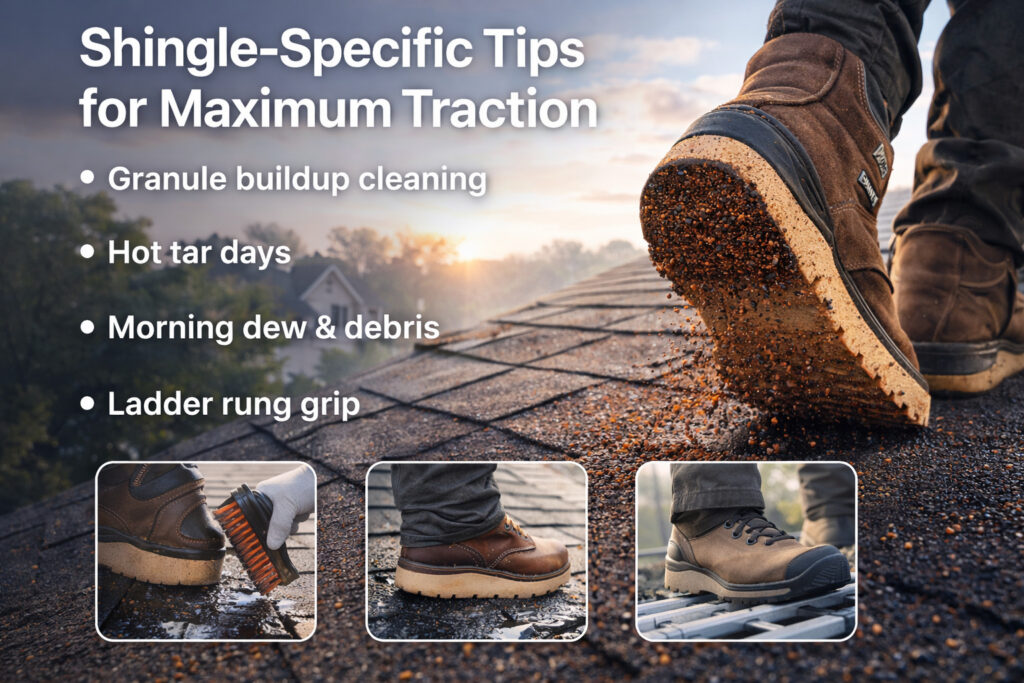
shingle specific
Cleaning Granule Buildup Mid-Job
Granules accumulate along the heel perimeter and edge channels of even wedge soles after 2–3 hours of continuous shingle work. A stiff-bristle brush kept on the nail belt — a 10-second sole scrub at each break — restores 80–90% of grip performance. This is the single cheapest and most effective traction maintenance habit on a shingle roof.
Hot Tar Days
Above 85°F ambient temperature, asphalt softens slightly, granules release more readily from the shingle face, and tar patch adhesion becomes a grip hazard. Boots with harder compounds — Thorogood, KEEN Cincinnati — can pick up tar deposits that coat the sole and reduce traction for the rest of the day. Softer compound boots — Cougar Paws, Ariat Workhog — handle this significantly better, though they degrade faster under extended heat exposure. Practical tip: carry a small container of mineral spirits on the nail belt for mid-day tar removal from boot soles without damaging the rubber compound.
Morning Dew and Thermal Cycling
The most dangerous window on a shingle roof is early morning — roughly 6 to 9 AM — on east-facing slopes where overnight condensation sits on cold shingles. At this temperature-surface combination, granules become hydrophilic and micro-lubricated. This is when most shingle roof falls happen, and it has nothing to do with boot quality. The practical fix: start the day on west-facing slopes and let dew burn off before tackling east faces. This single scheduling adjustment prevents more falls than any boot upgrade.
Ladder Rung Grip — The Wedge Boot Tradeoff
Wedge soles do not hook ladder rungs the way a lugged heel does. The technique adjustment that every lug-to-wedge convert needs to make: position the ladder rung at the ball of the foot rather than mid-sole when climbing. This is the most important physical adaptation when switching sole types on a job site, and it takes about one day of conscious effort to become automatic. For steep pitch work where ladder transitions are frequent and aggressive, see our steep roof boots guide — at pitches above 10/12, the balance between pitch grip and ladder hook changes significantly.
Frequently Asked Questions
Wedge or lug sole for shingles?
Wedge sole — definitively. Lug soles trap loose granules in void channels, effectively making the boot ride on a compressed granule layer rather than the shingle surface itself. Wedge soles maintain continuous rubber-to-surface contact across the entire sole. The only scenario where a lugged sole outperforms a wedge on a shingle roof is during active rain — at which point neither sole type is safe to work on without fall protection.
Do I need steel toe for shingle roofing?
Not typically. Falling objects on a residential shingle reroof are lighter than industrial environments, and steel toe adds weight that accelerates fatigue on steep pitch work. Composite toe (ASTM F2413-rated) is the preferred middle ground for crews with OSHA safety documentation requirements on commercial reroof jobs. Soft toe is acceptable for owner-operator residential work where no safety certification is required on site.
How often should I replace Cougar Paws pads?
Every 100–150 hours on standard 3-tab shingles; closer to 75–100 hours on architectural or dimensional shingles due to their deeper granule texture profile. The practical field test: run your thumb firmly across the pad surface — if it no longer feels distinctly tacky and slightly grabby, grip is already compromised well before any visible wear-through. Budget pad replacement cost (~$30–50 per set) into your job pricing from day one.
Can shingle roofing boots work on metal roofs too?
Soft rubber wedge boots provide adequate grip on low-slope metal roofs (under 6/12) where you’re relying on rubber-to-painted-metal friction rather than granule engagement. Not recommended for standing seam metal above 6/12 — the grip mechanism is fundamentally different from shingle work and the margin for error is much smaller. See our waterproof roofing boots guide for metal-compatible options with appropriate sole designs.
What’s the best roofing boot for shingles under $150?
The Thorogood American Heritage Wedge. It’s the strongest budget pick on this list — USA-made construction, solid MAXwear compound, and the best ladder rung grip of any wedge boot here thanks to the slightly contoured heel profile. The tradeoffs to know upfront: the medium-hard compound underperforms on summer hot-tar days above 90°F, and there’s no waterproof option in this model line.
The right roofing boot for shingles comes down to three things: a flat or wedge sole with no lug channels to trap granules, a rubber compound soft enough to grip the granule texture rather than ride over it, and a fit that stays stable through the full range of foot angles a pitched roof demands. Every boot on this list delivers on those three criteria — the differences between them are about pitch range, climate, budget, and how you prefer to manage sole wear.
Working More Than Just Shingles?
For every roofing surface — metal, tile, low-slope, and flat — our complete guide covers them all in one place.