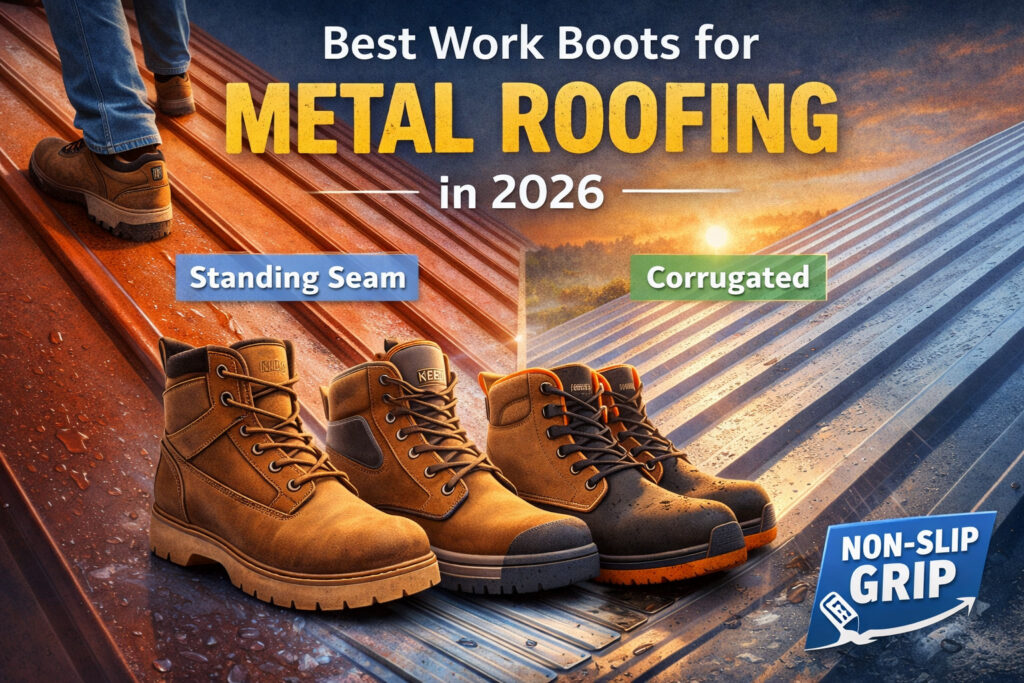

Metal roofing is the hardest surface to stay planted on — slick when dry, treacherous when wet, and genuinely unpredictable when morning condensation hits a cold standing seam panel at 7 AM. Unlike asphalt shingles, metal offers no granule texture to grip. The boot sole is working against a painted or bare metal surface with near-zero inherent friction, which means every traction variable lives entirely in the rubber compound and sole geometry of the boot. Get the compound wrong and no amount of roofing experience keeps you planted.
If you work across multiple roof types, our complete roofing boots guide covers every surface. This article focuses entirely on metal roofing — standing seam, corrugated, and ribbed panel — where the traction rules are completely different from asphalt or tile work.
Below you'll find 6 metal-roofing-specific picks with compound-level field notes, a sole science explainer built around rubber hardness rather than vague grip claims, a morning condensation protocol, and a FAQ that addresses the questions metal roofing contractors actually ask.
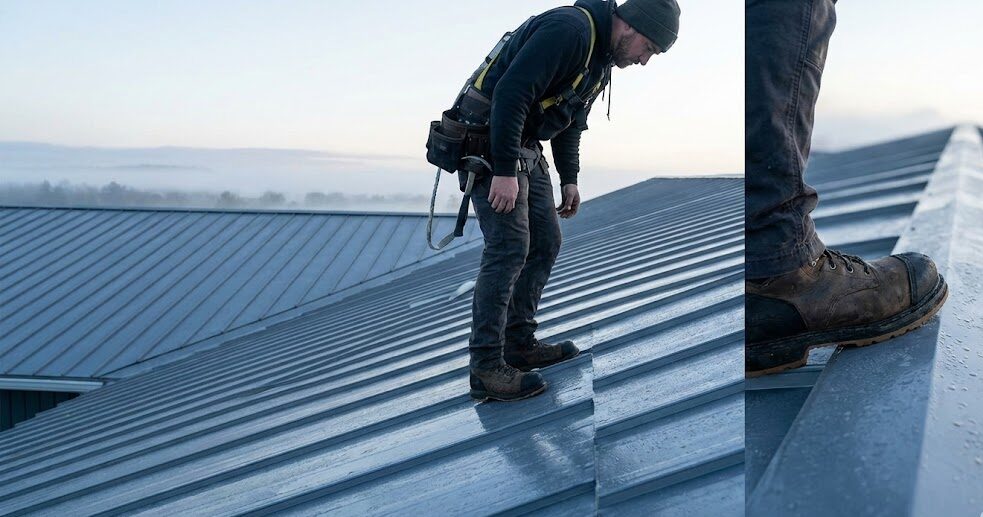
Why Metal Roofs Are Different
Zero Inherent Texture
Asphalt shingles give you granule texture — imperfect, shifting, but present. Metal roofing gives you nothing. A painted standing seam panel has a surface roughness measured in microns. The entire traction equation relies on rubber compound conforming microscopically to that near-flat surface and generating friction through molecular adhesion rather than mechanical interlocking. This is why compound hardness matters more on metal than on any other roofing surface — and why a boot that grips shingles confidently can be completely wrong on standing seam. The two surfaces demand different physics, not just different sole profiles.
For shingle-specific boot selection, see our roofing boots for shingles guide — the wedge vs. lug geometry debate that dominates shingle work is almost irrelevant on smooth metal.
Heat Expansion and Panel Movement
Metal roofing panels expand and contract significantly with temperature. A 20-foot standing seam panel can move 3/8" or more between early morning and midday peak heat. This thermal movement means the surface beneath your foot is subtly shifting throughout the day. Boots with stiffer midsoles that don't flex with the panel create micro-lift at the heel and toe edge, reducing effective contact area precisely when you need full sole engagement. Softer, more conforming soles track thermal movement better than rigid platforms — another reason compound softness wins on metal.
The Condensation Window
The single most dangerous condition on a metal roof is not rain — it's morning condensation. Metal panels cool faster than asphalt overnight because metal has higher thermal conductivity and lower thermal mass. Dew forms earlier, heavier, and persists longer on metal than on any other roofing surface. On an east-facing standing seam panel at 6–7 AM, you're not dealing with light surface dew — you're dealing with a continuous moisture film that reduces friction to near zero even for high-quality soft rubber compounds. The 6–9 AM window on east-facing metal slopes is when metal roof falls happen. Section 5 covers the full protocol — read it before stepping on any metal panel in the morning.
For pitches above 10/12 where condensation risk combines with maximum fall exposure, see our steep roof boots guide.
Corrugated vs. Standing Seam — Different Grip Challenges
Corrugated metal has raised ribs that give a boot edge something to register against mechanically — the traction dynamic is closer to a textured surface and softer compound requirements are somewhat less critical. Standing seam is the harder problem: the seams are tall enough to create uneven footing on approach but the panel faces between them are completely smooth. Every boot on this list is rated separately for both surfaces in the comparison table — a boot adequate for corrugated may be genuinely unsafe on slick painted standing seam above 6/12.
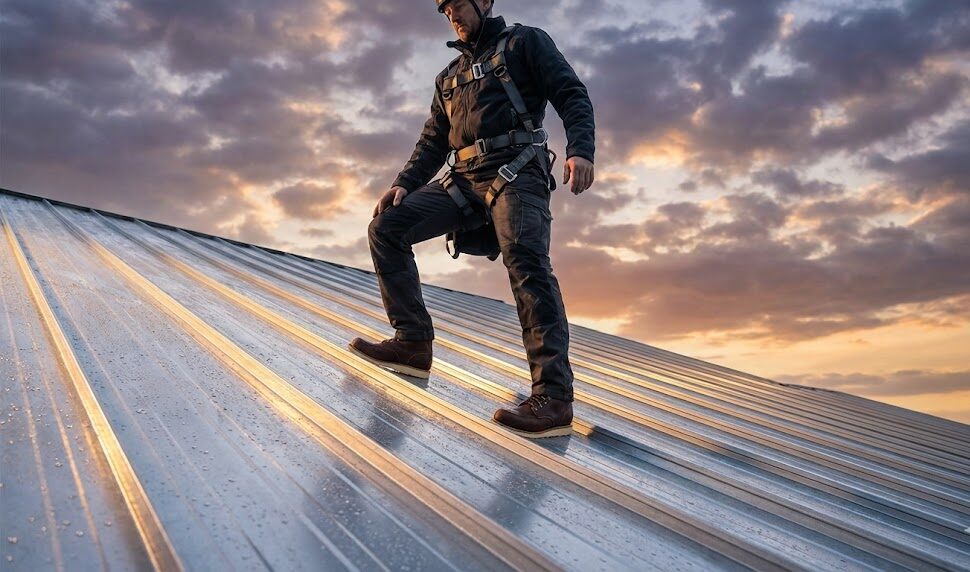
Sole Compounds That Actually Work on Metal
Why Compound Hardness Is Everything
On asphalt shingles, sole geometry — wedge vs. lug — is the dominant traction variable. On metal, compound hardness takes over as the single most important factor. The target range for standing seam metal roofing is a Shore A durometer reading below 55 Shore A <55 — soft enough for the rubber to conform microscopically to the smooth surface and generate adhesive friction. Above 65 Shore A, a compound effectively skates on painted metal regardless of how flat or wide the sole profile is. This number is the purchase filter that matters most on metal, and almost no boot retailer publishes it — which is why compound-specific field notes exist in every review below.
Soft Rubber — The Right Choice, With Caveats
Soft rubber compounds below 55 Shore A grip metal surfaces well in dry conditions. The caveats are real and worth knowing upfront: they wear faster on abrasive edge transitions and ladder rungs than harder compounds; they degrade more quickly in UV-heavy summer conditions; and they pick up debris — tar residue, granule dust from adjacent shingle sections — that can temporarily reduce metal grip. Managing soft compound boots means regular sole inspection and cleaning, not just installation and forget.
Cougar Paws' specialty metal roofing pads use a specifically formulated soft compound designed for painted metal — a different formulation from their standard shingle pads, with higher oil content for better adhesive friction on smooth surfaces. This is the clearest example of compound-first engineering on this list and the benchmark everything else is measured against.
Specialty Pad Systems vs. Integrated Compounds
Two approaches exist on this list. The pad system — Cougar Paws — allows you to swap metal-specific formulations in and out depending on the day's surface. The integrated approach — Timberland Gridworks, KEEN Cincinnati, Ariat Workhog — bakes a fixed compound into the sole that approximates the right hardness range. The pad system wins on pure metal grip performance but adds ongoing replacement cost and the discipline to actually swap pads between surface types. The integrated approach is better for crews splitting time across surfaces who want one boot that performs adequately everywhere without managing a pad inventory.
What to look for in a metal roofing boot:
- Sole compound: Shore A below 55 for standing seam; medium-soft (55–65) acceptable for corrugated
- Sole profile: Flat or minimal texture — raised lugs create uneven contact on smooth panels and accelerate wear on seam edges
- Weight: Under 2 lbs/boot — metal work involves more lateral repositioning than shingle work
- Waterproofing: Strongly recommended — condensation hits metal panels before any other roofing surface on site
- Toe type: Composite strongly preferred — steel toe conducts heat from hot summer panels directly to the toes
Quick Comparison: 6 Best Boots for Metal Roofing
Use this table to match boot to metal roof type — standing seam demands softer compound than corrugated, and wet-climate work demands waterproofing that several picks here don't offer.
| Model | Compound | Best Metal Surface | Waterproof | Weight | Best Pitch | Price | Link |
|---|---|---|---|---|---|---|---|
| Cougar Paws Premium (Metal Pads) | Soft metal-specific | Standing seam + corrugated | No | ~1.8 lbs | 5/12–12/12 | $$$ | View Deal |
| Timberland PRO Gridworks | Soft flat wedge | Corrugated + standing seam | Yes | ~1.9 lbs | 4/12–9/12 | $$ | View Deal |
| KEEN Utility Cincinnati | Medium-soft flat wedge | Corrugated + low-slope seam | Yes | ~2.0 lbs | 4/12–7/12 | $$ | View Deal |
| Ariat Workhog XT | Soft heat-stable ATS | Standing seam (hot climates) | Yes | ~2.0 lbs | 4/12–9/12 | $$ | View Deal |
| Danner Bull Run Moc Toe | Soft-medium thin wedge | Standing seam (dry, experienced) | No | ~1.75 lbs | 5/12–10/12 | $$$ | View Deal |
| Thorogood Heritage Wedge | Medium-hard MAXwear | Corrugated low-slope only | No | ~2.0 lbs | 4/12–5/12 | $ | View Deal |
The 6 Best Work Boots for Metal Roofing: Full Reviews
1 Cougar Paws Premium Series (Metal Roofing Pads) — Best Overall for Metal
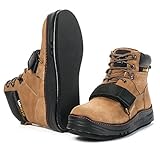
Best for: Metal roofing contractors who want the closest thing to a purpose-built metal grip system
The Cougar Paws system with metal-specific pads is the only option on this list engineered from the compound up for painted metal. The metal roofing pad formulation is distinct from the standard shingle pad — softer, with higher oil content for better adhesive friction on smooth painted surfaces. On dry standing seam, nothing on this list comes close. If you're regularly working painted standing seam above 6/12, this is the correct answer and the comparison ends here.
Sole: Replaceable pad system
Weight: ~1.8 lbs/boot
Waterproof: No
Best pitch: 5/12–12/12
Field notes: Two things to know before ordering. First, confirm you are ordering metal-specific pads — not standard shingle pads. The product names are similar and the difference in performance on smooth metal is significant. Second, metal pads wear faster than shingle pads on ladder rungs and abrasive panel edge transitions because the softer compound sacrifices durability for grip — budget replacement cost accordingly and inspect pads after every 60–80 hours on metal rather than the 100–150 hour interval for shingle pads. Important limitation: Cougar Paws metal pads perform well on dry metal but offer only marginal improvement over standard pads in true condensation conditions. No boot compound fully overcomes a moisture film on painted metal — the protocol in Section 5 matters more than boot choice when dew is present.
✅ Pros
- Best dry-metal grip on this list — purpose-built metal compound with no close second on standing seam
- Switchable pads let you run metal formulation one day and shingle formulation the next without buying a second pair
- Proven on commercial metal jobs — the professional roofing industry's standard for steep metal work
❌ Cons
- Metal pads wear faster than shingle pads on abrasive transitions — inspect every 60–80 hours, not 100–150
- No waterproof membrane — significant limitation for crews starting early on dew-heavy metal jobs
2 Timberland PRO Gridworks — Best All-Around for Metal + Shingle Crews

Best for: Crews alternating between standing seam and shingle work on the same day who need one boot that handles both
The Gridworks' soft flat-wedge compound lands in the right hardness range for corrugated metal and performs adequately on standing seam panels in dry conditions. It's not purpose-built for metal the way Cougar Paws metal pads are, but for a crew that spends the morning on a shingle section and moves to a metal addition after lunch, it's the strongest single-boot solution on this list. The waterproof membrane earns its keep specifically on metal jobs — condensation arrives earlier and more intensely on metal than on asphalt, and starting a metal roofing shift in wet boots meaningfully compounds the traction problem before you've taken a single step on the panel.
Sole: Flat wedge (integrated)
Weight: ~1.9 lbs/boot
Waterproof: Yes
Best pitch: 4/12–9/12
Field notes: On corrugated metal the Gridworks performs solidly — the flat soft sole wraps the rib profile and soft compound provides adequate dry adhesion. On standing seam specifically, performance is noticeably below Cougar Paws metal pads in marginal conditions — slightly damp panels, aged paint, or steep pitches above 8/12. For dry standing seam at 4/12–7/12, it's a reliable daily driver. The waterproof membrane handles the early-morning condensation transition window — not full dew, but the partial-moisture phase after the worst has burned off — better than non-membrane alternatives.
✅ Pros
- Soft compound performs across both metal and shingle surfaces — best versatility on this list
- Waterproof membrane handles early-morning condensation exposure without soaking through
- Flat sole profile maximizes contact on smooth metal panels with no lug void penalty
❌ Cons
- Not optimized for standing seam — loses grip faster than Cougar Paws metal pads on marginal or steep conditions
- Soft compound wears faster on the abrasive panel edge transitions common in standing seam work
3 KEEN Utility Cincinnati — Best for Wet Climates and Corrugated Metal
No products found.Best for: Metal roofing contractors in wet climates where waterproofing and condensation resistance are the primary daily concerns
The Cincinnati's wider flat platform is a genuine advantage on corrugated metal where uneven footing across rib profiles demands lateral stability — a wider sole distributes weight more evenly across the rib faces and reduces the rocking sensation that narrower profiles produce on corrugated at slope. The waterproof membrane is one of the stronger performers at this price point for extended condensation exposure, making it particularly well-suited for Pacific Northwest and Northeast metal roofing where morning moisture is a near-daily variable rather than an occasional one.
Sole: Flat wedge (integrated)
Weight: ~2.0 lbs/boot
Waterproof: Yes
Best pitch: 4/12–7/12
Field notes: The medium-soft compound is the Cincinnati's key limitation on metal — adequate for corrugated and low-slope standing seam (under 6/12) in dry conditions, but marginal on slick painted standing seam above 6/12. Think of this as the wet-climate corrugated specialist rather than a standing seam all-rounder. For full wet-climate roofing boot options across surfaces, see our waterproof roofing boots guide. The wider platform also helps with lateral repositioning on corrugated rib profiles — something narrower boots don't handle as cleanly.
✅ Pros
- Wide platform improves lateral stability on corrugated rib profiles — best corrugated footing on this list
- Best waterproof membrane on this list for extended daily condensation exposure
- Reliable performer on corrugated and low-slope standing seam in wet climates year-round
❌ Cons
- Medium-soft compound is marginal on slick painted standing seam above 6/12 — honest limitation worth knowing
- Heaviest pick on this list at ~2.0 lbs — noticeable on the lateral movement demands of metal work
4 Ariat Workhog XT — Best for Hot Climate Summer Metal Work

Best for: Metal roofers in hot southern climates where summer panel temps exceed 140°F and heat conduction through the boot is a real fatigue factor
Hot metal panels create a problem no other roofing surface generates at the same intensity: heat conduction through the boot sole into the foot. On a Florida, Texas, or Arizona summer reroof, a south-facing metal panel in direct afternoon sun can reach 160°F surface temperature. At those temps, two things happen simultaneously: the sole compound of most boots begins to soften and lose its hardness-range advantage, and foot heat fatigue sets in faster than almost any other roofing condition. The Workhog XT's heat-stable ATS compound is formulated to maintain grip integrity at higher surface temps than most competitors.
Sole: ATS wedge (integrated)
Weight: ~2.0 lbs/boot
Waterproof: Yes
Best pitch: 4/12–9/12
Field notes: The ATS compound maintains effective grip at metal surface temps up to approximately 140–150°F — meaningfully above where standard soft compounds start to over-soften and smear rather than grip. The footbed insulation layer reduces heat transfer to the foot measurably over a full summer shift, and the moisture-wicking lining addresses the sweat accumulation that compounds heat fatigue on summer metal work. Waterproof membrane handles early-morning condensation at the start of hot-climate days where dew is present before ambient temps climb. Softer compound wears faster on abrasive standing seam edge transitions — inspect monthly on heavy summer use.
✅ Pros
- Heat-stable compound maintains grip at panel temps where standard soft compounds over-soften — effective to ~150°F surface temp
- Footbed insulation reduces heat transfer from hot summer panels — meaningful fatigue difference over a full shift
- Waterproof membrane handles morning condensation before the day heats up
❌ Cons
- Softer compound wears faster on abrasive standing seam edge transitions — inspect sole monthly on heavy use
- At ~2.0 lbs, heavier than ideal for the lateral movement demands of standing seam work
5 Danner Bull Run Moc Toe — Best for Experienced Metal Roofers on Steep Standing Seam

Best for: Experienced metal roofers working standing seam above 7/12 who prioritize proprioceptive feedback over cushioning
The proprioception advantage that makes the Bull Run valuable on complex shingle geometry applies — and arguably matters even more — on standing seam metal. On a smooth painted panel above 7/12 where there is zero texture feedback from the surface itself, the ability to feel subtle grip changes through the sole before they escalate into a slip is a genuine safety advantage. The thin-sole profile transmits surface feedback that thicker, cushioned soles filter out. You feel the micro-moment when adhesive friction begins to change — before it's too late to redistribute weight. This is a skill-amplifying boot, not a beginner's tool.
Sole: Thin wedge (integrated)
Weight: ~1.75 lbs/boot
Waterproof: No
Best pitch: 5/12–10/12
Field notes: The soft-medium compound performs well on dry standing seam across the 5/12–10/12 range. The absence of a waterproof membrane is the significant limitation for metal-specific work — condensation exposure is routine on metal jobs, and the Bull Run should not be your first choice when the morning condensation window is in play. Save it for mid-morning-to-afternoon standing seam work on panels you know are fully dry. Lightest boot on this list at ~1.75 lbs, which helps with the lateral repositioning demands of standing seam work. Premium Danner construction amortizes the price over 3–4 seasons of careful use.
✅ Pros
- Thin sole maximizes proprioceptive feedback on smooth standing seam — feel grip changes before they become slips
- Lightest pick on this list at ~1.75 lbs — best lateral mobility for standing seam repositioning
- Soft-medium compound performs on dry standing seam across 5/12–10/12 range
❌ Cons
- No waterproof membrane — a significant limitation on metal jobs where morning condensation is routine
- Thin sole offers less insulation from hot summer metal panels than cushioned alternatives
6 Thorogood American Heritage Wedge — Best Budget for Corrugated Low-Slope

Best for: Budget-conscious metal roofing crews working corrugated panels at low slope (under 5/12) with frequent ladder transitions
Sole: MAXwear Wedge (contoured heel)
Weight: ~2.0 lbs/boot
Waterproof: No
Best pitch: 4/12–5/12 (corrugated only)
Field notes: On corrugated metal at 4/12 and under, the Thorogood performs reliably and represents outstanding value. The MAXwear compound's slightly contoured heel gives it the best ladder rung grip of any boot on this list — a genuine advantage on installation jobs where 40–60 ladder transitions a day is normal. The medium-hard compound that disqualifies it for standing seam is exactly what makes it durable on the abrasive rib edges and ladder rungs that eat through softer compounds quickly. Know your surface type before buying. If your job is corrugated low-slope with heavy ladder use, this is the pick. If your job is standing seam, look at picks 1 or 2.
✅ Pros
- Best ladder rung grip of any boot on this list — contoured heel advantage on high-transition corrugated jobs
- Medium-hard compound is more durable on abrasive corrugated rib edges than softer alternatives
- Strongest budget pick — USA-made construction at the lowest price on this list
❌ Cons
- Medium-hard compound is wrong for standing seam — do not use on smooth painted panels above 4/12
- No waterproof membrane — not suitable for wet-climate metal roofing or morning condensation conditions
Morning Condensation Protocol — When to Delay, Which Boots Help Most
Why Metal Condensation Is Different From Dew on Shingles
Metal panels cool faster than asphalt overnight because metal has higher thermal conductivity and lower thermal mass — it releases stored heat rapidly after sunset. Condensation forms earlier on metal, heavier, and persists longer into the morning than on any other roofing surface. On an east-facing standing seam panel at 6 AM, you're not dealing with light surface moisture — you're dealing with a continuous film of water that reduces friction coefficient to near zero even for premium soft rubber compounds. The 6–9 AM east-facing metal slope window is when the majority of metal roof falls happen, and most of them involve roofers who decided the condensation had cleared "enough." It hadn't.
The Four-Step Protocol
Morning Condensation Protocol — Metal Roofing
- Surface test before stepping on. Press the back of your bare hand flat against the panel. If it feels cool and you can feel any moisture or tacky-wet sensation, condensation is present. Do not step on the panel regardless of boot quality or pitch. Return in 20–30 minutes and test again.
- Start on west-facing and low-slope sections. West-facing panels didn't receive direct early sunlight the previous afternoon and cool less overnight. Low-slope sections warm faster from ambient temperature. Begin your day there and let east-facing steep panels come up in temperature naturally.
- Use the shadow line as your working boundary. Once direct sunlight has hit a panel section for a minimum of 20–30 minutes and you can feel surface warmth radiating when you hold your hand 2 inches above the panel, grip has returned. Work inside the sun's footprint. Do not cross into shadow-side panels until they receive direct sun and have held it for 20+ minutes.
- Boots that help in the transition window. As condensation partially clears — the panel is warming but still slightly moist — Cougar Paws metal pads and the Timberland Gridworks handle this partial-moisture transition better than medium or hard compounds. In this window only, boot choice provides a marginal safety buffer. In full condensation, it does not.
Never Rush the Condensation Window
The most common scenario for metal roof falls is a roofer who decides condensation has cleared "enough" because the job is behind schedule or a client is waiting. On smooth painted metal, the transition from adequate grip to zero grip happens with almost no warning and no tactile precursor — there is no granule crunch, no visual texture change, no sound. You are gripping, and then you are not. The protocol exists precisely because judgment calls made in the condensation window are consistently wrong, and the consequences on metal roofing are severe. Schedule the condensation window into your job timeline as a fixed delay, not a variable.
Frequently Asked Questions
Do Cougar Paws work on metal roofing?
Yes — but only with the metal-specific pad formulation, not standard shingle pads. The metal pad compound is softer and oil-infused for adhesive friction on smooth painted surfaces. Standard shingle pads on metal perform only marginally better than a medium-hard compound boot. Always confirm you're ordering metal pads specifically, and expect a shorter replacement interval — 60–80 hours on metal vs. 100–150 hours on shingles.
What grip compound actually works on standing seam?
Soft rubber compounds below approximately 55 Shore A durometer — soft enough to conform microscopically to a smooth painted surface and generate adhesive friction rather than sliding over it. Above 65 Shore A, compounds effectively skate on standing seam regardless of sole geometry or width. Cougar Paws metal pads and the Timberland Gridworks' flat-wedge compound are the closest to this target range among boots with broad commercial availability.
Composite toe vs. steel toe on hot metal panels?
Composite toe — definitively. Steel toe conducts heat from hot summer metal panels directly through the toe box into your toes. On south-facing panels in summer climates above 120°F surface temperature, the heat conduction difference between steel and composite toe is significant and cumulative — it accelerates foot fatigue measurably over a full afternoon shift. Composite materials are thermal insulators. For any metal roofing work in warm climates, composite toe is the right choice.
Can I use the same boots for metal and shingle roofing?
Partially. A soft-compound flat wedge boot — Timberland Gridworks, KEEN Cincinnati — performs adequately on both corrugated metal and asphalt shingles. Standing seam specifically demands a softer compound than most shingle-optimized boots provide. If you're working standing seam regularly, Cougar Paws with switchable pad formulations is the only system that lets you optimize compound per surface type without buying and maintaining two separate pairs of boots.
Metal roofing has one non-negotiable: compound hardness below 55 Shore A for standing seam, with softer being better up to the point of durability tradeoffs. Everything else — waterproofing, weight, toe type — is secondary to getting the compound right for your specific surface. And on any metal roof in the morning, the condensation protocol matters more than any boot choice. No rubber compound substitutes for waiting out the moisture window.
Working Across Multiple Roof Types?
Our complete guide covers every roofing surface — shingles, metal, tile, low-slope — with surface-specific boot recommendations in one place.