
Carhartt makes over 40 boot SKUs. Most buying guides just copy-paste the same three models, slap a "Best Overall" label on the most popular one, and call it done. You buy the wrong boot, spend two weeks breaking it in, and realize it wasn't built for your job at all.
We've matched each pick to a specific trade and worker type — because the right Carhartt for a concrete finisher is not the right Carhartt for an electrician. Here are the 7 best Carhartt work boots in 2026, ranked by job fit, not just star count.
Best Carhartt Work Boots at a Glance
| Boot | Best For | Toe Type | Waterproof | EH Rated | Price |
|---|---|---|---|---|---|
| Carhartt Rugged Flex 6" | Best Overall / Construction | Composite | Yes (Storm Defender) | Yes | ~$155 |
| Carhartt Rugged Flex 8" Met Guard Pull-On | Heavy Industry / Ironworkers | Composite | Yes (Storm Defender) | Yes | ~$185 |
| Carhartt 6" Waterproof Wedge Soft Toe (CMW6175) | Concrete / Carpenters | Soft Toe | Yes | No | ~$150 |
| Carhartt Moc Toe Wedge Composite Toe (CMX4023) | Finish Work / Carpenters | Composite | Yes | Yes | ~$165 |
| Carhartt 11" Insulated Wellington Steel Toe | Ranch / Farm / Mud / Pipeline | Steel Toe | Yes | No | ~$175 |
| Carhartt Force Nano Toe Work Sneaker | Warehouse / Light Duty | Nano Toe | No | Yes | ~$110 |
| Carhartt CMF6371 6" Composite Toe | Budget / Entry-Level | Composite | Water-Resistant Only | Yes | ~$105 |
1. Carhartt Rugged Flex 6" Composite Toe — Best Overall Carhartt Work Boot

If you're buying one Carhartt boot and you work in general construction, delivery, or any labor-intensive trade that doesn't require a met guard, the Rugged Flex 6" Composite Toe is the answer. It combines Carhartt's Storm Defender waterproof membrane with a 30% flex advantage over standard work boot construction — meaning you're not fighting the boot every time you bend your knee on a ladder or step over debris on a job site.

The composite toe clears metal detectors and carries full ASTM F2413-18 compliance with EH rating, which matters if you work around live circuits or need site access at facilities with strict PPE requirements. The EVA midsole provides all-day cushioning without the dead-sponge feeling you get from cheaper foam after six months of use. Most wearers report a break-in period of 7–10 days — shorter than a traditional full-grain leather Carhartt, largely because the upper uses a leather-nylon combination that flexes from day one.

Owner review patterns show strong praise for comfort on concrete and wet conditions, with the most consistent complaint being that the boot runs approximately half a size large. Order your normal size and expect a slightly roomy fit, or size down half if you have a narrow foot. The Storm Defender membrane breathes — this is not a hot, sweaty boot even in warmer months.

Best for: Construction workers, delivery drivers, general laborers, electricians needing EH compliance
Not for: Workers who need met guard protection, or anyone needing a pure steel toe for high-compression hazards
2. Carhartt Rugged Flex 8" Pull-On Met Guard — Best for Heavy Industry
Most workers don't need a met guard. But if you're an ironworker, work in a steel mill, or operate near heavy equipment that can drop or roll over your midfoot — a met guard isn't optional. The Rugged Flex 8" Pull-On is the best Carhartt for that environment. It pairs the same Storm Defender waterproofing and EH-rated composite toe from the 6" model with an internal metatarsal guard that meets ASTM F2413-18 Mt/75 standards, added height for ankle protection, and a pull-on design that eliminates the lace failure point entirely.
The pull-on format divides opinion. If you have a wide forefoot or high instep, you'll love the unrestricted fit once the boot is on. If you have a very narrow foot, the pull-on can feel sloppy. Either way, getting in and out is faster than any lace-up — relevant on sites where you're donning and doffing PPE multiple times per shift.
At roughly 185 dollars, this is Carhartt's most capable work boot. The 8" shaft protects against ankle rolls on uneven terrain, and the rubber outsole handles oil, water, and chemical resistance that lighter construction boots don't address. If you want more context on when internal met guard protection is actually required, see our full breakdown of the best metatarsal guard work boots.
Best for: Ironworkers, steel mill workers, heavy equipment operators, any OSHA-mandated met guard environment
Not for: Workers who need a laced fit, or trades where the extra height and weight are unnecessary
3. Carhartt 6" Waterproof Wedge Soft Toe (CMW6175) — Best for Concrete & Flat Surfaces
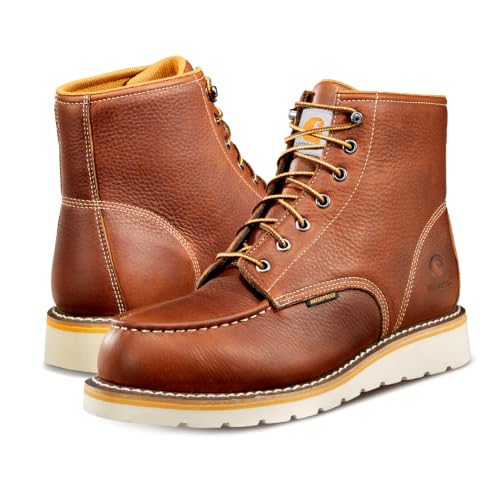
Concrete workers, carpenters, and finish tradespeople often get pushed toward lug-sole boots by generic buying guides. That's a mistake. Lug soles trap concrete, create uneven pressure on flat surfaces, and accelerate fatigue when you're standing or walking on poured slabs all day. The CMW6175 wedge sole solves all three problems. The flat contact patch distributes your body weight evenly, grips polished concrete better than a deep lug pattern, and keeps debris from packing under your foot.

The full-grain leather upper is waterproofed and tough enough for job site conditions, and the soft toe design means no metal or composite cap adding stiffness to the toe box — your foot flexes naturally through a full stride. The tradeoff is obvious: this boot has no safety toe. That means it's not suitable for sites where OSHA or your employer mandates ASTM-rated toe protection. Know your worksite requirements before ordering.

Break-in on the CMW6175 takes longer than the Rugged Flex models — typically two to three weeks — because of the full-grain leather construction. Use a leather conditioner after the first week to accelerate the process. Once broken in, owners consistently report it as the most comfortable Carhartt they've ever worn, particularly on long standing shifts. This is also worth comparing if you're looking at the full category of work boots for standing on concrete all day.
Best for: Concrete finishers, masons, carpenters, finish tradespeople on flat job sites
Not for: Any site requiring ASTM safety toe compliance, or outdoor terrain with uneven surfaces
4. Carhartt Moc Toe Wedge Composite Toe (CMX4023) — Best Wedge Boot with Safety Toe
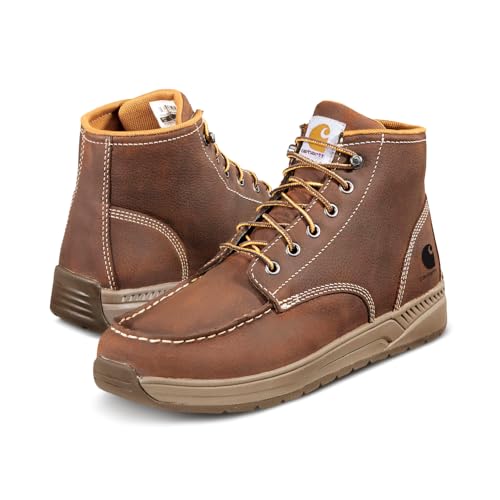
If you want the wedge sole advantage but your site mandates safety toe compliance, the CMX4023 Moc Toe Wedge is the answer. It combines the flat-contact wedge outsole with a composite toe that meets ASTM F2413-18 — and adds a Goodyear welt construction that most boots at this price point skip entirely. A Goodyear welt means the boot is resolable. A quality cobbler can replace the outsole for $60–$80, effectively doubling the boot's useful life and cutting your annual footwear cost in half.

The moc toe silhouette is wider across the forefoot than a standard cap toe, making this an excellent option for workers with wide feet or those who've previously experienced the composite toe box digging into the pinky toe. The EH rating holds, and the waterproofing uses a Storm Defender-equivalent membrane in the CMX line. Most owners size true with this model — no half-size adjustment needed unlike the CMF6366.

The one complaint that appears consistently in owner reviews: the lug-wedge hybrid sole on this model has slightly less grip on wet metal surfaces than the pure rubber lug on the Rugged Flex. If your job involves wet steel grating, ladders, or scaffolding, the Rugged Flex 6" is a better call. For flat surfaces and mixed indoor/outdoor work, the CMX4023 wins on comfort and longevity.
Best for: Carpenters, finish workers, electricians on flat sites, workers with wide feet needing safety toe compliance
Not for: High-grip wet metal surfaces, scaffolding-heavy roles
5. Carhartt 11" Insulated Wellington Steel Toe — Best for Ranch, Farm & Mud

Most work boot guides ignore agricultural and pipeline workers entirely. If you're walking muddy fields, feeding livestock, working around manure, or following a pipeline through soft terrain, you don't want a laced boot — you want a pull-on Wellington that seals out mud and water without relying on laces that rot, clog, and fail. The Carhartt 11" Wellington is the most capable barn-to-job-site boot in the Carhartt lineup.

The 11" shaft height keeps mud and debris out in the conditions a 6" boot simply cannot handle. The steel toe provides crushing resistance appropriate for livestock environments where a composite toe's lower impact resistance is genuinely a concern — a horse standing on a composite toe tells a different story than on steel. The full waterproof construction means you can wash this boot down at the end of a shift without worrying about the membrane failing over time.

The honest downside: this is a heavy boot, and it is not EH rated. If you're a ranch-based electrician or pipeline worker who also works near live circuits, you'll need the Rugged Flex 6" or CMX4023 for electrical safety. For pure mud, livestock, and terrain work, nothing in the Carhartt line matches the Wellington's combination of height, protection, and waterproofing. It also pairs well with our guide on boots for farmers in muddy fields if you're comparing options outside the Carhartt brand.
Best for: Ranchers, farmers, pipeline walkers, agricultural workers, anyone in deep mud or manure environments
Not for: Electrical work (no EH rating), long-distance walking on hard surfaces, workers needing lightweight mobility
6. Carhartt Force Nano Toe Work Sneaker — Best for Warehouse & Light Duty

The Force Nano Toe is the boot a lot of warehouse managers and long-shift workers are switching to, and the resistance they get from traditionalists who think "work boot" means heavy leather is exactly wrong. This is a safety sneaker — and that's a feature, not a compromise. The nano composite toe meets ASTM F2413-18 at roughly half the weight of a steel toe cap, the athletic last fits like a running shoe, and the FastDry moisture-wicking lining keeps feet drier than most traditional leather boots on a 10-hour warehouse shift.

The EH rating holds, which matters for warehouse workers in facilities with forklift charging stations, electrical panels, or any environment with incidental electrical exposure. The slip-resistant outsole handles smooth warehouse floors and wet dock areas. For delivery drivers, warehouse pickers, and anyone covering 8–15 miles a day on foot, this is the most ergonomically appropriate Carhartt in the lineup. Cross-reference our full roundup of work boots for warehouse pickers to see how it stacks up against non-Carhartt competitors.

Be honest with yourself about where you work before buying this. The Force Nano Toe is not a construction boot. The outsole wears faster than full leather work boots on abrasive outdoor terrain, the upper does not handle heavy debris or rough material contact, and there's no metatarsal protection. For job sites — even light construction — step up to the Rugged Flex 6". For warehouse, food service, healthcare, or delivery, the Force Nano Toe is the best value in the entire Carhartt lineup at around $110.
Best for: Warehouse workers, delivery drivers, food service, healthcare/light industrial, anyone on smooth floors all day
Not for: Outdoor construction, abrasive terrain, any environment requiring heavy-duty outsole durability
7. Carhartt CMF6371 6" Composite Toe — Best Budget / Entry-Level Pick

The CMF6371 is the Carhartt boot that built the brand's reputation in the safety footwear market. It's been around long enough that you'll find it on every job site in America, and its durability record is legitimate. For a first-time buyer who needs a compliant, honest work boot under $110, it remains a strong pick. ASTM F2413-18 compliance, EH rating, composite toe — the safety fundamentals are all present.

Here is the thing most guides won't tell you: the CMF6371 is water-resistant, not waterproof. Carhartt uses FastDry technology on this model — a moisture-wicking lining — not the Storm Defender waterproof membrane found on the Rugged Flex line. In light rain or wet grass, you'll be fine. Standing in an inch of water on a job site for four hours, your feet will be wet. If your work environment involves sustained water exposure, spend the extra $45 and get the Rugged Flex 6" instead. Don't find this out after the fact.

The other honest note: the Rugged Flex line simply outperforms the CMF6371 in every category except price. The flex technology, the superior waterproofing, the EVA midsole — the CMF6371 is a solid boot, but it's a 2015 design competing against an updated platform. Buy it if budget is the primary constraint. Buy the Rugged Flex if you can stretch to $155 and you're going to live in these boots for the next two years. For more budget-focused options across all brands, see our guide to the best work boots under $100.
Best for: First-time buyers, budget-constrained workers, light-duty jobs without sustained water exposure
Not for: Sustained wet environments, workers wanting the latest Carhartt technology platform
What Is Carhartt Rugged Flex Technology — And Does It Actually Matter?
Rugged Flex is Carhartt's proprietary construction platform that delivers approximately 30% more flexibility than standard work boot builds without sacrificing structural integrity or waterproofing. It matters if you spend your shift climbing, kneeling, or bending — and it doesn't matter if you're mostly standing still at a workstation.
- Storm Defender membrane: A breathable, fully bonded waterproof liner — not a spray coating or wax treatment. Keeps water out while allowing moisture vapor to escape, reducing sweating on long shifts
- Rugged Flex upper: A combination of full-grain leather and nylon panels positioned at flex zones — toe box, instep, and ankle — that bend with foot movement instead of fighting it
- EVA midsole: Lightweight cushioning that maintains rebound over time. Standard PU midsoles compress and deaden after 6–8 months of daily wear; EVA holds up longer
- Weight benchmark: The Rugged Flex 6" comes in at approximately 30oz per boot — lighter than most comparable steel toe or composite toe leather boots at the same price point
The short answer: if you're on your feet for more than 6 hours a day and your job involves any dynamic movement, Rugged Flex is worth the $40–$50 premium over the CMF6371 platform. If you stand at a station all day, you'll barely notice the difference.
Which Carhartt Boot Is Right for Your Trade?
| Trade / Role | Recommended Carhartt | Key Reason |
|---|---|---|
| Electrician | Rugged Flex 6" or CMX4023 | EH rated, composite toe (no metal), ASTM F2413-18 compliant — see our full guide to work boots for electricians |
| Construction (General) | Rugged Flex 6" | Storm Defender waterproofing, EH rated, best flex-to-durability ratio |
| Carpenter / Finish Work | CMX4023 Moc Toe Wedge | Wedge sole for flat surfaces, resolable Goodyear welt, wide toe box |
| Concrete Finisher / Mason | CMW6175 Wedge Soft Toe | Flat sole grip on concrete, no toe box stiffness, long-shift comfort |
| Ironworker / Steel Mill | Rugged Flex 8" Met Guard Pull-On | Internal met guard (ASTM Mt/75), 8" ankle protection, pull-on speed |
| Welder | Rugged Flex 8" Pull-On or CMX4023 | Pull-on eliminates lace burn risk; composite toe is non-conductive |
| Warehouse / Delivery | Force Nano Toe Sneaker | Athletic fit, EH rated, lightest option, best for high step-count shifts |
| Ranch / Farm / Pipeline | 11" Wellington Steel Toe | 11" shaft for mud and debris, steel toe for livestock compression risk |
| First-Time Buyer / Budget | CMF6371 | Entry-level price, solid safety compliance — just understand the waterproofing limit |
Steel Toe vs Composite Toe vs Nano Toe in Carhartt Boots
All three toe types meet ASTM F2413-18 safety standards when properly certified — the difference is weight, conductivity, and specific use-case fit.
- Steel toe (Wellington): Heaviest, highest crush resistance, conducts electricity and temperature — not EH rated, not ideal for electricians or extreme cold/heat environments
- Composite toe (Rugged Flex, CMX4023, CMF6371): Lighter than steel, non-conductive, EH rated, passes metal detectors — the right choice for most trades
- Nano toe (Force Sneaker): Lightest option, meets same ASTM impact/compression ratings as composite in a thinner cap — ideal for sneaker-style builds where bulk is unacceptable
If you work around electrical hazards, always verify the EH rating on the specific model — not just the brand. The CMW6175 wedge soft toe, for example, does not carry an EH rating. The CMX4023 does. For a full breakdown of how safety ratings work across all work boot types, see our guide to steel toe vs composite toe boots.
Carhartt Sizing — The Half-Size Problem You Need to Know
Carhartt sizing is not uniform across the line. Here's what the owner review data consistently shows:
- CMF6366 / Rugged Flex 6": Runs approximately ½ size large — most wearers order their normal size and find it slightly roomy, or size down ½ for a snug fit
- CMF6371: Generally true to size with a standard D width fit
- CMX4023 Moc Toe Wedge: True to size; the moc toe silhouette provides natural extra width across the forefoot
- CMW6175 Wedge: True to size; leather upper will stretch slightly over the first 2 weeks
- Width options: The Rugged Flex 6" and CMF6371 are available in W (wide) and select models in EW (extra wide) — check the Amazon listing for the exact width options on each ASIN
If you have wide feet or have previously dealt with composite toe boxes cutting into your pinky toe, the CMX4023 moc toe or the Rugged Flex in a W width are your best starting points. For more guidance, see our detailed breakdown of work boots for wide feet.
How Long Do Carhartt Work Boots Last? (Cost-Per-Month Reality)
The honest lifespan answer depends entirely on the model and your work environment — but here's the practical math most buyers never run:
- CMF6371 / entry level: 12–18 months of daily wear in demanding conditions — at $105, that's roughly $6–$9/month
- Rugged Flex 6": 18–24 months of daily wear — at $155, that's $6.50–$8.50/month. Comparable cost per month to the budget option, with better comfort throughout
- CMX4023 Moc Toe Wedge (Goodyear Welt): 24–36+ months if resoled — at $165 initial cost plus $70 resole, that's $165+70=235 over 4+ years, or under $5/month. Best long-term value in the lineup
- Force Nano Toe Sneaker: 12–18 months for warehouse/light duty — outsole wears faster on smooth hard floors under high step counts
The Goodyear welt on the CMX4023 is the hidden value play in the entire Carhartt lineup. A resolable boot is a fundamentally different financial proposition from a cement-lasted boot. For workers who stay in one trade long-term, it's worth the extra $15 over the Rugged Flex.
What Most Buyers Get Wrong About Carhartt Waterproofing
This is the most common and most expensive mistake Carhartt buyers make. There are two completely different waterproofing systems in the Carhartt lineup, and they are not equivalent:
- Storm Defender (membrane waterproofing): Found on the Rugged Flex line and select premium models. A fully bonded breathable membrane that blocks water ingress under sustained wet conditions — hours of standing in wet terrain. This is genuine waterproofing.
- FastDry (moisture-wicking lining): Found on the CMF6371 and Force Nano Toe. This wicks moisture away from your skin but does not block external water. Your foot will stay drier for longer in light wet conditions, but this boot will soak through in sustained water exposure.
The rule: If your job regularly puts you in standing water, rain, or wet terrain for more than an hour at a stretch — Storm Defender only. If you work indoors or in incidentally wet conditions — FastDry is sufficient. For a full guide on keeping feet dry in all conditions, see our article on how to keep feet dry in work boots.
Break-In Reality for Carhartt Leather Boots
The Rugged Flex models break in faster than traditional all-leather Carhartt boots — most wearers are comfortable within 7–10 days. The CMW6175, CMX4023, and CMF6371 use heavier full-grain leather and typically need 14–21 days of regular wear before they conform to your foot. Three steps that speed up the process:
- Wear thick work socks for the first 5 days — they compress the toe box and heel collar against your foot shape instead of a last
- Apply a leather conditioner after the first week — Obenauf's Heavy Duty LP or Bickmore Bick 4 are the standard recommendations; they soften the upper without breaking down waterproofing
- Flex the toe box manually before wearing — grip the heel and toe and bend the boot through its natural flex point 20–30 times before the first wear
Frequently Asked Questions
Are Carhartt work boots true to size?
Most Carhartt models are true to size, with one notable exception: the Rugged Flex 6" (CMF6366) runs approximately half a size large. The CMF6371, CMX4023, and CMW6175 are all true to size. Always check the specific model's sizing notes before ordering.
Are Carhartt work boots EH rated?
Several Carhartt models are EH rated, including the Rugged Flex 6", the Rugged Flex 8" Met Guard Pull-On, the CMX4023 Moc Toe Wedge, the Force Nano Toe, and the CMF6371. The CMW6175 Wedge Soft Toe and the 11" Wellington Steel Toe are not EH rated. Always verify on the specific model if electrical hazard protection is required for your site.
How long do Carhartt work boots last?
In daily heavy-duty use, expect 18–24 months from the Rugged Flex line and 12–18 months from the CMF6371. The CMX4023 Moc Toe Wedge with its Goodyear welt can last 4+ years with a professional resole. Lifespan is significantly impacted by whether you rotate between two pairs — single-pair daily use compresses midsoles faster.
What is Carhartt Rugged Flex technology?
Rugged Flex is Carhartt's construction platform that adds approximately 30% more flexibility than standard work boots using strategically placed flex zones in the upper, combined with a Storm Defender waterproof membrane, EVA midsole cushioning, and a weight reduction compared to traditional leather-only construction.
Can Carhartt boots be resoled?
Only Goodyear welt models — specifically the CMX4023 Moc Toe Wedge — can be professionally resoled. Cement-lasted models including the Rugged Flex and CMF6371 are not resolable in any practical sense. If resolability is a priority, the CMX4023 is your only option in the current Carhartt lineup.
Are Carhartt work boots good for concrete?
Yes — specifically the wedge sole models (CMW6175 and CMX4023). The flat contact patch of a wedge sole performs significantly better on poured concrete and flat surfaces than a deep lug outsole. For all-day standing on concrete, these two models are the top Carhartt picks.
What's the difference between Carhartt steel toe and composite toe?
Carhartt steel toes (found on the Wellington) are heavier, provide the highest crush resistance, and are not EH rated. Carhartt composite toes (Rugged Flex, CMX4023, CMF6371) are lighter, non-conductive, EH rated, and pass metal detectors. Both meet ASTM F2413-18 impact and compression standards when certified.
Final Verdict: Which Carhartt Should You Buy?
For most trades, the Rugged Flex 6" Composite Toe is the right call — it's the most complete work boot Carhartt makes, combining genuine waterproofing, EH compliance, composite toe, and an updated flex construction that holds up over an 18–24 month lifespan. If your job is concrete or finish work, the CMX4023 Moc Toe Wedge adds resolability that makes it the better long-term investment. If you're in warehouse or delivery, stop fighting a heavy boot — the Force Nano Toe is built for your job, not against it.
The one thing to get right before you click buy: know whether your site requires EH rating, met guard protection, or a specific toe type. The table above routes you to the right model in under 30 seconds. Don't buy a boot and discover the requirement mismatch on day one. (Still deciding on the brand itself? See our honest answers on whether Carhartt boots are any good and whether they hold up long-term.)