
Last Updated: October 25, 2025 | Tested By: The BootsGuru Team
Hey there! If you love getting out on the trails but hate letting snow shut down your adventures, snowshoes are your new best friend. They unlock the silent, beautiful world of winter landscapes, allowing you to explore places inaccessible during warmer months. The right pair makes you feel like you’re floating over the snow, keeping you suspended on top of deep drifts and letting you move naturally.
The big problem? Choosing the right pair can be overwhelming. Do you need a rigid aluminum frame or a flexible composite deck? What’s the deal with bindings—are simple straps okay, or do you need a high-tech BOA system? And how do you even pick the right size?
Don’t worry, we’ve got you covered. We’ve spent serious time testing these top models across icy mountain slopes and fluffy backcountry drifts, putting them through heavy use to see which ones actually perform and stand up to abuse. This guide breaks down the 10 best snowshoes for every kind of winter activity, from casual trail walks to serious mountaineering.
First, check out our comparison table for the quick specs, then dive into the detailed reviews to find the perfect match for your winter adventures.

Finding the best snowshoes depends on your activity and weight.
Top Picks Comparison Table: 2026’s Best Snowshoes
Here’s a quick overview of the top models we trust:
| Model | Weight (Pair, Approx.) | Ideal Activity | Binding System | Traction Type | MSRP* |
| MSR Lightning Ascent | 4 lbs 5 oz (25″) | Best Overall (Backcountry) | Paragon™ (Mesh straps) | 360° Traction Frame | $390 |
| Atlas Helium Trail | 3 lbs 2 oz (23″) | Best for Beginners | Wrapp™ Trail (Pull Webbing) | Helium Trail crampon | $150 |
| TSL Symbioz Hyperflex Elite | 4 lbs 3 oz | Best All-Terrain Hiking | BOA Fit System (on Elite) | Steel toe crampon & blades | $390 (Elite est.) |
| Dion NevaTREK | 2 lbs 10 oz | Best for Trail Running | Secure-Fit™ Webbing | Deep-Cleat™ Aluminum | $$$ |
| XtremPro Outdoors | 4 lbs 14 oz (25″) | Most Affordable (Budget Pick) | Double Ratchet Strap | Aluminum/Plastic Teeth | $50 |
| MSR Evo Trail | 3 lbs 10 oz | Best Value (Performance/Price) | Paraglide Binding (Straps) | Steel Traction Rails | $170 |
| Tubbs Mountaineer | 4 lbs 14 oz (25″) | Best for Deep Powder | ActiveFit™ 2.0 (Ratchet) | Anaconda™ Crampon | $280 |
| Atlas Helium Backcountry | 3 lbs 5 oz (25″) | Best Lightweight Backcountry | PackFlat™ Binding (Webbing) | Helium BC Crampon | $220 |
| Crescent Moon EVA | 3 lbs 5 oz | Most Comfortable / Quietest | Hook & Loop Straps | EVA Foam Lugs + Hard Inserts | $170 |
| Tubbs Flex RDG | 4 lbs (24″) | Most Walkable (Flexible Deck) | BOA Fit System | Flex Torsion Deck, Traction Rails | $210 |
* MSRP reflects manufacturer suggested retail price at time of writing and may be subject to change. Check current prices via links.
Detailed Reviews: The 10 Best Snowshoes of 2026
1. MSR Lightning Ascent

The Honest Take: This is the gold standard for serious backcountry snowshoeing. If you only buy one pair to handle everything from icy traverses to steep climbs, the Lightning Ascent is it. Its legendary 360° Traction frame features serrated teeth around the entire perimeter, providing unparalleled bite in every direction – absolutely critical for off-trail safety. The newer **Paragon™ binding** is a huge improvement, using a comfortable mesh strap that eliminates pressure points and is easy to use with gloves. Add in the essential **Ergo Televator heel lift** (easily flicked up with a pole) for uphill climbs, and optional flotation tails, and you have a durable, reliable, high-performance tool built for challenging conditions.
Pros & Cons
| Pros | Cons |
|
|
Best For: Backcountry enthusiasts, mountaineers, off-trail exploration, anyone needing maximum traction and reliability.
2. Atlas Helium Trail

The Honest Take: For recreational snowshoers sticking to packed or rolling trails, the Atlas Helium Trail offers an unbeatable mix of simplicity, low weight, and value. At just over 3 lbs, it’s incredibly light, reducing fatigue significantly. The **Wrapp™ Trail binding** uses a simple pull-webbing system that’s fast, fits a wide range of boots, and is less intimidating for beginners. While the **Helium Trail crampon** isn’t designed for steep ice, it provides reliable grip on typical trail conditions. A fantastic, affordable entry point into the sport.
Pros & Cons
| Pros | Cons |
|
|
Best For: Beginners, casual hikers on packed trails, budget-conscious buyers.
3. TSL Symbioz Hyperflex Elite

The Honest Take: The TSL Symbioz Hyperflex completely changes how snowshoeing feels. Its unique composite deck **flexes torsionally and longitudinally** with your foot’s natural movement, providing an incredibly smooth, ergonomic stride that feels less like clomping and more like walking. This flexibility also keeps the aggressive steel crampons and side blades engaged with uneven terrain. The **BOA Fit System** on the Elite version offers quick, precise, glove-friendly adjustments. While flotation in deep powder is its weakness, for long days on rolling, mixed, or icy trails, the comfort and walkability are unmatched.
Pros & Cons
| Pros | Cons |
|
|
Best For: All-terrain hiking on packed or variable snow, long distances on rolling terrain, users prioritizing walking comfort.
4. Dion NevaTREK
The Honest Take: When speed is the goal, the Dion NevaTREK is the weapon of choice for winter trail runners. Weighing under 3 pounds, these are phenomenally light. The narrow, asymmetrical frame allows a natural running stride without interference. The **Secure-Fit™ binding** is simple, incredibly secure for running shoes, and eliminates heel slap. Traction is minimalist – **Teflon-coated aluminum cleats** provide just enough bite on packed snow without adding weight. Dion’s modular system also allows swapping bindings/cleats. Pure speed and efficiency.
Pros & Cons
| Pros | Cons |
|
|
Best For: Winter trail running, snowshoe racing on packed or groomed trails.
5. XtremPro Outdoors Snowshoes
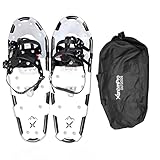
The Honest Take: Let’s be real: at around $50 (often including poles and a bag), you’re not getting a high-performance snowshoe. But what the XtremPro *does* offer is an incredibly accessible way to try snowshoeing on flat, packed trails or just walking around a snowy park. The **double ratchet bindings** are easy to use, and the basic aluminum crampons provide enough grip for casual, non-technical use. It gets you out on the snow without breaking the bank.
Pros & Cons
| Pros | Cons |
|
|
Best For: First-time casual users, flat park walks, absolute budget buyers.
6. MSR Evo Trail

The Honest Take: The MSR Evo Trail is arguably the best value in snowshoeing. You get legendary MSR durability and excellent traction for a very reasonable price. Its unique **unibody polypropylene deck** is incredibly tough and virtually indestructible. The traction comes from aggressive **steel side rails** and toe crampons, providing fantastic grip on packed snow and even moderate icy slopes. The updated **Paraglide™ bindings** are simple, secure, freeze-proof, and easy to use with gloves. While it lacks a heel lift and can be noisy on hardpack, its blend of durability, traction, and price makes it the workhorse choice for most recreational hikers.
Pros & Cons
| Pros | Cons |
|
|
Best For: Recreational hikers, value-conscious buyers needing durability, rolling terrain with moderate ice.
7. Tubbs Mountaineer

The Honest Take: When you’re breaking trail through waist-deep powder or tackling serious mountain terrain, the Tubbs Mountaineer is your tool. Its large surface area (available up to 36″) provides **maximum flotation**. The aggressive **Anaconda™ carbon steel toe crampon** combined with heel crampons offers a vice-like grip for climbing steep, soft slopes. The **ActiveFit™ 2.0 binding** uses a reliable ratchet system perfect for locking down bulky mountaineering boots. Add the highest heel lift on the market (**ActiveLift™ 19°**), and you have a backcountry beast built for heavy loads and deep snow.
Pros & Cons
| Pros | Cons |
|
|
Best For: Deep powder, mountaineering, carrying heavy packs, breaking trail, users needing maximum flotation.
8. Atlas Helium Backcountry

The Honest Take: For winter thru-hikers, fast-packers, or anyone counting every single ounce, the Atlas Helium Backcountry is a game-changer. It delivers serious backcountry features – aggressive **Helium BC crampon** traction, a heel lift, and durable composite decking – at a staggeringly low weight (just over 3 lbs). The **PackFlat™ binding** is key for long trips, allowing the snowshoes to pack flat against a backpack. It’s a remarkably capable technical snowshoe that disappears on your feet and your pack.
Pros & Cons
| Pros | Cons |
|
|
Best For: Winter thru-hiking, fast-packing, lightweight backcountry tours, ounce-counters.
9. Crescent Moon EVA

The Honest Take: If you find traditional snowshoes loud, clunky, and unnatural, the Crescent Moon EVA foam snowshoe is a revelation. Made from dual-density EVA foam (like running shoes), it’s **whisper-quiet**, incredibly lightweight, and has a rocker shape that promotes a natural walking stride. The simple hook-and-loop straps are comfortable and secure. The “traction” comes from embedded hard plastic lugs. It’s surprisingly effective on packed snow, light powder, and even slush. Just don’t mistake it for a technical snowshoe – it has **no place on steep, icy terrain.**
Pros & Cons
| Pros | Cons |
|
|
Best For: Casual hikers on packed trails, dog walkers, users prioritizing comfort and quiet, gentle terrain.
10. Tubbs Flex RDG

The Honest Take: Similar to the TSL Symbioz, the Tubbs Flex RDG uses a **flexible composite deck (Flex Torsion Deck)** that allows for a more natural, comfortable stride on rolling terrain. Combined with the incredibly convenient **BOA Fit System** (dial closure), it’s one of the easiest and most comfortable snowshoes to walk in for long distances. The traction comes from steel rails and a toe crampon, providing good grip on packed snow and moderate slopes. The flexible tail also sheds snow effectively, reducing swing weight.
Pros & Cons
| Pros | Cons |
|
|
Best For: Day hikers on rolling terrain, users who value convenience (BOA binding) and a natural walking feel.
How to Choose Snowshoes: A Buyer’s Guide

Matching snowshoe type and size to your activity and weight is crucial.
Choosing the right snowshoe ensures safety and enjoyment. It boils down to your activity, weight, and needed features.
1. Match Your Activity (Trail vs. Backcountry vs. Running)
- Recreational/Trail (Packed Snow): Light, simple models with moderate traction work best. Comfort and ease of use are key. (e.g., MSR Evo Trail, Atlas Helium Trail, Crescent Moon EVA).
- Rolling Terrain/Hiking (Variable Snow): Need a balance of flotation, traction (toe/heel crampons), sturdy bindings, and often heel lifts. (e.g., TSL Symbioz, Tubbs Flex RDG).
- Steep/Backcountry (Deep Snow/Ice): Demand maximum traction (aggressive crampons/rails), robust bindings, heel lifts, and often larger sizes for flotation. (e.g., MSR Lightning Ascent, Tubbs Mountaineer, Atlas Helium BC).
- Running:** Ultralight, narrow, minimalist traction for speed on packed trails. (e.g., Dion NevaTREK).
2. Sizing: Based on Total Weight (You + Gear!)
This is critical for flotation. Size based on your **body weight PLUS the weight of your pack, clothing, and gear.**
| Total Loaded Weight | Recommended Length | Best For |
|---|---|---|
| 80 – 160 lbs | 21 – 23 inches | Packed snow, lighter hikers |
| 120 – 200 lbs | 25 – 27 inches | All-around, most common size |
| 170 – 250 lbs | 30 inches | Heavier loads, deeper snow |
| 220+ lbs | 35 – 36 inches | Max flotation, deep powder, heavy packs |
Rule of Thumb:** Choose the smallest size that supports your weight for better maneuverability, unless you primarily encounter deep powder, where larger is better.
3. Decoding the Features
- Frames & Decking: Aluminum frames are durable; composite decks (plastic) can be lighter or flexible. Decking material (nylon, plastic) provides flotation.
- Bindings: Secure your boot. Look for ease of use (with gloves), comfort (no pressure points), and security. BOA dials are fast but not field-repairable. Strap/mesh systems (MSR Paragon) are reliable and often repairable.
- Traction: Steel crampons (toe/heel) and side rails provide grip on ice/slopes. Mountaineering models have the most aggressive teeth.
- Heel Lifts (Televators): Essential for steep uphill climbs. Reduces calf fatigue significantly. Look for pole-deployable options.
4. MSR vs. Atlas vs. TSL: Brand Focus
- MSR: King of traction, durability, backcountry performance.
- Atlas: Focus on comfort, user-friendly bindings (BOA), lightweight composite (Helium).
- TSL: Innovator in flexible decks for natural walking motion.
How We Tested

We didn’t just read spec sheets. Our testing involved real snow in diverse conditions – from light Colorado powder to heavy Pacific Northwest slush. We tackled steep inclines, icy traverses, and deep drifts, evaluating flotation, grip, durability, binding security, and ease of use (especially with gloves). Comfort over several hours was a key factor.
How to Store and Maintain Your Snowshoes
Good snowshoes can last a decade+ with simple care:
- After Use: Knock off snow/ice. Rinse off salt/grit if needed. Air dry completely away from direct heat.
- Pre-Storage: Inspect bindings, rivets, crampons, straps for damage. Sharpen dull crampons with a file if needed. Lubricate metal pivots/buckles with silicone spray.
- Storage: Store in a cool, dry place out of direct sunlight (UV degrades materials). Use a bag or hang them, crampons facing inward.
Frequently Asked Questions (FAQ)
Do I need poles with my snowshoes?
Highly recommended, especially for uneven or steep terrain. Poles provide balance, aid propulsion, reduce joint strain, and help you get up after a fall. Use trekking poles with snow baskets swapped in.
What boots should I wear with snowshoes?
Insulated, waterproof hiking boots or winter boots are essential. Avoid soft trail runners for general hiking. Pair with quality merino wool or synthetic socks (NO COTTON). Gaiters are crucial to keep snow out of your boots.
How is a women’s snowshoe different?
They are often narrower with frames shaped for a smaller gait to prevent stepping on the snowshoes. Bindings may also be sized differently. However, sizing should primarily be based on total loaded weight.
What’s the difference between running and backpacking snowshoes?
Running snowshoes are ultralight, narrow, and minimalist for speed on packed trails. Backpacking snowshoes are larger, more durable, with aggressive traction and heel lifts designed to support heavy loads in deep snow.
Final Verdict
Finding the right tool for the job transforms winter from an obstacle into an invitation. Choose your snowshoes based on your typical terrain and weight, and a whole new season of exploration opens up.
- For the Serious Adventurer/Backpacker: You will never regret investing in the MSR Lightning Ascent. Its unmatched traction and bombproof build are worth every penny for safety and reliability.
- For the Weekend Hiker/All-Around Use: The MSR Evo Trail offers legendary durability and great traction at an unbeatable value. Or, for a uniquely comfortable stride on rolling trails, consider the TSL Symbioz Hyperflex or Tubbs Flex RDG.
- For the First-Timer on Packed Trails: The Atlas Helium Trail is light, user-friendly, and a fantastic value to get you started.
Grab the right pair, layer up, and go enjoy the quiet beauty of the winter world!