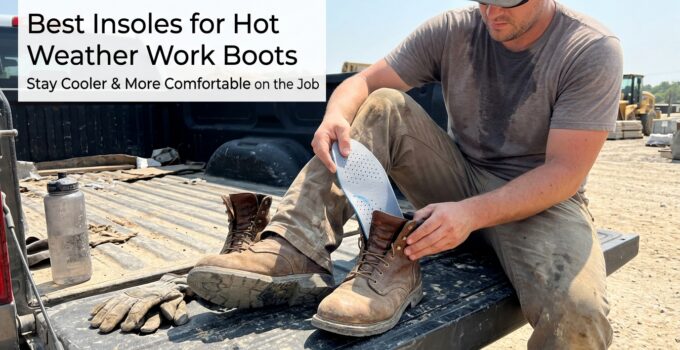
Your insoles are dead by lunch. Not your boots — your insoles. You bought decent boots, you laced them up, and by the time the sun hit the asphalt at 10 AM your feet were soaked, hot, and that soft layer underfoot had compressed to something closer to cardboard than cushion. This is not a comfort problem. It is a materials problem. The foam in most budget insoles has a heat tolerance threshold of around 40°C (104°F). Inside a steel-toe boot on a summer construction site, the boot interior regularly hits 50 to 60°C. Cheap EVA foam at those temperatures does not just feel softer — it permanently deforms, losing up to 40% of its original thickness within the first few hours of a hot shift.
The fix is not buying better boots. It is buying insoles built for the specific conditions that summer work creates: radiant heat from asphalt and concrete, sweat accumulation that standard foam cannot wick away, foot swelling that peaks by midday and fights with whatever was a perfect fit at 7 AM, and the particular cruelty of steel toe boots — which compress the toe box just enough to make any insole that adds the wrong kind of volume cause pressure points right where you don’t need them.
This guide covers eight insoles selected specifically for summer and hot weather work boot use. They are ranked by breathability, heat stability, arch support durability, and trade fit. Budget picks that last through a hot season, mid-tier picks with semi-rigid shells that hold their shape when foam softens, and premium picks for the specific edge cases — steel toe compression, plantar fasciitis in heat, and the HVAC technician spending four hours in a 120°F attic — that generic insole guides never address.
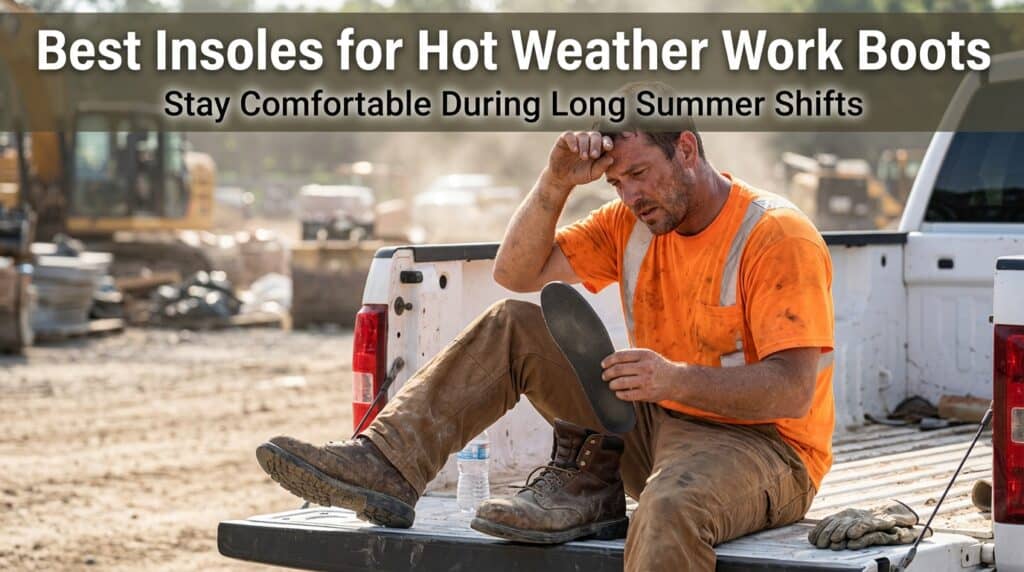
A construction worker adjusting insoles in his work boots to stay comfortable during hot weather shifts.
What Are the Best Insoles for Hot Weather Work Boots?
For most workers in hot conditions: Superfeet Work Cushion (best overall summer support), Timberland PRO Anti-Fatigue (best for concrete and asphalt standing), and Sof Sole Airr Orthotic (best active airflow for breathability-first needs). For steel toe boots specifically: Protalus M-100 Elite (thinnest full-support insole that fits without creating toe box pressure). See the full trade breakdown below.
Quick Comparison: Best Insoles for Hot Weather Work Boots (2026)
| Insole | Best For | Arch Type | Heat Durability | Steel Toe Compatible | Price |
|---|---|---|---|---|---|
| Superfeet Work Cushion | Best overall / all-day standing | Medium arch | ★★★★★ | ✅ Yes | ~$30–$40 |
| Dr. Scholl’s WORK Gel Advanced | Best budget / warehouse | Low-medium | ★★★☆☆ | ✅ Yes | ~$12–$18 |
| Timberland PRO Anti-Fatigue | Best for concrete / hard floor standing | Medium | ★★★★☆ | ✅ Yes | ~$25–$35 |
| Powerstep Pinnacle Maxx | Best for high arches / plantar fasciitis in heat | High arch | ★★★★★ | ~$25–$35 | |
| Sof Sole Airr Orthotic | Best breathability / airflow | Medium | ★★★★☆ | ✅ Yes | ~$20–$30 |
| Polysorb Cross Trainer | Best moisture wicking / roofers | Low-medium | ★★★★☆ | ✅ Yes | ~$18–$28 |
| CURREX SupportSTP | Best for HVAC / varied terrain trades | Dynamic | ★★★★★ | ✅ Yes | ~$40–$55 |
| Protalus M-100 Elite | Best steel toe boot fit / slim profile | Medium-high | ★★★★★ | ✅ Best choice | ~$45–$60 |
1. Superfeet Work Cushion Insoles — Best Overall Summer Work Boot Insole

Best for: All-day standing workers in hot conditions who need the full combination of heat-stable support, dual-layer cushioning, and odour control that makes the Superfeet Work Cushion the closest thing to a summer-specific insole that a general-purpose pick can be.
Most “best for summer” insole claims are marketing. The Superfeet Work Cushion earns the label structurally. The dual-layer foam system uses a high-density base layer specifically selected for its resistance to heat-driven compression — the failure mode that turns budget insoles to mush by noon in hot work environments. Where standard EVA compresses permanently at temperatures above 40°C, Superfeet’s stabiliser cap and foam combination maintains its geometry through the temperature swings a work boot experiences across a summer shift: from ambient in the morning, to 50°C+ during sustained concrete or asphalt standing at midday, and back down during break periods. The odour control coating is particularly relevant for summer use — antimicrobial treatment that manages the bacterial growth that hot, moist boot interiors accelerate significantly faster than in winter conditions.

The medium arch profile covers the widest range of foot types without requiring a specific arch diagnosis. Workers with normal to slightly flat arches will find the support hits correctly. Workers with very high arches should look at the Powerstep Pinnacle Maxx (Pick 4) for more aggressive arch posting. The insole is trimmable to fit, with size markers on the trim edge — always trim from the toe end only, never the heel. Steel toe boot compatibility: the Work Cushion is available in multiple size ranges with a moderate profile that fits into standard steel toe boxes without the toe-area pressure that thicker insoles create. If you are between sizes, go to the smaller size and trim rather than using a larger insole that crowds the toe box.

✅ Best for: Warehouse workers, construction supervisors, general labour, anyone needing summer-durable daily support across a full shift in hot conditions.
⚠️ Not ideal for: Very high arch profiles (the medium arch won’t provide enough posting); workers who specifically need maximum airflow (the Sof Sole Airr, Pick 5, is better for breathability-first priorities).
Pros: Heat-stable dual-layer foam resists the compression that kills budget insoles in summer, antimicrobial odour control specifically relevant for hot/moist summer boot interiors, medium arch covers the widest range of foot types, trimmable for steel toe fitting, Superfeet’s proven construction quality.
Cons: Not the maximum breathability pick — if airflow is your #1 priority, Pick 5 is more specific. Medium arch profile will under-support very high arches. Higher price than budget alternatives.
2. Dr. Scholl’s WORK Massaging Gel Advanced Insoles — Best Budget Insole for Summer

Best for: Budget-first workers who need an accessible summer insole that outperforms bare stock insoles significantly, with a gel layer that resists the initial heat-driven softening better than pure EVA foam alternatives at the same price point.
The honest budget insole assessment: Dr. Scholl’s WORK Gel Advanced is not the most heat-durable insole on this list, and it will not outlast premium alternatives in sustained high-temperature conditions. What it does correctly is provide a sweat-resistant gel layer that manages the moisture accumulation that standard foam insoles cannot. Gel does not absorb moisture the way foam does — it resists saturation at the surface, which means the insole does not develop the compacted-wet-foam sensation that budget foam insoles produce by early afternoon on a hot day. The massaging gel nodules specifically provide active circulation stimulation with each step, which matters more in summer conditions when prolonged standing in heat reduces lower limb circulation compared to cooler seasons.

Replace these more frequently than premium alternatives in summer conditions. The EVA foam base compresses at standard rates — plan replacement at 6 to 8 weeks of daily hot-weather use rather than the 6 month interval that premium insoles allow. The cost math: at $12 to $18 per pair, even 5 replacements per summer season costs less than a single premium insole. For workers who are not experiencing arch conditions or plantar fasciitis, this replacement-frequency budget approach is entirely rational. Steel toe compatibility is good — the relatively thin gel profile does not add significant volume to the toe box.

✅ Best for: Warehouse workers, delivery drivers, and general labour on a tight budget; first insole purchase for workers who want to evaluate whether insole upgrading makes a noticeable difference before committing to a premium option.
⚠️ Not ideal for: Workers with plantar fasciitis or high arches who need structural arch support — gel provides cushioning but not posting. Workers who want to buy once and not think about insoles for 6+ months.
Pros: Most accessible price point on this list, gel layer resists moisture saturation better than pure foam at the same price, massaging nodules support circulation during prolonged summer standing, widely available and easily replaceable, good steel toe box compatibility.
Cons: EVA base compresses at 6–8 weeks in summer heat — faster replacement cycle than premium picks. No meaningful arch support for workers with specific arch conditions. Not the answer for plantar fasciitis.
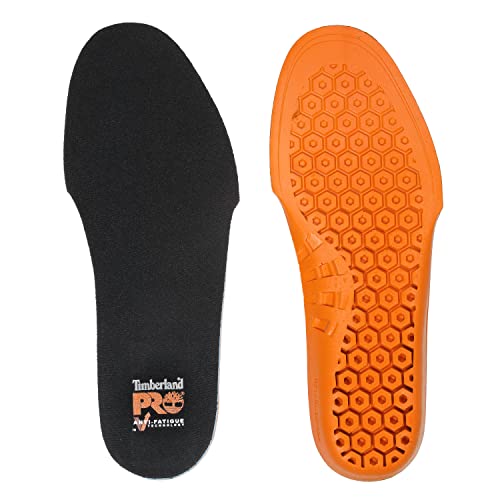
3. Timberland PRO Anti-Fatigue Insoles — Best for Concrete and Hard Surface Standing
Best for: Construction workers, concrete finishers, manufacturing floor staff, and anyone whose summer work involves sustained standing on hard surfaces where the combination of heat from above and radiant heat from the concrete below creates the most punishing insole environment available in a work setting.
The Timberland PRO Anti-Fatigue insole’s defining technology is the inverted cone geometry — a midsole structure that uses cone-shaped compression points rather than a flat foam layer to absorb impact and return energy. On a hot concrete floor in summer, this geometry does something that flat foam cannot: it manages heat transfer from the ground surface as a structural feature. Flat foam transmits heat conductively across its entire surface area when in contact with hot concrete. The inverted cone structure creates air pockets within the insole’s footprint that interrupt this conductive transfer, reducing the temperature the foot experiences relative to a flat insole with equivalent surface contact. This is the specific reason Timberland PRO’s insole belongs in a summer guide that flat-foam alternatives do not — the geometry addresses heat at the ground interface, not just at the foot surface.

The Anti-Fatigue technology also returns energy at toe-off — the forward propulsion phase of walking and standing movement that becomes progressively more fatiguing as the day extends in heat. This energy return is measurably present in the morning and remains functional into the afternoon, which is the key differentiator from budget foam that provides cushioning at 8 AM and essentially nothing by 2 PM. Workers who stand in one position for extended periods on concrete (assembly line, concrete finishing) will notice this less than workers who walk continuously, but both groups benefit from the reduced cumulative ground-contact fatigue that the cone geometry provides. Note: these insoles are not the maximum arch support option — for high arch profiles, see Pick 4.

✅ Best for: Concrete workers, manufacturing floor workers, construction crews on hard surfaces, warehouse workers whose routes involve sustained standing more than walking.
⚠️ Not ideal for: Very high arch profiles requiring posting. Workers whose primary summer concern is moisture wicking rather than heat-from-ground management — see Pick 6 for wicking priority.
Pros: Inverted cone geometry reduces conductive heat transfer from hot ground surfaces — summer-specific advantage over flat foam, energy return at toe-off extends effective cushioning through afternoon hours, proven construction from a brand whose insoles are specifically used by heavy-trade workers, steel toe compatible profile.
Cons: Not maximum arch support — workers with high arches should use Pick 4 instead. No active airflow — if breathability is the priority, Pick 5 is more specific. Mid-tier price point.
4. Powerstep Pinnacle Maxx Insoles — Best for High Arches and Plantar Fasciitis in Summer Heat

Best for: Workers with high arches or plantar fasciitis who need arch support that maintains its structural integrity as the boot interior heats up — the Powerstep Pinnacle Maxx’s semi-rigid shell is specifically what keeps this insole supporting correctly when soft-foam alternatives have collapsed.
Here is the specific summer problem for plantar fasciitis sufferers that no generic insole article explains: heat softens foam. The semi-flexible arch support in budget insoles relies on foam density to provide the posting that reduces fascial tension. When that foam softens at 50°C boot temperatures, the arch collapses to a lower height than designed, reducing support precisely at the point when feet are most fatigued and most susceptible to PF aggravation. The semi-rigid polypropylene shell of the Powerstep Pinnacle Maxx does not soften at work boot temperatures. The shell maintains its geometry across the temperature range a hot-weather boot experiences, which means the arch support you measured when you put the insole in at 7 AM is functionally the same arch support at 2 PM — a characteristic that soft-foam competitors simply cannot match in summer conditions.

The Pinnacle Maxx specifically targets high arch profiles with more aggressive posting than standard insoles. If you have a normal to low arch and have been using this insole, you may find it overcorrects — it is specifically designed for the upper end of the arch height spectrum. The double-layer EVA cushioning above the shell provides adequate shock absorption while the shell below provides the structural support. The VCT (Variable Cushioning Technology) foam layer is firmer than standard EVA precisely to resist the heat-driven compression that degrades softer foam alternatives faster in summer. Steel toe compatibility requires checking the specific trim size — the Maxx has a wider heel base than some insoles, and workers with very compressed toe boxes in steel toe boots should trim carefully to the smaller size range.

✅ Best for: Workers with high arches, plantar fasciitis sufferers in summer conditions, asphalt crews and anyone whose hot-environment work has caused their previous soft insoles to fail to provide consistent all-day PF relief.
⚠️ Not ideal for: Normal or flat arches — the Maxx’s aggressive posting will overcorrect for lower arch profiles. Steel toe wearers should verify the trim fits their specific boot before committing.
Pros: Semi-rigid polypropylene shell maintains arch height in summer temperatures where soft-foam insoles collapse, specifically designed for high arch profiles and PF management, VCT foam resists heat compression better than standard EVA, podiatrist-designed construction, good durability for the price.
Cons: Too aggressive for normal or low arch profiles. Trim-fit check required for steel toe applications. Not a breathability-focused pick — see Pick 5 if airflow is your primary concern alongside arch support.
5. Sof Sole Airr Orthotic Insoles — Best Breathability and Active Airflow

Best for: Workers whose primary summer insole problem is heat accumulation and sweat — whose feet are not just uncomfortable but genuinely hot from inadequate air circulation inside the boot — and who want the most active ventilation mechanism available in an insole.
Most insoles manage moisture passively — wicking fabric on the surface draws sweat away from the skin, but the air inside the boot remains stationary and hot. The Sof Sole Airr’s air chamber heel changes this. Each heel-strike compresses the air chamber and each toe-off draws air back in — creating a bellows-like microventilation cycle with every step. In a sealed boot where the upper provides no meaningful air exchange, this active air movement at the insole level is the most effective passive cooling mechanism available without an external fan. The air chamber is specifically positioned at the heel because this is where heel-strike impact generates the most heat at the insole interface and where the most circulation benefit is achieved.

The honest expectation about “cooling insoles”: no insole refrigerates your feet. The Sof Sole Airr does not make your feet cold — it makes them meaningfully less hot than they would be in the same boot with a non-ventilated insole. The subjective difference that workers describe is not coolness but the absence of the trapped heat accumulation that produces the burning sensation in the afternoon of a hot shift. The orthotic component provides medium arch support appropriate for normal to slightly low arches. The combination of arch support and active ventilation in one insole makes this the most well-rounded breathability pick for workers who need both functions without separate insoles. Heel chamber durability: the air chamber is a sealed unit that should last 6 to 10 months of regular use before the chamber integrity degrades — inspect periodically.

✅ Best for: Workers who describe their summer boot problem as “burning feet” rather than arch pain or fatigue — HVAC technicians in enclosed spaces, roofers in direct sun, any worker in conditions where heat accumulation inside the boot is the primary comfort failure.
⚠️ Not ideal for: High arch profiles requiring aggressive posting — the medium arch support is insufficient for significant PF or high arch conditions. Workers who prioritise long-term structural support over airflow management.
Pros: Air chamber heel creates active microventilation with every step — the most functional breathability mechanism available in a work boot insole, reduces heat accumulation specifically relevant for summer enclosed-boot conditions, medium arch support for normal foot profiles, good steel toe box compatibility, available in multiple widths.
Cons: Air chamber adds slight heel height — verify boot fit before purchasing. Not for high arch or significant PF conditions. Air chamber integrity should be periodically inspected for degredation at high daily mileage.
6. Polysorb Cross Trainer Insoles — Best Moisture Wicking for Roofers and Delivery Workers
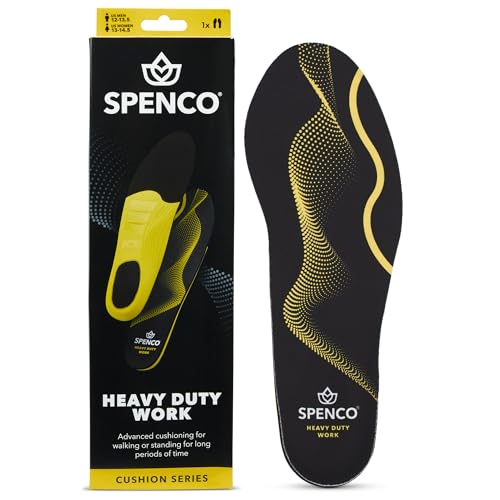
Best for: Roofers, delivery drivers, and outdoor workers who move constantly across varied terrain in summer heat and whose primary insole failure is moisture saturation — the Polysorb’s 4-way stretch fabric top cover is the fastest-drying, most effective sweat-management surface available at this price point.
The top cover fabric is where summer insole moisture management actually happens, and the Polysorb Cross Trainer’s 4-way stretch fabric is specifically engineered for rapid moisture movement. Where standard insole covers hold sweat against the foot until the fabric is saturated (at which point wicking stops entirely), the cross-trainer fabric moves moisture laterally and downward through the cover toward the foam layer where it can evaporate. For workers covering 8 to 15 miles per shift across a summer delivery route or walking across a roof in direct sun, this faster moisture transfer extends the period before the boot interior reaches the fully-saturated state that causes blistering and the hot, waterlogged sensation that makes afternoon shifts difficult. The fast-drying characteristic also means overnight drying between shifts is more complete — the insole returns to near-dry condition before the next day’s shift rather than starting damp.

The cushioning profile is softer than the anti-fatigue picks and appropriate for workers who prioritise comfort on varied terrain over maximum cushioning for sustained static standing. Roofers who step across uneven tile and shingles, delivery workers whose surfaces change from pavement to gravel to stairs within minutes, and HVAC workers navigating attic spaces benefit from the flexible cushioning that conforms to irregular surfaces better than rigid anti-fatigue structures. The polyurethane foam base resists compression better than standard EVA at equivalent price points — the “Polysorb” in the name reflects the polyurethane absorption layer that provides the heat-stability advantage over budget alternatives. Recommended replacement at 8 to 10 months of daily summer use.

✅ Best for: Roofers in direct sun, delivery drivers covering high daily mileage across varied surfaces, any worker whose summer insole problem manifests as wet, waterlogged feet rather than burning or arch fatigue.
⚠️ Not ideal for: Workers who need maximum structured arch support for PF or high arches — the Polysorb is comfort-cushioning focused, not arch-support focused. Not for workers who primarily stand in one position on hard concrete.
Pros: 4-way stretch fabric top cover moves moisture faster than standard insole covers — extends the comfortable portion of a hot, sweaty shift, polyurethane base resists heat compression better than EVA at similar price, flexible cushioning conforms to varied terrain, fast overnight drying between shifts, good all-day comfort profile for high-mobility summer trades.
Cons: Not maximum structured arch support — workers with PF should use Pick 4 instead. Softer cushioning profile less appropriate for sustained static standing on concrete than the Timberland PRO (Pick 3). Not the breathability-through-airflow pick — see Pick 5 for active ventilation priority.
7. CURREX SupportSTP Insoles — Best for HVAC Technicians and Mixed-Terrain Trades
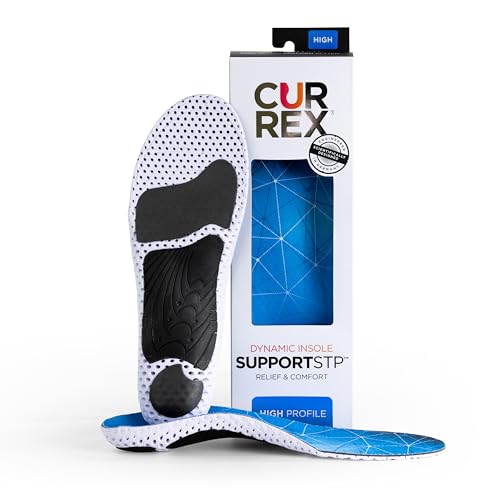
Best for: HVAC technicians, electrical workers, plumbers, and tradespeople who work across varied terrain and positions in hot conditions — the CURREX SupportSTP’s dynamic arch profile technology provides support that adapts to foot movement rather than imposing a fixed profile that fights natural summer foot swelling and gait variation.
Most insole arch support works like a physical ramp — a fixed structure that pushes against the arch regardless of the position the foot is in or how much the foot has swollen during the shift. CURREX’s dynamic arch technology uses a different approach: a variable-profile structure that provides more posting during the high-load phases of the gait cycle and more flexibility during the recovery phase. For tradespeople who spend their day in varied positions — kneeling, climbing, crouching in attic spaces, standing on ladders — a fixed-profile insole fights these varied loading patterns while a dynamic profile accommodates them. In summer specifically, this matters because feet swell up to half a size by midday, changing the relationship between the foot’s arch and a fixed-profile insole. A dynamic profile adapts to this swelling-driven change rather than becoming an increasingly poor fit as the shift progresses.

The SupportSTP (Standing/Training/Performance) is available in three arch profiles — low, medium, and high — and matching the correct profile to your arch type is the most important purchase decision. The insole will not function correctly if you buy the wrong arch profile regardless of its quality. To identify yours: wet your foot and step on a paper bag. A full footprint with minimal inward curve = low arch (get the low profile). A curve that excludes about half the midfoot = medium. A narrow midfoot impression = high arch. The premium price point reflects genuine engineering quality — this is the insole for workers who have tried multiple cheaper options and found them inadequate for the specific demands of mixed-position trade work in hot conditions.

✅ Best for: HVAC technicians, electricians, plumbers, and skilled tradespeople in varied-position work; workers who have experienced fixed-profile insoles fighting their natural foot movement; summer conditions where foot swelling changes the fit relationship over the course of a shift.
⚠️ Not ideal for: Workers who do not correctly identify and match their arch profile — wrong profile selection negates the insole’s advantage. Not the budget option — the premium price is only justified for workers in the specific mixed-terrain/position use case.
Pros: Dynamic arch profile adapts to foot movement and summer swelling rather than imposing a fixed structure that fights natural gait variation, available in three arch profiles for correct matching, premium construction quality for sustained daily trade use, excellent heat stability, good steel toe compatibility.
Cons: Must correctly identify arch profile — buying wrong profile defeats the purpose. Premium price point. Not necessary for workers with static-standing routes where a fixed profile works adequately.
8. Protalus M-100 Elite — Best for Steel Toe Boots and Tight Toe Box Fit
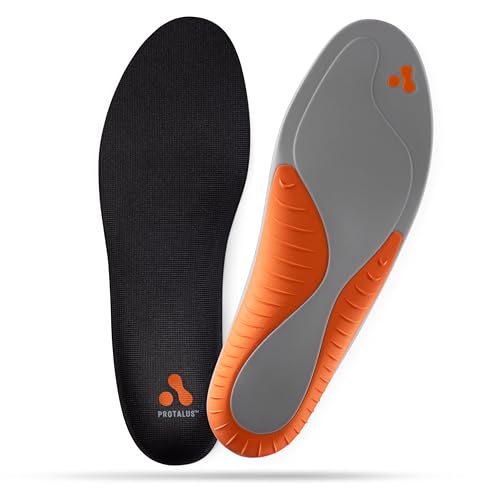
Best for: Workers who wear steel toe or composite toe safety boots and have been unable to add insole support without creating the toe box pressure and cramping that thicker insoles cause in compressed safety toe profiles — the Protalus M-100’s slim profile is the specific engineering solution to this problem.
Steel toe boots have a fixed interior volume determined by the safety cap geometry. Adding a standard-thickness insole to a steel toe boot reduces toe box volume, pushing the toes against the underside of the safety cap and creating exactly the pressure point that causes toenail bruising, toe pain, and circulation restriction in warm-weather use when feet are already swelling. The standard advice — “just buy a half size larger” — solves the insole volume problem by creating a worse fit everywhere else. The Protalus M-100 Elite’s slim profile is designed specifically to provide biomechanical alignment and arch support with minimum additional volume, fitting inside steel toe boots without triggering the toe box pressure problem. The Protalus alignment system works differently from standard arch posting — rather than pushing the arch upward, it aligns the heel, ankle, and arch in a posture that reduces fascial loading without requiring the same volume as a high-profile posting insole.

The summer-specific advantage: in summer heat, feet swell. In a steel toe boot with a standard-thickness insole already filling the volume, mid-shift foot swelling creates a compression event in the toe box that does not occur in the morning — contributing to the afternoon toe pain that many workers incorrectly attribute to the boot rather than the insole-volume interaction. The M-100’s slim profile leaves enough volume margin that standard summer swelling does not create this compression crisis. The premium price is the highest on this list — it is specifically justified for workers in steel toe boots who have tried cheaper insoles and experienced the toe box cramping problem. For soft-toe boot wearers without this specific constraint, other picks provide better value at their price points.

✅ Best for: Any worker in steel toe or composite toe safety boots who has experienced toe box pressure, toenail pain, or cramping from insole use; workers with safety toe boots who have been told insoles won’t fit their boot type.
⚠️ Not ideal for: Soft-toe boot wearers who don’t have the toe box volume constraint — other picks at lower price points provide comparable support. Workers whose primary concern is breathability or moisture wicking rather than biomechanical fit.
Pros: Slim profile specifically designed for steel toe and composite toe boot compatibility, Protalus alignment system provides biomechanical support with minimum volume addition, leaves volume margin for summer foot swelling without triggering toe box compression, premium construction durability for daily safety boot use, effective heat stability.
Cons: Premium price point — the highest on this list, justified only for the specific steel toe use case. Not the maximum cushioning or breathability pick — this insole solves the fit problem, not the airflow or anti-fatigue problem primarily.
What to Look for in Summer Work Boot Insoles
Top Cover Material: Wicking vs. Non-Wicking
The top cover is the insole surface your foot actually contacts. In summer conditions, the difference between a wicking and non-wicking top cover is measurable within the first two hours of a hot shift. Non-wicking covers (basic foam, smooth fabric) allow sweat to pool between the foot and the insole surface — creating the wet, sliding sensation that causes blisters. Wicking covers (polyester mesh, 4-way stretch performance fabric) move moisture laterally away from the skin surface toward the edges of the insole where evaporation can occur.
What to look for: “moisture wicking,” “anti-moisture,” “performance fabric,” or “mesh top cover” in the product description. What to avoid: “soft fabric lining,” “plush top cover,” or any description that emphasises softness over moisture management — these are winter-oriented cover materials that trap moisture in summer conditions.
Foam Type: Heat Stability Is the Summer Variable
EVA (ethylene vinyl acetate) is the standard insole foam. It is lightweight, cushioned, and inexpensive. It also has a heat tolerance threshold around 40°C (104°F). Inside a work boot on a summer construction site, interior temperatures routinely reach 50 to 60°C during sustained hard-surface standing. At these temperatures, EVA undergoes permanent compression — it does not spring back when the boot cools. A brand-new EVA insole at 7 AM may be providing 15mm of cushioning. By 2 PM in a hot boot, that same insole may be providing 8 to 9mm — and the loss is permanent, not temporary.
Heat-stable alternatives: PU (polyurethane) foam maintains its geometry at higher temperatures and recovers better from heat compression. Semi-rigid polypropylene shells (Powerstep, Superfeet Green) do not compress at work boot temperatures regardless of how hot the boot interior gets. Gel compounds resist heat compression better than standard EVA. The practical buying rule: any insole that will spend hours in a hot boot should have a PU base layer, a semi-rigid shell, or a gel component — not just EVA throughout.
Arch Profile: Summer Swelling Changes the Fit
Feet swell in heat. Specifically, the combination of sustained standing, vasodilation in warm temperatures, and fluid accumulation in the lower limbs causes feet to increase 5 to 10% in volume from morning to mid-afternoon in summer conditions. This swelling affects the relationship between a fixed-profile insole and the foot’s arch — a high-profile insole that fits correctly at 8 AM may create pressure at 1 PM when the midfoot has swollen against it.
Summer buying guidance: choose your arch profile correctly for your morning anatomy, but if you are between profiles, choose the lower of the two for summer use. Dynamic arch profiles (CURREX) accommodate swelling better than fixed profiles. If you experience arch pain specifically in the afternoons that was not present in the morning, insole arch overcorrection from swelling is the likely cause.
Thickness: The Steel Toe Compatibility Guide
Steel toe and composite toe boots have a fixed interior volume that standard-depth insoles compromise. The practical guide: remove your existing stock insole and place the new insole next to it for comparison. If the new insole is significantly thicker than the stock, you will likely experience toe box pressure when it is installed. Solutions: (1) choose a slim-profile insole specifically designed for safety toe boots (Protalus M-100 Elite is the specific recommendation); (2) size up by half a step and use a standard-profile insole; (3) trim the insole to the smaller end of your size range, reducing both length and heel volume.
Why Summer Heat Destroys Cheap Insoles
The foam science in plain language: EVA foam is a closed-cell structure — millions of tiny air pockets trapped in a polymer matrix. The cushioning you feel when you step on an EVA insole is the compression of these air pockets. When you lift your foot, the foam should spring back as the pockets re-expand.
Heat changes this. Above approximately 40°C, the polymer matrix of EVA begins to soften. The air pockets compress more easily under foot weight, and the softened polymer does not return them to their original shape when the foot lifts. Each step at high temperature permanently compresses a small percentage of the foam structure. Over the course of a 10-hour shift in a 55°C boot interior, this permanent compression compounds until the insole has lost a significant fraction of its original thickness — and this loss does not recover when the boot cools overnight.
Premium insoles address this through three mechanisms: PU foam polymer that softens at higher temperatures than EVA; semi-rigid structural shells that do not depend on foam geometry for their support function; and gel compounds that are inherently less temperature-sensitive than foam. The practical test: press your thumb firmly into the centre of your insole after a hot shift. If the indentation remains visible for more than a second after you remove your thumb, your insole foam has heat-degraded past its functional cushioning life. Replace it regardless of how the boot looks externally.
Which Insole for Which Hot-Weather Trade?
| Trade | Primary Heat Source | Key Priority | Top Pick |
|---|---|---|---|
| Warehouse worker | Concrete radiant + equipment heat | Anti-fatigue, heat-stable cushion | Timberland PRO Anti-Fatigue |
| Roofer | Direct sun + hot tar/membrane surface | Wicking + heat-stable foam | Polysorb Cross Trainer |
| HVAC technician | Attic/confined space trapped heat | Dynamic arch + airflow | CURREX SupportSTP |
| Asphalt / paving crew | Ground radiant from hot asphalt | Heat-stable shell, maximum durability | Superfeet Work Cushion |
| Delivery driver / postal | Vehicle heat + pavement walking | Cushion + wicking, varied terrain | Dr. Scholl’s WORK Gel Advanced |
| Construction (general) | Direct sun + concrete ground heat | All-day support + heat stability | Superfeet Work Cushion |
| Steel toe boot wearer (any trade) | Sealed boot amplifies all heat | Slim fit, no toe box pressure | Protalus M-100 Elite |
| Worker with PF (any trade) | Heat softens standard arch support | Semi-rigid shell maintains posting | Powerstep Pinnacle Maxx |
Do “Cooling” Insoles Actually Work?
The honest answer: no insole refrigerates your feet. No insole makes your feet cold. Any product that claims to “cool” your feet is using the word to mean “less hot than without this insole” — which is a real and achievable outcome, but very different from temperature reduction in any absolute sense.
What actually works in summer insoles and why:
Moisture wicking: Sweat against the skin conducts heat efficiently — wet skin in contact with warm surfaces feels hotter than dry skin at the same temperature. An insole that moves moisture away from the foot surface reduces this conductive heat transfer. This is real and measurable. It does not cool your feet — it prevents sweat from making them feel hotter than the ambient boot temperature.
Active airflow (Sof Sole Airr): The air chamber bellows mechanism moves air across the foot with each step. Moving air evaporates moisture faster than still air. Faster evaporation = faster cooling of the moisture film at the skin surface. This is real. It reduces the hot-wet sensation at the foot surface. It does not reduce boot interior temperature.
Anti-microbial top covers: Bacteria produce odour and heat as metabolic byproducts of consuming sweat. Antimicrobial treatments reduce bacterial colony growth, which reduces the additional metabolic heat generation inside the boot. This is a small contributor to the overall thermal environment but real in conditions of sustained heavy sweating over long shifts.
The realistic expectation: a good summer insole will make hot-weather work boot use noticeably more comfortable within the first week, primarily through reduced moisture accumulation, maintained cushioning through the afternoon, and reduced odour from antimicrobial treatment. It will not make your feet feel like they are in air-conditioned sneakers. Setting this expectation correctly is what prevents the disappointment that comes from expecting refrigeration from a foam insert.
Insole Cost-Per-Month: Budget Isn’t Always Cheaper
| Insole Tier | Example | Price | Summer Lifespan | Annual Cost (5-day work week) |
|---|---|---|---|---|
| Budget EVA | Generic / no-brand | ~$8 | 4–6 weeks in heat | 8–10 replacements = $64–$80 |
| Budget gel | Dr. Scholl’s WORK Gel | ~$15 | 6–8 weeks in heat | 5–6 replacements = $75–$90 |
| Mid-tier PU foam | Timberland PRO / Polysorb | ~$28 | 5–7 months in heat | 2 replacements = $56 |
| Mid-tier semi-rigid | Superfeet Work / Powerstep Maxx | ~$35 | 8–12 months in heat | 1–1.5 replacements = $35–$52 |
| Premium | CURREX / Protalus M-100 | ~$50 | 10–14 months in heat | Less than 1 replacement = $50 |
The $8 insole is the most expensive option per year of summer work boot use. The $50 premium insole is among the cheapest. This calculation changes how workers should think about insole purchasing — the question is not “can I afford a $45 insole” but “can I afford to buy $80 worth of $8 insoles per year when a $45 premium insole lasts the same period and provides better support throughout.”
Common Mistakes Workers Make With Summer Insoles
Buying thick insoles for steel toe boots. The toe box volume in a safety boot is fixed. Adding significant insole thickness reduces toe room, causes toenail pressure, and in summer conditions — when feet swell — creates a genuine circulation-restricting compression event by midday. For steel toe boots: thin profile insoles only. See Pick 8.
Not replacing insoles when foam heat-compresses. The thumb test: press firmly into your insole after a hot shift. A visible indent that takes more than one second to disappear means the foam has heat-degraded past its effective cushioning life. Replace the insole — do not wait for pain to develop. By the time foot pain starts from compressed insoles, cumulative damage to the plantar fascia and metatarsal tissue has already occurred.
Using winter insoles in summer. Insoles with thermal lining, wool cover layers, or closed-cell moisture-barrier construction are winter tools. In summer, these retain the heat and moisture that summer work generates, accelerating the hot-wet-foot problem rather than managing it. Remove winter insoles in summer and replace with moisture-wicking alternatives.
Not trimming to fit correctly. Insoles that extend past the correct fit point in the toe create a fold that adds unwanted volume and can cause painful ridging under the forefoot. Always trim from the toe end only — never the heel, which contains the arch support positioning. Trim one size smaller than your shoe size if you are between sizes in a tight boot.
Stacking insoles. Placing a new insole on top of the existing stock insole is never correct. Remove the stock insole first. Stacking doubles the volume in the toe box, creates uneven support layers, and produces a less stable foot platform than a single correctly fitted insole.
Frequently Asked Questions
How often should I replace insoles in summer?
Budget EVA insoles: every 6 to 8 weeks of daily hot-weather work. Mid-tier PU foam insoles: every 5 to 7 months. Premium semi-rigid or semi-flexible insoles: every 10 to 14 months. The practical test: press your thumb into the insole centre after a hot shift. If the indent remains more than one second after lifting your thumb, the foam has heat-degraded and needs replacement regardless of calendar date.
Can I use the same insoles in winter and summer?
Generally no. Winter insoles optimised for thermal retention — wool or fleece covers, closed-cell moisture barriers, thick insulated foam — are wrong for summer use. They trap the heat and moisture that summer insoles should be managing away from the foot. If you have a year-round insole in mind, choose a mid-tier moisture-wicking option (Timberland PRO Anti-Fatigue, Superfeet Work Cushion) that provides good support without thermal retention features.
Do insoles fit inside steel toe work boots?
Standard-thickness insoles often create toe box pressure in steel toe boots. The solution: use slim-profile insoles specifically designed for safety toe boot compatibility (Protalus M-100 Elite is the specific recommendation). Alternatively, trim standard insoles to the smaller end of your size range — this reduces both length and toe area volume. Never stack a new insole on top of the existing stock insole in a steel toe boot.
What’s the difference between cooling insoles and regular insoles?
“Cooling insoles” is largely a marketing term. No insole refrigerates feet. What summer-specific insoles actually do better than standard insoles: moisture wicking (moving sweat away from the foot surface faster), active airflow (the Sof Sole Airr’s air chamber mechanism), antimicrobial treatment (reducing bacteria-generated heat and odour), and heat-stable foam that maintains its cushioning as boot temperatures rise. Set realistic expectations: better summer insoles make hot work boot use significantly more comfortable, not cold.
What insole is best for feet that swell in heat?
Choose a dynamic arch profile (CURREX SupportSTP) or the lower of two arch profile options rather than a high-profile posting insole that fits correctly in the morning but overcorrects as the foot swells by midday. For steel toe wearers experiencing swelling-driven afternoon toe pain: slim-profile insole (Protalus M-100) leaves sufficient volume margin for swelling without triggering toe box compression.
Are expensive insoles worth it for hot weather jobs?
Yes — specifically because of the cost-per-month calculation. Budget insoles at $8 to $15 replaced every 6 to 8 weeks in summer conditions cost $64 to $90 per year. Premium insoles at $45 to $55 replaced once per year cost $45 to $55 per year. The premium insole is cheaper per year of use, provides better support throughout its life, and requires fewer purchasing decisions. The only situation where budget insoles make more financial sense is for workers who specifically need to try insoles before committing to a premium option.
The Bottom Line: Best Insoles for Hot Summer Shifts
For most hot-weather workers who need reliable daily support across a full summer shift: the Superfeet Work Cushion provides the best all-around heat stability, odour control, and medium arch support. For concrete and hard surface standing specifically: the Timberland PRO Anti-Fatigue addresses radiant heat from below through its inverted cone geometry while providing the energy return that extends effective cushioning through the afternoon. For steel toe wearers who have given up on insoles because every option creates toe box pressure: the Protalus M-100 Elite is the specific solution — thin enough to fit, supportive enough to matter.
| Best For | Pick | Link |
|---|---|---|
| Best overall summer insole | Superfeet Work Cushion | Check Price → |
| Best budget | Dr. Scholl’s WORK Gel Advanced | Check Price → |
| Best for concrete standing | Timberland PRO Anti-Fatigue | Check Price → |
| Best for high arches / PF | Powerstep Pinnacle Maxx | Check Price → |
| Best breathability / airflow | Sof Sole Airr Orthotic | Check Price → |
| Best moisture wicking / roofers | Polysorb Cross Trainer | Check Price → |
| Best for HVAC / varied terrain | CURREX SupportSTP | Check Price → |
| Best for steel toe boots | Protalus M-100 Elite | Check Price → |