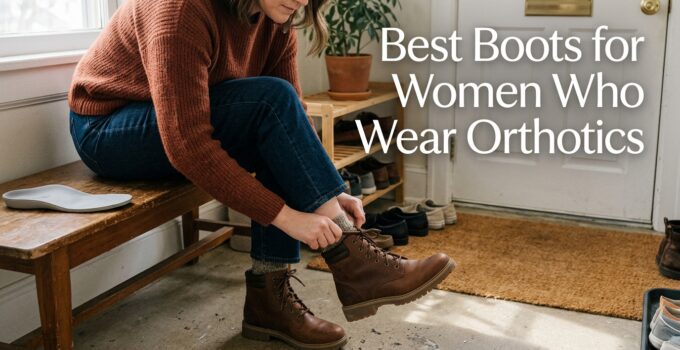
Here’s the frustration no one talks about honestly: if you wear orthotics, you’ve almost certainly bought a boot that looked perfect online, arrived, seemed promising — and then failed the moment you tried to fit your insert. Either the insole was glued in and wouldn’t budge, or the toe box cramped when the orthotic went in, or the heel counter was so soft it made the whole device pointless. You returned it, or worse, kept wearing it in discomfort, and went back to the same three boots you’ve been rotating for years because at least those ones work.
This guide is written for that exact experience. The boots below were selected because they meet four structural requirements that make orthotic use actually possible — not just technically possible, but comfortable enough for a full day on your feet. More importantly, they were selected because several of them look like regular, stylish boots. Because the other thing no one says plainly: you should not have to wear ugly footwear as the price of foot health. The clinical brands that dominate most orthotic boot guides are excellent at function. They are not always excellent at style. There are mainstream boots from mainstream brands that pass every compatibility test, and this guide surfaces them alongside the dedicated orthopedic options so you can choose based on your own priorities.
Before the product picks, there are four technical sections that will permanently change how you shop for boots. Read them first — they explain the depth problem, the sizing question, the heel height rules by condition, and the boot styles that fight orthotics rather than working with them. Two minutes of reading here will save you hours of trial and error and several expensive returns.
Custom Orthotics vs. OTC Insoles: Your Boot Requirements Are Different Depending on Which You Use
custom orthotics vs otc insoles 202605272224
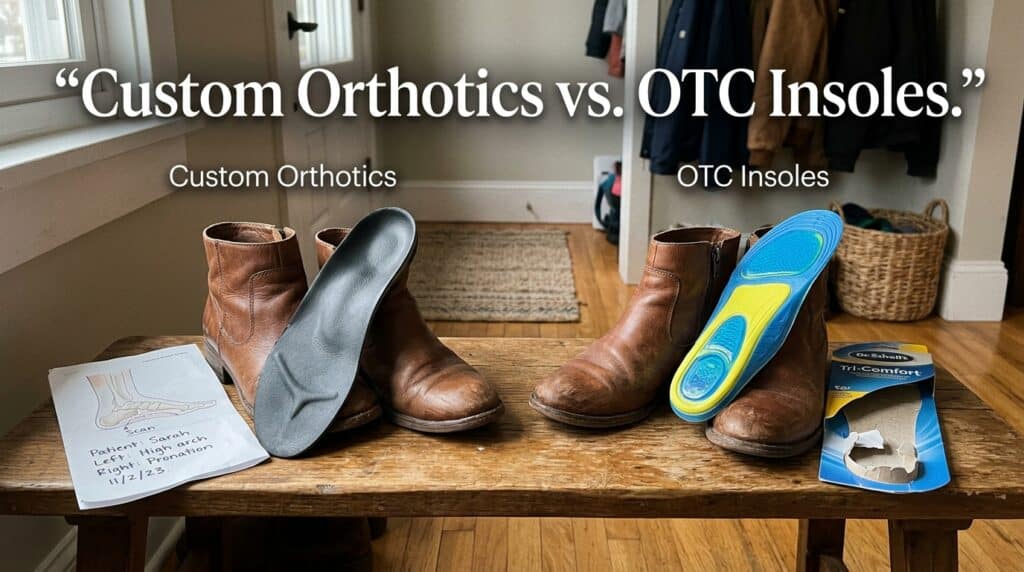
Most orthotic boot guides treat orthotics as a single category and give a single set of recommendations. This is incorrect — and it’s why the advice often doesn’t work for you specifically. The boot compatibility requirements differ significantly depending on which type of orthotic you use.
Custom prescription orthotics from a podiatrist are typically made from rigid or semi-rigid polypropylene or carbon fibre shells. They have deeper heel cups — the clinical standard for custom devices ranges from 18mm to 30mm in heel cup depth, compared to the 12mm standard in most shoes. They are thicker overall: typically 6–10mm at the forefoot, more at the heel. This added volume requires a boot with genuine extra internal depth — not just a removable insole, but enough vertical space above the insole layer to accommodate the orthotic’s height without pushing your toes into the shaft lining or your heel above the heel counter. Many boots with removable insoles are still too shallow for custom devices.
Over-the-counter insoles (Superfeet, Powerstep, Dr. Scholl’s custom-fit series) are thinner and more flexible, with heel cups of 10–16mm and a thinner overall profile. The volume they add is typically 3–6mm — manageable in most boots with a removable insole, without requiring designated extra-depth construction. If you use OTC insoles, your selection of compatible boots is significantly wider than if you use custom devices.
Throughout this article, each product review specifies which type of orthotic it works for. If you use custom prescription orthotics, pay close attention to those specifications — the standard-depth boots on this list may serve you well for OTC insoles but be too shallow for your device.
The Depth Problem: What Actually Happens When Your Orthotic Goes Into a Boot
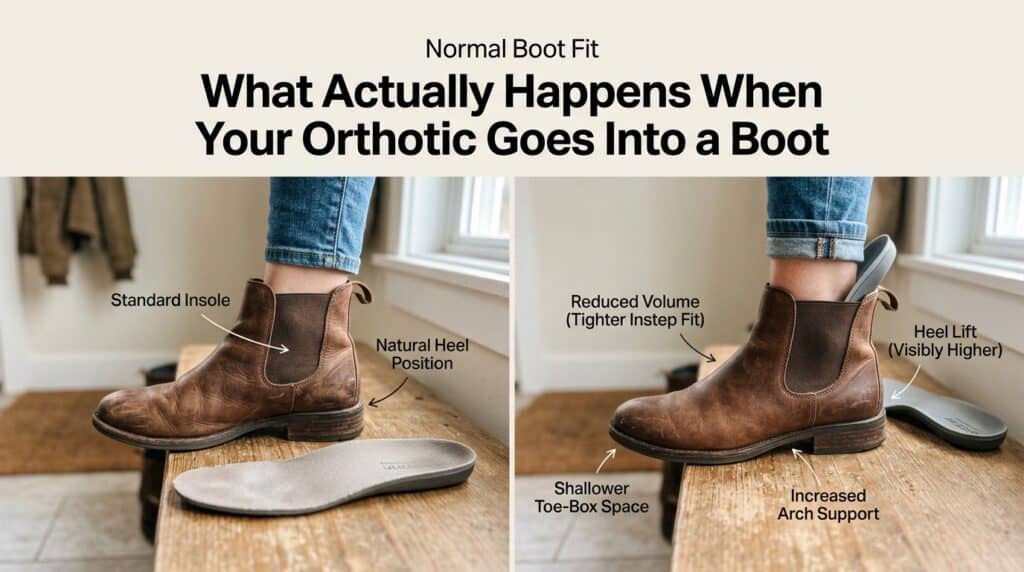
This is the technical issue that causes most orthotic boot failures, and almost no guide explains it clearly. When you remove a factory insole and replace it with an orthotic, the orthotic adds height to the interior of the boot. An OTC insole typically adds 3–6mm of net height; a standard custom orthotic adds 6–10mm; a custom device with a deep heel cup adds 10–15mm. That added height means your foot now sits higher inside the boot than the boot was designed for.
The immediate consequences: first, your toes move closer to the ceiling of the toe box and the inner lining of the shaft — particularly noticeable in ankle boots and Chelseas, where the front collar is close to the toe level. Second, your heel may rise above the heel counter — the stiff cup at the back of the boot — which reduces the containment that holds your heel correctly over the orthotic’s posting and correction elements.
orthotic in boot comparison 202605272226
The practical solution is not simply “buy a boot with a removable insole.” It’s to find a boot with enough vertical depth above the insole layer to absorb the orthotic’s added height. Extra-depth boots — a specific construction category used by brands like Orthofeet, Propét, and Drew — are built with an additional ¼ to ⅜ inch (6–10mm) of interior depth specifically to accommodate custom orthotics. Standard boots with removable insoles may have just enough depth for an OTC insole (which typically replaces rather than adds to the factory insole’s volume) but not for a custom device. This is the most important distinction in this entire article for custom orthotic users.
The practical test you can do with any boot during an Amazon return window: remove the factory insole, place your orthotic inside, and check the depth above the orthotic at the ball of the foot — there should be at least 3mm of visible clearance above the orthotic surface before it reaches the lining. Less than that will cramp your toes within an hour of walking.
The Four Non-Negotiable Features — and How to Test Each One
Every boot on this list meets all four of these requirements. Use this as your checklist for any boot you’re considering that isn’t on this list.
1. Removable insole. Insert your fingernail or the edge of a credit card under the heel of the factory insole — it should lift cleanly without resistance or tearing. If the insole is glued, bonded, or stitched down, the boot cannot be used with orthotics without damaging it. Many fashion boots fail this test. Many winter boots fail this test. Always verify before purchasing.
2. Firm heel counter. Squeeze the heel counter — the stiff cup at the back of the boot — between thumb and forefinger. It should resist firmly without flexing or collapsing. A soft heel counter means your heel can move independently of the orthotic’s correction, reducing the device’s biomechanical function to near-zero. It will still provide cushioning, but no correction. Most budget fashion boots and many soft-leather ankle boots fail this test.
3. Adequate depth. For OTC insoles: standard removable-insole boots are usually sufficient. For custom orthotics: look specifically for extra-depth models, or apply the clearance test described above during your return window. Do not skip this test for custom orthotics.
4. Round or wide toe box. Orthotics can push the forefoot laterally (sideways) as well as upward. A narrow or pointed toe box adds compression in exactly the space the orthotic is already filling. With the orthotic in place, wiggle your toes — they should move without touching the sides or ceiling of the toe box. Pointed-toe fashion boots almost universally fail this test.
Heel Height Compatibility with Orthotics — by Condition
Choosing the wrong heel height with an orthotic does not just create discomfort — it can actively counteract the biomechanical correction the device is designed to provide. Here is the complete guide by condition:
| Condition | Optimal Heel Height | Why | Avoid |
|---|---|---|---|
| Plantar fasciitis | 0.75–1.5 inches | Moderate heel elevation reduces tension on the plantar fascia and works with the orthotic’s rearfoot correction | Flat soles; heels above 2 inches |
| Flat feet / overpronation | 0.5–1.25 inches | Modest heel supports the medial post correction; high heels reduce the orthotic’s contact area and correction effectiveness | Heels above 2 inches; very flat soles with no structure |
| High arches / supination | Under 1 inch | Low heel distributes load across the foot; high heels concentrate weight on the already-stressed lateral forefoot | Any heel above 1.5 inches with supination orthotics |
| Achilles tendinitis | 0.5–1.25 inches | A natural heel lift in the boot complements the heel-lift element of the orthotic; reduces tension on the tendon | Completely flat soles; heels above 1.5 inches |
| Bunions | Any height — forefoot width is the priority | Heel height is secondary for bunions; the primary requirement is a wide, round toe box wide enough to not compress the bunion joint | Pointed-toe boots regardless of heel height |
| Metatarsalgia | Under 1 inch | Low heels reduce forefoot pressure; with a metatarsal pad in the orthotic, low-heeled wide toe boxes minimise ball-of-foot pain | Any heel above 1 inch (increases forefoot pressure) |
Boot Styles Ranked: Best to Worst for Orthotics
1. Lace-up ankle boot — Best overall. Lacing adjusts for the volume the orthotic adds to the forefoot and ankle; side zippers make entry easy; firm heel counters are common in quality leather construction; deep heel pockets work naturally with the orthotic’s heel cup. This is the most reliably orthotic-compatible boot style across all orthotic types. If you use custom orthotics and are choosing between a lace-up and a Chelsea, choose the lace-up every time.
2. Work boot (6-inch lace-up) — Excellent. Work boot construction is inherently aligned with orthotic requirements: firm heel counters, high-volume interiors, removable insoles that are standard rather than an afterthought, and wide toe box options available. The main caveat: choose composite safety toe over steel — a steel cap steals vertical space at the toe box ceiling, compounding the depth problem. The best category for custom orthotic users who need maximum compatibility.
3. Chelsea boot — Good with important caveats. The elastic-panel design means no lacing to adjust for added orthotic volume — a potential limitation for custom orthotic users where fit needs to be more precise. Good for OTC insoles in most construction levels. For custom orthotics: specifically required are extra-depth Chelsea models. The round toe of quality Chelsea boots is a proportion advantage. Avoid pointed-toe Chelseas entirely for orthotic use.
4. Knee-high boot — Good. The shaft is orthotic-irrelevant — what matters is the foot and ankle compartment construction. A knee-high boot that meets the four compatibility criteria works as well as any ankle boot. Choose based on foot box construction, not shaft height. The shaft adds warmth and style without complicating orthotic fit.
5. Winter / waterproof boot — Variable. Highly model-specific. Some winter boots (specific Sorel and Timberland Waterproof models) have removable insoles and adequate depth; others have bonded foam liners that cannot be removed. Always verify the removable insole before purchasing. Insulation layers can also reduce available interior volume — check depth with your orthotic during the return window.
6. Heeled ankle boot — Depends on heel height and condition. Use the heel height compatibility table above. A 1–1.5 inch block heel works well for plantar fasciitis and flat feet. A stiletto or heel above 2 inches counteracts orthotic correction for most conditions. Block heels are significantly more stable than slim heels for orthotic use — the wider base allows the orthotic to function correctly.
7. Pointed-toe fashion boot — Avoid. The forefoot taper reduces exactly the space the orthotic adds volume to. Even with a removable insole, the toe box compression makes pointed-toe boots incompatible for most orthotic users. The only partial exception: ¾-length orthotics that don’t extend into the forefoot, in boots where the taper only begins well forward of the ball of the foot.
8. Traditional pull-on Western boot — Usually avoid. Bonded insoles and narrow forefoot construction are doubly problematic. The exception: Western-style ankle boots with side zippers and wide toe boxes — check specifically for removable insoles, as the pull-on construction that’s standard in traditional cowboy boots is typically incompatible.
Sizing for Orthotics: The Decision You Get Wrong Most Often
The near-universal advice is “size up half a size or a full size for orthotics.” This is sometimes correct and frequently wrong. Here is the accurate decision guide:
OTC insoles with a removable insole boot: Order your normal size. When you remove the factory insole and replace it with your OTC insole, you’re making a roughly volume-neutral swap — the OTC insole is typically similar in thickness to the factory insole it replaces. No size change is needed.
Custom orthotics with an extra-depth boot: Order your normal size. The extra-depth construction is specifically designed to accommodate the custom orthotic’s added height without requiring a size change.
Custom orthotics with a standard-depth removable-insole boot: Order half a size up. The minor length increase creates a small amount of additional forefoot room, but this is a compromise solution — the underlying issue is depth, not length. If a correct-size extra-depth model is available, that is always the better choice.
Never size up more than half a size for orthotics. The arch of the orthotic is positioned for your foot length. Going up a full size moves the arch position forward relative to your foot — the arch support no longer aligns with your arch, defeating the device’s primary function.
Quick Comparison: Best Boots for Women Who Wear Orthotics
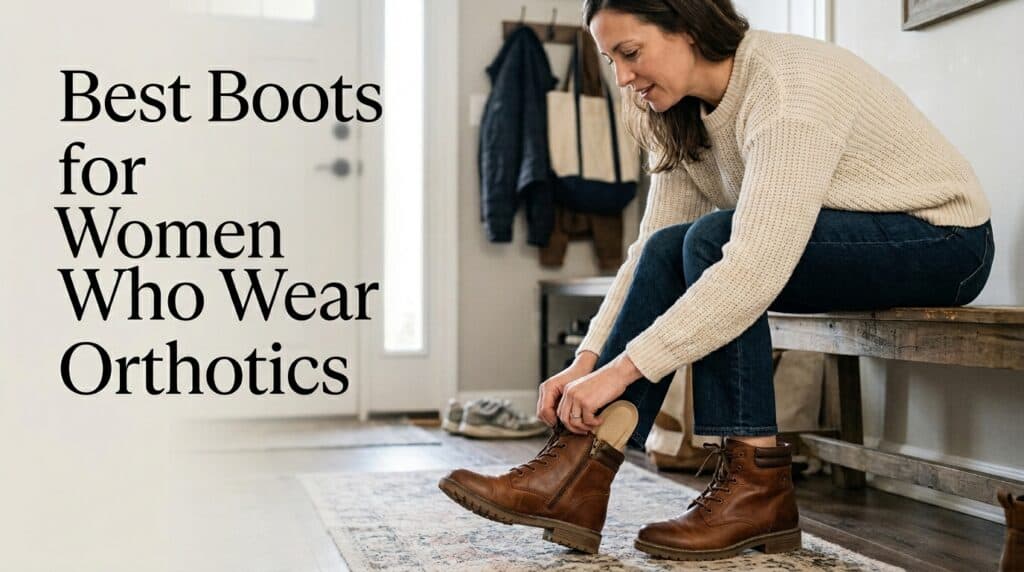
Women’s orthotic-friendly boots with supportive insoles, stylish design, and comfort for everyday wear. Ideal for women needing footwear that accommodates orthotics without sacrificing style.
| Boot | Style | Orthotic Type | Heel Height | Toe Shape | Best For | Price Range | Link |
|---|---|---|---|---|---|---|---|
| Vionic Kamryn | Ankle Boot | OTC + light custom | ~1.5 inch | Round/Almond | Best overall | $130–$170 | View → |
| Clarks Un Elda | Chelsea | OTC | ~1 inch | Round/Almond | Best Chelsea | $80–$130 | View → |
| Keds Tahoe Boot | Lace-up Ankle | OTC | ~1 inch | Round | Best casual everyday | $60–$90 | View → |
| Timberland PRO Direct Attach 6″ | Work Boot | OTC + custom | ~1.5 inch | Round/Wide | Best work boot | $130–$180 | View → |
| Naturalizer Jessie | Knee-High Boot | OTC | ~1 inch | Round/Almond | Best knee-high | $100–$150 | View → |
| Sorel Joan of Arctic | Winter Boot | OTC | ~1.5 inch | Round | Best winter / waterproof | $190–$240 | View → |
| Aetrex Jillian Sandal | Sport Sandal | OTC + custom | ~0.5 inch | Open / wide | Best plantar fasciitis relief | $100–$140 | View → |
| Propét Delaney | Ankle Boot | OTC + custom | ~1 inch | Round/Wide | Best for bunions + orthotics | $70–$110 | View → |
| ECCO Shape 35 Zipper | Ankle Boot | OTC | ~1.4 inch | Plain / Round | Best fashion / style-forward | $170–$230 | View → |
| Skechers BOBS Chill Wedge | Wedge Boot | OTC | ~1.75 inch wedge | Round/Almond | Best budget smart-casual | $45–$75 | View → |
| Skechers Arch Fit Mojave | Lace-up Ankle | OTC (APMA-accepted insole) | ~1 inch | Round | Best APMA-certified everyday | $60–$85 | View → |
1. Vionic Kamryn Women’s Ankle Boot — Best Overall
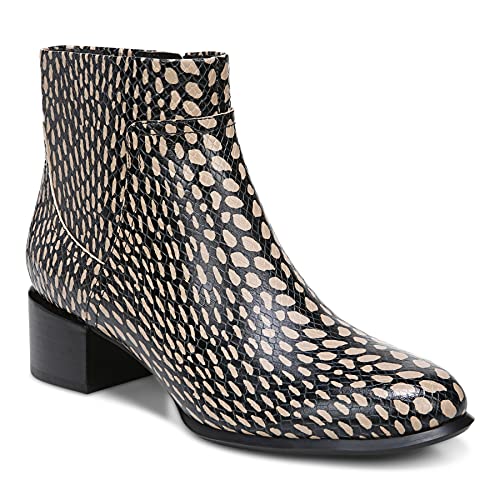
If there is one boot on this list that represents what the whole guide is trying to do — be genuinely stylish while being genuinely orthotic-compatible — it’s the Vionic Kamryn. Vionic was founded with podiatrist input and their footbeds are developed with clinical foot health in mind, but the Kamryn doesn’t look like a medical device. It looks like a clean, modern leather ankle boot you’d see on any well-dressed woman walking through a city — and it passes all four orthotic compatibility tests with room to spare.

The key technical detail is Vionic’s VIO-Motion podiatrist-developed footbed, which features a deep heel cup, lateral stability wings, and arch contouring — and is fully removable. When you remove it and replace it with your OTC orthotic, the boot’s interior has been designed with enough depth to accommodate the swap without crowding the toe box. The heel counter is firm — it passes the squeeze test — and the round-to-almond toe box gives adequate forefoot room. A side zipper makes entry and exit easy without disturbing fit. Available in medium and wide widths, which covers the majority of orthotic users who need a slightly wider forefoot for the orthotic’s lateral posting.

The Kamryn’s heel height sits at approximately 1.5 inches — ideal for plantar fasciitis and flat feet, within range for most other conditions. The leather upper is full-grain on premium versions, and the clean silhouette pairs with slim jeans, tailored trousers, midi skirts, and work-appropriate outfits. This is not a boot that announces itself as “orthopedic.” It’s a boot that looks at home in any context and happens to work with orthotics better than most boots twice the price.
Orthotic Compatibility: Removable VIO-Motion footbed: Yes | Depth: Standard-plus (adequate for most OTC insoles; light custom orthotics with standard heel cup) | Heel counter: Firm | Toe box: Round/almond | OTC compatible: Yes | Custom orthotic compatible: Yes for standard depth devices; verify for deep heel cup custom orthotics | Widths: M and W | Heel height: ~1.5 inches | Best condition fit: Plantar fasciitis, flat feet, overpronation
✅ Orthotic Verdict: The best all-around orthotic-compatible ankle boot for women who want to look stylish. Vionic’s clinical pedigree meets mainstream fashion aesthetics, and the VIO-Motion footbed design means the interior is built for support from the ground up — your OTC orthotic replaces a device that was already excellent, and a light custom orthotic fits without requiring a size change.
Pros: Genuinely stylish — looks nothing like an orthopedic boot; deep heel cup factory footbed already provides support before orthotics go in; firm heel counter ensures biomechanical correction functions correctly; available in wide width; side zipper for easy entry; ideal heel height for the two most common orthotic conditions.
Cons: Standard depth may be insufficient for rigid custom orthotics with deep heel cups (18mm+) — verify during return window; higher price point than non-orthotic-focused competitors.
2. Clarks Women’s Un Elda Chelsea Boot — Best Chelsea Boot for Orthotics
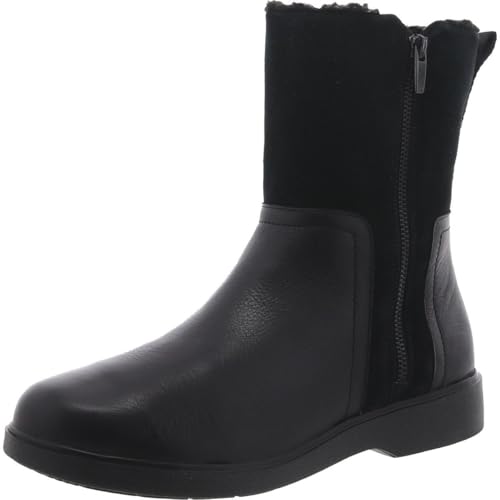
The Chelsea boot is arguably the most important style in a woman’s wardrobe for effortless, put-together dressing — and it’s also one of the trickier styles for orthotic users, because the slip-on construction offers no lacing to adjust for the volume the orthotic adds. The Clarks Un Elda is the Chelsea boot that solves this problem without making you feel like you’ve compromised on anything. It’s a beautiful, simple Chelsea boot in full-grain leather that happens to have Clarks’ OrthoLite removable footbed, an adequately roomy interior, and a construction quality that puts it above most competitors in this price range.

The OrthoLite insole lifts out cleanly — there’s no resistance, no adhesive — and the interior below it is clean and smooth, receiving your OTC orthotic without any ridges or bumps that could create pressure points. The round-to-almond toe provides enough forefoot space that most OTC orthotics sit comfortably without lateral compression. The elastic goring on the Un Elda is generous enough to accommodate the slight volume difference when the orthotic goes in. The leather upper and Goodyear welt construction mean this is a boot designed to last years, not months — an important consideration when you’re investing in footwear that has to work with an expensive orthotic prescription.

Note for custom orthotic users: the Un Elda is well-suited for OTC insoles and light custom devices with standard heel cup depths. If your custom orthotic has a deep heel cup (18mm or more) or is particularly rigid and thick, you may find the Un Elda’s standard depth insufficient — in that case, look at the Propét Delaney at Position 8 as an extra-depth alternative. For the majority of orthotic wearers using OTC insoles or standard-profile custom devices, the Un Elda is the most elegant Chelsea solution on this list.
Orthotic Compatibility: OrthoLite removable footbed: Yes | Depth: Standard (adequate for OTC; light custom orthotics) | Heel counter: Firm (leather and welt construction) | Toe box: Round/almond | OTC compatible: Yes | Custom orthotic compatible: Yes for standard depth; verify for deep heel cup devices | Width: Standard (D) and wide available in select colours | Heel height: ~1 inch | Best condition fit: Flat feet, overpronation, general orthotic use
✅ Orthotic Verdict: The best Chelsea boot for orthotic users who want the classic Chelsea silhouette without the clinical aesthetic. Clarks’ OrthoLite footbed makes it compatible with OTC insoles out of the box; the clean leather construction and quality build make it a boot you’ll reach for daily.
Pros: Classic Chelsea silhouette that pairs with everything from tailored trousers to dark jeans; OrthoLite footbed removes cleanly for orthotic insertion; Goodyear welt construction for durability and longevity; genuine leather that develops character with wear; available in wide fit in select styles.
Cons: Standard depth limits compatibility for deep heel cup custom orthotics; the Chelsea construction offers no adjustability if the orthotic adds more volume than the elastic goring can accommodate — test with your specific orthotic.
3. Keds Women’s Tahoe Boot — Best Casual Everyday Boot
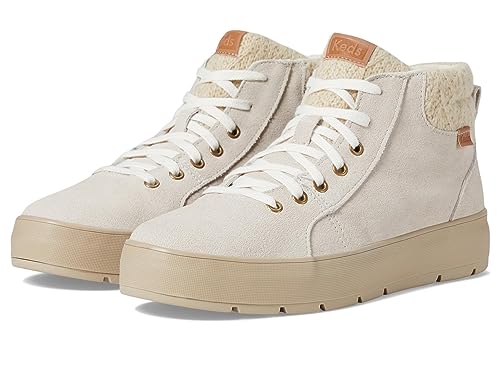
Not every occasion calls for leather or polish, and not every orthotic-wearing woman needs a boot that works in a boardroom. The Keds Tahoe Boot is for the everyday — the school run, the weekend errands, the casual work-from-office day when you want something comfortable and put-together without overthinking it. It is a lace-up ankle boot with a clean, simple profile, a round toe box, and a construction that accommodates OTC insoles readily. It’s also a genuinely affordable option for women who want to test the lace-up ankle boot format with orthotics before committing to a premium leather version.

The Tahoe’s lace-up construction is its main orthotic advantage over Chelsea alternatives in this price range: because you control the lacing tension, you can compensate for the slightly increased forefoot volume that comes with an OTC insole by loosening the lacing appropriately. The round toe box is genuine — not a fashion round that tapers after the ball of the foot — and the interior is clean enough to receive a replacement insole without complication. The low heel profile keeps it in a neutral position for most orthotic conditions, and the rubber outsole provides grip on wet surfaces.

For custom orthotic users, the Tahoe is not the recommended choice — the construction is not designed for the additional depth requirements of rigid prescription devices. This is an OTC insole boot. But for the large portion of women who use Superfeet, Powerstep, or similar over-the-counter arches, the Tahoe delivers comfortable, adjustable, orthotic-friendly wear at a price that doesn’t require deliberation. It pairs well with straight-leg jeans, casual trousers, and relaxed work outfits where a sneaker would be too casual but a dress boot would be too formal.
Orthotic Compatibility: Removable insole: Yes | Depth: Standard (adequate for OTC insoles) | Heel counter: Firm (lace-up construction) | Toe box: Round | OTC compatible: Yes | Custom orthotic compatible: Not recommended | Heel height: ~1 inch | Best condition fit: General arch support, mild plantar fasciitis, light overpronation with OTC insoles
✅ Orthotic Verdict: The best accessible everyday lace-up boot for OTC orthotic users. The lacing adjustability, round toe, and firm heel counter do the important work; the casual profile handles everything from weekend to casual office. Not for custom orthotic users — step up to the Vionic Kamryn or Propét Delaney for custom device compatibility.
Pros: Lace-up construction allows adjustment for OTC insole volume; genuinely round toe box with no false narrowing; firm heel counter for correct orthotic function; accessible price point for testing lace-up format; casual versatility for daily wear.
Cons: Not suitable for custom prescription orthotics — insufficient depth for rigid devices; casual aesthetic limits use to informal contexts; less durable than leather alternatives at longer wear intervals.
4. Timberland PRO Women’s Direct Attach 6″ Boot — Best Work Boot
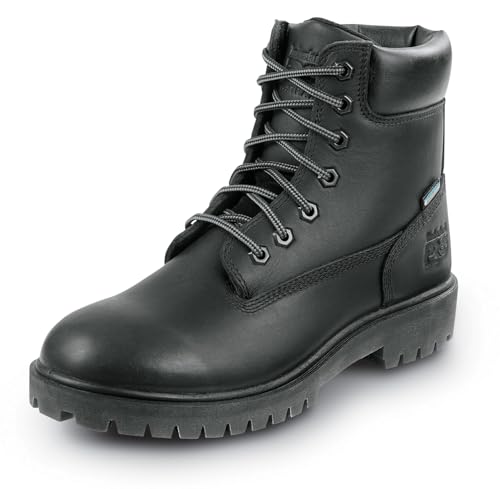
Work boot construction is inherently aligned with what orthotics need: firm heel counters are standard, interior volumes are high, removable anti-fatigue insoles are common, and the lace-up system allows precise fit adjustment for added orthotic volume. The Timberland PRO Women’s Direct Attach 6″ is the pick for women who work on their feet — healthcare, retail, warehouse, construction, trades — and need both ASTM safety protection and genuine orthotic compatibility in the same boot.

The Direct Attach construction bonds the rubber outsole directly to the upper using heat and pressure, creating a waterproof seal that keeps feet dry in wet work environments without a separate seam. The steel toe provides ASTM F2413 impact and compression protection. The anti-fatigue footbed — Timberland PRO’s proprietary technology that uses inverted cone geometry to return energy to the foot — is removable, and the interior volume below it is generous enough for most OTC insoles and standard-profile custom orthotics. The firm heel counter is a structural necessity in work boot construction and functions excellently for orthotic biomechanical correction.

One important consideration for custom orthotic users with deep heel cups: the steel safety toe cap reduces the available vertical space at the front of the boot compared to a composite toe version. If you use a custom orthotic with a thick heel cup (18mm or deeper), test the depth clearance at the toe carefully during your return window. The safety toe is a structural requirement in this boot, so if you need maximum interior depth for a deep-cup custom device, the composite toe version of the Direct Attach is preferable where available. For OTC insoles, this distinction is less critical — the standard steel toe version accommodates OTC insoles comfortably across sizes.
Orthotic Compatibility: Anti-fatigue removable footbed: Yes | Depth: High volume (work boot construction — good for OTC and most custom orthotics) | Heel counter: Firm (work boot standard) | Toe box: Round/wide (safety construction) | OTC compatible: Yes | Custom orthotic compatible: Yes for standard-depth devices; verify for deep heel cup | Width: Standard and wide available | Heel height: ~1.5 inches | Best condition fit: All orthotic conditions — universal work boot compatibility
✅ Orthotic Verdict: The best work boot for women who wear orthotics. The work boot format is the most naturally orthotic-compatible boot style available, and the Timberland PRO’s anti-fatigue removable footbed and high-volume construction make it one of the few work boots that works equally well with OTC insoles and most custom devices. Safety, support, and orthotic compatibility in a single purchase.
Pros: Work boot construction is the most orthotic-friendly format available; anti-fatigue removable footbed designed for all-day standing; ASTM safety protection for workplace requirements; waterproof direct-attach construction; high interior volume accommodates most orthotic types; firm heel counter is structural standard.
Cons: Steel toe reduces vertical space versus composite — custom orthotic users with deep heel cups should verify; clearly a work boot aesthetic — not suited to smart-casual or formal contexts; heavier than non-safety ankle boots.
5. Naturalizer Women’s Jessie Knee-High Boot — Best Knee-High Boot

Knee-high boots occupy a special place in a woman’s wardrobe — they’re one of the few boot styles that works as well with a dress or skirt as with trousers, giving complete outfit versatility across seasons. But knee-high boots and orthotics have an uncomfortable relationship in the popular imagination: the assumption is that anything that tall and fashion-forward can’t possibly accommodate a foot health device. The Naturalizer Jessie disproves this, and it does so while looking exactly like the sophisticated, understated knee boot it is.

The critical insight about knee-high boots and orthotics: the shaft above the ankle is completely orthotic-irrelevant. What matters is the foot and ankle compartment construction — the same four criteria apply regardless of how tall the boot is. The Jessie’s foot compartment features Naturalizer’s N5 Contour+ cushioning system with a removable footbed, a round toe box with adequate forefoot width, and a heel construction that provides the firm counter necessary for orthotic function. The 1-inch heel sits at the neutral end of the compatibility range, working for all conditions except those that require a specific heel lift (Achilles tendinitis benefits from slightly more elevation).

Available in both standard and wide calf widths — a detail that matters because knee-high boots with narrow shaft openings can create calf compression that indirectly affects ankle and foot alignment, even when the foot compartment is compatible. The wide calf option is a genuine addition for women with broader calves, not just a stretched standard shaft. The Jessie is available in multiple colours and finish levels; the leather versions are the most durable and the most compatible with orthotics (softer fabric uppers can allow more heel counter flex). Pairs elegantly with midi skirts, wrap dresses, slim trousers, and over-the-knee sock styles.
Orthotic Compatibility: N5 Contour+ removable footbed: Yes | Depth: Standard-plus (adequate for OTC insoles and light custom orthotics) | Heel counter: Firm | Toe box: Round/almond | OTC compatible: Yes | Custom orthotic compatible: Yes for standard depth; verify for deep heel cup | Width: Standard and wide calf available | Heel height: ~1 inch | Best condition fit: General orthotic use, flat feet, mild plantar fasciitis
✅ Orthotic Verdict: The best knee-high boot for orthotic users who want complete wardrobe versatility. The Jessie’s orthotic compatibility is built into the foot compartment, the shaft above the ankle is irrelevant to function, and the style is genuinely elegant. The wide calf option is a meaningful addition for women who’ve struggled with shaft fit in standard knee boots.
Pros: N5 Contour+ removable footbed removes cleanly; knee-high silhouette works with dresses, skirts, and trousers for maximum wardrobe versatility; wide calf option available; round toe box adequate for most OTC orthotics; neutral 1-inch heel compatible with most conditions.
Cons: Standard depth limits compatibility for rigid custom orthotics with deep heel cups; shaft width can still be limiting for very wide calves even in the wide option — measure calf circumference before ordering; leather versions preferred over faux-leather for heel counter firmness.
6. Sorel Women’s Joan of Arctic Waterproof Boot — Best Winter/Waterproof Boot
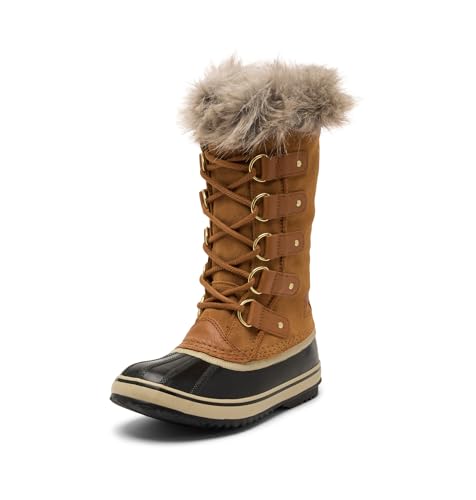
Winter is the season when orthotic compatibility is hardest to find in boots. Most winter and weather boots have bonded foam or wool liners that are fused permanently to the interior — which is excellent for insulation but disastrous for orthotic use, because the insole cannot be removed and replaced. The Sorel Joan of Arctic is one of the few genuinely warm, genuinely waterproof winter boots that maintains removable insole construction — which is why it’s the winter boot recommendation for orthotic users year after year.

The Joan of Arctic’s molded EVA footbed is removable, and the boot’s interior volume is generous — a function of the waterproof rubber shell and separate upper construction that gives this boot its distinctive silhouette. That generous volume is the winter orthotic user’s best friend: where other winter boots compress the interior with insulation layers, the Joan of Arctic’s construction keeps interior space available. The vulcanized waterproof rubber shell covers the lower portion of the boot completely, making it impervious to snow, slush, and rain in ways that seam-sealed leather or synthetic uppers cannot match. Warm to -32°C/-25°F with the standard liner, which is enough for almost any winter climate in which you’ll be walking rather than standing still in extreme cold.

The Joan of Arctic’s iconic design — the tall shaft, the puffer upper, the distinctive Sorel heel — has become a fashion item in its own right over the past decade. It is worn as a style choice as much as a weather necessity, which means orthotic users don’t have to accept a purely utilitarian aesthetic for winter coverage. The one honest caveat: if you use a custom orthotic with a deep heel cup (18mm or deeper), test the depth during your return window with the liner removed and the orthotic in place. The liner does reduce available interior depth, and custom device users may find the fit tighter than OTC users.
Orthotic Compatibility: Removable molded EVA footbed: Yes | Depth: High volume (generous interior construction) | Heel counter: Firm (rubber shell construction) | Toe box: Round | OTC compatible: Yes | Custom orthotic compatible: Yes for most standard devices; test with deep heel cup custom orthotics during return window | Width: Standard | Heel height: ~1.5 inches | Best condition fit: General orthotic use in winter conditions; good heel height for plantar fasciitis and flat feet
✅ Orthotic Verdict: The only fashionable winter boot that reliably accommodates OTC orthotics and most custom devices. The removable EVA footbed, generous interior volume, and waterproof construction solve the three main problems winter orthotic users face simultaneously. The design is iconic — this is not a compromise boot.
Pros: Removable EVA footbed confirmed — the rarest feature in winter boots; waterproof to snow, slush, and standing water; rated to -32°C for genuine winter protection; iconic silhouette that reads as a style choice; good heel height for plantar fasciitis and flat feet.
Cons: The removable liner reduces available depth — deep heel cup custom orthotic users must test during return window; runs warm — may be too hot for mild winters or indoor wear; premium price for a winter boot; standard width only in most colourways.
7. Aetrex Women’s Jillian Orthopedic Sport Sandal — Best for Plantar Fasciitis Relief

A note on positioning: the Aetrex Jillian is a sport sandal, not a boot — and that deserves an honest explanation rather than a quiet omission. It’s included here because it addresses a specific and important gap in the orthotic footwear conversation: for women who suffer from plantar fasciitis or severe heel pain, there are times when even the most orthotic-compatible boot is too much foot enclosure, particularly during flare-ups, after a long day, or during warmer months when the condition is being actively managed. The Jillian is what you reach for in those moments — APMA-approved, orthotic-grade support in an open, adjustable format that gives the foot relief without sacrificing function.

Aetrex designed the Jillian specifically around their Cobra orthotic insole technology — a biomechanically engineered insole that provides deep heel cup containment, firm arch support, and forefoot cushioning in a single removable unit. The Cobra insole is removable and replaceable with a custom orthotic, making the Jillian one of the few sandals that works equally well as a self-contained orthotic footbed device or as a platform for a custom prescription orthotic. The adjustable straps accommodate different foot widths and allow the strap tension to be set correctly whether the factory insole or a custom device is in place. APMA acceptance (American Podiatric Medical Association) means the design has been reviewed and endorsed by the professional body for podiatric medicine.

Think of the Aetrex Jillian as the orthotic sandal that sits alongside your boots — the recovery footwear you wear at home, the transition piece between boot seasons, or the option for days when your feet need the most support with the least restriction. It’s a genuine therapeutic tool that also happens to look presentable enough for casual wear, which puts it ahead of most alternatives in this category.
Orthotic Compatibility: Removable Cobra orthotic insole: Yes | Depth: Designed for orthotics (extra depth construction) | Adjustable straps: Yes | OTC compatible: Yes | Custom orthotic compatible: Yes (insole designed for replacement) | Width: Standard and wide available | Heel height: ~0.5 inch | Best condition fit: Plantar fasciitis, metatarsalgia, flat feet, high arches — the Cobra insole targets all common orthotic conditions
✅ Orthotic Verdict: Not a boot, but a critical companion piece for women who wear orthotics in boots. The Aetrex Jillian provides APMA-accepted orthotic-grade support in an open sandal format — the footwear you reach for when boots are too much and bare feet are not enough. Custom orthotic users will find the removable Cobra insole is designed to be replaced with their prescription device.
Pros: APMA-accepted design with clinical plantar fasciitis credentials; Cobra insole is removable and designed to accept custom orthotics; adjustable straps accommodate width variation with orthotics; wider availability than most dedicated orthopedic sandals; genuine therapeutic value for plantar fasciitis management.
Cons: A sandal, not a boot — limited seasonal and contextual applicability; the sport aesthetic won’t suit formal or fashion-forward contexts; the low heel is below optimal for Achilles tendinitis management (see heel height table above).
8. Propét Women’s Delaney Boot — Best for Bunions and Custom Orthotics

If you have bunions alongside your orthotic prescription — one of the most common and most underserved combinations in women’s footwear — finding a boot that solves both problems simultaneously is genuinely difficult. Bunions require wide toe box construction that doesn’t compress the bunion joint; orthotics require removable insoles, adequate depth, and a firm heel counter. Most wide-width boots don’t have extra depth. Most extra-depth boots don’t have a wide enough toe box. The Propét Delaney is the boot that reliably provides both, which is exactly why it’s at Position 8 on this list.

Propét specifically designs their footwear for therapeutic use, and the Delaney’s construction reflects this: a roomy round toe box that provides genuine lateral space for the bunion joint without compressing the metatarsals, a removable cushioned footbed that lifts out cleanly, extra depth construction that accommodates most custom orthotics without a half-size increase, and a firm heel counter that supports orthotic function. Available in multiple widths including wide (W) and extra-wide (X-Wide/2E) — the extra-wide option is specifically valuable for women whose bunions have caused forefoot width expansion over time, which is a very common progression with untreated or poorly managed bunion conditions.

Honest aesthetic note: the Propét Delaney is a functional boot first and a fashion boot second. Its styling is clean and conservative rather than fashion-forward, which puts it on the less exciting end of this list visually. But for women whose primary requirement is that the boot works — that it accommodates the bunion, accepts the custom orthotic, doesn’t cause pain, and can be worn all day — the Delaney does all of this reliably and without the trial-and-error that comes with testing fashion boots for orthotic compatibility. If looking good in every context is the priority, the ECCO at Position 9 is your pick. If a boot that works without compromise is the priority, the Propét Delaney is it.
Orthotic Compatibility: Removable cushioned footbed: Yes | Depth: Extra depth (designed for custom orthotics) | Heel counter: Firm | Toe box: Round/wide | OTC compatible: Yes | Custom orthotic compatible: Yes — extra-depth construction is the most custom-orthotic-compatible on this list | Width: M, W, XW (2E) available | Heel height: ~1 inch | Best condition fit: Bunions + orthotics, custom prescription orthotic users, wide feet with any orthotic condition
✅ Orthotic Verdict: The most reliably custom-orthotic-compatible boot on this list. The extra-depth construction, wide-to-extra-wide sizing, and firm heel counter deliver the combination that custom orthotic users need without forcing a size compromise. The clear first recommendation for women with bunions alongside their orthotic prescription.
Pros: Extra-depth construction is the most custom-orthotic-friendly on this list; wide and extra-wide options for bunion and wide-foot accommodation; removable footbed removes cleanly and has adequate depth below; firm heel counter; therapeutic-grade construction for all-day wear.
Cons: Conservative styling — functional first, fashion second; limited colour and finish selection compared to mainstream brands; the therapeutic aesthetic will not suit formal or fashion-forward contexts.
9. ECCO Women’s Shape 35 Inside Zipper Ankle Boot — Best Fashion-Forward Pick
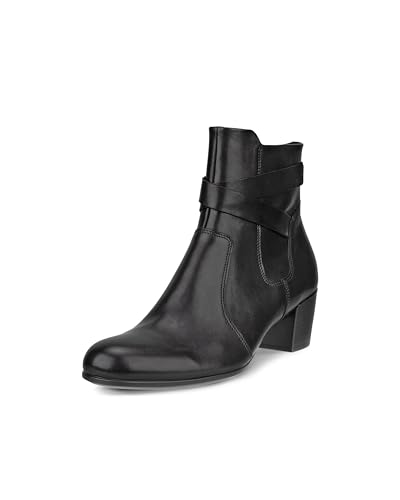
Here is the pick for the reader who is genuinely resistant to the idea that orthotic footwear has to look a certain way — clinical, chunky, or understated to the point of invisibility. The ECCO Shape 35 Inside Zipper ankle boot is a genuinely beautiful boot. It is the kind of boot you see in a window and want regardless of foot health considerations, made from ECCO’s full-grain leather in a clean, sophisticated silhouette with a 1.4-inch heel that gives it a dressed, elongating profile. And it happens to pass all four orthotic compatibility criteria for OTC insole users.

ECCO constructs their leather footwear with removable footbeds across most of their collections — a design commitment that reflects their Scandinavian comfort engineering ethos — and the Shape 35 is no exception. The leather upper is made from ECCO’s own tanneries (a supply chain distinction that results in higher-consistency leather quality than brands that source from multiple suppliers), and the inside zipper makes entry and exit clean without disturbing the fit. The plain toe silhouette is an elegant round-to-oval shape — no taper, no decorative cap toe that would reduce forefoot space. The heel counter is firm — ECCO’s leather construction standard maintains this even in their more refined styles.

For custom orthotic users, the Shape 35 is positioned for OTC insoles specifically. ECCO’s construction is not a designated extra-depth line, and rigid custom orthotics with deep heel cups may find the interior insufficient. This is the boot for the OTC insole user who has been told they must choose between foot health and dressing well — the ECCO Shape 35 is the counter-argument. It pairs with everything from tailored office wear to smart evening outfits, and it will be the most asked-about boot on this list by people who don’t know you wear orthotics.
Orthotic Compatibility: Removable ECCO footbed: Yes | Depth: Standard (OTC insoles; not recommended for deep heel cup custom orthotics) | Heel counter: Firm (leather construction standard) | Toe box: Plain round | OTC compatible: Yes | Custom orthotic compatible: Light custom orthotics only; not for deep heel cup devices | Width: Standard European sizing (verify with size chart) | Heel height: ~1.4 inches | Best condition fit: General OTC orthotic use; plantar fasciitis and flat feet at this heel height
✅ Orthotic Verdict: The best fashion-forward boot for OTC orthotic users who refuse to sacrifice style. ECCO’s quality leather construction, removable footbed, and firm heel counter deliver genuine orthotic compatibility in a boot that looks like a high-end fashion purchase. The honest limitation: custom orthotic users should look at the Propét Delaney or Vionic Kamryn instead.
Pros: Genuinely stylish — the most fashion-credible boot on this list; ECCO’s own-tannery leather construction delivers superior quality and consistency; removable footbed standard across ECCO collections; firm heel counter from leather construction; inside zipper for easy entry; ideal heel height for most common orthotic conditions.
Cons: Standard depth limits compatibility to OTC insoles — not for custom prescription orthotics with deep heel cups; European sizing requires careful conversion; premium price point; only one width option in most styles.
10. Skechers BOBS Chill Wedge Cruising Altitude Boot — Best Budget Smart-Casual
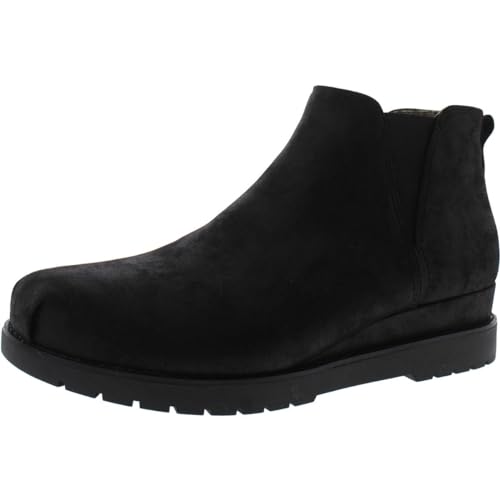
There’s a version of this article that only recommends boots above $100, and it ignores the reality that many women who need orthotics are already paying significantly for custom devices and podiatry appointments. The Skechers BOBS Chill Wedge Cruising Altitude exists for that reader — a budget-conscious option that still delivers the removable insole, round toe box, and firm enough construction to work with OTC insoles, at a price point that doesn’t require deliberation.

The wedge construction is the most distinctive feature: a continuous sole from heel to toe, rather than a separate stacked heel. For orthotic users, a wedge has an important advantage — the absence of a distinct heel-forefoot transition point means the orthotic sits on a more consistent surface, and there’s no abrupt height change at the heel that can interfere with the orthotic’s posting. The 1.75-inch wedge height puts it in the upper end of the compatibility sweet spot for plantar fasciitis and flat feet. The memory foam insole is removable and the interior is clean enough for standard OTC insole insertion. The round-almond toe gives adequate forefoot room.

Be honest about expectations at this price point: the heel counter is softer than the leather boots elsewhere on this list, which means biomechanical correction from the orthotic will be partially compromised. This is a cushioning and comfort boot, not a clinical correction boot. If your orthotic is prescribed for significant overpronation, Achilles tendinitis, or other conditions requiring precise heel control, the BOBS is not the right choice — the heel counter won’t hold the heel firmly enough over the orthotic’s correction element. If your orthotic is primarily for arch support and cushioning, or for mild plantar fasciitis management with an OTC insole, the BOBS delivers genuine comfort at an accessible price.
Orthotic Compatibility: Removable memory foam insole: Yes | Depth: Adequate for OTC insoles | Heel counter: Moderate (softer than leather alternatives) | Toe box: Round/almond | OTC compatible: Yes | Custom orthotic compatible: Not recommended — heel counter firmness insufficient for clinical correction | Heel height: ~1.75 inch wedge | Best condition fit: Mild plantar fasciitis, general arch support, cushioning with OTC insoles
✅ Orthotic Verdict: The best budget pick for OTC orthotic users who need a smart-casual boot without premium investment. The wedge construction and removable insole deliver genuine compatibility for mild conditions; the soft heel counter is the honest limitation for women with more clinical correction needs.
Pros: Best price point on this list; wedge construction provides consistent sole surface for orthotic seating; removable memory foam insole; round-almond toe with adequate forefoot room; wedge height in the compatibility sweet spot for plantar fasciitis; smart-casual profile that works for office and evening wear.
Cons: Softer heel counter than leather alternatives — insufficient for significant biomechanical correction needs; memory foam compresses with wear over time; not suitable for clinical custom orthotics; limited longevity compared to leather construction.
11. Skechers Women’s Arch Fit Mojave — Indefinite Lace-Up — Best APMA-Certified Everyday Boot
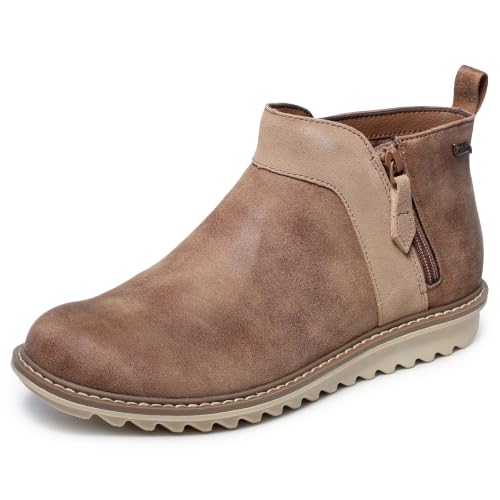
The Skechers Arch Fit line occupies a category that didn’t really exist five years ago: professional-grade orthotic engineering embedded into mainstream-priced footwear. The Arch Fit insole is developed with Dr. Andrew Weil’s clinical input, has received APMA acceptance (American Podiatric Medical Association), and is the result of 20 years of podiatric research into arch support geometry. That the insole comes standard in a boot that costs under $85 is genuinely impressive, and it makes the Arch Fit Mojave the most clinically credible orthotic-ready boot at the accessible price tier.

The Arch Fit insole is fully removable — not just technically removable but designed to be replaced with a custom orthotic, which is the critical distinction. Skechers engineers the interior of Arch Fit footwear with enough depth to accommodate the Arch Fit insole, and when that insole is removed, there is adequate space for a standard-profile OTC orthotic or a light custom device. The lace-up construction allows precise fit adjustment for the added volume, and the round toe box is genuine — the Mojave’s casual lace-up profile doesn’t include any toe narrowing that would interfere with orthotic forefoot placement. The 1-inch heel is at the neutral end of the compatibility spectrum, appropriate for most conditions.

The Mojave’s aesthetic is casual-athletic — think casual Friday, weekend errands, outdoor casual wear — rather than fashion-forward or formal. It sits in the same context as the Keds Tahoe but with significantly stronger clinical credentials. For women who take their orthotic prescription seriously and want a daily driver boot that meets podiatric standards without the premium brand price tag, the Arch Fit Mojave is the most defensible choice at this tier. It also works as a second boot alongside a premium leather option — the Arch Fit for daily high-mileage wear, the ECCO or Vionic for occasions where appearance matters more.
Orthotic Compatibility: APMA-accepted removable Arch Fit insole: Yes (designed to be replaced with custom orthotics) | Depth: Adequate for OTC and light custom orthotics | Heel counter: Firm (lace-up construction) | Toe box: Round | OTC compatible: Yes | Custom orthotic compatible: Yes for standard-depth devices | Heel height: ~1 inch | Best condition fit: Plantar fasciitis, flat feet, general arch support — the Arch Fit insole specifically targets these conditions
✅ Orthotic Verdict: The best APMA-certified orthotic-ready boot at an accessible price point. The Arch Fit insole’s clinical pedigree and removable design make this the most credible budget pick for women who take orthotic requirements seriously. Use as a daily driver or as a second pair alongside a premium leather option.
Pros: APMA-accepted Arch Fit insole is the best factory footbed at this price point; insole specifically designed to be replaced with custom orthotics; lace-up construction allows volume adjustment; firm heel counter for orthotic function; genuinely accessible price for a clinically endorsed design.
Cons: Casual-athletic aesthetic limits formal applicability; standard depth may be insufficient for deep heel cup custom orthotics; the Arch Fit insole’s support is outstanding for the price but not equivalent to a clinical custom device; less durable than leather alternatives.
The Genuinely Stylish Boots That Work — You Don’t Have to Choose Ugly
The frustration at the heart of this article is real: the boots recommended most often for orthotics — Orthofeet, Propét, Drew, most clinical orthopedic brands — are excellent at function and limited at fashion. This creates the impression that orthotic use requires a permanent aesthetic compromise. It does not, and the evidence is on this list.
The ECCO Shape 35, the Vionic Kamryn, the Clarks Un Elda, the Sorel Joan of Arctic, and the Naturalizer Jessie are all boots that pass every compatibility test for OTC insole users, and none of them announce their orthotic compatibility. They are bought and worn by women who don’t use orthotics, for the quality of their construction and the way they look. The Vionic is worn by style-conscious women who happen to want podiatric-grade support. The ECCO is bought as a fashion investment. The Sorel is an iconic design that became a cultural object.
The practical guide to finding more stylish orthotic-compatible boots beyond this list: search for full-grain leather ankle boots or Chelsea boots from brands that prioritise quality construction (ECCO, Clarks Artisan/Un series, Wolverine, Thursday Boot Company, Blundstone, Cole Haan). Quality leather construction almost always means a firm heel counter. Brands that position their footwear as comfort-forward (Vionic, Naturalizer, Clarks Cushion Plus) almost always include removable footbeds. Once you know which four features to test — removable insole, firm heel counter, adequate depth, round toe box — you can evaluate any boot in three minutes and buy with confidence.
How to Test Any Boot for Orthotic Compatibility — In Store and Online
In the store: Bring your actual orthotic. Remove the factory insole (it should lift without resistance). Place your orthotic inside. Check three things: (1) is there at least 3mm of clearance above the orthotic at the ball of the foot? (2) Does the toe box allow toe movement without lateral or ceiling contact? (3) Squeeze the heel counter — does it resist firmly? If all three pass, the boot is compatible. If the insole won’t lift, the boot fails immediately.
Online ordering protocol: Order your normal size in styles from brands known for removable footbeds (Vionic, ECCO, Clarks Un/Cushion Plus series, Naturalizer N5, Skechers Arch Fit). Order from Amazon specifically for the straightforward return window. When the boot arrives, test it immediately with your orthotic before wearing it outside — once the sole is worn or scuffed, returns become more complicated. If the insole is bonded: return it. If the depth is inadequate with your orthotic: return it. If the heel counter collapses when squeezed: return it. Do not attempt to make an incompatible boot work by sizing up more than half a size — this misaligns the arch and creates new problems.
Boots to Avoid — Styles That Almost Never Work with Orthotics
Pointed-toe fashion ankle boots. This includes the fashion boot styles that dominate most “best ankle boots” guides — the sharp-toed suede booties, the stiletto-heeled pointed ankle boots that cycle through fast fashion collections every autumn. The forefoot taper is incompatible with orthotic volume. Even if the insole is removable, the toe box shape eliminates the space the orthotic creates. No amount of sizing up resolves this.
Budget fashion boots with bonded insoles. A significant portion of the sub-$50 boot market — including many styles sold on Amazon, ASOS, and fast fashion platforms — have insoles that are glued or stitched directly to the interior. They may look like they have a removable insole. The credit card test will tell you immediately: if the insole edge doesn’t lift, the boot is not compatible.
Most winter boots below the Sorel/quality tier. Generic winter boots — the kind sold as seasonal fashion accessories — almost universally have bonded foam or felt liners. The Sorel Joan of Arctic and specific Timberland Waterproof models are exceptions because they use molded EVA or similar removable constructions. Generic fashion winter boots at low price points: assume incompatible until verified otherwise.
Traditional pull-on cowboy boots. The construction is designed for a very specific, typically narrow last, and the insole is usually bonded. The aesthetic is not the problem — Western-adjacent ankle boots with side zippers and roomy toe boxes can work. Traditional tall cowboy boots almost never do.
Soft-soled slip-on boots with collapsed heel counters. Sock boots, soft knit ankle boots, many “comfort” flat boots sold specifically for their softness — the very feature being marketed (softness) is exactly what prevents the boot from supporting orthotic function. If the boot is so soft that it wraps around your foot, it cannot hold the heel correctly over the orthotic’s correction element.
Caring for Boots When You Wear Orthotics
Rotate between at least two pairs of orthotic-compatible boots. The orthotic itself needs 24 hours to decompress between wearings — the foam and padding layers compress under body weight and need time to return to their functional geometry. Wearing the same boot every day compresses both the orthotic and the boot’s interior faster than alternating two pairs. The boots last longer, the orthotics last longer, and your feet are better supported.
When the factory insole is not in use, store it in the boot rather than discarding it — you may need it when the boot is worn without the orthotic, or for occasions when a different orthotic type is used. Replace OTC insoles every six to twelve months — the support geometry degrades with compression even when the foam still looks intact. Custom orthotics should be assessed by your podiatrist every one to two years — the correction prescription may change with changes in your foot structure or gait.
Condition leather boots regularly, particularly around the heel counter area where the boot flexes on and off with the orthotic in place. The repetitive flex of inserting and removing orthotics can stress the heel counter’s leather facing — regular conditioning prevents cracking at this point specifically.
FAQ: Boots for Women Who Wear Orthotics
Do I need to size up for orthotics in boots?
Not always. If the boot has a removable insole and you use an OTC insole, order your normal size — you’re making a roughly volume-neutral swap. If you use a custom orthotic and the boot is extra-depth construction, order your normal size. If you use a custom orthotic and the boot is standard depth, try half a size up. Never go up more than half a size — misaligning the arch position on the orthotic defeats its purpose.
What’s the difference between wide-width and extra-depth boots for orthotics?
They measure different dimensions. Width refers to horizontal forefoot measurement; depth refers to vertical internal clearance. A wide boot isn’t necessarily deep enough for orthotics. An extra-depth boot may be standard width. For orthotic use, depth is the critical specification — specifically extra depth for custom orthotics. Width is additionally relevant if you have bunions or wide feet alongside your orthotic requirement.
Can I wear Chelsea boots with custom orthotics?
Yes, with caveats. Standard-depth Chelseas work for OTC insoles and light custom devices. Deep heel cup custom orthotics (18mm or more) generally require extra-depth construction that is less common in Chelsea styles. The best Chelsea options for custom orthotics are extra-depth models from therapeutic brands. If your Chelsea passes the 3mm clearance test with your orthotic in place, it’s compatible regardless of whether it’s labelled “extra depth.”
Can I wear heeled boots with orthotics?
Yes — within the heel height ranges specified in the compatibility table above. A 1–1.5 inch block heel works well for plantar fasciitis and flat feet. Avoid stilettos and heels above 2 inches, which counteract orthotic correction for most conditions. Block heels are more stable than slim heels for orthotic function — the wider base allows the orthotic to work correctly.
How do I know if a boot has a truly removable insole?
The credit card test: insert the edge of a credit card under the heel of the insole. If it lifts, the insole is removable. If it resists or the material tears, the insole is bonded. Many boots look like they have removable insoles because there’s a visible seam — but the insole may be stitched rather than loose. Always test before removing forcefully.
What is a heel counter and why does it matter for orthotics?
The heel counter is the stiff cup at the back of the boot that wraps around your heel. It controls heel motion — preventing excessive inward (pronation) or outward (supination) movement. An orthotic works by controlling this same heel motion with its rearfoot posting. If the heel counter is soft and collapses, your heel moves independently of the orthotic’s correction, reducing the device’s biomechanical function to near-zero. It still provides cushioning, but no correction. Test by squeezing the heel counter between thumb and forefinger — it should resist without flexing.
Which brands make orthotic-compatible boots that don’t look orthopedic?
For OTC insoles: Vionic, ECCO, Clarks (Un and Cushion Plus series), Naturalizer, Skechers Arch Fit, Sorel (Joan of Arctic specifically). For custom orthotics: Orthofeet, Propét, and Drew for maximum compatibility; Vionic and Clarks for light custom devices. ECCO and Naturalizer are the strongest choices for women who won’t accept a clinical aesthetic.
How do I buy orthotic-compatible boots online when I can’t try them in store?
Order from Amazon using the return window. Bring your orthotic out before you wear the boots outside. Test the removable insole (credit card test), insert the orthotic and check the clearance test (3mm above orthotic at ball of foot), squeeze the heel counter, and check toe box room with the orthotic in place. If any test fails, return immediately before outdoor wear. Order from brands with documented removable insoles (see list above) rather than taking risks on unverified styles.
Can I use the same orthotics in all my boots?
Generally yes, for full-length orthotics. The fit will vary slightly between boot styles — a boot with a slightly tighter interior may feel snugger with the orthotic than a roomier boot — but the orthotic itself functions in any boot that passes the four compatibility tests. ¾-length orthotics (ending at the ball of the foot) are more versatile across boot styles, including some that full-length orthotics can’t fit. If you have a boot you love that’s slightly too snug with a full-length orthotic, ask your podiatrist about a ¾-length version.
Final Verdict: Best Boots for Women Who Wear Orthotics by Occasion and Condition
Best Overall: Vionic Kamryn Ankle Boot — The boot that best combines clinical orthotic credentials with genuine style. Podiatrist-developed footbed, firm heel counter, wide width available, ideal heel height. The first recommendation for every orthotic-wearing woman who wants to look good.
Best Chelsea Boot: Clarks Un Elda — OrthoLite removable footbed, full-grain leather, clean Chelsea silhouette. The smartest, most versatile daily boot for OTC orthotic users.
Best Casual Everyday: Keds Tahoe Boot — Lace-up adjustability, round toe, accessible price. For OTC insole users who want a no-drama daily driver.
Best Work Boot: Timberland PRO Direct Attach 6″ — Work boot construction is inherently orthotic-friendly. Safety protection + removable anti-fatigue footbed + high interior volume. The professional’s choice.
Best Knee-High: Naturalizer Jessie — N5 Contour+ removable footbed, round toe, wide calf available. The knee-high that proves tall boots and orthotics are not incompatible.
Best Winter/Waterproof: Sorel Joan of Arctic — The rare winter boot with a confirmed removable insole and adequate interior volume. Waterproof, rated to -32°C, iconic design.
Best for Plantar Fasciitis Relief: Aetrex Jillian Sport Sandal — APMA-accepted, removable Cobra insole designed for custom orthotic replacement. The therapeutic companion piece for boot-season orthotics management.
Best for Bunions + Custom Orthotics: Propét Delaney Boot — Extra-depth construction, wide-to-extra-wide sizing, removable footbed. The most custom-orthotic-compatible boot on this list. The choice when the orthotic requirement is non-negotiable.
Best Fashion-Forward Pick: ECCO Shape 35 Inside Zipper — Own-tannery full-grain leather, removable footbed, inside zipper. The counter-argument to “orthotic boots have to look orthopedic.”
Best Budget Smart-Casual: Skechers BOBS Chill Wedge — Removable memory foam insole, wedge construction, smart-casual profile. Best value for OTC insole users with mild conditions.
Best APMA-Certified Everyday: Skechers Arch Fit Mojave — APMA-accepted Arch Fit insole designed to be replaced with custom orthotics, lace-up adjustability, clinical credibility at accessible pricing.
For more guides at Bootsguru, see our complete guides to the best Chelsea boots for women, the best boots for plantar fasciitis, the best work boots for women, and our guide to wide-width boots for women.