Your feet have more sweat glands per square inch than anywhere else on your body — around 250,000 in total. Seal them inside a steel-toe work boot for 10 hours and you’re not dealing with a comfort problem anymore. You’re dealing with blisters, athlete’s foot, fungal nail infections, and skin breakdown that gets worse every shift you ignore it.
The good news: most workers need only 3 or 4 of these fixes to go from soaked to dry. Here are 10 that actually work — ranked from easiest to most impactful — with the real reason behind why each one matters.
Why Work Boots Make Sweaty Feet Worse
Before the fixes, understand the problem. Your boots aren’t neutral — they’re actively making your feet sweat more than they would in any other footwear. Here’s why:
- Steel toes conduct heat — steel absorbs your body heat and radiates it back. The toe box becomes a heat chamber by hour three of your shift
- Waterproof membranes trap vapor — Gore-Tex and similar membranes stop external water from getting in, but under heavy sweat load they slow vapor escape to a crawl. Great for rain. Terrible for a worker who runs hot
- Thick insulation = sauna effect — 400g Thinsulate boots in summer are not breathable. The insulation that keeps you warm in January is cooking your feet in July
- Synthetic linings breathe poorly — cheap synthetic boot linings have near-zero breathability compared to leather or moisture-wicking mesh
- No ventilation by design — work boots are built to keep things out (water, chemicals, debris). That same sealed construction keeps sweat vapor in
The boot is the environment. That’s why fixing your boot situation matters more than any product spray or powder — but the tips below address both.
10 Ways To Keep Feet From Sweating in Work Boots
1. Switch to Merino Wool or Synthetic Socks — Ditch Cotton Forever
Cotton is the worst sock material for sweaty feet, full stop. It absorbs moisture and holds it against your skin — by midshift you’re walking in a wet sponge. This is the single most common mistake sweaty-footed workers make, and fixing it costs $15.
Merino wool wicks moisture away from skin, regulates temperature in both heat and cold, and naturally resists odor-causing bacteria. It sounds counterintuitive to wear wool in summer, but merino is used in desert conditions for exactly this reason.
Synthetic blends (Coolmax, Dri-FIT, polyester-spandex) wick faster than merino and dry faster — better for workers who sweat heavily and need rapid moisture transfer rather than temperature regulation.
→ See our guide to the best merino wool socks for work boots for specific picks at every price point.
2. Apply Antiperspirant to Your Feet — At Night, Not Morning
Most workers don’t know you can use antiperspirant on your feet. You can — and for heavy sweaters it’s one of the most effective fixes on this list. The aluminum chloride in antiperspirant temporarily blocks sweat gland ducts, reducing output significantly.
The critical detail most people get wrong: apply it at night, not in the morning. Aluminum chloride needs 6–8 hours of dry skin contact to absorb properly and form the sweat-blocking plug. Morning application — right before you put on socks — washes off with your first sweat and does almost nothing.
Apply to clean, completely dry feet before bed. Focus on the soles and between the toes. Wash it off in the morning shower — the effect stays.
Product note: Use a proper antiperspirant, not a deodorant. Deodorant masks odor but does nothing to stop sweat. Look for: Carpe Foot Antiperspirant or Certain Dri — both are available on Amazon and formulated for high-sweat areas.
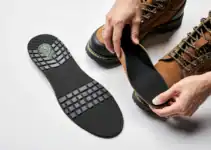
3. Replace the Stock Insole With a Moisture-Wicking One
The stock insoles in most work boots are compressed foam with a thin fabric cover. They have no moisture management, flatten out within weeks, and become a petri dish of bacteria and odor over time. Replacing them is a $20–40 fix that changes how your boot feels entirely.
For sweaty feet specifically, look for:
- Charcoal-topped insoles — activated charcoal absorbs both moisture and odor at the source
- Bamboo-top insoles — naturally antimicrobial, moisture-wicking, and cooler than foam surfaces
- Open-cell foam bases — allow air to circulate through the insole rather than trapping heat underneath your foot
→ See our full breakdown: best insoles for work boots with picks for sweaty feet, arch support, and steel-toe compatibility.
4. Rotate Between Two Pairs of Boots
A boot worn every single day never fully dries out. Residual moisture from yesterday’s shift compounds with today’s — the interior stays damp, bacteria multiply, and the boot liner breaks down faster. This is one of the least-discussed reasons work boots wear out prematurely.
The fix is simple: own two pairs and alternate daily. A boot needs a minimum of 24 hours to dry properly — 48 hours is better. While one pair is on your feet, the other is airing out.
- Use cedar boot trees to pull moisture and neutralize odor naturally overnight
- Remove insoles after each shift and let them dry separately — insoles hold roughly 40% of the boot’s total moisture
- Never store boots in a bag or locker where air can’t circulate
Cost math: Two pairs at $150 each = $300, lasting 3–4 years with rotation. One pair worn daily at $150 typically lasts 12–18 months. The rotation is cheaper long-term.
5. Air Your Feet Out on Breaks — 5 Minutes Is Enough
This sounds too simple to work. It isn’t. Even 5 minutes of boot-off time drops the internal boot temperature significantly and allows accumulated vapor to escape. The temperature drop alone slows sweat production for the next hour or two.
On a construction site or in a warehouse this is practical — take your boots off during your lunch break and let them sit open. If you can get your socks off and feet elevated, even better. Workers who do this consistently report their afternoon shift is dramatically drier than their morning.
If your environment won’t allow full boot removal, even loosening the laces completely during breaks allows some ventilation and temperature reduction.
6. Use Foot Powder — But Apply It Right
Foot powder works — but most workers only apply it to their feet and call it done. The more impactful application is inside the boot itself. The boot lining and insole hold bacteria and residual moisture that no amount of foot powder on your skin can address.
Apply to both:
- Your feet — soles, between the toes, around the heel
- Inside the boot — shake a thin layer across the insole and toe box
For most workers, talc-free formulas work well: Gold Bond Foot Powder, Arm & Hammer, Dr. Scholl’s Odor-X. For workers who’ve developed athlete’s foot or recurring fungal issues, switch to an antifungal powder: Zeasorb AF or Tinactin Powder — these treat the underlying infection while managing moisture.
If you change socks midshift (see tip #10), reapply powder at the same time for maximum effect.
7. Choose Breathable Boots — And Avoid Waterproof When You Don’t Need Them
This is the most impactful structural fix on this list — and the one most workers resist because “waterproof” sounds like it’s always better.
It isn’t. If you’re not regularly working in wet conditions, waterproof membranes are actively making your sweat problem worse. Gore-Tex and similar membranes work by allowing small vapor molecules to pass through while blocking larger water droplets. That works well at low to moderate sweat rates. At high sweat rates — which heavy sweaters hit within an hour — the membrane becomes a bottleneck and vapor backs up inside the boot.
Breathable alternatives for dry-condition workers:
- Full-grain leather uppers — breathe naturally and improve with conditioning
- Mesh panel boots — maximum airflow, best for summer and indoor work
- Unlined or minimal-lining boots — less material between your foot and the outside air
→ If sweating is your primary complaint and your job doesn’t require waterproofing, see our guide to breathable summer work boots — built for heat management, not waterproofing.
→ If you do need waterproofing, see best work boots for sweaty feet — we’ve identified the waterproof boots with the best vapor transmission rates for heavy sweaters specifically.
8. Wash and Dry Feet Thoroughly Every Day
Sweat itself doesn’t smell — the bacteria on your skin metabolizing sweat compounds produce the odor. Reducing bacterial load on your feet directly reduces both smell and infection risk.
- Use antibacterial soap on your feet daily — not just regular body wash
- Dry completely between the toes — this is where tinea pedis (athlete’s foot) starts, and most people towel-dry their feet without touching the inter-toe spaces
- Epsom salt soak 2–3 times per week — draws moisture out of skin, softens calluses, and creates an inhospitable environment for odor bacteria. 15 minutes, warm water, 1/2 cup Epsom salt
For workers with recurring athlete’s foot or fungal nail infections: treat it properly with an antifungal treatment before expecting any sweat management product to work. Active fungal infection dramatically worsens both odor and excessive sweating.
9. Dry Your Boots Properly After Every Shift
How you dry your boots matters as much as whether you dry them. The two most common mistakes:
- Direct heat (radiator, boot near a heater, tumble dryer) — degrades the adhesive bonding the sole, dries out leather, and warps the boot shape. Never do this.
- Storing while damp — closing your boots in a locker or bag while still wet creates the perfect bacterial growth environment overnight
The right approach:
- Remove insoles immediately — dry them separately, flat, in open air
- Loosen laces fully and open the boot as wide as possible
- Stuff with newspaper if you don’t have boot trees — newspaper pulls moisture effectively
- Place in a ventilated area at room temperature overnight
For heavy sweaters: a $25–35 electric boot dryer is worth every dollar. They circulate warm (not hot) air through the boot, drying the interior completely in 1–2 hours. Peet and Jobsite both make reliable options.
10. Change Socks Midshift
The simplest fix on this list — and the most underused. A dry sock at the midpoint of your shift resets the moisture environment entirely. It doesn’t require any product, any special boot, or any technique. Just a second pair of socks in your bag or your truck.
Pair this with tip #6: when you change socks, reapply foot powder to your feet and inside the boot. This two-minute midshift reset makes the second half of a 10-hour shift feel like you just started.
Workers who sweat heavily and have tried everything else find this the most reliable consistent fix — not because it stops sweating, but because it manages moisture before it accumulates to the problem threshold.
When Nothing Works: Understanding Hyperhidrosis
Some workers do everything on this list correctly and still soak through every pair of socks by hour two. If that’s you, the problem isn’t your boots or your routine — it’s your sweat glands. This condition is called primary focal hyperhidrosis, and it affects roughly 3% of the population. The feet are the most common affected site.
Hyperhidrosis is a neurological condition — the sweat glands are functioning normally, but the nerve signals telling them to activate are misfiring constantly. No boot, powder, or sock fixes a nerve signaling problem.
Medical options that actually work:
- Prescription-strength aluminum chloride (Drysol, Xerac AC) — significantly stronger than OTC antiperspirants; requires a prescription but works for most cases
- Iontophoresis — a device that passes a mild electrical current through water to temporarily shut down sweat glands; FDA-cleared and highly effective for plantar hyperhidrosis
- Botox injections — FDA-approved for hyperhidrosis; injected into the soles, effective for 4–6 months per treatment
- Oral medications (anticholinergics) — reduce sweating system-wide but have side effects; typically a last resort
See a podiatrist, not a GP — podiatrists treat hyperhidrosis regularly and understand the work boot context. A general practitioner will often recommend basic antiperspirant that you’ve already tried.
The Daily Anti-Sweat Routine
Most workers don’t need all 10 tips — they need a consistent daily system. Here’s the minimum effective routine:
| Time | Action |
|---|---|
| Night before | Apply antiperspirant to clean dry feet. Remove insoles from boots. Place boots in ventilated area. |
| Morning | Wash and completely dry feet (especially between toes). Apply foot powder to feet and inside boots. Put on merino wool or synthetic socks. Alternate to your second pair of boots. |
| Lunch break | Remove boots for 5 minutes minimum. Air feet if possible. |
| Midshift (optional) | Change into second pair of socks. Reapply foot powder. |
| After shift | Remove insoles immediately. Open boots fully. Use cedar trees or boot dryer. Wash feet with antibacterial soap. |
Frequently Asked Questions
Why do my feet sweat so much in work boots?
Work boots are sealed, insulated environments designed to keep external elements out — which also traps heat and moisture in. Steel toes conduct heat, waterproof membranes restrict vapor escape, and synthetic linings have poor breathability. Your feet produce up to a pint of sweat per day under normal conditions; in a sealed boot over a 10-hour shift, that moisture has nowhere to go.
Does foot powder actually work for sweaty feet?
Yes — if used correctly. Foot powder absorbs surface moisture and reduces bacterial growth, which controls both sweat buildup and odor. The key is applying it inside the boot as well as on your feet, and reapplying midshift if you’re a heavy sweater. For workers with fungal infections, use an antifungal powder (Zeasorb AF) rather than a standard moisture-absorbing formula.
Is it bad to wear waterproof boots if my feet sweat a lot?
For heavy sweaters working in dry conditions, yes — waterproof membranes restrict the vapor transmission that allows sweat to escape from the boot. If your job doesn’t require waterproofing, a breathable leather or mesh boot will be significantly more comfortable. If you need waterproofing, look for boots with high MVTR (moisture vapor transmission rate) ratings — some waterproof boots breathe far better than others.
What socks are best for sweaty feet in work boots?
Merino wool or moisture-wicking synthetic blends (Coolmax, polyester-spandex). Never cotton — cotton absorbs and holds moisture against your skin, making sweat problems significantly worse. Merino wool regulates temperature and resists odor naturally. Synthetics wick faster and dry faster, better for very heavy sweaters.
Can I use regular antiperspirant on my feet?
Yes — standard underarm antiperspirant works on feet. Apply to clean, completely dry feet at night before bed, not in the morning. For heavy sweaters, foot-specific formulas like Carpe Foot Antiperspirant contain slightly higher active ingredient concentrations and are formulated for the thicker skin of the sole. Prescription-strength options are available from a podiatrist for severe cases.
The Bottom Line
For most workers, the combination of merino wool socks + nightly antiperspirant application + a moisture-wicking insole eliminates 80% of the sweaty boot problem. Add a boot rotation and proper nightly drying, and you’ve solved it completely.
If you’ve done all of that and you’re still soaking through — your boots might be the real problem. A sealed synthetic boot with a waterproof membrane and no breathability is a sweat trap regardless of what you put on your feet.
→ See our full guide to the best work boots for sweaty feet — we’ve tested and ranked the most breathable options across steel-toe, composite-toe, and waterproof categories so you can fix the problem at the source.

Written by Ethan Walker
Ethan spent 8+ years fitting tradespeople and outdoor workers at a Midwest construction supply store. He’s helped hundreds of workers solve boot fit, comfort, and moisture problems across every trade and climate.