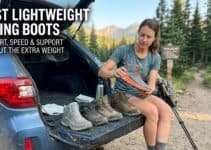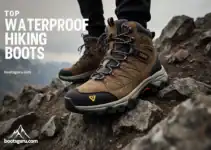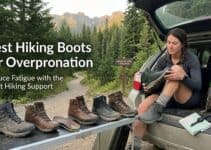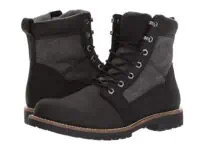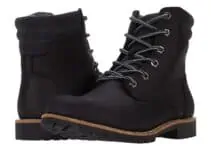
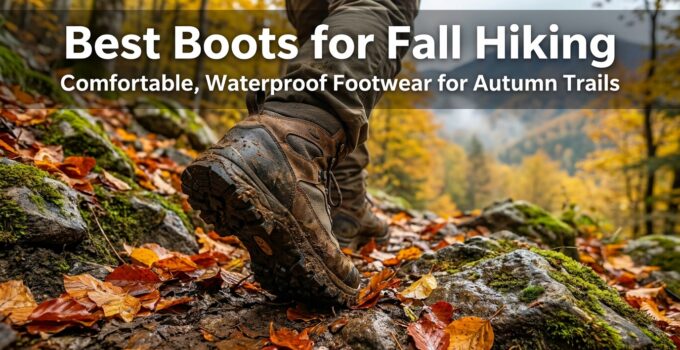
Fall is the most spectacular season to hike and the most technically deceptive. The trail that looked straightforward in summer is now buried under a uniform layer of wet leaves — a surface that’s genuinely more slippery than dry ice on any grade above 15%. Every root, rock edge, and step-down that was clearly visible in July is now hidden beneath three inches of maple and oak. The temperature that felt like a perfect 55°F at the trailhead turns to 38°F and drizzle by the time you’re descending. And the creeks you stepped over without thinking in August are now running ankle-deep with fallen debris and cold runoff.
Fall hiking demands a specific set of capabilities from a boot: aggressive traction on organic debris, reliable waterproofing without sacrificing breathability, mid-cut ankle support for the hazards hidden under leaf cover, and a temperature range that handles the 30–40°F swing between morning trailhead and afternoon summit. This guide reviews 11 of the best fall hiking boots on Amazon specifically for those conditions — not generic year-round picks with the word “fall” added to the title.
Every boot on this list is waterproof. Ten of the eleven are mid-cut. For fall hiking at any elevation with standard trail conditions, these are the two non-negotiable starting points — and the buying guide sections below explain exactly why.
Quick Comparison: Best Boots for Fall Hiking (2026)
| Boot | Waterproofing | Outsole | Lug Depth | Weight (pair) | Best For |
|---|---|---|---|---|---|
| Salomon X Ultra 5 Mid GTX | Gore-Tex | Contagrip TA | 4mm | 1 lb 11 oz | Best Overall |
| Merrell Moab 3 Mid WP | Merrell WP | Vibram TC5+ | 5mm | 2 lb 1 oz | Best Budget |
| KEEN Targhee IV Mid WP | KEEN.DRY | KEEN All-Terrain | 4mm | 2 lb 6 oz | Best Wide Feet |
| Lowa Renegade GTX Mid | Gore-Tex | Vibram Evo EXE | 4mm | 2 lb 8 oz | Best Premium / Lifetime Value |
| Hoka Kaha 3 GTX | Gore-Tex | Vibram Megagrip | 5mm | 3 lb | Best Cushioning / Joint Pain |
| Columbia Newton Ridge Plus II | Omni-Tech | Columbia rubber | 4mm | 2 lb 2 oz | Best Entry-Level |
| Danner Trail 2650 Mid GTX | Gore-Tex | Vibram Fuga | 3.5mm | 2 lb | Best Lightweight Leather |
| Salomon Quest 5 GTX | Gore-Tex | Contagrip MA | 5mm | 2 lb 12 oz | Best Fall Backpacking |
| TNF Ultra 112 WP | DryVent | Surface CTRL | 5mm | 2 lb 3 oz | Best Low-Cut for Mild Fall Trails |
| La Sportiva Ultra Raptor 3 Mid GTX | Gore-Tex ePE | FriXion XF 2.0 | 4mm | 1 lb 12 oz | Best Technical / Fast Hiker |
| Altra Olympus 6 Hike Mid GTX | Gore-Tex | Vibram Megagrip | 3.8mm | ~2 lb 4 oz | Best Zero-Drop / Wide Toe Box |
Why Fall Hiking Demands a Specific Boot — What Most Guides Miss
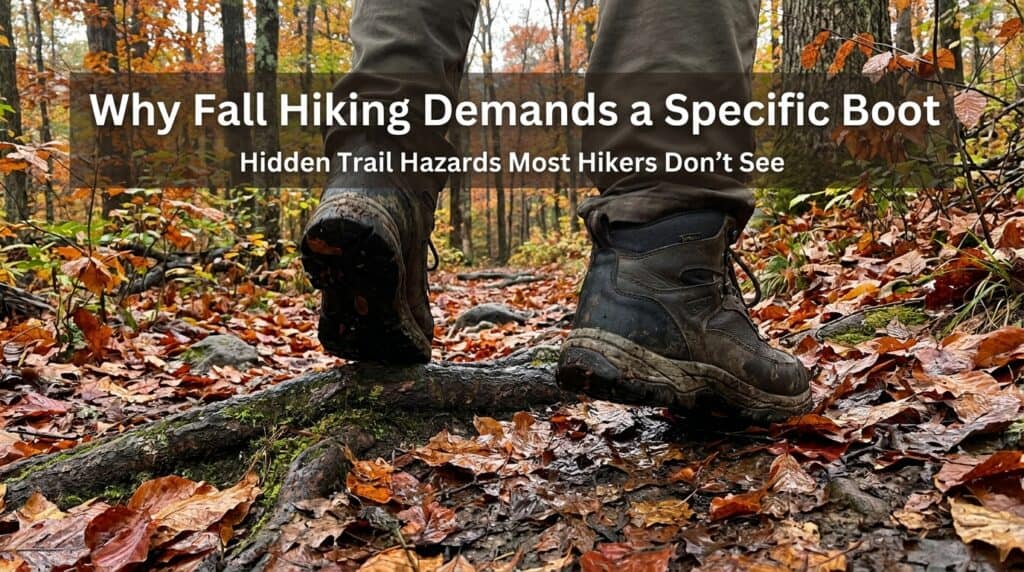
hiker stepping on forest trail 202607201355
Generic hiking boot guides tell you to buy something waterproof and mid-cut. For fall hiking specifically, the reasoning behind those recommendations matters — because the conditions you’ll encounter are genuinely different from every other season, and understanding them helps you match the right boot to your specific situation.
Wet Leaves — The Most Dangerous Traction Hazard in Hiking
No other season creates this specific hazard at scale. Wet, decomposing leaves on a trail form a compressed, low-friction surface that behaves similarly to wet ice on grades above 15%. The coefficient of friction on wet leaf debris is documented as comparable to packed snow at similar angles — and unlike snow, you don’t expect it to be slippery. Every root, rock edge, and trail-edge drop-off that would be clearly visible in summer is now concealed beneath a uniform carpet of oak, maple, and beech.
What matters in the outsole for fall leaf traction: lug depth of 4mm minimum, a multidirectional lug pattern that grips in multiple directions simultaneously rather than only forward-backward, wide lug spacing that sheds compacted leaf matter rather than clogging, and a rubber compound that grips wet organic surfaces. Vibram Megagrip and Salomon’s Contagrip are the two best-documented outsole compounds for wet organic surface performance. La Sportiva’s FriXion XF 2.0 also performs above average on wet natural surfaces. Shallow directional lugs designed primarily for rock — common on approach shoes and some lightweight trail runners — underperform specifically on wet leaf terrain.
Temperature Swings — Dressing Your Feet for 30°F Variation
A typical fall day hike in the northeastern United States starts at 45–55°F at the trailhead, peaks at 65–70°F on an exposed ridge at midday, and drops to 38–42°F during the descent with a high probability of afternoon rain. Your boots need to handle all of this without overheating on the climb or soaking your socks on the way down.
The implication most hikers miss: insulated boots are the wrong choice for the vast majority of fall hiking. Insulated boots with 200g Thinsulate or above are engineered for sustained temperatures below 25°F with minimal movement. On a fall hike where you’re generating significant body heat on a 2,000-foot climb, insulated boots will overheat your feet by mid-morning and trap the resulting sweat, making the cold, wet descent far more uncomfortable than uninsulated boots would. The correct fall hiking system: a non-insulated waterproof boot plus Merino wool socks in midweight (250–300g). This combination handles 30–65°F comfortably and manages sweat infinitely better than an insulated boot in the same conditions.
Why Mid-Cut Wins in Fall — Even for Experienced Hikers
In summer, hikers with strong ankles routinely choose low-cut trail shoes for speed and weight savings — the trails are dry, every hazard is visible, and ankle support comes from technique. In fall, the logic reverses. A uniform layer of wet leaves conceals every ankle-rolling hazard on the trail: exposed roots, edge drop-offs, embedded rocks, and soft spots where trail edges have eroded away. Mid-cut ankle support for fall hiking isn’t about technique level or pack weight — it’s about navigating terrain that actively hides what’s underneath it.
Ten of the eleven boots on this list are mid-cut for this reason. The one exception — the North Face Ultra 112 — is included because it’s an excellent waterproof hiking shoe for hikers who specifically prefer low-cut for mild, well-maintained fall trails.
The Case for Waterproofing in Fall (and the One Exception)
Fall makes the waterproofing argument stronger than any other season: morning dew soaks trail vegetation, leaf-hidden puddles appear without warning, mud hides its depth under organic cover, afternoon rain is common in most US hiking regions, and seasonal creek levels are higher than summer. For 90% of fall hikers on 90% of fall trails, a waterproof membrane is the correct choice.
The one exception: consistently dry fall climates — Arizona, Utah, and California desert regions — where rain is unlikely and daytime temperatures remain warm. In these conditions, a breathable non-waterproof boot often keeps feet drier by evaporating sweat better than a waterproof membrane allows. If you hike in the desert Southwest in fall, the Salomon X Ultra 5 is available without GTX in a lighter, more breathable version.
Break-In Period — The Most Overlooked Fall Buying Factor
If you’re buying boots in late September for a foliage hike two weeks later, break-in period is a real planning constraint. A Lowa Renegade GTX or Salomon Quest 5 requires 30–50 miles of gradual break-in before performing at its best — wearing either one straight on a 12-mile mountain hike risks blisters, heel abrasions, and ankle hot spots. Contrast with the Salomon X Ultra 5 Mid GTX and La Sportiva Ultra Raptor 3, both trail-ready within 10–15 miles, or the Columbia Newton Ridge which most wearers describe as comfortable from the first hike. This article flags break-in requirements for every boot.
The 11 Best Boots for Fall Hiking — Full Reviews
1. Salomon X Ultra 5 Mid GTX — Best Overall Fall Hiking Boot

The Salomon X Ultra 5 Mid GTX is the most complete fall hiking boot available at its price point, and the most independently validated — ranked #1 overall by CleverHiker, GearJunkie, SwitchbackTravel, and MountaineerJourney in their 2025–2026 updates. Released in spring 2025 as the update to the widely praised X Ultra 4, the fifth generation brings a more durable upper, a slightly wider forefoot that fits a broader range of foot shapes, and the same Contagrip TA outsole that has earned Salomon’s waterproof hiking boot line its reputation for wet-surface traction.
For fall hiking specifically, the Contagrip TA outsole is the standout feature. Salomon’s Contagrip compound is specifically documented for performance on wet organic surfaces — the wet leaves, pine needles, damp roots, and mud that define fall trail conditions in the Northeast, Midwest, Pacific Northwest, and Appalachian corridor. The 4mm multidirectional lug pattern grips in both the direction of travel and laterally, which matters on sidewall traverses across leaf-covered slopes. The Gore-Tex Extended Comfort membrane provides full waterproofing while maintaining above-average breathability for active fall hiking in 45–65°F conditions — better sweat management than standard Gore-Tex during the warm ascent portion of a fall hike.

The X Ultra 5 is trail-ready out of the box — virtually every independent reviewer describes minimal break-in, which is a meaningful advantage if you’re buying for an upcoming fall hike. At 1 lb 11 oz per pair in men’s sizing, it’s the second-lightest boot on this list (the La Sportiva Ultra Raptor 3 is lighter by one ounce). The Advanced Chassis (ADV/C) plate between the sole layers controls lateral flex on uneven surfaces — specifically relevant for trail edges buried in leaf cover where your foot encounters unexpected angle changes.
The honest limitations: the forefoot runs narrower than KEEN, Altra, or the North Face Ultra 112. If most hiking boots feel tight across the toes, size up half a size and consider a wider width option where available. The synthetic upper is less durable over 600+ miles than full-grain leather — at 400–500 miles, plan for noticeable outsole wear. And when wearing thicker Merino wool fall socks, confirm sizing in person or size up half a size when ordering online.

| Spec | Detail |
|---|---|
| Upper | Synthetic + textile |
| Waterproofing | Gore-Tex Extended Comfort |
| Outsole | Contagrip TA rubber |
| Lug Depth | 4mm multidirectional |
| Midsole | EVA foam |
| Ankle Height | Mid (above ankle bone) |
| Weight (pair, men’s) | 1 lb 11 oz |
| Break-in Period | Minimal — trail ready out of box |
| Heel Drop | 11mm |
What we like:
- Contagrip TA outsole — documented wet-surface performance on fall trail terrain
- Gore-Tex Extended Comfort for above-average breathability during active fall hiking
- Trail-ready out of the box — no prolonged break-in required
- Lightest mid-cut waterproof option at this performance level
- Advanced Chassis for lateral stability on uneven leaf-covered terrain
- Ranked #1 by multiple independent testing publications in 2025–2026
What we don’t like:
- Narrower forefoot than KEEN or Altra — not ideal for wide feet
- Synthetic upper has a shorter service life than leather above 500 miles
- Size up half a size for thick fall Merino wool socks
Bottom line: The best fall hiking boot for the majority of hikers. The combination of Contagrip wet-surface performance, Gore-Tex Extended Comfort breathability, minimal break-in, and independent validation from the industry’s most rigorous testers makes it the default recommendation for fall hiking across all trail types and conditions.
Check Price on Amazon — Salomon X Ultra 5 Mid GTX
2. Merrell Moab 3 Mid Waterproof — Best Budget Fall Hiking Boot

The Merrell Moab 3 Mid Waterproof is the most consistently recommended budget hiking boot across every major testing publication in 2025–2026, and its specs align particularly well with fall trail conditions. The Vibram TC5+ outsole with 5mm lugs is the deepest lug depth of any boot in the under-$180 price range — and those extra millimeters of lug depth matter specifically on fall terrain. Where 3–4mm lugs from lighter trail-oriented outsoles skim across compacted wet leaf surfaces, the 5mm TC5+ lugs penetrate through debris and grip the trail surface beneath it. Merrell’s use of Vibram rubber at this price point is a meaningful differentiator over competing budget boots using proprietary rubber compounds.
The pigskin leather and synthetic mesh upper provides a comfortable fit from the first wear with a short break-in period of 10–20 miles. Merrell’s proprietary waterproof membrane — not Gore-Tex, but consistently rated adequate for rain and puddle exposure in independent testing — holds up through 6+ hours of wet conditions. The air cushion heel absorbs impact specifically during descents, which are the most demanding moments on fall leaf-covered trails where traction limits speed and your body absorbs the controlled deceleration with each step.

The Moab 3 fits with a wider toe box than Salomon — closer to medium-wide — which accommodates the foot swelling that occurs during long fall hiking days and the thickness of Merino wool socks without creating the cramped forefoot that affects narrow-toed boots. At 2 lb 1 oz, it’s heavier than the Salomon X Ultra 5 but still manageable for day hikes. The main limitation at this price is the proprietary waterproof membrane: less breathable than Gore-Tex in sustained warm conditions (above 65°F), meaning feet can feel warmer on hot fall afternoons. For cool and wet fall conditions — the majority of fall hiking days — the performance difference from Gore-Tex is minimal in practice.

| Spec | Detail |
|---|---|
| Upper | Pigskin leather + synthetic mesh |
| Waterproofing | Merrell Waterproof membrane |
| Outsole | Vibram TC5+ |
| Lug Depth | 5mm (deepest in its price range) |
| Midsole | EVA with air cushion heel |
| Ankle Height | Mid |
| Weight (pair, men’s) | 2 lb 1 oz |
| Break-in Period | Short (10–20 miles) |
| Heel Drop | 12mm |
What we like:
- 5mm Vibram TC5+ lug depth — the deepest budget boot lug on this list, best for heavy leaf and mud
- Wider toe box than Salomon — accommodates thick fall socks without cramping
- Air cushion heel for descent impact absorption on fall downhill terrain
- Short break-in period — accessible for fall hikers buying mid-season
- Best budget-to-performance ratio of any boot on this list
- Available in both standard and wide widths
What we don’t like:
- Proprietary WP membrane less breathable than Gore-Tex on warm fall days above 65°F
- EVA midsole compresses under heavy pack loads above 35 lbs over time
- Traction on wet rock less impressive than on wet organic material
Bottom line: The best fall hiking boot under $180. The 5mm Vibram TC5+ lug depth gives it a genuine advantage on wet leaf trails that more expensive boots with shallower lugs can’t match, and the wide toe box and short break-in make it immediately practical for any fall hiker.
Check Price on Amazon — Merrell Moab 3 Mid Waterproof
3. KEEN Targhee IV Mid WP — Best for Wide Feet

The KEEN Targhee IV Mid WP is the boot for hikers who have spent years fighting against narrow toe boxes — the black toenails on descents, the forefoot pressure after mile 8, the feeling that every other hiking boot was designed for a foot shape that isn’t theirs. KEEN’s signature wide toe box allows natural toe splay, which reduces forefoot compression during long fall hiking days and eliminates the nail trauma that comes from toes pressing against a constrictive toe cap on steep descents through leaf-covered terrain. The asymmetric rounded toe profile is wider and more spacious than any other boot on this list.
The full-grain leather upper provides passive surface water resistance that sheds light rain and morning dew before the KEEN.DRY waterproof membrane even needs to engage. KEEN’s proprietary waterproof membrane is sandwiched between the outer leather and inner lining, performing consistently in rain, puddles, and shallow creek crossings. The 4mm multidirectional KEEN All-Terrain rubber outsole provides reliable fall trail traction, with wide-spaced lug channels that shed wet leaves and mud effectively. The Metatomical dual-density EVA footbed provides integrated arch support — many other boots rely on flat insoles and assume the hiker will add aftermarket orthotics if needed.

The KEEN Targhee IV is available in both standard and wide widths, with the women’s version specifically featuring a narrowed heel cup that prevents slippage while maintaining the wide toe box — a genuinely thoughtful design difference from the men’s version. At 2 lb 6 oz, it’s heavier than the Salomon or La Sportiva but comparable to other leather-upper mid-cut boots. The break-in period is moderate at 20–30 miles — the full-grain leather needs time to conform to the foot’s specific shape before performing optimally. On wet rock, the KEEN outsole’s traction is rated slightly below Salomon’s Contagrip; on wet leaves and mud — the primary fall trail surface — it performs competitively. Size up at least half a size when ordering, as KEEN’s sizing tends to run slightly small.

| Spec | Detail |
|---|---|
| Upper | Full-grain leather + KEEN.DRY |
| Waterproofing | KEEN.DRY proprietary membrane |
| Outsole | KEEN All-Terrain rubber |
| Lug Depth | 4mm multidirectional |
| Midsole | Metatomical dual-density EVA |
| Ankle Height | Mid |
| Weight (pair, men’s) | 2 lb 6 oz |
| Available Widths | Standard / Wide (both men’s and women’s) |
| Break-in Period | Medium (20–30 miles) |
What we like:
- Most generous toe box on this list — eliminates forefoot compression and black toenail on descents
- Full-grain leather sheds surface moisture passively before the membrane engages
- Available in wide widths for men’s and women’s
- Integrated arch support (Metatomical footbed) — not reliant on aftermarket insoles
- Wide-spaced lug channels shed wet leaves and mud effectively
- Women’s version has specifically narrowed heel cup for gender-appropriate fit
What we don’t like:
- Heavier than Salomon and La Sportiva options
- Moderate break-in period — not ideal for immediate hard use
- Wet rock traction slightly below Contagrip or FriXion XF 2.0
- Runs slightly small — size up half a size when ordering online
Bottom line: The best fall hiking boot for wide feet, high-volume foot shapes, or anyone who has consistently struggled with forefoot compression in hiking boots. The wide toe box is genuinely the widest on this list and solves the problem that every narrow-toed alternative creates.
Check Price on Amazon — KEEN Targhee IV Mid WP
4. Lowa Renegade GTX Mid — Best Premium / Best Long-Term Value
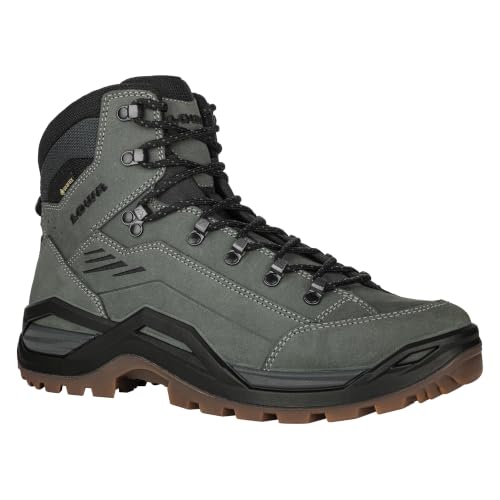
The Lowa Renegade GTX Mid has been the benchmark premium hiking boot for over a decade, and in 2026 it remains the right answer for hikers who want a boot they’ll still be using 10 years from now. Its polyurethane (PU) midsole is the most important differentiating spec at this level: where EVA foam (used by every other mid-priced boot on this list) gradually compresses and loses cushioning response over 300–500 miles, PU is denser and more resistant to compression under sustained load. A Renegade that’s been properly maintained after 600 miles retains more of its original midsole performance than a Merrell Moab 3 at 400 miles.
The full-grain leather upper develops a conforming fit over its break-in period that specifically molds to the ankle contours — providing proprioceptive feedback on uneven terrain that synthetic uppers can’t replicate. For fall trails where leaf cover creates constant unexpected ankle-angle changes, the Renegade’s structured leather upper communicates the terrain beneath the debris layer better than looser synthetic designs. The Gore-Tex lining provides reliable, long-lasting waterproofing — Gore-Tex bonded to a full-grain leather upper maintains its waterproof performance longer than Gore-Tex in synthetic uppers, which can delaminate with wear.

The Renegade can be resoled — this is the long-term value calculation that every serious hiker should run: a $280 Renegade resoled at year 5 for approximately $100 costs about $38 per year over 10 years. A $170 Merrell Moab replaced every 3 years costs about $57 per year over the same period. The premium boot is the better financial decision for hikers who use them regularly. Available in narrow, regular, and wide widths — one of the only premium boots offering this fitting range.
The honest limitation is the break-in period: 30–50 miles before the leather conforms and the stiffness resolves into the precise, supportive fit that Renegade fans describe. If you’re buying this boot for a fall hike two weeks away, wear it around the house and on short local walks daily in the interim. The Renegade also fits narrower to medium-volume feet best — wide feet should go to KEEN or Altra instead.

| Spec | Detail |
|---|---|
| Upper | Full-grain leather (monowrap construction) |
| Waterproofing | Gore-Tex lining |
| Outsole | Vibram Evo EXE |
| Midsole | PU (polyurethane) — resists EVA compression |
| Ankle Height | Mid |
| Weight (pair, men’s) | 2 lb 8 oz |
| Available Widths | Narrow / Regular / Wide |
| Break-in Period | Long (30–50 miles) |
| Resoleable | Yes |
What we like:
- PU midsole maintains cushioning over 600+ miles — outlasts every EVA boot on this list
- Full-grain leather upper develops a conforming, proprioceptive fit unique to leather boots
- Resoleable — the best 10-year cost-per-mile value on this list
- Available in narrow, regular, and wide — the widest fitting range on this list
- Gore-Tex bonded to leather outlasts GTX in synthetic uppers
- Benchmark premium boot consistently named best overall leather hiker by CleverHiker and SwitchbackTravel
What we don’t like:
- Long break-in period (30–50 miles) — not suitable for immediate hard use
- Not ideal for wide/high-volume feet — fits narrow to medium best
- Highest price point on this list
Bottom line: The right boot for hikers who view footwear as a long-term investment. The PU midsole, resoleable construction, and leather durability make the Lowa Renegade the most cost-effective premium fall hiking boot over a 10-year horizon. Plan for the break-in period.
Check Price on Amazon — Lowa Renegade GTX Mid
5. Hoka Kaha 3 GTX — Best Cushioned Fall Hiking Boot
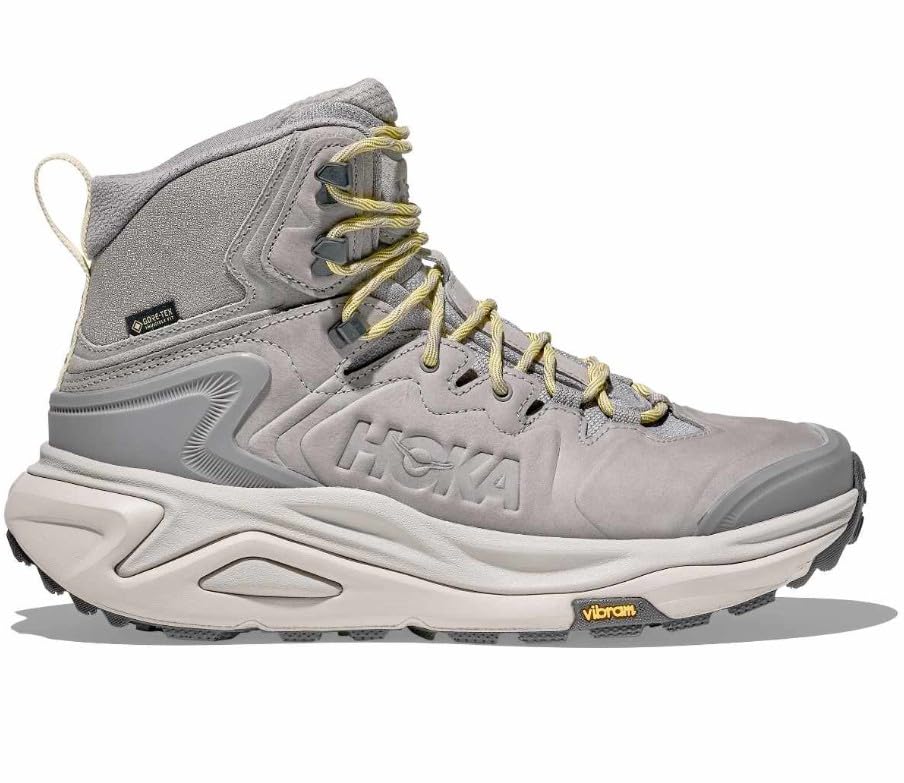
The Hoka Kaha 3 GTX is the boot for hikers whose joints are the limiting factor — knees, hips, plantar fascia, or any condition that makes the impact of 2,000 feet of descent on a fall trail painful the next day. Released spring 2025, the Kaha 3 builds on its predecessor with a sleeker, less bulky upper profile and a slightly firmer midsole that improves stability under heavy packs while maintaining the defining characteristic of the Kaha line: a maximalist stack height that absorbs more impact per step than any other boot on this list.
The Vibram Megagrip outsole with 5mm lugs is the strongest wet-surface traction package on this list — Megagrip’s rubber compound is specifically engineered for high friction on wet natural surfaces, and the 5mm lug depth clears wet leaf debris and mud consistently. OutdoorGearLab ranked the Kaha 3 GTX as the #1 men’s hiking boot in their 2026 update, specifically citing the cushioning-to-protection ratio as exceptional. The nubuck leather upper sheds surface moisture effectively, and the Gore-Tex lining provides full waterproofing. Short break-in period of 10–15 miles — the soft, conforming midsole adapts quickly.

For fall hiking specifically, the Kaha 3’s maximalist cushioning addresses the specific demand of slow, controlled descents on wet leaf trails. When traction requires you to decelerate carefully and absorb energy with each step on a steep, leaf-covered downhill, the additional midsole cushioning reduces the cumulative joint load meaningfully over a 2,000-foot descent. The trade-off is the heaviest weight on this list at approximately 3 lbs per pair — felt most on long uphill sections. The maximalist midsole also reduces ground feel, which some experienced technical hikers find destabilizing on rocky, off-trail navigation. On established fall trails, neither limitation is significant.
| Spec | Detail |
|---|---|
| Upper | Nubuck leather + CORDURA mesh |
| Waterproofing | Gore-Tex lining |
| Outsole | Vibram Megagrip |
| Lug Depth | 5mm |
| Midsole | Maximalist EVA stack (Hoka signature) |
| Ankle Height | Mid |
| Weight (pair, men’s) | ~3 lbs |
| Break-in Period | Short (10–15 miles) |
What we like:
- Vibram Megagrip + 5mm lugs — the best combined wet-surface traction package on this list
- Maximalist cushioning reduces joint impact on long fall descents
- Ranked #1 men’s hiking boot by OutdoorGearLab in 2026
- Short break-in period — accessible for mid-season buyers
- Nubuck leather with CORDURA mesh for durability and moisture resistance
What we don’t like:
- Heaviest boot on this list at ~3 lbs — noticeable on long ascents
- Reduced ground feel — less proprioceptive feedback on technical rocky terrain
- EVA midsole, despite being maximalist, still compresses over time under heavy pack loads
Bottom line: The best fall hiking boot for hikers with joint pain, plantar fasciitis, or any condition where impact absorption on descents matters. The Vibram Megagrip outsole’s documented wet-surface performance and 5mm lug depth make it genuinely excellent on wet fall leaf terrain. Accept the weight.
Check Price on Amazon — Hoka Kaha 3 GTX
6. Columbia Newton Ridge Plus II Waterproof — Best Entry-Level

The Columbia Newton Ridge Plus II is the most accessible entry point on this list — historically Amazon’s best-selling hiking boot in the category, with tens of thousands of reviews from real buyers. At under $130, it brings a leather and synthetic upper, Columbia’s Omni-Tech waterproof lining, a cushioned EVA midsole with energy-return foam heel, and a rubber outsole in a mid-cut package that handles standard fall day hiking conditions competently. If you’re buying your first fall hiking boot, hiking 5–15 times per year, and sticking to well-maintained trails with moderate mud and rain, the Newton Ridge handles the job without asking you to invest in a premium boot you may outgrow in a season.
The Omni-Tech membrane performs well in rain and puddles for standard day hiking durations. The leather and synthetic upper combination provides decent surface moisture resistance, and the cushioned midsole is comfortable from the first wear — minimal break-in required. At 2 lb 2 oz, it’s a manageable weight. The lace-up closure provides reasonable ankle lockdown, and the mid-cut height addresses the leaf-cover ankle protection case for fall hiking.

The honest limitations at this price: the Omni-Tech membrane begins to degrade in waterproofing performance after 1–2 seasons of heavy use — apply Nikwax Fabric and Leather Proof at the start of each fall season to extend it. The outsole rubber compound doesn’t match Vibram or Contagrip for wet leaf performance — hike at a measured pace on steep, wet leaf descents and don’t trust the grip to hold as confidently as a Vibram-soled alternative. This is a boot for trails, not technical terrain. For serious fall hikers or anyone going off-trail, step up to the Merrell Moab 3 or Salomon X Ultra 5.

| Spec | Detail |
|---|---|
| Upper | Leather + synthetic |
| Waterproofing | Omni-Tech membrane |
| Outsole | Columbia proprietary rubber |
| Midsole | Cushioned EVA with energy-return heel |
| Ankle Height | Mid |
| Weight (pair, men’s) | 2 lb 2 oz |
| Break-in Period | Minimal |
What we like:
- Most accessible price point on this list
- Minimal break-in — comfortable from the first fall hike
- Amazon’s historically best-selling hiking boot — real-world track record
- Adequate for standard fall day hiking on maintained trails
- Lightweight at 2 lb 2 oz for a leather-uppered mid-cut boot
What we don’t like:
- Omni-Tech degrades faster than Gore-Tex — re-treat annually with Nikwax
- Outsole compound underperforms Vibram on steep wet leaf terrain
- Not suited for technical terrain, heavy pack loads, or multi-day fall backpacking
Bottom line: The right entry-level boot for new fall hikers and casual day hikers on maintained trails. For anyone hiking more than 20 days per year or on technical terrain, the Merrell Moab 3 is the smarter mid-range step up.
Check Price on Amazon — Columbia Newton Ridge Plus II Waterproof
7. Danner Trail 2650 Mid GTX — Best Lightweight Leather Boot

The Danner Trail 2650 Mid GTX achieves something genuinely difficult: a full-grain leather waterproof mid-cut hiking boot that weighs approximately 2 lbs per pair. That’s lighter than many synthetic boots, lighter than the Columbia Newton Ridge, and about the same as the Salomon X Ultra 5 — while using a more durable material for the upper and carrying Danner’s USA-manufacturing heritage and resole capability. Made in Portland, Oregon, the Trail 2650 is one of the few hiking boots where “made in America” is a genuine descriptor rather than a marketing claim about some components.
The Vibram Fuga outsole with approximately 3.5mm lug depth provides Gore-Tex-level wet-surface performance through Vibram’s rubber compound rather than lug depth. On hardwood forest leaf cover — which compresses into a relatively smooth surface — the Fuga outsole’s Vibram compound grips effectively. The one limitation: in deep mud or after extended heavy rain where the leaf layer becomes a slippery slurry, the shallower 3.5mm lugs don’t penetrate as confidently as the 5mm alternatives on the Merrell Moab 3 or Salomon Quest 5. For standard fall trail conditions, the Fuga performs well. For consistently wet Pacific Northwest or Appalachian conditions with significant mud, the deeper-lugged alternatives are more reliable.

The break-in period is shorter than traditional leather boots — approximately 15–25 miles — because the Trail 2650’s lightweight construction uses a supple, thinner-cut leather rather than the heavy full-grain used in the Lowa Renegade. This makes it more accessible for mid-season buyers. Like the Renegade, the Trail 2650 can be resoled through Danner’s factory resole service, extending the boot’s service life significantly. For fall hikers who want a leather boot that moves quickly, looks classic, and represents the best available domestic manufacturing in the category, the Trail 2650 has no direct competitor.

| Spec | Detail |
|---|---|
| Upper | Full-grain leather + CORDURA |
| Waterproofing | Gore-Tex lining |
| Outsole | Vibram Fuga |
| Lug Depth | ~3.5mm |
| Ankle Height | Mid |
| Weight (pair, men’s) | ~2 lbs |
| Made In | USA (Portland, OR) |
| Break-in Period | Short-medium (15–25 miles) |
| Resoleable | Yes — Danner factory resole |
What we like:
- Lightest leather mid-cut waterproof boot on this list (~2 lbs)
- Made in USA — Portland, Oregon factory manufacturing
- Resoleable — extends service life for 10+ year ownership
- Shorter break-in than heavier leather boots (15–25 miles)
- Classic hiking boot aesthetic in a modern lightweight design
- Gore-Tex lining for full waterproofing
What we don’t like:
- 3.5mm lug depth is the shallowest on this list — less aggressive in deep mud
- Best for standard fall trail conditions; deeper lugs preferred for heavy mud or extended wet weather
Bottom line: The best option for fall hikers who want to move quickly, prefer the feel of leather, and value domestic manufacturing and long-term resole capability. A lighter alternative to the Renegade with a shorter break-in and classic aesthetics.
Check Price on Amazon — Danner Trail 2650 Mid GTX
8. Salomon Quest 5 GTX — Best for Fall Backpacking
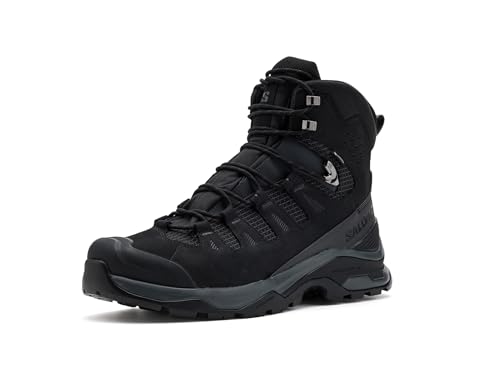
Released spring 2026, the Salomon Quest 5 GTX is the most structurally capable boot on this list — designed specifically for the scenario where fall hiking becomes fall backpacking: multi-day trips with 35–50 lb packs, sustained elevation gain, and the variable conditions above treeline in autumn where the trail can shift from leaf-covered hardwood forest to rocky alpine terrain to early-season snow over the course of a single day. BetterTrail’s reviewer tested the Quest 5 with a 45 lb pack in Utah canyon country, covering river cobble, sandstone slabs, and sandy washes — reporting that the boot handled every surface with confidence and maintained stability throughout.
The Contagrip MA outsole with 5mm lugs is Salomon’s most aggressive fall and backpacking outsole — deeper and more heavily patterned than the Contagrip TA used in the X Ultra 5. Combined with the Quest 5’s tall, structured collar — the tallest ankle cuff on this list — it provides the maximum ankle support available in a non-mountaineering hiking boot. This is specifically valuable for fall backpacking where leaf cover hides the ankle-rolling hazards described in the buying guide, and where a heavy pack’s load-on-ankle leverage makes ankle stability more critical than it is on a day hike.

At 2 lb 12 oz with a stiff, leather-synthetic upper, the Quest 5 is heavier than most day hiking boots and noticeably so on long flat sections and gradual ascents. It’s the right tool specifically for heavy-load technical terrain — for fall day hikes with a 15 lb pack on established trails, the X Ultra 5 is faster and more agile. The medium break-in period of 25–40 miles applies particularly to the tall, structured collar, which needs time to conform to the ankle before delivering its full support without any rubbing. The updated upper brings improved durability over the Quest 4 that multiple reviewers praised.

| Spec | Detail |
|---|---|
| Upper | Leather + reinforced synthetic |
| Waterproofing | Gore-Tex lining |
| Outsole | Contagrip MA (most aggressive Salomon outsole) |
| Lug Depth | 5mm |
| Midsole | EVA |
| Ankle Height | Full mid (tallest collar on this list) |
| Weight (pair, men’s) | 2 lb 12 oz |
| Break-in Period | Medium (25–40 miles) |
What we like:
- Contagrip MA with 5mm lugs — Salomon’s most aggressive fall and backpacking outsole
- Tallest collar / most ankle support on this list
- Handles 35–50 lb pack loads on technical fall terrain with documented confidence
- Updated upper brings improved durability over Quest 4
- Full Gore-Tex waterproofing for multi-day above-treeline fall conditions
What we don’t like:
- Heavier at 2 lb 12 oz — not ideal as a day hiking boot with light loads
- Medium break-in period — plan ahead
- Overkill for standard fall day hikes; the X Ultra 5 is faster and more comfortable for those applications
Bottom line: The best fall backpacking boot — specifically designed for heavy loads on technical terrain. For multi-day fall trips with significant pack weight and variable conditions including early-season snow, no other boot on this list matches the Quest 5’s structural capability.
Check Price on Amazon — Salomon Quest 5 GTX
9. The North Face Ultra 112 Waterproof — Best Low-Cut Option
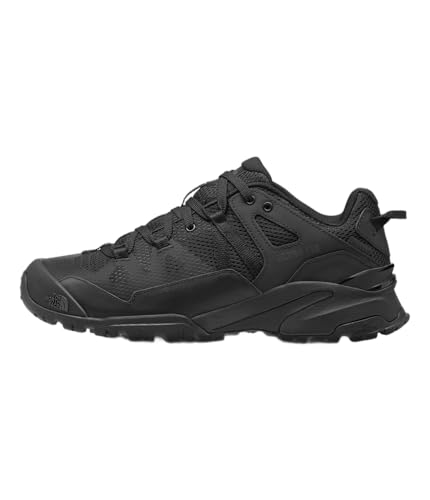
The North Face Ultra 112 is the only low-cut shoe on this list — included specifically for fall hikers who prefer the lighter, more agile feel of a hiking shoe and primarily hike on well-maintained, flat-to-moderate trails where the ankle-rolling hazard from leaf cover is minimal. The Surface CTRL rubber outsole with 5mm lug depth is the deepest lug on any low-cut waterproof shoe in this price range, delivering fall-capable traction despite the lower cut height. The DryVent waterproof membrane keeps water out in rain and puddles while maintaining reasonable breathability for active movement.
The mixed-material upper — leather, synthetic leather, ripstop, and spacer mesh — provides rugged toe and forefoot protection through multilayered overlays that protect against the trail debris (rocks, roots, sticks) that falls from branches in autumn. The reinforced heel cradle and shank provide underfoot structure and arch support. BetterTrail’s reviewer noted that the Ultra 112 delivers solid traction across a wide range of terrain and impressive overall protection, but flagged heel slippage and reduced ankle support compared to mid-cut alternatives as limitations on more technical terrain or with heavier packs. At approximately 2 lb 3 oz, it’s competitive in weight.

The key buying consideration for this shoe: it’s a low-cut design in a list of predominantly mid-cut boots, and that matters specifically for fall hiking where hidden ankle hazards are the primary risk argument for mid-cut. The Ultra 112 is the right choice for fall hikers on moderate, maintained trails — think state park day hike loops, forest service roads with trail access, flat hardwood forest trails — where the combination of good traction and waterproofing matters more than ankle protection. For trails with significant root exposure, elevation change, or off-trail navigation under leaf cover, a mid-cut boot is the safer choice. The Ultra 112 also fits wide in the toe box and narrow in the heel, a specific fit shape that works very well for some foot types and less well for others.

| Spec | Detail |
|---|---|
| Upper | Mixed material — leather, synthetic, ripstop, mesh |
| Cut Height | Low-cut (below ankle) |
| Waterproofing | DryVent membrane |
| Outsole | Surface CTRL rubber (34% recycled) |
| Lug Depth | 5mm |
| Midsole | EVA with reinforced heel cradle and shank |
| Weight (pair, men’s) | ~2 lb 3 oz |
| Break-in Period | Minimal |
| Fit Note | Wide toe box, narrower heel — confirm fit before buying |
What we like:
- Best low-cut waterproof hiking shoe for fall on this list
- 5mm Surface CTRL lug depth — deep for a hiking shoe
- Multilayered overlays protect against trail debris
- DryVent waterproofing with reasonable breathability
- Wide toe box for comfortable fall sock thickness
What we don’t like:
- Low-cut height — limited ankle protection for root/rock-heavy fall terrain under leaf cover
- Heel slippage reported by BetterTrail reviewer — confirm fit carefully
- Not recommended for technical terrain or heavy pack loads
Bottom line: The best fall hiking shoe for low-cut devotees on moderate maintained trails. If you specifically dislike mid-cut boots and primarily hike on well-maintained paths without significant technical terrain, the Ultra 112’s 5mm lug depth and DryVent waterproofing make it the strongest low-cut option for fall. For trails with hidden roots, rocks, and elevation change under leaf cover — choose a mid-cut instead.
Check Price on Amazon — The North Face Ultra 112 Waterproof
10. La Sportiva Ultra Raptor 3 Mid GTX — Best Technical / Fast Hiking Boot
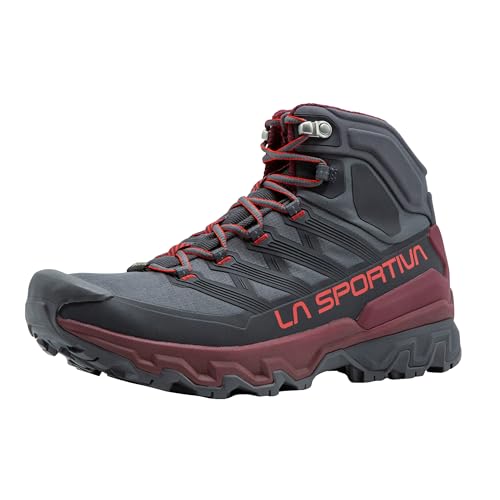
Released spring 2026, the La Sportiva Ultra Raptor 3 Mid GTX is the lightest mid-cut waterproof hiking boot on this list at 1 lb 12 oz per pair — one ounce lighter than the Salomon X Ultra 5, and the only boot here that genuinely crosses the line between hiking boot and trail running shoe in terms of on-foot feel. GearJunkie described it as a boot that has become “more of a classic hiker than the trail-running and hiking option its prior versions were touted as” — a deliberate evolution that adds a wider base, more durable mesh, deeper lugs, and improved shock absorption while keeping the agility that La Sportiva’s mountain athletes demand.
The FriXion XF 2.0 outsole is La Sportiva’s most capable wet-terrain compound — Trail and Kale’s tester described it as “the sticky compound holds where other shoes start hedging, unless they use Vibram Megagrip.” On wet roots, muddy switchbacks, and post-rain organic surfaces, the FriXion XF 2.0 performs above its weight class. The Impact Brake System under the heel is a specifically fall-relevant feature: it slows descent momentum during steep downhill sections where wet leaf cover requires careful foot placement and controlled deceleration. The Gore-Tex ePE Extended Comfort membrane is the most breathable waterproof lining on this list — engineered for high-output mountain use where sweat management is as important as rain exclusion.

The 4mm FriXion XF 2.0 lug depth performs exceptionally on mixed natural terrain but is marginally below the 5mm alternatives on very deep mud or thick, wet leaf accumulation — the same performance nuance reported by BetterTrail’s tester in their Ultra Raptor 3 review. On technical mountain terrain, rocks, and the majority of fall trail surfaces, the FriXion compound’s grip compensates for the depth difference. Break-in is minimal — the lightweight, synthetic-dominant construction adapts quickly. The Tempo 2 last provides a medium fit that’s narrower than KEEN and Altra but slightly more accommodating than Salomon’s Contragrip-focused designs. Size up half a size, particularly with thicker fall Merino wool socks.

| Spec | Detail |
|---|---|
| Upper | High-tenacity ripstop mesh + TPU overlays |
| Waterproofing | Gore-Tex ePE Extended Comfort |
| Outsole | FriXion XF 2.0 / Impact Brake System |
| Lug Depth | 4mm |
| Midsole | Dual-density CMEVA |
| Ankle Height | Mid |
| Weight (pair, men’s) | 1 lb 12 oz (lightest on this list) |
| Break-in Period | Minimal (10–15 miles) |
| Heel Drop | 6mm |
What we like:
- Lightest boot on this list at 1 lb 12 oz — the fastest-moving option for technical fall terrain
- FriXion XF 2.0 — sticky compound excels on wet rocks, roots, and mixed natural surfaces
- Impact Brake System — specifically reduces descent momentum on steep fall leaf-covered downhills
- Gore-Tex ePE Extended Comfort — most breathable WP membrane on this list
- Dual-density CMEVA midsole for improved shock absorption vs. Ultra Raptor 2
- Trail-ready with minimal break-in
What we don’t like:
- Ripstop mesh upper is less durable than leather over 500+ miles at high intensity
- 4mm lug depth marginally less aggressive than 5mm alternatives in very deep mud
- Narrow fit — not suitable for wide feet or high-volume foot shapes
- Size up half a size for thick fall wool socks
Bottom line: The best fall hiking boot for fast hikers and technical terrain enthusiasts who want the lightest possible mid-cut waterproof option with premium wet-surface traction. The FriXion XF 2.0’s grip and the Impact Brake System’s descent control make it specifically well-suited for the steep, leaf-covered fall terrain where most hiking injuries occur.
Check Price on Amazon — La Sportiva Ultra Raptor 3 Mid GTX
11. Altra Olympus 6 Hike Mid GTX — Best Zero-Drop / Widest Toe Box

The Altra Olympus 6 Hike Mid GTX occupies a specific position that no other boot on this list fills: a zero-drop, maximum-cushion, foot-shaped toe box mid-cut waterproof hiking boot. For hikers who have built their trail running and hiking life around Altra’s zero-drop philosophy — or who are transitioning from minimalist footwear and need maximum cushioning to buffer the impact during that transition — the Olympus 6 Hike Mid GTX is the only boot that delivers fall-capable Gore-Tex waterproofing and Vibram Megagrip traction while maintaining the 0mm heel-to-toe drop and Original FootShape toe box that Altra devotees require.
The Vibram Megagrip outsole with 3.8mm lug depth is the strongest wet-surface traction package available at this stack height — RunRepeat’s durometer testing confirmed Megagrip’s rubber hardness at 85.0 HC, indicating appropriate hardness for durability without becoming too rigid to grip wet surfaces. BetterTrail’s tester described the Megagrip as “phenomenal, delivering tacky, lively grip on wet rock, loose descents, and alpine talus.” The 33mm zero-drop stack height provides maximum impact absorption — over three days with a 40 lb pack, the reviewer’s feet stayed fresh with almost no soreness. The wide base adds stability despite the high stack, counteracting the balance challenge that some zero-drop hikers find with maximalist stack heights.

The honest limitations are material-specific. The Olympus 6 Hike’s upper is not as durable as full-grain leather — one REI reviewer noted significant wear and tread loss after a few months of intensive field use, and La Sportiva Ultra Raptor 3 reviewer comparison suggested the Altra’s upper holds up less well on abrasive terrain. The boot is heavier than its lightweight appearance suggests — approximately 2 lb 4 oz per pair — partly because of the thick midsole stack. Zero-drop geometry requires an adjustment period for hikers accustomed to 8–12mm heel drop; transitioning cold into aggressive fall hiking without this adaptation can lead to Achilles soreness. If you’re new to zero-drop, spend several weeks in easier terrain before long fall hikes.

| Spec | Detail |
|---|---|
| Upper | Leather + mesh overlays |
| Waterproofing | Gore-Tex lining |
| Outsole | Vibram Megagrip |
| Lug Depth | 3.8mm |
| Midsole | CMEVA, 33mm stack height, zero-drop |
| Heel Drop | 0mm (true zero-drop) |
| Ankle Height | Mid |
| Toe Box | Original FootShape — widest on this list |
| Weight (pair, men’s) | ~2 lb 4 oz |
| Break-in Period | Short (10–15 miles) for the boot; longer adaptation for zero-drop beginners |
What we like:
- Only zero-drop mid-cut waterproof hiking boot on this list
- Original FootShape toe box — the widest toe box available in the fall hiking category
- Vibram Megagrip — best-in-class wet-surface traction compound
- 33mm stack height with wide base — maximum cushioning with good stability
- Gore-Tex waterproofing
- Phenomenal comfort over long days and heavy packs per independent testing
What we don’t like:
- Zero-drop requires adaptation — don’t use for hard fall hiking immediately if transitioning from heel-dropped boots
- Upper durability below leather alternatives on abrasive terrain
- Heavier than expected for a synthetic upper boot
- Not ideal for very technical rocky terrain where ground feel matters
Bottom line: The best fall hiking boot for zero-drop advocates, wide-foot hikers who need even more room than the KEEN Targhee provides, and anyone whose joint comfort depends on the natural gait that zero-drop geometry promotes. The Vibram Megagrip traction is excellent for fall conditions. Adapt to the geometry before the season starts if you’re transitioning from conventional heel-drop boots.
Check Price on Amazon — Altra Olympus 6 Hike Mid GTX
Fall Hiking Sock Guide — The Overlooked Partner
No fall hiking boot performs at its best with the wrong sock. The requirements for fall hiking socks are thermal regulation across a 30°F daily swing, moisture wicking from active hiking sweat, and durability without compression inside the boot over 8+ hours.
Merino wool is the correct material for fall hiking socks. It regulates temperature naturally — warmer when you’re cold, less stifling than synthetics when you’re working hard. It wicks moisture away from the foot actively rather than saturating like cotton. And it resists odor development over multiple wears, which matters on multi-day fall backpacking trips.
For weight selection: lightweight Merino (150–200g) for temperatures above 55°F or high-output fast hikers; midweight Merino (250–300g) for the 40–55°F range that covers most fall hiking days; heavyweight Merino (400g+) for late-season hiking approaching winter conditions below 35°F. For most fall hiking, midweight Merino is the correct starting point. The most recommended brands on Amazon: Darn Tough Vermont Merino, Smartwool Hike Classic Edition, and Icebreaker Merino Hike.
Sizing note: Midweight to heavyweight Merino socks add 1–2mm of material thickness compared to thin synthetic liner socks. If ordering fall hiking boots online, size up half a size from your usual summer hiking shoe size to account for both sock thickness and end-of-day foot swelling.
Boot Care for Fall Hiking Season
Before the season — re-treat the DWR coating. Most hiking boots have a Durable Water Repellent (DWR) treatment on the outer face fabric or leather that causes water to bead off the surface. After one season of use, this treatment washes out. Apply Nikwax Fabric and Leather Proof (leather boots) or Nikwax TX.Direct (synthetic boots) before fall hiking season. It takes 15 minutes and substantially extends how long your waterproofing system stays effective before moisture starts wetting through.
After each fall hike — remove and dry the insoles. Insoles hold more moisture than the boot shell after a wet fall hike. Remove them, knock out mud and leaf debris, and allow both insoles and boots to dry naturally in a ventilated area — never next to a heat source, which cracks leather and degrades EVA foam.
End of season — condition leather before storage. Full-grain leather boots (Lowa Renegade, Danner Trail 2650, KEEN Targhee) should be cleaned thoroughly and treated with leather conditioner or beeswax before off-season storage. Unconditioned leather stored over winter dries out and cracks, which begins undermining the upper’s structural integrity. Store all boots in a cool, dry location stuffed with newspaper or a boot tree to maintain shape.
Frequently Asked Questions About Fall Hiking Boots
Do I need waterproof boots for fall hiking?
Yes, for the vast majority of fall hiking situations. Fall trails are consistently wetter than summer trails — morning dew on vegetation, leaf-hidden puddles, higher seasonal mud, and frequent afternoon rain showers all create moisture hazards that are less common in summer. The one exception: dry fall climates in the desert Southwest (Arizona, Utah, California desert fall) where rain is rare and breathability may matter more than waterproofing.
Should I get insulated hiking boots for fall?
No — for most fall hiking situations. Insulated boots are designed for sustained temperatures below 25°F with minimal movement. Fall hiking involves active movement that generates body heat; insulated boots will overheat your feet during any meaningful climb and saturate them in sweat. Pair a non-insulated waterproof boot with midweight Merino wool socks (250–300g) — this system handles 30–65°F comfortably, which covers the full range of typical fall hiking conditions.
What is the best boot for hiking on wet leaves?
The Hoka Kaha 3 GTX with Vibram Megagrip + 5mm lugs, and the Merrell Moab 3 with Vibram TC5+ + 5mm lugs, are the strongest performers specifically for wet leaf and organic debris surfaces. The La Sportiva Ultra Raptor 3’s FriXion XF 2.0 compound also excels on wet natural surfaces at 4mm depth. Key features for wet leaf traction: 4mm+ lug depth, multidirectional lug pattern, wide lug spacing, and a high-grip rubber compound (Megagrip, Contagrip, FriXion XF 2.0, or Vibram TC5+).
Are mid-cut boots necessary for fall hiking?
Strongly recommended for most fall trails. Wet leaves hide ankle-rolling hazards — roots, edge drops, embedded rocks — that are visible in summer. Mid-cut ankle support protects against the rolling hazards that leaf cover creates. For flat, maintained trails with minimal root and rock exposure, low-cut is manageable. For any trail with elevation change, rooted terrain, or uneven ground under leaf cover, mid-cut is worth the extra weight.
How do I break in hiking boots before fall hiking season?
Wear them around the house for 2–3 evenings. Walk on easy, flat terrain for 3–5 miles. Gradually increase mileage and elevation over 2–3 weeks before a long fall hike. For the Salomon X Ultra 5 and La Sportiva Ultra Raptor 3, this process is rapid (10–15 miles). For the Lowa Renegade and Salomon Quest 5, budget the full 30–50 miles. Never take a brand-new stiff leather boot on a 12-mile mountain hike — you will get blisters.
What socks should I wear for fall hiking?
Midweight Merino wool (250–300g) for the 40–55°F temperature range that covers most fall hiking days. Merino regulates temperature across a 30°F daily swing, wicks sweat actively, and resists odor over multiple wears. Avoid cotton — it holds moisture and provides no thermal regulation when wet. Size up half a size in boots when switching from thin synthetic to midweight Merino wool socks.
Can I hike in light snow with fall hiking boots?
Yes — all 11 boots on this list are waterproof and handle light snow and early-season slush confidently. None are insulated, so for sustained temperatures below 20°F with deep snow coverage, a winter boot with 200g+ Thinsulate is more appropriate. For the brief snow encounters common at fall elevation (dusting above treeline, early flurries), these boots are the correct choice. Pair with lightweight gaiters to keep snow out of the ankle collar on longer snow sections.
Final Verdict — Best Fall Hiking Boot for Every Hiker
For the majority of fall hikers on any trail, in any region, the Salomon X Ultra 5 Mid GTX is the recommendation that holds across the most variables: Contagrip wet-leaf traction, Gore-Tex Extended Comfort breathability, minimal break-in, lightest mid-cut waterproof weight at this performance level, and validation from every major testing publication. For hikers who prioritize budget, the Merrell Moab 3 Mid WP’s 5mm Vibram lugs are genuinely the deepest at its price point — a real advantage on heavy fall leaf accumulation. For wide feet, the KEEN Targhee IV or Altra Olympus 6 solve the problem every narrow-toed alternative creates. For joint pain and maximum cushioning, the Hoka Kaha 3 GTX’s Vibram Megagrip + maximalist stack is the right combination. For serious fall backpacking with heavy loads, the Salomon Quest 5 is the only boot on this list built specifically for that demand. And for buyers who want a boot that lasts a decade, the Lowa Renegade GTX Mid’s PU midsole and resole capability make it the best long-term investment in the category.
| Pick | Boot | Why |
|---|---|---|
| Best Overall | Salomon X Ultra 5 Mid GTX | Contagrip, Gore-Tex EC, lightest mid-cut, trail-ready, top-rated |
| Best Budget | Merrell Moab 3 Mid WP | 5mm Vibram TC5+, deepest budget lug, wide toe box |
| Best Wide Feet | KEEN Targhee IV Mid WP | Most generous toe box, full leather, integrated arch support |
| Best Premium | Lowa Renegade GTX Mid | PU midsole, resoleable, 10-year leather durability |
| Best Cushioning | Hoka Kaha 3 GTX | Vibram Megagrip + 5mm + maximalist cushioning, #1 OutdoorGearLab |
| Best Entry-Level | Columbia Newton Ridge Plus II | Lowest price, minimal break-in, Amazon’s best-seller |
| Best Lightweight Leather | Danner Trail 2650 Mid GTX | USA-made, lightest leather boot, resoleable, Gore-Tex |
| Best Backpacking | Salomon Quest 5 GTX | Contagrip MA 5mm, tallest collar, heavy-load structural support |
| Best Low-Cut | TNF Ultra 112 WP | 5mm lug hiking shoe, DryVent WP, mild fall trail specialist |
| Best Technical / Fast | La Sportiva Ultra Raptor 3 Mid GTX | Lightest boot, FriXion XF 2.0, Impact Brake, GTX ePE breathability |
| Best Zero-Drop | Altra Olympus 6 Hike Mid GTX | Only zero-drop mid-cut WP boot on this list, widest toe box, Megagrip |