Merrell claims to make the world’s best-selling hiking boot. They might be right — 25 million Moabs sold is not a number you argue with. But spend an afternoon in any serious outdoor gear shop and you will hear something different from the staff: most professional gear specialists do not hike in Merrells themselves, and many will not recommend them to customers who ask for “the best” boot for technical terrain.
Both things are true simultaneously. Merrell makes the hiking boot that fits the most people, requires no break-in, and performs reliably on the trails that 90% of hikers actually walk. They also make boots that a technical alpinist would find inadequate for serious terrain. The Merrell lineup spans a wider range than most buyers realise — from the traditional Moab 3 that belongs on established dirt trails to the Agility Peak 6 with Vibram Megagrip that grips wet granite better than most trail runners on the market.
This guide covers all nine Merrell hiking boots and shoes worth buying in 2026. It starts with a decoder of what the different model families actually mean — because Merrell’s lineup names are not self-explanatory — and then gives you a specific recommendation for each hiker type. All nine products are available on Amazon with confirmed links. The terrain-matching table in section seven will get most buyers to the right model before they reach the individual reviews.
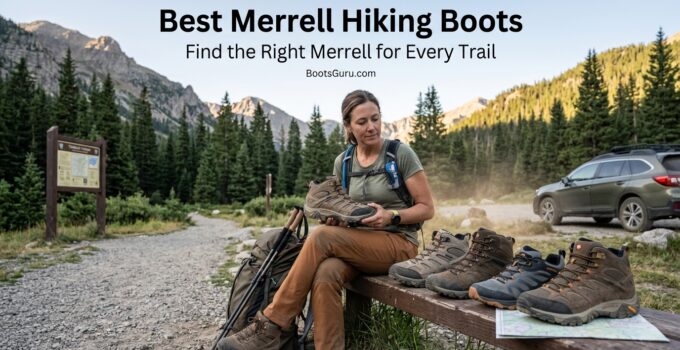
hiker comparing merrell boot fam… 202607062116(1)
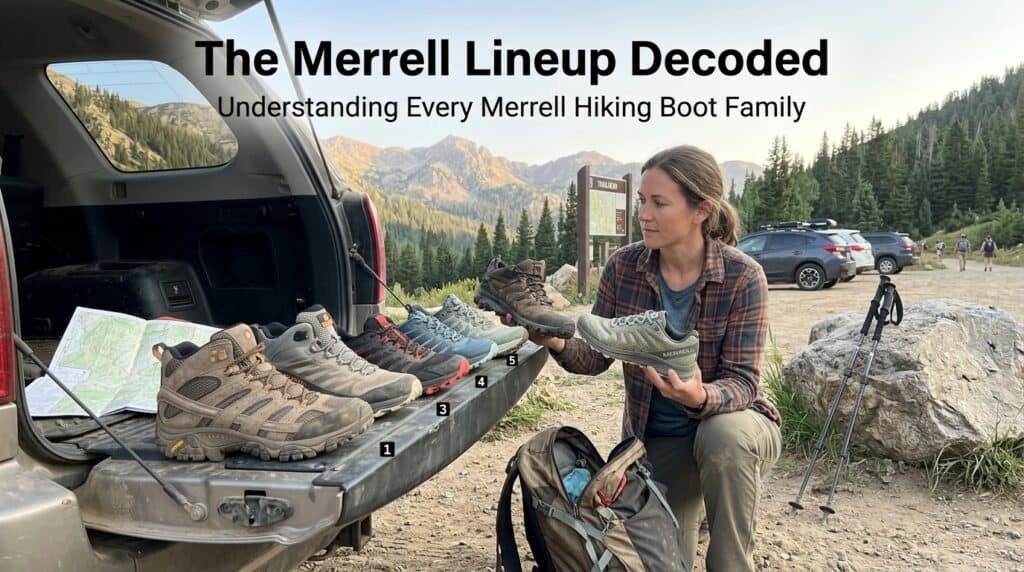
The Merrell Lineup Decoded: What Each Model Family Means
Merrell organises their hiking line along two axes that they never explicitly explain. Once you understand these axes, choosing between models becomes straightforward. The first axis is the protection spectrum: traditional and burly at one end, ultralight and minimal at the other. The second axis is the activity spectrum: heavy backpacking loads at one end, trail running at the other. Every Merrell hiking model sits somewhere on this grid.
Traditional protection line (Moab 3 family): Pigskin suede and mesh upper, nylon arch shank, Air Cushion heel, Vibram TC5+ outsole. Built for day hiking to light backpacking on established and moderate trails. Philosophy is comfort-first. This is the boot that fits the most foot types, requires no break-in, and works reliably on any maintained trail. It is heavier than Merrell’s marketing implies and not designed for technical scrambling.
Modern speed line (Moab Speed 2): Synthetic and nylon ripstop upper, EnergyCell foam midsole, rockered profile. Trail-runner-influenced construction with hiking-boot protection. For day hikers who find the Moab 3 too heavy or too stiff, this is the correct upgrade — lighter, more flexible, and faster-feeling underfoot while keeping the Vibram TC5+ outsole.
Technical trail line (Agility Peak 6): Vibram Megagrip outsole with 5mm lugs, large rock plate, trail-running construction. Built for technical trails, wet rock, and scrambling terrain where grip is the primary concern. The only Merrell in this guide with genuinely technical-grade traction. Lightest pick in the guide at approximately 9.8 oz per shoe.
Ultralight and trail-run line (Nova 4, Altalight): Minimal construction, low stack height, trail-running DNA. For experienced hikers who want the lightest possible Merrell option on maintained trails with a light daypack. Not designed for heavy loads or rough terrain.
Mixed use and sustainability (Speed Eco, Accentor 3): The Speed Eco prioritises recycled materials and eco-conscious construction. The Accentor 3 bridges hiking and approach-shoe categories for hikers who mix trail walking with rock scrambling.
Merrell Technology Guide
Woman preparing her hiking boots and gear in a scenic mountain forest, ready for an outdoor adventure.
Gore-Tex vs M Select Dry vs Non-Waterproof
Gore-Tex (GTX) is an ePTFE membrane bonded inside the upper, independently tested to specific hydrostatic pressure ratings, and quality-controlled by W.L. Gore rather than Merrell. It is the benchmark against which all other waterproof membranes are measured. More breathable than M Select Dry in sustained wet conditions and more resistant to pressure from prolonged water immersion.
M Select Dry is Merrell’s proprietary membrane — adequate for light rain and occasional creek crossings, less expensive to licence than Gore-Tex, and breathes similarly in dry conditions. The honest limitation: sustained submersion or prolonged heavy rain is more likely to breach M Select Dry than Gore-Tex. The price difference between M Select Dry and GTX versions is typically $20 to $30 — small enough that in genuinely wet climates, GTX is almost always worth it.
Non-waterproof versions use open mesh uppers for maximum breathability. Feet get wet in rain faster but also dry faster — because the same open mesh that lets water in lets it evaporate out. For hikers in climates where average summer highs exceed 80°F, the non-waterproof version often provides better day-to-day comfort than a sealed GTX boot that traps foot perspiration.
The decision rule: consistent rain or fog, temperatures below 50°F, or regular creek crossings → GTX justified. Occasional rain in a dry climate → M Select Dry is adequate. Summer-only hiking above 80°F with no creek crossings → non-waterproof for breathability.
Vibram TC5+ vs Vibram Megagrip
Most Merrell hiking boots use Vibram TC5+ — a versatile compound balanced for durability, wet traction, and longevity on varied terrain. It performs well on wet dirt, moderate rock, and established trails. It is not Vibram’s highest-friction compound.
The Agility Peak 6 uses Vibram Megagrip — Vibram’s performance compound specifically formulated for maximum friction on wet and technical surfaces. RunRepeat’s lab testing measured a friction coefficient of 0.64 for the Agility Peak 6’s outsole — meaningfully higher than the TC5+ compound across all tested surfaces. If wet rock, slick roots, or technical scrambling is the primary terrain, Megagrip is the correct outsole.
Air Cushion vs EnergyCell Midsole
Air Cushion (Moab 3 family) places an air pocket in the heel zone specifically to absorb impact from heel-strike on hard trail surfaces. It provides targeted heel protection particularly valued by hikers on rocky or rooted terrain.
EnergyCell (Moab Speed 2) is a modern responsive foam designed to return energy at toe-off — giving the boot a more athletic, propulsive feel than traditional EVA constructions. Better for hikers who move quickly and want the boot to feel more like a trail runner.
Weight and Heel Drop: The Real Numbers
One important note before the data: Merrell states boot weight per single shoe in their marketing materials. Most outdoor retailers including REI state weight per pair. This creates a confusing discrepancy — the Moab 3 is described as “13 oz” by Merrell but appears as “2 lbs 1 oz” at REI. These are the same boot: 13 oz per shoe equals approximately 26 oz, or 1 lb 10 oz, per pair. BetterTrail’s tested pair in men’s size 11 weighed 1 lb 14.7 oz. All weights in this article are stated per pair.
On heel drop: RunRepeat’s lab testing found the Moab Speed 2’s actual measured drop is 15mm, not the 10mm Merrell advertises. This matters for hikers managing Achilles or calf conditions who are making decisions based on drop specifications.
| Model | Drop (stated) | Drop (measured) | Weight per pair | Waterproofing |
|---|---|---|---|---|
| Moab 3 GTX | 11.5mm | ~11.5mm | ~2 lbs 1 oz | Gore-Tex |
| Moab 3 Mid GTX | 11.5mm | ~11.5mm | ~2 lbs 4 oz | Gore-Tex |
| Moab 3 (non-GTX) | 11.5mm | ~11.5mm | ~1 lb 14 oz | None (mesh) |
| Moab Speed 2 | 10mm (advertised) | 15mm (RunRepeat lab) | ~1 lb 10.8 oz | GTX or none |
| Agility Peak 6 | ~6mm | Trail run profile | ~1 lb 3.6 oz | None / GTX |
| Nova 4 | Low (trail run) | Not lab-tested | Ultralight | None |
| Altalight | Low (ultralight) | Not lab-tested | Ultralight | None |
| Accentor 3 | ~8–10mm | Not lab-tested | Moderate | M Select Dry / none |
| Speed Eco | Moderate | Not lab-tested | Moderate | None / M Select Dry |
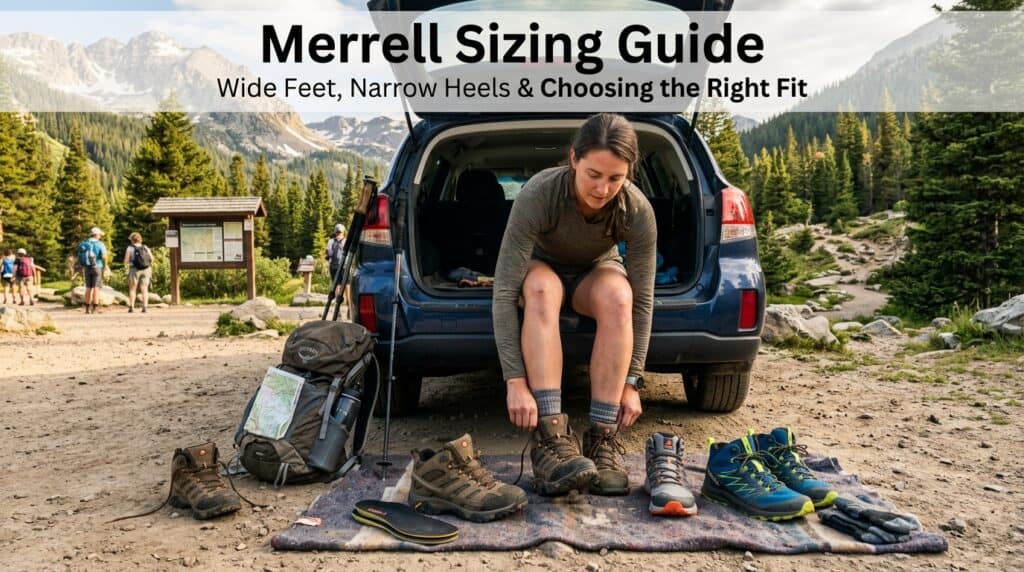
Merrell Sizing: Wide Feet, Narrow Heels, and What to Know
merrell boot sizing for fit 202607062118
Merrell’s Moab line runs wider than most hiking boot competitors — Treeline Review describes it as potentially having “the widest fit in hiking footwear.” The toe box on the Moab 3 specifically is the roomiest in the Merrell lineup, making it the correct choice for hikers with wide or standard-width feet who have historically struggled to find hiking boots that do not compress the forefoot.
Wide-width variants are available for both the Moab 3 low and Moab 3 Mid — rare for waterproof hiking boots at mainstream retail price points. If you have genuinely wide feet, the Moab 3 in wide width is one of the few hiking boots that addresses this without requiring a specialty retailer.
The narrow-heel caveat: HikingFeet documents that the Moab 3’s wide last creates a heel cup that can slip slightly for hikers with narrow heels during steep descents. This is not a defect — it is the predictable consequence of a wide last on a narrow heel. The fix: Superfeet Green or Tread Labs insoles add heel cup volume and significantly reduce slip for narrow-heeled hikers in the Moab 3.
The trail-runner-influenced models (Agility Peak 6, Nova 4, Altalight) run narrower than the Moab family — consistent with trail-running shoe geometry. Wide-footed hikers should stick to the Moab family rather than the speed/ultralight line.
Sizing recommendation: order your standard size. Merrell’s half-size availability allows precise fitting — if between sizes and the wide Moab toe box feels excessive, go half a size down.
Terrain Matching: Which Merrell for Which Trail
| Model | Dirt trail | Rocky / technical | Wet / mud | Desert / dry | Snow / alpine | Multi-day pack | Trail run |
|---|---|---|---|---|---|---|---|
| Moab 3 GTX | ✅ Ideal | ⚠️ Moderate | ✅ GTX + TC5+ | ⚠️ Hot in GTX | ⚠️ Light snow | ✅ Light loads | ❌ Too heavy |
| Moab 3 Mid GTX | ✅ Ideal | ⚠️ Better than low | ✅ | ⚠️ Hot | ✅ Better ankle | ✅ Mid loads | ❌ |
| Moab 3 (non-GTX) | ✅ Ideal | ⚠️ | ⚠️ Light rain only | ✅ Best breathable | ❌ | ✅ Light loads | ❌ |
| Moab Speed 2 | ✅ Ideal | ✅ TC5+ | ✅ GTX version | ✅ Non-GTX version | ⚠️ | ⚠️ Light only | ⚠️ Not true trail runner |
| Agility Peak 6 | ✅ | ✅✅ Best grip | ✅ Megagrip on wet rock | ✅ | ⚠️ | ❌ Low cushion | ✅ |
| Nova 4 | ✅ | ⚠️ | ⚠️ | ✅ Light + breathable | ❌ | ❌ | ✅ |
| Altalight | ✅ | ⚠️ | ⚠️ | ✅ | ❌ | ❌ | ✅ |
| Accentor 3 | ✅ | ✅ Approach grip | ⚠️ | ✅ | ⚠️ | ⚠️ | ⚠️ |
| Speed Eco | ✅ | ⚠️ | ⚠️ | ✅ | ❌ | ⚠️ | ⚠️ |
Quick Comparison: All 9 Merrell Hiking Boots (2026)
| Boot | Best for | Outsole | Waterproofing | Weight/pair | Drop | Price |
|---|---|---|---|---|---|---|
| Moab 3 GTX | Best overall / beginners | Vibram TC5+ | Gore-Tex | ~2 lbs 1 oz | 11.5mm | ~$150 |
| Moab 3 Mid GTX | Best ankle support / backpacking | Vibram TC5+ | Gore-Tex | ~2 lbs 4 oz | 11.5mm | ~$160 |
| Moab 3 (non-GTX) | Best breathable / desert / summer | Vibram TC5+ | None | ~1 lb 14 oz | 11.5mm | ~$125 |
| Moab Speed 2 | Best modern / versatile / lighter | Vibram TC5+ | GTX or none | ~1 lb 10.8 oz | 15mm (measured) | ~$145 |
| Agility Peak 6 | Best technical terrain grip | Vibram Megagrip | GTX or none | ~1 lb 3.6 oz | ~6mm | ~$135 |
| Nova 4 | Best ultralight / trail run style | Merrell grip | None | Ultralight | Low | ~$115 |
| Speed Eco | Best sustainable / eco-conscious | Merrell grip | None / M Select | Moderate | Moderate | ~$125 |
| Accentor 3 | Best approach / mixed use | Merrell grip | M Select / none | Moderate | ~8–10mm | ~$130 |
| Altalight | Best fast-and-light day hike | Merrell grip | None | Ultralight | Low | ~$120 |
Hiker reviewing Merrell hiking boots at a scenic mountain trail, showcasing outdoor footwear suitable for hiking adventures.
1. Merrell Moab 3 GTX — Best Overall Merrell Hiking Boot
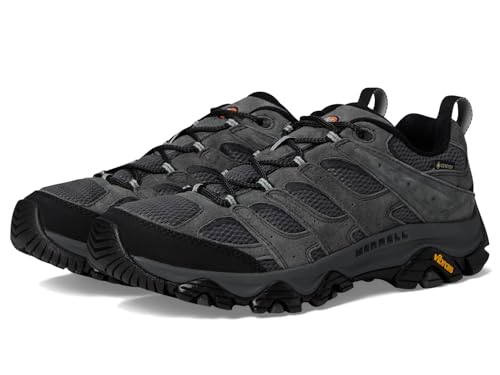
📍 Lineup position: Traditional protection × Day hiking to light backpacking · Gore-Tex waterproof
Best for: Beginner to intermediate hikers on established and moderate trails in wet climates who want the most comfortable, most forgiving Merrell available without any break-in period — the boot that 25 million hikers have chosen for a reason.
| Upper | Pigskin suede + breathable mesh |
| Waterproofing | Gore-Tex membrane |
| Outsole | Vibram TC5+ · 5mm lug depth |
| Midsole | EVA + Air Cushion heel |
| Heel drop | 11.5mm |
| Weight per pair | ~2 lbs 1 oz (men’s, tested) |
| Wide width | Yes — available in wide |
| Price range | ~$150 |

The Moab 3 GTX earns the top position in this guide for the same reason it has earned the world’s best-selling hiking boot status: it fits more feet correctly, requires no break-in period, and performs reliably on the moderate established trails that represent the vast majority of hiking done in North America. The pigskin suede and mesh upper is more durable than full synthetic alternatives while remaining lighter than full leather. The Air Cushion heel addresses the specific impact fatigue of heel-strike on rocky trail surfaces without the weight penalty of a foam platform. The Vibram TC5+ outsole provides reliable traction on wet dirt, moderate rock, and mixed terrain — not the most aggressive Vibram compound available, but genuinely capable across the terrain it is designed for.

The honest context: the Moab 3 GTX is not the correct choice for technical terrain, for hikers who prioritise low weight, or for trail running. Its Vibram TC5+ outsole has a moderate lug pattern that performs well on established trails but does not match the grip of the Agility Peak 6’s Megagrip compound on wet rock or scree. Its per-pair weight of approximately 2 lbs 1 oz is heavier than Merrell’s “13 oz” per-shoe marketing implies — heavier than the Moab Speed 2 by roughly 6 oz per pair and heavier than the Agility Peak 6 by approximately 12 oz per pair. But for the hiker who wants to buy one reliable boot for weekend hiking across varied conditions, the Moab 3 GTX remains the most defensible single choice in the lineup. Wide width available for hikers who need it — a rarity among Gore-Tex hiking boots at this price.
✅ Best for: Beginners, occasional hikers, wide feet, wet climates, hikers who want immediate comfort with no break-in, anyone carrying a light daypack on established trails.
❌ Not for: Technical scrambling, serious backpacking loads above 30 lbs, hikers who prioritise low weight, trail running.
Pros: Immediate out-of-box comfort with no break-in period, widest toe box in the Merrell line — excellent for wide and standard-width feet, Gore-Tex reliable waterproofing for wet climates, Vibram TC5+ proven performance on established trail surfaces, wide-width option available.
Cons: Heavier than Merrell’s stated per-shoe weight implies — ~2 lbs 1 oz per pair is above average for this category. Not designed for technical terrain where Agility Peak 6’s Megagrip outsole is meaningfully superior.
2. Merrell Moab 3 Mid GTX — Best Mid-Cut Boot for Ankle Support and Backpacking
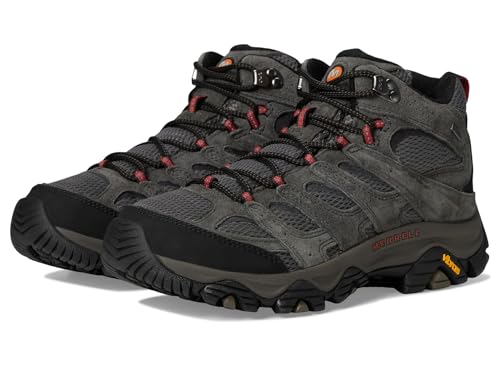
📍 Lineup position: Traditional protection × Light to moderate backpacking · Gore-Tex · Mid-cut ankle cuff
Best for: Hikers with prior ankle sprains or instability, those carrying 20 to 30 lb packs on multi-day routes, and anyone tackling moderate alpine terrain where ankle containment during lateral steps and descents matters more than the slight weight penalty of a mid cuff.
| Upper | Pigskin suede + breathable mesh + mid-cut cuff |
| Waterproofing | Gore-Tex membrane |
| Outsole | Vibram TC5+ · 5mm lug depth |
| Midsole | EVA + Air Cushion heel |
| Heel drop | 11.5mm |
| Weight per pair | ~2 lbs 4 oz (men’s, tested) |
| Wide width | Yes — available in wide |
| Price range | ~$160 |

The Moab 3 Mid GTX is identical to the low-top Moab 3 GTX in every specification except the mid-height collar that extends above the ankle. That difference matters for a specific group of hikers: those who have rolled an ankle previously and want the cuff’s lateral containment to reduce that risk on uneven terrain, those carrying pack weight that shifts their centre of gravity upward and increases the lateral force on the ankle joint during off-camber steps, and those hiking on alpine terrain where the terrain surface is more varied and demanding than established trail.

The weight penalty of the mid cuff is approximately 3 to 4 oz per pair compared to the low Moab 3 GTX — a small and justified cost for the hikers who need ankle containment. REI’s test team wore these specifically on rocky terrain in Washington State with positive results. For hikers who have never experienced ankle issues and hike only on established trails with a light daypack, the low Moab 3 GTX is the better choice — the mid cuff adds weight and reduces lower calf mobility without meaningful benefit on flat, even terrain. But for the backpacker or alpine day hiker for whom ankle containment is genuinely relevant, the Mid GTX is the correct Merrell at this price point. Wide-width variant available — one of the few mid-cut waterproof hiking boots at mainstream prices with a genuine wide option.
✅ Best for: Hikers with prior ankle injuries, backpackers carrying 20–30 lbs, alpine day hikers, wet climates requiring GTX protection with the added stability of a mid cuff.
❌ Not for: Hikers who prioritise low weight and have no ankle history — the low Moab 3 GTX is lighter and equally capable on established trails.
Pros: Mid cuff provides meaningful ankle containment for uneven terrain and pack-loaded hiking, identical Vibram TC5+ and Gore-Tex quality as low version, immediate comfort with no break-in, wide width available, proven performance on Northwest and alpine terrain.
Cons: 3–4 oz heavier per pair than the low-top version — unjustified weight for flat trail hikers. Not designed for technical terrain any more than the low-top version.
3. Merrell Moab 3 (Non-Waterproof) — Best Breathable Merrell for Summer and Desert Hiking

📍 Lineup position: Traditional protection × Day hiking · No waterproof membrane · Maximum breathability
Best for: Dry-climate hikers, desert hikers, and summer hikers above 80°F who want the Moab’s comfortable platform and Vibram traction without the breathability penalty of a waterproof membrane — and who understand that choosing maximum breathability means accepting faster wetting in rain.
| Upper | Pigskin suede + breathable mesh (no membrane) |
| Waterproofing | None — open mesh |
| Outsole | Vibram TC5+ · 5mm lug depth |
| Midsole | EVA + Air Cushion heel |
| Heel drop | 11.5mm |
| Weight per pair | ~1 lb 14 oz (men’s, tested) — lightest Moab 3 |
| Wide width | Yes |
| Price range | ~$120–$130 |

The non-waterproof Moab 3 is the Moab that HikingFeet specifically recommends for desert hiking — a counter-intuitive recommendation that makes complete sense when you understand boot thermal dynamics. A Gore-Tex membrane traps foot perspiration inside the boot. In a 90°F desert environment, a GTX boot accumulates significant internal moisture from foot sweat across a full hiking day. The non-waterproof Moab 3’s open mesh allows this moisture to evaporate outward, keeping the boot interior meaningfully cooler and drier during sustained high-temperature hiking. The trade-off is obvious: rain wets the foot faster. For desert and arid-climate hikers who rarely encounter rain and prioritise all-day thermal comfort, this is the correct trade-off.

The non-waterproof version is also approximately 3 oz lighter per pair than the GTX version — the membrane adds weight and stiffness that both disappear without it. Same Vibram TC5+ outsole, same Air Cushion heel, same wide-width availability, same pigskin suede durability. At $20 to $30 less than the GTX version, it is also the most accessible entry point into the Moab line for hikers on a tighter budget who hike in predominantly dry conditions. For wet-climate or four-season hikers, the GTX version is clearly correct. For everyone in the southwest, intermountain west, or dry summer climates east, this non-waterproof version is worth serious consideration.
✅ Best for: Desert hikers, dry-climate hikers, summer-only hikers above 80°F, budget-conscious hikers in dry regions, anyone who has found GTX boots uncomfortably hot in summer.
❌ Not for: Wet-climate hikers, Pacific Northwest, any hiker who regularly encounters rain or creek crossings.
Pros: Maximum breathability without membrane restriction — meaningfully cooler in summer than GTX version, ~3 oz lighter per pair than GTX, lower price point, same Vibram TC5+ outsole and Air Cushion heel, wide-width available.
Cons: No waterproofing — feet get wet in rain. Not appropriate for wet climates or four-season hiking without supplemental gaiters.
4. Merrell Moab Speed 2 — Best Modern Merrell for All-Terrain Versatility

📍 Lineup position: Modern speed line × Day hiking to fastpacking · Trail-runner-influenced construction
Best for: Experienced hikers who find the Moab 3 too heavy or too stiff, those who want a trail-runner feel without sacrificing hiking-boot stability, and anyone covering fast miles on mixed terrain who wants the proven Vibram TC5+ outsole in a lighter and more flexible platform.
| Upper | Nylon ripstop mesh (vegan-friendly, no leather) |
| Waterproofing | Available in GTX or non-waterproof |
| Outsole | Vibram TC5+ · 3.7mm lug depth |
| Midsole | EnergyCell foam · rockered profile |
| Heel drop | 15mm (RunRepeat lab measured) — listed as 10mm |
| Weight per pair | ~1 lb 10.8 oz — significantly lighter than Moab 3 GTX |
| Vegan | Yes — synthetic upper, no leather |
| Price range | ~$140–$170 |

The Moab Speed 2 is the correct evolution for hikers who have outgrown the Moab 3 rather than those who are starting with it. BetterTrail called it their “overall standout” hiking shoe pick and an REI tester wore the Moab Speed 2 specifically on a Kilimanjaro ascent — a demanding real-world validation that the modern construction holds up under genuine expedition conditions. The EnergyCell midsole with rockered profile changes the underfoot feel from the Moab 3’s traditional cushioned-platform feel to something closer to a trail runner — propulsive, responsive, and encouraging of a faster hiking pace. RunRepeat measured it as 16.9% more flexible than the Moab 3, which matters for hikers who find traditional hiking boot stiffness fatiguing over long miles.

Two important caveats. First, the heel drop discrepancy: Merrell advertises 10mm drop but RunRepeat’s caliper measurement found 15mm. For hikers who have been selecting footwear based on drop specifications — particularly those managing Achilles tendinopathy or calf tightness — the actual 15mm drop changes the picture. Second, the vegan note: the nylon ripstop synthetic upper contains no leather, making this the easiest non-waterproof Merrell recommendation for vegan hikers. The GTX version uses the same synthetic upper with a Gore-Tex membrane added — also vegan. The non-waterproof version in the correct climate is significantly lighter and more breathable than the GTX variant of the Moab 3.
✅ Best for: Experienced hikers wanting a trail-runner-influenced feel, fast-paced day hikers covering 15+ miles, hikers who prioritise low weight, vegan hikers wanting a quality synthetic Merrell option.
❌ Not for: Traditional hiking boot feel preference, beginners who want the forgiving Moab 3 platform, technical scrambling where Agility Peak 6 grip is needed.
Pros: Trail-runner-influenced EnergyCell midsole — more propulsive and flexible than Moab 3, significantly lighter at ~1 lb 10.8 oz per pair, vegan-friendly nylon ripstop construction, Vibram TC5+ outsole for proven mixed-terrain traction, REI-tested on Kilimanjaro.
Cons: Actual heel drop is 15mm by lab measurement, not 10mm as advertised — check if this affects your specific foot condition. Shallower 3.7mm lugs than Moab 3’s 5mm — less aggressive grip in deep mud.
5. Merrell Agility Peak 6 — Best Merrell for Technical Terrain and Wet Rock
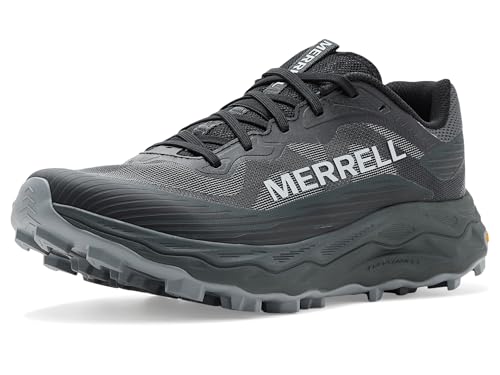
📍 Lineup position: Technical trail line × Trail running to technical day hiking · Vibram Megagrip
Best for: Hikers who regularly encounter wet rock, scree, slick roots, and scrambling terrain where grip is the primary performance requirement — and who are willing to sacrifice cushioning volume and wide-foot accommodation for the best traction Merrell makes.
| Upper | Synthetic mesh |
| Outsole | Vibram Megagrip · 5mm lug depth · 0.64 friction coefficient (RunRepeat) |
| Rock plate | Yes — large rock plate for trail debris protection |
| Midsole | Trail-running construction |
| Heel drop | ~6mm (trail-run profile) |
| Weight per pair | ~1 lb 3.6 oz — lightest boot in this guide |
| Price range | ~$130–$145 |

RunRepeat’s lab testing found the Agility Peak 6’s friction coefficient at 0.64 — the highest in the Merrell line and competitive with dedicated technical trail running shoes. The Vibram Megagrip compound that produces this number is specifically formulated for maximum friction on wet and technical surfaces: wet granite, slick limestone, rain-soaked roots. On these surfaces, the difference between Megagrip and the TC5+ compound used in the Moab line is meaningful and perceptible underfoot — not a marketing distinction. The 5mm lug depth matches the Moab 3’s lug depth but with a more aggressively patterned multi-directional tread that self-cleans better in mud and provides better edge grip on rock.

The trade-offs are genuine. The trail-running construction and low ~6mm heel drop is a departure from the Moab family’s traditional feel — hikers who love the Moab’s cushioned platform will find the Agility Peak 6 significantly firmer underfoot. The narrower trail-running last does not serve wide-footed hikers. The low stack height limits cushioning for extended backpacking days. And at approximately 1 lb 3.6 oz per pair, the Agility Peak 6 is the lightest boot in this guide — an advantage for trail runners and fast hikers but a meaningless metric for those carrying heavy packs over long days where cushioning matters more. This boot is for the specific hiker who regularly encounters technical surfaces and has been frustrated by the TC5+ compound’s limitations on wet rock.
✅ Best for: Technical day hikers, trail runners, hikers on wet granite or scree, anyone who regularly encounters the surfaces where Megagrip’s 0.64 friction coefficient matters.
❌ Not for: Wide feet (trail-running last runs narrower than Moab family), multi-day backpacking (low cushion), hikers who want the traditional Moab comfort platform.
Pros: Vibram Megagrip 0.64 friction coefficient — best traction in the Merrell line on wet and technical surfaces, 5mm lug depth for self-cleaning in mud, large rock plate for trail debris protection, lightest boot in this guide at ~1 lb 3.6 oz per pair, low drop for natural trail-running feel.
Cons: Narrower trail-running last — not suitable for wide feet. Low cushioning stack limits comfort under heavy backpacking loads. ~6mm drop requires adjustment period for hikers coming from high-drop footwear.
6. Merrell Nova 4 — Best Ultralight Merrell for Fast Day Hikes

📍 Lineup position: Ultralight line × Fast day hiking and trail-run adjacent · Minimal construction
Best for: Experienced hikers transitioning from trail runners who want a Merrell-quality option at minimal weight, those covering fast miles on maintained trails with a light daypack, and hikers who have found every other Merrell too heavy for their preferred pace and terrain.
| Upper | Lightweight synthetic mesh |
| Waterproofing | None — open mesh for maximum breathability |
| Midsole | Trail-running foam construction |
| Heel drop | Low — trail-run profile |
| Weight | Ultralight — sub-10 oz per shoe |
| Price range | ~$110–$125 |

RunRepeat called the Nova 4 the “best lightweight Merrell hiking shoe in our roster” — a designation earned by its minimal construction philosophy applied to the Merrell standard of quality and durability. The Nova 4 is not trying to be a hiking boot. It is a lightweight trail shoe that qualifies as a hiking shoe for the conditions it is designed for: well-maintained trails, light daypacks, experienced foot placement, and hikers who move quickly enough that the weight of a traditional hiking boot genuinely impairs their enjoyment. For this specific audience, the Nova 4 delivers Merrell construction integrity at a fraction of the weight of the Moab family.

The limitations are the expected ones for ultralight footwear: no waterproofing, limited cushioning for heavy loads, narrower trail-shoe last geometry, and lower ankle support than any mid-cut option. Beginners, hikers who carry heavy packs, and anyone who hikes primarily on technical or unpredictable terrain should look to the Moab or Agility Peak lines. But for the hiker who already knows they prefer minimal weight over maximum protection, and who primarily hikes on established trail in conditions that do not demand waterproofing, the Nova 4 is the correct ultralight choice within the Merrell lineup.
✅ Best for: Fast hikers on maintained trails, trail runners looking for a hiking-adjacent option, experienced hikers with a light daypack who prioritise weight above all other metrics.
❌ Not for: Beginners, heavy pack loads, technical terrain, wet climates requiring waterproofing.
Pros: Ultralight construction — sub-10 oz per shoe reduces pack-on-foot energy cost over long miles, Merrell quality construction at minimal weight, excellent breathability from open mesh, lowest price tier in this guide.
Cons: No waterproofing, limited cushioning for heavy loads, narrow last not suited to wide feet, low ankle support requires experienced foot placement on uneven terrain.
7. Merrell Speed Eco — Best Sustainable and Eco-Conscious Merrell

📍 Lineup position: Sustainability line × Mixed hiking and everyday use · Recycled content · Vegan-friendly
Best for: Eco-conscious hikers who want genuine sustainability credentials in their footwear — not marketing language but actual recycled materials and eco-conscious manufacturing — and who want a versatile trail shoe that moves between hiking and everyday use.
| Upper | Recycled synthetic mesh |
| Sustainability | Recycled content throughout — primary design differentiator |
| Vegan | Yes |
| Waterproofing | None or M Select Dry depending on variant |
| Construction | Trail shoe profile |
| Price range | ~$120–$135 |

The Speed Eco is Merrell’s most honest sustainability offering — a boot where recycled content and eco-conscious construction are the primary design intent rather than a secondary certification added to a standard product. RunRepeat confirmed that “some of this Merrell boot’s components are entirely made of recycled materials.” The vegan-friendly construction contains no leather, making it the correct recommendation for hikers who require both sustainability and vegan credentials in their footwear. The trail shoe profile and versatile construction also make it the most natural-feeling Merrell for hikers who want a shoe that moves between trail use and everyday casual wear without looking like a dedicated hiking boot.

The honest positioning: the Speed Eco is not chosen for its technical performance — the Agility Peak 6 grips better, the Moab 3 is more protective, the Moab Speed 2 is more responsive. It is chosen because of what it is made of and how it was made. For hikers to whom environmental impact is a genuine purchasing criterion, the Speed Eco is the Merrell that delivers on that value without requiring compromise on overall build quality. It is a capable trail shoe that happens to be built with recycled content — not a compromised sustainability product.
✅ Best for: Eco-conscious hikers, vegan hikers, those who want Merrell quality in a sustainable platform, hikers who use their trail shoes for everyday wear as well.
❌ Not for: Hikers prioritising maximum technical performance, wide-foot hikers (check specific last width), demanding backpacking loads.
Pros: Genuine recycled content throughout — not marketing language, vegan-friendly construction with no leather, versatile enough for both trail and everyday use, Merrell construction quality applied to a sustainable platform.
Cons: Not the top technical performer in the lineup — chosen for sustainability, not performance ceiling. Verify width availability if you have wider feet.
8. Merrell Accentor 3 — Best Merrell Approach Shoe for Mixed Hiking and Scrambling

📍 Lineup position: Mixed use line × Trail hiking to scrambling approach · Approach shoe influences
Best for: Hikers who regularly move between established trail walking and rock scrambling approaches — who need a shoe that grips rock well enough for scrambling without being so trail-running-specific that it is uncomfortable for longer trail sections.
| Upper | Synthetic + mesh (approach shoe construction) |
| Waterproofing | M Select Dry or non-waterproof depending on variant |
| Construction | Approach shoe hybrid — bridging trail hiking and scrambling |
| Heel drop | ~8–10mm (moderate) |
| Weight | Moderate — approach shoe build |
| Price range | ~$120–$140 |

The approach shoe category sits between hiking shoes and climbing shoes — built to walk trail efficiently and grip rock well enough for non-vertical scrambling without requiring a dedicated rock shoe. The Accentor 3 is Merrell’s answer to this category: an approach-influenced construction with grip geometry that handles rock contact better than the Moab family’s trail-optimised TC5+ pattern while remaining comfortable for the trail kilometres that connect scrambling sections.

For hikers whose routes are purely trail walking with no scrambling, the Moab 3 or Moab Speed 2 is the more appropriate choice. For hikers whose routes are primarily technical scrambling with no significant trail walking, the Agility Peak 6’s Megagrip compound is the stronger pick. The Accentor 3 earns its position for the middle case — the hiker who approaches a scrambling route via several kilometres of maintained trail and needs one shoe that handles both adequately rather than optimally.
✅ Best for: Hikers who mix established trail walking with rock scrambling approaches, mountaineers who need one shoe for trail approach plus non-vertical scrambling, hikers in terrain that alternates between established trail and technical rock.
❌ Not for: Pure trail hikers (Moab 3 is more comfortable), pure technical terrain (Agility Peak 6 Megagrip is superior), heavy pack backpacking.
Pros: Approach shoe geometry provides better rock grip than standard trail outsoles, versatile construction handles both trail and scrambling terrain adequately, moderate heel drop appropriate for varied terrain, more versatile than Moab 3 for scrambling-inclusive routes.
Cons: Excels at neither pure trail walking nor pure scrambling — a specialist hybrid for a specific use case. Not the correct pick for hikers whose terrain does not include scrambling.
9. Merrell Altalight — Best Fast-and-Light Merrell for Day Hiking

📍 Lineup position: Ultralight line × Fast day hiking · Minimal construction · Speed-focused
Best for: Experienced hikers who cover fast miles on well-maintained trails with a minimalist daypack and who want the lightest possible Merrell option that still delivers Merrell’s construction quality rather than budget-tier ultralight alternatives.
| Upper | Lightweight synthetic mesh |
| Waterproofing | None |
| Construction | Ultralight day hike · minimal platform |
| Heel drop | Low — ultralight profile |
| Weight | Ultralight — sub-10 oz per shoe |
| Price range | ~$110–$130 |

The Altalight sits alongside the Nova 4 in Merrell’s ultralight tier — both are built for fast, light movement on established trails rather than the heavy-duty protection of the Moab line or the technical grip of the Agility Peak 6. The Altalight’s distinction within this tier is its specific optimisation for fast-and-light day hiking: the minimal construction removes every gram that does not directly serve forward movement on maintained trail. For the hiker who knows exactly what conditions they will encounter and wants the shoe built specifically around efficient movement rather than versatile protection, the Altalight delivers that clearly defined purpose.

The honest guidance: if you are considering the Altalight versus the Nova 4, the choice comes down to the specific feel each model provides underfoot rather than a meaningful performance difference — both are ultralight trail shoes at similar price points. Try both if possible. If you are considering the Altalight versus the Moab 3, you are making a fundamentally different decision about what you value in a hiking shoe — the Moab 3 is not a heavier version of the Altalight, it is a different design philosophy. Neither is wrong, but only one is right for a given hiker’s priorities. The Altalight is for hikers who have made the conscious decision to prioritise weight savings above the protection and cushioning depth that the Moab family provides.
✅ Best for: Fast day hikers on maintained trails, experienced hikers with minimalist pack philosophy, trail-running-adjacent hikers who prefer a low-drop minimal construction.
❌ Not for: Beginners, heavy pack loads, technical terrain, wet climates, wide feet.
Pros: Ultralight construction for fast movement on established trail, low weight reduces cumulative fatigue over high-mileage day hikes, Merrell quality applied to minimal construction, excellent breathability.
Cons: No waterproofing, minimal cushioning for sustained heavy loads, low-drop requires adjustment for hikers coming from high-drop traditional boots, not for technical terrain or wide feet.
The Honest Moab Assessment: Why Professionals Don’t Recommend It and Why 25 Million People Bought It Anyway
HikingFeet published the most honest professional assessment of the Moab available: none of their co-workers in the outdoor industry actually hike in Merrells, and most won’t recommend the Moab to customers asking for the best hiking boot for technical terrain. This is worth engaging with directly because it sounds like a damning indictment and is actually a useful clarification.
The outdoor industry professional who recommends against the Moab is typically working with a customer who hikes Pacific Crest Trail sections, Washington Cascades routes, or other technical terrain where the Moab’s TC5+ outsole and moderate lug pattern are genuinely outperformed by alternatives. That professional is right for their customer.
The 25 million people who bought the Moab are typically weekend trail hikers who walk established routes in national and state parks, cover 5 to 15 miles on maintained surfaces, carry a daypack, and want a boot that is comfortable immediately and reliable across a season of weekend use. For those hikers, the Moab delivers exactly what they need, fits more foot types than any competitor, and requires no break-in period — a significant practical advantage for hikers who go out once or twice a month and cannot afford weeks of break-in across daily commuter wear.
The late-2025 price increase of approximately $30 across the Moab line has reduced the Moab’s value advantage against competitors. At its previous price point, the Moab was an easy recommendation on value alone. At the current price, the Moab Speed 2 offers a more modern feel for similar money, and budget-tier alternatives have closed the quality gap. The Moab 3 is still worth buying — but primarily for the specific hiker type it is designed for: comfortable, forgiving, and immediate, rather than technically superior.
How to Choose: Merrell Decision Tree
| Your priority | Best pick | Why |
|---|---|---|
| Beginner / first hiking boot / wide feet | Moab 3 GTX | Widest last, immediate comfort, no break-in, proven on any established trail |
| Ankle support / backpacking / ankle history | Moab 3 Mid GTX | Mid cuff provides ankle containment for pack weight and uneven terrain |
| Dry climate / summer / desert / breathability | Moab 3 non-GTX | Open mesh dramatically cooler than sealed GTX in high-temperature hiking |
| Modern feel / lighter / trail-runner DNA | Moab Speed 2 | EnergyCell midsole, rocker profile, 6 oz lighter per pair than Moab 3 GTX |
| Technical terrain / wet rock / scrambling grip | Agility Peak 6 | Vibram Megagrip 0.64 friction — best traction in the Merrell line |
| Ultralight / fast day hikes / trail running | Nova 4 or Altalight | Sub-10 oz per shoe — lightest Merrell options for fast movement on maintained trails |
| Sustainability / vegan / eco-conscious | Speed Eco | Recycled content throughout, vegan-friendly, Merrell quality in eco construction |
| Mixed hiking and scrambling approach | Accentor 3 | Approach shoe hybrid grips rock better than trail outsoles on scrambling terrain |
Merrell vs the Competition: Where Merrell Wins and Where It Doesn’t
Merrell vs Salomon: The Salomon X Ultra 5 is lighter than the Moab 3, has more aggressive outsole geometry, and a more precise fit for performance hikers. The Moab 3 is wider, more comfortable out of the box, and better for hikers who need a roomy toe box. Salomon wins on technical performance and lower weight. Merrell wins on comfort, fit variety, and wide-width availability.
Merrell vs KEEN: KEEN’s asymmetric wide toe box is competitive with the Moab’s width advantage, and KEEN’s outsole on the Atlanta Cool is specifically excellent for varied outdoor terrain. KEEN’s waterproof builds are generally more burly than Merrell’s for serious wet-weather hiking. Merrell’s Agility Peak 6 Megagrip outsole outperforms KEEN’s standard compound on technical rock. The two brands are most comparable in the everyday trail hiking category where both perform reliably.
Merrell vs HOKA: HOKA’s Anacapa and Kaha lines offer dramatically more midsole cushioning and a rocker geometry that Merrell does not match in any model except the Moab Speed 2’s mild rocker. HOKA wins for hikers who prioritise cushioning, are managing plantar fasciitis, or cover very high-mileage days. Merrell wins on outsole variety (Megagrip in the Agility Peak 6 outperforms HOKA’s standard compound on technical terrain) and price — HOKA’s premium is significant.
Boot Care and Maintenance by Waterproofing Type
Gore-Tex Merrell Boots (Moab 3 GTX, Moab 3 Mid GTX)
Clean with Gore-Tex approved products only — Nikwax Tech Wash or Grangers Performance Wash. Standard detergents degrade the DWR (durable water repellent) coating on the outer fabric, reducing effective waterproofing even though the membrane itself is intact. Refresh DWR treatment every 15 to 20 uses or whenever water stops beading on the upper surface — use Nikwax TX Direct or Grangers Performance Repel applied to a damp boot. Do not machine wash, do not dry-clean, do not use a dryer. Air dry at room temperature with newspaper inside.
M Select Dry Merrell Boots (Accentor 3 M Select Dry version)
Same cleaning protocol as GTX — membrane-compatible cleaners only. Re-treat DWR more frequently than GTX: every 10 to 15 uses. M Select Dry’s outer coating degrades faster than Gore-Tex’s bonded membrane, so proactive re-treatment maintains performance more than reactive re-treatment after water stops beading.
Non-Waterproof Merrell Boots (Moab 3 non-GTX, Moab Speed 2 non-GTX, Agility Peak 6, Nova 4, Altalight, Speed Eco)
Rinse with cold water and a soft brush after muddy hikes. A light DWR spray applied to the mesh upper reduces water absorption and speeds drying time — it does not waterproof the shoe but meaningfully reduces wetting from light rain and morning dew. Air dry with newspaper inside. No special cleaning product required.
Leather Upper Merrell Boots (Moab 3 suede/pigskin)
Condition the pigskin suede with Merrell All Conditions Cleaner and Conditioner or Nikwax Nubuck and Suede Proof. Do not use standard shoe polish — polishes designed for smooth leather damage suede construction. Condition every four to six uses in wet conditions or monthly in dry conditions. Apply conditioner to a slightly damp boot for best absorption.
Universal Care Rules for All Merrell Models
Never use direct heat to dry Merrell boots — boot dryers on high settings, car dashboards, proximity to heat vents, and direct sunlight all degrade EVA foam in the midsole, weaken adhesive bonds at the outsole, and damage waterproof membrane integrity. Room temperature air drying with newspaper inside and good air circulation is the correct approach for all models. Inspect outsole bonding at the toe and heel seam quarterly — delamination at the cement bond is the most common durability failure in modern hiking shoes and is preventable with Barge Cement or Shoe Goo applied at the first sign of separation before it progresses.
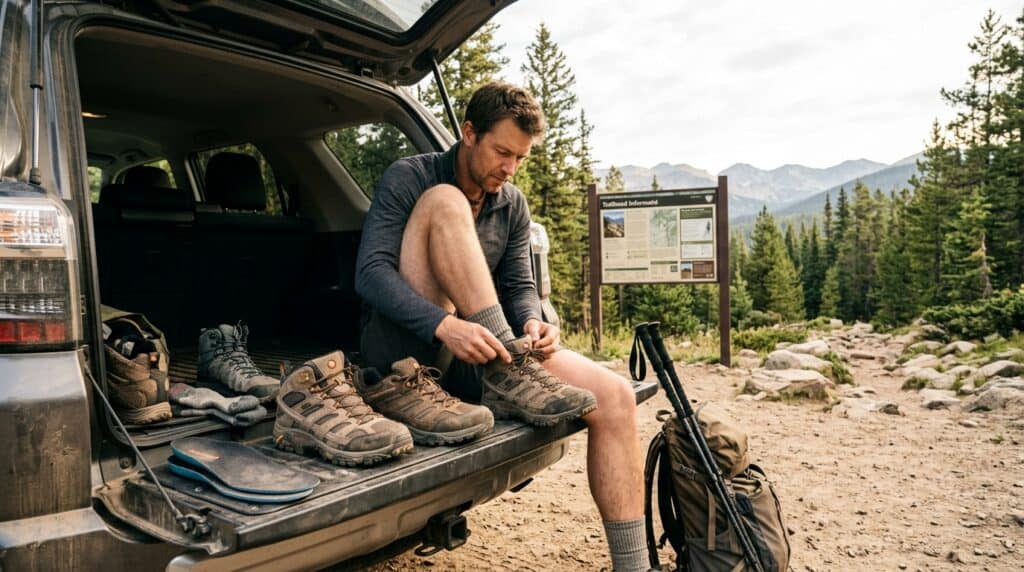
merrell boot sizing for fit 202607062118(1)
Common Mistakes Merrell Buyers Make
Choosing the GTX version because waterproof sounds better. In dry climates and summer hiking above 80°F, the GTX version is meaningfully less comfortable than the non-waterproof version because it traps foot perspiration. Waterproofing should match your climate, not your general preference for premium features.
Comparing Merrell’s per-shoe weight to competitors’ per-pair weight. Merrell states weight per single shoe. REI and most outdoor retailers state weight per pair. A Moab 3 listed at “13 oz” is approximately 26 oz per pair — heavier than it sounds in comparison to Salomon or Hoka listed as full-pair weights.
Buying the Moab 3 for technical terrain. The Moab 3 is an excellent boot for established and moderate trails. Its TC5+ outsole is not designed for wet granite, scree, or serious scrambling. If your route includes technical terrain, the Agility Peak 6 with Megagrip is the correct Merrell choice.
Ignoring the Moab Speed 2’s actual heel drop. Merrell lists the Moab Speed 2 at 10mm drop. RunRepeat’s lab measured 15mm. For hikers managing Achilles conditions or transitioning from lower-drop footwear, the actual 15mm matters for managing load on the posterior chain.
Not using aftermarket insoles for narrow-heel fit issues. The Moab’s wide last is its greatest strength and its limitation for narrow-heeled hikers. Heel slip during descents is not a sign the boot is defective — it is a sign the last does not match the foot’s geometry. Superfeet Green or Tread Labs insoles add heel cup volume and resolve this for most narrow-heeled hikers without requiring a different boot.
Frequently Asked Questions
Are Merrell hiking boots good?
Yes, for the right hiker and terrain. Merrell makes the world’s best-selling hiking boot because the Moab line fits the widest range of foot types, requires no break-in, and performs reliably on established moderate trails. Where Merrell falls short: technical terrain where the Agility Peak 6 aside, Merrell’s standard TC5+ outsole is outperformed by dedicated technical compounds from La Sportiva, Scarpa, and Salomon’s aggressive tread patterns. The honest answer is that Merrell is excellent for the 90% of hikers on maintained trails and adequate-to-good for the 10% who regularly encounter technical terrain.
What is the difference between Merrell Moab 3 and Moab Speed 2?
The Moab 3 uses traditional hiking boot construction: pigskin suede upper, Air Cushion heel, nylon arch shank, EVA midsole. It is heavier (~2 lbs 1 oz per pair in GTX), more protective, and has the widest toe box in the line. The Moab Speed 2 uses trail-runner-influenced construction: synthetic nylon ripstop upper, EnergyCell midsole, rockered profile. It is lighter (~1 lb 10.8 oz per pair), more flexible (16.9% more flexible per RunRepeat), and has a more propulsive underfoot feel. Choose Moab 3 for comfort-first established trail hiking. Choose Moab Speed 2 for pace-focused hiking, lighter weight, or trail-runner-adjacent feel.
Is Gore-Tex worth it on Merrell hiking boots?
Depends on your climate and season. GTX is worth it for wet-climate hikers, Pacific Northwest routes, four-season hiking, and anyone who regularly encounters rain or creek crossings. GTX is not worth it for dry-climate summer-only hikers — the non-waterproof version breathes better and keeps feet cooler in high temperatures. The price difference is typically $20 to $30, making GTX a justified investment in genuinely wet conditions.
Do Merrell hiking boots run wide or narrow?
The Moab family runs wide — Treeline Review considers it potentially the widest fit in hiking footwear. The speed and ultralight models (Moab Speed 2, Agility Peak 6, Nova 4, Altalight) run closer to trail-running shoe geometry and are narrower. Wide-width variants are available for the Moab 3 low and Moab 3 Mid.
What Merrell boot is best for wide feet?
The Moab 3 or Moab 3 Mid GTX in wide width. These are among the few waterproof hiking boots at mainstream retail prices with a genuine wide-width variant. The Moab 3’s wide toe box also accommodates wider feet in standard width better than most competitors.
How long do Merrell hiking boots last?
The Moab 3 family typically lasts 500 to 800 miles before the outsole shows significant wear under normal trail use. The midsole may compress meaningfully at 400 to 600 miles — the boot can look fine externally while no longer providing adequate cushioning. The practical test: press your thumb firmly into the heel midsole. A retained indent means the foam is past its performance life. Synthetic uppers (Moab Speed 2, Agility Peak 6) show less upper wear than leather suede but are equally affected by midsole compression timelines.
Can you use Merrell Moab for backpacking?
Light backpacking on established trails — yes. The Moab 3 Mid GTX handles 20 to 30 lb packs on maintained routes with its mid cuff providing additional stability under load. The Moab 3 low is appropriate for packs up to approximately 20 lbs on moderate terrain. For heavier loads on rough terrain, a stiffer full-support backpacking boot provides better long-term foot health on multi-day routes. The Moab is not designed for heavy expedition loads or off-trail routes with pack weight.
Are any Merrell hiking boots vegan?
Yes. The Moab Speed 2 in synthetic/nylon ripstop construction (no leather version), the Speed Eco, the Nova 4, the Altalight, and the Agility Peak 6 are all built without leather uppers. The Moab 3 and Moab 3 Mid use pigskin suede and are not vegan. The GTX versions of vegan-upper models add a Gore-Tex membrane — still vegan as GTX membrane is not an animal product.
Final Verdict: The Best Merrell Hiking Boot for Your Specific Situation
For most hikers buying their first Merrell or their first quality hiking boot: Moab 3 GTX in a wet climate or Moab 3 non-GTX in a dry climate. Immediate comfort, widest fit, reliable performance on established trails.
For hikers with ankle history or those carrying pack weight: Moab 3 Mid GTX. The mid cuff is the most meaningful upgrade available within the Moab family.
For experienced hikers wanting a modern trail-runner-influenced feel at lower weight: Moab Speed 2. The EnergyCell midsole and rockered profile represent the correct evolution of the Moab for pace-focused hikers.
For technical terrain, wet rock, and scrambling where grip is the primary concern: Agility Peak 6. Vibram Megagrip’s 0.64 friction coefficient is not matched by any other boot in this guide on wet and technical surfaces.
For eco-conscious and vegan hikers: Speed Eco for sustainability-primary buyers, Moab Speed 2 (synthetic version) for performance-primary vegan hikers.
For fast and light day hiking on maintained trails: Nova 4 or Altalight — both ultralight options for experienced hikers who have made the conscious decision to prioritise weight savings over protection depth.