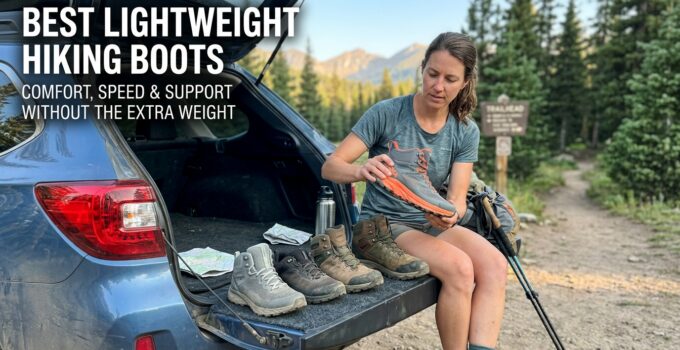
Every hiking boot review says “lightweight.” Almost none tell you what that actually means in ounces, or what you give up to get there. The sports science rule of thumb is blunt: every 100g added to your foot costs roughly the same energy as adding 500g to your back, because your foot is the end of a long lever your leg has to swing thousands of times per hike. A traditional leather hiking boot at 600g per boot is, in fatigue terms, like carrying an extra 5kg in your pack — before you’ve packed a single water bottle.
This guide ranks lightweight hiking boots by actual measured weight, not marketing copy, and organizes them into three clear weight tiers so you know exactly what you’re buying and what you’re trading away — protection, waterproofing, ankle support, or durability — to get there. We cover day-hike picks, backpacking-capable lightweight boots, budget options, and the honest answer to “should I just buy trail runners instead.”
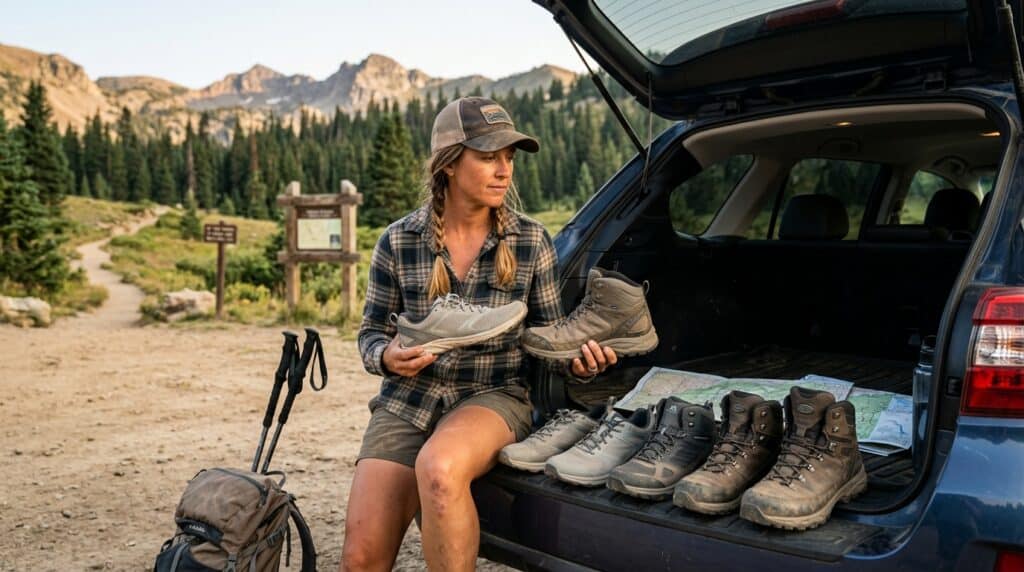
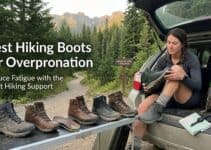
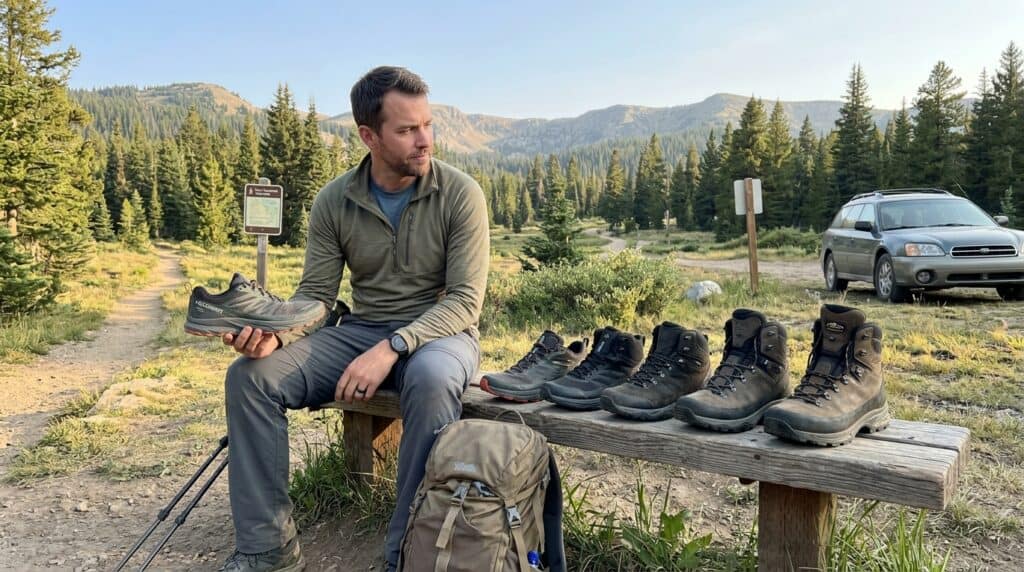
A man preparing for a hike outdoors, with a selection of lightweight hiking boots displayed on a wooden bench in a scenic mountain setting.
What Are the Best Lightweight Hiking Boots?
For most hikers: the Salomon X Ultra 4 GTX is the best overall lightweight hiking boot, balancing a true lightweight-tier weight with real ankle support and waterproofing. If you want the lightest option available, the Altra Lone Peak 9 WP Mid pushes into ultralight territory with a zero-drop platform. For backpacking with a loaded pack, size up to the Salomon Quest Winter GTX, which trades some weight for the structure heavier loads demand. See the full weight-tier breakdown below before you buy.
Quick Comparison: Best Lightweight Hiking Boots (2026)
| Boot | Weight (per boot) | Weight Tier | Waterproof | Drop | Best For | Price |
|---|---|---|---|---|---|---|
| Salomon X Ultra 4 GTX Wide | ~15.5 oz / 440g | Lightweight | ✅ Gore-Tex | 10mm | Best overall | ~$150–$180 |
| Altra Lone Peak 9 WP Mid | ~12.8 oz / 363g | Ultralight | ✅ Waterproof | 0mm (zero drop) | Lightest pick / fast hikers | ~$150–$170 |
| Salomon Quest Winter GTX | ~19.5 oz / 553g | Midweight | ✅ Gore-Tex | 13mm | Backpacking / loaded pack | ~$190–$220 |
| HOKA Anacapa Mid GTX Wide | ~16.2 oz / 460g | Lightweight | ✅ Gore-Tex | 6mm | Lightweight + waterproof combo | ~$175–$200 |
| Merrell Moab 3 Mid Wide | ~17.1 oz / 485g | Lightweight | ✅ Waterproof | 11mm | Best budget lightweight | ~$110–$140 |
| KEEN Circadia Mid WP Wide | ~17.8 oz / 505g | Lightweight | ✅ Waterproof | 8mm | Wide feet | ~$150–$175 |
| Merrell Moab 2 Vent | ~14.9 oz / 422g | Lightweight | ❌ Non-WP / breathable | 11mm | Women’s / summer trails | ~$100–$130 |
| Altra Lone Peak Mid | ~13.2 oz / 374g | Ultralight | ✅ Waterproof | 0mm (zero drop) | Minimalist / barefoot-style | ~$140–$165 |
The Lightweight Hiking Boot Weight Tier System
“Lightweight” gets used as marketing shorthand across the entire hiking boot industry, but the actual weight range varies wildly between brands with no consistent standard. To make an honest comparison possible, this guide uses three defined tiers based on per-boot weight (not per-pair, which some brands use to make numbers look smaller).
Ultralight (under 14 oz / 400g per boot): This is trail-runner-adjacent territory. Boots in this tier prioritize speed and minimal energy cost above almost everything else. Expect thinner uppers, less structured ankle support, and lighter-duty outsoles. Best suited to experienced hikers on maintained trails without heavy loads — the Altra Lone Peak 9 and Lone Peak Mid both sit here.
Lightweight (14–18 oz / 400–510g per boot): The sweet spot for most day hikers and light backpackers. Boots in this tier retain genuine boot structure — a supportive midsole, a real outsole lug pattern, some ankle protection — without the traditional weight penalty of a leather backpacking boot. Five of the eight picks in this guide fall into this tier, because it’s where the best weight-to-capability ratio lives for most trail conditions.
Midweight (18–24 oz / 510–680g per boot): Structured enough for loaded backpacking while still saving meaningful weight over traditional full-leather boots (which often run 24–30+ oz per boot). The Salomon Quest Winter GTX sits at the top of this range — it’s the pick in this guide built specifically for pack weight beyond 25–30 lbs, where a lighter boot’s reduced torsional support becomes a real stability liability.
Waterproofing: The Hidden Weight Cost
Gore-Tex and similar waterproof membranes typically add 80 to 120 grams per boot compared to a non-waterproof version of the same model — a fact that almost no competitor guide mentions when recommending GTX by default. That weight comes from the membrane layer itself plus the denser, less breathable upper construction needed to support it. In hot, dry summer conditions — exactly when most people search for lightweight boots — a non-waterproof or “breathable mesh” boot dries faster after stream crossings or sweat, breathes significantly better, and shaves real weight off every step.
When Gore-Tex earns its weight penalty: Pacific Northwest trails, shoulder-season hiking with wet ground, frequent stream crossings, or any trip where sustained wet feet are a genuine risk rather than a minor inconvenience.
When to skip it: Dry summer trails in the Southwest or similar climates, short day hikes where you’re never far from dry socks, or any trip where breathability and quick-dry performance matter more than staying bone-dry. The Merrell Moab 2 Vent in this guide is included specifically for this scenario — it drops the GTX membrane entirely and comes in noticeably lighter as a result.
For a deeper breakdown of waterproof boot technology and when it’s worth the trade-offs, see our full waterproof hiking boots guide.
1. Salomon X Ultra 4 GTX Wide — Best Overall Lightweight Hiking Boot
No products found.Best for: Hikers who want the single best balance of true lightweight-tier weight, genuine ankle support, and waterproofing without compromise in any one category.
At roughly 15.5 oz per boot, the X Ultra 4 sits comfortably in the lightweight tier while still delivering the SensiFit lacing cradle and Contragrip outsole that Salomon’s heavier boots are known for. This is the rare boot that doesn’t force you to choose between weight savings and stability — the torsional support is genuinely present on uneven terrain, which is unusual at this weight class. The Gore-Tex membrane adds the expected weight penalty over a non-waterproof version, but the trade-off is justified for a boot marketed as an all-rounder rather than a specialist summer pick.
No products found.The wide-fit last is worth noting specifically — many lightweight boots achieve their weight savings partly by narrowing the toe box, which can create pressure points on longer days. Salomon’s wide version avoids this trade-off entirely. The 10mm drop sits in the moderate range, offering a slight forward lean that suits hikers transitioning from traditional boots without the adjustment period a zero-drop boot requires.
✅ Best for: Day hikers and light backpackers who want one boot that handles varied terrain and conditions without specializing too narrowly.
⚠️ Not ideal for: Backpackers carrying 30+ lb loads regularly — see the Salomon Quest Winter GTX (Pick 3) for that use case. Hikers who prioritize absolute minimum weight over all-round capability should look at Pick 2 instead.
Pros: Genuinely lightweight-tier weight without sacrificing torsional support, wide-fit option avoids toe box pressure, proven Contragrip traction, versatile across trail types.
Cons: GTX weight penalty is present, as with any waterproof boot. Not built for heavy backpacking loads. Premium price point relative to budget alternatives.
2. Altra Lone Peak 9 WP Mid — Best Ultralight Pick

Best for: Experienced hikers on maintained trails who want the absolute lowest weight available while retaining waterproofing, and who are comfortable with a zero-drop platform.
At approximately 12.8 oz per boot, the Lone Peak 9 WP Mid is the lightest boot in this guide by a meaningful margin — nearly 3 oz lighter than the overall-pick Salomon. Altra achieves this through a zero-drop platform and a foot-shaped toe box design that uses less material than traditional tapered lasts while actually improving natural toe splay. This is not a boot that fakes lightness by cutting corners on the outsole — the MaxTrac rubber compound and lug pattern remain genuinely trail-capable.

The honest trade-off is the zero-drop design itself. Hikers accustomed to a traditional 10-12mm drop will feel a different loading pattern through the calf and Achilles, and this typically requires a genuine adjustment period of several shorter hikes before attempting long mileage. This is an ultralight-tier boot in every sense — the ankle collar is lower and less structured than the lightweight-tier picks in this guide, so it is not the right choice for hikers who need ankle support on technical, uneven, or loaded terrain.
✅ Best for: Fast, experienced hikers on well-maintained trails; anyone specifically seeking a zero-drop, foot-shaped platform; minimal daypack use.
⚠️ Not ideal for: Hikers new to zero-drop footwear without a transition period. Backpackers with loads over 20 lbs — see Pick 3. Anyone needing structured ankle support on technical terrain.
Pros: Lightest boot in this guide, genuine foot-shaped toe box improves natural movement, waterproof without excessive weight penalty, capable outsole despite the low weight.
Cons: Zero-drop requires an adjustment period for most hikers. Less ankle structure than lightweight-tier alternatives. Not suited to loaded backpacking.
3. Salomon Quest Winter GTX — Best for Backpacking with a Loaded Pack
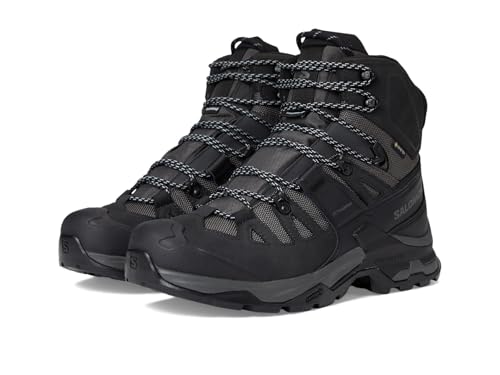
Best for: Backpackers carrying loads of 25 lbs or more who need the torsional rigidity and ankle structure that lighter boots can’t provide once a heavy pack starts amplifying every misstep on uneven terrain.
At roughly 19.5 oz per boot, the Quest Winter GTX sits at the top of the midweight tier — deliberately. This is the pick in this guide built around the principle that a loaded pack changes the weight-versus-support calculation. A 15 oz boot that feels perfectly stable on a day hike with an empty back can feel noticeably under-supported once a 35 lb pack shifts your center of gravity on a sidehill traverse. The taller collar and firmer midsole shank exist specifically to resist that added strain.

This is still meaningfully lighter than a traditional full-leather backpacking boot, which commonly runs 24 to 30+ oz per boot — the weight savings here come from the synthetic-leather hybrid upper rather than any compromise in structural support. The Gore-Tex membrane is a sensible inclusion at this weight tier, since backpacking trips are more likely to involve multi-day wet conditions than a short day hike.
✅ Best for: Multi-day backpacking trips, loaded packs over 25 lbs, technical or uneven terrain where ankle stability under load matters most.
⚠️ Not ideal for: Day hikers with no pack weight — the added structure and weight are unnecessary overhead for unloaded hiking. See Pick 1 or 4 instead.
Pros: Genuine torsional support for heavy loads, still lighter than traditional leather backpacking boots, Gore-Tex appropriate for multi-day exposure, proven on technical terrain.
Cons: Heaviest boot in this guide — not the right choice for unloaded day hikes. Premium price point. Break-in period recommended before a long trip.
4. HOKA Anacapa Mid GTX Wide — Best Lightweight and Waterproof Combo
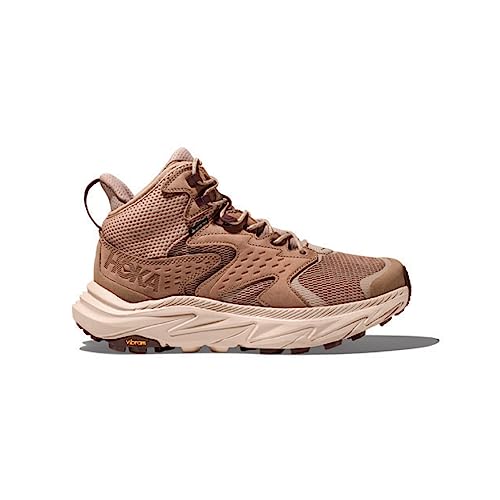
Best for: Hikers who want HOKA’s signature maximalist cushioning in a genuinely lightweight, fully waterproof package — a combination that’s harder to find than it sounds.
At approximately 16.2 oz per boot, the Anacapa Mid GTX proves that generous stack-height cushioning doesn’t have to come with the weight penalty traditional cushioned boots carry. HOKA achieves this through their compression-molded EVA midsole, which delivers noticeably more underfoot cushioning per gram than the denser EVA compounds used in older-generation lightweight boots. The relatively low 6mm drop keeps the ride feeling stable rather than perched, despite the tall stack height.
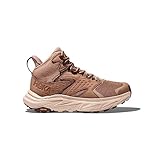
The wide-fit version addresses a common HOKA fit complaint directly — the brand’s standard lasts run narrow through the midfoot, which can crowd wider feet especially on longer descents when feet naturally swell. This wide iteration solves that without sacrificing the cushioning that makes the Anacapa line popular for hikers managing joint sensitivity or recovering from injury.
✅ Best for: Hikers who prioritize cushioning and joint comfort without wanting to carry the weight of a traditional maximalist boot; wide or swelling feet on long days.
⚠️ Not ideal for: Hikers who prefer a firmer, more ground-connected feel — the plush midsole trades some trail feedback for comfort. Technical scrambling where precise foot placement matters more than cushioning.
Pros: Excellent cushioning-to-weight ratio, wide-fit option prevents midfoot crowding, Gore-Tex waterproofing without excessive weight, low drop keeps the ride stable.
Cons: Plush midsole reduces trail feedback on technical terrain. Higher price point than several alternatives. HOKA’s standard (non-wide) fit runs narrow if you order the wrong version.
5. Merrell Moab 3 Mid Wide — Best Budget Lightweight Boot

Best for: Hikers who want genuine lightweight-tier performance without paying the $150–$200 premium that most technical lightweight boots command.
At roughly 17.1 oz per boot, the Moab 3 Mid Wide sits comfortably within the lightweight tier while typically pricing $40–$60 below several other picks in this guide. Merrell doesn’t achieve this through corner-cutting — the Vibram outsole and EVA midsole are proven, trail-tested components that have made the Moab line one of the best-selling hiking boot families for over a decade. What you give up compared to premium picks is refinement rather than core function: slightly less advanced cushioning foam and a less technical lacing system.

The wide-fit version is a genuine wide last, not a half-size-up substitute, which matters significantly for hikers with wider forefeet who’ve struggled with standard-width lightweight boots elsewhere in this guide. Waterproofing is present but uses Merrell’s proprietary membrane rather than licensed Gore-Tex — functionally similar for most hiking conditions, at a lower cost.
✅ Best for: Budget-conscious hikers, wide feet, first-time lightweight boot buyers who want to test the category before investing in a premium pair.
⚠️ Not ideal for: Hikers wanting the most advanced cushioning technology available — see Pick 4. Technical mountaineering or off-trail scrambling.
Pros: Best price-to-performance ratio in this guide, genuine wide-fit last, proven Vibram outsole, widely available and easy to find replacement pairs.
Cons: Proprietary waterproofing rather than licensed Gore-Tex. Less advanced cushioning than premium picks. Break-in period slightly longer than some competitors.
6. KEEN Circadia Mid WP Wide — Best for Wide Feet

Best for: Hikers with wide or splayed feet who’ve found even other “wide” hiking boots too narrow through the toe box, particularly on multi-hour descents when feet swell.
At approximately 17.8 oz per boot, the Circadia Mid WP Wide keeps a lightweight-tier weight while delivering KEEN’s signature roomy toe box — historically wider than almost every other major hiking boot brand, wide-fit versions included. This matters more than it sounds on paper: toe box crowding is one of the most common causes of black toenails and blister formation on long descents, and no amount of ankle support or cushioning compensates for a boot that’s simply too narrow for your foot shape.

KEEN’s waterproof membrane and 8mm drop round out a boot built for stability without excessive stiffness — appropriate for moderate day hikes and light backpacking rather than technical terrain. The outsole lug depth is moderate rather than aggressive, which suits maintained trail use better than loose scree or off-trail conditions.
✅ Best for: Wide or splayed feet, hikers prone to toe box crowding and blister issues in narrower boots, moderate day hikes and light backpacking.
⚠️ Not ideal for: Narrow feet, who will find this boot loose and unsupportive through the forefoot. Technical off-trail terrain requiring aggressive lug depth.
Pros: Genuinely roomy toe box even in the “wide” category, reliable waterproofing, moderate drop suits most hikers, solid weight for the support level provided.
Cons: Too roomy for narrow or average-width feet. Moderate (not aggressive) lug pattern limits off-trail capability. Mid-range price without premium-tier cushioning tech.
7. Merrell Moab 2 Vent — Best Non-Waterproof / Summer Pick

Best for: Hikers in hot, dry summer conditions who want maximum breathability and the lowest weight in the lightweight tier by deliberately skipping waterproofing altogether.
At roughly 14.9 oz per boot, the Moab 2 Vent is notably lighter than its waterproof Moab siblings elsewhere in this guide — direct proof of the 80–120g weight penalty a waterproof membrane typically carries. The mesh upper ventilates far better than any GTX-lined alternative, drying within an hour of a stream crossing rather than staying damp for the rest of a hike. For summer trail conditions — which is exactly when most lightweight boot searches happen — this trade-off consistently favors the Vent over its waterproof counterpart.

This is an honest specialist pick rather than an all-rounder: in wet, muddy, or cold conditions, the lack of waterproofing becomes a genuine liability rather than a minor inconvenience. Buyers should treat this as a dedicated summer/dry-climate boot rather than a year-round choice, and pair it with quick-dry synthetic socks to maximize the ventilation benefit.
✅ Best for: Summer hiking, hot and dry climates, frequent stream crossings where fast drying matters more than staying dry, hikers who run hot.
⚠️ Not ideal for: Wet, muddy, or cold-weather conditions. Shoulder-season or winter hiking — see the waterproof picks above instead.
Pros: Lightest non-ultralight-tier option in this guide, excellent breathability, fast-drying after water crossings, budget-friendly pricing.
Cons: No waterproofing — genuinely wet or muddy trails will soak through quickly. Not suited to cold or wet-season use.
8. Altra Lone Peak Mid — Best Minimalist / Barefoot-Style Pick
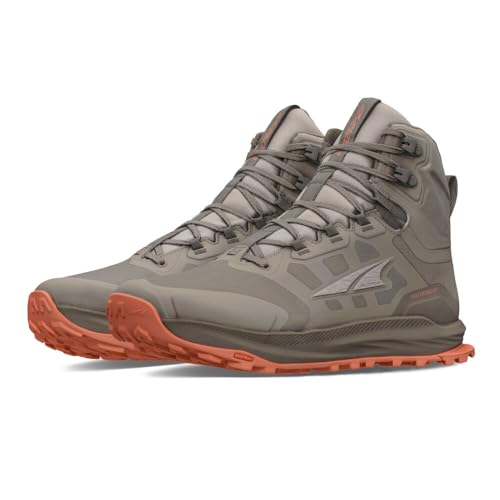
Best for: Hikers already comfortable with zero-drop, foot-shaped footwear who want the lightest possible boot with the least structural intervention between the foot and the trail.
At approximately 13.2 oz per boot, the Lone Peak Mid pairs with the Lone Peak 9 WP as the two lightest boots in this guide, both from Altra’s zero-drop platform. The difference here is a slightly simpler, less technical construction than the WP version — appropriate for hikers who’ve already adapted to the zero-drop, foot-shaped category and don’t need waterproofing for their typical trail conditions.

This boot is explicitly not a starting point for hikers new to minimalist or zero-drop footwear — the transition from a traditional 10-12mm drop boot requires a genuine adaptation period, and skipping that step risks calf and Achilles strain on longer hikes. For hikers who’ve already made that transition through trail running shoes or a previous zero-drop boot, this is a natural next step for backpacking and longer trail use.
✅ Best for: Experienced zero-drop and minimalist footwear users, hikers prioritizing natural foot movement and toe splay, warm-weather trail use.
⚠️ Not ideal for: Anyone new to zero-drop footwear — start with a traditional-drop boot first. Wet or cold conditions given the non-waterproof-focused construction.
Pros: Among the lightest boots available, genuine foot-shaped toe box, natural gait feel for adapted users, capable outsole despite minimal weight.
Cons: Not suitable for hikers unfamiliar with zero-drop platforms. Less structured support than any other pick in this guide. Adjustment period required even for experienced hikers switching models.
Day Hiking vs. Backpacking: Which Weight Tier Should You Choose?
Pack weight fundamentally changes which weight tier makes sense, and this is the single most common mistake buyers make when shopping by weight alone. A boot that feels perfectly stable and supportive on an unloaded day hike can feel noticeably under-built once a heavy pack shifts your center of gravity and amplifies every misstep on uneven ground.
- Under 20 lb pack (day hikes, short overnights): Ultralight or lightweight tier boots work well. Prioritize weight savings — the load isn’t heavy enough to expose the reduced structure.
- 20–35 lb pack (standard 2-4 day backpacking): Lightweight tier at minimum; midweight preferred if the terrain is technical or the trip extends beyond a few days.
- 35+ lb pack (extended trips, winter loads, mountaineering approach): Midweight tier is strongly recommended. Lightweight and ultralight boots risk genuine ankle instability under this much sustained load, particularly on sidehills and uneven terrain.
hiker comparing hiking boots 202607011436(1)
When to Choose Trail Running Shoes Instead
The honest answer many hiking boot guides avoid: for well-maintained trails under roughly 10 miles with no pack load, trail running shoes often make more practical sense than even the lightest hiking boots in this guide. If your typical hikes fit that profile, models like the HOKA Challenger, Salomon Speedcross, or Brooks Cascadia — all built for trail-specific traction without boot-level structure — will feel faster and less fatiguing over the course of a day.
The deciding factors: choose a boot over trail runners if you have a history of ankle instability, if your terrain includes loose scree or off-trail scrambling, if you’re carrying any meaningful pack weight, or if you’re hiking in cold or wet conditions where the boot’s higher collar keeps debris and moisture out more effectively. For a full breakdown of this decision, see our trail running shoes vs. hiking boots guide.
Buying Guide: What Actually Makes a Boot “Lightweight”
Upper Materials
Full-grain leather uppers, prized for durability, typically add 100–150g per boot compared to synthetic mesh and TPU overlay construction. Every lightweight boot in this guide uses a synthetic or hybrid upper for this reason — the weight savings come at some cost to long-term abrasion resistance, but modern synthetic materials have closed that durability gap considerably over the last decade.
Midsole Foam
Standard EVA foam remains the most common lightweight boot midsole, but newer compounds like PEBA/Pebax-based foams (used in HOKA’s premium lines) and Altra’s proprietary EGO foam deliver more cushioning per gram than older-generation EVA. This is why boots like the HOKA Anacapa can offer generous stack heights without the weight penalty that maximalist cushioning traditionally carried.
Outsole
Vibram Megagrip and similar premium rubber compounds add some weight over generic rubber outsoles but deliver meaningfully better traction on wet rock and loose terrain. Most lightweight boots compromise slightly here compared to heavier backpacking boots — moderate lug depth rather than the deepest, most aggressive patterns — as part of the overall weight-saving strategy.
Cut Height
Low-cut trail shoes save the most weight but offer minimal ankle protection. Mid-cut boots, which make up most of the picks in this guide, balance weight savings with meaningful ankle support. High-cut boots add the most weight but offer maximum protection against debris, moisture, and lateral ankle rolling — appropriate for technical or loaded backpacking rather than standard day hiking.
Frequently Asked Questions
What is considered a lightweight hiking boot?
Using the tier system in this guide, a lightweight hiking boot weighs between 14 and 18 oz (400–510g) per boot. Boots under 14 oz fall into the ultralight tier, while boots between 18 and 24 oz are considered midweight. Traditional full-leather backpacking boots often exceed 24 oz per boot for comparison.
Are lightweight hiking boots good for backpacking?
Yes, for loads under roughly 25-30 lbs. Beyond that weight, the reduced structural support of lightweight-tier boots can create genuine ankle stability issues on uneven terrain, and a midweight boot like the Salomon Quest Winter GTX becomes the more appropriate choice.
Do lightweight hiking boots have less ankle support?
Generally yes, though the reduction varies significantly by model. Lightweight-tier boots in this guide retain a genuine mid-cut collar and reasonable lateral support, while ultralight-tier boots (like the Altra Lone Peak line) sacrifice more ankle structure specifically to minimize weight.
What’s the lightest hiking boot available in 2026?
Among the boots in this guide, the Altra Lone Peak Mid is the lightest at approximately 13.2 oz per boot, followed closely by the Lone Peak 9 WP Mid at roughly 12.8 oz. Both use Altra’s zero-drop, foot-shaped platform to achieve this weight.
Are trail runners better than lightweight hiking boots?
For well-maintained trails under about 10 miles with no significant pack load, trail runners often outperform even lightweight hiking boots in comfort and fatigue reduction. Boots remain the better choice for technical terrain, loaded backpacking, or hikers with a history of ankle instability.
Do I need waterproof lightweight hiking boots for summer?
Usually not. In hot, dry summer conditions, a non-waterproof or vented boot like the Merrell Moab 2 Vent typically performs better overall — it breathes and dries faster, and the 80-120g weight penalty of a Gore-Tex membrane isn’t justified when sustained wet conditions aren’t a realistic risk.
Final Verdict
Weight alone shouldn’t drive a hiking boot purchase — the right tier depends on your typical pack load, terrain, and climate far more than shaving a few extra ounces. For most hikers, the Salomon X Ultra 4 GTX offers the best all-round balance in the lightweight tier, while backpackers carrying real loads should size up to the Salomon Quest Winter GTX rather than chasing the lowest possible weight at the cost of stability.
| Boot | Best For | Price | Link |
|---|---|---|---|
| Salomon X Ultra 4 GTX Wide | Best overall | ~$150–$180 | Check Price → |
| Altra Lone Peak 9 WP Mid | Lightest / ultralight | ~$150–$170 | Check Price → |
| Salomon Quest Winter GTX | Backpacking / loaded pack | ~$190–$220 | Check Price → |
| HOKA Anacapa Mid GTX Wide | Cushioning + waterproof | ~$175–$200 | Check Price → |
| Merrell Moab 3 Mid Wide | Best budget | ~$110–$140 | Check Price → |
| KEEN Circadia Mid WP Wide | Wide feet | ~$150–$175 | Check Price → |
| Merrell Moab 2 Vent | Summer / non-waterproof | ~$100–$130 | Check Price → |
| Altra Lone Peak Mid | Minimalist / barefoot-style | ~$140–$165 | Check Price → |