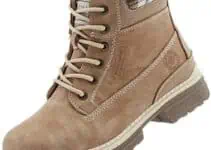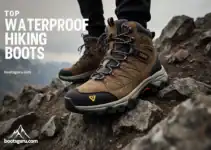
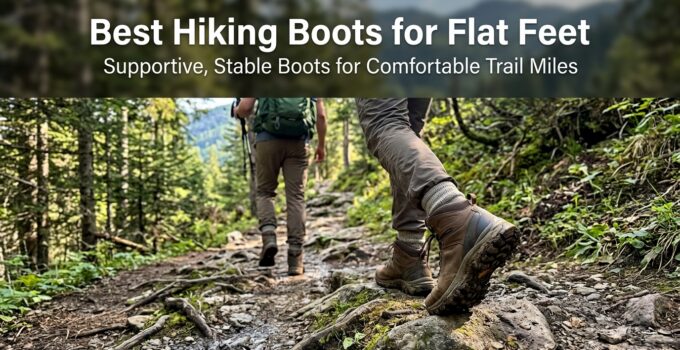
Flat feet don’t just hurt on the trail — they trigger a cascade. The arch collapses inward, your ankle rolls, your shin rotates, your knee torques, and by mile 5 you’re limping with pain you can’t quite locate. The boot you’re wearing either interrupts that chain at step one, or lets it run unchecked for the rest of the day.
Flat feet (pes planus) means the medial arch of your foot collapses under bodyweight — either partially or fully. It’s one of the most common foot conditions, affecting an estimated 20–30% of adults. On the trail, the problem compounds: uneven terrain amplifies every roll of the ankle, pack weight multiplies the force through the arch, and cumulative mileage means a minor structural flaw becomes a full-shift injury by afternoon.
Most guides for flat-footed hikers list the same 5–8 boots and call it done. This guide goes further — covering the two distinct types of flat feet that need different boot features, three severity tiers, condition combinations (plantar fasciitis, knee pain, wide feet), a women’s section, a kids’ section, and a specific insole upgrade guide. Every pick is available on Amazon.
This guide is NOT for: hikers with high arches or supination. Stability and motion control features designed for flat feet will worsen alignment for high-arch hikers.
🥾 Best Hiking Boots for Flat Feet — Quick Picks by Situation
| Situation | Best Pick | Key Reason | Buy |
|---|---|---|---|
| Best overall | Merrell Moab 3 Mid WP | Nylon shank + wide platform + orthotic-ready | Amazon |
| Best for mild flat feet / day hikes | KEEN Targhee IV Mid WP | Metatomical footbed + wide asymmetric toe box | Amazon |
| Best for moderate-severe flat feet | Salomon Quest 4 GTX | 4D Chassis — most aggressive medial control | Amazon |
| Best technical terrain | Salomon X Ultra 5 Mid GTX | Advanced Chassis + Contagrip MA on rocky trails | Amazon |
| Best for flat feet + plantar fasciitis | HOKA Kaha 3 GTX | Max cushion + wide stability base | Amazon |
| Best for backpacking (heavy pack) | Salomon Quest 5 GTX | Load-bearing chassis + high ankle support | Amazon |
| Best long-term durability | Lowa Renegade GTX Mid | PU midsole — consistent support for 500+ miles | Amazon |
| Best lightweight / trail runner feel | Altra Olympus 6 Hike Mid GTX | MaxTrac cushion + FootShape toe box + zero drop | Amazon |
| Best women’s pick | Merrell Women’s Moab 3 Mid WP | Women’s-specific last + nylon shank | Amazon |
| Best budget (under $100) | Columbia Newton Ridge Plus II | Nylon shank + waterproof under $100 | Amazon |
Full Comparison: All Boots at a Glance
| Boot | Arch Support | Heel Counter | Waterproof | Orthotic-Ready | Severity Fit | Price |
|---|---|---|---|---|---|---|
| Merrell Moab 3 Mid WP | ★★★★☆ | Firm | Yes | ✅ Yes | Mild–Moderate | $130–$155 |
| KEEN Targhee IV Mid WP | ★★★★★ | Firm | Yes | ✅ Yes | Mild–Moderate | $155–$175 |
| Salomon Quest 4 GTX | ★★★★★ | Very Firm | Yes (GORE-TEX) | ⚠️ Limited | Moderate–Severe | $180–$220 |
| Salomon X Ultra 5 Mid GTX | ★★★★★ | Firm | Yes (GORE-TEX) | ⚠️ Limited | Mild–Moderate | $155–$185 |
| HOKA Kaha 3 GTX | ★★★★★ | Firm | Yes (GORE-TEX) | ✅ Yes | Moderate + heel pain | $200–$220 |
| Salomon Quest 5 GTX | ★★★★★ | Very Firm | Yes (GORE-TEX) | ⚠️ Limited | Moderate–Severe + heavy load | $195–$230 |
| Lowa Renegade GTX Mid | ★★★★☆ | Very Firm | Yes (GORE-TEX) | ✅ Yes | Mild–Moderate, high mileage | $200–$230 |
| Danner Trail 2650 Mid GTX | ★★★★☆ | Moderate–Firm | Yes (GORE-TEX) | ✅ Yes | Mild–Moderate | $165–$195 |
| Oboz Bridger Mid WP | ★★★★☆ | Firm | Yes | ✅ Yes | Mild–Moderate, rocky terrain | $155–$175 |
| Columbia Newton Ridge Plus II | ★★★☆☆ | Moderate | Yes | ✅ Yes | Mild only | $75–$100 |
| Merrell Women’s Moab 3 Mid WP | ★★★★☆ | Firm | Yes | ✅ Yes | Mild–Moderate (women’s) | $130–$155 |
| HOKA Women’s Kaha 3 GTX | ★★★★★ | Firm | Yes (GORE-TEX) | ✅ Yes | Moderate + heel pain (women’s) | $200–$220 |
| Merrell Kids’ Moab 3 Mid WP | ★★★★☆ | Firm | Yes | ✅ Yes | Children (mild–moderate) | $60–$85 |
🔬 Do You Actually Have Flat Feet? 3 Ways to Check at Home
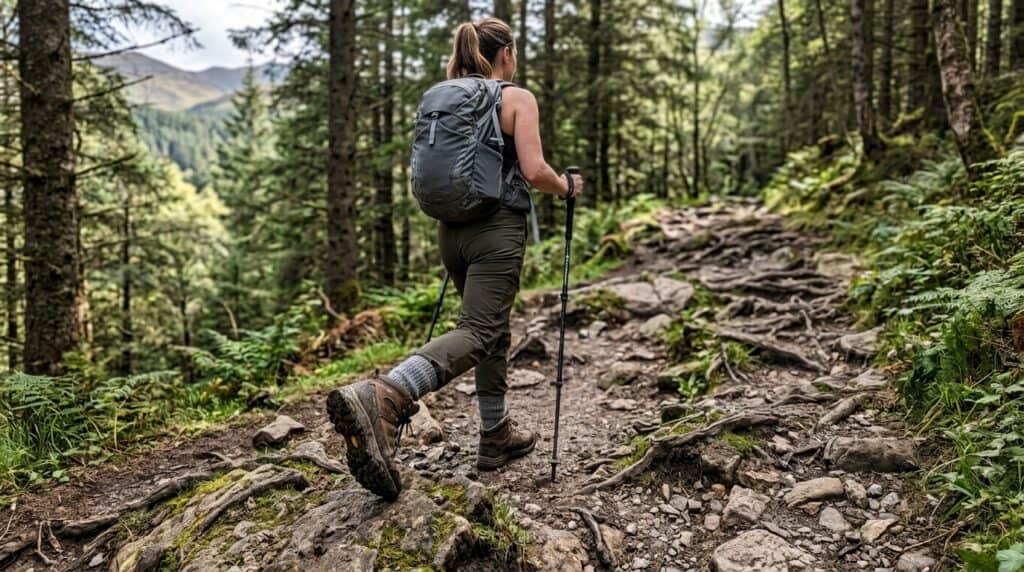
A woman hiking on a challenging forest trail, equipped with a backpack and trekking poles, enjoying outdoor adventure.
Before choosing a boot, spend 5 minutes confirming you actually have flat feet — and ruling out the opposite condition (supination/high arch), where flat-feet boots would hurt rather than help.
Method 1: The Wet Foot Test
Wet the bottom of your foot and step firmly onto a piece of brown paper or cardboard. Look at the imprint:
- Full imprint — barely any inward curve: Flat arch → likely flat feet. Continue to the severity section below.
- Partial imprint with a clear inward curve: Normal arch. You likely don’t need stability-grade hiking boots for arch correction.
- Only heel and ball visible with a very narrow middle: High arch → supination. Stability boots designed for flat feet will worsen your alignment. This guide is not for you.
Method 2: The Shoe Wear Pattern Test
Look at the outsole of your most-worn pair of shoes or hiking boots (3+ months of use):
- Heavy wear on the inner heel and ball of the foot: Strong flat feet + overpronation signal.
- Even wear across heel and forefoot: Neutral gait — mild support only needed.
- Heavy wear on the outer edge: Supination — do not use flat-feet stability boots.
Method 3: The Standing Mirror Test
Stand barefoot on a hard floor and look at your ankles from behind (or use a mirror):
- Achilles tendon curves inward / ankles tilt medially: Classic flat feet with overpronation. The more pronounced the bow, the more severe.
- Achilles runs straight and vertical: Neutral gait.
- Ankles tilt outward: Supination — this guide is not for you.
⚠️ When to see a podiatrist before buying boots: If you experience pain at rest, within the first mile of hiking, or have a history of ankle sprains, plantar fasciitis, or posterior tibial tendon dysfunction (PTTD) — get a professional gait analysis first. Self-diagnosis works well for mild to moderate flat feet. Severe or painful cases need professional assessment.
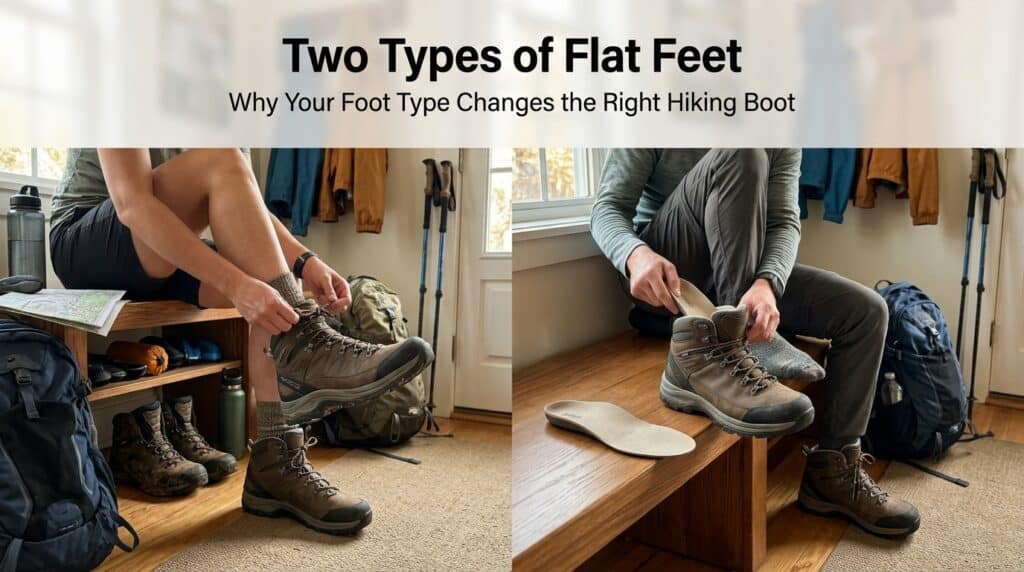
🦶 Two Types of Flat Feet — Why It Changes Everything About Your Boot Choice
hikers comparing hiking boots 202607211256
This distinction is missing from almost every hiking boot guide for flat feet — but it’s the most important factor in choosing the right boot. Flexible and rigid flat feet require fundamentally different features.
Flexible Flat Feet (Most Common — ~90% of flat-footed hikers)
What it is: The arch appears when you sit or stand on tiptoe, but collapses when you bear full weight. The arch structure exists — it just can’t support itself against gravity and load.
What happens on the trail: Every step collapses the arch, rolling the ankle inward, rotating the shin, and torquing the knee. Pack weight and steep descents amplify this with every step.
What boots need: A firm medial post (denser inner midsole) that resists collapse. A nylon or steel shank to prevent midfoot torsion. A rigid heel counter to stop rearfoot eversion. Most of the boots in this guide are designed for flexible flat feet.
Rigid Flat Feet (Less Common — ~10%, often more painful)
What it is: The arch is collapsed at all times — even when non-weight-bearing. Usually congenital or caused by tarsal coalition, arthritis, or PTTD. The arch cannot be restored by any boot or insole.
What boots need: Maximum cushioning to absorb impact (the arch cannot do it). A wide toe box to accommodate foot splay. An extra-depth design for custom orthotics — which are typically required. Posting against a rigid flat foot creates painful pressure on the bony structure.
Critical distinction: Most hiking boot guides recommend medial posting for ALL flat feet. For rigid flat feet, this is wrong — and potentially harmful. If your flat arch is still visible when you sit or stand on tiptoe, you likely have flexible flat feet. If it’s flat in all positions, you may have rigid flat feet and should see a podiatrist before investing in stability boots.
📊 Flat Feet Severity Tiers — Matching Boot Support to Your Condition
| Severity | Description | Trail Symptoms | Boot Priority | Insole Priority |
|---|---|---|---|---|
| Mild | Arch collapses slightly under load; minimal daily symptoms | Arch fatigue after 5+ miles; occasional mild knee ache | Stability boot with nylon shank + firm heel counter | Superfeet Blue or Currex HikePRO (Low) |
| Moderate | Arch collapses significantly; overpronation visible; consistent pain on hikes | Arch pain from mile 2–3; ankle fatigue; medial knee pain on descents | Stability to motion control boot + medial posting | Superfeet Green or Powerstep Pinnacle |
| Severe | Arch fully collapsed; visible inward ankle roll; pain at rest or within 1 mile | Immediate discomfort; heel pain; possible PTTD symptoms | Max cushion + extra-depth orthotic accommodation | Custom orthotics from podiatrist |
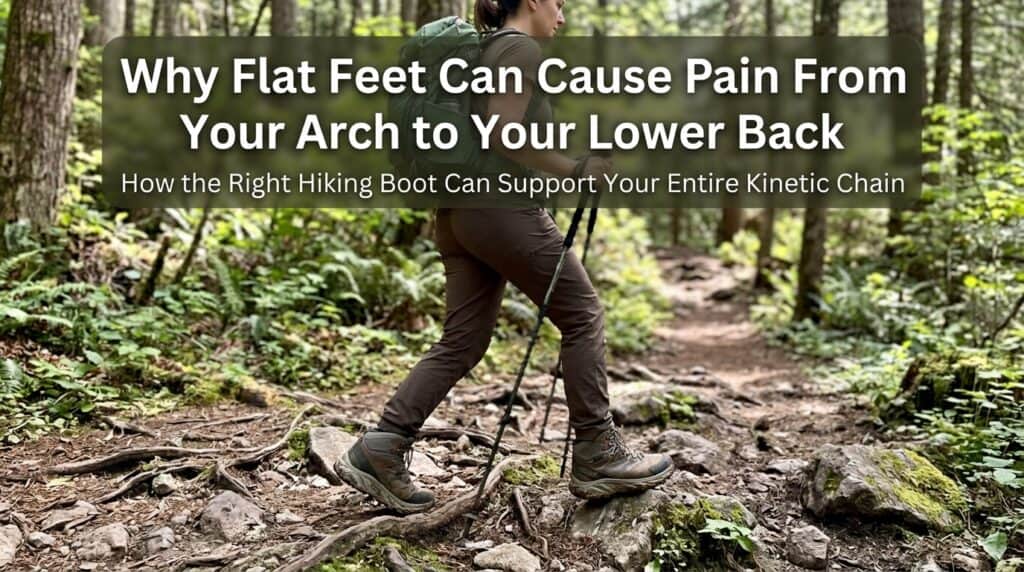
🧠 Why Flat Feet Cause Pain from Your Arch All the Way to Your Lower Back
hiker walking on forest trail 202607211257
Most boot guides say flat feet “can cause knee pain.” That’s accurate but incomplete. Here is the full kinetic chain — and why intercepting it at the foot with the right boot prevents every downstream consequence.
- Arch collapse — The medial arch drops under load. The plantar fascia stretches beyond its design range with every step. Result: arch pain, plantar fasciitis, heel spurs.
- Ankle eversion — Arch collapse rolls the ankle inward (valgus). The ankle joint experiences chronic medial stress. Result: ankle sprains, Achilles tendinopathy, posterior tibial tendon dysfunction.
- Tibial rotation — The inward ankle forces the tibia to rotate internally. Result: shin splints, medial tibial stress syndrome.
- Knee torque — Tibial rotation causes the kneecap to track medially and incorrectly. Result: patellofemoral pain syndrome, medial compartment knee pain, IT band syndrome.
- Hip compensation — The knee torque forces the hip to compensate with internal rotation. Result: IT band syndrome extending to the hip, gluteal weakness, hip bursitis.
- Lower back strain — Hip compensation tilts the pelvis forward. Result: lumbar strain, sacroiliac joint dysfunction, sciatic nerve irritation.
The point: A boot with a firm medial post, nylon shank, and rigid heel counter interrupts this chain at step one — preventing every downstream consequence listed above.
What to Look for in Hiking Boots for Flat Feet: 6 Non-Negotiables
1. Nylon or Steel Shank — The Most Important Feature
A shank is a rigid plate embedded in the midsole. It prevents the boot from twisting along its length, protecting the flat arch from collapsing medially under load. Every stability hiking boot for flat feet should have one. Test it: Hold the boot by toe and heel and twist. A properly shanked boot resists twisting to at least 30–45°. A boot that folds in half provides no midfoot protection.
2. Firm Heel Counter
The heel counter is the hard cup at the back of the boot. For flat-footed hikers, it’s the primary barrier against ankle rolling inward. Test it: Press your thumb firmly into the back of the boot from outside. A good heel counter barely moves. If it collapses with light thumb pressure, it will not resist your bodyweight on a 10-mile descent.
3. Medial Post or Dual-Density Midsole
The inner (arch) side of the midsole should be noticeably firmer than the outer side. This density difference resists the inward roll of arch collapse. Test it: Squeeze both sides of the midsole between thumb and forefinger. Equal firmness on both sides = no medial posting = no flat-feet correction.
4. Wide, Stable Platform
Flat feet splay laterally as the arch collapses. A wide midsole base provides a more stable platform and reduces lateral instability. HOKA’s oversized midsole, KEEN’s wide toe box design, and Merrell’s Moab platform are all wider than typical hiking boot construction.
5. Orthotic Compatibility
A removable insole is essential for moderate-to-severe flat feet. The factory insole in even quality hiking boots is designed for average feet — not corrective support. For moderate flat feet, the aftermarket insole upgrade is as important as the boot choice itself. Look for removable insoles and sufficient depth for aftermarket or custom orthotics.
6. Mid-Cut or Higher Ankle Height
The ankle collar provides a secondary stability layer above the midsole. For flat-footed hikers on uneven terrain, this matters significantly — the collar physically limits the range of inward ankle motion. Low-cut hiking shoes are a last resort for flat-footed hikers on anything beyond flat, groomed trails. Mid-cut is the minimum for day hikes; high-cut for backpacking or rocky terrain.
⚠️ Why Minimalist and Zero-Drop Boots Are Dangerous for Most Flat-Footed Hikers
Minimalist and zero-drop hiking boots have become popular based on the theory that they strengthen intrinsic foot muscles over time. This theory has some validity for neutral-gait or high-arch hikers. For flat-footed hikers, it is a reliable path to injury on the trail.
A flat foot has structurally inadequate arch tendons and ligaments that cannot be “strengthened” into supporting the arch through barefoot exposure — especially on uneven terrain with a pack. Zero-drop eliminates the slight heel elevation that reduces plantar fascia stretch on descents, dramatically increasing plantar fasciitis risk. Flexible, unstructured soles provide no resistance to the medial collapse that drives the entire kinetic chain described above.
Who should absolutely avoid minimalist boots: Anyone with moderate or severe flat feet, existing plantar fasciitis or Achilles tendinopathy, a history of ankle sprains, or anyone carrying a pack over 20 lbs.
Note on the Altra Olympus 6 Hike Mid GTX in this guide: Altra uses zero-drop geometry but pairs it with maximum cushion and a FootShape toe box that works differently from minimalist boots. The Olympus 6 is included as a specific pick for mild flexible flat feet who prefer a more natural foot position — not as a general recommendation for the condition. If in doubt, start with a traditional stability boot.
The Best Hiking Boots for Flat Feet — Full Reviews
1. Merrell Moab 3 Mid Waterproof — Best Overall Hiking Boot for Flat Feet

Best for: Mild to moderate flat feet on most trail types — the starting point for any flat-footed hiker buying their first stability hiking boot.
The Merrell Moab 3 Mid is the most trusted hiking boot for flat feet at its price point, and for straightforward reasons: the nylon molded arch shank in the midfoot provides the torsional rigidity that flat arches need, the midsole platform measures over 55mm wide at the forefoot (wider than most competitors), and the Q-Form midsole adds mild medial posting. This isn’t a boot that merely says “arch support” — it has the structural features that actually resist arch collapse on the trail.
The firm heel counter locks the rearfoot and prevents the ankle eversion that starts the pain cascade. The removable insole means a $55 Superfeet Green upgrade transforms it from a good stability boot into an excellent one. M Select DRY waterproofing handles rain, wet trails, and creek crossings. Vibram TC5+ outsole grips confidently on most surfaces.
At mile 8 with flat feet, the shank is quietly doing its job — you feel it in the absence of the arch fatigue and knee ache you’d have in a standard neutral boot. The wide platform doesn’t wobble on off-camber ground. The Q-Form posting is mild enough to not be intrusive, yet firm enough for the majority of flat-footed day hikers.

Key Specs
| Price | $130–$155 |
| Waterproofing | M Select DRY membrane |
| Midsole | EVA + nylon arch shank + air cushion heel |
| Medial Posting | Q-Form mild posting |
| Heel Counter | Firm |
| Outsole | Vibram TC5+ — 5mm multi-directional lugs |
| Orthotic-Ready | Yes — removable insole |
| Shaft Height | Mid (~5″) |
| Best Severity Tier | Mild to moderate flat feet |
✅ Pros
- Nylon arch shank — the most important structural feature for flat feet
- Wide midsole platform for lateral stability
- Firm heel counter prevents rearfoot eversion
- Removable insole — easy Superfeet upgrade
- Vibram TC5+ outsole — reliable on wet and dry trails
- Available in wide widths
❌ Cons
- Q-Form posting is mild — insufficient for severe flat feet without insole upgrade
- M Select DRY less breathable than GORE-TEX in summer heat
❌ Skip this if: You have severe flat feet requiring maximum medial control / you need GORE-TEX-level breathability / you’re backpacking with 35+ lb loads (see Quest 5).
2. KEEN Targhee IV Mid Waterproof — Best for Flat Feet + Wide Forefoot

Best for: Flat-footed hikers who also have wider-than-average forefeet — which is extremely common, since flat arches cause the forefoot to splay laterally over time.
KEEN’s Targhee IV earns its place through the metatomical footbed — a PU-based structured arch support that is meaningfully different from shaped EVA foam. PU provides real structural resistance, not just contouring. Paired with KEEN’s asymmetric wider toe box, which was specifically widened in the IV generation to accommodate natural toe splay, this boot addresses two of the most common flat-feet hiking problems simultaneously: arch collapse and forefoot compression.
The KEEN.DRY waterproof membrane keeps moisture out reliably. The KEEN.ReGEN midsole provides energy return that reduces cumulative fatigue over long days. The heel counter is firm enough to provide meaningful rearfoot control. And crucially, the Targhee IV is available in wide widths on Amazon — a significant advantage for flat-footed hikers who’ve struggled with toe compression in standard-width boots.

Key Specs
| Price | $155–$175 |
| Waterproofing | KEEN.DRY membrane |
| Footbed | Metatomical PU footbed — structured arch support |
| Toe Box | Asymmetric wide — accommodates forefoot splay |
| Heel Counter | Firm |
| Outsole | KEEN All-Terrain rubber |
| Orthotic-Ready | Yes — removable insole |
| Width Options | Standard and wide available on Amazon |
| Best Severity Tier | Mild to moderate flat feet |
✅ Pros
- Metatomical PU footbed provides real structural arch support
- Wider asymmetric toe box accommodates forefoot splay from arch collapse
- KEEN.DRY waterproofing
- Wide widths available on Amazon
- KEEN.ReGEN midsole reduces shift fatigue
❌ Cons
- KEEN.DRY less breathable than GORE-TEX in hot conditions
- PU footbed posting level insufficient for severe cases without insole upgrade
❌ Skip this if: You have severe flat feet / you primarily hike in summer heat where breathability is critical / you need the aggressive medial control of the Salomon Quest 4.
3. Salomon X Ultra 5 Mid GTX — Best for Technical Terrain with Flat Feet

Best for: Flat-footed hikers tackling rocky, technical, or off-camber terrain where medial control and ground traction are equally critical.
The Salomon X Ultra 5 Mid GTX delivers the Advanced Chassis system — a semi-rigid plate integrated into the midsole that actively controls heel motion medially. Unlike passive medial posting that merely resists collapse, the Advanced Chassis provides structured guidance for every step, particularly effective on the off-camber and uneven surfaces where flat-footed ankle roll is most dangerous.
At approximately 1 lb 13 oz per pair, it’s one of the lightest boots on this list with genuine flat-feet control features. GORE-TEX waterproofing and Contagrip MA outsole provide confidence on wet rock and loose terrain. The defined heel supports ladder use. The fit is slightly narrower in the toe box than KEEN’s offering — relevant for flat-footed hikers with forefoot splay.

Key Specs
| Price | $155–$185 |
| Waterproofing | GORE-TEX |
| Stability System | Advanced Chassis — active medial heel control |
| Heel Counter | Firm |
| Outsole | Contagrip MA — exceptional wet and dry traction |
| Weight | ~1 lb 13 oz (pair) |
| Orthotic-Ready | Limited — chassis reduces insole room |
| Best Severity Tier | Mild to moderate flat feet |
✅ Pros
- Advanced Chassis actively controls medial heel motion on technical terrain
- Lightweight for the stability level
- GORE-TEX waterproofing
- Contagrip MA — best traction compound on wet rock
❌ Cons
- Narrower toe box than KEEN — flat-footed hikers with forefoot splay may need wider alternative
- Limited orthotic accommodation
❌ Skip this if: You have wide forefoot splay from arch collapse (try KEEN Targhee IV Wide) / you need maximum medial posting for severe flat feet / you use thick custom orthotics.
4. Salomon Quest 4 GTX — Best for Moderate-Severe Flat Feet

Best for: Moderate to severe flexible flat feet requiring the most aggressive medial control available in a hiking boot at this price point.
The Quest 4 GTX earns its place through Salomon’s 4D Advanced Chassis — not a passive dual-density midsole, but an integrated structural plate system that guides and controls rearfoot motion throughout the entire gait cycle. For flat-footed hikers on steep terrain with medium-to-heavy pack loads, this is the most effective motion control system available under $250.
The high 6.75-inch shaft provides a secondary ankle support layer that flat-footed hikers on technical terrain genuinely need. The GORE-TEX waterproofing is excellent, and Contagrip MA delivers confident traction on wet rock, mud, and loose scree. The very firm heel counter is the best rearfoot eversion control on this list.
The break-in period is real — plan 8–12 miles before long days in these. And the 4D Chassis leaves limited room for aftermarket insoles — if you depend on custom orthotics, verify compatibility before purchasing.

Key Specs
| Price | $180–$220 |
| Waterproofing | GORE-TEX |
| Stability System | 4D Advanced Chassis — motion control level medial support |
| Heel Counter | Very firm — best rearfoot control on this list |
| Shaft Height | High (6.75″) |
| Outsole | Contagrip MA |
| Orthotic-Ready | Limited — verify custom orthotic compatibility |
| Best Severity Tier | Moderate to severe flat feet |
✅ Pros
- Most aggressive medial control system on this list (4D Chassis)
- Very firm heel counter — maximum rearfoot eversion control
- High shaft for secondary ankle support on technical terrain
- GORE-TEX waterproofing
- Handles heavy backpacking loads
❌ Cons
- Real break-in period (8–12 miles)
- Limited orthotic room — confirm custom orthotic compatibility
- Heavier than X Ultra 5
- Premium price
❌ Skip this if: You have mild flat feet where this level of control will feel overly stiff / you use thick custom orthotics / you prioritize lightweight for fast hiking.
5. HOKA Kaha 3 GTX — Best for Flat Feet + Plantar Fasciitis
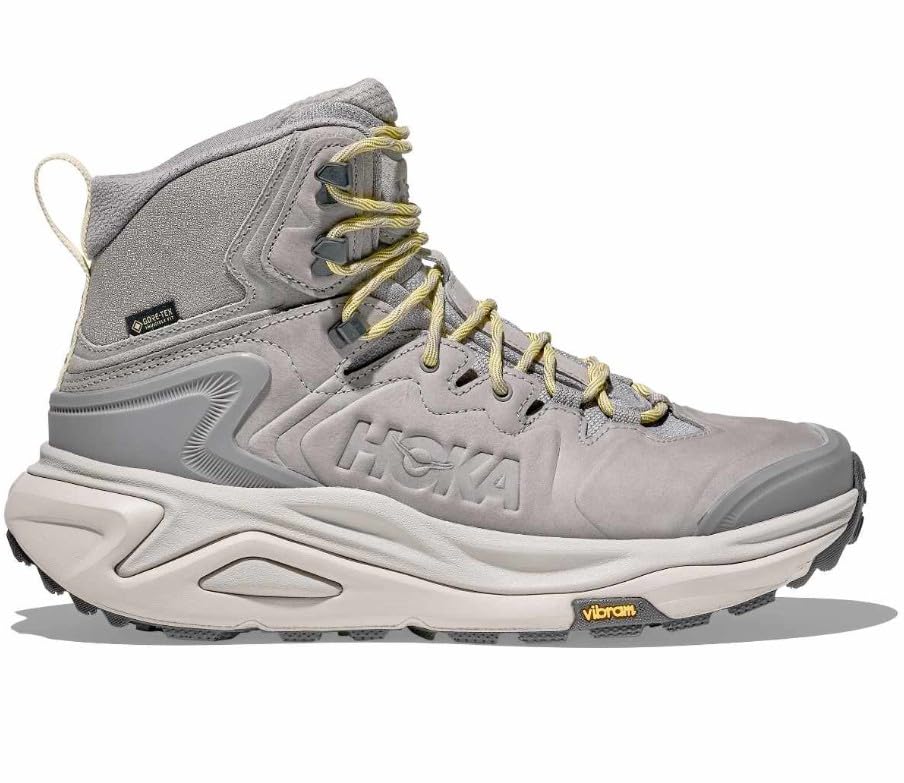
Best for: Flat-footed hikers who also experience plantar fasciitis, heel pain, or chronic arch inflammation — where maximum cushioning and stability must coexist.
The HOKA Kaha 3 GTX solves a problem that most boots can’t: providing both maximum cushioning AND flat-feet stability simultaneously. The oversized EVA midsole (approximately 37mm at the heel) delivers the best heel cushioning available in a hiking boot. But what makes it work for flat feet is the midsole’s extra-wide base — the platform width does the lateral stability work that a narrower maximalist boot cannot.
GORE-TEX Invisible Fit bonding eliminates traditional seams, reducing waterproof failure points. Vibram Megagrip is the best wet-traction compound available — critical on descents where flat-footed hikers experience peak knee torque. The tall Nubuck leather collar provides secondary ankle support. The removable insole accommodates Superfeet Green or Powerstep Pinnacle for additional flat-feet correction.
At hour 10 on a long day, this boot provides heel pain relief that no other boot on this list matches. The trade-off: the high stack height reduces proprioception on very technical terrain. On moderate-to-challenging trails with plantar fasciitis alongside flat feet, it is the definitive recommendation.

Key Specs
| Price | $200–$220 |
| Waterproofing | GORE-TEX Invisible Fit (fewer seams) |
| Midsole | Max-cushion EVA (~37mm) with wide stability base |
| Drop | 6mm |
| Heel Counter | Firm |
| Outsole | Vibram Megagrip — best wet traction available |
| Orthotic-Ready | Yes — removable insole |
| Best Severity Tier | Moderate flat feet + heel pain conditions |
✅ Pros
- Maximum cushioning for flat feet + plantar fasciitis combination
- Wide stability base — cushion without medial wobble
- GORE-TEX Invisible Fit
- Vibram Megagrip — excellent descents
- Removable insole — orthotic compatible
- Men’s and women’s versions available
❌ Cons
- High stack creates lateral instability on very technical scrambling terrain
- Premium price
- Heavier than performance-first alternatives
❌ Skip this if: You primarily do technical, exposed, or scrambling terrain / you want maximum medial control rather than maximum cushion / you have rigid flat feet needing accommodation over posting.
6. Salomon Quest 5 GTX — Best for Flat Feet + Heavy Backpacking Loads
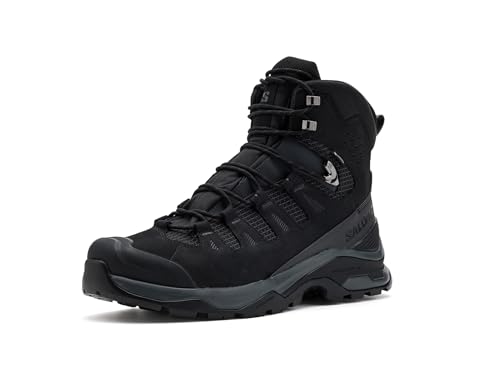
Best for: Backpackers carrying 30–65 lb packs who have flat feet — where pack weight dramatically amplifies every arch collapse event.
Pack weight is the multiplier that turns mild flat feet into severe pain — every extra pound adds 3–5x force through the arch with each step on a descent. The Salomon Quest 5 GTX is purpose-built for heavy loads, and its medial chassis provides the load-bearing stability that flat arches need when they’re supporting both bodyweight and a full backpacking kit.
The updated Quest 5 refines the Quest 4 platform with an improved upper and chassis geometry tuned for sustained heavy-load stability. The high ankle collar prevents the ankle eversion that becomes even more pronounced under pack weight. GORE-TEX waterproofing handles multi-day wet conditions. Contagrip MA provides the descent traction that loaded flat-footed backpackers need most.

Key Specs
| Price | $195–$230 |
| Waterproofing | GORE-TEX |
| Stability System | Advanced Chassis — load-bearing medial control |
| Heel Counter | Very firm |
| Shaft Height | High cut |
| Outsole | Contagrip MA |
| Best Pack Weight | 30–65 lbs |
| Best Severity Tier | Moderate to severe flat feet under load |
✅ Pros
- Purpose-built for heavy pack loads — best for backpacking with flat feet
- Advanced Chassis controls flat-arch collapse under load
- GORE-TEX waterproofing for multi-day conditions
- High ankle collar for secondary support under loaded conditions
- Contagrip MA traction on technical loaded descents
❌ Cons
- Significant break-in period — plan 25–30 miles before long use
- Stiffness less natural on casual flat trails without a pack
- Premium price
❌ Skip this if: You primarily day hike with light loads / you need immediate out-of-box comfort / your flat feet are mild and a lighter boot is sufficient.
7. Lowa Renegade GTX Mid — Best for Long-Term Flat Feet Support That Doesn’t Degrade
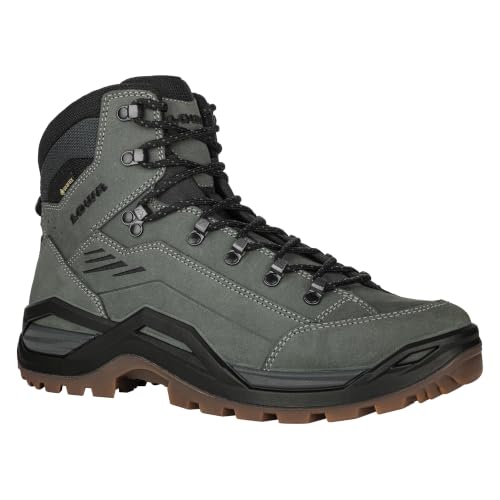
Best for: Frequent hikers who need consistent flat-feet support over hundreds of miles — not just for the first season.
The dirty secret about EVA midsoles: they compress over time. A boot that provides excellent medial support at mile 1 provides meaningfully less support at mile 300–400 because the foam has compressed and lost its density differential. The Lowa Renegade GTX uses a PU (polyurethane) midsole that holds its cushioning and stability properties for 500–800 miles — providing the same medial support to a flat foot at mile 1 and mile 500.
The X-Lacing system with tongue hardware allows genuinely precise fit adjustment — significant for flat-footed hikers who need consistent heel lockdown as the day and mileage progress. GORE-TEX waterproofing, Vibram outsole, and German precision construction make this a genuine long-term investment. The removable insole accommodates Superfeet Green for additional flat-feet correction.

Key Specs
| Price | $200–$230 |
| Waterproofing | GORE-TEX |
| Midsole | Double-injection PU — consistent support for 500–800 miles |
| Heel Counter | Very firm — X-Lacing precision heel lockdown |
| Construction | Goodyear welt — resoleable |
| Outsole | Vibram outsole |
| Orthotic-Ready | Yes — removable insole |
| Best Severity Tier | Mild to moderate — best for high-mileage frequent hikers |
✅ Pros
- PU midsole maintains consistent flat-feet support for 500–800 miles
- Goodyear welt — resoleable for multi-year investment
- X-Lacing precision heel lockdown
- GORE-TEX waterproofing
- German precision construction
❌ Cons
- PU feels firmer underfoot than EVA — takes adjustment
- Moderate break-in period
- Premium price; ankle cuff can feel restrictive for fast-paced hikers
❌ Skip this if: You need maximum cushion for plantar fasciitis / you only hike occasionally and won’t benefit from PU durability / you’re on a tight budget.
8. Oboz Bridger Mid Waterproof — Best for Flat Feet on Rocky Terrain with Great Factory Insole
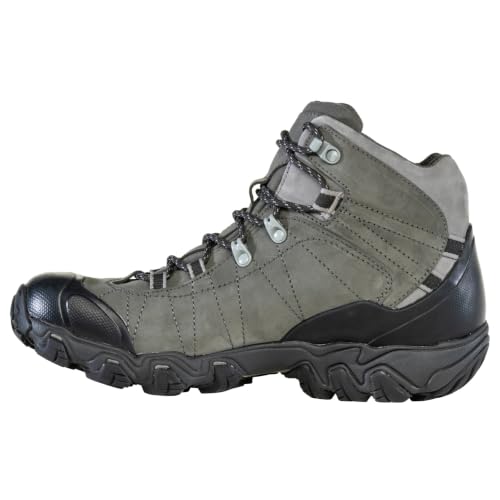
Best for: Rocky trail day hiking with flat feet — particularly hikers who want the best factory insole without an immediate aftermarket upgrade.
The Oboz Bridger stands out for one feature that most guides ignore: the BFit insole included in every pair is the best factory insole of any hiking boot under $175 for flat-footed hikers. It provides real arch contouring — not just a foam bump — along with a deep heel cup. For mild flat-footed hikers, this is the boot where you may not immediately need a $55 Superfeet upgrade.
The TPU stability frame in the midsole provides good midfoot rigidity alongside a nylon shank. The B-DRY waterproof breathable membrane keeps feet dry while offering better breathability than some proprietary alternatives. Deep multi-directional lugs extending over the outsole sides provide confident grip on rocky terrain regardless of foot strike angle.

Key Specs
| Price | $155–$175 |
| Waterproofing | B-DRY waterproof breathable |
| Midsole | EVA + nylon shank + TPU stability frame |
| Factory Insole | BFit — best factory insole on this list for flat feet |
| Heel Counter | Firm |
| Outsole | Oboz BFT rubber — deep multi-directional lugs over sides |
| Orthotic-Ready | Yes — removable insole |
| Best Severity Tier | Mild to moderate flat feet |
✅ Pros
- Best factory insole on this list for flat feet — BFit provides real arch contouring
- TPU stability frame + nylon shank for midfoot rigidity
- Deep outsole lugs over sides for rocky terrain traction
- B-DRY waterproofing with good breathability
- Multiple widths available
❌ Cons
- Less aggressive medial control than Salomon options for severe cases
- Less cushioning than HOKA for heel pain
❌ Skip this if: You have severe flat feet / you need maximum heel cushioning / you primarily do wet muddy trails (KEEN or Merrell better suited).
9. Altra Olympus 6 Hike Mid GTX — Best for Mild Flat Feet Who Prefer Natural Foot Position

Best for: Mild flexible flat feet in hikers who prefer a wide, natural foot position and maximum underfoot cushioning — with the important caveat noted below.
⚠️ Important note before reading this profile: Altra uses zero-drop geometry (heel and forefoot at equal height). For most flat-footed hikers — especially those with moderate or severe flat feet, plantar fasciitis, or Achilles tendinopathy — zero-drop is not recommended. The Olympus 6 is included as a pick specifically for mild flexible flat feet in hikers who are already adapted to low-drop footwear and prefer natural foot positioning. Do not use this boot as your first stability hiking boot for flat feet.
What makes the Olympus 6 different from minimalist zero-drop boots: the MaxTrac cushioning platform provides substantial underfoot volume (not minimal), and the FootShape toe box accommodates the natural foot splay of flat arches. GORE-TEX waterproofing, a substantial outsole, and mid-cut support make this a genuine hiking boot. For the right person — mild flat feet, low-drop experience, prefers wide toe positioning — this provides excellent all-day comfort.

Key Specs
| Price | $165–$195 |
| Waterproofing | GORE-TEX |
| Drop | 0mm (zero drop) |
| Cushioning | MaxTrac — substantial cushion volume |
| Toe Box | FootShape — wide, natural foot position |
| Outsole | MaxTrac rubber |
| Orthotic-Ready | Yes — removable insole |
| Best Severity Tier | Mild flexible flat feet only — low-drop experience required |
✅ Pros
- FootShape toe box accommodates natural forefoot splay from flat arches
- MaxTrac cushioning reduces fatigue on long days
- GORE-TEX waterproofing
- Natural foot positioning reduces toe compression
❌ Cons
- Zero-drop NOT recommended for moderate/severe flat feet, plantar fasciitis, or Achilles tendinopathy
- Requires prior adaptation to low-drop footwear
- Less medial posting than stability-category alternatives
❌ Skip this if: You have moderate or severe flat feet / you have plantar fasciitis or Achilles tendinopathy / you haven’t worn low-drop footwear before / you’re starting with hiking boots for flat feet for the first time.
10. Columbia Newton Ridge Plus II Waterproof — Best Budget Pick for Mild Flat Feet

Best for: Mild flat-footed hikers on a budget who need stability-grade features without spending $130+.
The Columbia Newton Ridge Plus II delivers the two most important flat-feet structural features at under $100: a nylon shank in the midfoot and a functional heel cup. Combined with Columbia’s Omni-TECH waterproofing, this boot provides meaningful flat-feet support on moderate trails at a price point that leaves budget for a Superfeet insole upgrade.
The $75–$100 + $55 Superfeet Green combination ($130–$155 total) often outperforms a $140 boot with factory insole for mild flat-footed hikers — the insole upgrade adds more flat-feet correction than the price difference between budget and mid-range boots delivers.

Key Specs
| Price | $75–$100 |
| Waterproofing | Columbia Omni-TECH |
| Midsole | Lightweight EVA + nylon shank |
| Heel Counter | Moderate (functional for mild cases) |
| Outsole | Omni-GRIP |
| Orthotic-Ready | Yes — removable insole |
| Best Severity Tier | Mild flat feet only |
✅ Pros
- Best budget option for mild flat feet
- Nylon shank — the most important structural feature
- Waterproof — Omni-TECH
- Removable insole for easy Superfeet upgrade
❌ Cons
- Moderate heel counter insufficient for moderate-severe cases
- Less durable construction — plan to replace after 1–2 seasons
- Mild flat feet only
❌ Skip this if: You have moderate or severe flat feet / you hike regularly on technical terrain / you want a 2+ year boot without insole dependency.
Best Women’s Hiking Boots for Flat Feet
Women are underserved in most flat-feet hiking boot guides — given a “women’s colorway” of a men’s boot as an afterthought. Women’s foot anatomy differs meaningfully from men’s: narrower heel, different arch position, shorter Achilles tendon attachment. A boot on a men’s last in a women’s size is not a women’s boot. After 8 hours on trail, that difference is not academic.
Post-pregnancy note: Many women develop flat feet or experience worsening arch collapse during and after pregnancy. The hormone relaxin loosens plantar ligaments during pregnancy, and in some women these ligaments don’t fully recover postpartum. If you’ve developed new arch pain after pregnancy, the condition is real, common, and responds well to quality stability boots + insoles.
Women’s Pick 1 — Merrell Women’s Moab 3 Mid Waterproof
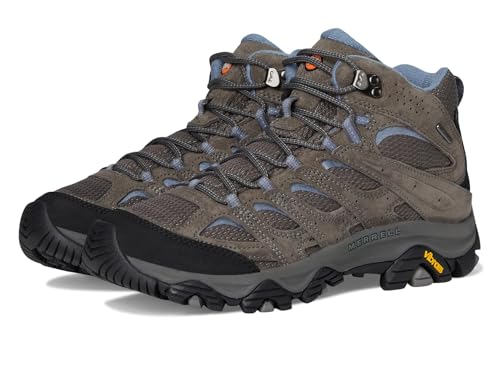
Best for: Women with mild to moderate flat feet — the best-value women’s stability hiking boot available on Amazon.
The Merrell Women’s Moab 3 Mid is built on a women’s-specific last — narrower heel, correctly positioned arch support for women’s foot geometry. The nylon shank, firm heel counter, Q-Form medial posting, and removable insole are identical in purpose to the men’s version, but the anatomical fit is designed around women’s feet. At mile 7 when feet have swollen, a properly fitting women’s last makes a difference that a men’s boot in a smaller size cannot replicate.
Women’s Pick 2 — HOKA Women’s Kaha 3 GTX
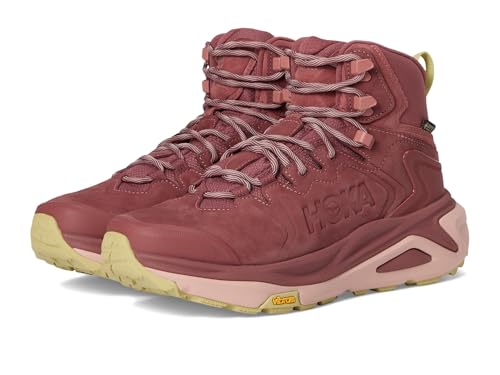
Best for: Women with flat feet and plantar fasciitis, or those who need maximum cushion for long hiking days.
The Women’s Kaha 3 GTX provides the same maximum-cushion wide-stability-base platform as the men’s version, built on a women’s-specific last. For women dealing with flat feet combined with heel pain or plantar fasciitis, this is the top recommendation available on Amazon. GORE-TEX Invisible Fit, Vibram Megagrip, and the wide EVA platform work identically to the men’s version — in a fit designed for women’s foot geometry.
Best Kids’ Hiking Boots for Flat Feet
Important note for parents: Most children under age 5–6 appear to have flat feet because the arch fat pad hasn’t yet revealed the arch structure underneath. By age 6–8, most children develop a visible arch. Flat feet that persist beyond age 8–10 and cause pain during activity warrant a pediatric podiatrist evaluation. Not all children’s flat feet need corrective footwear — but children who complain of foot, arch, or leg fatigue on hikes do.
Signs a child’s flat feet need boot support:
- Pain or fatigue during or after hikes beyond what peers experience
- Visible ankle rolling inward when walking or running
- Complaining of arch or heel pain after moderate activity
- Calves tire very quickly on trails
Kids’ Pick — Merrell Kids’ Moab 3 Mid Waterproof
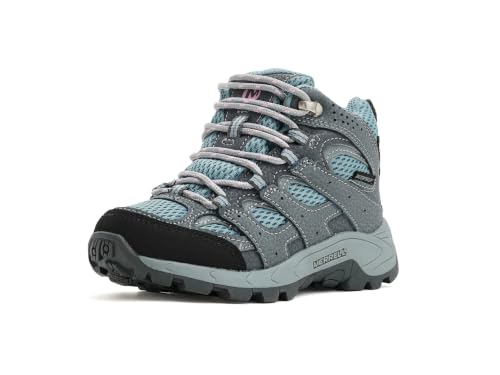
Best for: Children ages approximately 5–14 with flat feet who hike on moderate to challenging trails.
The Merrell Kids’ Moab 3 Mid brings the same nylon arch shank and firm heel counter found in the adult version to a youth-specific last construction. The removable insole accommodates pediatric orthotics if prescribed by a podiatrist. M Select DRY waterproofing handles creek crossings and wet trails. Available in a wide range of youth sizes on Amazon.
If a child’s flat feet cause significant pain despite quality boots, a pediatric podiatrist evaluation is the next step — not a more expensive boot. Prescribed pediatric orthotics are significantly more effective than boot selection alone for pain-causing flat feet in children.
🧦 Best Insoles for Flat Feet in Hiking Boots — Upgrading What Comes in the Box
Factory insoles in even quality hiking boots are designed for average feet. For flat-footed hikers, the aftermarket insole is often as important as the boot choice. A $110 mid-range boot + $55 Superfeet Green frequently outperforms a $200 boot with factory insole for moderate flat-footed hikers.
| Insole | Best For | Arch | Key Feature | Price |
|---|---|---|---|---|
| Superfeet Green | Moderate-severe flat feet, hiking & backpacking | High, firm | Best overall for flat feet on trail | ~$55 |
| Superfeet Blue | Mild flat feet, lighter hiking | Medium | Lower profile than Green, more flexible feel | ~$55 |
| Powerstep Pinnacle | Flat feet + plantar fasciitis | Medium-high | Semi-rigid arch + deep heel cup — dual-condition | ~$45 |
| Currex HikePRO | Trail-specific flat feet, 3 arch heights available | Low/Med/High | Dynamic arch support for trail biomechanics | ~$55 |
| Spenco Polysorb | Budget, mild flat feet | Medium | Affordable immediate comfort improvement | ~$25 |
| Custom orthotics (podiatrist) | Severe or rigid flat feet, PTTD | Custom | Only correct solution for rigid flat feet | $300–$600 |
Terrain-Specific Boot Picks for Flat-Footed Hikers
Rocky / Technical Terrain
Maximum torsional rigidity + firm heel counter + aggressive outsole. Any ankle roll on technical terrain with flat feet risks a serious sprain. Best pick: Salomon X Ultra 5 Mid GTX — Advanced Chassis + Contagrip MA on wet and loose rock.
Wet / Muddy Trails
Membrane waterproofing + deep lug outsole for mud shedding + firm shank. Best pick: Merrell Moab 3 Mid GTX or KEEN Targhee IV Mid WP.
Long Day Hikes (8–15 miles)
Maximum cushion + stability platform. Best pick: HOKA Kaha 3 GTX — wide stability base handles flat-arch collapse; max EVA handles descents. Add Superfeet Green for comprehensive flat-feet management.
Backpacking with Heavy Pack (25+ lbs)
Pack weight amplifies every arch collapse event. Maximum structural support + high shaft. Best pick: Salomon Quest 5 GTX or Lowa Renegade GTX Mid.
🩺 Hiking Boots for Flat Feet Combined with Specific Conditions
Flat Feet + Plantar Fasciitis
You need medial posting to stop further fascia stretch AND cushioned heel impact absorption. Best pick: HOKA Kaha 3 GTX — wide stability base + maximum heel cushion. Pair with Powerstep Pinnacle insole (~$45 on Amazon).
Flat Feet + Knee Pain
Medial knee pain in flat-footed hikers is almost always caused by tibial rotation from ankle eversion. Control the rearfoot to reduce knee torque. Best pick: Salomon Quest 4 GTX — firmest heel counter and most aggressive 4D chassis medial control.
Flat Feet + Wide Feet
Flat arches cause forefoot splay over time. Standard-width boots compress this splay, causing metatarsalgia and bunion pressure. Best pick: KEEN Targhee IV Mid WP Wide or Merrell Moab 3 Mid WP Wide — both available in wide widths on Amazon.
Flat Feet + Overpronation
Overpronation is the gait expression of flat feet. For severe overpronation alongside flat arches, motion control features are needed. Best pick: Salomon Quest 4 GTX (motion control level) for severe; Merrell Moab 3 Mid for mild-moderate.
❌ 6 Mistakes Flat-Footed Hikers Make When Choosing Boots
- Buying neutral cushion boots marketed as “comfort.” Maximum-cushion single-density midsole boots feel great in the store and collapse under a flat arch on the trail. You need stability-grade boots with dual-density or posted midsoles.
- Wearing minimalist or zero-drop boots. For most flat-footed hikers, this increases pain rather than reducing it. The “build foot strength” theory does not apply on a 10-mile day hike with a pack. See the dedicated warning section above.
- Not replacing factory insoles. A $55 Superfeet Green provides more flat-feet-specific support than most $200 boots’ factory insoles. Always replace for moderate-to-severe cases.
- Getting the wrong width. Flat feet splay the forefoot. Standard-width boots often compress this splay, causing metatarsalgia. Try wide (EE) sizing if you feel pressure on outer toes.
- Starting with a long, hard hike in new stability boots. Stability hiking boots have real break-in periods. Starting in a new pair on a 12-mile ridgeline hike is a blister guarantee. Build up over 3–4 weeks of progressively longer hikes.
- Ignoring ankle height. Low-cut hiking shoes for flat-footed hikers on rocky terrain is a sprained ankle waiting to happen. Mid-cut is the minimum; high-cut for backpacking and technical terrain.
🩺 When Boots Aren’t Enough — Signs You Need a Podiatrist
Quality boots + aftermarket insoles resolve the majority of flat-feet hiking pain for mild to moderate cases. See a podiatrist before buying more boots if:
- You experience pain at rest or within the first mile of hiking despite quality stability boots
- You have a history of PTTD or have been told your flat feet are “rigid”
- Ankle pain is significant and persistent (may indicate Achilles tendinopathy or tarsal coalition)
- You’ve worn quality stability boots + Superfeet Green for 6+ weeks with no improvement
- Your flat feet developed rapidly after pregnancy
- A child’s flat feet cause pain beyond age 8
Custom orthotics + an extra-depth boot is significantly more effective than any off-the-shelf stability boot for severe flat feet. The boots in this guide are the correct starting point for mild-to-moderate cases — not a substitute for professional assessment of severe cases.
Frequently Asked Questions
What are the best hiking boots for flat feet?
The best hiking boots for flat feet combine a nylon arch shank, firm heel counter, medial posting, and a wide stable platform. Top picks include the Merrell Moab 3 Mid WP (best overall value), Salomon Quest 4 GTX (best for moderate-severe flat feet), and HOKA Kaha 3 GTX (best for flat feet + plantar fasciitis). All are available on Amazon.
How do I know if I have flat feet?
Three home tests: the wet foot test (full footprint with no inward curve = flat arch), the shoe wear pattern test (heavy inner heel wear = flat feet + overpronation signal), and the standing mirror test (Achilles tendon curves inward = classic flat feet). For severe pain or ankle instability, see a podiatrist for gait analysis.
What features should hiking boots for flat feet have?
Six non-negotiables: a nylon or steel shank in the midfoot, a firm heel counter, a medial post or dual-density midsole, a wide stable platform, a removable insole for orthotic upgrades, and mid-cut or higher ankle height. All six should be present in any flat-feet hiking boot you consider.
Are minimalist boots bad for flat feet?
Yes, for most flat-footed hikers. Zero-drop and minimalist hiking boots eliminate the heel elevation that reduces plantar fascia stretch on descents, provide no resistance to medial arch collapse, and are not appropriate for hikers with moderate or severe flat feet, plantar fasciitis, or Achilles tendinopathy. Start with a traditional stability boot.
What insoles should I use in hiking boots for flat feet?
Superfeet Green is the best overall insole for moderate-to-severe flat feet on the trail. For flat feet + plantar fasciitis, Powerstep Pinnacle adds a deep heel cup. For mild flat feet, Superfeet Blue or Currex HikePRO (Low profile) are appropriate. Replace factory insoles before your first long hike — they are not designed for flat feet correction.
Can I hike with flat feet without pain?
Yes — the majority of mild to moderate flat-footed hikers can hike pain-free with the right stability boots and aftermarket insoles. The key combination is a boot with a nylon shank, firm heel counter, and medial posting, paired with a Superfeet Green or equivalent insole. Severe flat feet may require custom orthotics from a podiatrist.
Are there hiking boots for flat feet and wide feet?
Yes. KEEN Targhee IV Mid WP is available in wide widths on Amazon and has the widest asymmetric toe box of the major brands. Merrell Moab 3 Mid WP is also available in wide. Both provide the stability features flat-footed hikers need alongside the wider toe box that forefoot-splaying flat arches require.
Should children with flat feet wear special hiking boots?
Only if they experience pain during or after hiking. Most children under 5–6 have normal developmental flat feet that resolve on their own. For children 8+ whose flat feet cause hiking pain, the Merrell Kids’ Moab 3 Mid WP provides appropriate stability features. Children with significant pain should see a pediatric podiatrist.
What is the difference between flexible and rigid flat feet?
Flexible flat feet show an arch when sitting or standing on tiptoe but collapse under full weight — the most common type, needing medial posting and shank support. Rigid flat feet have no arch in any position — usually structural, often requiring custom orthotics and cushioning over posting. Most hiking boot guides treat all flat feet as flexible, which can harm rigid flat-footed hikers.
What heel height is best for hiking boots with flat feet?
Traditional hiking boot heel heights (8–12mm drop) work well for most flat-footed hikers. Zero-drop should be avoided by most flat-footed hikers due to increased plantar fascia stretch on descents. HOKA’s 6mm drop provides good compromise between natural foot position and descent protection. Avoid anything marketed as “zero-drop” as a first stability boot.
Final Verdict — Best Hiking Boots for Flat Feet by Need
Flat feet aren’t a death sentence for hiking — but they need the right boot from the start. Here’s the direct match:
- Mild flat feet, first stability boot: Merrell Moab 3 Mid Waterproof — best value, nylon shank, orthotic-ready. Add Superfeet Green.
- Flat feet + wide forefoot splay: KEEN Targhee IV Mid WP Wide — widest toe box with genuine arch support.
- Technical rocky terrain: Salomon X Ultra 5 Mid GTX — Advanced Chassis + Contagrip MA.
- Moderate-severe flat feet: Salomon Quest 4 GTX — most aggressive medial control on this list.
- Flat feet + plantar fasciitis: HOKA Kaha 3 GTX — max cushion + wide stability base.
- Backpacking with heavy packs: Salomon Quest 5 GTX — purpose-built for loaded flat-feet hikers.
- Long-term high-mileage investment: Lowa Renegade GTX Mid — PU midsole consistency for 500+ miles.
- Best factory insole / rocky trails: Oboz Bridger Mid Waterproof — BFit insole beats all factory alternatives.
- Women’s overall: Merrell Women’s Moab 3 Mid WP — women’s-specific last, nylon shank, best value.
- Women’s flat feet + plantar fasciitis: HOKA Women’s Kaha 3 GTX — max cushion on women’s-specific last.
- Kids: Merrell Kids’ Moab 3 Mid WP — youth nylon shank + firm heel counter.
- Budget under $100: Columbia Newton Ridge Plus II + Superfeet Green upgrade.
Whatever you choose — pair it with a Superfeet Green insole and the flat-feet protection increases more than any single boot upgrade delivers alone. And if quality boots + insoles haven’t resolved your pain after 6 weeks, that’s not a boot problem — that’s a podiatrist appointment.