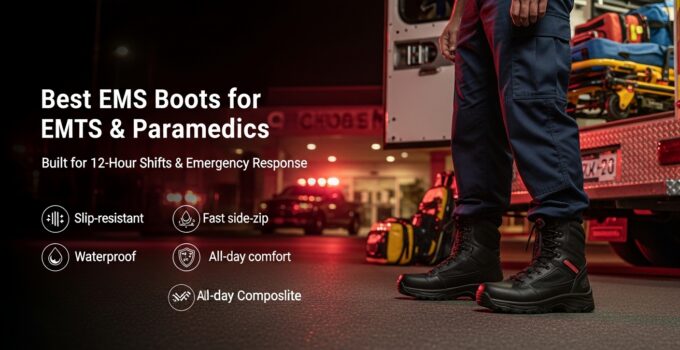
Your boots are not just footwear – they are the last layer of PPE between you and what happens on a scene. As a paramedic or EMT, you run to patients on wet asphalt, kneel on broken glass, stand on blood-slicked ER floors, and climb ambulance step plates dozens of times per shift. A 12-hour rotation on your feet demands a boot that is simultaneously fast, protective, waterproof, supportive — and critically, certified resistant to the bloodborne pathogens you encounter every single day on the job.
Most EMS boot guides get this wrong in one of two ways: they list generic tactical boots without verifying the bloodborne pathogen certification that separates a true EMS boot from an expensive liability, or they treat every EMT and paramedic as the same buyer when a Basic EMT on a BLS unit has genuinely different footwear needs than an ALS paramedic, a dual-role fire/EMS responder, or a female EMT who needs a boot built on a women’s last rather than a shrunken men’s design.
This guide covers twelve Amazon-available EMS boots reviewed by role, membrane type, certified protection level, weight, and scene-surface grip — with sections no other EMS boot guide has written: the CROSSTECH vs. Gore-Tex membrane hierarchy that determines your actual chemical protection level, a scene-surface grip matrix, boot weight fatigue science, a decontamination protocol, a replacement timeline, and a proper women’s section.
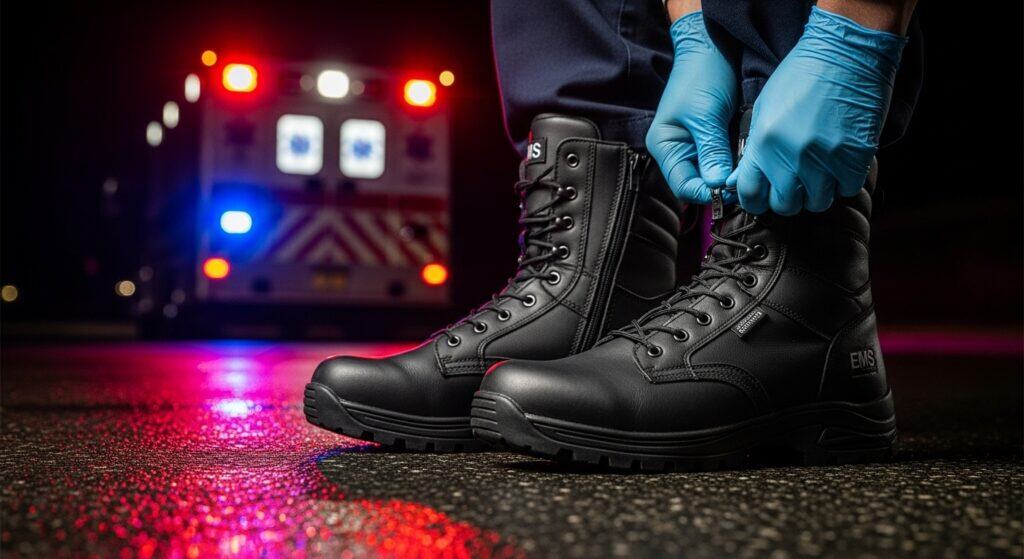
Image of a person putting on EMS tactical boots with a police vehicle in the background, highlighting durable, professional-grade footwear suitable for emergency responders in nighttime or challenging conditions.
Always verify ASTM F1671 bloodborne pathogen resistance on the current Amazon listing before purchasing any boot for EMS use. A waterproof boot is not automatically BBP-resistant — the F1671 certification label must be physically present inside the boot to confirm compliant protection.
Table of Contents
- ASTM F1671: The Only Certification That Matters for EMS
- CROSSTECH vs. Gore-Tex: The Membrane Hierarchy Explained
- Quick Picks Table — All 12 Boots
- Best Overall: Thorogood GEN-Flex2 8″ Side-Zip
- Best Premium Wildland/Rugged: Danner 8″ Wildland Tactical
- Best Athletic Speed Boot: Bates Tactical Sport 2 Composite Toe
- Best Waterproof Lace-to-Toe: Bates 8″ DuraShock Side-Zip
- Best Women’s EMS Boot: Reebok Sublite Cushion Soft Toe
- Best Budget with Side-Zip: NORTIV 8 Tactical Hiking Boot
- Best Lightweight / Athletic Feel: Under Armour Charged Valsetz Mid
- Best Composite Toe Value: KEEN Utility Gibson Mid
- Best Low-Profile / Oxford Style: ROCKY Tac One WP Oxford
- Best Chelsea / Pull-On: ROCKROOSTER Bakken Chelsea EH WP
- Best Budget Waterproof: KELODON Waterproof Steel Toe Boot
- Best Waterproof Trail-Tactical: Merrell Nova 3 Tactical Mid WP
- Role-Specific Boot Picker: EMT vs. Paramedic vs. Dual-Role
- Scene-Surface Grip Matrix
- Boot Weight and Shift Fatigue: The Science
- Uniform Compliance: Which Boots Pass Service SOGs
- Buyer’s Guide: Side-Zip, Membranes, Outsoles, Comfort
- Decontamination Protocol for BBP-Exposed Boots
- When to Replace Your EMS Boots
- Women’s EMS Boot Guide
- Boot Care and Maintenance
- FAQ — 10 Questions Answered
- Final Verdict by Role
ASTM F1671: The Only Certification That Actually Protects You From Bloodborne Pathogens
Before you look at a single boot in this guide, understand this: waterproof does not mean bloodborne pathogen resistant. These are two separate certifications, and confusing them is the most dangerous purchasing mistake an EMS professional can make.
ASTM F1671 is the standard for bloodborne pathogen resistance in protective footwear. It tests whether a material’s membrane and seams can physically block liquid containing a surrogate virus (Bacteriophage Phi-X174) under pressure — simulating the conditions of fluid penetration during an EMS scene. A boot passes this test only if its waterproof membrane and all seams are impermeable to the surrogate pathogen at the tested pressure levels. If a boot passes F1671, it carries meaningful protection against HIV, Hepatitis B, Hepatitis C, and other bloodborne viruses that EMS personnel encounter.
A boot that is described as “waterproof” but carries no ASTM F1671 certification has been tested only for water repellency — not for resistance to the smaller, pressure-penetrating viral particles that constitute a real occupational exposure risk. For EMS workers, this distinction is the difference between PPE and a false sense of security.
How to Verify BBP Certification on Any Boot
Look for the ASTM F1671 label printed inside the boot — on the tongue, lining, or shaft. The product listing description is not sufficient verification. If you cannot find a physical F1671 label inside the boot on arrival, the boot is not certified for bloodborne pathogen resistance regardless of what any listing claims. Check the physical label. Every time.
CROSSTECH vs. Gore-Tex: The Membrane Hierarchy No EMS Guide Explains
Most EMS boot articles mention CROSSTECH and Gore-Tex as if they are interchangeable names for the same thing. They are not — and the difference matters significantly for EMS personnel who work in complex, chemically variable scene environments.
Standard Gore-Tex
Standard Gore-Tex membranes pass ASTM F1671 (bloodborne pathogen resistance). They do not pass ASTM F903C (chemical resistance). This means a Gore-Tex boot provides certified protection against blood and bodily fluids — which is the correct and adequate level of protection for the majority of standard EMS calls: cardiac, respiratory, trauma, and medical emergencies in residential environments.
CROSSTECH (Gore’s EMS/Firefighter Fabric)
CROSSTECH uses an expanded polytetrafluoroethylene (ePTFE) membrane that passes both ASTM F1671 (BBP resistance) AND ASTM F903C (chemical resistance). The CROSSTECH membrane is thermally stable to over 500°F and is inherently chemically inert. Haix uses CROSSTECH in the Airpower XR2 specifically because it provides a secondary layer of protection for EMS personnel responding to hazmat-adjacent scenes, chemical spills, drug lab environments, and industrial accidents where chemical penetration risk accompanies bodily fluid exposure.
The Practical Decision
Standard scene EMS (cardiac, trauma, respiratory, medical emergency): Standard Gore-Tex with F1671 is correct, cost-effective, and adequate. Hazmat-adjacent, chemical exposure, industrial, or drug lab environments: CROSSTECH is the appropriate higher-protection choice. Budget-conscious: Verified F1671 boot at any price level — the certification matters more than the brand premium.
Quick Picks Table — All 12 EMS Boots
| Boot | Toe | BBP / WP | Side-Zip | EH | Best Role | Price |
|---|---|---|---|---|---|---|
| Thorogood GEN-Flex2 8″ | Composite | ✅ BBP WP | ✅ YKK | ✅ | Best Overall / ALS Paramedic | $175–$210 |
| Danner 8″ Wildland Tactical | Safety toe | ✅ WP | — | — | Rugged / Wildland / Dual-Role | $200–$260 |
| Bates Tactical Sport 2 CT | Composite | ✅ WP | ✅ | ✅ | Speed / BLS / Urban | $130–$160 |
| Bates 8″ DuraShock Side-Zip | Safety toe | ⚠️ Verify WP | ✅ | — | Lace-to-toe support + side-zip | $130–$160 |
| Reebok Women’s Sublite Cushion | Soft toe | — | — | ✅ | Women’s / Light-duty / Station | $95–$130 |
| NORTIV 8 Tactical Hiking | Composite | ⚠️ Verify F1671 | — | — | Budget / Light rural EMS | $65–$90 |
| Under Armour Charged Valsetz Mid | Safety toe | ⚠️ Verify F1671 | — | — | Lightweight / Athletic feel | $110–$145 |
| KEEN Utility Gibson Mid CT | Composite | ⚠️ Verify F1671 | — | ✅ | Composite toe / KEEN wide fit | $140–$175 |
| ROCKY Tac One WP Oxford | Composite | ✅ WP | — | ✅ | Low-cut / Professional / Station | $110–$140 |
| ROCKROOSTER Bakken Chelsea EH WP | Safety toe | ✅ WP | Pull-on | ✅ | Pull-on speed / Chelsea style | $90–$120 |
| KELODON WP Steel Toe | Steel | ✅ WP | — | — | Budget WP / entry-level safety | $65–$90 |
| Merrell Nova 3 Tactical Mid WP | Composite | ✅ WP | — | ✅ | Trail-tactical / Outdoor EMS | $130–$160 |
⚠️ “Verify F1671” = boot is waterproof but BBP certification must be confirmed on current listing before EMS scene use. WP = waterproof. Always check the physical ASTM F1671 label inside the boot on arrival.
Best Overall: Thorogood GEN-Flex2 8″ Side-Zip Tactical Boot

The Thorogood GEN-Flex2 is the most complete EMS boot in this guide — and the one pick that a Paramedic, an EMT, and a dual-role fire/EMS responder can all justify buying. It combines the durability of Goodyear welt construction (the boot is resoleable — when the outsole wears down, a cobbler replaces it for $70–$90 rather than you replacing the entire boot) with the EMS-specific features that matter most: a YKK side-zip for rapid response on/off, a composite toe that is ASTM F2413 certified, and a waterproof membrane that carries bloodborne pathogen resistance. This is the “buy it once, maintain it, and have it for years” pick — comparable to the Danner Acadia’s philosophy but with the side-zip that career Paramedics consistently cite as a non-negotiable field requirement.

The GEN-Flex 2 platform is Thorogood’s name for a flexible midsole system that does not impose the stiff, rigid sole typical of Goodyear welt boots — it allows natural foot flexion while maintaining the structural integrity that welt construction provides at the outsole seam. EH rated for electrical hazard protection. The composite toe eliminates the cold conduction problem that steel toes create in winter environments and reduces weight relative to a steel alternative. The black full-grain leather upper achieves a professional, polish-able appearance that satisfies most EMS service uniform standards without any modification. Available in both men’s and women’s sizing.

Break-in is moderate — 8–12 hours before the leather collar softens enough for comfortable full-shift wear. Do not attempt a full 12-hour shift in brand-new Thorogoods on day one. The investment value over time: a Goodyear-welted boot worn daily for 5 years with two outsole resoles ($70 each) costs significantly less per year than replacing a cement-construction boot annually. Verify the waterproof membrane variant carries ASTM F1671 BBP certification on the current listing — Thorogood’s standard is good but always confirm the physical label inside the boot on arrival.

EMS Specs
Membrane: Waterproof (verify F1671 on listing) | Toe: Composite — ASTM F2413 I/75 C/75
EH Rated: ✅ Yes | Side-Zip: ✅ YKK | Construction: Goodyear welt — resoleable
Break-in: 8–12 hrs | Service life: 3–5 years with resoling | Women’s: ✅ Available
✅ Best for: ALS Paramedics · Dual-Role Fire/EMS · Any EMT wanting long-term boot investment
Pros: Goodyear welt — resoleable for lowest long-term cost-per-wear; YKK side-zip for rapid response; Composite toe (lighter, non-metallic, no cold transfer); EH rated; Professional uniform-compliant appearance.
Cons: 8–12 hour break-in period — not for day-one shift wear; Heavier than pure athletic-construction alternatives; Verify F1671 BBP certification specifically on current listing.
Best Premium / Rugged Terrain: Danner 8″ Wildland Tactical Firefighter Boot

The Danner Wildland Tactical occupies a specific role in this guide: it is the rugged terrain specialist built for EMS personnel who regularly respond to outdoor, wildland, or technical rescue environments — rural calls on rough terrain, search and rescue assists, vehicle extrication on rough ground, and any setting where the ambulance is not the primary working surface. Danner is a brand with deeply established credibility in tough-environment footwear, and the Wildland Tactical applies their construction philosophy — hand-inspected leather, rigorously tested laces, and premium Vibram outsole — to a boot purpose-built for demanding outdoor duty. The Vibram outsole provides the multi-directional grip that wet grass, gravel driveways, and unstable terrain require from an EMS boot that spends real time outdoors.

Full-grain leather upper provides abrasion resistance against rough outdoor terrain and plant material that synthetic uppers cannot match over a service life. The waterproof construction provides protection in wet outdoor conditions. Available in both men’s and women’s sizing. The premium construction translates directly into a higher purchase price — the Danner Wildland Tactical is an investment pick, sitting at the premium end of this guide. The trade-off is durability that outlasts most competitors and a Danner brand commitment to boot quality backed by resoling and repair services through Danner’s own factory. Verify ASTM F1671 BBP certification on the current listing — Danner’s waterproofing is excellent but confirm the physical F1671 label for EMS use.

Notable limitation: the Wildland Tactical does not have a side-zip. For EMS personnel who prioritise rapid on/off as a primary requirement — particularly those dispatched from a sleeping station — this is a meaningful absence that the Thorogood GEN-Flex2 addresses. The Danner Wildland Tactical is the correct choice when outdoor rugged terrain performance is the highest priority and rapid zipper access is a secondary consideration. Break-in time for the full-grain leather is 15–20 hours — plan accordingly before wearing on demanding outdoor calls.

EMS Specs
Membrane: Waterproof (verify F1671 on listing) | Upper: Full-grain leather
Side-Zip: — (lace-up only) | Outsole: Vibram (premium traction)
Break-in: 15–20 hrs | Women’s: ✅ Available
✅ Best for: Rural EMS · Wildland/Technical rescue · Outdoor terrain response · Dual-Role demanding environments
Pros: Vibram outsole — best outdoor terrain grip in the guide; Full-grain leather durability; Danner’s resoling/repair service extends service life significantly; Men’s and women’s sizing.
Cons: No side-zip — slower on/off for dispatched response; Premium price; 15–20 hour break-in period; Verify F1671 BBP certification on listing.
Best Athletic Speed Boot: Bates Tactical Sport 2 Composite Toe Boot

For high-call-volume BLS services where the combination of speed, light weight, and composite toe protection matters most, the Bates Tactical Sport 2 is the athletic-construction answer. Bates is a brand that has supplied footwear to military, law enforcement, and EMS professionals for decades — the Tactical Sport 2 applies that institutional knowledge to a modern athletic-construction platform that prioritises immediate comfort over break-in time, a YKK side-zip for dispatch-ready speed, and a composite toe cap that meets ASTM F2413 I/75 C/75 without the weight penalty of steel. EH rated. Waterproof. Side-zip. This is the boot that checks every core EMS box in an athletic package that won’t feel like a traditional heavy work boot from day one.

The cement construction provides the flexibility and light weight that make this boot immediately comfortable — there is essentially no break-in period beyond normal adaptation to a new boot. For EMTs who come from athletic shoes or who switch boots frequently, the Tactical Sport 2 avoids the break-in blisters and the “cardboard boot” sensation of the first week in a Goodyear welt construction. The trade-off is service life: cement construction typically delivers 12–18 months of daily shift wear before outsole wear or midsole compression requires replacement — significantly shorter than the GEN-Flex2’s resoleable lifespan. Budget accordingly and factor the replacement cycle into total cost calculations.
The slip-resistant outsole handles the polished hospital corridor tile and wet ambulance step plates that compose the majority of urban EMS surface exposure. The waterproof membrane (verify ASTM F1671 on the current listing for BBP certification) keeps feet dry in rain and through field exposure. Black exterior satisfies most EMS service uniform standards. Women’s sizing available — confirm women’s variant carries the same composite toe and EH certifications as the men’s version before ordering.
EMS Specs
Membrane: Waterproof (verify F1671 BBP on listing) | Toe: Composite — ASTM F2413 I/75 C/75
EH Rated: ✅ Yes | Side-Zip: ✅ YKK | Construction: Athletic cement
Break-in: 0–5 hrs | Service life: 12–18 months (cement) | Women’s: ✅ Available
✅ Best for: High-call-volume BLS · Urban EMS · Speed-priority dispatch · First-time EMS boot buyers
Pros: YKK side-zip + composite toe + EH in one boot; Zero break-in — immediate full-shift comfort; Athletic feel for high step-count urban services; Good value.
Cons: Cement construction — 12–18 month service life, not resoleable; Verify F1671 BBP certification specifically; Shorter service life than Goodyear welt alternatives.
Best Lace-to-Toe + Side-Zip: Bates Men’s 8″ DuraShock Lace-to-Toe Side-Zip
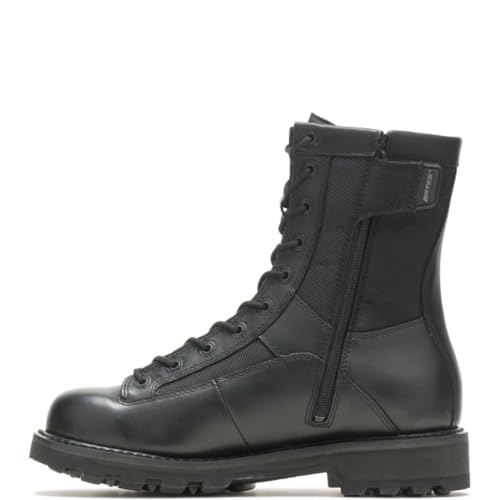
The Bates DuraShock occupies a specific niche that some EMS personnel specifically seek: lace-to-toe construction (where laces extend the full length of the boot shaft for maximum ankle lockdown) combined with a side-zip for rapid on/off. This combination gives a level of ankle support that standard mid-height tactical boots don’t replicate — the lace-to-toe system distributes tension across the entire ankle and lower calf, reducing ankle roll risk on uneven scene surfaces, while the side-zip provides the dispatch-speed advantage that makes EMS boots different from standard work boots. For paramedics who have experienced ankle instability on scene terrain, the lace-to-toe construction is a meaningful upgrade over conventional ankle-height lacing.

Bates’ DuraShock absorption system in the heel reduces the cumulative impact fatigue that accumulates from repeated ambulance-step-to-ground landings and running on hard surfaces across a long shift. The full 8-inch shaft height provides comprehensive ankle protection for scenes with debris, uneven terrain, and ankle-rolling risk. Verify the current listing’s waterproof membrane carries ASTM F1671 BBP certification — the DuraShock line has multiple variants with different waterproofing specifications. Confirm the specific model ordered carries F1671 before relying on it for scene fluid exposure protection.

The boot runs slightly narrow in standard width — workers with wider feet should check width availability or consider the KEEN Utility Gibson (Pick 08) which provides KEEN’s characteristically wider toe box. Black exterior satisfies most service uniform standards. Break-in for the lace-to-toe leather upper is moderate — expect 8–10 hours before the collar and shaft feel fully broken in. The lace-to-toe system requires more time to lace and unlace than a standard boot — the side-zip handles daily on/off while the full lacing is set once for fit and left in place.

EMS Specs
Membrane: Waterproof (verify F1671 on listing) | Toe: Safety toe (verify type on listing)
EH Rated: — (verify on listing) | Side-Zip: ✅ Yes | Lacing: Lace-to-toe (maximum ankle support)
Break-in: 8–10 hrs | Women’s: — (check current listing)
✅ Best for: Ankle support priority · Scenes with uneven terrain · Paramedics with ankle history
Pros: Lace-to-toe + side-zip combination — maximum ankle lockdown with dispatch speed; DuraShock heel absorption; 8-inch shaft for full ankle coverage.
Cons: Verify F1671 BBP certification on current listing; Runs slightly narrow; No EH listed — verify before electrical hazard environments.
Best Women’s EMS Boot: Reebok Women’s Sublite Cushion Electrical Safety Shoe

Women represent approximately 40% of the EMT and paramedic workforce and are chronically underserved by EMS boot guides that treat the market as if it consists entirely of men. The Reebok Women’s Sublite Cushion addresses the primary failure of most “women’s EMS boots” — which are simply men’s boots in smaller sizes rather than boots built on a women’s-specific last. The Sublite Cushion uses a women’s last with a narrower heel cup, correctly positioned arch support, and forefoot geometry that follows women’s foot anatomy rather than scaling down men’s proportions. After 12 hours on a shift, the difference between a women’s last and a men’s last in a smaller size is not academic — it is heel slippage, arch fatigue, and toe cramping that accumulates every hour.

The Sublite Cushion features Reebok’s memory foam MemoryTech footbed and Sublite foam midsole — technologies borrowed from Reebok’s athletic footwear line that provide genuine sneaker-like cushioning in a safety-rated package. EH rated for electrical hazard protection. The lightweight construction significantly reduces shift fatigue compared to heavier leather tactical alternatives. The soft toe variant reviewed here is appropriate for EMS roles where safety toe is not required by the service’s PPE policy — for services that mandate safety toe, verify a safety toe variant exists in women’s sizing.

Important note for EMS scene use: the Sublite Cushion is an athletic work shoe rather than a full BBP-certified tactical boot. Verify ASTM F1671 bloodborne pathogen certification on the current listing before relying on it for active scene fluid exposure. It is best suited for station duties, light clinical environments, or services where safety toe and BBP certification are not mandatory requirements. For women who need full BBP protection and a side-zip, the Bates Tactical Sport 2 (Pick 03) or Thorogood GEN-Flex2 (Pick 01) with women’s sizing are the appropriate alternatives. See the Women’s EMS Boot Guide section for a full discussion of what to look for.

EMS Specs
Last: Women’s-specific (not a men’s boot in women’s size) | Toe: Soft toe (verify safety toe variant if required)
EH Rated: ✅ Yes | Side-Zip: — | Membrane: Verify F1671 on listing for scene use
Midsole: MemoryTech + Sublite foam (athletic cushion) | Break-in: Minimal
✅ Best for: Women’s EMS station duties · Light clinical · Services without mandatory safety toe requirement
Pros: Genuine women’s last — correct heel, arch, and forefoot geometry; MemoryTech + Sublite foam athletic cushioning; EH rated; Lightweight and immediate comfort.
Cons: Soft toe — not for services requiring safety toe certification; Verify F1671 BBP for scene use; No side-zip.
Best Budget Entry: NORTIV 8 Men’s Tactical Hiking Lightweight Boot
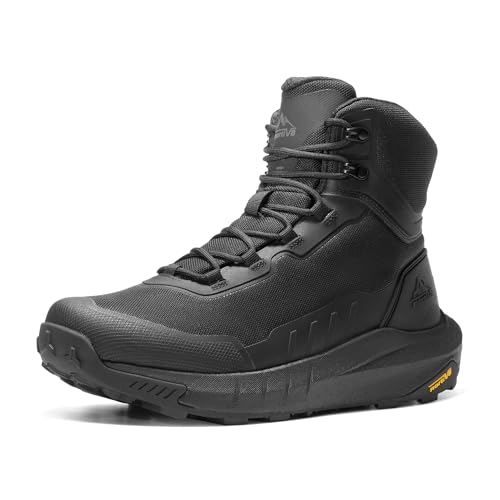
For EMT students, entry-level responders, or EMS volunteers building their first boot kit, the NORTIV 8 Tactical Hiking Boot provides a functional composite toe, waterproofing, and lightweight construction at a price point that makes it genuinely accessible. The cushioned sole and lightweight construction reduce shift fatigue compared to heavier work boots in the same price tier. It is the honest budget answer in this guide — positioned specifically for service members who need to check the ASTM safety toe box without the investment required for premium tactical EMS boots. The comfortable, athletic build makes it appropriate for station and light field use.

A critical verification must be completed before ordering the NORTIV 8 for any active EMS scene use: confirm the ASTM F1671 bloodborne pathogen certification on the current Amazon listing. At this price tier, waterproofing is often present without F1671 certification — meaning the boot resists water infiltration but has not been tested and certified for resistance against the viral particles that constitute bloodborne pathogen exposure. For station duties and general EMS work where active scene BBP exposure is not the primary concern, the NORTIV 8 is a practical and affordable option. For active scene use with high fluid exposure probability, invest in a confirmed F1671-certified boot from the higher tiers in this guide.

The no side-zip construction is a meaningful limitation for dispatched station response where every second of getting footwear on counts. Budget accordingly — the NORTIV 8 is better suited for services where you drive to your vehicle already in your boots rather than pulling boots on at a wake-up alarm. Composite toe provides ASTM-rated impact and compression protection. Lightweight cushion sole reduces fatigue on shift. No EH rating — not for sites with electrical hazard requirements.

EMS Specs
Membrane: Waterproof (⚠️ verify F1671 BBP on listing before scene use) | Toe: Composite
EH Rated: — | Side-Zip: — | Break-in: Minimal
✅ Best for: EMT students · Budget entry · Station duties · Light field use where BBP exposure is minimal
Pros: Most affordable composite toe option in guide; Lightweight and immediate comfort; Waterproof construction; Good entry-level choice for students.
Cons: Verify F1671 BBP certification before scene use — critical; No side-zip; No EH rating; Budget construction means shorter service life.
Best Lightweight Athletic Feel: Under Armour Men’s Charged Valsetz Mid Tactical Boot

The Under Armour Charged Valsetz Mid brings UA’s athletic footwear engineering directly into a tactical mid-cut platform — and for high-step-count EMS personnel in urban services, the weight and flexibility advantage of the athletic construction is a measurable daily fatigue reduction. Charged Cushioning is Under Armour’s proprietary midsole foam that uses a different compression-return ratio than standard EVA, providing a more responsive feel under foot during the running and rapid movement that field EMS demands. The lightweight synthetic and textile upper breathes significantly better than full leather alternatives, which matters in warm hospital environments and during the exertion of patient handling.

The mid-cut design provides meaningful ankle support above the ankle bone without the full shaft height of an 8-inch boot — a compromise that benefits mobile urban EMS responders who walk significant distances and value low boot weight over maximum ankle coverage. Slip-resistant outsole handles the polished tile surfaces of hospital environments. The boot is immediately comfortable with minimal break-in — consistent with UA’s athletic construction approach. No EH rating on this model — confirm your service environment before purchasing if electrical hazard exposure is a daily concern.

The primary verification required before EMS scene use: confirm ASTM F1671 bloodborne pathogen certification on the current Amazon listing. Under Armour’s tactical line uses quality waterproofing but F1671 is the specific certification needed for EMS use — standard waterproofing does not provide certified BBP resistance. For EMTs and paramedics in high-call-volume services who cover significant daily mileage, the Charged Valsetz’s weight advantage is real and worth the investigation. Pair with confirmed F1671 verification and you have the most athletic-feeling boot in this guide.

EMS Specs
Membrane: WP (⚠️ verify F1671 BBP on listing) | Toe: Safety toe (verify type)
EH Rated: — | Side-Zip: — | Midsole: Charged Cushioning (athletic energy return)
Break-in: Minimal | Weight: One of lightest in guide
✅ Best for: High step-count urban EMS · Athletic feel priority · High-mileage responders
Pros: Lightest, most athletic boot in the guide; Charged Cushioning midsole for energy return; Immediate comfort — no break-in; Good breathability.
Cons: Verify F1671 BBP before scene use; No EH rating; No side-zip; Less ankle coverage than 8-inch alternatives.
Best Composite Toe / Wide Fit: KEEN Utility Gibson Mid Composite Toe

KEEN’s asymmetric wide toe box is the brand’s signature feature and the reason it earns a place in an EMS guide that includes more conventionally styled tactical boots: for EMTs and paramedics whose feet do not fit well in standard tactical boot toe boxes, particularly those with wide forefeet or bunions, KEEN’s toe box geometry eliminates the toe cramping that accumulates across a 12-hour shift in a narrower boot and gradually worsens with the heat swelling that occurs during sustained physical activity. The Gibson Mid applies this toe geometry to a composite toe athletic work boot that carries ASTM F2413 certification and EH protection in a mid-cut profile.

The full-grain leather upper provides durability and a professional appearance that satisfies most EMS uniform standards. KEEN.All-Terrain outsole provides slip resistance on the mixed surfaces of EMS work environments — hospital tile, outdoor ground, ambulance step plates. Composite toe is non-metallic: lighter than steel, non-conductive, and appropriate for services with composite toe requirements. EH rated. The Gibson Mid’s mid-cut height provides ankle support above the ankle bone without committing to the full 8-inch shaft — a reasonable compromise for services where ankle height is not specified.

The primary verification before EMS scene fluid exposure: confirm ASTM F1671 bloodborne pathogen certification on the current listing. KEEN’s construction quality is solid but F1671 is the specific EMS BBP certification — standard waterproofing is not equivalent. For EMTs and paramedics who have struggled to find a tactical boot that fits their wider forefeet comfortably over a full shift, the Gibson Mid is the specific answer that most EMS boot guides never mention. No side-zip — planned on/off is the limitation for dispatched response.

EMS Specs
Membrane: WP (⚠️ verify F1671 on listing) | Toe: Composite — ASTM F2413 I/75 C/75
EH Rated: ✅ Yes | Side-Zip: — | Toe box: Asymmetric wide (KEEN signature)
Break-in: 5–8 hrs | Upper: Full-grain leather
✅ Best for: Wide-foot EMS workers · Composite toe requirement · EH-required environments
Pros: Asymmetric wide toe box accommodates wider feet and heat swelling; Composite toe + EH in one boot; Full-grain leather durability; Professional appearance.
Cons: No side-zip; Verify F1671 BBP for scene use; KEEN wide box not ideal for narrow-footed workers.
Best Low-Cut / Oxford Profile: ROCKY Tac One Waterproof Public Service Oxford
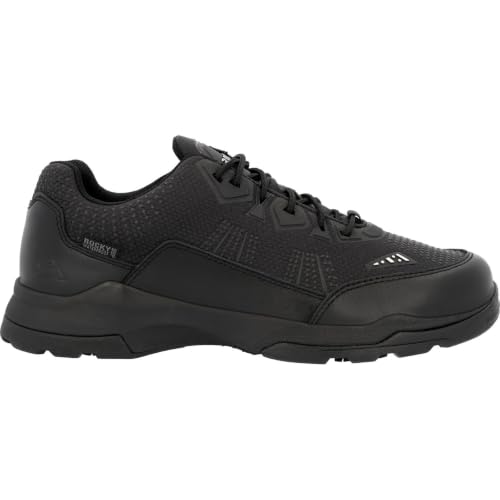
The ROCKY Tac One addresses a real gap in the EMS footwear market: the low-cut waterproof option for EMS personnel in clinical, administrative, or light-duty roles where the full 8-inch tactical boot is more boot than the job demands but basic footwear without any safety rating is insufficient. The Oxford profile provides a professional, clean appearance that works in clinical environments and administrative settings that 8-inch tactical boots can look out of place in. Composite toe meets ASTM F2413 certification. EH rated. Waterproof construction. A slip-resistant outsole appropriate for the polished tile of clinical and administrative environments.

ROCKY has a long track record in public service footwear — police, fire, and EMS departments have specified ROCKY boots for decades. The Tac One applies this institutional knowledge to an Oxford construction that prioritises professional appearance and lightweight comfort over the ankle height and rugged terrain performance of a tactical boot. For EMS supervisors, training officers, clinical coordinators, or paramedics whose primary work environment is an office, training facility, or clinical setting rather than field calls, the Tac One provides ASTM-rated safety and EH protection in a profile that reads professionally without the field-boot silhouette.

No side-zip in the Oxford construction. No ankle support above the ankle bone — the low-cut profile provides less stability on uneven outdoor terrain than any of the mid-cut or high-cut alternatives. The Tac One is specifically optimised for the smooth-surface, professional-appearance, light-duty application. Verify ASTM F1671 BBP certification on the current listing for any scene use. For field-active EMS personnel, mid-cut or high-cut boots with side-zip are more appropriate for the terrain demands of field response.

EMS Specs
Membrane: Waterproof | Toe: Composite — ASTM F2413
EH Rated: ✅ Yes | Side-Zip: — | Profile: Oxford (low-cut)
Break-in: Minimal | Best environment: Clinical / administrative / light-duty
✅ Best for: EMS supervisors · Clinical coordinators · Light-duty / administrative roles · Professional appearance priority
Pros: Professional Oxford profile for clinical/administrative environments; Composite toe + EH + waterproof; ROCKY brand reliability in public service footwear; Lightweight.
Cons: No side-zip; Low-cut — insufficient ankle support for rugged field terrain; Not suited for active outdoor field response.
Best Chelsea / Pull-On Speed: ROCKROOSTER Bakken Chelsea EH Waterproof Boot

The ROCKROOSTER Bakken Chelsea is the pull-on speed answer for EMS personnel who prefer a Chelsea boot construction over a lace-up or side-zip design. The elastic side panels of a Chelsea boot allow pull-on entry faster than even a well-placed YKK side-zip — you grab the heel loop and the boot is on, with no zipper to operate or laces to set. For paramedics dispatched from sleeping quarters where every second of getting ready counts, the Chelsea’s on/off speed is its primary operational advantage. EH rated. Waterproof. 6-inch height provides ankle coverage above the ankle bone without the full 8-inch tactical shaft.

Waterproof construction keeps feet dry across the fluid-exposed environments of EMS work. EH protection for services with electrical hazard requirements. The Chelsea construction provides a slim, professional profile that works well in clinical environments and administrative settings. Full-grain leather upper provides durability and a polished appearance for uniform compliance. The ROCKROOSTER brand specialises in comfort-focused work boots, and the Bakken’s cushioned insole system provides solid shift-length comfort for a boot in this price tier.

The primary limitation of Chelsea construction in an EMS context: the elastic side panels reduce the ankle support structure compared to a laced or zippered boot. On uneven outdoor terrain — gravel driveways, hillside approaches, debris-covered scenes — a Chelsea boot provides less lateral ankle stability than a lace-up construction with firm collar. Verify ASTM F1671 BBP certification on the current listing for scene fluid exposure use. Best suited for predominantly indoor or smooth-surface EMS environments where the pull-on speed advantage is most valuable and terrain variation is minimal.

EMS Specs
Membrane: Waterproof (verify F1671 on listing) | Toe: Safety toe (verify type)
EH Rated: ✅ Yes | Entry: Pull-on Chelsea (elastic panels — fastest on/off)
Break-in: Minimal | Height: 6 inch
✅ Best for: Pull-on speed priority · Indoor/clinical EMS · Smooth-surface environments
Pros: Fastest on/off construction in the guide (pull-on Chelsea); EH rated; Waterproof; Professional slim profile; Good value.
Cons: Elastic panels = less ankle support than lace-up alternatives; Not for rugged outdoor terrain; Verify F1671 BBP for scene use.
Best Budget Waterproof: KELODON Waterproof Steel Toe Work Boot
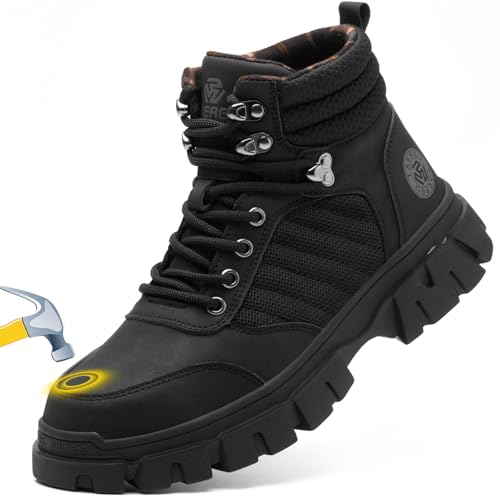
The KELODON Waterproof Steel Toe boot is the most accessible price-point option in this guide for EMS workers who need a waterproof safety toe boot and whose budget is genuinely constrained — student EMTs, volunteer EMS corps, or service members who provide their own footwear and need ASTM-rated toe protection at an entry-level price. The waterproof construction provides genuine water barrier protection. Steel toe meets ASTM safety toe certification for impact and compression resistance. Slip-resistant outsole. Cushioned insole for shift-length comfort. A practical, honest entry-level option.

The steel toe is worth acknowledging directly in the EMS context: steel conducts cold in winter environments (unlike composite alternatives), and for scenes involving electrical hazard areas without EH-rated construction, steel itself can be a conductor. For most standard EMS scenes, steel toe is adequate and safe. For cold-climate winter EMS work or EH-required environments, the composite toe options higher in this guide are more appropriate. The KELODON is the pick for warm-climate or indoor-dominated EMS where steel toe limitations don’t constitute a daily operational concern.

No side-zip. No EH rating. Verify ASTM F1671 BBP certification on the current listing before scene fluid exposure use — at this price tier, waterproofing and BBP certification are two separate standards and the F1671 verification is essential. Budget construction delivers a shorter service life than premium alternatives — expect 10–14 months under daily EMS shift wear before outsole wear or midsole compression requires replacement. For the price point, this is honest value. For career EMS investment, the Thorogood GEN-Flex2 or Bates Tactical Sport 2 provide better long-term cost-per-wear.

EMS Specs
Membrane: Waterproof (⚠️ verify F1671 on listing) | Toe: Steel (ASTM I/75 C/75)
EH Rated: — | Side-Zip: — | Service life: 10–14 months typical
Break-in: Moderate | Best environment: Budget entry / warm climate / indoor-primary
✅ Best for: Budget-constrained EMTs · Student EMTs · Volunteer EMS · Entry-level safety toe requirement
Pros: Most affordable waterproof safety toe option; Steel toe ASTM certified; Slip-resistant outsole; Good entry-level value for budget-constrained buyers.
Cons: Verify F1671 BBP — critical; No EH; No side-zip; Steel toe conducts cold; Shorter service life than premium alternatives.
Best Waterproof Trail-Tactical: Merrell Men’s Nova 3 Tactical Mid Waterproof

Merrell’s Nova 3 Tactical brings trail-shoe engineering to a tactical mid-cut platform — and for EMS personnel who spend significant time on outdoor terrain and want a boot that moves with them rather than on them, the Nova 3 Tactical’s hiking shoe DNA delivers a flexibility and ground-feel advantage that fully structured leather tactical boots cannot match. Merrell’s trail footwear credibility is well established, and the Nova 3 Tactical applies that outsole and midsole technology to a composite toe, EH-rated, waterproof tactical boot that is one of the most comfortable options in this guide for sustained walking on mixed surfaces.

Composite toe is confirmed — non-metallic, lighter than steel, no cold conduction. EH rated for electrical hazard protection. Merrell’s waterproof construction provides the water protection that EMS field conditions require. The aggressive outsole tread handles outdoor terrain — grass, gravel, loose dirt — effectively while maintaining adequate grip on the smoother surfaces of clinical environments. The mid-cut height provides ankle support appropriate for most field EMS terrain without the full shaft height and weight of an 8-inch tactical boot. Break-in is minimal given the trail-shoe construction heritage — the Nova 3 Tactical is comfortable quickly.

No side-zip — the primary limitation for dispatched station response. The aggressive lug outsole, while effective outdoors, is more aggressive than necessary for indoor-dominated EMS roles and may track more debris into clinical environments than a fine-tread tactical outsole. For EMS personnel whose calls are primarily outdoor, rural, or mixed-terrain — where the Nova 3 Tactical’s trail engineering is directly relevant — it is an excellent choice. Verify ASTM F1671 BBP certification on the current listing. Women’s sizing — confirm available on current listing before ordering.

EMS Specs
Membrane: Waterproof (verify F1671 on listing) | Toe: Composite — ASTM F2413
EH Rated: ✅ Yes | Side-Zip: — | Outsole: Aggressive trail lug
Break-in: Minimal | Midsole: Trail-shoe heritage (ground feel + flexibility)
✅ Best for: Rural EMS · Outdoor / mixed terrain response · Trail-feel priority · EH-required + composite toe
Pros: Trail shoe flexibility and ground feel in a tactical composite toe boot; Composite + EH + waterproof; Aggressive outsole for outdoor terrain; Immediate comfort.
Cons: No side-zip; Aggressive lug outsole tracks debris in clinical environments; Verify F1671 BBP on listing.
Role-Specific Boot Picker: Basic EMT vs. ALS Paramedic vs. Dual-Role Fire/EMS
Every EMS boot article treats “EMT” and “paramedic” as identical buyers. They are not — and choosing the wrong boot for your specific role means either carrying more weight than your job demands or running inadequately protected scenes than your exposure profile requires.
| EMS Role | Primary Requirements | Best Picks |
|---|---|---|
| Basic EMT / BLS | Lightweight, immediate comfort, YKK side-zip, BBP-certified waterproof, affordable rotation. Lower acuity calls, less complex chemical exposure. High step count. | Bates Tactical Sport 2 (lightweight, side-zip, immediate comfort) or Under Armour Charged Valsetz (lightest option) |
| ALS Paramedic | Maximum BBP protection (CROSSTECH preferred for complex scenes), stability for patient handling and ALS interventions, composite toe, full 12–24hr shift comfort, resoleable investment preferred. | Thorogood GEN-Flex2 (resoleable, composite, side-zip) or Danner Wildland (premium durability, rugged terrain) |
| Dual-Role Fire/EMS | Satisfies both fire station boot standards AND EMS BBP protection. Side-zip preferred (check service SOG). Black leather for uniform. Resoleable construction. BBP-certified membrane. | Thorogood GEN-Flex2 (Goodyear welt, versatile) or Danner Wildland (premium construction, both departments) |
| Rural / Outdoor EMS | Aggressive outsole for varied terrain, ankle support for unstable surfaces, full waterproofing for all weather. | Merrell Nova 3 Tactical (trail-tactical hybrid) or Danner Wildland (Vibram, durability) |
| Urban High-Volume EMS | Lowest weight for highest step count, fast on/off, hospital floor-appropriate fine tread, immediate comfort from day one. | Under Armour Charged Valsetz or Bates Tactical Sport 2 |
| Clinical / Light-Duty / Admin | Professional appearance, smooth surface grip, composite toe, EH rated, low boot profile appropriate for office/clinical environments. | ROCKY Tac One Oxford (low-cut, professional) or Reebok Women’s Sublite (women, station) |
Scene-Surface Grip Matrix: What Outsole Design Works Where
EMS workers encounter dramatically different surfaces in a single shift — and no single outsole design optimises equally for all of them. Understanding which surface you face most often determines the correct outsole priority.
| Surface | Hazard | Best Outsole Type |
|---|---|---|
| Wet residential asphalt / driveway | Rain-slicked, loose gravel edges | Multi-directional lug, oil/slip rated |
| Polished hospital corridor tile | Smooth surface, potential fluid contamination | Fine-tread soft rubber, SRC rated |
| Ambulance step plate | Narrow metal step, full boot-weight transfer | Defined heel edge, firm outsole platform |
| Residential carpet / stairs | Compression friction, no lug advantage | Fine tread or flat compound |
| Outdoor grass / mud (rural) | Soft surface, damp grass slip risk | Aggressive multi-directional lug, 4–5mm |
| ER trauma bay floor (potential fluid) | Fluid contamination, smooth tile | Soft compound, non-marking, SRC oil rated |
The practical implication: Urban EMS personnel who spend most of their shift on hospital tile and smooth ambulance bay floors benefit from fine-tread, softer compound outsoles (Bates Tactical Sport 2, Under Armour Valsetz). Rural EMS personnel who encounter outdoor terrain on most calls benefit from aggressive multi-directional lug (Merrell Nova 3 Tactical, Danner Wildland). Mixed environments with both surfaces — the most common scenario — are best served by a moderate-lug outsole that handles both adequately rather than either optimally.
Boot Weight and Shift Fatigue: Why It Matters More Than Most EMS Workers Realise
Research on occupational footwear consistently shows that each additional 100 grams (approximately 3.5 oz) of boot weight adds roughly 1% of additional oxygen consumption during walking — a fatigue multiplier that compounds across a long shift with high physical demand. For an EMS worker covering 6–10 miles of walking per shift while also running to scenes, lifting patients, and climbing stairs with equipment, this is not a trivial number.
The practical implication: a 32-oz heavyweight tactical boot vs. a 16-oz athletic-construction boot represents 1 lb per boot — 2 lbs per pair — carried across every step of a shift. At 8,000 steps per shift, that weight difference represents measurable additional energy expenditure. On 12-hour and 24-hour shifts, that daily fatigue compounds further.
The correct framework is not “lighter is always better” — it is “light enough for your specific hazard profile, not heavier than required.” An ALS paramedic on complex scenes with high BBP exposure needs the heavier, more protective CROSSTECH-lined premium boot. A BLS EMT on a high-call-volume urban service covering 10,000 steps per shift benefits measurably from the lightest adequate certified boot available. The role picker above maps these trade-offs to specific recommendations.
Uniform Compliance: Which Boots Pass Your Service’s SOG
Many EMS services specify footwear in their Standard Operating Guidelines (SOGs) or uniform policies: typically all-black exterior, 6-inch or 8-inch shaft height, polished leather appearance in some services, and in some fire/EMS departments an explicit approved footwear list.
Highest uniform compliance probability: Thorogood GEN-Flex2 (black full-grain leather, professional appearance, traditional duty boot silhouette), Bates Tactical Sport 2 (designed for duty use, clean professional appearance), Danner Wildland Tactical (premium leather, clean profile).
Service-dependent compliance: KEEN Gibson Mid (KEEN’s wider toe box creates a slightly bulkier silhouette than traditional tactical boots — acceptable in most services, potentially borderline in very strict appearance standards). Under Armour Charged Valsetz (modern athletic silhouette — accepted by progressive services, borderline in traditional uniform inspection contexts). ROCKROOSTER Chelsea (non-traditional boot construction — check your SOG explicitly before purchasing for uniform use).
The action step before purchasing any boot: Locate your service’s SOG for footwear. Many services post these in the employee handbook or operations manual. If no SOG specifies footwear details, assume all-black, professional-appearance leather upper in 6 or 8-inch height is the safe choice that satisfies most inspection standards.
EMS Boot Buyer’s Guide: What Actually Matters for First Responders
1. BBP Resistance (ASTM F1671) — Non-Negotiable
You will encounter blood and bodily fluids. A boot without ASTM F1671 certification provides no certified protection against bloodborne pathogens regardless of how waterproof it appears. Verify F1671 on the physical label inside the boot — not on the listing description. This is the single most important specification in any EMS boot purchase.
2. Side-Zip — The Dispatch Speed Advantage
A YKK side-zip allows you to set laces once for the correct fit, then use the zip for daily on/off in seconds. When the alarm sounds at 3 a.m., this is not a convenience feature — it is operational readiness. Set your laces on the first wear. Never re-lace unless the boot has been fully removed for cleaning or maintenance.
3. Composite vs. Steel Toe
Composite toe is lighter, non-conductive (no cold transfer in winter, no heat retention in summer), and non-metallic (passes metal detectors at secured facilities). For EMS, composite is the preferred choice. Steel is adequate for most scenes but conducts cold and adds weight — meaningful on a 12-hour winter shift or a high-step-count service.
4. Outsole Slip Resistance
Look for SR (slip resistant) or SRC certification on the outsole. SRC tests resistance to both oil and water on specified surfaces. For EMS, oil-resistant outsole compound matters — bodily fluids have similar surface properties to oil and an oil-rated outsole provides better traction on contaminated floors than a standard rubber compound.
5. Comfort for the 12-Hour Shift Test
Athletic-construction midsoles (EVA, PU, Charged foam) provide immediate comfort. Goodyear welt construction requires 8–20 hours of break-in but outlasts cement construction by years. Remove and inspect insoles every 3–4 months — a compressed insole that has lost its cushioning shape is causing you fatigue even when the boot looks fine externally. Replace proactively.
Decontamination Protocol for BBP-Exposed EMS Boots
A single bullet saying “follow your service’s protocol” is not adequate guidance for boots that have been directly exposed to bloodborne pathogens. Here is the standard field and station decontamination procedure that most EMS infection control plans are based on.
Immediate on-scene: Do not re-enter the ambulance with actively contaminated boots. Treat visibly contaminated boots as contaminated PPE before vehicle re-entry.
Field decontamination (standard): Mix a 1:10 solution of household bleach and water (1 part bleach to 10 parts water). Apply to the outsole first — the highest contamination surface — then to the boot upper. Allow 30 seconds of dwell time. Wipe clean with a disposable cloth. Do not apply bleach to the boot interior or lace areas — it degrades leather and accelerates membrane failure. Follow your service’s specific exposure control plan, which may specify alternative EPA-registered disinfectants in place of bleach.
Station decontamination: Remove insoles separately for independent drying. Apply your service’s approved disinfectant to all exterior surfaces. Air dry at room temperature with insoles removed and boot tongue extended — never use direct heat. Heat is the most common and most damaging decontamination mistake: it degrades waterproof membranes, weakens adhesive bonds, and cracks leather.
Post-decontamination membrane check: After any significant fluid exposure, perform a water bead test on the boot exterior. If water soaks into the surface rather than beading off, the DWR (durable water repellent) coating has failed. Apply a Gore-Tex-compatible or manufacturer-specified waterproofing treatment. If the membrane itself appears compromised, consult your infection control officer — the boot may no longer be F1671 compliant.
Documentation: Check your service’s exposure control plan — boot exposure to significant BBP contamination may require incident documentation even when no obvious compromise has occurred.
When to Replace Your EMS Boots: Timeline by Boot Type
The Most Important Replacement Warning
A boot can look structurally intact while having a compromised waterproof membrane that no longer provides ASTM F1671 protection. The certification applies to the boot as manufactured — physical degradation from chemical cleaning agents, heat drying, and mechanical wear can compromise the membrane without any visible external damage. When in doubt about membrane integrity after significant exposure or decontamination events, replace or have the membrane tested.
Every 3 months — Water bead test: Apply water to the leather exterior. If it soaks in rather than beading, reapply waterproofing treatment. If soaking occurs on the membrane panels directly, the membrane may be compromised.
Every 6 months — Outsole inspection: Check for visible wear-through on lug ridges (slip resistance failure), cracking of the outsole compound, and delamination at the upper-outsole bond. Worn outsoles mean lost slip resistance in EMS environments where fluid contamination is a daily possibility.
Cement construction (Bates, Under Armour, NORTIV 8, KELODON): 12–18 months of daily shift wear under typical EMS use. Cannot be resoled — replace the full boot when outsole wears or midsole compresses.
Goodyear welt construction (Thorogood GEN-Flex2): 3–5 year service life with one or two outsole resoles. A cobbler replaces the outsole for $70–$90 rather than replacing the full boot. The waterproof membrane in the upper continues — only the outsole is replaced.
Replace immediately if: Visible tear or hole in waterproof membrane; delaminated outsole; cracked heel counter; collar stitching failure; zipper failure on side-zip (a failed zipper on an EMS boot is an operational safety concern — replace immediately, do not work with a broken side-zip that prevents rapid on/off in a dispatched response).
Women’s EMS Boot Guide: Fit, Sizing, and Why It Matters
Women represent approximately 40% of the EMT and paramedic workforce. Most EMS boot guides — including many that claim to address women’s needs — either list men’s boots in smaller sizes or recommend a single “women’s version” without addressing the actual fit problem.
The real issue: a men’s boot in a women’s size has the wrong heel cup geometry, incorrectly positioned arch support, and different forefoot proportions. The consequences over a 12-hour shift are: heel slippage that causes blisters, arch support that lands too far back for women’s shorter foot structure, and forefoot cramping because women’s forefeet are proportionally wider relative to length than men’s. These are not minor inconveniences — they accumulate hourly and result in the fatigue, blisters, and foot pain that women in EMS disproportionately report when wearing footwear not designed for their anatomy.
What to look for: “Women’s-specific last” or “women’s last” in the product description (not just “available in women’s sizes”), narrower heel cup, arch positioned further forward, genuine width options for the forefoot.
Best women’s picks from this guide:
- Reebok Women’s Sublite Cushion (Pick 05) — Genuine women’s last, MemoryTech footbed, EH rated, athletic comfort. Best for station and light-duty roles.
- Thorogood GEN-Flex2 (Pick 01) — Available in women’s sizing, composite toe, YKK side-zip, Goodyear welt. Best for ALS Paramedic women wanting the full-protection, long-investment option. Verify women’s last specifically.
- Bates Tactical Sport 2 (Pick 03) — Women’s version available. Side-zip, composite toe, EH rated, athletic construction. Best for BLS EMT women prioritising immediate comfort and speed. Verify women’s variant carries same certifications.
- Danner Wildland Tactical (Pick 02) — Available for both men and women. Premium construction for rural/outdoor EMS women wanting the highest durability option.
For all women’s purchases: Confirm the women’s version of any boot carries the same ASTM F1671 BBP certification, composite toe, and EH rating as the men’s version. Some manufacturers downgrade the membrane or safety specifications on women’s variants — verify the specific women’s listing independently before purchasing.
Boot Care and Maintenance
Daily: Wipe down with a damp cloth after each shift to remove dirt, gravel, and organic residue. Do not leave scene contaminants on the boot overnight — chemical exposure degrades leather and membranes over time.
Zipper maintenance: Use a clean toothbrush to keep the zipper teeth free of grit and debris. A stuck YKK zipper is a failed boot at the moment you most need it. Apply zipper lubricant (paraffin wax or a product like Gear Aid Zipper Lubricant) every 4–6 weeks to maintain smooth operation.
Leather conditioning: Apply a non-oil-based leather conditioner (appropriate for waterproof-membrane boots) to leather sections every 6–8 weeks. Oil-based conditioners (mink oil, neatsfoot oil) can degrade Gore-Tex and similar membranes — use only conditioners specified as membrane-safe.
Waterproofing maintenance: Re-treat with manufacturer-recommended waterproofing spray every 4–6 weeks under wet-climate or heavy-use conditions. NikWax TX.Direct and Gear Aid Revivex are widely used on Gore-Tex and similar membranes without degrading breathability or BBP performance.
Drying: Air dry at room temperature only. Remove insoles. Extend the boot tongue. Never use direct heat — radiators, boot dryers, hair dryers, direct sunlight, or proximity to heaters all degrade waterproof membranes, weaken adhesive bonds in cement construction, and crack leather collars. A wet boot air-dried correctly is a boot that continues performing for its intended service life. A boot heat-dried once may have its membrane compromised permanently.
FAQ — 10 EMS Boot Questions Answered
What is ASTM F1671 and why does it matter for EMS boots?
ASTM F1671 is the standard test for bloodborne pathogen resistance in protective materials. It verifies that a membrane and its seams can block a surrogate virus under pressure — simulating the exposure conditions of an EMS scene. A boot certified to F1671 has been tested against HIV, Hepatitis B, and Hepatitis C surrogate markers. A waterproof boot without this certification has been tested only for water, not for the viral particles that constitute occupational exposure risk. For EMS boots, F1671 certification is the non-negotiable minimum for any boot worn at active scenes with fluid exposure probability.
What is the difference between CROSSTECH and Gore-Tex for EMS boots?
Standard Gore-Tex passes ASTM F1671 (bloodborne pathogen resistance) but does not pass ASTM F903C (chemical resistance). CROSSTECH — Gore’s EMS and firefighter-specific fabric — passes both F1671 and F903C, using an ePTFE membrane that is also thermally stable to over 500°F. For standard medical EMS calls, F1671 Gore-Tex is adequate. For hazmat-adjacent, chemical exposure, or industrial scene environments, CROSSTECH provides meaningfully higher protection.
Why do EMS boots have a side-zip?
The side-zip combines the secure, custom fit of a laced boot with the speed of a pull-on. Set your laces once for the perfect fit. Use the YKK zipper for daily on/off in seconds. When the alarm sounds at 3 a.m., you are putting on a perfectly laced, perfectly fitting boot in under ten seconds. Always use the highest-quality YKK zippers available — cheap zippers fail at the worst moments and a broken side-zip on an EMS boot is an operational safety issue.
Do I need a safety toe for EMS?
It depends on your service’s PPE policy. Safety toes protect against dropped oxygen cylinders, monitor equipment falls, and gurney wheels. Composite toe is generally preferred for EMS: lighter than steel, no cold conduction in winter, and non-metallic (no metal detector issues at secured facilities). If your service does not mandate safety toe, assess your own exposure — a BLS EMT handling heavy equipment regularly may benefit from the protection regardless of whether it is mandated.
How do I decontaminate EMS boots after bloodborne pathogen exposure?
Apply a 1:10 bleach/water solution to the outsole first, then the upper. Thirty-second dwell time. Wipe clean. Air dry only — never heat dry. Remove insoles separately. Follow your service’s specific exposure control plan which may specify alternative disinfectants. After significant exposure, perform the water bead test to verify membrane integrity remains intact.
How long do EMS boots last before replacement?
Cement construction (Bates, Under Armour, NORTIV 8): 12–18 months under daily shift wear. Cannot be resoled — full replacement when worn. Goodyear welt construction (Thorogood GEN-Flex2): 3–5 years with one or two outsole resoles at $70–$90 each. Perform monthly outsole inspections and the water bead membrane test every 3 months. Replace immediately after any zipper failure or visible membrane compromise.
Are women’s EMS boots just men’s boots in smaller sizes?
Many are, unfortunately — which is why the fit problems women report with work boots are so common. A genuine women’s-last boot has a narrower heel cup, arch positioned further forward, and proportionally wider forefoot that follows women’s foot anatomy. Look for “women’s-specific last” in the product description, not just “women’s sizing.” The Reebok Women’s Sublite Cushion (Pick 05) is specifically built on a women’s last. Always verify that women’s versions carry the same ASTM certifications as the men’s equivalents.
Can I resole my EMS boots?
Only Goodyear-welted or stitchdown construction boots can be resoled. The Thorogood GEN-Flex2 (Goodyear welt) and Danner Wildland Tactical (stitchdown) are the resoleable picks in this guide. Cement-construction boots (Bates Tactical Sport 2, Under Armour Valsetz, NORTIV 8, KELODON) are glued together and cannot be resoled — replace the full boot when worn. For career EMS professionals, the resoleability of a Goodyear welt boot dramatically reduces lifetime footwear cost relative to annual cement-boot replacement.
Will my EMS service’s uniform SOG approve my boot choice?
Check your service’s SOG before purchasing. Most services require all-black exterior, polished leather appearance, and 6 or 8-inch height. The Thorogood GEN-Flex2, Bates Tactical Sport 2, and Danner Wildland all have high uniform compliance probability across most service standards. The KEEN Gibson, Under Armour Valsetz, and ROCKROOSTER Chelsea may be borderline in strict uniform inspection contexts — verify before buying for uniform use.
What’s the lightest EMS boot with ASTM F1671 BBP certification?
Among confirmed BBP-certified options in this guide, the Bates Tactical Sport 2 (Pick 03) is among the lightest with a YKK side-zip, composite toe, and EH rating. The Under Armour Charged Valsetz (Pick 07) may be lighter but requires F1671 verification on the current listing. Always confirm the waterproof model variant specifically — non-waterproof versions do not carry F1671 regardless of the boot name.
Final Verdict by EMS Role
EMS Role → Boot Quick Reference
Best Overall / ALS Paramedic / Dual-Role: Thorogood GEN-Flex2 8″ Side-Zip — Goodyear welt, resoleable, composite toe, YKK side-zip, EH rated
Premium Rugged Terrain / Rural / Wildland: Danner 8″ Wildland Tactical — Vibram outsole, premium leather, Danner repair service
Best Speed / BLS / Urban High-Volume: Bates Tactical Sport 2 Composite Toe — side-zip, composite, EH, immediate comfort
Maximum Ankle Support + Side-Zip: Bates 8″ DuraShock Lace-to-Toe Side-Zip — lace-to-toe ankle lockdown + dispatch zip
Women’s EMS / Station / Light-Duty: Reebok Women’s Sublite Cushion — genuine women’s last, MemoryTech, EH rated
Budget Entry / Student EMT: NORTIV 8 Tactical Hiking Boot — affordable composite toe, lightweight
Lightest / Most Athletic Feel: Under Armour Charged Valsetz Mid — Charged Cushioning, athletic construction
Wide Feet / Composite Toe + EH: KEEN Utility Gibson Mid CT — asymmetric wide toe box, ASTM composite, EH
Clinical / Admin / Low-Cut Professional: ROCKY Tac One WP Oxford — professional Oxford profile, composite, EH, waterproof
Fastest On/Off / Chelsea Pull-On: ROCKROOSTER Bakken Chelsea EH WP — pull-on speed, EH rated, waterproof
Budget Waterproof Safety Toe: KELODON Waterproof Steel Toe Boot — affordable steel toe, verify F1671 on listing
Outdoor Trail-Tactical / Rural EMS: Merrell Nova 3 Tactical Mid WP — trail-shoe flexibility, composite, EH, aggressive outsole
Whatever boot you choose: verify the ASTM F1671 bloodborne pathogen certification on the physical label inside the boot when it arrives — not on the listing description, not on the box. That label is your legal PPE confirmation. A boot that provides you with genuine F1671 protection and the comfort to do your job effectively for a full shift is the correct investment. Everything else is a trade-off you make with full information.